
“How are you?” I said. You said:
“Sad, as I always am in transition.”
It is the only place I am happy.
– Joanna Walsh, Hotel, 2015
“How are you?” I said. You said:
“Sad, as I always am in transition.”
It is the only place I am happy.
– Joanna Walsh, Hotel, 2015
“Everyone knows that to write is to have died. Only death makes a clean copy of life, and it is only death that, at such a distance, can rewrite it. This is why to be a writer means relating the world of the living from the world of the dead.”
– Agustín Fernández Mallo, Nocilla Dream
[See Simon Critchley.]
“‘In my world there is something wrong with people who are writers,’ he says. ‘If someone wants to write, that means there is something incomplete in them; if they’re writers, it’s a certain sign of unhappiness.'”
– Karl Ove Knausgaard, “Why Karl Ove Knausgaard Can’t Stop Writing” by Liesl Schillinger, The Wall Street Journal 4 November 2015
“I’m not exactly autistic, but if you called me that, I wouldn’t object.”
– Gordon Lish, The Paris Review, Winter 2015
“And the babes flung their duvets back in abandon, swung their little legs over the edge of the bed and scampered down the stairs. The chambers of their baffled baby hearts filled with yearning and they tingled, they bounded down towards before, before, before all this. The father, drunk on the voice of his beloved, raced down after them. The sound of her voice was stinging, like a moon-dragged starvation surging into every hopeless raw vacant pore, undoing exquisite undoing.”
– Max Porter, Grief is the Thing with Feathers, 2015
“Perhaps the closest we come to dying is through writing, in the sense that writing is a leave-taking from life, a temporary abandonment of the world and one’s petty preoccupations in order to try to see things more clearly. In writing, one steps back and steps outside life in order to view it more dispassionately, both more distantly and more proximately. With a steadier eye. One can lay things to rest in writing: ghosts, hauntings, regrets, and the memories that flay us alive.”
– Simon Critchley, Notes on Suicide, 2015
[See Agustín Fernández Mallo.]
“Les abrutis ne voient le beau que dans les belles choses.”
– Arthur Cravan
“It had something to do with love. About the essential brutality of love. About those adventitious souls who deliberately seek out love as a prime agent of total self-immolation. Yes, that’s right. It attempted to show that in the whole history of literature love is quite routinely depicted as an engulfing process of ecstatic suffering which finally, mercifully, obliterates us and delivers us to oblivion. Dismembered and packed off. Something like that. Something along those lines. I am mad about you. I am going out of my mind. My soul burns for you. I am inflamed. There is nothing now, nothing except you. Gone, quite gone. That kind of thing. … Actually, now that I come to think of it, I think the gist of my argument was simply that love is indeed a vicious and divine disintegration of selfhood and that artistic representations of it as such aren’t at all uncommon or outlandish and have nothing whatsoever to do with endeavouring to shock an audience.”
– Claire-Louise Bennett, “Morning, Noon & Night,” Pond (2015)
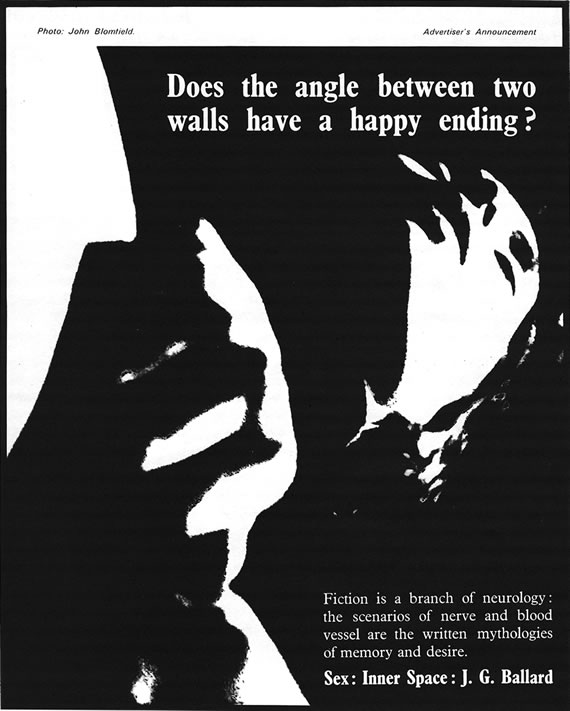
J.G. Ballard, “Does the Angle Between Two Walls Have a Happy Ending?” Ambit 33 (Autumn 1967)
“The show is over. The audience get up to leave their seats. Time to collect their coats and go home. They turn round. No more coats and no more home.”
– Vasily Rozanov, “The Apocalypse of Our Time”
 ANDREW GALLIX