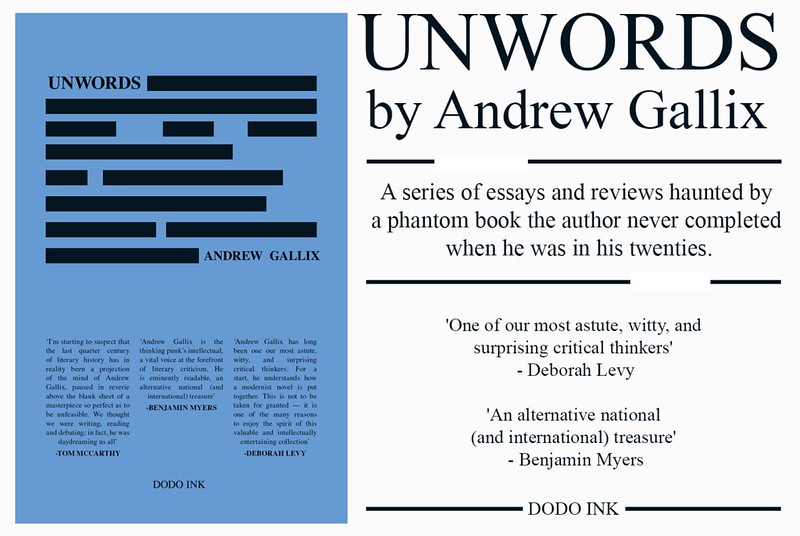
This was the afterword to my non-fiction collection, Unwords (Dodo Ink, 2024) — a manifesto-in-quotes straight from the mouth of a ventriloquist’s dummy:
The one thing that seems to unite all poets, according to Mary Ruefle, is a yearning to enter the world ‘everybody else lives in’ and from which they feel excluded. Theodor Adorno defines writing as a dwelling for those who have lost their homeland. Lavinia Greenlaw has come to understand that each new book she writes ‘is a home’, hence the profound sadness she feels following publication. Writing, writes Brian Dillon, ‘happens to a body, which is in touch with time and things, and which tries to enclose itself and connect itself to real and fantastical outsides, to make itself at home and fling itself abroad in a mobile analogue of home’. ‘All literature carries exile within it,’ declares Roberto Bolaño. This sense of dis-location, Susan Sontag observes, is at the heart of most serious thinking today. Andrea Barrett believes that the compulsion to write stems from feeling ‘unhoused’: ‘We feel we don’t fit in, that this world is not our world, that though we may move in it, we’re not of it’. Rachel Cusk suspects that maintaining an ‘essential discomfort in the world’ is crucial if one wants to lead a creative life. David Bezmozgis argues that literature must have ‘at its core some kind of irretrievable loss’. Gordon Lish claims that the thing taken from you is your gift (as a writer). ‘The splinter in your eye is the best magnifying glass’ (Adorno again). Karl Ove Knausgaard is convinced that there is always ‘something wrong’ with writers. ‘Writing is the stigma that the writer bears — that there’s something wrong with you’ (Cusk again). ‘All normal writers are weird’ (Toby Litt).
In a letter, Stéphane Mallarmé confesses (or boasts) that he only exists — ‘and, even then, so little’ — on the page, ‘[p]referably one that’s still blank’. Does he mean (as I hope he does) one that, ideally, will remain blank? And did he manage to impress the woman he was writing to, if indeed that was his intention? Was he perchance addressing Claire-Louise Bennett, who recalls that she started writing, not — as the Pavlovian refrain goes — in order to make sense of things, but on the contrary ‘to prolong and bask in the rhythmic chaos of existence, to remain adrift from the social contract and luxuriate in the magnificent mystery of everything’? Steve Finbow accounts for our deep-rooted (possibly hardwired) attraction to this ‘initial anonymity’: ‘We return to where we haven’t been before, but where everything else was; we go towards the infinite potentiality of life, from which actuality and the inherent margin of individuation got us out’ (more on this anon). As Arthur Schopenhauer put it, ‘After your death, you will be what you were before your birth’. When Jenny Diski was dying, she regularly comforted herself with the thought of the ‘not-being’ she had already been. Rebecca Solnit enjoins us to leave the door open to the unknown, ‘where the most important things come from, where you yourself came from, and where you will go’. ‘If I wanted a description of what I have always wanted from a book,’ says Toby Litt, ‘it would be TO NOT BE ME. To be anything other than me, to be anywhere other than where I am.’ Anne Carson regrets that there are ‘no words for a world without a self, seen with impersonal clarity’. The protagonist in Rachel Cusk’s Second Place, is fascinated by the ‘existence of things before our knowledge of them’. Simone Weil longs to perceive the world as it is when she is not there, so that the beating of her heart will no longer ‘disturb the silence of heaven’. Iris Murdoch, who castigates the ‘fat relentless ego’, calls this ‘unselfing’. Eugene Thacker speaks of the world-without-us — a world untainted by words. ‘What kind of beast would turn its life into words?’ wonders Adrienne Rich. A character in a Steven Millhauser short story laments the ‘terrible life of words, the unstoppable roar of sound that comes rushing out of people’s mouths and seems to have no object except the evasion of silence. The talking species! We’re nothing but an aberration, an error of Nature. What must the stones think of us?’ (more from ‘History of a Disturbance’ later). Maurice Blanchot: ‘The word gives me the being, but it gives it to me deprived of being. The word is the absence of that being, its nothingness, what is left of it when it has lost being — the very fact that it does not exist’. He therefore wonders, ‘How can I, in my speech, recapture this prior presence that I must exclude in order to speak, in order to speak it?’ Simon Critchley:
[L]anguage is murder, that is, the act of naming things, of substituting a name for a sensation, gives things to us, but in a form that deprives those things of their being. Human speech is thus the annihilation of things qua things. . . . In speaking, I separate myself from things and I separate myself from myself. . . . What speaks, then, when I speak? In a sense . . . nothing speaks. Negation is the very work of language and thus when I speak a nothing comes to speak in me. . . . Literature’s right to death — its absolute freedom, its terrifying revolutionary power — is a Hegelian-Sadistic right to the total negation of reality taking place in and as language. . . . However, literature does not stop here, for it simultaneously works on a second slope, where it attempts to recall the moments leading up to the murder of the first moment, and where literature becomes ‘a search for this moment which precedes literature’ [Maurice Blanchot] — the trembling, pre-linguistic darkness of things, the universe before the creation of the human being. . . . To express this differently, literature seeks that moment of existence or Being prior to the advent of the Subject and its work of negation. If consciousness is nothing but this work of negation, then the second slope of literature wants to attain that point of unconsciousness, where it can somehow merge with the reality of things. Literature here consists, in the words of Francis Ponge, in Le parti pris des choses, that is, in seeking to recover the silence and materiality of things as things before the act of naming where they are murdered by language and translated into literature (Very Little . . . Almost Nothing, 1997).
Decreation is the term Anne Carson uses (after Simone Weil) to refer to the process whereby the teller vanishes in the telling. ‘In solitude you don’t need to make an impression on the world, so the world has some opportunity to make an impression on you’ (Claire-Louise Bennett again). ‘Books are solitudes in which we meet’ (Rebecca Solnit again). ‘Circumstances compel unity;’ says Virginia Woolf, ‘for convenience’ sake a man must be a whole.’ ‘What I want to delve into and express is the peregrine self — the being who is fluid, exotic, and nebulous’ rather than the ‘boundaried and stable’ social self (Claire-Louise Bennett). ‘[T]here will be a new form; and . . . this form will be of such a type that it admits the chaos and does not try to say that the chaos is really something else. . . . To find a form that accommodates the mess, that is the task of the artist now’ (Samuel Beckett). ‘[A]t once it struck me what quality went to form a Man of Achievement, especially in Literature, and which Shakespeare possessed so enormously — I mean Negative Capability, that is, when a man is capable of being in uncertainties, mysteries, doubts, without any irritable reaching after fact and reason’ (John Keats).
‘Sooner or later, everyone invents a story that they think is their life’ (Max Frisch). ‘Life is not a story’ (John Gray). ‘The unity of one’s life consists in the coherence of the story one can tell about oneself. People do this all the time. It’s the lie that stands behind the memoir’ (Simon Critchley). ‘By stepping out of the story she had come upon the emptiness that lay all around it’ (Rachel Cusk). ‘If I want a plot I’ll watch Dallas’ (Elizabeth Hardwick). ‘We start from scratch and words don’t; which is the thing that matters — matters over and over again’ (Eudora Welty). ‘Realism is a corruption of reality’ (Wallace Stevens). ‘All writers believe they are realists’ (Alain Robbe-Grillet). ‘There are only realists’ (Donald Barthelme). ‘That such blatant and splendid takedowns of naturalism, such eviscerations of any notion that writing might operate as a faithful, penetrative rendering of a reality itself unmediated, are written right into the source code of the realist tradition makes the naive or uncritical realism dominating contemporary middlebrow fiction, and the doctrine of authenticity peddled on creative writing classes the world over, all the more simple-minded’ (Tom McCarthy). ‘One great part of human existence is passed in a state which cannot be rendered sensible by the use of wide-awake language, cut-and-dry grammar and go-ahead plot’ (James Joyce). Mina Loy describes her work in terms of a quest for a new foreign language, English having already been used. Marcel Proust claims that great works of literature are invariably written ‘in a kind of foreign language’. Christine Brooke-Rose says that she has always avoided the ‘expected word’. ‘How tired I am of stories, how tired I am of phrases that come down beautifully with all their feet on the ground! . . . I begin to long for some little language such as lovers use, broken words, inarticulate words, like the shuffling of feet on the pavement’ (Virginia Woolf). ‘[J]ust the thought of fiction, just the thought of a fabricated character in a fabricated plot made me feel nauseous’ (Karl Ove Knausgaard). ‘I, too, am sick of the well-made novel with its plot and its characters and its settings. . . . I, too, like novels that don’t look like novels’ (J. M. Coetzee). ‘[T]he kind of novels I like are ones which bear no traces of being novels’ (Geoff Dyer). ‘In general I have a predilection for novels that don’t act like novels’ (Rob Doyle). ‘For me, the literary novel itself is a fiction, existing through a kind of collective fantasy’ (Lars Iyer). ‘A book which does not contain its counterbook is considered incomplete’ (Jorge Luis Borges).
‘If I were to wish for anything, I should not wish for wealth and power, but for the passionate sense of the potential, for the eye which, ever young and ardent, sees the possible. Pleasure disappoints, possibility never’ (Søren Kierkegaard). ‘I dwell in Possibility — / A fairer House than Prose —’ (Emily Dickinson). ‘As soon as we put something into words, we devalue it in a strange way. We think we have plunged into the depths of the abyss, and when we return to the surface the drop of water on our pale fingertips no longer resembles the sea from which it comes’ (Maurice Maeterlinck). ‘Although I claimed to be a poet, although my supposed talent as a writer had earned me my fellowship in Spain, I tended to find lines of poetry beautiful only when I encountered them quoted in prose, in the essays my professors had assigned in college, where the line breaks were replaced with slashes, so that what was communicated was less a particular poem than the echo of poetic possibility’ (Ben Lerner). ‘To me, art almost always speaks more forcefully when it appears in an imperfect, accidental, and fragmentary way, somehow just signalling its presence, allowing one to feel it through the ineptitude of the interpretation. I prefer the Chopin that reaches me in the street from an open window to the Chopin served in great style from the concert stage’ (Witold Gombrowicz). ‘We’re only going to ruin it by actually playing something, I say. We should play this, Art says, pressing his ear to the speaker cone. Play all this potential … Like, what we could play, rather than anything we actually play’ (Lars Iyer). ‘For [Maurice] Blanchot, the possibility of literature is found in the radical impossibility of creating a complete work. That is to say, it is the impossibility of literature that preserves literature as possibility. Higher than actuality, echoing Heidegger’s definition of phenomenology in Sein und Zeit, literature is the preservation of possibility as possibility’ (Simon Critchley).
‘Ah, but a man’s reach should exceed his grasp, / Or what’s a heaven for?’ (Robert Browning). ‘My reach always exceeds my grasp’ (Jenny Offill). ‘The land of chimera is the only one in this world that is worth dwelling in, and such is the nothingness of the human lot that, except for the Being which exists self-created, there is nothing beautiful except that which does not exist’ (Jean-Jacques Rousseau). ‘Invisible things are the only realities’ (Edgar Allan Poe). ‘We are subjected to that which does not exist’ (Simone Weil). ‘Heard melodies are sweet, but those unheard / Are sweeter; therefore, ye soft pipes, play on; / Not to the sensual ear, but, more endear’d, / Pipe to the spirit ditties of no tone . . .’ (John Keats). ‘Behind every assertion “is not” lies the admission “not is”’ (Eugene Thacker). ‘Awesome is the God who is not’ (George Steiner). ‘In the beginning, my blueprint had absorbed all my time and attention because I was going to build the house from it. Gradually, the blueprint became more vivid to me than the actual house: in my imagination, I spent more and more time among the pencilled lines that shifted at my will. Yet if I had openly admitted that there was no longer any possibility of building this house, the blueprint would have lost its meaning. So I continued to believe in the house, while all the time the possibility of building it eroded steadily from under my belief’ (Lydia Davis). ‘Now if possibility outstrips necessity, the self runs away from itself in possibility so that it has no necessity to return to. . . . Thus possibility seems greater and greater to the self; more and more becomes possible because nothing becomes actual. In the end it seems as though everything were possible, but that is the very moment that the self is swallowed up in the abyss’ (Søren Kierkegaard).
‘Every book,’ according to Iris Murdoch, ‘is the wreck of a perfect idea.’ Whatever you write turns out to be ‘a bad, ridiculous copy of what you had imagined’ (Thomas Bernhard); ‘a betrayal of all perfection’ (David Foster Wallace), the ‘death mask of its conception’ (Walter Benjamin). Sadie Jones says that the book in her head is ‘a cathedral’ that morphs into ‘a garden shed’ as soon as she puts pen to paper. ‘None of my work has met my own standards’ (William Faulkner). ‘You never get the book you wanted, you settle for the book you get’ (James Baldwin). ‘I am irritated by my own writing. I am like a violinist whose ear is true, but whose fingers refuse to reproduce precisely the sound he hears within’ (Gustave Flaubert). ‘The poem inside is perfect; I have a very clumsy retrieval process for getting it out’ (Carolyn Kizer). ‘The actual poem Caedmon brings back to the human community is necessarily a mere echo of the first [the one in his dream]’ (Ben Lerner). ‘Everything we do, in art and life, is the imperfect copy of what we intended’ (Fernando Pessoa). ‘All language is but a poor translation’ (Franz Kafka). ‘There is something maddeningly attractive about the untranslatable, about a word that goes silent in transit’ (Anne Carson). ‘To attempt to write seriously is always, I feel, to fail’ (Will Self). ‘[T]o be an artist is to fail, as no other dare fail’ (Samuel Beckett). ‘It is the writer’s duty to fail’ (Marguerite Duras). ‘The greatness of Rimbaud is to have led poetry to the failure of poetry’ (Nick Land). ‘The very definition of a serious book is that it is one which should have been better’ (George Steiner). ‘A writer is someone for whom writing is more difficult than it is for other people’ (Thomas Mann). ‘A creative writer is one for whom writing is a problem’ (Roland Barthes). ‘I write because I hate. A lot. Hard’ (Willam H. Gass).
Being modern, for Roland Barthes, means knowing what can no longer be done (and no longer written, in particular). One can no longer write like Rabelais, for instance, who — according to Witold Gombrowicz — ‘wrote the way a child pees against a tree, in order to relieve himself’. Gabriel Josipovici concurs: returning to the world of genres is just as impossible as going back to the ancien régime.
‘All artists dream of a silence which they must enter, as some creatures return to the sea to spawn’ (Iris Murdoch). ‘Now the Sirens have a still more fatal weapon than their song, namely their silence. And though admittedly such a thing never happened, it is still conceivable that someone might possibly have escaped from their singing; but from their silence certainly never’ (Franz Kafka). ‘For whatever is truly wondrous and fearful in man, never yet was put into words or books’ (Herman Melville). Ben Lerner:
The fatal problem with poetry: poems. This helps explain why poets themselves celebrate poets who renounce writing. In college at the end of the last millennium the coolest young poets I knew were reading Rimbaud and Oppen — two very great and very different writers who had in common their abandonment of the art (although Oppen’s was only temporary). . . . It was as if writing were a stage we would pass through, as if poems were important because they could be sacrificed on the altar of poetry in order to charge our silence with poetic virtuality.
And Susan Sontag:
[T]he choice of permanent silence doesn’t negate their [Rimbaud, Wittgenstein, Duchamp’s] work. On the contrary, it imparts retroactively an added power and authority to what was broken off; disavowal of the work becoming a new source of its validity, a certificate of unchallengeable seriousness. That seriousness consists in not regarding art (or philosophy practiced as an art form: Wittgenstein) as something whose seriousness lasts forever, an ‘end,’ a permanent vehicle for spiritual ambition. The truly serious attitude is one that regards art as a ‘means’ to something that can perhaps be achieved only by abandoning art.
‘To write without “writing”, to bring literature to that point of absence where it disappears, where we no longer have to dread its secrets, which are lies, that is “the degree zero of writing”, the neutrality that every writer seeks, deliberately or without realising it, and which leads some of them to silence’ (Maurice Blanchot). ‘The writer doesn’t really want to write, he wants to be; and in order to truly be, he must face up to the difficult challenge of not writing at all — not even a single line’ (Luis Chitarroni). ‘The most beautiful and perfect book in the world is a book with only blank pages, in the same way that the most complete language is that which lies beyond all that the words of a man can say’ (Ulises Carrión). ‘The fact that artists are willing to go to all the trouble of producing an edition of a book that is completely or largely blank testifies to a faith in the ineffable’ (Michael Gibbs).
Fernando Pessoa, of course:
Ah, my love, the glory of works which have been lost for ever, of treatises which today are mere titles, of libraries which burned down, of statues which were demolished! How blessed with absurdity are the artists who set fire to a beautiful work! Or the artists who could have made a beautiful work but deliberately made it ordinary! Or the great poets of silence who, knowing they were capable of writing an absolutely perfect work, preferred to crown it with the decision never to write it. (For an imperfect work, it makes no difference.) How much more beautiful the Mona Lisa would be if we couldn’t see it! And if someone were to rob it just to burn it, what an artist he would be, even greater than the one who painted it!
‘It seemed to me that all language was an excess of language’ (Samuel Beckett). ‘Music is the silence of words, just as poetry is the silence of prose’ (Vladimir Jankélévitch). ‘Try halting your sub-vocal speech. Try to achieve even ten seconds of inner silence. You will encounter a resisting organism that forces you to talk’ (William S. Burroughs). ‘What we require is silence, but what silence requires is that I go on talking’ (John Cage). ‘Wittgenstein’s all too famous and all too often repeated precept, “Whereof one cannot speak, thereof one must be silent” — given that by enunciating it he has not been able to impose silence on himself — does indicate that in the final analysis one has to talk in order to remain silent. But with what kinds of words?’ (Maurice Blanchot). ‘Writing also means not speaking. Keeping silent. Screaming without sound’ (Marguerite Duras). ‘[T]he word silence is still a sound’ (Georges Bataille). ‘[I]t is also a space devoid of speech that constitutes writing’ (Roland Barthes). ‘You were kind enough to express your regret that no more books by me have been arriving “to make up for the loss of our companionship”. . . . There is only one reason for this. . . . It is that the language in which I might have been granted the opportunity not only to write but also to think is not Latin or English, or Italian, or Spanish, but a language of which I know not one word, a language in which mute things speak to me and in which I will perhaps have something to say for myself someday when I am dead and standing before an unknown judge’ (Hugo von Hoffmansthal). ‘I have nothing to say / and I am saying it / and that is poetry / as I need it’ (John Cage). ‘I’m still very interested in the attempt to get beyond language — or to get the better of it, in some way. I’ve sort of made a couple of small breakthroughs on that front. I suppose the idea I had was actually writing something that’s silent. A silent work. And you can do that in other forms. You can do that in art, you can do that in music, and I’m quite interested in doing that in language’ (Rachel Cusk). ‘Books that the writer does not write, that he will certainly never undertake, come what may, and that can be attributed to fictitious authors — are not such books, by virtue of their nonexistence, remarkably like silence?’ (Stanislaw Lem). ‘That the inability to write should itself become utterance, and thus text: this most nocturnal of thoughts is the restless spectre that the writer can neither still, nor embrace’ (Nick Land). ‘The expression that there is nothing to express, nothing with which to express, nothing from which to express, no power to express, no desire to express, together with the obligation to express’ (Samuel Beckett). ‘The writer finds himself in the increasingly ludicrous condition of having nothing to write, of having no means with which to write it, and of being constrained by the utter necessity of always writing it’ (Maurice Blanchot).
‘[T]here is but one art: to omit!’ (Robert Louis Stevenson). ‘You can tell a great writer by the number of pages he does not publish’ (Stéphane Mallarmé). ‘The test of a book is how much good stuff you can throw away’ (Ernest Hemingway). ‘Where words are scarce, they are seldom spent in vain’ (William Shakespeare). ‘My writing is shaped by the stories I will not tell’ (Lavinia Greenlaw). ‘[W]hat one chooses to exclude from a piece of writing is as — or more — important than what is included’ (Kathryn Scanlan). ‘A reviewer said about my third book, a collection of linked stories, that if I kept going in this direction (i.e., toward concision), I’d wind up writing books composed of one very beautiful word. He meant it as a put-down, but to me it was wild praise’ (David Shields). ‘Just how small an object, or intervention in the world, can an artist make before the idea of a “work” drifts away on the wind?’ (Brian Dillon). ‘Without actually suggesting this course to any of our living bards, when, I may ask — when shall that true poet arise who, disdaining the trivialities of text, shall give the world a book of verse consisting entirely of margin?’ (Kenneth Grahame). ‘My work was created only by elimination, and each newly acquired truth was born only at the expense of an impression which flamed up and then burned itself out, so that its particular darkness could be isolated and I could venture ever more deeply into the sensation of Darkness Absolute. Destruction was my Beatrice’ (Stéphane Mallarmé). ‘To drill one hole after another into it [language] until that which lurks behind, be it something or nothing, starts seeping through — I cannot imagine a higher goal for today’s writer. . . . On the way to this literature of the unword, which is so desirable to me, some form of Nominalist irony might be a necessary stage’ (Samuel Beckett). ‘I am starting a Logoclast’s League. May I count on your support? I am the only member at present. The idea is mystical writing, so that the void may protrude like a hernia’ (Samuel Beckett). ‘You would do better, at least no worse, to obliterate texts than to blacken margins, to fill in the holes of words till all is blank and flat and the whole ghastly business looks like what it is, senseless, speechless, issueless misery’ (Samuel Beckett). ‘I rub out the word’ (William S. Burroughs). Steven Millhauser:
Something uncapturable in the day had been harmed by speech. . . . Not to speak, not to form words, not to think, not to smear the world with sentences — it was like the release of a band of metal tightening around my skull. . . . My vow of silence sought to renew the world, to make it appear before me in all its fullness. . . . Words harmed the world. They took something away from it and put themselves in its place. . . . As I train myself to cast off words, as I learn to erase word-thoughts, I begin to feel a new world rising up around me. . . . We are shut off from the fullness of things. Words hide the world. . . . I see a place where nothing is known, because nothing is shaped in advance by words (‘History of a Disturbance’).
‘In the pass the muttering sickness leaped into our throats, coughing and spitting in the silver morning. . . . Sound bubbling in throats torn with the talk sickness. . . . When we came out of the mud we had names’ (William S. Burroughs). ‘It is the job of poetry to clean up our word-clogged reality by creating silences around things’ (Stéphane Mallarmé). ‘I would like to efface the trace of my steps’ (Georges Bataille). ‘I kind of hope that somebody goes up there one of these days and cleans them up’ (Neil Armstrong). ‘One day when I was studying with Schoenberg, he pointed out the eraser on his pencil and said, “This end is more important than the other”’ (John Cage). ‘My favourite key is the one that deletes’ (Elena Ferrante). ‘Erasure is never merely a matter of making things disappear: there is always some detritus strewn about in the aftermath, some bruising to the surface from which word or image has been removed, some reminder of the violence done to make the world look new again’ (Brian Dillon). ‘When Francis Bacon approaches a white canvas, its empty surface is already filled with the whole history of painting up to that moment, it is a compaction of all the clichés of representation already extant in the painter’s world, in the painter’s head, in the probability of what can be done on this surface. Screens are in place making it hard to see anything but what one expects to see, hard to paint what isn’t already there’ (Anne Carson). ‘The pages are still blank, but there is a miraculous feeling of the words being there, written in invisible ink and clamoring to become visible’ (Vladimir Nabokov).
‘Everything that is possible demands to exist’ (Gottfried Wilhelm Leibniz). ‘I repeat: in order for a book to exist, it is sufficient that it be possible’ (Jorge Luis Borges). ‘A book unwritten is more than a void. It accompanies the work one has done like an active shadow, both ironic and sorrowful. It is one of the lives we could have lived, one of the journeys we did not take. Philosophy teaches that negation can be determinant. It is more than a denial of possibility. . . . It is the unwritten book which might have made the difference. Which might have allowed one to fail better. Or perhaps not’ (George Steiner). ‘Footfalls echo in the memory / Down the passage which we did not take / Towards the door we never opened / Into the rose-garden. My words echo / Thus, in your mind’ (T. S. Eliot). ‘Everyone has a book inside them, which is exactly where I think it should in most cases remain’ (Christopher Hitchens).
‘[M]odernity often prefers the sketch to the finished painting and prizes the draft, chaotic with corrections, to the published text’ (George Steiner). ‘We crave an increasingly intimate relationship with the author, unmediated, in so far as possible, by the contrivances of art. A curious reversal takes place. The finished works serve as a prologue to the jottings; the published book becomes a stage to be passed through — a draft — en route to the definitive pleasure of the notes, the fleeting impressions, the sketches, in which it had its origin’ (Geoff Dyer). ‘Thus the painter prefers the various states of a painting to a painting. And the writer often wishes not to finish anything entirely, leaving as fragments a hundred stories that led him to a certain point and that he must abandon to try to go beyond that point’ (Maurice Blanchot). ‘The Romantic exalts the artist who does not give a material form to his dreams — the poet ecstatic in front of a forever blank page, the musician who listens to the prodigious concerts of his soul without attempting to translate them into notes. It is romantic to consider concrete expression as a decadence, a contamination’ (Mario Praz). ‘We are increasingly interested not in what an author says but in what he may have meant, not in his actions but in his projects, less in his actual work than in the work he dreamed of. If Mallarmé intrigues us, it is because he fulfils the conditions of the writer who is unrealised in relation to the disproportionate ideal he has assigned himself. . . . We are adepts of the work that is aborted, abandoned halfway through, impossible to complete, undermined by its very requirements’ (E. M. Cioran). ‘Will I reallywrite a Novel? I’ll answer this and only this. I’ll proceed as if I were going to write one. . . . It’s therefore possible that the Novel will remain at the level of — or be exhausted by — its Preparation. Another title for this course . . . could be “The Impossible Novel”’ (Roland Barthes). ‘This is doubtless why the novel is always the critic’s horizon: the critic is the man who is going to write and who, like the Proustian narrator, satisfies this expectation with a supplementary work, who creates himself by seeking himself and whose function is to accomplish his project of writing even while eluding it’ (Roland Barthes). ‘All over the world people are taking notes as a way of postponing, putting off and standing in for. My case was more extreme for not only was taking notes about Lawrence a way of putting off writing a study of — and homage to — the writer who had made we want to become a writer, but this study I was putting off writing was itself a way of putting off and postponing another book’ (Geoff Dyer). Maurice Blanchot on the modernity of Joseph Joubert:
Joubert had this gift. He never wrote a book. He only prepared himself to write one, resolutely seeking the right conditions that would allow him to write. Then he forgot his aim. More precisely, what he sought, this source of writing, this space in which to write, this light to define in space, demanded of him and asserted in him characteristics that made him unfit for any ordinary literary work, or made him turn away from it. He was thus one of the first entirely modern writers, preferring the centre over the sphere, sacrificing results for the discovery of their conditions, not writing in order to add one book to another, but to make himself master of the point whence all books seemed to come, which, once found, would exempt him from writing them. . . . [Concluding a list of similarities between Joubert and Mallarmé] [T]he feeling that literature and poetry are the locus of a secret that should perhaps be preferred to anything else, even to the glory of making books. . . . He seems to have been a failure. But he preferred this failure to the compromise of success (‘Joubert and Space’, The Book to Come, 1959).
‘I prepare a story and then when I start to write something else emerges’ (Harold Brodkey). ‘I kind of always assume that you don’t write the poem you want to write, you know, or you don’t make the book you want to make. And, on the one hand, it can be kind of depressing or whatever, right? But, on the other hand, it’s quite freeing because it means you discover something in the act of composition that you didn’t know in advance. Generally, I think of art as really about trying to actualize impossible desires with form. And you always fail to make the virtual actual’ (Ben Lerner). ‘Every book is a grave of countless others, it deprives them of life by supplanting them’ (Stanislaw Lem). ‘The minute you start putting words on paper you’re eliminating possibilities. Unless you’re Henry James’ (Joan Didion). ‘I’m astounded whenever I finish something. Astounded and distressed. My perfectionist instinct should inhibit me from finishing; it should inhibit me from even beginning. But I get distracted and start doing something. What I achieve is not the product of an act of my will but of my will’s surrender. I begin because I don’t have the strength to think; I finish because I don’t have the courage to quit. This book is my cowardice’ (Fernando Pessoa). ‘Great poets as different as Keats and Dickinson express their contempt for merely actual poems by developing techniques for virtualising their own compositions — by dissolving the actual poem into an image of the Poem literary form cannot achieve’ (Ben Lerner). ‘A book describes works conceived of but not realised by its author’ (Édouard Levé). ‘God keep me from ever completing anything. This whole book is but a draught — nay, but the draught of a draught’ (Herman Melville). ‘But it holds me in its sway and I may yet be able to succeed, not in the contemplation of this work as a whole (one would have to be God-knows-who for that!) but in showing a successful fragment . . . proving through finished portions that this book does exist, and that I was aware of what I wasn’t able to accomplish’ (Stéphane Mallarmé). ‘Mallarmé’s Book cannot be written, but the demand to do so, once it has been issued, sets the parameters of future serious literature’ (Tom McCarthy). ‘But this book [The Man Without Qualities] was created to be incomplete, and if it had an end it would not be finished. . . . Postponement was the plan; so, in addition to his additions, he revised, held portions back, wrote over proofs until every unprinted space was also dark, made alternative drafts of scenes and chapters, mourned whatever bit of text he had let escape from his fanatical concern for exact analysis to reach the embarrassment of print; because Musil polished not to achieve a finish or a shine, but (like every perfectionist) to accomplish the inconclusive’ (William H. Gass). ‘The fertility of a text . . . is its inachievement, its premature termination, its inconclusiveness’ (Nick Land). ‘Art isn’t complete, is it? You finish a bit of work and a strange thing happens: as soon as it’s done, it becomes part of a greater incompletion’ (Will Eaves). ‘If you can look across the distance without wanting to close it up, if you can own your longing in the same way that you own the beauty of that blue that can never be possessed? For something of this longing will, like the blue of distance, only be relocated, not assuaged, by acquisition and arrival, just as the mountains cease to be blue when you arrive among them and the blue instead tints the next beyond’ (Rebecca Solnit). ‘[T]his imminence of a revelation which does not occur is, perhaps, the aesthetic phenomenon’ (Jorge Luis Borges). ‘It is striking how many of the works of pessimism are incomplete — Pascal’s Pensées, Leopardi’s Zibaldone, Lichtenberg’s Sudelbücher, Joubert’s Carnets, the stray fragments of Csath, Kafka, Klíma, Pessoa… These are not just works that the author was unable to complete, cut short by illness, depression, or distraction. These are works designed for incompletion — their very existence renders them dubious. I like to think this is why such works were so precious to their authors — but also so insignificant, a drawer of paper scraps, in no particular order, abandoned at one’s death, like one’s own corpse’ (Eugene Thacker).
‘[W]hat an artist talks about is never the main point’ (Thomas Mann). ‘To believe that the novelist has “something to say” and that he then looks for a way to say it represents the gravest of misconceptions’ (Alain Robbe-Grillet). ‘[Apropos of Joyce’s Finnegans Wake] Here form is content, content is form. You complain that this stuff is not written in English. It is not written at all. It is not to be read — or rather it is not only to be read. It is to be looked at and listened to. His writing is not about something; it is that something itself’ (Samuel Beckett). ‘In the end, I want to write a book that is the thing itself’ (Karl Ove Knausgaard). ‘[A]n event that would involve the violent rupture of the very form and procedure of the work itself’ (Tom McCarthy). ‘A poem should not mean / But be’ (Archibald MacLeish). ‘Language can do what it can’t say’ (William Stafford). ‘Sometimes you must sing what cannot be said’ (Lavinia Greenlaw). ‘The painting is finished when it has erased the idea’ (Georges Braque). ‘In fiction, I am interested in transforming language, in disarming the almost insistent communicability of language’ (William H. Gass). ‘We often hear it said that it is the task of art to express the inexpressible; it is the contrary which must be said (with no intention of paradox): the whole task of art is to unexpress the expressible, to kidnap from the world’s language, which is the poor and powerful language of the passions, another speech, an exact speech’ (Roland Barthes). ‘I have no idea what this sentence means but it gives me a thrill. It fills me with wonder’ (Anne Carson). ‘And don’t worry about the bits you can’t understand. Sit back and allow the words to wash around you, like music’ (Roald Dahl). ‘For writing to be manifest in its truth (and not in its instrumentality) it must be illegible’ (Roland Barthes). ‘By the mouth for the ear: that’s the way I’d like to write’ (William H. Gass). ‘Gary [now Garielle] [Lutz] was the first writing teacher I had who showed me that the sentence was capable of art. He would underline good sentences and interrogate bad ones. Verbs would be circled and Gary would ask “inevitable?” And no, the verb was not inevitable, and I’d never considered that concept before, inevitability. It smacks of the eternal, a text beyond the writer to which the writer submits’ (Dylan Nice). ‘[O]rdinary books are like meteors. Each of them has only one moment, a moment when it soars screaming like the phoenix, all its pages aflame. For that single moment we love them ever after, although they soon turn to ashes. With bitter resignation we sometimes wander late at night through the extinct pages that tell their stone dead messages like wooden rosary beads’ (Bruno Schulz). ‘I want every sentence of this book to be a climax’ (Clarice Lispector). ‘To write something in which every sentence is a first sentence. To write something in which every sentence is as good as the first sentence’ (Joshua Cohen). ‘I rewrite my beginning until the book is done’ (William H. Gass). ‘This was my first real lesson about language — this inkling that a word is a solid, something firm and palpable. It was news to me that word is matter, that it exists in tactual materiality, that it has cubic bulk. Only on the page is it flat and undensified. In the mouth and in the mind it is three-dimensional, and there are parts that shoot out from it or sink into its syntactic surround’ (Garielle Lutz). ‘Constructed in this painstaking way — “worked and reworked until their forms and contours and their organizations of sound [have] about them an air of having been foreordained” (Lutz again) — sentences become like physical objects. . . . I try to write a sentence as unbudging and fully itself as some object sitting on a shelf in my office’ (Kathryn Scanlan). ‘A work of art is a thing in the world, not just a text or commentary on the world’ (Susan Sontag). ‘Yes, happily language is a thing: it is a written thing, a bit of bark, a sliver of rock, a fragment of clay in which the reality of the earth continues to exist’ (Maurice Blanchot).
‘In conditions of digital recall, loss is itself lost’ (Mark Fisher). ‘That gap between the way things really were and the way we remember them to be is closing. If I had a gun against truth I’d use it every day’ (Nicholas Rombes). ‘What, in the end, makes advertisements so superior to criticism? Not what the moving red neon sign says — but the fiery pool reflecting it in the asphalt’ (Walter Benjamin). ‘My library is an archive of longings’ (Susan Sontag). ‘Life slips past me like pages in a book I never read’ (Bobbi Lurie). ‘To continue reading without the book before you…’ (Virginia Woolf). ‘He asked her again to please, please, please drive him home to his wife and daughter. “Yes,” she said. “Life is only worth living because we hope it will get better and we’ll all get home safely”’ (Deborah Levy). ‘The show is over. The audience get up to leave their seats. Time to collect their coats and go home. They turn round. No more coats and no more home’ (Vasily Rozanov).
 ANDREW GALLIX