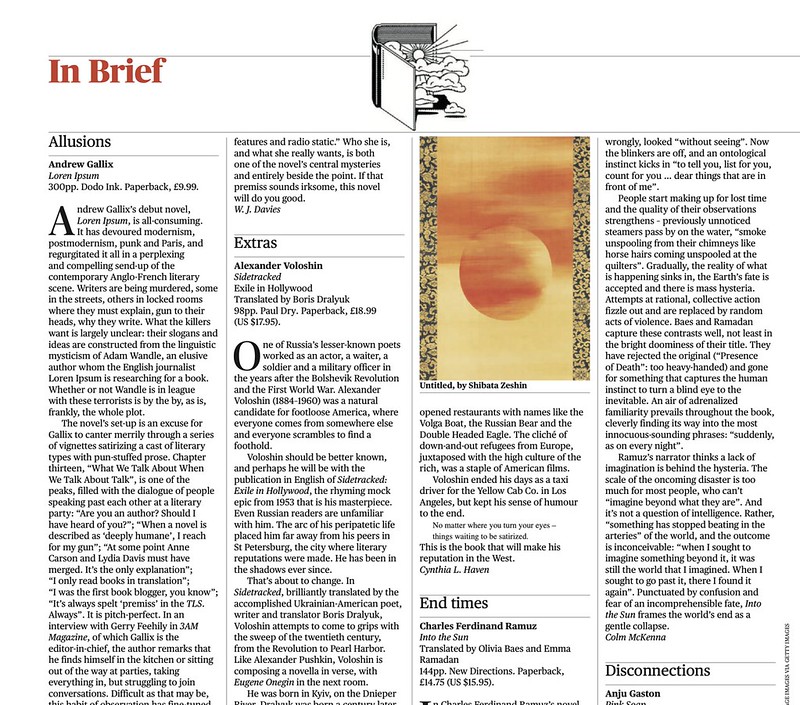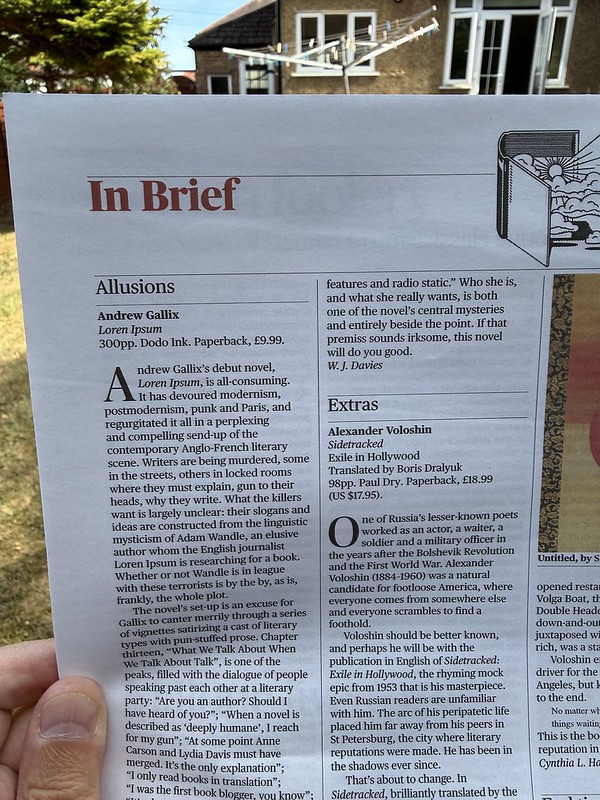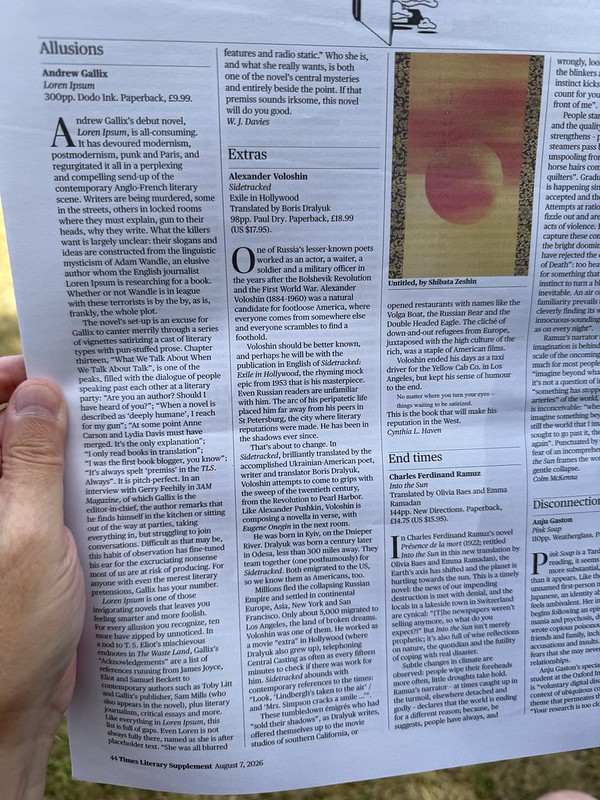
I have interviewed Gerry Feehily for 3:AM Magazine:
“The Annihilating Now: An Interview with Gerry Feehily.” 3:AM Magazine, 7 September 2026.
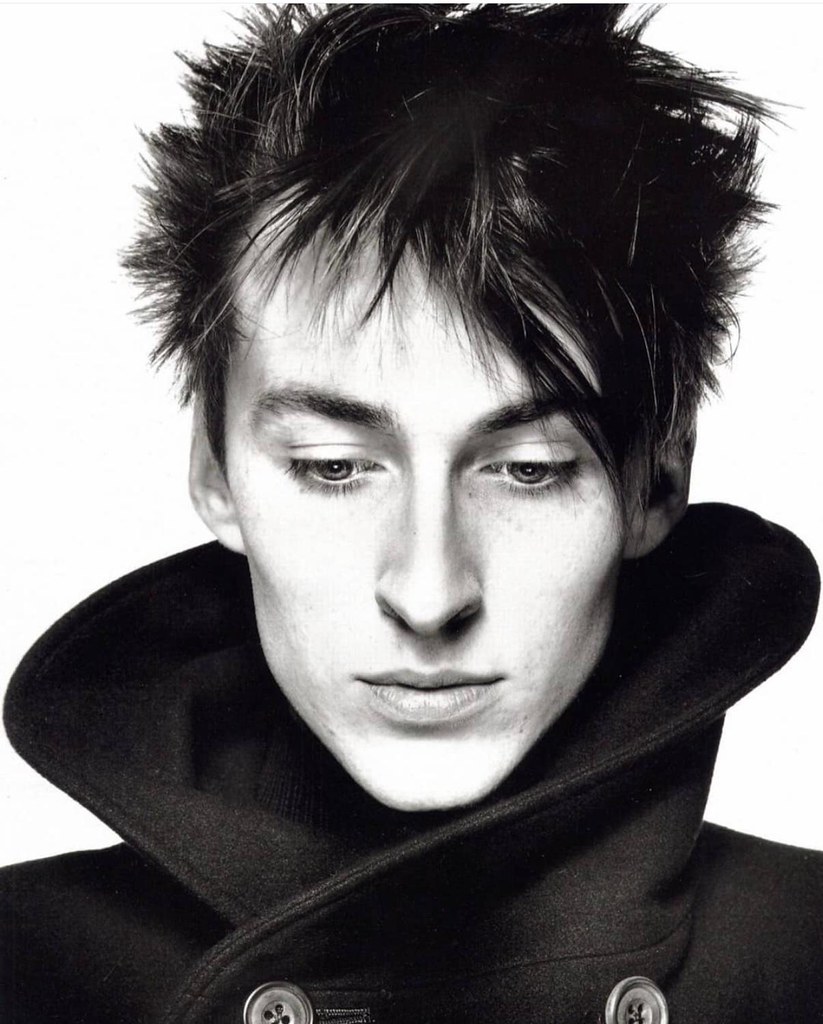
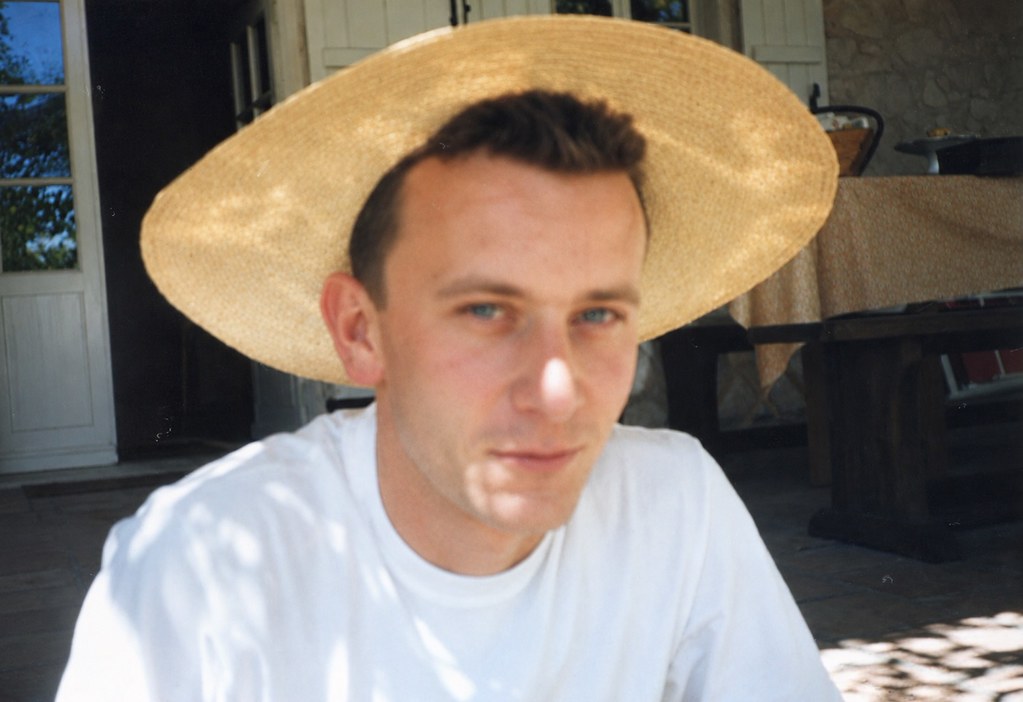
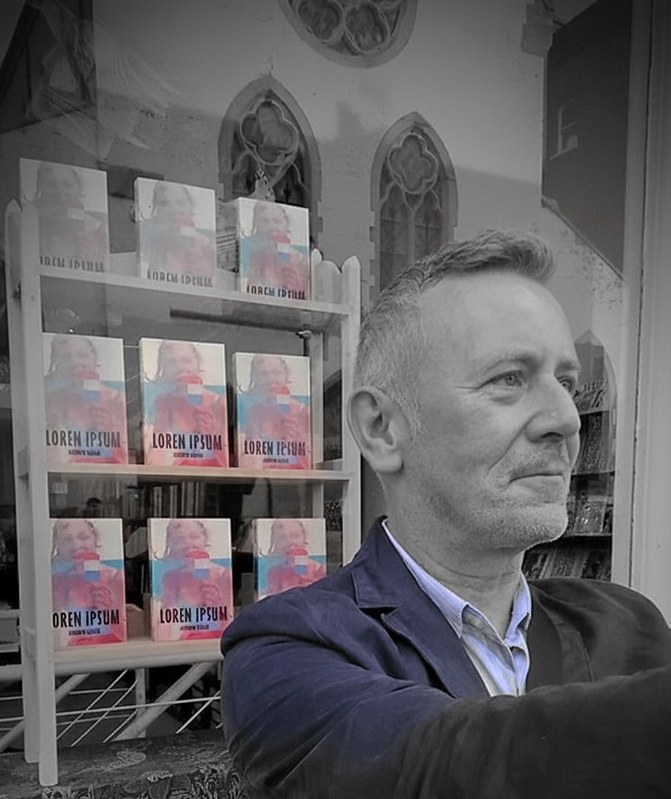
The following interview took place on 5th July at Gerry Feehily’s spacious, immaculate apartment, located on a bustling street — close to the Pompidou Centre — which a famous listings magazine recently described as the hippest in town right now. The Paris-based Irish author sits on a plush white leather sofa, suitably attired for the latest heatwave in a green T-shirt and cream-coloured shorts. Tall and slim — a former male model — he still cuts a fine Byronic figure. He has the patrician nose and piercing blue eyes of Julian Barnes, as well as the floppy hairstyle, complete with centre parting, of a young Hugh Grant (or Wyndham Lewis) but with a few distinguished greying strands. Wisps of blue, orange, and red float above his head across the canvas of an elegant abstract painting, which looks tantalisingly incomplete — Twombly interrupted. Lancelot, Gerry’s strikingly beautiful cat, elects to sleep next to me throughout.
Over the years, Gerry has been a translator, literary critic, and journalist. His first novel, Fever (Parthian), was published in 2007, followed in 2014 by a chapbook entitled Gunk (3:AM Books). His second novel, Now (KC Éditions), recently came out in France.
Tell us about your day job…
Oh God. I work at Courrier International, which is part of the Le Monde group. It’s a weekly magazine focused on world affairs, geopolitics and culture, founded in 1991 and still going strong.
And what’s your current position?
Europe editor. I manage a team of about twenty journalists, most based in their respective zones — Athens, Lisbon, Prague and so on. I edit, organise the day-to-day work, come up with ideas: what are we going to put on the front page next week, next month? It’s a sort of rawer version of The Economist.
So you’re not in charge of North America?
No, just Europe, which is everywhere from Belfast to Vladivostok. The specific thing about Courrier is that we select articles from the press of all these countries and have them translated into French. The original idea was simply to show how other countries think, what they talk about. Compared to Le Monde, we’re tiny — more a niche Wes Anderson-type outfit compared to the Batman-like grandeur of Le Monde.
How do you reconcile your day job with writing?
Courrier is quite an intense job, particularly since the accelerations of 2015-16 — Trump, Brexit, the migrant crisis — and because news websites are bulimic and need content 24/7. I started there in 2009, a couple of years after I published Fever, my first novel. It was my first full-time job after years of hand-to-mouth freelancing.
The shameful truth is that I became more disciplined as a writer with the day job taking up a third of my day than I ever was when I was freelancing. Most weeknights you’ll find me writing from about nine until eleven or midnight.
Do you consider yourself an Irish writer?
It’s complex. I was born in Willesden in London and until I was seven I thought I was English. We moved to Lewisham where my folks ran a pub, The Sydney Arms! Then they announced that we were moving “back” to Ireland. We arrived in Bundoran, a seaside town in Donegal. Living standards fell off a cliff. Suddenly there was no colour TV, no running hot water, the teachers carried canes and beat kids up. The Troubles were going on a couple of miles across the border, with bombs and killings every week. Englishness was not a popular move, so I worked hard on getting an Irish accent.
I haven’t lived in Ireland since I was nineteen. All my breaks as a writer and journalist came from Britain, London more precisely. My first novel, Fever, was set in a fictionalised Bundoran, but with Now — or The House of Now, as it’s called in English — I wanted to write a specifically English novel.
Of course I feel very Irish. That’s non-negotiable. My sister did a DNA test a few years ago and apparently it’s 98% from Leitrim, Cavan and Monaghan. Ninety-eight per cent spud. But “Irish writer” suggests to me someone talking out of Ireland to the world. I’m talking from France, which is another zone, mentally and culturally.
The writers I most admire are the nomads and wild rovers — Lawrence Durrell, Paddy Leigh Fermor, Aidan Higgins, Francis Stuart — writers who made deep dives into the culture and consciousness of continental Europe and the Balkans and beyond. I’ve lived in Spain and Italy, and spent almost every summer since I was twenty-one in Greece. I can get by tolerably enough in five languages. I see myself as European, but not in some fake and lame EU sense: European with Irish lumps.
Were there writers who made you want to become one yourself?
When I was eleven or twelve, the BBC did a television adaptation of A Portrait of the Artist as a Young Man. I saw it and thought: I want to be an artist! So I started writing poems, mainly about the girls I was into.
My father saw how much the film had affected me and bought me the book. It blew my mind. I didn’t know books could do that. How much I actually understood is another question. Stephen Dedalus’s convoluted religious and philosophical musings went completely over my head. But I loved the wordiness of it all.
I was also lucky because my best mate’s older brother had been at UCD and brought about two thousand second-hand Penguin books back to Bundoran. So I became a voracious reader of modern fiction.
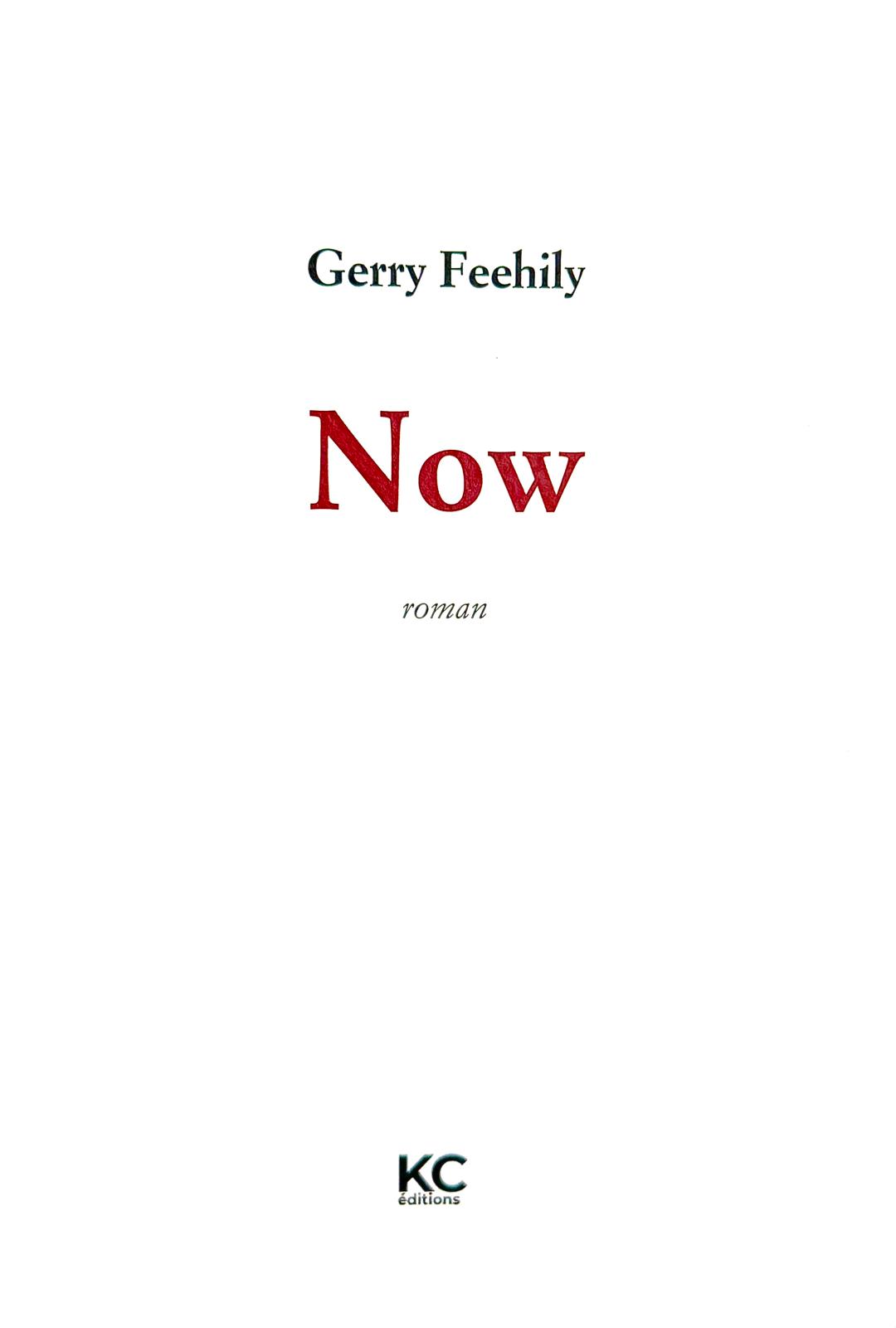
You wrote The House of Now in English, then attracted the interest of a French publisher, who asked you to translate your own book. But my understanding is that it’s not a straightforward translation… So which is the original: the English version or the published version in French?
In 2024, Silvia Contarini of KC éditions published Pavel Hak’s Autobiographie. He’s an extraordinary Franco-Czech writer whose second novel, Sniper, I translated for Serpent’s Tail back in 2003. Pavel’s a mate. Silvia had already seen some of my stories, including Gunk and “The Irish Genius” in your Paris anthology. She invited me to come up with a French translation.
I thought: if I simply translate this, I’m going to lose too much of what is happening in the English. Traduttore, traditore: the translator as traitor. So I thought, I have to write another book. The French became an adaptation.
I delivered it in spring 2025 and we went through a very rigorous editing process. Early this year, all those cuts and edits went back into the English and made that novel shorter, quicker, snappier. Silvia really identified the soul of the book: the accelerations, the cascade, that sense that things are forever tottering and about to collapse.
The two books are autonomous. Basically twins, with ever so slightly different traits.
You moved to Paris in the 1990s. Was that linked to modelling (the focus of your new book) or to your literary ambitions?
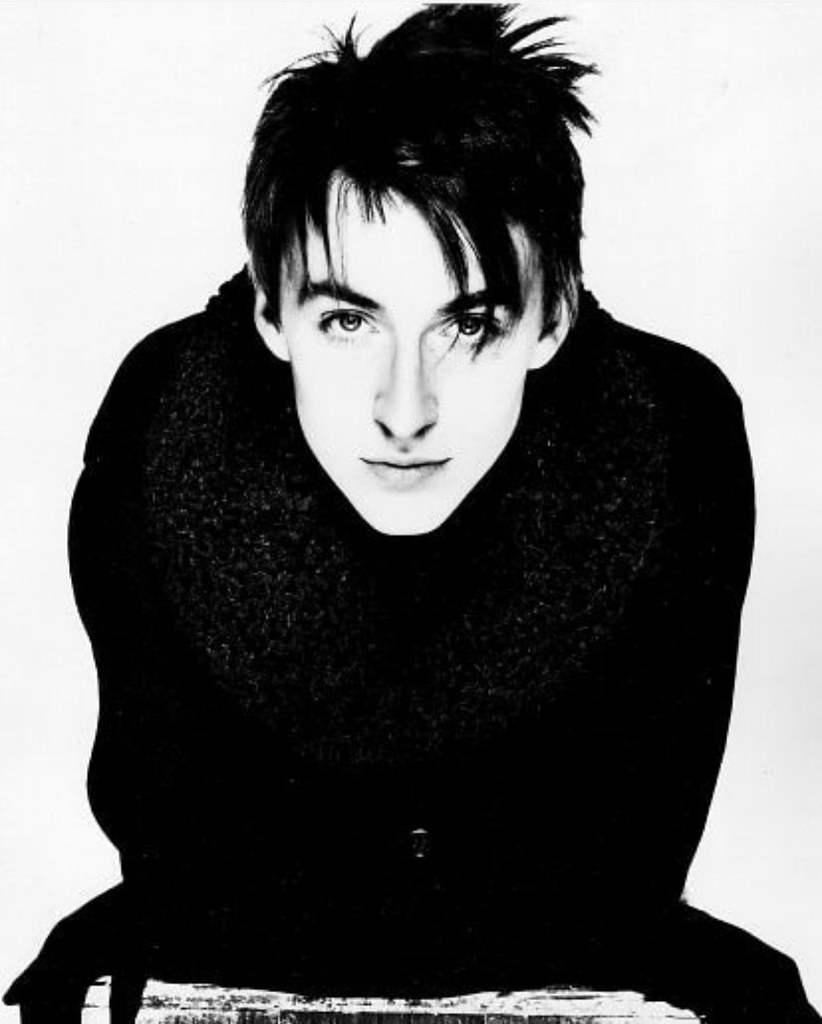
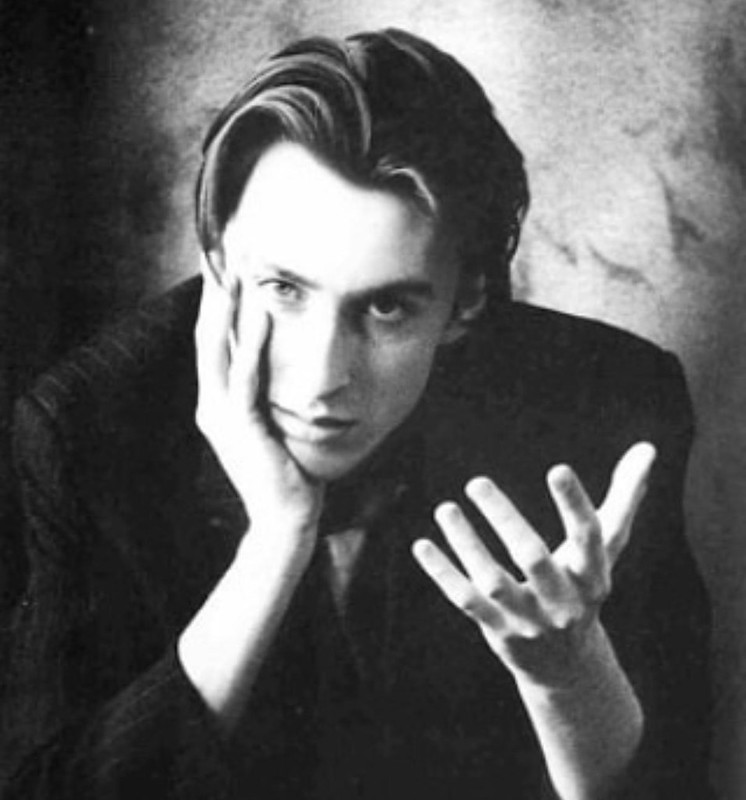
Both, really. From the age of thirteen or fourteen I knew I wanted to live on the “Continent”. Modelling allowed me to put that plan into action. I had a French girlfriend, I was spending a lot of time in Milan, I lived in Japan for six months — I was big in Japan — and worked in London, Barcelona and Madrid. The literary ambition was already there. I was still modelling when I wrote the first version of what, decades later, would become this book.
How did you become a model?
I was in the Spice of Life, this once gothy (but no longer), punky pub at Cambridge Circus, London, waiting to meet some Irish goth punks I was in a band with. We were called the Fireworks Factory.
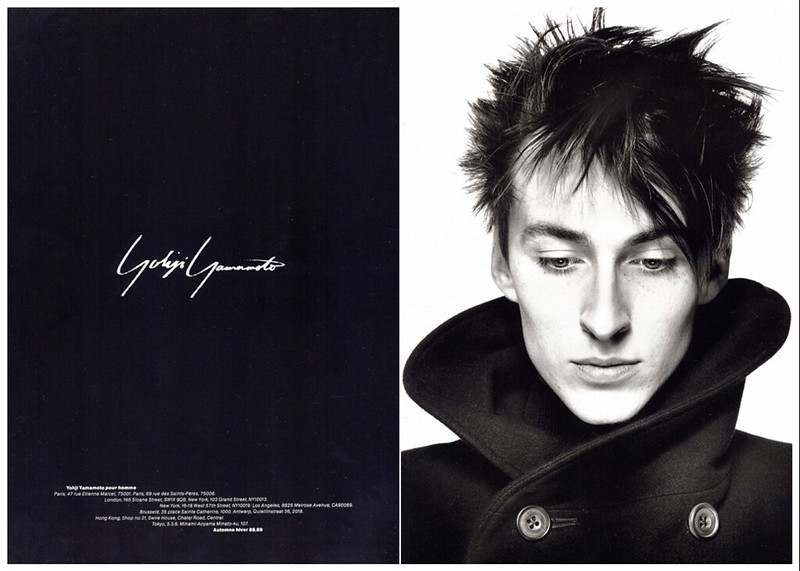
This incredibly well-dressed man came up while I was having my pint and said, in a very strong French accent, “Excuse me, I’m the art director of Yohji Yamamoto in France. Would you be interested in doing our fashion show in a couple of weeks?”
I said, “Are you taking the piss, mate?”Three weeks later I was in Paris.
They put me up in a four-star hotel, I did the show, went out to places like Le Palace, Les Bains Douches, the legendary nightclubs, and that same weekend I ended up with agents in Paris, London and Milan. I was supposed to go back to Dublin to continue studying English and philosophy. I wasn’t a bad student at all, but I simply couldn’t say no.
So I never went back. Never finished the degree. I’m a dropout, mate.
To what extent is The House of Now based on your experiences as a model? And which character do you feel closest to?
Art is the obvious one because he’s Irish and drops out of philosophy. But I don’t think I was quite as naïve as Art, and probably not quite as nice. Dave and Doug contain other bits and bobs. But I wasn’t writing autobiography. At a certain point the characters developed their own internal logic, and I had to follow that rather than my memories.
I’d been trying to write a fashion novel since I was about twenty-four or twenty-five. For years, there was a conflict in me: I wanted to be an intellectual, I wanted to be considered a serious writer, and fashion seemed so trivial and silly.
Then, much later, once I’d established myself professionally and had a family, that part of my past somehow broke off from me and became an object. I could look at it and think: that was actually great craic. There’s a great story there. I could finally tease out all the different strands of the experience, including Amber, who for me is central to the book. She’s the star around whom the main characters orbit.
There’s a commercial they’re filming for the perfume called Now, which is central to the novel. You’re making fun of fashion’s exploitation of high culture, aren’t you?
Yes, but there’s an ambiguity there. It’s a standard trope in fashion photography: photograph a model in front of a great monument because the monument gives weight and density to what is essentially a commercial exercise.
Fashion is constantly feeding off culture and whatever happens to be fashionable culturally. If there’s a huge Frida Kahlo exhibition, you can guarantee that within six months there’ll be Frida Kahlo-influenced fashion shows. Put a beautiful woman in front of Machu Picchu, dress her in Dior, and of course it’s completely absurd. But it may also look absolutely fantastic.
That’s the ambiguity: fashion is parasitic on culture, but the parasite can produce something genuinely beautiful.
There’s a sequence in the book with a wax effigy of Shelley burning on a bonfire while the models are dressed in velvet dresses, leather boots, et cetera, in this nineteenth-century style, with Dave effectively playing Byron. It’s ridiculous. It’s also beautiful. You can’t entirely resist beauty or cultural references simply because you know they’re being used to sell clothes.
The novel isn’t simply a satire or a critique of fashion…
No. I didn’t want it to be broad. I’d spent five years modelling and probably, in total, ten years in and around fashion through relationships afterwards. I knew photographers, I saw textiles being chosen, visited factories, watched seamstresses work. I even assisted the great Nick Knight for one day and was an absolute disaster. I realised I was crap at it and that I wasn’t visual.
But I knew enough of the industry to know I couldn’t just take the piss out of people because they were fashion people. They’re young people, often with artistic longings, involved in the drama of their own lives, and that drama is real to them, even inside a superficial, exploitative world. Once you take that drama seriously, you’re no longer just doing satire.
There’s a fairy-tale element too: the rags-to-riches stories of characters like Doug and Burt. And at one point the Dutch film director Wik Volkskrant says that models aren’t paid to speak, they’re paid “to be.” That struck me because models embody desire, don’t they? They embody a kind of aesthetic perfection…
Absolutely. If you were chosen to do a major fashion show, it was an extraordinary ego boost — like having your manuscript accepted. And then you were paid a disproportionately large sum simply to put on an outfit.
So Wik is being disparaging when he says models are paid “to be”, but there’s something true in it. For a brief period, your existence itself becomes the commodity. And then all these doors open into a world of luxury and privilege.
That’s the fairy tale. Except a fairy tale takes place in a moral universe and has a moral at the end. I absolutely didn’t want to write the moralising fashion book: like, it’s empty, it’s superficial, everybody is crazy, stay away. If the satire was going to work, the world had to be as attractive in the book as it really was.
What tradition does the novel belong to?
I think much more of the picaresque and the nineteenth-century roman d’ascension sociale than the modern fashion novel. I loved Fielding’s Joseph Andrews, but I’m particularly interested in the much more cynical French tradition: Balzac, then the anti-Balzac of Flaubert, then Maupassant and Bel-Ami, stories of social ascent with something caustic underneath.
I think the French were particularly good at it. Dickens veers treacly, whereas Balzac goes off into grandeur.
So I see The House of Now in that tradition: the rake’s progress, social ascent, people moving through worlds that weren’t supposed to be open to them.
Which brings us to the structure. It’s episodic, with multiple points of view. Why did you choose that approach?
Because when I read the catastrophic first draft I realised I’d actually written about five different stories. And I thought: what the fuck am I going to do with this?
I started thinking about Faulkner’s As I Lay Dying, the different points of view, and Graham Swift’s Last Orders, which itself owes something to Faulkner. Books beget books.
Then I realised the episodic structure could actually give me what I wanted. Short chapters, multiple characters, deliberately disobeying sequencing so the book doesn’t simply proceed A, B, C, D. Dos Passos and the early modernists were doing these things, obviously — nothing new, of course.
My one rule was that every chapter had to move forward in time. An Art chapter might be followed by Doug, Amber, Nick or the Wicked Agency, but a day, a week or a month has passed. That creates the acceleration towards the climax — the cascade, the feeling that everything is tottering and about to collapse. I wanted the reader to have that picaresque sensation I love myself.
The book is set in 1989, against the background of AIDS, the fall of the Berlin Wall and the collapse of the Soviet bloc. There’s an atmosphere of decadence, of decline and fall — shades of Gibbon, perhaps even Spengler. Why 1989?
I chose 1989 because there was still a kind of innocence to the period. The Wall was coming down, the Soviet system was collapsing, and in the West there was this sense that history might somehow have resolved itself in our favour. Fukuyama’s end of History. But there were bum notes already. A shady figure like Herbert von Karajan had conducted Beethoven’s Ninth at the Brandenburg Gate; Václav Havel, the great post-communist saint, would write an essay called “The Twilight of Europe”. Twilight? Wasn’t this supposed to be the dawn of the new Europe?
Then 9/11 happened and all of a sudden the ground shifted again. Retrospectively, the Berlin Wall triggered it. Like a lot of people, I suspect, I only began reading Gibbon and Spengler much later because we intuit that there’s some kind of unravelling going on. In Gibbon’s case, Rome unravels over centuries, with its eastern empire surviving at Constantinople for another millennium. I imagine the current unravelling will go much faster. That’s also the unravelling in Now: everything accelerating, everything being forgotten more quickly. What city falls first?
Here’s an anecdote.
I saw the Smiths in Dublin in spring of 1987, around the time of “Shoplifters of the World Unite”, and I had this strange sensation that night that I was witnessing the end of something — of what I had thought pop or rock music was: a way of life, a form of freedom. That was my first apprehension of decline and fall.
Took me years to interpret what bothered me: the extent to which rock itself was like a propaganda machine, making millions out of the demoralisation of young people, the artists themselves being barely conscious of it. I remember hearing Beck’s “Loser” for the first time on a beach in Greece and thought: yes, I’m a loser too — but this guy is an elite Californian grifter.
What I’m saying is that a lot of rock, not all, contains an element of capitalist agitprop. That’s Baz’s story in the novel: a public-school boy affecting a working-class accent and raging against life. It’s pure fakery. The songs are still fabulous, though. Baz’s are too. But that negative epiphany that The Smiths or the Bunnymen or rock won’t save us, that they are the system, although they think they’re not, was shattering.
There’s also nostalgia in the novel for a lost golden age — those old waiters in Naples, for instance, who remember the real stars. An idea that authentic glamour has been devalued.
Edmund Wilson made the point that revolutionaries are always nostalgic for an earlier period: Lenin for the Commune, the French revolutionaries for the Roman republic. Even revolutionaries, God bless them! The old Italian waiters in Naples are nostalgic, I suspect, for that enormous sense of American power embodied, first, by the army coming through the city and then later the soft power of the Hollywood stars flooding into Italy, discovering Capri and the Amalfi coast. They’re nostalgic for a glamour inseparable from power, which isn’t there in mass democratic tourism.
Coming out of comparatively poor Ireland in the eighties, though, my experience was very different. I remember going “up” to Dublin to study and being struck by how disillusioned my contemporaries from well-to-do backgrounds already were. I was working class, coming out of a small town, and I was ecstatic. I was completely full of joy about getting out and seeing this world.
There’s an irony there. Working-class people take cultural disillusionment to heart, the black pill is really meant for them, whereas the elites sail on regardless. That’s why Art’s optimism matters. He hasn’t yet acquired the luxury of disillusionment.
So where next? What’s the next book about?
I can’t tell you. But I have a five-year plan.
Like in the Soviet Union?
Exactly. Going full on CCCP. And look how well that went.
You’ve done fashion. What about journalism?
That’s part of the five-year plan.
We haven’t talked about Spengler properly.
Nor Leopardi, who provides the opening epigraph!
So let’s turn now to this dialogue between Fashion and Death, which gives the book its epigraph.
Leopardi’s Dialogue Between Fashion and Death, 1824. Someone first gave it to me when I was modelling. I read it and thought: this is very odd and very strange and cool. Fashion and Death are sisters?
It was only much later that I really twigged it. They’re both children of time — of caducità, caducity, transience, decay. Death destroys us biologically. Fashion destroys us in another way: by continually making the new old. Our clothes, tastes, identities, desires — everything falls into obsolescence.
Fashion is an accelerator of time and therefore, in a sense, an accelerator of our own death.
That became a springboard for the entire novel. The models are paid “to be”, as Wik says, but precisely what they’re being paid for is extraordinarily perishable: beauty, youth, newness. Fashion creates the Now and immediately begins destroying it.
And hence the title Now…
Exactly. Schopenhauer’s essay On the Vanity of Existence is a banger about Time, the idea that even a great event happening today will eventually seem insignificant, almost as though it had never happened. Our greatest passions, our greatest love affairs — years later, what was that all about? The present has this awful habit of becoming the past while you’re still living in it. The Now annihilates.