
“Un grand écrivain se remarque au nombre de pages qu’il ne publie pas.”
“Vaincre le hasard mot pour mot.”
– Stéphane Mallarmé
“Un grand écrivain se remarque au nombre de pages qu’il ne publie pas.”
“Vaincre le hasard mot pour mot.”
– Stéphane Mallarmé
“MG: Talking of our generation — I mean ours (we’re exactly the same age) — a real symptom of it, as this conversation is so aptly demonstrating, is that we keep referencing theory when we talk about our work. More than that: theory informs the making of it.
TMCC: But that’s always the case, even for people who claim not to ‘have’ theory. ‘Not’ having theory just means having crap theory, i.e. adhering to a humanism that has erased all traces of its own constructedness.”
– Tom McCarthy and Margarita Gluzberg, “Circuits and Loops,” BOMBlog 4 May 2012
From the first smouldering taper to the elegant lanterns whose light reverberated around eighteenth-century courtyards and from the mild radiance of those lanterns to the unearthly glow of the sodium lamps that line the Belgian motorways, it has all been combustion. Combustion is the hidden principle behind every artefact we create. The making of a fish-hook, manufacture of a china cup, or production of a television programme, all depend on the same process of combustion. Like our bodies and like our desires, the machines we have devised are possessed of a heart which is slowly reduced to embers.
– W. G. Sebald, The Rings of Saturn
Franz Kafka, letter to Max Brod, 5 July 1922
Writing sustains me. But wouldn’t it be more accurate to say that it sustains this kind of life? Which does not, of course, mean that my life is any better when I don’t write. On the contrary, at such times it is far worse, wholly unbearable, and inevitably ends in madness. This is, of course, only on the assumption that I am a writer even when I don’t write — which is indeed the case; and a non-writing writer is, in fact, a monster courting insanity.
Jon Savage [on west London’s empty “breathing spaces” circa 1977], “Interzone,” Dazed & Confused May 2012 (p. 18)
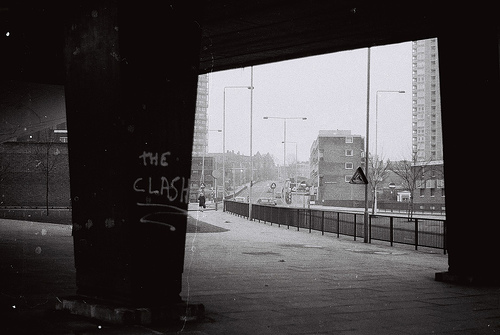
There was space to move, to think and daydream… and these places weren’t even inhabited by people. These places were blank, they were interzones.
MG: …And in your latest novel, C, you talk a lot about static: you call it ‘the sound of thinking’.
TMC: Yes. That’s where Serge, the hero, is listening to the radio. But there’s another bit in that book where he’s playing a record and he lets it run on after it’s finished to listen to the static at the end, and he hears a huge amount of information in all that silence.
– Tom McCarthy and Margarita Gluzberg, “Circuits and Loops,” BOMBlog 4 May 2012
Emil Cioran, Tears and Saints
Is it possible that existence is our exile and nothingness our home?
“I often feel one drink away from whatever makes dogs hump women’s legs.”
– Greg Baxter, A Preparation for Death (2010)
“Ah ! princesse, vous n’êtes pas Guermantes pour des prunes.”
– Marcel Proust, A la recherche du temps perdu
On one of the corners of rue des Abbesses and rue Aristide Briand, there is a café called La Villa. The decor could be described as gentlemen’s club stroke colonial chic. African masks look down, with long faces, from dark oak panelling. The lighting is always subdued, as though some hallowed mystery had to be preserved from the cold light of day. In the first section, there are twelve black leather armchairs on either side of six black round tables. The armchair where Emilie once sat is in front of me, by the window. It is impossible to say for sure if it is the exact same one, or if the armchairs have been moved around. It is a question of belief. I believe this is the armchair in which Emilie is no longer sitting. I believe that everything must leave some kind of mark, and that her buttocks are haunting the leather seat. The distance separating the armchair in which I am sitting from the armchair in which Emilie is no longer sitting is absolute. The journey between the two refuses to draw to a close as I draw close.
 ANDREW GALLIX