
Costica Bradatan, “In Praise of Failure,” The New York Times 15 December 2013
For, in a sense, the capacity to fail is much more important than any individual human achievements: It is that which makes them possible.
Costica Bradatan, “In Praise of Failure,” The New York Times 15 December 2013
For, in a sense, the capacity to fail is much more important than any individual human achievements: It is that which makes them possible.
Maurice Blanchot, “The Disappearance of Literature,” The Book to Come
Whoever asserts literature in itself asserts nothing. Whoever looks for it looks for only what is concealed; whoever finds it finds only what is on this side of literature or, what is worse, beyond it. That is why, finally, it is non-literature that each book pursues as the essence of what it loves and wants passionately to discover.
David Winters, “Like Sugar Dissolving: On The End of the Story by Lydia Davis,” The Quarterly Conversation 35 (March 2014)
… In The End of the Story, and arguably across Davis’ stories more broadly, the composition of a fictional form coincides, at all times, with the preservation of “something not formed.” After all, any closed circle’s circumference still opens up a continuous curve. Closure and openness, answers and questions, fixity and infinity: to these unsettled oppositions we could also add the “written” and its counterpart, the “unwritten.” Thus, the novel that Davis’ narrator writes is itself encircled, like any novel, by a halo of hypothetical, unfinished books. In this way, the written work retains an internal relation to an idealized, unwritten other:
I’m afraid I may realize after the novel is finished that what actually made me want to write it was something different, and that it should have taken a different direction. But by then I will not be able to go back and change it, so the novel will remain what it is and the other novel, the one that should have been written, will never be written.
Late in his life, in a series of lectures inspired by his own unwritten novel, Roland Barthes examined Mallarmé’s distinction between the “Album” and the “Book.” The Book, argued Barthes, aspires to perfection — it aims to provide an accurate “representation of the universe, homologous to the world.” To create such an artwork would be to reflect “the totality of reality and history, from the perspective of transcendence.” The Album, by contrast, remains rooted within reality, rather than striving to stand outside it. The world as rendered by the Album is incomplete and chaotic; “not-one, not-ordered, scattered, a pure interweaving of contingencies, with no transcendence.” Needless to say, neither Barthes nor Mallarmé crudely confuses these two entities with actual literary texts. The binary is not taxonomical but conceptual; the push and pull between these two poles shapes the production of literary works. On the one hand, the Album and all its manifestations: the fragment, the essay, the unfinished effort. On the other, the Book and its corollaries: the summa, the opus, the completed oeuvre.
Jason Farago, “Degenerate Art: The Attack on Modern Art in Nazi Germany, 1937 review — What Hitler Dismissed as ‘filth’,” The Guardian 13 March 2014
Dix, who earned the Iron Cross as a soldier during the first world war, was a favourite target of these proto-Degenerate Art shows; his glorious grotesques such as War Cripples (1920), they claimed, were insufficiently patriotic. War Cripples was included in the later Munich exhibition and was subsequently destroyed. The Neue Galerie [in NYC] has a contemporary postcard of the lost work, as well as the painting’s frame, hanging empty.
Stan Brakhage, Metaphors on Vision, 1963
Imagine an eye unruled by man-made laws of perspective, an eye unprejudiced by compositional logic, an eye which does not respond to the name of everything but which must know each object encountered in life through an adventure of perception. How many colors are there in a field of grass to the crawling baby unaware of ‘Green’? How many rainbows can light create for the untutored eye? How aware of variations in heat waves can that eye be? Imagine a world alive with incomprehensible objects and shimmering with an endless variety of movement and innumerable gradations of color. Imagine a world before the ‘beginning was the word’ [via / See Simone Weil.]
David Lynch, “David Lynch Presents: Ruth, Roses and Revolver,” Arena (BBC), 1987
I think films should have a surface story, but underneath it there should be things happening that are abstract; there are things that resonate in areas that words can’t help you find out about [via].
William H. Gass, “The Hovering Life,” The New York Review of Books 11 January 1996
…But this book was created to be incomplete, and if it had an end it would not be finished. …For a time, in Musil’s youth, he had been a librarian, and soon he needed his knowledge of indexes and files in order to remember what he’d done, to find where he was, and keep track of all the creatures of his invention. The risk of conclusion increased in company with his desire to call it quits, since the novel was for Musil life itself by this time, and pulled on weary acceptance like a pair of familiar trousers and wore fastidious revulsion for its party shirt. …Postponement was the plan; so, in addition to his additions, he revised, held portions back, wrote over proofs until every unprinted space was also dark, made alternative drafts of scenes and chapters, mourned whatever bit of text he had let escape from his fanatical concern for exact analysis to reach the embarrassment of print; because Musil polished not to achieve a finish or a shine, but (like every perfectionist) to accomplish the inconclusive — caught, as he was, in a race which only Zeno of Elea could have charted — edging closer and closer to assassination time, that other August, near enough perhaps to feel the first guns go off, but not close enough to hear in them the clap of doom.
Ujana Wolf, “Whiting Out, Writing In, Or a Technique for Recording the Migratory Orientation of Captive Texts,” Asymptote October 2013
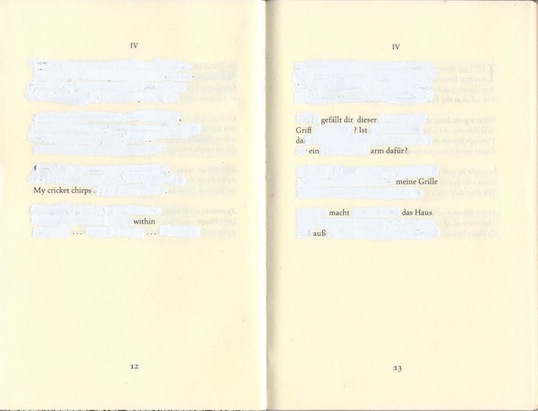
… Erasure, the reworking of found or selected texts by erasing most of the words, be it with the aid of correction fluid, ink, painting over or leaving out, oscillates between sabotage and homage, vandalism and reanimation. In Jen Bervin’s Nets, for example, all the words of the original text — Shakespeare’s sonnets — are still legible, yet most of them are printed in grey, almost faded away. They form a net, a shadow text, which can support the remaining words or at any moment lay itself protectively over them, as if they wanted to emerge briefly or themselves join in the disappearance. This curious tension is common to all erasures, the appearance of disappearance; they foreground — like concrete, experimental, lyrical, or language poetry — the materiality of language, of every single letter. They know that the space on the page is party to a text’s writing, a valve to let off steam, a white that structures silence, physically tangible,
notationen, reproduktionen von schnee
Claude Debussy
Music is the space between the notes.
[Quoted in Jonathan G. Koomey’s Turning Numbers into Knowledge: Mastering the Art of Problem Solving, 2001]
Søren Kierkegaard, Either/Or
If I were to wish for anything, I should not wish for wealth and power, but for the passionate sense of the potential, for the eye which, ever young and ardent, sees the possible. Pleasure disappoints, possibility never. And what wine is so sparkling, what so fragrant, what so intoxicating, as possibility!
 ANDREW GALLIX