Is E-literature Just One Big Anti-Climax?

This appeared in Guardian Books on 24 September 2008:

Is E-literature Just One Big Anti-Climax?

When I first ventured online, the internet struck me as the last word in literary experimentation. I was in good company. For Kathy Acker, and other pioneers who were already pushing the envelope on papyrus, cyberspace (copyright William Gibson) was truly the final frontier.

The very first novel to be serialised online — Douglas Anthony Cooper’s Delirium (1994) — made full use of the new medium by allowing readers to navigate between four parallel plotlines. Geoff Ryman’s 253, first posted in 1996, became an instant hypertext classic. A year later, Mark Amerika’s Grammatron transcended the fledgling genre by turning it into a multimedia extravaganza. This, I believe, was a crucial turning point. The brief alliance between literati and digerati was severed: groundbreaking electronic fiction would now be subsumed into the art world or relegated to the academic margins. The subsequent blogging revolution shifted the focus further away from web-based writing to news coverage of dead-tree tomes, thus adding yet another layer of commentary to the “mandarin madness of secondary discourse” George Steiner had long been lamenting. Bar a few notable exceptions (Penguin’s wiki-novel or We Tell Stories project), traditional publishers have used the internet as a glorified marketing tool providing them with new ways of flogging the same old same old: e-books, Sony Readers, digi-novels, slush-pile outsourcing …

My contention that e-literature has been gradually sidelined by the rise of the internet as a mass medium proves controversial. A straw poll of some of the movers and shakers on the digital writing scene indicates that a huge majority believes e-lit has a higher profile today than it did 10 years ago. In fact, Dene Grigar — who chaired the Electronic Literature Organization’s latest international conference — was alone in thinking that I may have a point. Interestingly enough, she argues that American universities’ digital humanities departments are partly to blame because of their emphasis on digitising traditional books at the expense of promoting creative electronic writing: “In reality, unless it is a department where Kate Hayles, Matt Kirschenbaum, and a handful of other scholars reside, Michael Joyce‘s work will not receive the attention that James Joyce’s does”. Nevertheless, she is convinced that e-lit remains a “viable art form”. That it may be, but is it still writing?

Chris Meade, director of the thinktank if:book, agrees that e-lit practitioners are increasingly forced “to engage more fully with either the literary or digital arts”. He mentions Naomi Alderman and Kate Pullinger as “two of the few writers who still straddle the literary and new media fields”. Meade himself probably fits the bill too. In Search of Lost Tim, his multimedia novella which was recently described as “just possibly, the future of fiction”, may be based on a mixture of blogs and videos but it still clearly belongs to the Gutenberg Galaxy.

For others, like Sue Thomas, professor of new media at Leicester’s De Monfort University, the way forward (or sideways) is precisely to abandon our print fixation. This is why she rejects the term “e-lit” (with its reference to an old-fashioned notion of ‘literature’) in favour of “new media writing” or, better still, “transliteracy” — which covers all forms of literacy ranging from orality to social networking sites. Mark Amerika, pope of avant-pop-cum-new-media guru has referred to himself as a designwriter, a remixologist, a visual jockey (VJ) and, of course, a net artist, over the years, whereas he used to be a plain old writer in his younger days. This isn’t just a question of semantics. As Grigar points out, “one of the most difficult aspects of e-lit is the ability to talk about it fast enough, so fast is the landscape changing”.

Since its inception, e-lit has been struggling to free itself from its generic limitations and now seems to be on the verge of doing so. At long last. Although interesting, its early manifestations were hardly groundbreaking. Collaborative narratives are as old as literature itself. Generative poetry simply adds a technological twist to Tzara‘s hat trick, the Surrealists’ automatic writing or Burroughs’ cut-ups. Interactive fiction has its roots in Cervantes and Sterne. Hypertexts seldom improve on gamebooks like the famous Choose Your Own Adventure series, let alone BS Johnson‘s infamous novel-in-a-box. Besides, if you really want to add sound and pictures to words, why not make a film?

So far, the brave new world of digital literature has been largely anti-climatic. Meade himself confides that he is yet to be “seized by a digital fiction that is utterly compelling”. I can but concur. Technology — the very stuff e-lit is made of — has also turned out to be its Achilles heel. The slow switch to broadband limits its potential audience, e-readers are only adapted to conventional texts – and when was the last time you curled up in bed with a hypertext? In spite of all this, Amerika may well be on to something when he claims that we are witnessing the emergence of a “digitally-processed intermedia art” in which literature and all the other arts are being “remixed into yet other forms still not fully developed”. My feeling is that these “other forms” will have less and less to do with literature. Perhaps e-lit is already dead?

All the Latest

My piece on electronic literature appeared today in the Guardian books blog. Here’s an extract:

“When I first ventured online, the internet struck me as the last word in literary experimentation. I was in good company. For Kathy Acker, and other pioneers who were already pushing the envelope on papyrus, cyberspace (copyright William Gibson) was truly the final frontier. The very first novel to be serialised online — Douglas Anthony Cooper’s Delirium (1994) — made full use of the new medium by allowing readers to navigate between four parallel plotlines. Geoff Ryman’s 253, first posted in 1996, became an instant hypertext classic. A year later, Mark Amerika’s Grammatron transcended the fledgling genre by turning it into a multimedia extravaganza. This, I believe, was a crucial turning point. The brief alliance between literati and digerati was severed: groundbreaking electronic fiction would now be subsumed into the art world or relegated to the academic margins. The subsequent blogging revolution shifted the focus further away from web-based writing to news coverage of dead-tree tomes, thus adding yet another layer of commentary to the ‘mandarin madness of secondary discourse’ George Steiner had long been lamenting….”

More here.

All the Latest

Donari Braxton was kind enough to mention me, along with Tony O’Neill and HP Tinker, in his interview with Hillary Raphael posted in Anthem magazine on 20 September 2008. He describes all of us as “enveloppe-pushers”:

“…Raphael’s novels and those of envelope-pushers under the same stamp — HP Tinker’s brilliantly progressive fiction comes to mind, likewise authors Andrew Gallix and Tony O’Neill — exist on their own accord, de-contextualized. And if you’re able to nix ‘experimental lit’s’ elitist subterfuge and instead embrace the tabula-rasa, you’ll see they read like any other, er, ‘non-experimental’ book. With pleasure.”

On 5 September, Susan Tomaselli posted my recent Dazed & Confused article in 3:AM Magazine‘s Buzzwords with added links.

The New Wave of French Urban Fiction

This appeared in Guardian Books on 12 September 2008:

The New Wave of French Urban Fiction

Between mid-August and late October, the French publishing industry goes into overdrive. The current rentrée littéraire (named after la rentrée scolaire — the beginning of the school year) has seen fewer novels hitting the shelves but their subject matter is as Gallicly grim as ever — not that much of it is likely to find favour in Britain anyway. It’s not all gloom and doom, though. Besides the fact that local authors are increasingly young and female, urban fiction seems to be finally breaking out of its generic ghetto.

This new trend first hit the headlines at the Gauloise-end of the nineties when Rachid Djaïdani — a small-time actor and Thai-boxing enthusiast from the deprived banlieues — published his debut novel (Boumkeur) to rave reviews. The second milestone was the runaway success, in 2004, of Faïza Guène‘s Just Like Tomorrow, which earned her the “Françoise Sagan of the estates” sobriquet. In spite of their critical and commercial success, both books were often regarded as mere novelty hits by the snooty Left Bank literati. Djaïdani explains, for instance, that the big publisher to whom he had sent his first manuscript just could not believe he had written it by himself: after all, he came from the wrong side of town and was the offspring of immigrants. No wonder the leafless Paris suburbs erupted in 2005, just in time to commemorate the tenth anniversary of La Haine. (Incidentally, Djaïdani was part of the security team on the set of Kassovitz’s film and claims, half-jokingly, that the actors probably owe their lives to him.) Since then, many other writers from similar backgrounds have made it into print, including Hamid Jemaï, Skander Kali, Karim Madani, Mohamed Razane, Thomté Ryam, Insa Sané and Livres Hebdo points out that “More and more young authors don’t want to be published by the big houses so are self-publishing via the internet”. Antoine Dole has been instrumental in bringing them together and fostering a sense of community. In November 2006, this young writer produced the first issue of a home-made fanzine which showcased some of the “word activists” — rappers, slammers, bloggers — who were using blogs or social networking sites to bypass mainstream publishing. En attendant l’or soon became a word-of-mouth success via MySpace and a focal point for Les Décalés, a burgeoning literary movement which coalesced around Dole and Elsa Delachair. Most of the members of the Décalés group have now been published in a collection called eXprim’, launched a couple of years ago by 28-year-old Tibo Bérard. The collection addresses itself specifically to teenagers and young adults, which has proved rather controversial in recent months. Antoine Dole’s first novel, Je Reviens de mourir (“I Have Died Again”), was banned by some bookshops and libraries following accusations that it glamourised suicide.

So what is this “littérature urbaine” lark really about, then? Above all, it reflects the advent of a new generation; a changing of the guard: Faïza Guène was only 13 when Georgia de Chamberet edited her anthology of fresh French fiction back in 1999. Giving voice to the vernacular of the banlieues — with its backslang (“verlan”) and borrowings from Arabic — may not seem a big deal in post-Trainspotting Britain, but it is truly novel, and perhaps even revolutionary, given the conservative nature of the French literary establishment. Antoine Dole believes that this movement actually represents a long-awaited “democratisation of writing,” which is why some (like the Qui Fait la France? collective or guerilla micro-publishers Impact Verbal) see it as inherently political. The conception of what a writer should be is also evolving: urban fiction authors often see books as just one means of expression; many of them are also musicians, actors, painters or film directors. Their works are saturated with references to pop rather than high culture — yet another trait which brings them closer to their Anglo-American counterparts.

Although urban fiction is a reaction against the very kind of navel-gazing autofiction that puts off so many British readers, a literary entente cordiale still seems a long way away. The pervasive influence of hip hop and slam poetry on many of these young French writers leads to a stylistic inventiveness which seldom goes down well on this side of the Channel. Another major obstacle is that literary movements — especially when they have a socio-political dimension — are usually met with derision over here. Let the scoffing begin.

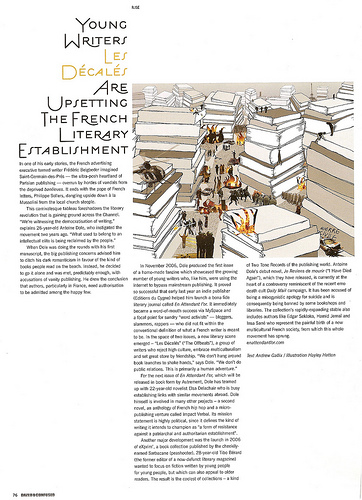
Young Writers Les Décalés Are Upsetting The French Literary Establishment

This was published in the September 2008 issue of Dazed & Confused (vol. 2 issue 65, p. 76):

Young Writers Les Décalés Are Upsetting the French Literary Establishment

In one of his early stories, the French advertising executive turned writer Frédéric Beigbeder imagined Saint-Germain-des-Prés — the ultra-posh heartland of Parisian publishing — overrun by hordes of vandals from the deprived banlieues. It ends with the pope of French letters, Philippe Sollers, dangling upside down à la Mussolini from the local church steeple.

This carnivalesque tableau foreshadows the literary revolution that is gaining ground across the Channel. “We’re witnessing the democratisation of writing,” explains 26-year-old Antoine Dole who instigated the movement two years ago. “What used to belong to an intellectual elite is being reclaimed by the people”.

When Dole was doing the rounds with his first manuscript, the big publishing concerns advised him to ditch his dark romanticism in favour of the kind of books people read on the beach. Instead, he decided to go it alone and was met, predictably enough, with accusations of vanity publishing. He drew the conclusion that authors, particularly in France, need authorisation to be admitted among the happy few.

In November 2006, Dole produced the first issue of a home-made fanzine which showcased the growing number of young writers who, like him, were using the internet to bypass mainstream publishing. It proved so successful that, early last year, an indie publisher (Editions du Cygne) helped him launch a bona fide literary journal called En Attendant l’or. It immediately became a word-of-mouth success via MySpace and a focal point for sundry “word activists” — bloggers, slammers, rappers — who did not fit within the conventional definition of what a French writer is meant to be. In the space of two issues, a new literary scene emerged — “Les Décalés” (“The Offbeats”), a group of writers who reject high culture, embrace multiculturalism and set great store by friendship. “We don’t hang around book launches to shake hands,” says Dole. “We don’t do public relations. This is primarily a human adventure”.

For the next issue of En Attendant l’or, which will be released in book form by Autrement, Dole has teamed up with 22-year-old novelist Elsa Delachair who is busy establishing links with similar movements abroad. Dole himself is involved in many other projects — a second novel, an anthology of French hip hop and a micro-publishing venture called Impact Verbal. Its mission statement is highly political, since it defines the kind of writing it intends to champion as “a form of resistance against a patriarchal and authoritarian establishment”.

Another major development was the launch in 2006 of eXprim’, a book collection published by the cheekily-named Sarbacane (peashooter). 28-year-old Tibo Bérard (the former editor of a now-defunct literary magazine) wanted to focus on fiction written by young people for young people, but which can also appeal to older readers. The result is the coolest of collections — a kind of Two Tone Records of the publishing world. Antoine Dole’s debut novel, Je Reviens de mourir (“I Have Died Again”), which they have released, is currently at the heart of a controversy reminiscent of the recent emo death cult Daily Mail campaign. It has been accused of being a misogynistic apology for suicide and is consequently being banned by some bookshops and libraries. The collection’s rapidly-expanding stable also includes authors like Edgar Sekloka, Hamid Jemaï and Insa Sané who represent the painful birth of a new multicultural French society, from which this whole movement has sprung.

(Illustration by Hayley Hutton.)

Sweet Fanny Adams

Granted, it could have been an airport, say, or any other point of departure for that matter, not necessarily a railway station. Then again, I wouldn’t want you to go thinking that his choice had been totally arbitrary, although he was, admittedly, no stranger to acts of random behaviour. It didn’t have to be an overcrowded railway station, but it sort of made sense somehow.

It’s like this: your train is due to leave any minute now. You look up from your book or paper — if you are reading, that is, but I think we can safely assume that you, mon semblable, mon frère, are reading at least one or the other, possibly even both, one after the other, or, better still, simultaneously. You check the time on your wristwatch, the kind that they advertise in The Economist and suchlike periodicals, something Swiss or German with knobs on (the more, the merrier) which exudes manly sophistication. Just as the Red Sea parted for Moses, the door slides open, blissfully pneumatic, to reveal a stunning Mary Poppins — stacked, stockinged, sorted — in a comely knicker-skimming skirt: entrancing entrance. Being the proud possessor of a Y chromosome, your eyes make a beeline for her A-line, zooming in on silken thighs, NordicTrack-toned. While she fafs about with her umbrella (which will be left behind, of course, accidentally-on purpose like), you are at leisure to divide her putative weight in kilograms by her hypothetical height in metres squared, thus reaching the satisfactory conclusion that the young woman’s Body Mass Index slots into the ideal 18 to 20 range. Stocky stoccado, scatty scattato, she click-clicks her way towards the only vacant space (which just so happens to be facing you) aloft a pair of chichi cha-cha heels, whereupon her petulant posterior takes a pew. As she crosses her endless legs with a hushed swish whoosh, the bright young thong hitches up her skirt a notch, pinching the flimsy fabric on either side of broad hips between manicured thumb and forefinger. At this juncture — when you are about to abandon wife and children, sail the seven seas or commit genocide because men cannot help acting on impulse — you notice that those are tear- and not raindrops irrigating her tanned, yet still unblemished, features. Ever the gentleman, or simply embarrassed, you interrupt your ornithological study and peer out of the window which, being in dire need of a good clean, forces you to squint in the most unsightly fashion. Now is when it happens. For a few split nanoseconds, another train pulling into the station tricks you into believing that your train is pulling out.

****

Adam Horton — 33, caucasian, 5’6”, underendowed, thinning on top — viewed this sensation as a perfect metaphor of his stumbling through life like a sleepwalker on a treadmill, a pet hamster on a wheel, or a commuter on the Circle Line. Hence the choice of a railway station over any other point of departure. But which one? Paris offered un embarras de choix.

Gare de l’Est was a definite no-no for some obscure reason. Gare d’Austerlitz was likewise ruled out: Adam, you see, had a passion for Waterloo Station. Watching the workers munching their lunch-break baps at the bottom of the up escalator, eyes cast skirtwards all the while, never failed to microwave the cockles of his little heart. Since childhood, he had conceived of Austerlitz as a sort of counter- or even anti-Waterloo; it was enemy territory. This still left Gare de Lyon, built in the grandiose style — probably the most pleasing, aesthetically. Gare St Lazare, caught between the red-light district and the posh department stores, scored a few brownie points. Proust’s lycée was close by, as well as the Opéra Garnier (a fine example of architectural eclecticism) and, more importantly, Marks & Sparks with its large lingerie section where Adam often indulged in a little lingering among the petticoats and suspender belts. There was also Gare Montparnasse, where the muses hung out, free and easy, serpentine locks flailing the air. They rode around like BMX bandits astride expensive Dutch bicycles sporting a saucy look on their freckly faces and precious little else. The area never failed to remind him of the time when he micturated on the tomb of Jean-Paul Sartre after burying his late goldfish (Botty, short for Botticelli) in the shadow of Baudelaire’s corpse. Such fond memories.

In the end, however, he had plumped for Gare du Nord which houses the Eurostar terminal. Adam’s grasp of French had greatly improved over the past twelve months, but he was looking for a lady who spoke the old mother tongue. Besides, the word ‘terminal’ had a certain ring to it, the finality of a full stop.

****

The air hung heavy with Chaucerian expletives; dropped aitches were strewn about his feet. Here and there, love thugs sprouting Hoxton Fins were reading redtops from back to front. The odd diamond geezer was getting twatted while his missus flaunted the latest erogenous zones. In the distance, a posse of blue-rinsed senior citizens could be seen giving a spirited rendition of the hokey-cokey. A good vibe was being had by one and all. If I should die, Adam muttered, think only this of me: that there’s some corner of a foreign railway station that is forever In-ger-land. And there she was.

Sweet Fanny Adams.

Sweet Fanny Adams and no mistake.

Although he had never actually seen her before, he recognised her at once, and once he had recognised her, he realised he would never see her again. After all, not being there was what she was all about; it was the essence of her being, her being Fanny Adams and all that.
As he walked towards the bench where she was sitting pretty, Adam missed her already. Missed her bad.
‘How do you do?’
‘How do I do what? The imperfect stranger looked up from her slim, calf-bound volume and flashed him a baking-soda smile, all cocky like.

Their eyes met, pairing off at first sight. The earth moved, orbiting at half a kilometre per second around her celestial globes — a couple of scalloped cupfuls with peek-a-boo trimmings — in what can only be described as a new Copernican revolution. For the first time since Mrs Horton’s belaboured parturition, when he was eventually sprung off into the world, Adam didn’t feel at the wrong place at the wrong time: he was back in the bountiful bosom of Mummy Nature. As if to celebrate this return to the much-maligned Ptolemaic system, a gaggle of gurgling putti glided overhead to the strains of syrupy muzak and departing trains. All in all, it was an auspicious overture, fraught with the promise of premise.

‘Adam,’ said Adam, extending his right arm.
‘Margherita,’ said Margherita, giving it a hearty shake.
Still reeling from that initial, blinding smile — let alone the handshake — he struggled to regain his composure. ‘Have you read The Leaning Tower of Pizzas by N.E. Tchans?’
‘Is that the one which ends with an epic battle between gangs of pre-pubescent herberts bouncing around on orange space-hoppers?’
‘Yes.’
‘No, but I read a review at the time.’
‘Well, it’s all about this Mr Soft Scoop bloke, right, who comes from Italy and settles down in South London where he falls in love with a girl called Margherita.’ She was fiddling with her umbrella, a faraway look on her face. ‘Like you, like.’
‘Oh, I see, yes. Sorry, I was miles away.’
‘I know: that’s the attraction,’ he sighed sotto voce, before getting a grip on himself. ‘Anyway, you should check it out some time — if you’re into lolloping lollipop ladies, lesbians from Lisbon, the romance of ice-cream vans, that kind of thing.’
‘Sounds right up my street.’
‘I see it as a contemporary footnote to Dante.’
‘Talking of contemporary feet, mine are killing me.’
‘Dying on our footnotes are we? One footnote in the grave, eh? How long have you got left?’
‘Long enough to grab a bite to eat — or so says my chiropodist.’
‘I think there’s an Italian just round the corner that might tickle your fancy.’
‘Sounds great. I feel like a pizza.’
‘I’m not surprised, love, with a name like that.’

Adam caught a fleeting glimpse of the dark, gaping twilight zone between Margherita’s parted thighs as she uncrossed her legs to get up. That topsy-turvy Bermuda Triangle twixt skirt and stocking exerted a gravitational pull of such magnitude that he was sucked in, there and then, never to re-emerge. He picked up her bulky suitcase, l’air de rien, but in his mind’s X-ray eye he could see her neatly-packed unmentionables. He was big on smalls was old Adam Horton.

‘Heavy, innit?’
‘It’s a burden I feel I’ve been carrying all my life.’ He turned to face her, fair and square. ‘This may sound potty, but you are the hollowness inside. At last, I have found my sense of loss.’
‘I’m flattered,’ she said in Estuarine undertones, blushing a little. Her dimpled cheeks resembled two squashed cherry tomatoes, only bigger. ‘I always like to be of assistance to strangers.’
‘After you,’ said Adam, bowing theatrically and showing the way with her suitcase like a truncheon-toting gendarme stopping the traffic for pedestrians. He couldn’t help noticing the shaft of light that fell on Margherita’s top bottom — proof positive that the sun shone out of her behind — before leaving the station, hot on her high heels.

They repaired to a Greekish spoon which Margherita praised on account of its ‘atmosphere’.
‘Looks great,’ she gushed, surveying the menu in the window, ‘I feel like a cocktail’.
‘I’m not surprised, love, with a name like that.’

****

The walls were festooned with fairy lights, garlands of garlic and pictures of Asma Assad, the Syrian President’s trophy wife. The waiters were all male to a man. It soon transpired that none of them were actually Italian having been born and bred, through no fault of their own, on the wrong side of Thessaloniki. (‘Oh, that’s a shame, isn’t it?’ cooed Margherita, detaching each word as if dismembering some wingèd insect.) The chef, a diminutive Algerian with an endearing paunch, had a Saddam Hussein mustache going on and a nice line in knock-knock jokes. The toilets were typically Turkish.

Having taken in the scenery, Adam proceeded to pour out his heart and a couple of cheap, albeit cheerless, bottles of Sidi Brahim. Whining and dining, in medias res.
‘We are all post-Denis de Rougemont.’
‘Couldn’t agwee maw,’ said Marwghewita, making a mental note never again to shpeak wiv her mouf full. Frankly, she didn’t have a clue what he was going on about.
‘We are the first generation to know full well that love doesn’t last, and yet we cling to the ideal like shit to a protective blanket.’
She turned up her already-retroussé nose. How more retroussé can it get? he wondered.
‘Maybe it’s just me. The whole thing’s very Oedipal, I know.’ Adam cringed at his attempt to laugh it off.
‘I could spank you, free of charge, if you think that might help.’
‘I’d rather not if it’s all the same with you,’ he replied rather primly, his flushed face a slapped-arse crimson, ‘but thanks for the offer. Might even take you up on it some other time. Except…’ Adam paused for effect, ‘there won’t be another time.’ He sighed, baleful, into his bowlful of miniature bow-ties, topped up their glasses and cleared his throat. ‘Love stories are like fairy tales…’
‘Aren’t they just,’ she interrupted, a trifle too eager.
‘…in that we know the end from the start. Only it’s not and they lived happily ever after, is it?’
Tears welled up in her belladonna eyes.
‘You know, someone should really write a different kind of love story for the new millenium. It would start with the foregone conclusion and work its way back towards the unknown: how it all started in the first place.’
‘Will you write this new-fangled love story?’
‘I’m writing the first pages even as we speak — with your assistance, of course.’
‘I like to be of assistance.’ She smiled a wet smile.
‘Shall we call it a day then?’
‘Call it what you like. It’s your book, your call. So that’s it then, is it?’
‘Yes. In our beginning is our end.’
‘We’re obviously going nowhere slowly.’

Margherita seemed in a hell of a hurry all of a sudden, even her nose was running. Where is it running to? he wondered. To by-corners Byzantine, I’ll be bound, and wondrous Wherevers, to the end of the earth, at the end of its tether. Then he shrugged — to himself and at it all — because it didn’t really matter anymore, it really didn’t. Whatever: yeah, right.

It was raining when Margherita stepped out of the restaurant. Adam watched her amber umbrella disappear from view, a Belisha beacon of hope on a dimmer switch. He scribbled a few words on the paper tablecloth. D’elle, il ne reste que ses tagliatelles.

****

The door slides open — which is where you came in. You assess her golden-delicious breasts as if you were picking apples on a market stall. You think that a man should never trust a woman who offers him an apple, let alone two. You think that this woman’s tits are perfectly identical, for Christ’s sake. Like bookends.

God knows what happens next. God — and you.

Albert Cossery’s Last Siesta in Paris

This appeared in Dazed Digital on 16 July 2008:

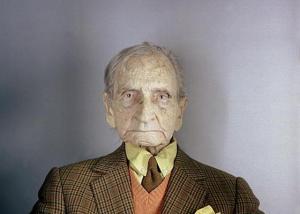
Albert Cossery’s Last Siesta in Paris

The cult author, famous for his indolence and libido, closes his eyes for the last time

Albert Cossery was a lazy old sod — a relic from the past who looked, of late, as if he felt he had outstayed his welcome. Always dressed to the nines, this dandy anarchist could be observed sitting in the legendary Café de Flore, casting an Olympian eye over the aimless crowds outside, biding his time. His militant idleness coupled with a strange mummified existence blurred the boundary between life and death for so long that his passing away, last month, could almost have gone unnoticed — had he not been a living legend.

The cult author moved to Paris from his native Cairo in 1945 and soon became a fixture of the Saint-Germain-des-Prés boho scene. His friends included some of the most influential writers and artists of the last century: Sartre, Genet, Vian, Queneau, Tzara, Giacometti and others. Lawrence Durrell championed his first book — a brilliant collection of short stories entitled Men God Forgot (1940) — and Henry Miller ensured it got published Stateside. He even picked up girls — lots of them — with Albert Camus. According to legend (that word again), Durrell informed the American secret services that Cossery could not possibly be a spy, as they suspected, because he spent most of his time shagging. By the early 90s, he was claiming more than 3,000 female conquests.

Sex aside, Cossery never believed in exerting himself. His very name evokes divine indolence: avoir la cosse is a colloquial expression meaning to be bone idle. True to his moniker, he spent his life resisting any work ethic that prevents people from enjoying “the Edenic simplicity of the world”. He often showed off his delicate hands, explaining, somewhat provocatively, that they had not toiled in 2,000 years. And when a journalist inevitably enquired why he wrote, he answered that he hoped his books would prompt readers to pack in their jobs.

For Cossery, idleness was more than a way of life. It afforded him the greatest luxury of all: the time to contemplate — to think or observe — and therefore the opportunity to be fully alive, “minute by minute”. This accounts for the constant connection he establishes between destitution and nobility, which is reflected, for instance, in the beautiful descriptions of glistening gobbets of spit, or light playing upon puddles of piss. The author claimed that he always felt like the son of a king, even when he was penniless — or rather, especially when he was penniless, just like the university professor in Proud Beggars (1955) who finally feels like a million dollars after electing to become a pauper. The lesson here is that those who reject (or are deprived of) material wealth gain access to a heightened state of consciousness. When Cossery died, the French Culture Minister described him as a “prince”, even though he owned little more than the clogs he had just popped.

All his works (for want of a more congenial word) focus on the members of this aristocratic underclass — the holy hooligans who wear their hashish-smoke halos raffishly askew and jump through the eyes of needles like so many biblical camels. Cossery was not just their poet laureate: he considered himself as a fully unpaid-up member of the idle poor and certainly put his lack of money where his mouth was. Long before downshifting became trendy among trustafarians, he checked into a small hotel room and lived off handouts and publishing rights. Not so much because property is theft but because it can rob you of your soul.

Cossery’s anti-work ethos and all-round laziness only partly account for his limited output (a mere eight books in sixty-five years). He was a typical Platonic author who saw his works as imperfect reflections of an unattainable ideal. As such, he despised hackwork, often only producing a single perfectly-honed sentence a week. No wonder his last novel — a slim volume called Les Couleurs de l’infamie (1999) — was fifteen years in the making.

This unattainable literary ideal is symbolised by his characters’ noble dreams. Cossery’s anti-heroes are for ever lost in sleep or reverie, as if they were hankering after some prelapsarian state of perfect vegetative bliss. In the aptly-titled The Lazy Ones (1948), a character remains bedridden, out of choice, for a whole year; another opts for celibacy in order to preserve his sacred sleep patterns. In an early short story, the inhabitants of an impoverished neighbourhood are prepared to kill off those who have the nerve to disturb their slumber before noon. Some characters are even afraid to move lest they should break the magic spell of their daydreams. The author himself revelled in the out-of-time experience afforded by sleep, which is hardly surprising given that what he called living “minute by minute” meant, in practice, living the same minute over and over again Groudhog Day-style.

Time stood still for Cossery as soon as he settled in Paris. In 1945, he checked in to a small room in a hotel called La Louisiane on Rue de Seine and remained there until his recent demise. Every day, he would get up at noon (like his characters), dress up in his habitual dandified fashion and make his way to the Brasserie Lipp for a spot of lunch. From there, he would usually repair to the Café de Flore or the Deux Magots before going home for his all-important siesta. Repeat ad infinitum. A similar case of arrested development can be found in the books, which are all, without exception, set in the Middle East, although Cossery, of course, spent most of his life in France. His French style even mimics the Arabic of his youth. One of the most haunting passages in Men God Forgot is the description of a crude fresco representing a motionless sailing boat on the Nile, frozen in time, refusing to move on.

Cossery described sleep as “death’s brother” and one can wonder if this refusal to turn his back on the glory days of Saint-Germain-des-Prés did not hide a desire for the big sleep: the eternal here and now. The author’s later years give a distinct impression of slow exhaustion. In 1998, he fell silent as a result of cancer and the following year he stopped writing, claiming that he no longer had anything to say.

For almost fifteen years (the time it took him to write his last book), I lived just up the road from Cossery. Whenever I got home in the small hours — usually a little worse for wear — my thoughts would turn to the “Voltaire of the Nile” sleeping in his diminutive mausoleum. It was a comforting thought, like a sailing boat that will never sail away.

The next time you walk down Rue de Seine, tread lightly: Albert Cossery sleeps on. Shh!

13994

Albert Cossery Loved Men God Forgot

This appeared in Guardian Books on 8 July 2008:

Albert Cossery Loved Men God Forgot

The Egyptian lived radically lazily on the Left Bank, challenging social norms with books devoid of materialism and ambition

Albert Cossery was a living legend — until he died a few weeks ago. The Egyptian author was one of the last links to the glory days when Paris was the capital of world culture, with Saint-Germain-des-Prés its swinging epicentre.

Having already sampled the louche pleasures of interbellum Montparnasse, Cossery left Cairo in 1945 and relocated to the Left Bank where he hung out on a nightly basis with Genet, Giacometti, Gréco, Queneau, Sartre, Tzara, Vian et al. His first book, Men God Forgot, was published in the States courtesy of Henry Miller, one of his biggest fans. Accompanied by Camus, he cruised the streets of the Latin Quarter, soon acquiring something of a reputation as a Levantine lover. Indeed, by the early 90s he was boasting that he had bedded more than 3,000 women which, if true, would put him right up there in Simenon’s priapic super league. When the American secret services suspected him of being a spy, Lawrence Durrell — another close friend — pointed out that he was far too busy shagging.

The secret services had good reason to be wary of this dapper anarchist, often dubbed the “Voltaire of the Nile”. His caustic satire burned like the desert sun, undermining all forms of authority. In La Violence et la Dérision (unfortunately not translated into English) freedom fighters use mockery and contempt, not violence, as political weapons against state tyranny.

All his life, Cossery sided with those he felt God had forgotten: petty thieves, pretty prostitutes, exploited workers and hungry vagrants. He despised materialism and eschewed the rat race. In Proud Beggars (1955), usually considered his masterpiece, a university professor finds peace of mind by becoming a bum, proving that beggars can be choosers. In The Lazy Ones (1948), a character stays in bed, out of choice, for a whole year. Another decides, on reflection, not to take a wife for fear she might disrupt his precious sleep patterns. In an early short story, the inhabitants of an impoverished neighbourhood even take up arms against all those who prevent them from snoozing in peace until midday.

For the author and his lovable rogue’s gallery, sleep, daydreams and hashish-induced reverie are endowed with mystical qualities. Idleness is more than a way of life. It offers the greatest luxury of all: time to think and therefore the chance to be fully alive, “minute by minute”. The overt message of these people whom God has forgotten (but who themselves have not forgotten God) is that paradise is not lost, but most of us are too busy to bask in “the Edenic simplicity of the world”.

There is, however, a darker covert message. In practice, living “minute by minute” meant living the same minute over and over again. Time seems to have stood still for Cossery as soon as he settled in Paris. In 1945, he checked into a small room in a hotel called La Louisiane on Rue de Seine and remained there until his death. Every day, he got up at noon (like his characters), dressed up in his habitual dandified fashion and made his way to the Brasserie Lipp for a spot of lunch. From there, he usually repaired to the Flore or the Deux Magots where he would cast an Olympian eye over the drones passing by. Then it was time for his all-important siesta. Repeat ad infinitum. Cossery, who once described sleep as “death’s brother”, lived a strange, mummified existence, reminiscent of Beckett’s “sleep till death/ healeth/ come ease/ this life disease”.

Spam Lit: The Silver Lining of Junk Mail?

“misfires”

This appeared in Guardian Books on 1 July 2008:

Spam Lit: The Silver Lining of Junk Mail?

Spammers embed chunks of literary classics to dodge email filters. Weird/wonderful nuggets are found in inboxes. ‘Spoetry’ is born

Ever since the dawn of the world wide web, to give it its old-fashioned moniker, our communications have been beset by spam. We ignore it almost as much as we receive it, but around the turn of the century Mammon’s pursuit of our attention led to an extraordinary coupling with the Muse.

Here’s what happened. In order to bypass increasingly efficient filters, spammers began embedding blocks of text — often pilfered from great literary works via Project Gutenberg — in their junk mail. Techniques like the Dissociated Press algorithm were employed to randomly generate new, essentially meaningless texts or text collages (“word salads”) so that each message would seem unique. Lee Ranaldo has compared the outcome to a “dictionary exploded”. Another early aficionado, Ben Myers, observed that “it was as if the text had somehow been remixed and shat out down the wires of modernity”. “Spam Lit”, as Jesse Glass dubbed it in 2002, uncannily mirrored bona fide literary experiments that were taking place simultaneously: Jeff Noon‘s exploration — through textual sampling and remixing — of “metamorphiction” in Cobralingus; Jeff Harrison‘s aleatoric poems based on Markov chains; or even Kenji Siratori‘s baffling cyber-gibberish.

Equally intriguing was the trend Wired magazine identified in 2006 as “empty spam”: Spam Lit messages that were, paradoxically, all lit and no spam. The consensus among geeks is that they were probably “misfires” due to faulty server connections. To their recipients, however, these instances of found poetry — often containing nuggets of unwitting but unalloyed beauty — seemed, in Myers’ words, like “scriptures from the future” or “postcards from another planet”. Discovering them in your inbox made you feel like Cocteau‘s Orpheus picking up cryptic poetic messages from the underworld on his car radio.

No wonder, then, that Spam Lit should have inspired the only new literary genre of the early 21st century (if we exclude crimping). The earliest examples of spoetry on record date back to 1999. A pioneering annual competition was even established by Satire Wire the following year. By 2003, when the BBC picked up on the phenomenon, it was already quite clear that writers were approaching spoetry in very different ways – an observation confirmed by Morton Hurley‘s Anthology of Spam Poetry (2007). Some, like Kristin Thomas only used the subject lines of spam messages; others were content to cut, paste and add their names à la Duchamp. Myers, who has just published a collection entitled Spam (Email Inspired Poetry) believes, for his part, that the secret lies in the editing: “A spam poet is as much an editor as a bard“. Sonic Youth co-founder Lee Ranaldo, who has also just released an anthology (Hello From the American Desert), uses spam emails as a source of inspiration for his own work rather than as a raw material. Mark Amerika, meanwhile, describes the composition of his 29 Inches as a “spam collage” and a “narrative remix”.

Although published last year, Amerika’s work was written in 2004, which also happens to be the year when Myers and Ranaldo penned their first spoems. None of them were aware that others were doing similar things at the same time. There must have been something in the air. If my inbox is anything to go by, however, Spam Lit is now on the wane, so the time may have come to assess the merits of spoetry, its literary by-product. Beyond the genre’s obvious affinities with automatic writing, cut-ups, constrained writing (of the Oulipian variety) and found poetry, is it any cop?

Thirty Two Feet Per Second

My love has just left the flat, never to return. I can still smell the scent of her perfume in the room. I can hear her receding footsteps in the corridor.

When I was a kid, there were two different ways to go home, both equidistant. Every day, me and my sister would split up outside the school gates and see who would get there first.

As I open the window I think of the future that could have been, of the children we will never have. Every day they will split up outside the school gates and see who gets home first. We will hear their footsteps coming up the garden path.

Standing on the windowsill, I watch her winding down the six flights of stairs, carrying her blue suitcase. There are two ways to go home, both equidistant, but mine’s the quickest.

Last one’s a sissy.