Componimento Inculto

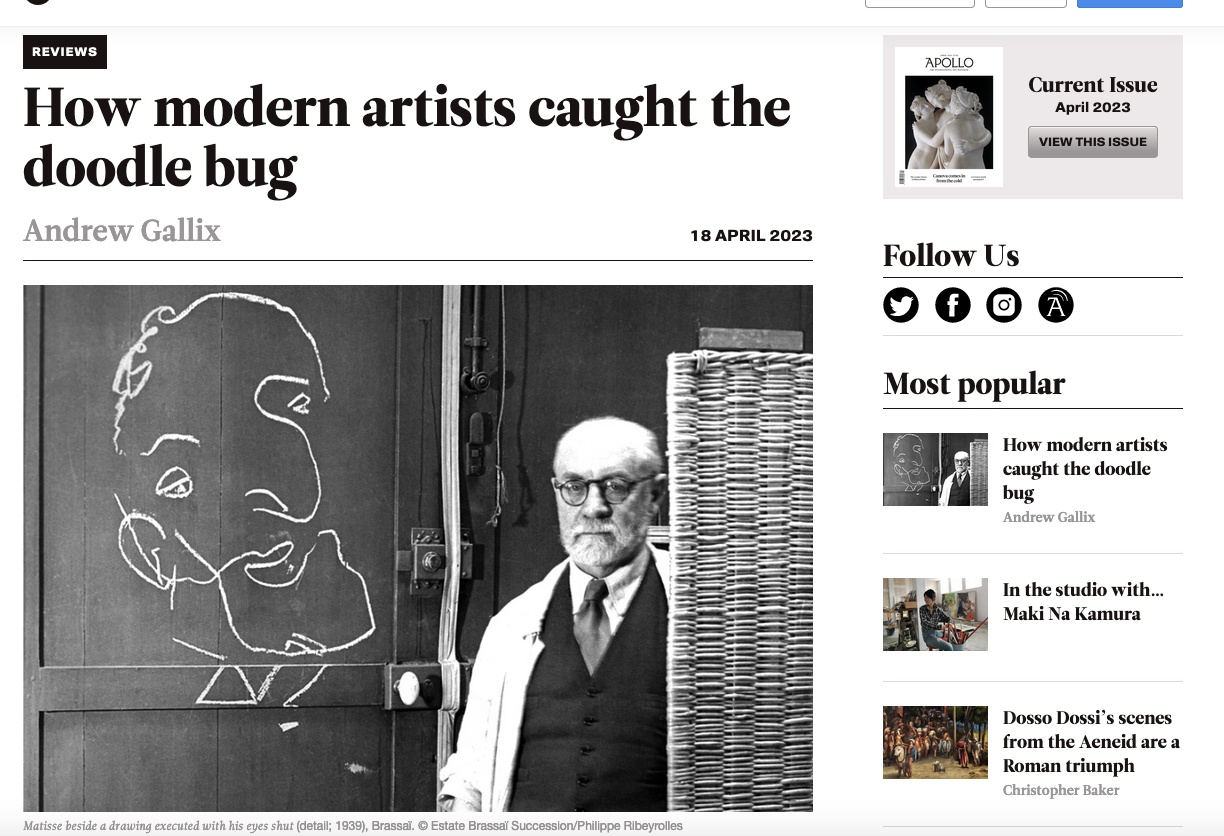
“How Modern Artists Caught the Doodle Bug.” Apollo, 18 April 2023.

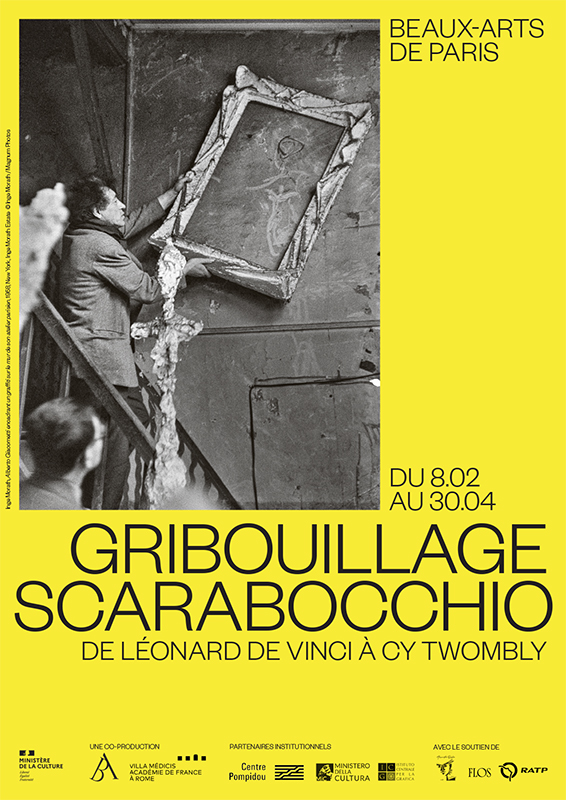
Imagine Dubuffet or Basquiat scrawling on the back of a Michelangelo and you get a good idea of the first impressions of a visitor to ‘Gribouillage/Scarabocchio: From Leonardo da Vinci to Cy Twombly’, currently at the Beaux-Arts de Paris. Curated by Francesca Alberti and Diane H. Bodart, the show explores the striking, perhaps even disquieting resemblance between doodles discovered on works by the Renaissance masters and those of modern artists.

This sumptuously presented exhibition maintains an achronological arrangement throughout. The antique cast of a profile carved into a segment of wall from Alberto Giacometti’s Paris studio hangs cheek by jowl, at the entrance, with the drawing of another profile, discovered — along with a profusion of small but intricate sketches — behind a fresco by Benozzo Gozzoli (1471–72). On a nearby partition, works by Cy Twombly (1967) are flanked by Claude Lorrain drafts (1630) and a Delacroix lithograph (1827), its thick borders alive with the artist’s marginalia.

The question that hangs over the entire exhibition is whether the doodles of the past should be interpreted in the light of artistic modernity. In the Renaissance, prevailing wisdom dictated that the hand was the instrument of reason. By contrast, Leonardo da Vinci himself described his sketching technique as componimento inculto — literally, uncultivated compositions. Leonardo advocated letting go; allowing the hand to drift on the page — guided by happenstance or what we would now call the unconscious — until latent figures surface. The finest example of this vagabond style is Stefano della Bella’s 1648 study of a young man falling to his death, seemingly submerged by the swirling scribbles from which he emerges.

The exhibition abounds in variations on Leonardo’s template: André Masson’s surrealist automatic drawings, Robert Breer’s minimalist cartoon, A Man and His Dog Out for Air (1957), or Henri Michaux’s suitably hypnotic pieces produced under the influence of mescaline. Physical constraints are frequently adopted in pursuit of spontaneity: Salvador Dalí drawing while pleasuring himself; Willem de Kooning electing to draw with his left hand or with several pencils at the same time. A film of 1995 shows Robert Morris performing one of his numerous Blind Time compositions. The film finds an echo in Brassaï’s photograph of Henri Matisse from 1939, standing bold upright beside the face he has just scrawled on a door with closed eyes and a piece of chalk, while also calling to mind the spiritualism that inspired Victor Hugo’s ink sketches.

For Paul Klee, who naturally looms large here, the activities of drawing and writing were identical. Many of the works on display — those of Klee, Giacometti, Masson, Twombly, and Steinberg in particular — conjure up Roland Barthes’ famous essays on the artistic tradition of ‘illegible’ writing, which, he felt, held out the utopian promise of a world free from the tyranny of preordained meaning.

But the exhibition also revels in the subversive charge of doodling. The section where Renaissance sketches are presented vertically on counters — allowing you to see the official production on one side and the unofficial on the other — provides the illicit thrill of a peep show. Images are sometimes of a scatological or sexual nature. There are caricatures of cuckolds with outsize horns from the 17th century and photographs of criminals’ tattoos taken by the French police around the Second World War. A diminutive sketch by Michelangelo represents a young man defecating. James Ensor draws a man urinating against a graffitied wall on which someone has scrawled ‘Ensor is mad’! The artistic production of the mentally ill is explored, as well as that of bored office clerks and children. ‘It took me four years to paint like Raphael, but a lifetime to paint like a child,’ said Picasso. Visiting this exhibition, one gets the impression that he was by no means the only one.

Like its subject matter, ‘Gribouillage’ is an irreverent, provocative and playful show, but it also reaffirms the power that doodles hold over us in the modern era. As George Steiner once remarked, ‘modernity often prefers the sketch to the finished painting’ — both because it gets us closer to the original inspiration of the artist and because it remains unfinished, in the process of becoming.
Here is a different, longer, unpublished version of the above review:

To misquote Borges, all artists create their own precursors. ‘Gribouillage de Léonard de Vinci à Cy Twombly’, currently at the Beaux-Arts de Paris, seems predicated on such a principle. The premise of this sumptuous exhibition, curated by Francesca Alberti and Diane H. Bodart, is the striking — at times even disquieting — resemblance between doodles discovered on works by the Renaissance masters and those of prominent modern artists. Imagine Dubuffet or Basquiat scrawling on the back of a Michelangelo and you get a good idea of the visitor’s initial impression, sustained by a studiously achronological arrangement, with ancient and modern juxtaposed throughout. The antique cast of a profile carved into a segment of wall from Alberto Giacometti’s Paris studio hangs cheek by jowl, at the entrance, with the drawing of another profile, discovered — along with a profusion of small but intricate sketches — behind a fresco by Benozzo Gozzoli (1471-1472). On a nearby partition, works by Cy Twombly (1967) are flanked by Claude Lorrain drafts (1630) and a Delacroix lithograph (1827), its thick borders alive with the artist’s marginalia. Thus reframed, should the doodles of yesteryear be reinterpreted à rebours, in the light of artistic modernity? This question, that hangs over the entire exhibition, is illustrated by Inge Morath’s black-and-white photograph of Giacometti holding up an empty frame to showcase a white figure daubed on his studio wall.

The existence of a rival tradition — whose origins may stretch back to the cave paintings painstakingly reproduced by Henri Breuil or the Pompeian graffiti photographed by Brassaï, both on display here — is embodied by Leonardo da Vinci himself. The sketching technique he described as componimento inculto — literally, uncultivated compositions — ran counter to the then prevailing notion that the artist’s hand should be the instrument of reason. Contrarily, Leonardo advocated letting go; allowing the hand to drift on the page — guided by happenstance or what we would now call the unconscious — until latent figures surface from the tohubohu. The finest example of this vagabond style is Steffano della Bella’s 1648 study of a young man falling to his death, seemingly submerged by the swirling scribbles he emerges from. Robert Breer’s minimalist cartoon, A Man and His Dog Out for Air (1957), comes a close second.

The exhibition abounds in variations on Leonardo’s template: André Masson’s surrealist automatic drawings, or Henri Michaux’s suitably hypnotic pieces produced under the influence of mescaline. Physical constraints are frequently adopted in pursuit of spontaneity: Salvador Dalí drawing while pleasuring himself; Willem de Kooning electing to draw with his left hand or with several pencils at the same time. A 1995 film shows Robert Morris, eyes wide shut, performing, as it were, one of his numerous Blind Time compositions. The latter echoes Brassaï’s 1939 photograph of Henri Matisse standing bold upright beside the face he has just scrawled on a door with closed eyes and a piece of chalk. (We are not far off from the spiritualism that inspired Victor Hugo’s ink sketches.) Svetlana and Igor Kopystiansky’s short film, Steps Sole Sound (1979), put me in mind of Robert Walser — the infamous picture of footsteps in the snow leading up to the dead writer’s prone body — or the Ann Quin character who abandons conventional art in favour of making ‘paintings with her footprints in the snow’.

Doodling, especially in the shape of scribbles and squiggles, lies at the intersection of art and writing. It is the liminal space where the one becomes the other. For Paul Klee, who naturally looms large here, both activities were identical. For most preliterate children too, presumably. Many of the works on display — those of Klee, Giacometti, Masson, Twombly, and Steinberg in particular — conjure up Roland Barthes’ famous essays on the artistic tradition of ‘illegible’ writing, which, he felt, held out the utopian promise of a world free from the tyranny of preordained meaning. The best way to sever the connection between hand and intellect is indeed by deactivating the communicative powers of language itself.

If doodling has gradually come out of the closet and taken centre stage, this sprawling exhibition manages to retain part of its subversive charge. The section where Renaissance sketches are presented vertically on counters — allowing you to see the official production on one side and the unofficial on the other — provides the illicit thrill of a peep show. Images are sometimes of a scatological or sexual nature. There are dick pics from the 16th century, caricatures of cuckolds with outsize horns from the 17th, and photographs of criminals’ tattoos taken by the French police around the Second World War. A diminutive sketch by Michelangelo represents a young man defecating. James Ensor draws a man urinating against a graffitied wall on which someone has scrawled ‘Ensor is mad’! The artistic production of the mentally ill is explored, as well as that of children or bored office clerks à la Bartleby.

Like its subject matter, ‘Gribouillage’ is an irreverent, provocative and ludic show, but it is also an important one. As soon as Western art ceased to be mere imitation of the great works of the past — as soon as it became modern — a glaring gap opened up between inspiration and execution. This is why, as George Steiner remarks, ‘modernity often prefers the sketch to the finished painting’. Not only does it seem closer to the source of origin, but its unfinished nature means that it remains in the process of becoming. Doodling preserves art’s potentiality by gesturing to a future finished work as yet untainted by instantiation.
France’s Pre-Banksy Art Provocateurs

This appeared in the Guardian (Art & Architecture blog) on 14 May 2008:

France’s Pre-Banksy Art Provocateurs

At the time of punk, a ‘commando’ unit of French creative guerrillas spearheaded a movement that was the forerunner of today’s spray-stencil street culture

Bazooka
Dominique Fury flanked by two of the Banshees wearing her T-shirts

Imagine Jamie Reid stealing the Sex Pistols’ thunder or Linder Sterling upstaging the Buzzcocks: this is pretty much what happened in France at the end of the 70s. The Jeunes Gens Mödernes (“Mödern Young Things”) exhibition, curated by Jean-François Sanz at the Galerie du Jour in Paris, showcases most aspects of local post-punk culture from badges to paintings through record sleeves, fanzines, photographs, videos and films. A totemic synthesizer, an old-school keyboard and a couple of guitars propped up against diminutive amps take pride of place at the centre of the main room. Cigarette butts have been studiously littered around the pretend stage for added authenticity. This installation of sorts embodies the ghost of gigs past, but it also draws attention to the deafening sound of silence. Visiting agnès b’s labyrinthine gallery is not dissimilar to attending a concert wearing earplugs or watching television on mute — and, frankly, it is all the better for it.

With a few notable exceptions, Gallic punk was derivative and devoid of any real social resonance. Singing about anarchy in front of a handful of socialites on loan from the neighbouring gay clubs was unlikely to threaten the status quo. This is probably why the extraordinary creative energies unleashed in New York and London were channelled, most effectively, into the edgiest fringes of the French art world.

Bazooka, who appeared in 1975, were arguably the greatest punk artists this side of Jamie Reid (Malcolm McLaren once described them as “influential”). They are mainly known in Britain for designing the cover of Elvis Costello’s Armed Forces, but they first shot to infamy during the summer of 1977 when they were invited to (dis)grace the pages of Libération. This led to a series of nocturnal art attacks which consisted in adding increasingly provocative artwork and comments on every inch of space available. Sometimes they even went as far as doctoring the content of articles or changing the layout. They always did this at the 11th hour — just before the paper went to press — so that nobody could foil their subversive plans. “All hail the graphic dictatorship,” trumpeted one of Bazooka‘s most famous slogans, reflecting their fascination with Suprematism (Lissitzky), Constructivism (Rodchenko) and totalitarian propaganda. The aim was to wind up the leftist “war veterans” of May 1968 and their hippie fellow-travellers who made up the bulk of Libé‘s staff and readership. In this they succeeded only too well. Lawsuits were filed and tempers flared. Olivia Clavel was soundly slapped by a female photographer whose work she had butchered; Kiki Picasso (Christian Chapiron) and Loulou Picasso (Jean-Louis Dupré) were both beaten up for their provocative flirtations with fascist iconography. Tensions ran so high that the editor eventually gave Bazooka their own monthly magazine (1978) to avoid a full-blown rebellion within his daily.

At the time, the members of this “graphic commando” were all living together in a large flat which was part Warholian Factory, part Bauhaus-style powerhouse. Fuelled by drugs, they worked day and night while musicians drifted in and out. There is a famous picture showing Dominique Fury flanked by a pair of Banshees sporting T-shirts she had just produced (pictured above). Speed and (especially) acid led to a Stakhanovist output ranging from countless record sleeves to the credits of TV programmes via an issue of NME. The switch to heroin soon slowed them down and heralded the group’s demise in 1980.

In many ways Bazooka provided a blueprint for the post-punk art collectives which followed in their wake. They celebrated everything modern in a knowing retro-futurist manner that was, in fact, typically postmodern; they rejected the traditional highbrow-lowbrow dichotomy, shunned museums and attacked the cultural establishment.

The Musulmans Fumants (a reference to Chester Himes), co-founded in 1980 by Tristam Dequatremare (former lead singer with punk combo Guilty Razors), preferred to exhibit their works in nightclubs rather than traditional galleries. They were instrumental in reviving figurative painting and launching the international careers of Robert Combas and Hervé Di Rosa who spearheaded the successful Figuration Libre movement (1981).

The Frères Ripoulin (1984) were the Musulmans Fumants’ partners in artistic crimes. They included Nina Childress, who graduated from art-punk band Lucrate Milk, as well as Claude Closky and Pierre Huyghe who went on to find fame and fortune.

Jean Faucheur, their theoretician, believed that the streets were the new art schools at a time when graffiti art had hardly reared its head. The Ripoulins were “affichistes”: they painted their works on posters which were then pasted on strategically-placed advertising hoardings. All these groups were linked to Basquiat, Haring and the whole Lower East Side scene across the Atlantic, but they are also very much the forefathers of the current Street Art movement.

Jeunes Gens Modernes in Paris

This was published by Dazed Digital (Dazed & Confused‘s website) on 24 April 2008:

Jeunes Gens Modernes in Paris

The opening of the Jeunes Gens Mödernes exhibition offered a whole generation a sense of closure. Quite literally, in the case of the hundreds of people who, unable to get in, transformed Rue Quincampoix into an impromptu al fresco carnival — a gathering of the tribes. Once-dodgy skinheads rubbed shoulders with effete dandies under the eyes of mohicaned whippersnappers who could have been (and indeed often were) their offspring.

At times, it felt a bit like having a chinwag with a grizzled Dorian Gray in front of his youthful likeness. Most of the faces on the Parisian post-punk scene were out in force, simultaneously plastered on the walls of the labyrinthine gallery and getting plastered in the cobbled courtyard. Weather-beaten but unbowed. Still high from 1001 nights at Le Palace or Le Rose Bonbon. Happy to have lived to tell the tale.

The “Jeunes Gens Mödernes” (“Mödern Young Things”) tag first cropped up in an issue of Actuel back in 1980. It referred specifically to a small coterie of hipsters revolving around rarefied bands like Artefact, Modern Guy or Suicide Romeo and nightclubs with the strictest of door policies. Here, curator Jean-François Sanz has given the expression a more comprehensive definition to include most aspects of Gallic post-punk culture between 1978 and 1983.

Like Spain’s La Movida or New York’s No Wave (largely inspired by Frenchman Michel Esteban), this was indeed far more than just a musical movement. It was a fully-fledged cultural revolution bent — sometimes outrageously so — on redefining fin-de-siècle modernity.

“Modern” (or “novö” to use Yves Adrien’s coinage with its trademark umlaut) was a ubiquitous buzzword in the wake of punk’s year zero. With hindsight, however, it is quite obvious that this phenomenon bears all the hallmarks of postmodernism — from its recycling of the major 20th century avant-gardes to its space-age retro-futurism.

Philippe Morillon, one of the emblematic artists of that era, explains that “it is at the very point when things disappear that we cling on to them”. He belongs to a generation which jettisoned the traditional highbrow/lowbrow dichotomy and shunned museums altogether. Newspapers, T-shirts or record sleeves were the Bazooka collective’s media of choice; the Musulmans Fumants showcased their works in nightclubs while the Frères Ripoulin turned to billboards. As for Morillon, he worked for advertising agencies.

The exhibition’s achronological bric-à-brac organisation is in keeping with the eclectic, iconoclastic spirit of the Jeunes Gens Mödernes themselves. Paintings, badges, films, fanzines, photographs, installations and videos all take pride of place in deliberately haphazard-fashion: this, after all, was the first truly multimedia movement.

If Jean-François Sanz eschews value judgements, his is not a hands-off approach — much to the chagrin of those who feel excluded. Former Guilty Razors frontman Tristam Dequatremare is perplexed at the absence of the Musulmans Fumants — the group he co-founded — despite being instrumental in reviving figurative painting and launching the international careers of Robert Combas and Hervé Di Rosa. Dominique Fury, who lobbied for their inclusion, believes the curator assembled works which all express a certain “existential frailty” she associates with the essence of adolescence. This is why he opted for the tortured genius of Bazooka, say, over the joie de vivre of the Musulmans Fumants for whom the 80s were one big party.

Fury herself is omnipresent, both as a muse and an artist in her own right. She is an Ariadne’s thread weaving her magic between past and present — the glamorous embodiment of this scene’s enduring legacy. No wonder some 3,000 punters attended the opening which offered a whole generation — and us — a sense of closure.

Des Jeunes Gens Mödernes runs until 17 May at the Galerie du Jour agnès b, 44 Rue Quincampoix, 75004 Paris

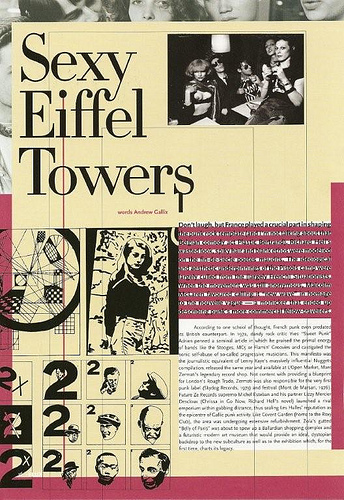
Sexy Eiffel Towers

This appeared in the April-May 2008 issue of Flux magazine (issue 64, PP. 36-37)

Sexy Eiffel Towers

Don’t laugh, but France played a crucial part in shaping the punk rock template (and I’m not talking about that Belgian comedy act Plastic Bertrand). Richard Hell’s wasted look, spiky hair and blank ethos were modelled on the fin-de-siècle poètes maudits. The ideological and aesthetic underpinnings of the Pistols camp were largely culled from the (largely French) Situationists. When the movement was still anonymous, Malcolm McLaren favoured calling it “new wave” in homage to the nouvelle vague — a monicker that ended up describing punk’s more commercial fellow-travellers.

According to one school of thought, French punk even predated its British counterpart. In 1972, dandy rock critic Yves “Sweet Punk” Adrien penned a seminal article in which he praised the primal energy of bands like the Stooges, MC5 or Flamin’ Groovies and castigated the sonic self-abuse of so-called progressive musicians. This manifesto was the journalistic equivalent of Lenny Kaye’s massively influential Nuggets compilation, released the same year and available at L’Open Market, Marc Zermati’s legendary record shop. Not content with providing a blueprint for London’s Rough Trade, Zermati was also responsible for the very first punk label (Skydog Records, 1973) and festival (Mont de Marsan, 1976). Future Ze Records supremo Michel Esteban and his partner Lizzy Mercier Descloux (Chrissa in Go Now, Richard Hell’s novel) launched a rival emporium within gobbing distance, thus sealing Les Halles’ reputation as the epicentre of Gallic punk activity. Like Covent Garden (home to the Roxy Club), the area was undergoing extensive refurbishment. Zola’s gutted “Belly of Paris” was about to spew up a Ballardian shopping complex and a futuristic modern art museum that would provide an ideal, dystopian backdrop to the new subculture as well as to the exhibition which, for the first time, charts its legacy.

Des Jeunes Gens Mödernes (“Modern Young Things”), hosted by fashion designer agnès b.’s Galerie du Jour, covers the post-punk period between 1978 and 1983. The title alludes to a label coined by trendy magazine Actuel in 1980 to describe a short-lived local scene — revolving around nightclub Le Rose Bonbon and bands such as Suicide Romeo or Modern Guy — that was unashamedly incestuous and elitist. Curator Jean-François Sanz is eager to explain that the reference is simply an “excuse” to gauge the far wider cultural fallout from the 1977 explosion. Like New York’s No Wave, this was indeed a fully-fledged cultural revolution involving artists, writers, filmmakers and fashionistas as well as musicians.

Dominique Fury — once described as the Parisian Edie Sedgwick — embodied the restless creative spirit of the times. After leaving all-girl combo L. U. V., she joined the Bazooka collective (arguably the most influential punk artists this side of Jamie Reid) having been attracted by the “sheer intensity of their graphic production”. By 1980, she was producing her famous line of signed, one-off “geometric cold wave” T-shirts-cum-artworks for agnès b. and experimenting with industrial fabrics. Tristam Dequatremare, the former lead singer with Guilty Razors who likewise graduated to the art fraternity, sees this exhibition as a means of putting the record straight. “The revival of figurative painting started here in France,” he says, lamenting the fact that the likes of the Musulmans Fumants (the group to which he belonged) or the Frères Ripoulin (which included several members of art-punk outfit Lucrate Milk) have been airbrushed out of international contemporary art history.

The exhibition itself is complemented by a book, a double CD compilation as well as a documentary which reflect the movement’s inherently multimedia nature and exuberant originality. The album contains the cream of the local post-punk crop (Marquis de Sade, Taxi Girl, Elli & Jacno, Etienne Daho, Lizzy Mercier Descloux, Marie et les Garçons…) but also a few covers by contemporary bands who take their inspiration from this period. This is a nice touch as one is left with a distinct sense of unfulfilled promise. The early cultural maelstrom gradually gave way to a more somber mood as the Socialist government’s policies failed and AIDS started taking its toll. As Fury puts it, “Death was disco-dancing beneath the plush red velvet of Le Palace nightclub”.

Des Jeunes Gens Mödernes runs from 3 April until 17 May at the Galerie du Jour agnès b. (44 Rue Quincampoix, 75004 Paris).