
An extract from my review of Claire-Louise Bennett‘s Pond appears on the front cover of the Picador Australia edition, published on 22 December 2016.
“What Bennett aims at is nothing short of a re-enchantment of the world …a truly stunning debut.”

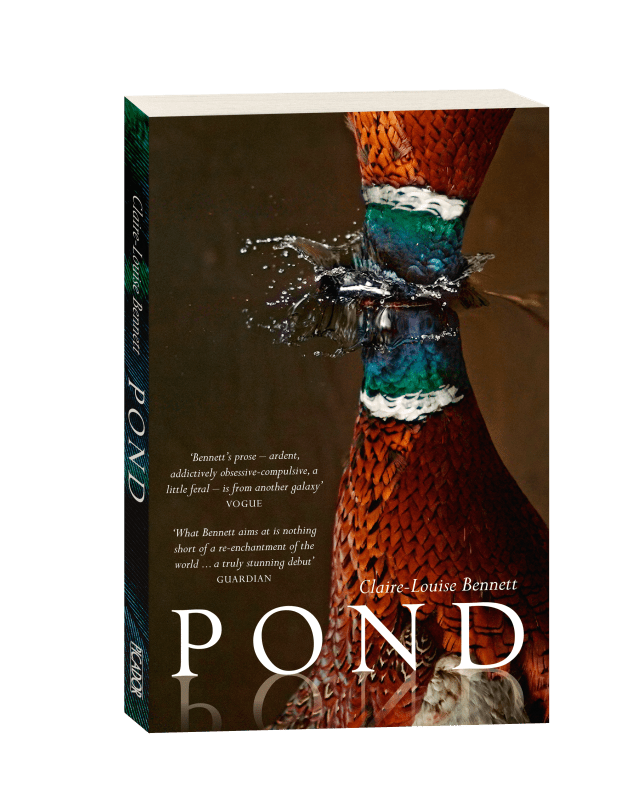
An extract from my review of Claire-Louise Bennett‘s Pond appears on the front cover of the Picador Australia edition, published on 22 December 2016.
“What Bennett aims at is nothing short of a re-enchantment of the world …a truly stunning debut.”
An extract from my review of Claire-Louise Bennett‘s Pond was quoted in Guardian Australia‘s “December literary picks” published on 10 December 2016:
Pond by Claire-Louise Bennett (Picador)
Guardian reviewer Andrew Gallix wrote of this collection of 20 stories:
“Reading them is an immersive experience. We come to share the “savage swarming magic” the narrator feels under her skin by focusing at length on her “mind in motion” … One of the most striking aspects of this extraordinary book is how well we get to know the narrator — whose brain and body we inhabit — yet how little we know about her. We don’t even learn her name …
What Bennett aims at is nothing short of a re-enchantment of the world. Everyday objects take on a luminous, almost numinous, quality through the examination of what Emerson called “the low, the common, the near” or the exploration of Georges Perec’s “infra-ordinary” — a quest for the quotidian.”
“Through tree-lined streets, past the terraced houses, I float, catching glimpses of those other, happier, families through the illuminated squares of their little brick boxes.”
– Viv Albertine, Clothes Clothes Clothes Music Music Music Boys Boys Boys (2014)
“Next to my primary and junior schools, in the small town where I grew up (Cheltenham, Gloucestershire) was a large recreation park. During term time we played there at lunchtimes; in the summer holidays, we spent whole afternoons playing football. At one corner of the rec was something we called the Hump: a hump of complicated dirt with trees growing on it — all that was left, presumably, of the land that had been cleared and flattened to form the rec; either that or — unlikely given the size of the trees — a place where some of the detritus from this process had been heaped up. The Hump was the focal point of all games except football and cricket. It was the first place in my personal landscape that had special significance. It was the place we made for during all sorts of games: the fortress to be stormed, the beachhead to be established (all games, back then, were war games). It was more than what it was, more than what it was called. If we had decided to take peyote or set fire to one of our schoolmates, this is where we would have done it.”
– Geoff Dyer, White Sands: Experiences from the Outside World (2016)
This appeared in Literary Review November 2016: 30-31.

The Making of Meursault
In July 1944 Albert Camus produced a counterfeit manuscript of his debut novel, The Outsider, published two years earlier. Josette Clotis, André Malraux’s partner, read the text aloud while Camus took it down in longhand, introducing the odd crossed-out variant to lend it the air of an early draft. In Looking for ‘The Outsider’, Alice Kaplan outlines this ingenious scam, born of wartime austerity, but does not say whether it proved successful or not. All the same, it speaks volumes about the book it sought to cash in on. The Outsider had already outgrown its title, acquiring the aura of a canonical work. Camus was now in a position to turn Bouvard and Pécuchet’s lowly profession — that of the copy clerk — into gold. All he had to do was replicate his near-indecipherable microscript, originally developed in response to an acute paper shortage.
Looking for ‘The Outsider’ is the biography of a book rather than of its author. Kaplan chronicles the story of The Outsider from the germ of an idea in Camus’s notebooks to the novel’s re-evaluation in the light of gender and postcolonial studies, taking in, chemin faisant, its wider impact on popular culture. She even identifies the individual who inspired the anonymous Arab. Her research really comes into its own when she pieces together the strange circumstances in which the novel saw the light of day. Retracing the various manuscripts’ convoluted journey between Algiers and occupied Paris — charted on four different maps — is likened to ‘chasing several Minotaurs in a maze’. Even Raymond Queneau, at publishers Gallimard, was baffled, ending up with two different versions before going to press.
In 1937, with two collections of essays under his belt, Camus set about writing fiction. The provisional title of his work-in-progress, ‘A Happy Death’, clearly anticipated The Outsider (published as The Stranger in the United States), as did the protagonist’s name, Patrice Mersault. However, if Kaplan’s precis of this first attempt — ‘the story of a tubercular young man who commits murder for freedom’ — is anything to go by, it sounds more like an autobiographical take on André Gide’s Lafcadio’s Adventures than a new departure. When he peered into his manuscript, Camus increasingly caught glimpses of a ‘completely different book’ within it. By the autumn of the following year, a ‘second novel’, which he went on to describe as ‘already completely traced within me’, stared back at him. Kaplan explains that the ‘ambitious writer who wanted to control every aspect of his craft found himself confronted with the unexpected’. Just as Meursault would realise, in extremis, that he had been ‘a stranger to his life’, Camus had to draw the conclusion that he was a stranger to his work. Having abandoned ‘A Happy Death’, he was ready to yield to something he did not fully comprehend: ‘Sometimes I need to write things that escape me in part, but which are proof of precisely what within me is stronger than I am.’
Eschewing belletristic ‘chit-chat’, he developed his trademark laconic style that gestures discreetly towards that which eludes language. ‘To write,’ he realised, ‘one must fall slightly short of the expression’, for the ‘true work of art … is the one that says the least’. Sartre greatly admired the way Camus deployed words ‘almost miraculously to produce a sensation of silence’, unaware that he had been brought up by a deaf mother and uncle. Estrangement was not only rooted in experience, however; it was also a literary device. Under the influence of James M Cain’s The Postman Always Rings Twice (translated into French in 1936), Camus switched his narrative from the third to the first person, a style that, as Kaplan remarks, ‘usually lets the reader inside the narrator’s head — but he did it so that there was no getting inside, no way to feel close to Meursault’. The novelist described this technical breakthrough, somewhat self-deprecatingly, as a mere ‘trick’: ‘once I discovered the trick, all I had to do was write.’
If Camus discovered The Outsider ‘within himself’, he breathed life into the novel as a genre. His protagonist’s ‘lack of connection to people’, writes Kaplan, is offset by his ‘sensual connection to the world’. ‘He exists,’ Camus declared, ‘like a stone or the wind or the sea, under the sun.’ So far, so nouveau roman. Yet when Kaplan quotes the climactic passage in which Meursault opens himself to the ‘gentle indifference of the world’, finding it ‘so much like myself — so like a brother’, she fails to point out how much the world is anthropomorphised and recast in his image, and how even its indifference becomes benevolent. Is this really what Camus meant by living ‘without appeal’; cut adrift from religion or ideology? And, while we are on the subject, is a godless universe ipso facto absurd? As Alain Robbe-Grillet objected, the world is neither meaningful nor meaningless: ‘It is, that’s all’. A major flaw throughout this study is Kaplan’s promptness to take Camus’s ideas as read although, in all fairness, analysis does not fall within her remit.
Meursault fails to feel the gravitational pull of Paris, which, as Kaplan shrewdly observes, is a measure of his strangeness in a highly centralised country like France. Camus, however, had far more in common with Rastignac, Balzac’s arch-arriviste, than with Meursault. Despite going on to become the editor of an underground newspaper during the war, he ‘never questioned the idea of publishing his novel in occupied Paris’ and had no qualms about excising an essay on Kafka from The Myth of Sisyphus lest it attract the attention of the Germans. Within months of the appearance of The Outsider in bookshops, he was already ‘at the heart of things’, dining out with Sartre and de Beauvoir at the Café de Flore, an outsider no more.
At the outset, Alice Kaplan describes reading The Outsider as a ‘rite of passage’ that people throughout the world connect to ‘their coming of age’. Perhaps it is in the nature of such works to be outgrown, as The Outsider was, almost immediately, by Camus himself. Contrarily, our compulsion to reinterpret the book — in the light of the French Resistance, Algerian independence, the banlieues or the Arab Spring — may testify to its irreducible otherness and our inability to simply let it be, like a stone or the wind or the sea.
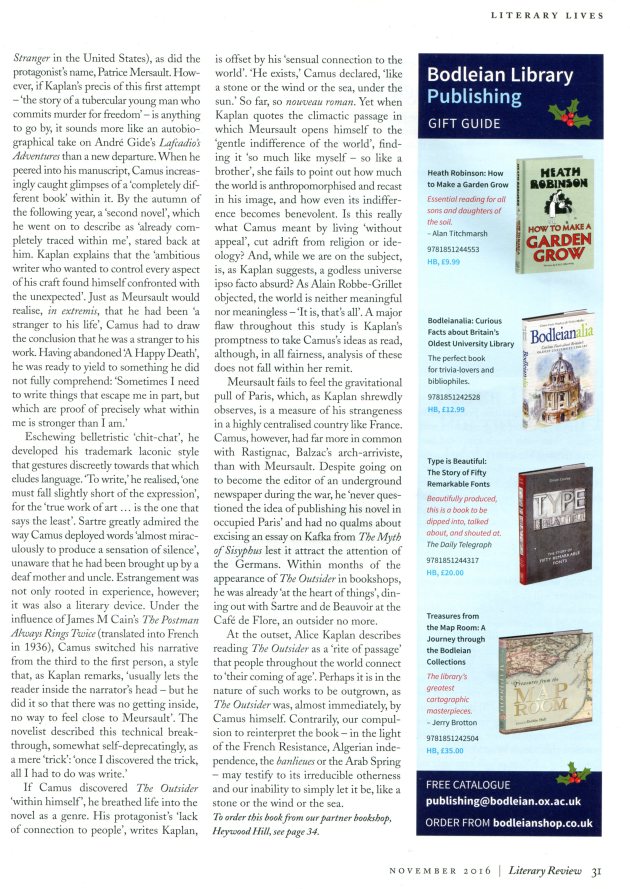

This appeared in The Irish Times (Weekend Review) 8 October 2016: 10.
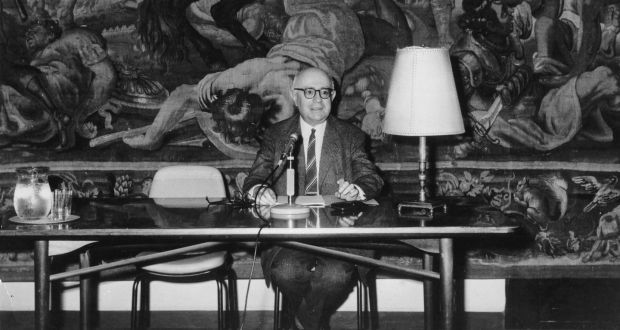
Frankfurt School lecture: Theodor Adorno in Rome. Photograph: Ullstein Bild via Getty
A Towering Work of Staggering Scholarship
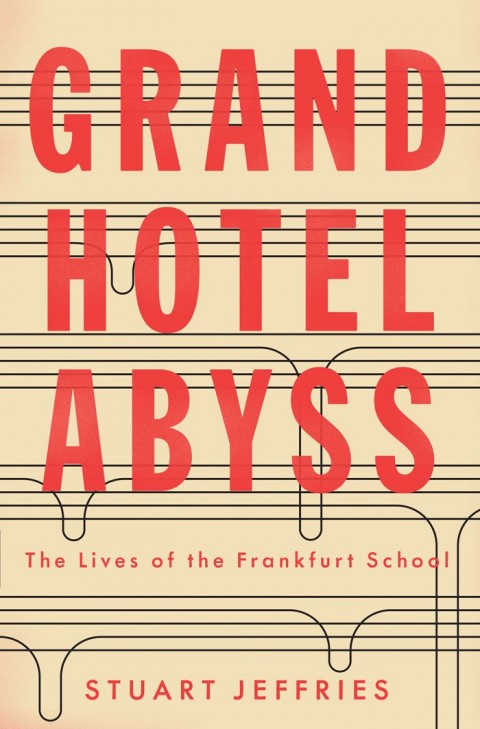
Grand Hotel Abyss is a towering work of staggering scholarship. It is so comprehensive that even its own existence falls within its purview. Stuart Jeffries, a former Guardian arts editor, reflects, in the closing pages, on the “mini-boom in popularising critical theory books” — a “perverse consequence of the global capitalist crisis” — comprising “graphic guides, dictionaries, perhaps even this book”.
It is as if his magnum opus were enacting one of the Frankfurt School’s central tenets: the absence of any external perspective from which to critique the system. “There is,” lamented Theodor Adorno, “no exit from the entanglement” — a maxim that also applies to these thinkers’ pervasive influence and, dare I say, aura. Those whom Bertolt Brecht dismissed as the “Frankfurturists” are now an integral part of our theoretical make-up, whether we agree with them or not.
Jeffries should be applauded for sticking to a broadly chronological narrative rather than experimenting with Walter Benjamin’s rather baffling “dialectical image”. His engagement with these thinkers’ ideas is, contrarily, very much in keeping with the Frankfurt School ethos.
He counters Benjamin’s technological utopianism by stating that “one could also argue the opposite” and reminds Adorno, beyond the grave, that Germany was first defeated by “Soviet totalitarianism”, not by a “more advanced form of capitalism”.
Jeffries is unafraid of giving voice to common sense — “isn’t it ludicrous to compare the Third Reich to Hollywood?” — or being didactic when needs be: apropos of Adorno’s constellation theory of knowledge he writes, “This is all quite tough stuff and, even for adepts of critical theory, hard to swallow.”
Unexpected humour
Humour (“to get dialectical for a moment”) is one of the most unexpected facets of this book devoted to hard-core German intellectuals. Benjamin’s somewhat ludicrous resemblance to Groucho Marx or Charlie Chaplin is remarked on, and a quotation from his Neapolitan peregrinations elicits the following gloss: “It’s hard to tell in this passage whether Walter Benjamin is being given directions or being propositioned. Either way, he seems to like it.” And Herbert Marcuse’s meeting with Jean-Paul Sartre (above) at La Coupole is recounted in hilarious detail.
His “group biography” is an intellectual saga. Readers looking for upskirt pictures of Hannah Arendt will be sorely disappointed: titillation in these rarefied climes is of a purely cerebral nature. The infamous Busenaktion of 1969, when Adorno was surrounded by three female students who “bared their breasts and scattered rose and tulip petals over him”, barely raises an eyebrow. A benign, possibly enviable form of protest to be faced with, in theory, but one that proved profoundly hurtful in praxis.
Commendably, Jeffries only ever adduces private matters to highlight glaring discrepancies between rhetoric and reality. A prime example is the highly conventional lifestyle led by Marcuse, despite publishing works “indicting bourgeois repression”.
The New Left darling’s fondness for a stuffed hippo is as close as we get to tittle-tattle. Yet even this cuddly-toy fetish proves significant, highlighting how some of the last century’s finest minds were also overgrown children. Incapable of making himself a cup of coffee, Benjamin was bankrolled by his parents until “well into his thirties”. Marcuse could neither cook nor drive. Adorno is described as a “child prodigy who never grew up (because he didn’t have to)”. Few of them did, given their wealthy backgrounds and the women — conspicuous by their absence at the Institute for Social Research, to give the Frankfurt School its proper name — who waited on them at home. Practice was never the school’s forte; nor, to be fair, was it ever meant to be.
Although ostensibly Marxist, the institute was founded, at Goethe University in 1924, not to promote revolution but to analyse its failure. Focus on the ill-fated Spartacist uprising soon shifted to understanding the triumph of Nazism — which led the scholars into exile — and Germany’s postwar “psychopathology of denial”.
Capitalism had moved on since Marx. It was no longer a mere mode of production but an entire superstructure, encompassing the mass media and show business, geared towards concealing its exploitative nature. As Marcuse astutely observed, anticipating today’s ludic work environment, “the pleasure principle had absorbed the reality principle”.
Under the aegis of Max Horkheimer, who became its director in 1931, the institute took a “multidisciplinary turn” so as to embrace all aspects of this complex system, thus giving birth to critical theory. Such hybrid studies conducted “at the trough of mass culture” would indicate, contra Marx, that the proletarian revolution was not inevitable. As a result the Frankfurt School became “modern-day monks working in retreat from a world they could not change”.
Adorno and Horkheimer jettisoned the Enlightenment’s legacy, arguing that reason had become an instrument of oppression rather than emancipation (Dialectic of Enlightenment, 1944). They did so, in brilliantly paradoxical style, by taking “the corpse of reason” and making it “speak of the circumstances of its own death”.
In Negative Dialectics (1966) Adorno went on, quite logically, to reject Hegel and Marx’s “conception of history as moving dialectically towards a happy ending”. If the Holocaust had produced a “new categorical imperative” — that is, ensuring it never repeated itself — revolution was perhaps no longer even desirable. He sought utopia through art that was at odds with the affirmative culture that had done “little more than supply a soundtrack to mass murder”: art that could express “the truth of suffering ‘in an age of indescribable horror'” by daring to be radically negative.
It is this embrace of negativity that is so bracing to some and frustrating to others, even within the school.
During the 1960s student protests, change was deemed possible by Marcuse, who embodied a sunnier, Californian take on critical theory. The institute’s “late ethos” is likewise predicated on the feasibility of “ameliorating the conditions of capitalism and liberal democracy”.
Yet Café Marx, as it used to be called derisively, remains tainted by Georg Lukács’s quip that these representatives of the chattering classes — branded traitors by Brecht — had holed themselves up in a beautiful hotel “equipped with every comfort, on the edge of an abyss, of nothingness, of absurdity”.
There is a great deal of wisdom, however, in Adorno’s suspicion of revolutionary students’ “aversion to introspection”, which he had already observed in the dark days of Nazism. “I established a theoretical model of thought,” he told an interviewer in 1969. “How could I have suspected that people would want to implement it with Molotov cocktails!”
There is also a great deal of hope in his belief that “whoever thinks offers resistance”.
At its best the Frankfurt School was always a think tank — in the armoured-fighting-vehicle sense of the word.
Cabut, Richard, and Andrew Gallix, editors. Punk is Dead: Modernity Killed Every Night. Zero Books, 2017.

“Today, nostalgia is almost as unacceptable as racism. Our politicians speak of drawing a line under the past and turning our back on ancient quarrels. In this way, we can leap forward into a scrubbed, blank, amnesiac future. If [Walter] Benjamin rejected this kind of philistinism, it was because he was aware that the past holds vital resources for the renewal of the present. Those who wipe out the past are in danger of abolishing the future as well. Nobody was more intent on eradicating the past than the Nazis, who would, like the Stalinists, simply scrub from historical record whatever they found inconvenient.”
– Terry Eagleton, “Waking the Dead,” New Statesman 12 November 2009
“Is the true self this which stands on the pavement in January, or that which bends over the balcony in June? Am I here, or am I there? Or is the true self neither this nor that, neither here nor there, but something so varied and wandering that it is only when we give the rein to its wishes and let it take its way unimpeded that we are indeed ourselves? Circumstances compel unity; for convenience’ sake a man must be a whole. The good citizen when he opens his door in the evening must be banker, golfer, husband, father; not a nomad wandering in the desert, a mystic staring at the sky, a debauchee in the slums of San Francisco, a soldier heading a revolution, a pariah howling with scepticism and solitude. When he opens the door, he must run his fingers through his hair and put his umbrella in the stand like the rest.”
– Virginia Woolf, “Street Haunting: A London Adventure,” Selected Essays
My review of Alice Kaplan‘s Looking for ‘The Outsider’: Albert Camus and the Life of a Literary Classic appears in the November 2016 issue of the Literary Review.
In July 1944 Albert Camus produced a counterfeit manuscript of his debut novel, The Outsider, published two years earlier. Josette Clotis, André Malraux’s partner, read the text aloud while Camus took it down in longhand, introducing the odd crossed-out variant to lend it the air of an early draft. In Looking for ‘The Outsider’, Alice Kaplan outlines this ingenious scam, born of wartime austerity, but does not say whether it proved successful or not. All the same, it speaks volumes about the book it sought to cash in on. The Outsider had already outgrown its title, acquiring the aura of a canonical work. Camus was now in a position to turn Bouvard and Pécuchet’s lowly profession — that of the copy clerk — into gold. All he had to do was replicate his near-indecipherable microscript, originally developed in response to an acute paper shortage. …

