
London, Christmas 2001.
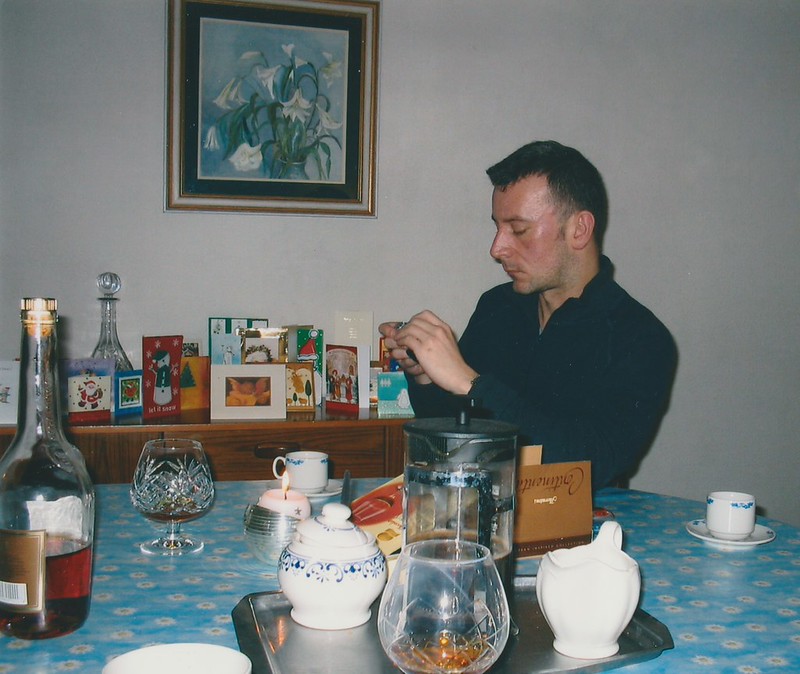
London, Christmas 2001.
The wine bar we used to go to so often is no longer there — and neither are you, Mum, or Amis.

Just found this in my battered old copy of John Lahr’s Prick Up Your Ears. It must date back to the very early 1990s (I lived at that address between late 1986 and 1993). They used to have slot machines in Paris that printed out cheap visiting cards.
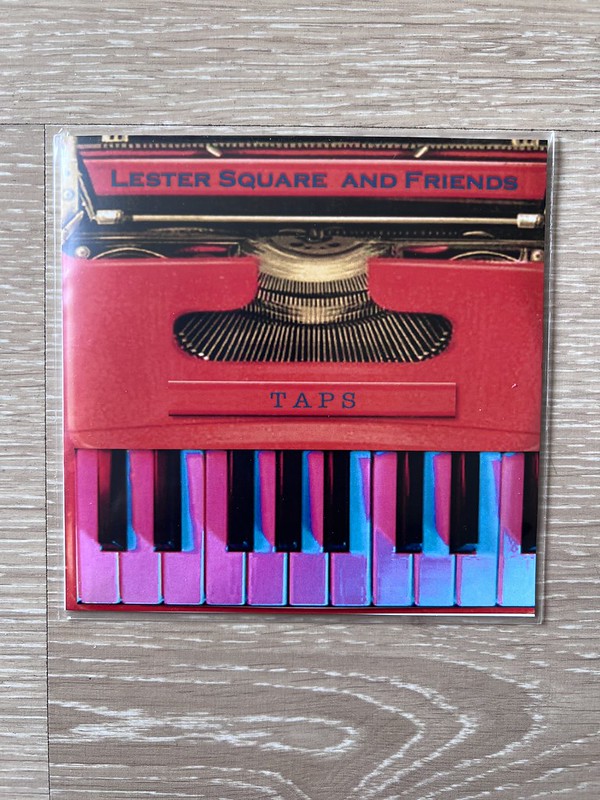
Lester Square and Friends. “The Space Between the Notes.” Taps, Cubist Records, 2023.

Lester Square was the original guitarist in Adam and the Ants and went on to co-found the Monochrome Set. So you can imagine how thrilled I was when he asked me to contribute to this project alongside the likes of Toby Litt, Nicholas Blincoe and John Robb.
Here’s the press release:
The English affection for miniatures has a long history: Nicholas Hilliard, John Hoskins and Samuel Cooper to name but a few. In the world of literature, critic Colin Manlove observed “The growing pleasure of English writers in creating fantastic miniature worlds which work on their own.”
It may be that those who live upon a small island take delight in small things.
In 2022, having tired of a solitude born of Covid 19, Lester Square emerged blinking into the light and, desperate for company, laid down a challenge to a number of eminent authors of his acquaintance to provide a short story: short enough to leave room for a musical backdrop to provide an expressive counterpoint and intriguing enough to elicit full immersion in a pocket otherworld: as William Blake would describe it, seeing “a world in a grain of sand.”
The process couldn’t have been simpler, collaborators merely sent in a sound file of their reading recorded on a phone. The challenge then for Lester was to set them to music and sound collage which complemented and amplified the mood conjured up by the written word. Sometimes literally — the rhythmic headboard banging as the neighbours have sex next door to Andrew Gallix; sometimes through counterintuitive juxtaposition — the jolly counterpoint to a skinhead attack in Lucy O’Brien’s memoir.
The collision and interplay of genres has resulted in 13 evocative vignettes – some magical, some comical, some foreboding – that have become more than the sum of their miniature parts
…but which leave you wanting more.
Full line-up (in order of appearance): Alan Platt, Michele Kirsch, John Robb, Lucy O’Brien, Nicholas Blincoe, Toby Litt, Paul D Brazill, Lobby Robinson, John Haney, Andrew Gallix.

Here is my review of The Fear by Christiana Spens, published in The Irish Times on 1 April 2023.

In The Fear, Christiana Spens maps out her existential journey through a trauma-induced underworld — a demimonde of the angst-ridden mind — looking to philosophy and politics, art and writing for an “escape route”. Addicted to the all-consuming melodrama (and attendant melancholia) of toxic romances, she eventually suffers a breakdown in Paris while working as an au pair: “I opened my arms to an emptiness I could not contain”.
Having hit rock bottom, it becomes clear that these relationships are not so much doomed to fail as designed to do so. Their essential function is to subsume all her “deeper fears” in a bid to bury them.
Back in Scotland, Spens embarks upon a Master’s degree in terrorism studies — a natural choice given the personal war on terror she is waging. The Fear — this “perpetual flight or fight” mode — takes on a collective dimension at this juncture. It is, she argues, bound up with patriarchal values that rely on “terror and everyday fearfulness to persist” as evidenced, closer to home, by her enigmatic, emotionally absent, and virtually mute, father.
This book of disquiet orbits a sinister black hole that manifests itself through violent panic attacks on the London underground, however much the author strives to repress it. In a particularly poignant passage, she goes on a valiant “pilgrimage” to the suburban neighbourhood where she was raped a decade earlier.
Spens discovers how devilishly difficult it is to face up to her demons. The Fear, itself a survival strategy — a desperate attempt to “negate the pain” of an overwhelming, unbearable reality — keeps on producing new coping mechanisms and displacement activities. “I was writing about fear,” she remarks with regards to her studies, “but the writing itself was a way to avoid feeling it fully”.
The disconnection the author has felt since her assault — when “a phone line [was] cut between the mental and the physical” — is countered by the connection experienced through drawing: “Dissociation was cured by this line, this one simple act”. A similar flow state is achieved when she relates her father’s demise or her son’s birth. Gradually, art becomes “part of living” rather than a mere “solace”. Spens writes herself back to life — and it is a joy to behold.


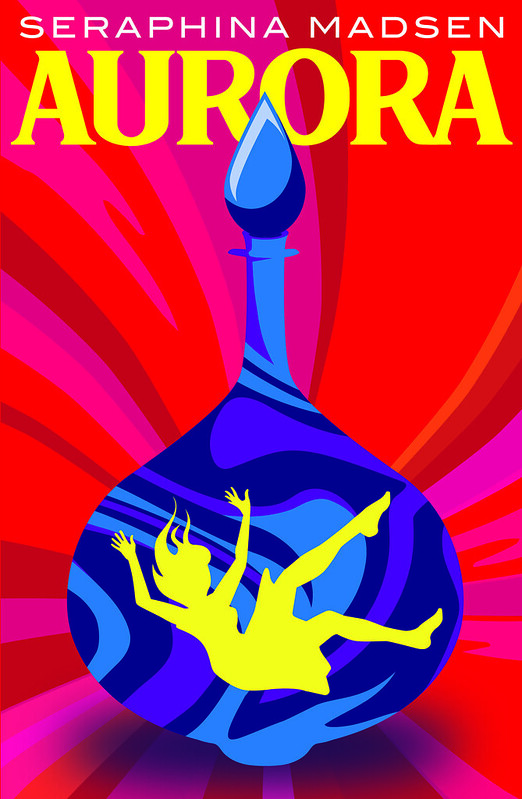
I am delighted to have worked on Seraphina Madsen‘s fantastic new novel, Aurora, published by Dodo Ink in January 2023.

Foulc, Sarah. “The Flip Side of Hemingway’s Paris.” Lit Picks, 4 November 2022.

This is why, for the closing of our Paris-themed week, I’ve chosen to feature the complete antithesis of the book I mentioned in the first issue (Hemingway’s A Moveable Feast), a book that has sharpened my literary landscape of Paris and that I highly recommend:
It’s a collection of written pieces titled We’ll Never Have Paris, edited and introduced by Andrew Gallix, an Anglo-French writer, journalist, and Sorbonne teacher. . . . In response to a “vision of literary Paris (that) has been shaped by anglophone writers”, in his brilliant introduction to the collection, Gallix argues that:
“The Paris we know was always already a beguiling simulacrum, a facsimile of itself, and possibly a dream — ‘the fever dream of Paris,’ as Julian Hanna puts it — from which we should try to awake. (…) Although the museumification of Paris is often overstated, perhaps the city, like Eurydice, can only be contemplated nowadays by turning away from it. It is striking how the following pages abound in alternative visions of the French capital.”
Before coming to this conclusion, Gallix first paints an accurate picture of what Paris is in the global imagination. One that reverberates with the sentence I wrote in the opening paragraph: “Paris is a lightning rod for liberty, a beacon of freedom of expression. Paris is the reinvention of the self.”
“Paris often seems to hold out that promise of radical transformation. When asked why he moved there, Luke, in Geoff Dyer’s Paris Trance, responds ‘To become a different person.’
Paris leaps into our imagination exactly as we remember it from the written tales of those that have glorified the city, at least assigned an ideal to it, and who lived fully in the narrative of their glorification, so much so that — as many writers understand — some of us can only come to see a Paris made of those words:
“For the likes of Tomoé Hill, traveling to Paris is a pilgrimage, not a city break: ‘We go to Paris reverent: as if the city was a heart in a reliquary beating with the words of writers instead of blood’ (p.114) — words which are not, of course, necessarily French ones.”
Gallix, when speaking of his “contention”, directly mentions ‘Hemingway’s Paris’, immediately contrasting it with something else, something more honest, perhaps — ‘that of Rimbaud and Verlaine or Sartre and de Beauvoir’. He invites us to question this vision:
“My contention — and a contentious one it is too — is that the bohemian Paris people think of most readily outside of France — the ur-cliche, if you will — is anglophone. It is the Paris of Hemingway, Joyce, and Shakespeare and Company before being that of Rimbaud and Verlaine or Sartre and de Beauvoir. If we accept this as true, or at least partly so, it is doubtless due to the hegemony of the English language and imperialism of Hollywood as much as the appeal of Hemingway’s blueprint. Scandinavians, say, or Latin Americans have their own take on this myth, revolving around their own writers’ interaction with the French capital, but these versions are mainly consumed locally.”
To this, he adds the relevant argument of the only authors mentioned by Hemingway in A Moveable Feast:
“How many French authors does Hemingway encounter, or even mention, in A Moveable Feast? To be honest, apart from Blaise Cendars, I cannot name a single one off the top of my head. All those that come to mind are either American (Scott Fitzgerald, Ezra Pound, Gertrude Stein, Alice B. Toklas, John Dos Passos), Irish (James Joyce) or English (Ford Maddox Ford, Wyndham Lewis, Aleister Crowley).”
Gallix isn’t certainly the only one to think this, as we discover throughout the collection. British novelist Jean Rhys, best known for her modernist novel Wide Sargasso Sea, is also mentioned in the introduction. She had already noticed the influence of the English-speaking writers in the shaping of the imagination of what Paris was supposed to be. As Gallix writes:
“In a 1964 letter to Diana Athill, Jean Rhys railed against what she dubbed ‘America in Paris’ or ‘England in Paris’, dismissing Hemingway and Miller’s take on the city as inauthentic. ‘The real Paris had nothing to do with that lot’.”
Some of the most interesting insights of this introduction to the collection come directly to broaden our perspective on the conditions that have created the almost-personified Paris that we know today.
“Hemingway described Paris in the 1920s as a place ‘where there was a way of living well and working, no matter how poor you were,’ adding that this was ‘like having a great treasure given to you’. That treasured lifestyle was swept away by the onset of the Depression in the 1930s. As Will Ashon remarks, artists thrive where there is ‘affordable, preferably semi-derelict real estate. Which is to say you can’t be an artist in Paris anymore, or in London either’ (p.301).”
Affordable prices. That was the thing about Paris at that time.
And about New York, Hong Kong, London, and all of these giant capitals, now overpriced, but that still attract swarms of idealistic urban aficionados despite the very high costs of living, compared to when these past legendary generations of artists and intellectuals thrived. In the 20s, writers could sleep in hotels and eat well in Paris.
The ‘daily grind’ that most citizens experience in these cities is overlooked, especially for passing travelers. Tourists will often first spot the tall woman in the trench coat smoking a cigarette and drinking a glass of Chardonnay at the corner brasserie, before the one who just sold them a bottle of water at a kiosk.
It’s often not that glamorous in Paris, nor even artistic.
But despite having always known this, for I had witnessed the less charming aspects of Parisian living, I kept returning and kept getting disillusioned. Maybe it’s unsurprising:
“As a subgenre, the expat memoir or novel frequently follows a narrative arc that takes us on a journey from euphoria (the possibility of escaping, and reinventing oneself elsewhere) to disillusionment (the failure to escape oneself and go native. Fittingly, Jonathan Gibb’s piece is entitled ‘Every Story of Paris is also a Story of Disillusion.’ (…) Christian Spens’s heroine states that ‘Paris had always been a good escape, the best escape of them all’ — until now (p.147) This theme is actually so prevalent that Gavin James Bower fears he may have become a walking (or running) cliché: ‘I run away to Paris — am I sure I’m not a trope?’ (p.151)”
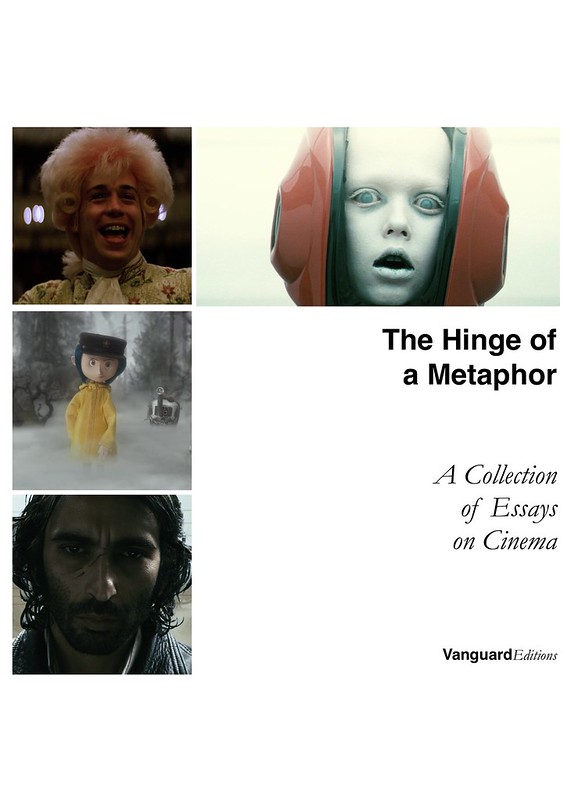
I have a rather personal essay on Olivier Assayas’s Après mai in The Hinge of a Metaphor, edited by Richard Skinner. It also contains contributions from the likes of Susana Medina, Rachel de Moravia, Christian Patracchini, Imogen Reid, Matthew Turner, Tony White, Eley Williams, Richard Skinner himself and others.
I have just found this in a pile of books.
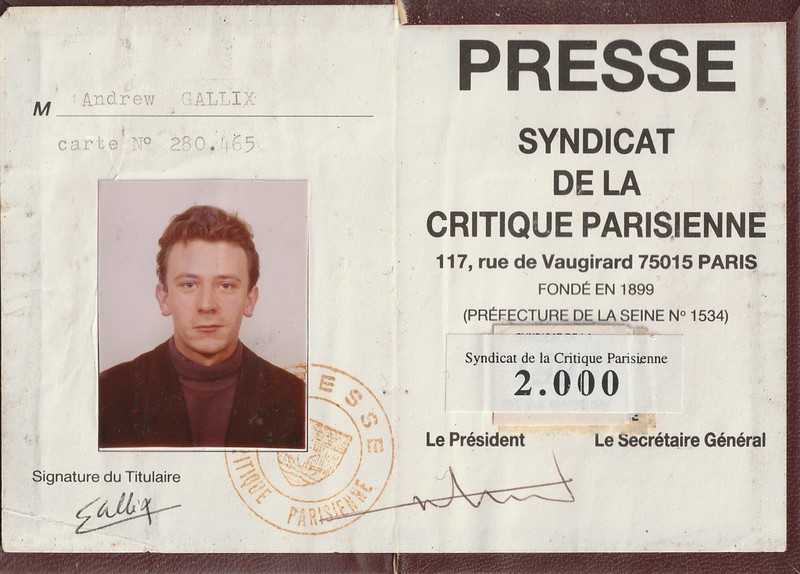

I was looking for a quotation in a book and this just fell out.
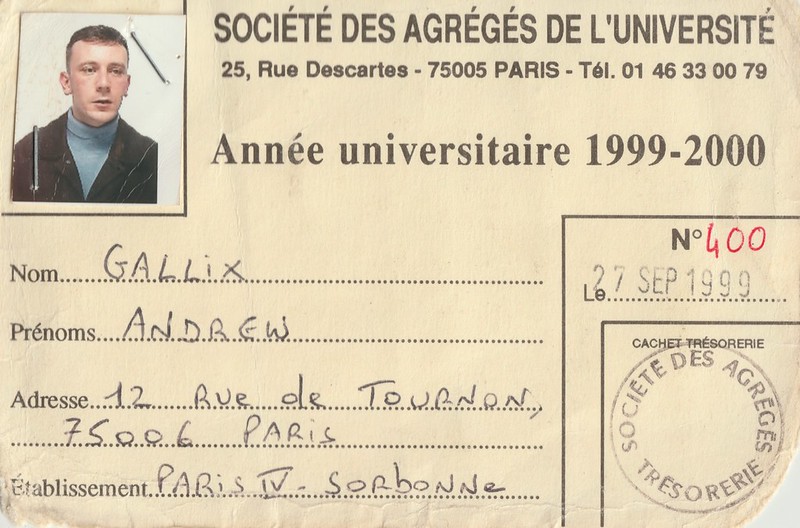
 ANDREW GALLIX