This interview with Simon Reynolds appeared in 3:AM Magazine on 2 March 2009:
The Geist of the Zeit

3:AM: Could you tell us how you came to start a fanzine — Monitor — while at Oxford University in 1984?
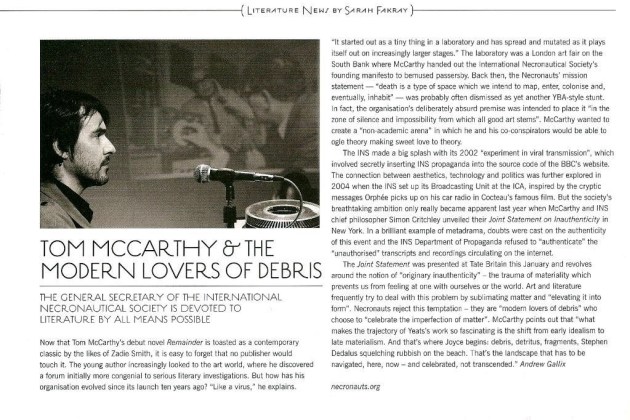
SR: We did one called Margin first, a pretty basic-looking zine about music and student stuff, e.g. like why most student parties were so boring. That turned into a wall poster that we hung up around town for free, and the content got more theoretical and manifesto-like. Monitor was started in 1984 after most of us had graduated and were living on the dole, and its focus was primarily music with some cultural overviews and some feminist pieces by the team’s female writer Hilary Little. We were keen to distinguish ourselves from other fanzines, which were generally quite scrappy-looking and descended from punk (they were anarcho, or indie-noise, or hardcore, or Goth…). So we had relatively high production values and a striking design aesthetic courtesy of Paul Oldfield, the editor in chief, and Hilary, who was an art student. In the first issue I wrote a critique of fanzine culture, in fact.

We didn’t want to have interviews or reviews like regular zines, but be more of a pop culture journal with just thinkpieces and manifestos and rants (courtesy of David Stubbs, mostly). Then after three issues and a bit of a reputation that we’d garnered for ourselves, we came into an unexpected source of financial support, which allowed us to dramatically rachet up the production values: we had glossy, high quality paper stock, really clear typefaces and proper layout (courtesy of the early word processing programs that were just becoming available and which Paul mastered — and I happened to live above a business that offered computers for postgraduates to do their dissertations on). The last three issues of Monitor looked fantastic and the writing of the team — Oldfield, Little, Stubbs, Chris Scott and myself — really hit a synchronised peak.

3:AM: How did you graduate to Melody Maker?
SR: I sent them some sample reviews. Steve Sutherland the reviews editor at the time was immediately enthusiastic, whereas NME at that time was difficult to penetrate. So although Melody Maker was very much the underdog then in terms of circulation and reputation I joined it and found it to be a very encouraging environment. Later in 1986, David Stubbs followed, followed the next year by Paul Oldfield. Stubbs and I were both given staff writer positions.

[Simon Reynolds circa 1985 in his Monitor days]
3:AM: Did you then decide to go freelance in order to have enough time to write books?
SR: No, I fell in love with an American, Joy Press, who, after a year of doing a postgraduate course in London, was obliged to return to New York. I couldn’t keep the staff writer position and be always going over to America for lengthy stays, so going freelance was the only option. Initially I was quite trepidatious about the move, calculating how much money in the bank I had and how many flights to America that would pay for before running out. It never occurred to me that spending half the year in America would actually be a boon for a freelance writer!
In terms of books, my first one Blissed Out came out almost exactly around the time I quit Melody Maker, but I had no particular notion I would do other books at that point, Blissed was a collection of the Melody Maker-era, mostly late Eighties stuff, it seemed like a one-off.
3:AM: Were you able to witness the whole Strokes/White Stripes rock revival scene?
SR: Not really. I was in New York when that happened but still focused largely on the dance scene which in the late 90s and early Noughties was pretty vibrant.
3:AM: Initially, you became famous for writing about rave music which is interesting since it is a phenomenon which rock critics (and the traditional British music papers) usually had a hard time dealing with. You turned this into an advantage…

SR: Well, initially I was more known for writing about underground rock in the late Eighties — me and my comrades at Melody Maker were pushing groups like My Bloody Valentine, AR Kane, Butthole Surfers, Loop, Sonic Youth, Dinosaur Jr, etc. We also celebrated rap and electronic dance stuff and industrial things like The Young Gods, but that sort of neo-psychedelic rock is what I was generally associated with. And that is what Blissed Out is largely about. But yes the rave scene took over for me by 1992 and increasingly the various directions that came out that “chemical beats” culture — jungle, gabba, IDM, trip hop, big beat etc — were my primary focus in the Nineties as a writer. And that writing led to Energy Flash.

[Simon Reynolds blissed out in Brockwell Park, Brixton, circa 1989]
Rock magazines and rock critics do tend to approach electronic music in the standard auteur-focused way, they liked your Aphex Twins and Goldies, eccentric or colourful characters who can give good quote and did these Grand Masterpiece type records. I used to write about electronic dance in those terms too, before I got actively involved in raving and club culture. But I soon realised that the focus of the scene was on tracks and the DJ, it was much more about the anonymous collective — the interaction between the music, the club space, the crowd, the DJ — and drugs too, of course. So you had to try to bring those elements in really prominently rather than just pinpointing the pioneers and the outstanding auteur figures. They exist in even the most hardcore underground scenes but more important is the evolution of the music according to this almost depersonalised logic, where it feels like the music knows where it wants to go. It’s what Brian Eno calls scenius as opposed to genius.
3:AM: In the introduction to Rip It Up and Start Again, you write: “As a rock critic, when you reach a certain age, you begin to wonder if all the mental and emotional energy you’ve invested in this music was such a shrewd move. Not exactly a crisis of confidence, but a creasing of certainty”. Similarly, in Totally Wired, you wonder if the “searching for utopia through music” wasn’t “a mistake”. Aren’t these doubts mainly due to the fact that music no longer occupies the central cultural role that it did during the punk and post-punk years?
SR: I think you’re right, to an extent, but it’s also questioning what was actually achieved during those periods when it was central and seemed to have enormous power to motivate individuals and mobilise populations. A lot of great music was made but beyond that… Some nowadays would say, ‘well what did you expect?’, but at the time, something else, something extra, was expected. It felt like the music had a transformative power, a promise. Perhaps it’s just the slow fading of the Sixties dream (or delusion?), with punk/postpunk being the next and in some ways just as intense and far-reaching spasm of that excessive belief in the power of music, and rave in its own different way being another.

3:AM: You’re known for having introduced critical theory into music journalism: wasn’t this in part a way of providing an intellectual justification to what you were doing?
SR: No, I don’t think so — I’ve never felt the need to justify or aggrandise music in that way. Music asserts its own importance and crucialness without any help from me or the books I’ve read! What it is, I’m a fan of critical theory, of that kind of philosophy and writing, and it just seemed like there was a natural fit between certain ideas and what was going on in the music. It wasn’t about legitimising “low” culture in high culture or highbrow terms, but just about intensification — the ideas would potentiate (to use drug terminology) the most radical aspects of the music. The combination of the music and the theorisation seemed to create a bigger buzz, basically.
3:AM: You point out that there is “a lot less theory” in Rip It Up than in your other books partly because many of the actors on the post-punk scene were themselves “musician/critics” who were already “eloquent in meta-talk”. I was wondering if post-punk bands had turned you on to theory in the first place?
SR: To an extent, because people like Green from Scritti Politti or the guys in Gang of Four (although they like to downplay it now) were fluent in a lot of neo-Marxist ideas. But really it was the NME journalists of that time who turned me onto the French theorists. When you read about one of your favourite bands and there’s chunks of Barthes or Kristeva or Foucault flying about, the sparks created light a fire in your brain. The music is enriched by the theory, but the theory is also enflamed by the music, if you get me. You might say that the theory is justified by the music, in a way. Much more so than the other way round. It’s brought alive by the music, and substantiated by the music.
3:AM: In his Guardian review of Totally Wired, David Sinclair claims that you don’t “so much put words into [your] subjects’ mouths as ram them down their throats”. Your response?
SR: I really think that’s rubbish, to be honest. The specific example he quoted, when I’m talking to Andy Gill, comes out like that because nowadays the members of Gang of Four like to downplay their debts to theory and make out they were never particularly Marxist. That’s probably got something to do with how they’re all involved in the business world nowadays! My question to Gill is naturally informed by reading the interviews they did back in the day, and of course listening to the lyrics of their songs — which are clearly shaped by awareness of concepts like reification and commodity-fetishism. It’s really not my fault if Andy Gill wants to make out that Gang of Four weren’t especially influenced by Marxism!
Generally the interviews are more like genial conversations than interrogations. I’m not looking to ambush them or find holes in their statements, but nor am I imposing my view of things. I’m asking questions and listening, finding out stuff I didn’t know, following up tangents. But there’s obviously areas and issues I’m looking to be covered. And I have my own opinions.

3:AM: Surely, you must have been tempted at times to write literary criticism or perhaps even fiction?
SR: I’ve written some book reviews. I have some pet projects, dream projects, that would be largely about literature. As for doing fiction myself, a long time ago, when I was a teenager maybe. I once wanted to write science fiction but was handicapped by my inability to come up with plots! I could do the s.f. scenario but not the narrative bit.
3:AM: Rock stars used to want to be writers; today writers want to be rock stars (at least that’s my theory)… The punk and post-punk years were undoubtedly the “golden age” of the music press (“The day the new issues of the music press came out was the best day of the week”) which explains why you were “as passionate about the journalism as the music”. However, why did you choose to “contribute to the music through writing” instead of producing music yourself? After all, many rock critics from that period (Nick Kent, Kris Needs, Giovanni Dadamo, Mark P, Paul Morley, the Vermorels spring to mind) made the move from the page to the stage with varying degrees of success and seriousness…
SR: Um, well, no offence to the above, but “varying degrees of success” — you’re kidding right! Chrissie Hynde would be a better example by far. There are music journalists who’ve acquitted themselves just fine as music-makers — most recently the grime/dubstep journalist Martin Clark aka Blackdown was the co-creator of a very fine dubstep-influenced album, Margins Music. I admire the balls of those who attempt it.
I’ve never made any serious attempt to make music because I’m aware of my limitations. But really I just always wanted to be a writer. It never seemed like a second-best option to me, not at all.
That said, if I had a shred of musical talent, I would probably have a go — why not, it would be fun, it would be challenging, I’d probably learn something that would make me a better critic.
3:AM: You argue that journalists could be as important as musicians in those days: bands would form after reading articles by Lester Bangs or Paul Morley. Do you think your writings will have a similar influence? Do you know if Rip It Up, for instance, had any impact on the recent post-punk revival?
SR: Rip It Up came out smack bang in the middle of the postpunk revival, which had a big momentum already rolling by the time it was published. It probably helped to keep the revival going a bit longer, maybe. It’s still ticking a long, isn’t it?
I’m not sure if any of my writings had a direct motivational effect on musicians. I do know some musicians who grew up reading my stuff but I can’t see how it’s affected what they do. In the late Eighties and early Nineties the kind of way me and my comrades at Melody Maker wrote about My Bloody Valentine and AR Kane probably contributed to the vibe at the time that led to shoegaze, but it’s obviously primarily the music itself — MBV, AR Kane, Cocteau Twins, etc — that birthed shoegaze. Whether having a role in it would be something to be proud of, I’m not sure! There were certainly things going on in that music which we as writers articulated and glamorized — this sort of narcoleptic, swoony, blissed-out dream-daze vibe — all that became hegemonic with shoegaze, and frankly rather predictable and played-out. But that was being articulated in the original shoegaze-inspiring music too, in the song titles and lyrics and things like Daydream Nation. It was all the Geist of the Zeit. So our writing was symptom rather than agent.

3:AM: In both Rip It Up and Totally Wired, you talk about the “accidental innovation syndrome”: when post-punk bands tried to play music that was technically “beyond their reach”, it often came out wrong which is why it sounded interesting (you mention, for instance, the Gang of Four’s take on disco which you describe as an “abstraction of disco”). When these bands became more competent, their music often became bland and uninteresting. Was there a similar “accidental innovation syndrome” in rock criticism?
SR: I don’t know about that. I think rock criticism breaks the rules of other forms of journalism, but quite consciously most of the time. It is deliberately and even contrivedly more informal and sloppy, or more theoretical and neologistic, or…
When I started out I didn’t know any of the rules of reported journalism or feature writing — the idea of starting with a lead, having the nut graph, using a well-observed scene to draw in the reader — none of that I knew about, at all. I picked all that up much later, in the late Nineties really. My early Melody Maker interviews always started with some kind of bombastic micro-manifesto or oration, then slipped into a kind of Platonic dialogue, an exchange between disembodied minds. I seldom did any scene-establishing observational type writing, about clothes or where the interview took place or the gestures made by the interviewee and so forth. So you could say that was accidental innovation, perhaps. The pieces might have been improved by having some of that conventional journalistic framing, but they were also quite intense hits of rockcrit, through being so stripped down.
3:AM: You distinguish two types of rock critics: the gonzo “prophet/catalyst” who has been replaced today by the “analyst and historian”. Do you regret this trend? Even though rock criticism is far less influential than it was back in the punk/post-punk days, the British music press still played an important part in the rise of Suede, the subsequent Britpop phenomenon as well as the post-Strokes rock revival, so it’s not completely dead is it?
SR: I kind of have a foot in both camps, and enjoy both modes — the Lester Bangs and Greil Marcus approaches. I suppose the first form, the messianic mode, is the one that sets my heart on fire. I love to read that kind of stuff, and to write that kind of thing. The more measured and balanced kind of writing, I can do that easy enough, but…
The messianic mode I would distinguish from your standard hype-hype, “here’s a hot new scene” type journalism, though, since the prophetic style is always gesturing towards some kind of salvation for rock/music, which in turn would be a salvation or redemption or something like that for the world, given that the messianic mode of rockwriting is predicated on the attribution of monstrous world-historical importance to rock music (or rap, or rave, or whatever…). That explains both the born-again fervour and the rage at rock music when it fails to live up to its potential or goes through periods of doldrums.

[Simon Reynolds, Williamsburg, 2007]
3:AM: “Post-punk completely inverted punk’s organization of sound: the guitar became more sporadic and thin-bodied; the bass becomes the melodic voice and centre of emotion in a song” (Totally Wired). You are renowned for your accurate descriptions of music (see the spot-on example above), but you also believe that “Myth is what rock music is all about”. In other words, you seem to be (or to have become) an “analyst and historian” but you’re also clearly a “prophet/catalyst”. Rock critics were important when rock was about far more than just music, right? In your case, one could even argue that you invented post-punk as a genre: nobody had brought all the threads together before…
SR: The problem with the “myth is what rock is all about” statement is that you can only have an insight like that from a fallen state of consciousness, a demystified mindset. To even say that statement is to already be incapable of participating in myth, falling for myth. People who think mythically don’t see it as myth, you see, they see it as The Truth.
That said there have been times when the music has been so powerful it’s knocked my hyper-aware self off its feet and I have believed — early rave and jungle was one such phase, and when I wrote about jungle I was helping to construct a myth while also believing in it with all my heart.
Postpunk — this idea some people put about that I came up with the term or the concept is such nonsense. It was used from about 1979 onwards, not in a huge way but it definitely cropped up in the music papers (and I’ve read every single issue of the NME and most Sounds and Melody Makers and Faces etc for the whole period covered by Rip It Up and Totally Wired). By the time we did Monitor, starting in 1984, postpunk was generally accepted as the term for that period, I refer to “postpunk” in my early articles in Monitor, which were often digesting what had happened to punk’s energies and where all that idealism and creativity had gone.
3:AM: In Totally Wired you write that “The nineties felt like this blur of constant change” — an affirmation which, in my opinion, seems far more suited to the punk and post-punk days when things were changing from week to week. (What fundamental difference was there between, say, 1998 and 1999? But 1978 had a totally different feel from 1979.) This constant activity took place, paradoxically, within what you call an “economy of delay and anticipation” — music and music news weren’t instantly accessible like they are now. Don’t you think these two contradictory phenomena played an essential part in the rise of rock criticism? Rock critics were there to make sense of the frenetic activity that was taking place and music fans spent ages poring over their articles (just as they spent hours scrutinising album covers while listening to records)…
SR: My Nineties comment is referring to the electronic dance music culture, all the energies that came out of rave, in which category I also include post-rock and trip hop as adjuncts (trippy, samples-beats-electronics based mood music). That’s how it felt, from 1990 to the end of 1998! It was a rollercoaster ride.
You’re right though about the totally different feel between 1978 and 1979, and 1980 and 1981 and 1982. That was one of the things that I wanted to convey in Rip It Up, the reactive way that music evolved, rebelling against the preceding phase.
Back then, things took longer, but the culture as a whole felt like it was hurtling. Nowadays the sense of temporality is completely inverted: everything is too instant, too fast (the speed of downloading, the impatient, skimming way one reads text on the computer screen etc), yet on the larger cultural level it feels like everything is stalled. We have this paradoxical combination of acceleration and standstill. The worst of both worlds!
3:AM: The original idea for Rip It Up was a book chronicling the “punk diaspora”. Do you think you will ever return to this project one day?
SR: I think with Rip It Up I’ve kind of done the “good bit”. Tracking the other streams of the punk delta might not be so enticing — second and third wave industrial, or Pogues-y punk-folk, or…
Some of the tangents that came out of punk — Situationist, McLaren-imitator bands, for instance — are covered quite intensively in Blissed Out. During our Melody Maker days, me and the ex-Monitor types were often working through stuff that related to punk, to the hangover of its ideas, which we felt had become unhelpful and counterproductive. We talked about the need to un-punk British music culture. We got interested in reclaiming late Sixties type ideas and even progressive rock type values. Which of course was going on in the music of the late Eighties, it was getting wiggy and blissed out. We thought that was the current in leftfield music that was crucial and to be championed against stuff that was still tied to punk and the various “creation myths” of what 1977 had signified.

[Robert Wyatt and Simon Reynolds, Hay Literary Festival, 2007]
3:AM: In Totally Wired, you write that the “shared point of origin — the mythic site of lost unity — is punk. That’s the ignition point. The Big Bang”. The strength of punk, and the reason why it was (and indeed is) so important, was its ambiguity: the political, arty, fun, fashion and hooligan elements all coexisted for a short but exhilarating time. More than with any other movement, there is a fascination with the origins of punk — the days before it even had a proper name (see John Ingham’s October 76 “Welcome to the (?) Rock Special” article in Sounds), when the movement seemed to have appeared out of nowhere, when the clothes and music still escaped categorization. All the disparate elements started going their own way as soon as the movement could be pinned down. Do you agree with this?
SR: The archaeology of the origins of punk is this massive thing, you’re right. One thing that interests me about punk is how long the idea was in circulation before it took off. Lester Bangs and others were writing about the need for something like punk from about 1970 onwards! There were various false starts, the most famous being The Stooges, and The New York Dolls, but you could also see punk figuring in aspects of glam rock, and obviously in pub rock. And you have stray figures like The Sensational Alex Harvey Band, or Ian Dury’s first group Kilburn and the High Roads…
I’m quite into this idea that the best phase of a music is before it is named, before it gets codified. Often there’s a semantic profusion/confusion syndrome. The early days of what would be codified as drum’n’bass were very unstable in terms of nomenclature — over about three years you had terms like “breakbeat house”, “hardcore techno”, “ardkore”, “jungle techno”, “darkside”, “jungle” etc all competing and overlapping. Or with grime, where it took the longest time for anybody in the scene to settle on a name, and Wiley even released a song called “Wot U Call It” addressing this issue.
But equally it’s the aftermath era that seems fruitful too. In some ways it’s the before and the after of any musical revolution that seems richer and more suggestive than the Moment itself.
3:AM: As you write in the introduction to Totally Wired, “Books continue to write themselves in your head long after the official end of the project” which is why you have several blogs which you use to publish “footnotes” to your books. What impact has the internet had on rock criticism?
SR: That’s too big a question, really. But one effect it’s had on me is this idea that I can put the left-overs and stray thoughts on the web — it has made me more comfortable with the cutting of things down to size, whether it’s an article or a book. I can run the director’s cut version or the ideas that were never integrated into the piece on the web, for the small minority of people who are interested.
3:AM: Were you disappointed by any of the people you interviewed for Rip It Up and Totally Wired?
SR: I don’t think I was, actually. Frustrated in a few cases. Martin Fry for instance has this thing of not replying to the question — not in the least! He’ll just talk about something else altogether. But after I realised this was going on I just let go of the reins and let him flow, and he did bring up a lot of interesting stuff along the way, even if there were many things I would have liked to have had discussed that weren’t. But you know it was cool to meet him, he’s certainly a charismatic guy. No, I can’t think of any disappointments.
3:AM: Who is your all-time favourite rock critic and why?
SR: It would be a close race between Paul Morley and Barney Hoskyns. But Barney would win. First off I suppose it comes down to taste. The definition, the sine qua non, of a great critic is having great taste. You can have the most elegant prose style and the sharpest insights and wittiest wisecracks, but if you can’t lead me to amazing music, then you’re of a limited use, I think.
Barney’s writing at the NME in the early Eighties introduced me to so much amazing music. So many of my all-time favourites, I wonder if I would have heard without his advocacy… He introduced me to Astral Weeks, John Martyn… The Blue Orchids… Meat Puppets… all the US hardcore stuff in fact: Black Flag, Flipper, Husker Du… But also things like Donna Summer, who I knew for her more famous hits but would I have otherwise bothered to chase down “Working the Midnight Shift/Now I Need You”, this amazing Moroderized electronic dreamscape song-suite, if he hadn’t written so alluringly about it? All kinds of soul music… old stuff, but also great New York black postdisco and club music of the early Eighties. But at the opposite end of the spectrum, he made certain heavy metal things intriguing. And it was actually his writing that got me interested in The Smiths, who I’d initially found a bit mundane-sounding.
Barney Hoskyns had this thing of having an incredibly wide range of music he wrote about but the effect was never merely eclectic, there was an overall vision that encompassed all these disparate and seemingly remote from each other things.
What I also really dug was this Dionysian view of music he was pushing in the early Eighties in reaction to the New Pop philosophy of Paul Morley’s that was so widely adopted by other UK journalists. Hoskyns was a renegade against that hegemony, he was celebrating music in terms of obsession, madness, dirt, danger, frenzy, sickness, “convulsive bliss”, druggy oblivion… This at a time when music was very much about cleanliness and health and non-intoxication and this sort of uptight hyper-rationality. He was championing Nick Cave and The Birthday Party and also placing them in a lineage that included The Stooges, The Saints, Suicide, The Stones and so forth. He was celebrating rock at a time when rock’n’roll was a dirty word, a complete no-no. But he didn’t reject New Pop completely, he championed certain artists within it who he felt had a certain excess and tragic intensity like The Associates, Soft Cell and Scritti Politti.
His writing style at its height is incomparable, the mixture of prose poetry and theoretical penetration, shot through with humour. And he was one of the NME guys who used critical theory and riffs from philosophers (Nietzche was a favourite) in a very effective way.
I suppose the NME-era Hoskyns was kind of my own Lester Bangs. Later on he switched to the other mode, he went from prophet to historian/analyst; he became an excellent critic and writer of histories and biographies, such as his Tom Waits books. But it’s the more adolescent phase — the fucked-up phase, a period he had to leave behind for his own well-being (because he was walking it like he talked it) that had the massive impact on me. It hit me at a very impressionable age. And it took me a long time to develop my own vision of music, incorporating Hoskyns’s ideas and developing them, embracing other approaches. Perhaps I only fully managed to invent my own identity as a writer and thinker thanks to rave culture, which was my own Dionysian moment but based around really radically different music.
Barney is also a really nice guy, which is not always the case with your heroes!
[This interview was translated into Spanish by Alejandrino Delfos and posted on his site on 17 March 2009.]