Journal

I spent half the night tossing and turning, fending off panic attack upon panic attack, fretting over everything in general; in particular, a few sentences I’d spent ages trying — and failing — to write. To think that, on a good day, Michael Moorcock can toss off some 50,000 words — or so I read in Hari Kunzru’s fascinating interview in The Guardian yesterday.

Naturally, today was a bit of a blur. I met one of my three half-sisters at Anvers. As I was early, I had a coffee at Les Oiseaux, a café across the road from La Cigale, the famous concert hall. I remember going there after an Interpol gig, in 2003, with a group of friends that included the young lady who would become my wife: that’s obviously one of the reasons why I’m fond of that café. It’s also slightly secluded and a good spot for people-watching — the prerequisites for any good Parisian café. It was mild and sunny, so I sat outside. It almost felt as though spring had arrived. It felt good, or as good as could be in my present state. It felt almost good. It almost felt good.

The restaurant experience was slightly surreal. For starters, the owner, who I had down as a typically Gallic character, was entertaining a young English guy in perfect English. He may well have been bilingual; I couldn’t hear him well enough to make sure. Then another English guy came in and they all started talking about Zadie Smith. (I almost expected her to walk in at this juncture.) Was he a literary agent or a translator? He was accompanied by a young woman — probably a writer — who was all dressed in black. The gaffer remarked that she looked scary. I glanced over at her. She was staring blankly at the menu. I felt I knew how she felt. Of course, it may just have been the effect produced by the menu.

On my way home, I walked past another restaurant. In fact, I walked past many other restaurants, but in this particular one I spotted an old mate of mine. He had already spotted me, but pretended he hadn’t. I followed suit.

Switched on the telly this evening, and my friend Tom McCarthy, was being interviewed about Tristram Shandy. As usual, he was spot-on. “A novel,” he said, “is something that contains its own negation, right?” Right.

I have always been very ambivalent about journals. I’m wary of the idea of writing as self-expression. I’ve always found it very difficult to talk about myself, as I fail to understand how anyone could be interested. People are attracted to journals in order to discover other people’s secret, private lives but I would never record anything that could embarrass anyone or hurt anyone’s feelings. Simon Critchley writes — and I was re-reading this yesterday — that “In the journal, the writer desires to remember himself as the person he is when he is not writing. …” Perhaps I don’t want to remember. Or can’t. I’m not even sure such a person really exists anyway.

The Silent Call of Conscience

Simon Critchley,”Being and Time, Part 7: Conscience,” The Guardian 20 July 2009

“…What gets said in the call of conscience? Heidegger is crystal clear: like Cordelia in King Lear, nothing is said. The call of conscience is silent. It contains no instructions or advice. In order to understand this, it is important to grasp that, for Heidegger, inauthentic life is characterised by chatter — for example, the ever-ambiguous hubbub of the blogosphere. Conscience calls Dasein back from this chatter silently. It has the character of what Heidegger calls “reticence” (Verschwiegenheit), which is the privileged mode of language in Heidegger. So, the call of conscience is a silent call that silences the chatter of the world and brings me back to myself….”

We Are All Necronauts

409692229_e75d124f7c_t

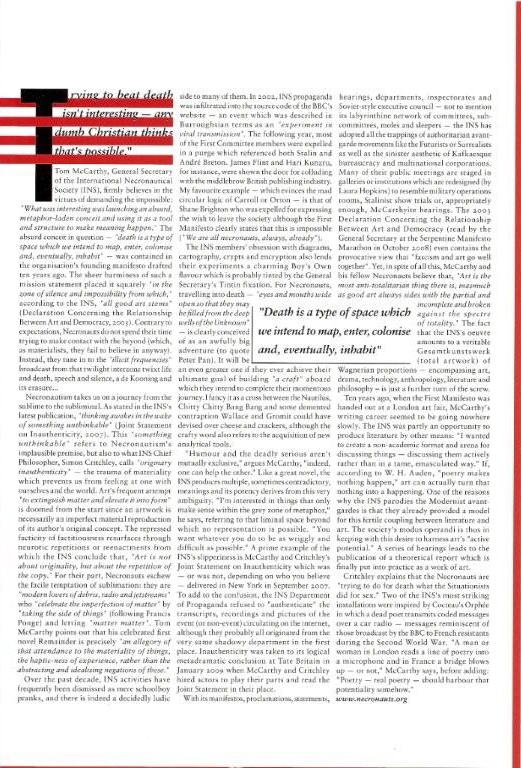
This appeared in the summer 2009 issue of Flux magazine (issue 69, pp. 42-43):

We Are All Necronauts

For the past decade, the International Necronautical Society has been encouraging us to learn to die in new, imaginative ways

“Trying to beat death isn’t interesting — any dumb Christian thinks that’s possible.” Tom McCarthy, General Secretary of the International Necronautical Society (INS), firmly believes in the virtues of demanding the impossible: “What was interesting was launching an absurd, metaphor-laden conceit and using it as a tool and structure to make meaning happen.” The absurd conceit in question — “death is a type of space which we intend to map, enter, colonise and, eventually, inhabit” — was contained in the organisation’s founding manifesto drafted ten years ago. The sheer barminess of such a mission statement placed it squarely “in the zone of silence and impossibility from which,” according to the INS, “all good art stems” (Declaration Concerning the Relationship Between Art and Democracy, 2003). Contrary to expectations, Necronauts do not spend their time trying to make contact with the beyond (which, as materialists, they fail to believe in anyway). Instead, they tune in to the “illicit frequencies” broadcast from that twilight interzone twixt life and death, speech and silence, a de Kooning and its erasure…

Necronautism takes us on a journey from the sublime to the subliminal. As stated in the INS’s latest publication, “thinking awakes in the wake of something unthinkable” (Joint Statement on Inauthenticity, 2007). This “something unthinkable” refers to Necronautism’s implausible premise, but also to what INS Chief Philosopher Simon Critchley calls “originary inauthenticity” — the trauma of materiality which prevents us from feeling at one with ourselves and the world. Art’s frequent attempt “to extinguish matter and elevate it into form” is doomed from the start since an artwork is necessarily an imperfect material reproduction of its author’s original concept. The repressed facticity of factitiousness resurfaces through neurotic repetitions or reenactments from which the INS conclude that “Art is not about originality, but about the repetition of the copy”. For their part, Necronauts eschew the facile temptation of sublimation: they are “modern lovers of debris, radio and jetstreams” who “celebrate the imperfection of matter” by “taking the side of things” (following Francis Ponge) and letting “matter matter”. Tom McCarthy points out that his celebrated first novel Remainder is precisely “an allegory of that attendance to the materiality of things, the haptic-ness of experience, rather than the abstracting and idealising negations of these”.

Over the past decade, INS activities have frequently been dismissed as mere schoolboy pranks, and there is indeed a decidedly ludic side to many of them. In 2002, INS propaganda was infiltrated into the source code of the BBC’s website — an event which was described in Burroughsian terms as an “experiment in viral transmission”. The following year, most of the First Committee members were expelled in a purge which referenced both Stalin and André Breton. James Flint and Hari Kunzru, for instance, were shown the door for colluding with the middlebrow British publishing industry. My favourite example — which evinces the mad circular logic of Carroll or Orton — is that of Shane Brighton who was expelled for expressing the wish to leave the society although the First Manifesto clearly states that this is impossible (“We are all necronauts, always, already”).

The INS members’ obsession with diagrams, cartography, crypts and encryption also lends their experiments a charming Boy’s Own flavour which is probably tinted by the General Secretary’s Tintin fixation. For Necronauts, travelling into death — “eyes and mouths wide open so that they may be filled from the deep wells of the Unknown” — is clearly conceived of as an awfully big adventure (to quote Peter Pan). It will be an even greater one if they ever achieve their ultimate goal of building “a craft” aboard which they intend to complete their momentous journey. I fancy it as a cross between the Nautilus, Chitty Chitty Bang Bang and some demented contraption Wallace and Gromit could have devised over cheese and crackers, although the crafty word also refers to the acquisition of new analytical tools.

“Humour and the deadly serious aren’t mutually exclusive,” argues McCarthy, “indeed, one can help the other”. Like a great novel, the INS produces multiple, sometimes contradictory, meanings and its potency derives from this very ambiguity. “I’m interested in things that only make sense within the grey zone of metaphor,” he says, referring to that liminal space beyond which no representation is possible. “You want whatever you do to be as wriggly and difficult as possible”. A prime example of the INS’s slipperiness is McCarthy and Critchley’s Joint Statement on Inauthenticity which was — or was not, depending on who you believe — delivered in New York in September 2007. To add to the confusion, the INS Department of Propaganda refused to “authenticate” the transcripts, recordings and pictures of the event (or non-event) circulating on the internet, although they probably all originated from the very same shadowy department in the first place. Inauthenticity was taken to its logical metadramatic conclusion at Tate Britain in January 2009 when McCarthy and Critchley hired actors to play their parts and read the Joint Statement in their place.

With its manifestos, proclamations, statements, hearings, departments, inspectorates and Soviet-style executive council — not to mention its labyrinthine network of committees, sub-committees, moles and sleepers — the INS has adopted all the trappings of authoritarian avant-garde movements like the Futurists or Surrealists as well as the sinister aesthetic of Kafkaesque bureaucracy and multinational corporations. Many of their public meetings are staged in galleries or institutions which are redesigned (by Laura Hopkins) to resemble military operations rooms, Stalinist show trials or, appropriately enough, McCarthyite hearings. The 2003 Declaration Concerning the Relationship Between Art and Democracy (read by the General Secretary at the Serpentine Manifesto Marathon in October 2008) even contains the provocative view that “fascism and art go well together”. Yet, in spite of all this, McCarthy and his fellow Necronauts believe that “Art is the most anti-totalitarian thing there is, inasmuch as good art always sides with the partial and incomplete and broken against the spectre of totality.” The fact that the INS’s oeuvre amounts to a veritable Gesamtkunstswerk (total artwork) of Wagnerian proportions — encompassing art, drama, technology, anthropology, literature and philosophy — is just a further turn of the screw.

Ten years ago, when the First Manifesto was handed out at a London art fair, McCarthy’s writing career seemed to be going nowhere slowly. The INS was partly an opportunity to produce literature by other means: “I wanted to create a non-academic format and arena for discussing things — discussing them actively rather than in a tame, emasculated way.” If, according to W. H. Auden, “poetry makes nothing happen,” art can actually turn that nothing into a happening. One of the reasons why the INS parodies the Modernist avant-gardes is that they already provided a model for this fertile coupling between literature and art. The society’s modus operandi is thus in keeping with this desire to harness art’s “active potential.” A series of hearings leads to the publication of a theoretical report which is finally put into practice as a work of art.

Critchley explains that the Necronauts are “trying to do for death what the Situationists did for sex”. Two of the INS’s most striking installations were inspired by Cocteau’s Orphée in which a dead poet transmits coded messages over a car radio — messages reminiscent of those broadcast by the BBC to French resistants during the Second World War. “A man or woman in London reads a line of poetry into a microphone and in France a bridge blows up — or not,” McCarthy says, before adding: “Poetry — real poetry — should harbour that potentiality somehow.”

http://www.necronauts.org

1

2

Dead Philosophers Society

409692229_e75d124f7c_t

Here is my interview with philosopher Simon Critchley, published in 3:AM Magazine on 26 June 2008:

Dead Philosophers Society: An Interview With Simon Critchley

3:AM: Did the idea for The Book of Dead Philosophers come from the Montaigne quote you use as an epigraph? Was that the first spark?

SC: It was one of the first sparks. As so often happens in writing, it was a coincidence: a close friend sent me that quotation from Montaigne just as I was rereading the latter’s “To philosophie is to learne how to die” in Florio’s florid translation. Montaigne is really the hero of the book and I love his suspicion of suspicion, his skepticism and the deeply personal quality of his prose, which is never narcissistic. It is ourselves that we find in Montaigne, not him. But I suppose that’s a narcissistic thing to say.

3:AM: Commenting on another passage from Montaigne, you state that “The denial of death is self-hatred”. This reminded me of Dostoevsky’s Kirilov who attempts to defeat God by committing suicide. His rationale is that, in order to negate transcendence, Man must learn to love himself for what he is and must therefore embrace his own finitude — desire his own death. (One could wonder if the espousal of death isn’t a form of self-love?) Your own conclusion — “Accepting one’s mortality…means accepting one’s limitation” — isn’t that far removed from Kirilov’s way of thinking, is it?

SC: It is very similar to Kirilov and you are right to point that out. I think I wrote about Kirilov somewhere, maybe in Very Little…Almost Nothing. If the denial of death is self-hatred, as it is to deny our freedom and live in fear of death (which is to say, to live in a form of bondage), then the acceptance and affirmation of death is indeed a form of self-love. But I’d want to make a distinction between a form of self-love which is essential to what it means to be human, and a narcissism of self-regard, like Rousseau’s distinction between amour de soi and amour propre, self-love and pride.

coverl.jpg

3:AM: You remind us that Socrates’ last words “articulate the view that death is the cure for life”. This idea that life is a kind of disease to be cured through extinction is key to the likes of Schopenhauer, Leopardi, Beckett and Cioran. Do you agree that there’s a kind of lineage here?

SC: I am hugely attracted to the idea of life as a mistake, as a kind of natural error for which we try and find some metaphysical assurance or consolation. This is the core of Schopenhauer’s dark comic genius. It attracts me because it is based on the idea of life as rooted in an experience of contingency, physical contingency, which we forget and convert into various forms of necessity. I do see a lineage from forms of ancient skepticism and cynicism through Schopenhauer and into figures like Beckett and Cioran. One of the peculiar features of The Book of Dead Philosophers is that I simultaneously play on a number of different and contradictory tendencies in the history of the last few thousand years: cynicism, skepticism, Epicureanism, primitive Christianity, occasionalism, rationalism. The fragmentary form of the book allows me to move across and through a number of different philosophical registers. It is so ridiculous to limit oneself to one version of the truth.

2614324306_5988f39a8f.jpg

3:AM: I’ve always felt that the rise of the writer/artist as alter deus that accompanied the secularisation of many European countries led to the spread of a kind of death wish in literature and the arts (culminating with people like Arthur Cravan and Jacques Rigaut). My theory is that many writers/artists believed the hype and were so frustrated when they realised that godlike, ex nihilo creation eluded them that they turned to destruction. Is (to paraphrase Bakunin) the urge to destroy also a creative one (or, as Larkin put it: “Beneath it all, desire of oblivion runs”)?

SC: I completely agree: one of the outcomes of Romanticism for me is the idea of the writer as imago dei without a deus where art becomes a Promethean creation ex nihilo. I think this tradition also inspired a related Promethean tendency in politics, from the ‘nihilism’ of Nechaev, through to Lenin’s Bolshevism and Marinetti’s futurism. It’s the tradition of what I call “active nihilism“. I criticize this tradition heavily in a number of places, but only because it is so compelling.

3:AM: Wouldn’t you agree that the “fantasies of infantile omnipotence” you hope will disappear through an acceptance of our “limitedness” are often at the root of great art and literature?

SC: Sure. Much of literature in what we might call its rigorously Hegeliano-Sadist development is about the dream of infantile omnipotence which is rooted in the idea that the artist is like Adam in the Garden of Eden, baptizing things into existence through nomination. I don’t think that this tradition can simply be eliminated or overcome, but it should be contrasted with what Blanchot calls “the second slope” of literature, which is concerned with allowing things to be in their irreducible materiality. This is what I think of as the Levinasiano-Stevensian (if that’s an adjective) succession. This is the sort of materialism that Tom McCarthy and I have experimented with in the writing we have done together on Joyce, Shakespeare and others.

3:AM: Some think that art and literature are predicated on what Eluard called “le dur désir de durer” (the painful desire to last) — a desire you don’t seem too keen on…

SC: No, I am perfectly happy with the idea of literature as le dur désir de durer and would want to put the virtue of endurance at the core of much that I think about. But that is not the same as denying one’s mortality. On the contrary, I think.

thumbnail.jpeg

3:AM: The Book of Dead Philosophers has lofty ambitions. You set out to write “a history of philosophers” as opposed to “a history of philosophy” in the teleological mould. In effect, you are defending a specific conception of philosophy against another…

SC: Yes, I am against the idea of the history of philosophy as a history of systems that can be arranged in a certain logical and historical order, such as one finds in Hegel or Heidegger. It is one of the many aspects of being deluded by the idea of progress (Hegel) or even the idea of regress (Heidegger). I am opposing it with an idea of the history of philosophy as a history of philosophers, that is, a history of mortal, fragile and limited creatures like you and I. I am against the idea of clean, clearly distinct epochs in the history of philosophy or indeed in anything else. I think that history is always messy, contingent, plural and material. I am against the constant revenge of idealism in how we think about history.

3:AM: You praise the “ideal of the philosophical death”: what exactly do you mean by that?

SC: The idea of the philosophical death is the core teaching of philosophy in antiquity from Socrates and Epicurus onwards: we can go to our death freely and without fear having given up the consolation of any belief in an afterlife. As Wittgenstein says, is some problem solved by the idea of my living forever? Of course not. It is, however, difficult to fully and completely renounce any idea of the afterlife.

2613539055_0ff865b078.jpg

3:AM: You write that “Death is the last great taboo” and question the unthinking belief in ever-increasing longevity: are we turning into a race of Struldbruggs?

SC: Absolutely. I think we are turning into a world of Struldbruggs. That is all I saw last year in Los Angeles last year when writing the book: bloody botoxed suntanned Struldbruggs. To that extent, I completely agree with Swift. The flip-side of his seeming misanthropy is an affirmation of virtue.

3:AM: Your book also has a self-help quality (to “begin to enable us to face the reality of our death”) — aren’t you afraid of being accused of having done an Alain de Botton?

SC: No comment. My problem with self-help is that I don’t think there is a self to help. The self is something that we become through a series of acts.

3:AM: Don’t you think your attempt to bring philosophers closer to us (“It is in the odd details of a philosopher’s life that they become accessible to us”) runs the risk of being seen as a little reactionary — the equivalent of basing an interpretation of a novel on its author’s life?

SC: It is profoundly reactionary. Absolutely. I’ve turned into some sort of dreadful cultural conservative. No, but seriously, I am not engaging in some sort of biographical reductionism and I loathe such tendencies in relation to literature. I am reacting – and perhaps over-reacting – to an allergy to biography in relation to philosophy and philosophers. Also, much of the biographical information in the book is highly dubious and all the more interesting for that reason.

3:AM: In The Guardian you were recently described as having “found a vocation in teaching philosophy, although [your] passions still lie in music, poetry and politics”. Are you less passionate about philosophy? And how did you end up at university by “complete accident”?

SC: Yes, I don’t know where The Guardian found that stuff, but maybe I said something similar in another interview. The truth is actually much worse and would have to include sob stories about years at catering college, working in factories, a series of industrial accidents and even a year and a half as a lifeguard. I did not mean to suggest that I am less passionate about philosophy than I was. On the contrary, I have an immense childish enthusiasm for the history of philosophy and for what is going on right now and remain stupidly optimistic. The thing is that after leaving school with one ‘O’ level, I played in bands for some years, then became a poet before going to an FE college in Stevenage where someone said that I should apply to university. The thought had never previously crossed my mind. Something to do with social class, no doubt.

3:AM: On the subject of music, please tell us about the “large number of punk bands” you played in. Does that period still resonate as it does with so many of us?

SC: Punk was the crucible out of which my paltry subjectivity was formed. My years watching bands and performing in bands allowed me the imaginative space to try and conceive of a life a little different from what I was meant to do. It was a relentlessly affirmative nihilism. Of course, this was sheer luck. I was born in 1960, and so I was 16 when punk began to happen just down the road in London. Suddenly I found myself at the edge of the world’s centre. And it was because of punk that I began reading Burroughs, Bataille and the Situationists. It was also the time when I became politicized through Rock Against Racism and the Anti-Nazi League. My bands had silly names: The Social Class Five, Panic, The Fur Coughs (who became The Bleach Boys*, I thought of that name) and The Good Blokes. I still mess around with music and have done a lot of work with my oldest friend, John Simmons. I think it is somewhere on YouTube.

[* See their current website]

All the Latest

My interview with philosopher Simon Critchley appeared in 3:AM Magazine on 26 June 2008:

“The idea of the philosophical death is the core teaching of philosophy in antiquity from Socrates and Epicurus onwards: we can go to our death freely and without fear having given up the consolation of any belief in an afterlife. As Wittgenstein says, is some problem solved by the idea of my living forever? Of course not. It is, however, difficult to fully and completely renounce any idea of the afterlife.” More here.