
Aldridge, Jonny. “Haunting and Being Haunted.” Review of Unwords by Andrew Gallix, Writing Stories, 21 May 2024
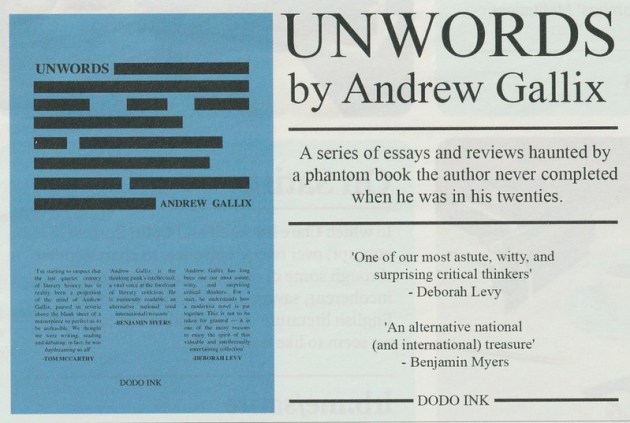
Most of what I write never lives up to my expectations artistically or commercially and I spent a lot of time (my twenties) haunted by the feeling this was a problem.
But some books change you and Unwords by Andrew Gallix was one of them. It is a litany of reimaginings, reframings of what the novel is. It’s 600 pages of “essays and reviews haunted by a phantom book the author never completed when he was in his twenties”. It’s — a paean to writers who do not feel the need to publish in order to affirm or reaffirm their status qua writers. Writers for whom literature is ‘the locus of a secret that should be preferred to the glory of making books’ (Maurice Blanchot). Writers of works whose potentiality never completely translates into actuality. Writers who believe in the existence of books they have imagined but never composed. Writers whose books keep on writing themselves after completion.
This list (about a third the length of Andrew Gallix’s in full) seems to me far truer than the narrow notion of a book as the discrete thing bought from shelves in shops or shoved hastily through letterboxes by harassed couriers. If not truer, then more palatable, digestible, and easier on the gut. Proper writers bear this out: the 90,000 words binned during drafting (Bernardine Evaristo), the 40-something full rewrites (Claire Keegan), the seven novels written before the ‘debut’ (Richard Milward)… To say writing is a mess is to say: creativity is creative. The problem isn’t my writing, it’s my expectations. My shallow idea of what the novel can be.
Reinventing the novel
Perhaps this is obvious: Unwords is unapologetically esoteric. But its punk intellectual aesthetic is playful, endearing, and thought-provoking. A collection of 20 years of words, it’s also unsettlingly repetitious. Gallix not only circles the same ideas but reuses the exact same quotes, rehashes the same phrases and sentence structures, plagiarises his own opinions. Haunts his own writing. This is the point. It’s the text he should have completed in his twenties. We are, all of us, writing our ur-novel, seeking the ideal of literature that made us want to wade among words in the first place. …

 ANDREW GALLIX