
W. J. Davies reviews Loren Ipsum in the Times Literary Supplement, 7 August 2026, p. 44:
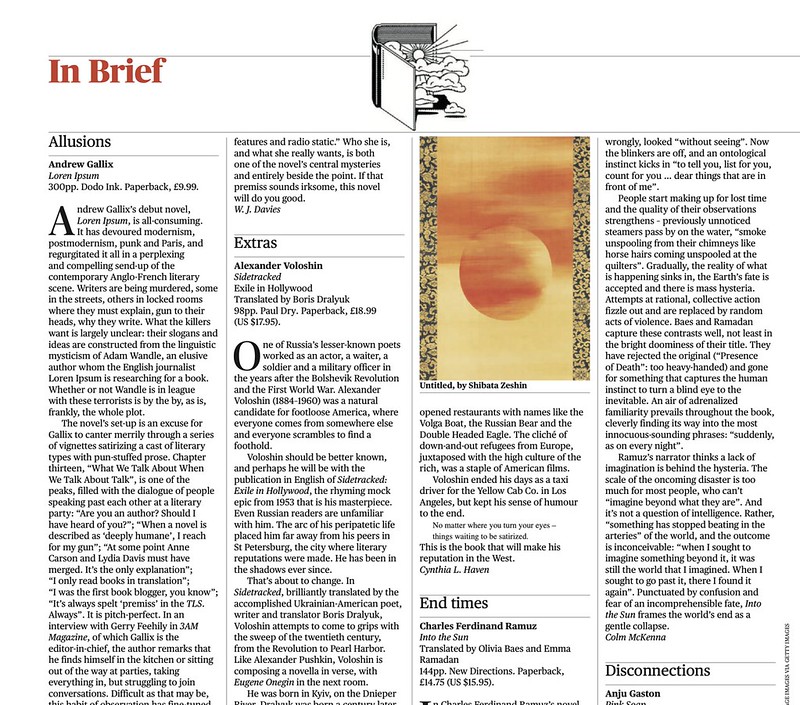
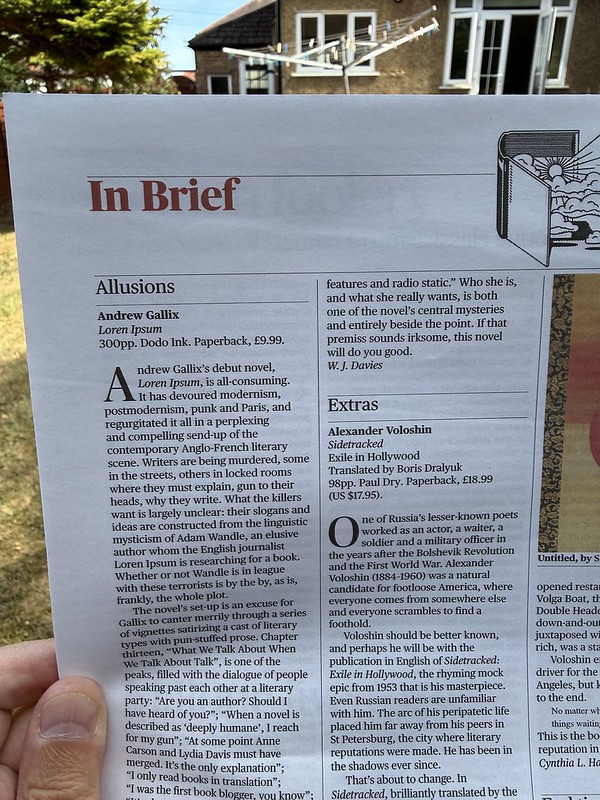
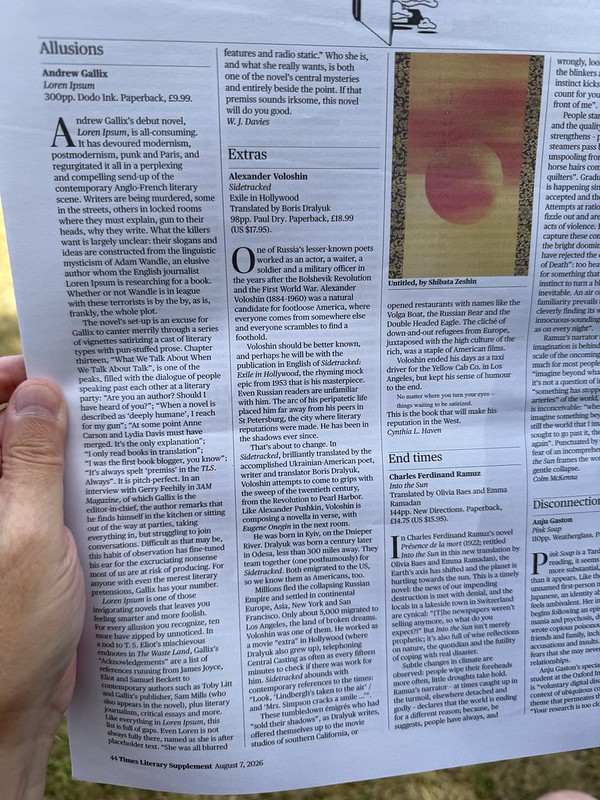
Andrew Gallix’s debut novel, Loren Ipsum, is all-consuming. It has devoured modernism, postmodernism, punk and Paris, and regurgitated it all in a perplexing and compelling send-up of the contemporary Anglo-French literary scene. Writers are being murdered, some in the streets, others in locked rooms where they must explain, gun to their heads, why they write. What the killers want is largely unclear: their slogans and ideas are constructed from the linguistic mysticism of Adam Wandle, an elusive author whom the English journalist Loren Ipsum is researching for a book. Whether or not Wandle is in league with these terrorists is by the by, as is, frankly, the whole plot.
The novel’s set-up is an excuse for Gallix to canter merrily through a series of vignettes satirizing a cast of literary types with pun-stuffed prose. Chapter thirteen, “What We Talk About When We Talk About Talk”, is one of the peaks, filled with the dialogue of people speaking past each other at a literary party: “Are you an author? Should I have heard of you?”; “When a novel is described as ‘deeply humane’, I reach for my gun”; “At some point Anne Carson and Lydia Davis must have merged. It’s the only explanation”; “I only read books in translation”; “I was the first book blogger, you know”; “It’s always spelt ‘premiss’ in the TLS. Always”. It is pitch-perfect. In an interview with Gerry Feehily in 3:AM Magazine, of which Gallix is the editor-in-chief, the author remarks that he finds himself in the kitchen or sitting out of the way at parties, taking everything in, but struggling to join conversations. Difficult as that may be, this habit of observation has fine-tuned his ear for the excruciating nonsense most of us are at risk of producing. For anyone with even the merest literary pretensions, Gallix has your number.
Loren Ipsum is one of those invigorating novels that leaves you feeling smarter and more foolish. For every allusion you recognize, ten more have zipped by unnoticed. In a nod to T. S. Eliot’s mischievous endnotes in The Waste Land, Gallix’s “Acknowledgements” are a list of references running from James Joyce, Eliot and Samuel Beckett to contemporary authors such as Toby Litt and Gallix’s publisher, Sam Mills (who also appears in the novel), plus literary journalism, critical essays and more. Like everything in Loren Ipsum, this list is full of gaps. Even Loren is not always fully there, named as she is after placeholder text. “She was all blurred features and radio static.” Who she is, and what she really wants, is both one of the novel’s central mysteries and entirely beside the point. If that premiss sounds irksome, this novel will do you good.

 ANDREW GALLIX