Surplus Will: the Stories of Andrew Gallix

The second chapter of Tom Bradley‘s Put It Down in a Book is devoted to a brilliant analysis of some of my short stories. It’s a slightly altered version of an essay that appeared in nthposition in 2007:

Tom Bradley. “Surplus Will: the Stories of Andrew Gallix.” Put It Down in a Book. Cedar Park, TX: 2009. 21-26.

A myriadminded man, Mr Best reminded.
Coleridge called him a myriadminded man…
His unremitting intellect is the hornmad Iago…

— James Joyce, Ulysses

Almost nobody has ever adequately evoked that gorgeous monster-hardon called Paris. But Andrew Gallix has nailed it to the wall like a luminiferous aether of opium jelly. I reckon he can do it because his language is lush and orgiastic as the topic it encompasses. Well up to the task, with plenty left over.

One is left hankering for more, for a whole book of his “Gelignite Dolly-Bird.” She calls for an unzipping and delectating till consciousness succumbs, spilling out into a larger frame: effusion, sheer tsunamic detail of sense and satire, where one gets to fuck and mock multiple celebrities, ankle deep in menses and jizz, all over million-franc Persian rugs.

Gallix’s heroine has only just awakened from a drunken swoon when she sees a silver-greasepainted faun tiptoeing among the piles of her fellow fucked out orgiasts. He has awakened her with his “muffled squishy sound as of manifold foreskins peeled back in unison,” as he despoils the flopped bodies, the semi-comatose pataphysicians, post-structuralists and “pointilllist ponces in pointy shoes.”

Such a silver faun must soon transmogrify into an incubus outright, and so he does. He coalesces into Beauty itself, personified with a dick attached, and he despoils Gallix’s heroine, to the accompaniment of this mentholated whisper: “You can only take so much Beauty…”

And that’s how much Beauty he gives us. The depravity of Gallix’s Paris is transfigured by paragraphs of sheer transcendent Beauty, given out with virtuosic offhandedness, as we ascend into Gallix’s galaxy: “…Fanny’s angelic features were bathed in gold, her halo melting like fondue cheese, and sparkling fruit carved in dewdrops dangled lasciviously from chandeliers like overripe testes.”

This Beauty, this silver faun, is a slender version of that other incubus whom we once saw tiptoeing and despoiling the flopped bodies at Shrewsbury, on the plain between Prince Hal’s camp and the rebels’. That far fatter faun, metallic with chain mail rather than silver greasepaint, was bent over a supine figure, too, like Gallix’s, and likewise whispered in its ear. But he didn’t say, “You can only take so much beauty.” Rather, he huffed, “if thou embowel me to-day, I’ll give you leave to powder me and eat me too tomorrow… with a new wound in your thigh, come you along with me.”

Falstaff’s embowelling cannibal woundings go direct and deep as Gallix’s Beauty, right down to our connective tissue. The former’s stomping ground was a blood-rank battlefield, while the latter’s is a rut-reeking Parisian parlour. But the deeper parallels hold true, those beauteous similarities obtain. As it is in Henry IV Part I, so it is in “Half-Hearted Confessions of a Gelignite Dolly-Bird”: every phrase of Gallix, every juxtaposition of words, is considered and balanced, faithful to the Shakespearean ideal. And, like Will, he waxes hilarious, at will. An almost random selection of one liners from another Gallixean rhapsody, “Forty Tiddly Winks,” will demonstrate:

God knows how much of his mortal coil ended up in the hoover on a weekly basis.

One of them could actually recall being buggered by Bulgakov, and a bloody good shag it was too…

…as if he had spent the night snogging a siren in the snot-green sea. (Not only the Bard, but Joyce is all through this, thoroughly assimilated and metabolized.)

In “Forty Tiddly Winks”, Gallix obliges so-called Judeo-Christian civilization with a hilariously despairing revision of the first several chapters of Genesis. His could be one of those great revisionist insights that penetrate and suffuse the collective awareness and spur new epochs: “The genocide of humanity itself.”

For Gallix, Adam has been replaced by Tim(e), the Miltonic lecturer who lives opposite Cerberus and is perpetually pursued by his own (Time’s) winged chariot. I can see why “Tim is out of joints,” and why he’s in such deep trouble with “them.” It’s because he has found out the most hideous secret of all: Eve and her hung hubby never ate of the tree in the first place, and were never as gods. Tim has Holocausted us all into a hole, Jew and gentile alike. Tim has run out.

The kiddy classroom in “Forty Tiddly Winks,” like the sixth chapter of Genesis, is peopled by critters procreatively bizarre enough to be identified with the Nephilim. Those tots prematurely pubesce, “ovulating wildly” as they gaze up at the forbidden fruit that oozes “Angel-come,” in a paragraph that, beyond its other-dimensional strangeness, is physically delicious, like so many other Gallixian structures.

Miss Ramsay, the kiddies’ teacher, is terrible and unparaphrasable. She is the trans-sexed YHWH, jealous, apple-forbidding, seeing that “it was good.” She skips ahead a few pages to peek at the end of the Good Book, and finds herself suddenly in the middle of Saint John’s rant. Seeing the Four Horsemen of the Apocalypse “beyond the pale, skimming candy-floss clouds on foot-propelled micro-scooters,” Miss Ramsay is turned into a serpent coiffed medusa — one of many magical metamorphoses in this strange Gallixy.

Those micro-scooters go beyond art and beyond criticism, and scoot into realms we can only speculate about. We can only tentatively hazard that something seems to be undulating, or breathing, behind these stories, as in the Hindus’ Unthinkable That — unadulterated strangeness.

This is my favorite kind of writing, all the more pleasurable for its rarity (almost nobody has the chops to do it): exploding with allusions to the big, the timeless, the Biblical, the Shakespearean, the Miltonic, the Joycean, claiming its own niche among those gorgeous monster hardons through sheer dint of artistic and intellectual doughtiness, and at the same time dancing light as a mote of hashish ash.

Nietzsche distinguished between artists who wring their works from a deficit of vitality, and those who blast forth from sheer surplus will. Andrew Gallix is clearly to be counted among the latter.

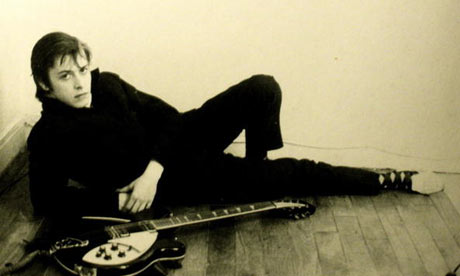
Remembering Jacno: France’s First Punk

This appeared on the Guardian Music Blog on 9 December 2009:

Remembering Jacno: France’s First Punk

The new wave icon, who died last month, founded the Parisian punk scene and pioneered French electropop

“Denis Denis, oh with your eyes so blue/Denis Denis, I’ve got a crush on you.” So sang Debbie Harry on Blondie’s first European hit in 1978. At the time, there were persistent rumours that the Denis in question was none other than Denis Quilliard — better known as Jacno — who died from cancer at the age of 52 last month. After embodying the post-punk years in France, Jacno (his soubriquet, which he acquired as a chain-smoking teenager, was a tribute to the graphic designer who created the iconic Gauloises cigarettes logo) had himself achieved cult status.

Despite being at the heart of the original Parisian punk scene, Jacno hated the herd mentality associated with such movements. One of his more recent songs is called “Je viens d’ailleurs” — “I Come from Elsewhere” — and in his book of interviews, he repeatedly refers to himself as a “martian” (which is quite fitting given his resemblance to Bowie circa The Man Who Fell to Earth).

Jacno met the beautiful Uruguayan Elli Medeiros (now Mme Brian de Palma) during a student demonstration in 1973. They became an item and formed the Stinky Toys (a reference to both Dinky Toys and New York Dolls). Following their first chaotic gig in 1976, the band acquired a reputation for debauched drunkenness that eventually alienated EMI who were about to sign them.

At Malcolm McLaren‘s behest, they played the 100 Club punk festival following which Elli appeared on the cover of Melody Maker. Their eponymous first album sold — as Jacno used to point out — as many copies as the Velvet Underground’s debut. And like the Velvets, their small fanbase included such luminaries as Andy Warhol. When he arrived at Orly airport in the summer of 1977 — having been invited to attend the inauguration of the Pompidou Centre — the Pope of Pop was sporting a conspicuous Jacno badge. Over the following days, Warhol would court the young musician assiduously (albeit unsuccessfully), famously painting his portrait on a restaurant tablecloth using a borrowed make-up kit.

On their second album, the Toys abandoned their original riff-heavy sound and explored colder, quirkier climes. The band disbanded after an Altamont-style gig during which a fan was killed by rampaging Hells Angels. It was time to move on.

In 1980 Jacno became the poster boy for the Jeunes Gens Modernes (“Modern Young Things”), a label coined by a local magazine to describe the resolutely elitist post-punk scene based around Le Rose Bonbon nightclub. He provided the soundtrack to Olivier Assayas‘s first short movie, including an instrumental entitled “Rectangle“, which no record company would release at first, although it ended up being a massive hit throughout Europe. The film also included a bittersweet track sung by Elli that marked the birth of the Elli & Jacno duo which would go on to sell millions of records until the couple split up in 1984.

Jacno also produced albums by some of France’s greatest stars like Jacques Higelin or Etienne Daho, but he will go down in history as a pioneer of electropop who anticipated the late 1990s French Touch. By playing schmaltzy 1960s “yéyé” tunes on Kraftwerk-style synthesisers, Jacno provided a perfect retro-futurist soundtrack to the melancholy innocence of adolescence. Paris will never be quite the same without him.

Silences

An excerpt from Tillie Olsen‘s Silences (1962):

Literary history and the present are dark with silences: some the silences for years by our acknowledged great; some silences hidden; some the ceasing to publish after one work appears; some the never coming to book form at all. What is it that happens with the creator, to the creative process, in that time? What are creation’s needs for full functioning? Without intention of or pretension to literary scholarship, I have had special need to learn all I could of this over the years, myself so nearly remaining mute and having to let writing die over and over again in me. These are not natural silences — what Keats called agonie ennuyeuse (the tedious agony) — that necessary time for renewal, lying fallow, gestation, in the natural cycle of creation. The silences I speak of here are unnatural: the unnatural thwarting of what struggles to come into being, but cannot. In the old, the obvious parallels: when the seed strikes stone; the soil will not sustain; the spring is false; the time is drought or blight or infestation; the frost comes premature. The great in achievement have known such silences — Thomas Hardy, Melville, Rimbaud, Gerard Manley Hopkins. They tell us little as to why or how the creative working atrophied and died in them — if ever it did. Kin to these years-long silences are the hidden silences; work aborted, deferred, denied — hidden by the work which does come to fruition. Hopkins rightfully belongs here; almost certainly William Blake; Jane Austen, Olive Schreiner, Theodore Dreiser, Willa Cather, Franz Kafka, Katherine Anne Porter, many other contemporary writers. Censorship silences. Deletions, omissions, abandonment of the medium (as with Hardy); paralyzing of capacity (as Dreiser’s ten-year stasis on Jennie Gerhardt after the storm against Sister Carrie). Publishers’ censorship, refusing subject matter or treatment as “not suitable” or “no market for.” Self-censorship. Religious, political censorship — sometimes spurring inventiveness — most often (read Dostoyevsky’s letters) a wearing attrition. The extreme of this: those writers physically silenced by governments. Isaac Babel, the years of imprisonment, what took place in him with what wanted to be written? Or in Oscar Wilde, who was not permitted even a pencil until the last months of his imprisonment? Other silences. The truly memorable poem, story, or book, then the writer ceasing to be published (As Jean Toomer, Cane; Henry Roth, Call It Sleep; Edith Summers Kelley, Weeds). Was one work all the writers had in them (life too thin for pressure of material, renewal) and the respect for literature too great to repeat themselves? Was it “the knife of the perfectionist attitude in art and life” at their throat? Were the conditions not present for establishing the habits of creativity (a young Colette who lacked a Willy to lock her in her room each day)? Or — as instanced over and over — other claims, other responsibilities so writing could not be first? (The writer of a class, sex, color still marginal in literature, and whose coming to written voice at all against complex odds is exhausting achievement.) It is an eloquent commentary that this one-book silence has been true of most black writers, only eleven in the hundred years since 1850 have published novels more than twice. There is a prevalent silence I pass by quickly, the absence of creativity where it once had been; the ceasing to create literature, though the books may keep coming out year after year. That suicide of the creative process Hemingway describes so accurately in “The Snows of Kilimanjaro.” He had destroyed his talent himself — by not using it, by betrayals of himself and what he believed in, by drinking so much that he blunted the edge of his perceptions, by laziness, by sloth, by snobbery, by hook and by crook, selling vitality, trading it for security, for comfort. Almost unnoted are the foreground silences, before the achievement. George Eliot, Joseph Conrad, Isak Dinesen, Sherwood Anderson, Dorothy Richardson, Elizabeth Madox Roberts, A. E. Coppard, Angus Wilson, Joyce Caryl. All close to, or in their forties before they came published writers; Lampedusa, Maria Dermout (The Ten Thousand Things). Laura Ingalls Wilder, the “children’s writer,” in their sixties. Very close to this last grouping are the silences where the lives never came to writing. Among these, the mute inglorious Miltons: those whose waking hours are all struggle for existence; the barely educated; the illiterate; women. Their silence the silence of centuries as to how life was, is, for most of humanity.

Literary Silences

Tom McCartan, “What Bolaño Read: The Literature of Silence,” MobyLives 7 December 2009:

Roberto Bolaño is famously the author of two very long novels. The English edition of 2666 is 912 pages, The Savage Detectives, 672 pages. And though Bolaño died prematurely at age fifty, he produced more than 25 published volumes. A stash of unpublished manuscripts was discovered earlier this year. He was, simply, prolific.

But Bolaño was deeply interested in writers who chose not to produce or publish, as well as writers who were prematurely silenced. In an interview from 2005 in the Spanish literary journal Turia, Bolaño declared that “There are literary silences.” And he connected a number of his favorite authors to this notion.

Kafka’s, for example, which is a silence that cannot be. When he asks that his papers be burned, Kafka is opting for silence, opting for a literary silence, all in a literary era. That is to say, he was completely moral. Kafka’s literature, aside from being the best work, the highest literary work of the 20th century, is of an extreme morality and of an extreme gentility, things that usually do not go together either.”

Another figure that Bolaño raised was Juan Rulfo, whose two books are among the most influential works of 20th century Mexican literature. After publishing the short story collection The Burning Plain (1953) and the novel Pedro Párama (1955), Rulfo (who lived from 1917 to 1986) stopped publishing narrative fiction, despite the enormous critical success of the books. Both Faulkner and García Márquez admitted to having been influenced by his prose.

Rulfo’s silence, according to Bolaño, “is obedient to something so quotidian that explaining it is a waste of time. There are several versions: One told by Monterroso is that Rulfo had an uncle so-and-so who told him stories and when Rulfo was asked why he didn’t write anymore, his answer was that his uncle so-and-so had died. And I believe it too…Rulfo stopped writing because he had already written everything he wanted to write and because he sees himself incapable of writing anything better, he simply stops… After dessert, what the hell are you going to eat?”

In the Turia interview, Bolaño also touched on Rimbaud, who famously gave up poetry at 20 for a life of gun-running, saying “Rimbaud would probably have been able to write something much better, which is to say bringing his words up even higher, but his is a silence that raises questions for Westerners.”

And, finally, the silence of passing… perhaps the only kind to which Bolaño succumbed: “There [also] stands the silence of Georg Büchner for example. He died at 25 or 24 years of age, he leaves behind three or four stage plays, masterworks. One of them is Woyzeck, an absolute masterwork…What might have happened had Büchner not died; what kind of writer might he have been?”

Quotes

“I had always maintained a difficult relationship with phones, a combination of repulsion, squeamishness, and lifelong fear, an irrepressible phobia that I no longer even tried to suppress but had finally come to terms with, handling it by using them as little as possible. I had always known more or less unconsciously that this fear was tied to death — maybe to sex and death — but never, before this night, never had I been given such an uncontestable confirmation that there is absolutely some secret alchemy connecting phones to death.”
Jean-Philippe Toussaint, Running Away, 2005

Only Disconnect

This was published on the Flux magazine website on 13 November 2009:

Only Disconnect

Andrew Gallix on this year’s new literary model

“All of this intellect stuff is fine as a consolation (which is how it developed in the first place: Socrates not being Alcibiades),” claims the narrator of an early Toby Litt story. He has a point, of course. Jean-Paul Sartre, for instance, famously confided that he had become a philosopher in order to make up for his ugliness and attract women. Conversely, ghostwriters keep churning out books for celebrity airheads in search of intellectual credibility. And then there’s Gavin James Bower. The author of Dazed & Aroused is the stuff publishers’ wet dreams are made of: a model turned writer; Socrates and Alcibiades rolled into one. “I’m too pretty to be a serious novelist but not pretty enough to be a top model,” he aphorises, “I have no consolation.” Call me jealous, but I have no sympathy.

Bower is far more than just another clothes horse who can string a few sentences together. He started putting pen to paper when he was still reading history at university. Among his influences, he cites Fitzgerald, Burroughs, Ellis, Marx, Sartre and Camus, but also Flux magazine editor Lee Taylor, who gave him his first break: “He was one of the first people who got me excited about being a writer myself”. An internship at Dazed & Confused took an unexpected turn when he was encouraged to go into modelling rather than journalism. After a year or so, his career went the way of the “skinny-jeans-and-winklepickers look,” but not before it had provided him with enough material for a stunning debut novel.

Having walked the (cat)walk, Gavin James Bower can talk authentically about inauthenticity. Alex, the narrator and anti-hero of Dazed & Aroused, slides down the surface of things, barely batting an eyelid when he is fellated by his father’s gorgeous girlfriend. In a rare moment of insight, he realises that the “nauseating truth” about a world in which anything is possible is that nothing is also a distinct possibility. The key to the book probably lies in this oscillation between surfeit and emptiness. Instead of leading to objectivity, Alex’s psychopathological detachment conjures up nightmarish dreamscapes — unreal cities — in which glamorous models are for ever tripping over the vagrants who litter the streets. From the ranters whose messages are always incomprehensible to the news bulletins invariably watched on mute, information overload leads to communication breakdown. The protagonist is bombarded by messages — via leaflets, billboards, freesheets, bumper stickers, graffiti or even fridge magnets — but they remain mere juxtapositions. On Oxford Street, for instance, he passes two men holding placards: “One sells Jesus to passers-by while the other advertises a buffet lunch deal”. The only point, if there is one, is that everything has been commodified. Gavin James Bower describes his character as a “personification of the capitalist social relation — an estranged individual who exploits others and refuses to connect to anything”. Yet, in spite of all that, he remains strangely alluring. Even when it comes to coke, the devil has all the best lines.

Dazed & Aroused is published by Quartet Books.

One Thousand Cranes Can Be Wrong

This piece was meant to appear on the website of a magazine in November 2009, but the artist who is the subject of the article objected to certain passages. Here it is, for the record, minus the artist’s name:

One Thousand Cranes Can Be Wrong

An introduction to **’s “action painting of the heart”

“I want to paint massive canvases so that I can stand in front of them and sense a wave of shade rising high above my head and it feels as if it will break and come crashing down on top of me with surf and sand like the sea.” ** often resorts to maritime similes when describing his elemental artwork. “Each piece,” he says, “is as different as each swell of the ocean”. Not only is this perfectly true — the techniques he employs range from candle-wax dripping to origami via oil painting and photography — but also most apposite for one born in Brighton and bred in nearby Worthing. Like Venus, his giant oil monochromes seem to have sprung fully-formed from the ocean spray. There is also this sense in much of *’s work that the tide is slowly rising. It is both a threat and a promise.

The (noble) savage beauty of the Hand Bursts series — which culminates in a bloody mess that could incarnadine the multitudinous seas — conjures up the fleeting patterns * creates on sundry beaches and then captures on camera. The Lines You Should Not Cross are vicious red pencil renditions of the artist’s bouts of self-harming, but they are also reminiscent of those lines literally drawn in the sand that will be, as it were, littorally washed away. The vibrancy of *’s works often comes from this tension between the compulsion to freeze moments in time (the large paintings are even entitled Frozen Moments in Texture) and the desire to dissolve into an eternal here and now. One of the most poignant pictures is that of hundreds of footprints left by so many Man Fridays on some deserted, seemingly godforsaken South Coast beach. Have all the holidaymakers gone home? Are we looking at fossilised vestiges of prehistoric humanity or the posthistoric consequences of Armageddon? Stone Age or Stoned Age? All we can be sure of is that the image is full of emptiness, achingly so. * shores these fragments against his — indeed our — ruin, but that, I suspect, is only part of the story. I can see him — all at sea on Worthing or Brighton sands — connecting nothing with nothing. Soon, however, the slate will be wiped clean and the canvas will heal: the world will return to its pristine, prelapsarian state. He closes his eyes, sensing a wave of shade rising high above his head… “We are the sea,” he writes, in his beautifully exalted, seer-like prose, “rushing in and out, forever changing as we alter with each swell of the waves. We are the sea.”

I first met ** at a reading I had co-organised at London’s Aquarium Gallery back in 2005 to showcase the thriving underground literary scene. He was just a member of the audience, but most female eyes were on him owing to his dashing Clark Gable looks. I remember a young lady in thigh-high boots gushing to no one in particular that he was the most handsome man she had ever seen. At the time, Coleman was shooting videos for up-and-coming bands and organising events at a trendy Shoreditch pub. He was also convalescing from a suitably ill-fated affair with a Norwegian junkie he had fallen madly in love with while exploring South East Asia. Soon he would gain a degree of notoriety as the Lord of the Unbuttoned Flies; a kind of Divine Marquis for the Offbeat Generation. Through his prolific priapic prose, he came across as the bastard offspring of Valmont and Sid James — the missing link between libertinage and the saucy seaside postcard.

Deep down, * had always been an artist — rather than just a peddler of literary smut or a budding avant-garde filmmaker — but it took the mother of all depressions to open up his eyes. His breakdown acted like a conversion; suddenly, he was born again. “The intensity, the violence of what I went through completely changed me,” he explains. ‘Intensity’ is a keyword here. *’s artwork is the product of “heightened states of feelings,” hence its air of jubilant inevitability. This, one senses, is a matter of life and death rather than a mere distraction. The canvas is a “battleground” on which the artist squares up to his demons, wielding the palette knife like “a sword”. *, however, is at pains to point out that depression is only the catalyst for his “action painting of the heart,” not its subject.

“I paint from within. I paint what I am.” Contrary to appearances, * is in no danger of disappearing up his own ars rhetorica. The result of his painting “from within” never feels introverted at all. In fact, it looks remarkably like without. Reflecting some kind of inverted pathetic fallacy, mindscapes are expressed as landscapes. Escaping the petty confines of the self is what this is all about. The aforementioned Hand Bursts could be the bloody handprints left by cavemen pounding away at the walls of their caves. When superimposed, they begin to resemble the graceful beating of wings. This metamorphosis reflects the artist’s desire to shed “the thing that wraps an anchor around the self and lets it drop into the dark abyss of fear” — an idea best expressed by his origami installations.

The Cry of a Thousand Cranes — red, blue and yellow paper birds hanging in the Saatchi Gallery or from a tree in the artist’s back garden — was inspired by the old Japanese legend according to which whoever folds 1,000 paper cranes will be granted a wish. When I ask him if he believes in this legend, — just smiles. Then he says, “I want yellows and blues and reds, I want to see them everywhere I walk, all exploding like fireworks”. We both stare in silence at the cranes gently swaying in the breeze.

Colossal Youth (Abridged Version)

409692229_e75d124f7c_t

An abridged version of “Colossal Youth,” my piece on Arthur Cravan, was posted on the Flux magazine website on Friday 13 November 2009:

Colossal Youth

You may never have heard of him, but Arthur Cravan was one of the most influential writers of the 20th century. The fact that he wrote precious little — and certainly nothing of any lasting literary value — should not be held against him. Quite the contrary, in fact. Oscar Wilde’s nephew put all his genius into his life, turning it into a magnum opus full of sound and fury, high farce and convulsive beauty. In so doing, he influenced every single major avant-garde movement from Dada onwards. Cravan was the original Sid Vicious, the blueprint for all the subsequent outrages committed in the name of art. “Let me state once and for all: I do not wish to be civilised,” he wrote — and he meant it, man.

Arthur Cravan (or Fabian Lloyd, to call him by his real name) was born in Switzerland in 1887. After being expelled from an English military academy for spanking a teacher, he relocated to bohemian Paris where he partied hard with the likes of Blaise Cendrars and managed to become France’s Heavyweight Champion without throwing a single punch.

Cravan first gained the notoriety he so craved through Maintenant (“Now”), the literary journal in which he wrote everything under various noms de plume. Sourced from a butcher’s shop, the very paper it was printed on highlighted his utter contempt for belles-lettres. He filled an entire issue with gratuitous insults aimed at the artists taking part in the 1914 Independents Exhibition. As a result, he was challenged to a duel by the poet Apollinaire and almost lynched by a posse of avant-garde painters. Result.

Art, for Cravan, was essentially boxing by another means, as proved by the infamous conferences he gave in Paris and New York. During these happenings, he would knock back absinthe, perform drunken stripteases, shout abuse at the spectators and even fire gunshots over their heads. His final Parisian gig descended into pandemonium when he failed to commit suicide as advertised.

The onset of the First World War marked the beginning of a convoluted vanishing act that led him — in various guises — from Paris to Mexico where he disappeared at sea on a drunken boat of his own making. His body was never found. For years to come, he would continue to be spotted throughout the world. Arthur Cravan is still at large.