
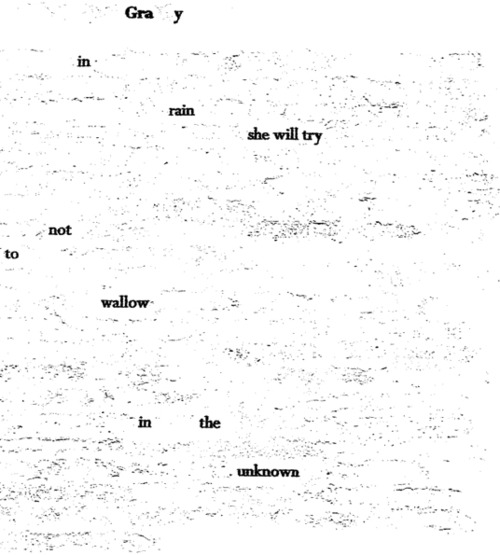
Bradley Harrison‘s erasure poetry
Jonathan Jones, “Lost Art Comes Back to Haunt Us,” The Guardian 6 June 2012
The art that exists is a tiny fraction of the art that is lost. Vanished works outnumber the surviving masterpieces in museums, just as the dead outnumber the living. Where are the paintings of Apelles, court artist to Alexander the Great, who was said to be the greatest artist of all time? Gone forever. Not a fragment of any of his paintings survives. Meanwhile, the reputation of Gustav Klimt is forever scarred by the destruction of some of his most serious works at the end of the second world war.
Lost art exerts a fascination all of its own. Like ghostly mutterings in galleries, the images of vanished works linger behind the surviving corpus of art. Ghosts of Leonardo da Vinci’s Battle of Anghiari haunt Salvador Dali’s painting Spain. Holbein’s destroyed Whitehall mural is commemorated by his eerie full-size drawing of Henry VIII.
In the 20th century, art’s relationship with disappearance got stranger than ever. Some artists made works that were designed to disappear — Robert Smithson’s Spiral Jetty sank into the landscape before re-emerging in recent years.
[…] It hurts to lose art. Lucian Freud never gave up looking for a portrait of Francis Bacon by him that was stolen in Berlin. He made a compelling Wanted poster appealing for its return — Freud’s only work of conceptual art. The loss was evidently painful: the painting was an intimate record of his friend and equal, and eerily vanished from Berlin, where Freud had spent his early years. Berlin was his lost city.
Lost art is fascinating because it epitomises everything else that is lost, as well. The miracle of its occasional recovery is an image of redemption.
Karyn Z. Sproles, Desiring Women: The Parthnership of Virginia Woolf and Vita Sackville-West (University of Toronto Press, 2006. 151-152)
In preparing for the publication of To the Lighthouse, the Hogarth Press made a dummy copy of the novel to see how it would look. Blank inside, but in all other respects identical to the real thing, the dumb volume was sent by Woolf to Sackville-West inscribed ‘In my opinion the best novel I have ever written.’ Instantly regretting this gesture, she wrote: ‘Dear donkey West, Did you understand that when I wrote it was my best book I merely meant because all the pages were empty? A joke, a feeble joke’ (9 May 1927, 3:372). Sackville-West responded: ‘But of course I realised it was a joke; what do you take me for? a real donkey?’ (10 May 1927, 195; emphasis original).
Sent under the cover of a legitimate book jacket, Woolf’s blank book might be her best work. What is not written might be the only place in which to read her desire. The letters speak of this struggle. They demonstrate it best when describing seemingly mundane events of their daily lives, which both women do with an eye for comic detail that sometimes obscures the profoundly symbolic nature of the scenes they describe.
…They tease about ‘dumb letters’ — letters that speak not of desire but of the banal details of their lives apart. Woolf writes that hers ‘is not a dumb letter. Dogs letters are’ (15 Jan. 1926, 3:230). Responding that she had arranged to meet Woolf later that week, Sackville-West writes: ‘So you see that if my letters are dumb, my actions aren’t’ (17 Jan. 1926, 86). Speaking louder than letters, actions facilitate desire. Letters are dumb, silent, on the subject.
Steven Millhauser, “History of a Disturbance,” Dangerous Laughter
Not to speak, not to form words, not to think, not to smear the world with sentences — it was like the release of a band of metal tightening around my skull. [via.]
Ulises Carrión, “The New Art of Making Books,” Kontexts no. 6-7, 1975
The most beautiful and perfect book in the world is a book with only blank pages, in the same way that the most complete language is that which lies beyond all that the words of a man can say. Every book of the new art is searching after that book of absolute whiteness, in the same way that every poem searches for silence.
Emilie
Emili
Emil
Emi
Em
E
e-i-l-i-m-E
Valentin Vermot deleted her name, one letter at a time, until he was back where he had begun. There was no escape.
George Steiner, My Unwritten Books
Awesome is the God who is not.
Elizabeth Day, “Sadie Jones: ‘You Imagine a Cathedral and on the Page it’s a Garden Shed’,” The Observer 1 April 2012
“I’m never happy with what I’ve written,” she says. “You imagine, before you start, there’s a cathedral, and the moment it starts on the page, it’s a garden shed. And then you just try to make it the best shed you can.”
Doug Beube, Reunification: The Grand Design, 1996 (altered book, 9 x 11 x 4 in.)

Using the original title, ‘The Grand Design,’ by Franz Josef Strauss, portions of the book’s printed matter are excised by drilling out all the words one at a time, a process that displaces the text’s narrative content of unifying both Germany and Europe. Overlapping pages of hollowed out letters with frayed edges remain as ghostly shadows of the text’s former shape. Since the obliterated words can no longer be read, the book becomes a memory of a memory. What we see in place of the original text is a mysterious, fragmented calligraphy of broken words. Each page is a palindrome and palimpsest, a white veil through which the underlying page is glimpsed. When a page is turned the veil remains. A visual — rather than a linear — read is necessary to understand the meta-language created by this altered syntax of disparate letters and empty spaces.
Just as the black ink has been erased and ripped away from the white paper of pages of the book, leaving a veil of frayed edges, when a nation is ethnically cleansed in order to create one homogeneous society, devoid of specific racial groups, the fabric of a nation is forever torn and lost, but never forgotten (via).
 ANDREW GALLIX