Young Writers Les Décalés Are Upsetting The French Literary Establishment

This was published in the September 2008 issue of Dazed & Confused (vol. 2 issue 65, p. 76):

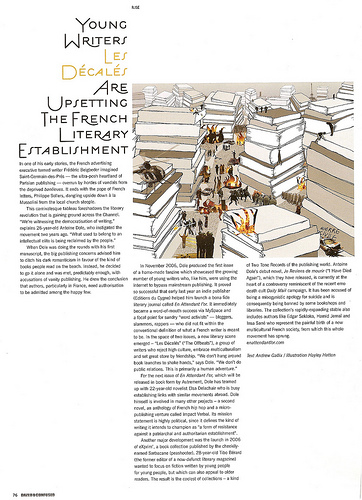
Young Writers Les Décalés Are Upsetting the French Literary Establishment

In one of his early stories, the French advertising executive turned writer Frédéric Beigbeder imagined Saint-Germain-des-Prés — the ultra-posh heartland of Parisian publishing — overrun by hordes of vandals from the deprived banlieues. It ends with the pope of French letters, Philippe Sollers, dangling upside down à la Mussolini from the local church steeple.

This carnivalesque tableau foreshadows the literary revolution that is gaining ground across the Channel. “We’re witnessing the democratisation of writing,” explains 26-year-old Antoine Dole who instigated the movement two years ago. “What used to belong to an intellectual elite is being reclaimed by the people”.

When Dole was doing the rounds with his first manuscript, the big publishing concerns advised him to ditch his dark romanticism in favour of the kind of books people read on the beach. Instead, he decided to go it alone and was met, predictably enough, with accusations of vanity publishing. He drew the conclusion that authors, particularly in France, need authorisation to be admitted among the happy few.

In November 2006, Dole produced the first issue of a home-made fanzine which showcased the growing number of young writers who, like him, were using the internet to bypass mainstream publishing. It proved so successful that, early last year, an indie publisher (Editions du Cygne) helped him launch a bona fide literary journal called En Attendant l’or. It immediately became a word-of-mouth success via MySpace and a focal point for sundry “word activists” — bloggers, slammers, rappers — who did not fit within the conventional definition of what a French writer is meant to be. In the space of two issues, a new literary scene emerged — “Les Décalés” (“The Offbeats”), a group of writers who reject high culture, embrace multiculturalism and set great store by friendship. “We don’t hang around book launches to shake hands,” says Dole. “We don’t do public relations. This is primarily a human adventure”.

For the next issue of En Attendant l’or, which will be released in book form by Autrement, Dole has teamed up with 22-year-old novelist Elsa Delachair who is busy establishing links with similar movements abroad. Dole himself is involved in many other projects — a second novel, an anthology of French hip hop and a micro-publishing venture called Impact Verbal. Its mission statement is highly political, since it defines the kind of writing it intends to champion as “a form of resistance against a patriarchal and authoritarian establishment”.

Another major development was the launch in 2006 of eXprim’, a book collection published by the cheekily-named Sarbacane (peashooter). 28-year-old Tibo Bérard (the former editor of a now-defunct literary magazine) wanted to focus on fiction written by young people for young people, but which can also appeal to older readers. The result is the coolest of collections — a kind of Two Tone Records of the publishing world. Antoine Dole’s debut novel, Je Reviens de mourir (“I Have Died Again”), which they have released, is currently at the heart of a controversy reminiscent of the recent emo death cult Daily Mail campaign. It has been accused of being a misogynistic apology for suicide and is consequently being banned by some bookshops and libraries. The collection’s rapidly-expanding stable also includes authors like Edgar Sekloka, Hamid Jemaï and Insa Sané who represent the painful birth of a new multicultural French society, from which this whole movement has sprung.

(Illustration by Hayley Hutton.)

Albert Cossery’s Last Siesta in Paris

This appeared in Dazed Digital on 16 July 2008:

Albert Cossery’s Last Siesta in Paris

The cult author, famous for his indolence and libido, closes his eyes for the last time

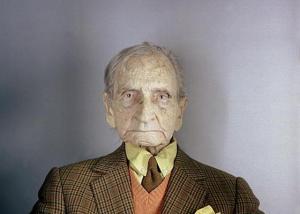
Albert Cossery was a lazy old sod — a relic from the past who looked, of late, as if he felt he had outstayed his welcome. Always dressed to the nines, this dandy anarchist could be observed sitting in the legendary Café de Flore, casting an Olympian eye over the aimless crowds outside, biding his time. His militant idleness coupled with a strange mummified existence blurred the boundary between life and death for so long that his passing away, last month, could almost have gone unnoticed — had he not been a living legend.

The cult author moved to Paris from his native Cairo in 1945 and soon became a fixture of the Saint-Germain-des-Prés boho scene. His friends included some of the most influential writers and artists of the last century: Sartre, Genet, Vian, Queneau, Tzara, Giacometti and others. Lawrence Durrell championed his first book — a brilliant collection of short stories entitled Men God Forgot (1940) — and Henry Miller ensured it got published Stateside. He even picked up girls — lots of them — with Albert Camus. According to legend (that word again), Durrell informed the American secret services that Cossery could not possibly be a spy, as they suspected, because he spent most of his time shagging. By the early 90s, he was claiming more than 3,000 female conquests.

Sex aside, Cossery never believed in exerting himself. His very name evokes divine indolence: avoir la cosse is a colloquial expression meaning to be bone idle. True to his moniker, he spent his life resisting any work ethic that prevents people from enjoying “the Edenic simplicity of the world”. He often showed off his delicate hands, explaining, somewhat provocatively, that they had not toiled in 2,000 years. And when a journalist inevitably enquired why he wrote, he answered that he hoped his books would prompt readers to pack in their jobs.

For Cossery, idleness was more than a way of life. It afforded him the greatest luxury of all: the time to contemplate — to think or observe — and therefore the opportunity to be fully alive, “minute by minute”. This accounts for the constant connection he establishes between destitution and nobility, which is reflected, for instance, in the beautiful descriptions of glistening gobbets of spit, or light playing upon puddles of piss. The author claimed that he always felt like the son of a king, even when he was penniless — or rather, especially when he was penniless, just like the university professor in Proud Beggars (1955) who finally feels like a million dollars after electing to become a pauper. The lesson here is that those who reject (or are deprived of) material wealth gain access to a heightened state of consciousness. When Cossery died, the French Culture Minister described him as a “prince”, even though he owned little more than the clogs he had just popped.

All his works (for want of a more congenial word) focus on the members of this aristocratic underclass — the holy hooligans who wear their hashish-smoke halos raffishly askew and jump through the eyes of needles like so many biblical camels. Cossery was not just their poet laureate: he considered himself as a fully unpaid-up member of the idle poor and certainly put his lack of money where his mouth was. Long before downshifting became trendy among trustafarians, he checked into a small hotel room and lived off handouts and publishing rights. Not so much because property is theft but because it can rob you of your soul.

Cossery’s anti-work ethos and all-round laziness only partly account for his limited output (a mere eight books in sixty-five years). He was a typical Platonic author who saw his works as imperfect reflections of an unattainable ideal. As such, he despised hackwork, often only producing a single perfectly-honed sentence a week. No wonder his last novel — a slim volume called Les Couleurs de l’infamie (1999) — was fifteen years in the making.

This unattainable literary ideal is symbolised by his characters’ noble dreams. Cossery’s anti-heroes are for ever lost in sleep or reverie, as if they were hankering after some prelapsarian state of perfect vegetative bliss. In the aptly-titled The Lazy Ones (1948), a character remains bedridden, out of choice, for a whole year; another opts for celibacy in order to preserve his sacred sleep patterns. In an early short story, the inhabitants of an impoverished neighbourhood are prepared to kill off those who have the nerve to disturb their slumber before noon. Some characters are even afraid to move lest they should break the magic spell of their daydreams. The author himself revelled in the out-of-time experience afforded by sleep, which is hardly surprising given that what he called living “minute by minute” meant, in practice, living the same minute over and over again Groudhog Day-style.

Time stood still for Cossery as soon as he settled in Paris. In 1945, he checked in to a small room in a hotel called La Louisiane on Rue de Seine and remained there until his recent demise. Every day, he would get up at noon (like his characters), dress up in his habitual dandified fashion and make his way to the Brasserie Lipp for a spot of lunch. From there, he would usually repair to the Café de Flore or the Deux Magots before going home for his all-important siesta. Repeat ad infinitum. A similar case of arrested development can be found in the books, which are all, without exception, set in the Middle East, although Cossery, of course, spent most of his life in France. His French style even mimics the Arabic of his youth. One of the most haunting passages in Men God Forgot is the description of a crude fresco representing a motionless sailing boat on the Nile, frozen in time, refusing to move on.

Cossery described sleep as “death’s brother” and one can wonder if this refusal to turn his back on the glory days of Saint-Germain-des-Prés did not hide a desire for the big sleep: the eternal here and now. The author’s later years give a distinct impression of slow exhaustion. In 1998, he fell silent as a result of cancer and the following year he stopped writing, claiming that he no longer had anything to say.

For almost fifteen years (the time it took him to write his last book), I lived just up the road from Cossery. Whenever I got home in the small hours — usually a little worse for wear — my thoughts would turn to the “Voltaire of the Nile” sleeping in his diminutive mausoleum. It was a comforting thought, like a sailing boat that will never sail away.

The next time you walk down Rue de Seine, tread lightly: Albert Cossery sleeps on. Shh!

13994

Albert Cossery Loved Men God Forgot

This appeared in Guardian Books on 8 July 2008:

Albert Cossery Loved Men God Forgot

The Egyptian lived radically lazily on the Left Bank, challenging social norms with books devoid of materialism and ambition

Albert Cossery was a living legend — until he died a few weeks ago. The Egyptian author was one of the last links to the glory days when Paris was the capital of world culture, with Saint-Germain-des-Prés its swinging epicentre.

Having already sampled the louche pleasures of interbellum Montparnasse, Cossery left Cairo in 1945 and relocated to the Left Bank where he hung out on a nightly basis with Genet, Giacometti, Gréco, Queneau, Sartre, Tzara, Vian et al. His first book, Men God Forgot, was published in the States courtesy of Henry Miller, one of his biggest fans. Accompanied by Camus, he cruised the streets of the Latin Quarter, soon acquiring something of a reputation as a Levantine lover. Indeed, by the early 90s he was boasting that he had bedded more than 3,000 women which, if true, would put him right up there in Simenon’s priapic super league. When the American secret services suspected him of being a spy, Lawrence Durrell — another close friend — pointed out that he was far too busy shagging.

The secret services had good reason to be wary of this dapper anarchist, often dubbed the “Voltaire of the Nile”. His caustic satire burned like the desert sun, undermining all forms of authority. In La Violence et la Dérision (unfortunately not translated into English) freedom fighters use mockery and contempt, not violence, as political weapons against state tyranny.

All his life, Cossery sided with those he felt God had forgotten: petty thieves, pretty prostitutes, exploited workers and hungry vagrants. He despised materialism and eschewed the rat race. In Proud Beggars (1955), usually considered his masterpiece, a university professor finds peace of mind by becoming a bum, proving that beggars can be choosers. In The Lazy Ones (1948), a character stays in bed, out of choice, for a whole year. Another decides, on reflection, not to take a wife for fear she might disrupt his precious sleep patterns. In an early short story, the inhabitants of an impoverished neighbourhood even take up arms against all those who prevent them from snoozing in peace until midday.

For the author and his lovable rogue’s gallery, sleep, daydreams and hashish-induced reverie are endowed with mystical qualities. Idleness is more than a way of life. It offers the greatest luxury of all: time to think and therefore the chance to be fully alive, “minute by minute”. The overt message of these people whom God has forgotten (but who themselves have not forgotten God) is that paradise is not lost, but most of us are too busy to bask in “the Edenic simplicity of the world”.

There is, however, a darker covert message. In practice, living “minute by minute” meant living the same minute over and over again. Time seems to have stood still for Cossery as soon as he settled in Paris. In 1945, he checked into a small room in a hotel called La Louisiane on Rue de Seine and remained there until his death. Every day, he got up at noon (like his characters), dressed up in his habitual dandified fashion and made his way to the Brasserie Lipp for a spot of lunch. From there, he usually repaired to the Flore or the Deux Magots where he would cast an Olympian eye over the drones passing by. Then it was time for his all-important siesta. Repeat ad infinitum. Cossery, who once described sleep as “death’s brother”, lived a strange, mummified existence, reminiscent of Beckett’s “sleep till death/ healeth/ come ease/ this life disease”.

Spam Lit: The Silver Lining of Junk Mail?

“misfires”

This appeared in Guardian Books on 1 July 2008:

Spam Lit: The Silver Lining of Junk Mail?

Spammers embed chunks of literary classics to dodge email filters. Weird/wonderful nuggets are found in inboxes. ‘Spoetry’ is born

Ever since the dawn of the world wide web, to give it its old-fashioned moniker, our communications have been beset by spam. We ignore it almost as much as we receive it, but around the turn of the century Mammon’s pursuit of our attention led to an extraordinary coupling with the Muse.

Here’s what happened. In order to bypass increasingly efficient filters, spammers began embedding blocks of text — often pilfered from great literary works via Project Gutenberg — in their junk mail. Techniques like the Dissociated Press algorithm were employed to randomly generate new, essentially meaningless texts or text collages (“word salads”) so that each message would seem unique. Lee Ranaldo has compared the outcome to a “dictionary exploded”. Another early aficionado, Ben Myers, observed that “it was as if the text had somehow been remixed and shat out down the wires of modernity”. “Spam Lit”, as Jesse Glass dubbed it in 2002, uncannily mirrored bona fide literary experiments that were taking place simultaneously: Jeff Noon‘s exploration — through textual sampling and remixing — of “metamorphiction” in Cobralingus; Jeff Harrison‘s aleatoric poems based on Markov chains; or even Kenji Siratori‘s baffling cyber-gibberish.

Equally intriguing was the trend Wired magazine identified in 2006 as “empty spam”: Spam Lit messages that were, paradoxically, all lit and no spam. The consensus among geeks is that they were probably “misfires” due to faulty server connections. To their recipients, however, these instances of found poetry — often containing nuggets of unwitting but unalloyed beauty — seemed, in Myers’ words, like “scriptures from the future” or “postcards from another planet”. Discovering them in your inbox made you feel like Cocteau‘s Orpheus picking up cryptic poetic messages from the underworld on his car radio.

No wonder, then, that Spam Lit should have inspired the only new literary genre of the early 21st century (if we exclude crimping). The earliest examples of spoetry on record date back to 1999. A pioneering annual competition was even established by Satire Wire the following year. By 2003, when the BBC picked up on the phenomenon, it was already quite clear that writers were approaching spoetry in very different ways – an observation confirmed by Morton Hurley‘s Anthology of Spam Poetry (2007). Some, like Kristin Thomas only used the subject lines of spam messages; others were content to cut, paste and add their names à la Duchamp. Myers, who has just published a collection entitled Spam (Email Inspired Poetry) believes, for his part, that the secret lies in the editing: “A spam poet is as much an editor as a bard“. Sonic Youth co-founder Lee Ranaldo, who has also just released an anthology (Hello From the American Desert), uses spam emails as a source of inspiration for his own work rather than as a raw material. Mark Amerika, meanwhile, describes the composition of his 29 Inches as a “spam collage” and a “narrative remix”.

Although published last year, Amerika’s work was written in 2004, which also happens to be the year when Myers and Ranaldo penned their first spoems. None of them were aware that others were doing similar things at the same time. There must have been something in the air. If my inbox is anything to go by, however, Spam Lit is now on the wane, so the time may have come to assess the merits of spoetry, its literary by-product. Beyond the genre’s obvious affinities with automatic writing, cut-ups, constrained writing (of the Oulipian variety) and found poetry, is it any cop?

Pour une littérature irréfutable

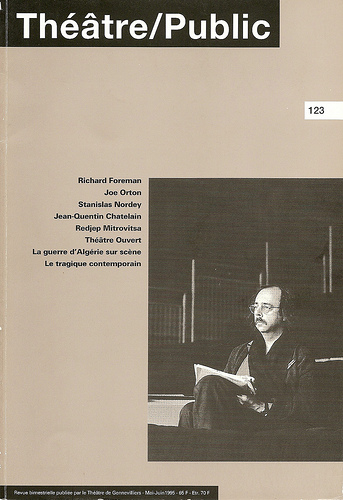
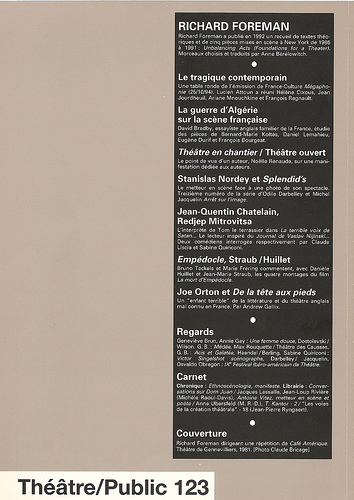
Pour une littérature irréfutable: Joe Orton et De la tête aux pieds, Théâtre/Public 123 (May-June 1995) : 65-70

De la tête aux pieds (1), le roman posthume de Joe Orton, l’enfant terrible de la nouvelle vague théâtrale britannique, a enfin été traduit en français, plus de vingt ans après sa publication outre-Manche. Les spectateurs parisiens ont également pu redécouvrir Le locataire (2), la pièce par laquelle le scandale arriva il y a tout juste trente ans. Deux textes qui n’ont pas pris une ride, d’un auteur qui n’a produit que des œuvres de jeunesse.

Incarcéré dans des latrines, Gombold compose un poème sur un avion en papier. Quelques secondes à peine après Ie décollage, l’engin est renvoyé à son expéditeur sans même avoir été déplié. Il s’agit là d’une des scènes clefs du roman de Joe Orton De la tête aux pieds. Sa carrière durant, l’écrivain fut hanté, en effet, par la peur de ne pas être écouté. Cette obsession n’était, certes, pas sans fondement. Lorsqu’il s’essaye pour la dernière fois au genre romanesque, en 1961, Orton est un homme de lettres…de refus. D’ailleurs, De la tête aux pieds fera aussi peu d’impression que l’envolée poétique de son protagoniste, et Ie rejet du manuscrit par les grandes maisons d’édition londoniennes sanctionnera plus d’une décennie d’échecs littéraires.

Un théâtre de farces et attrapes
John Kingsley Orton avait tout pour ne pas réussir. Il naît à Leicester en 1933 dans un milieu très modeste, et s’illustre rapidement par son recalage à l’examen d’entrée en sixième. Elsie Orton, une mégère qu’aucun homme ne parviendra à apprivoiser, a néanmoins de grands projets pour sa progéniture. Si elle est pleine de bonne volonté dès lors qu’il s’agit de ne pas se trouver en reste avec les voisins, Elsie n’a pas, hélas, les moyens de ses ambitions. Voyant son rejeton rejeté du système scolaire classique, elle sacrifie sa bague de mariage au mont-de-piété afin de l’inscrire dans une école privée, sans même se rendre compte que cet établissement le vouait au secrétariat et non aux humanités. De l’avis de ses professeurs, qui le vouent aux gémonies, le jeune homme est alors illettré. Orton ne peut, toutefois, se résoudre a une vie de grouillot ou de gratte-papier. Il tente d’échapper à la médiocrité de son existence en jouant dans diverses troupes théâtrales amateurs, et décroche par miracle une bourse à la Royal Academy of Dramatic Arts, Ie prestigieux conservatoire d’art dramatique britannique. C’est là qu’il rencontre son amant, Kenneth Halliwell, de sept ans son aîné, qui entreprend aussitôt de faire son éducation sentimentale et intellectuelle. Des échos a peine voilés de cette relation de maître a élève sont décelables dans De la tête aux pieds, une œuvre que l’on pourrait définir, au demeurant, comme un roman d’apprentissage. “J’ai un grand désir de m’instruire”, y affirme Gombold, en toute candeur, après avoir fait la connaissance du très savant Doktor Von Pregnant. On songe aussi à la reprise de ce thème sur Ie mode parodique dans Le locataire, la seule pièce qu’Orton ait dédiée à son compagnon.

A partir de 1953, la vie du couple s’organise autour d’une collaboration littéraire à laquelle Orton ne peut contribuer, dans un premier temps, que par son talent de dactylographe. Ironie du sort: lorsque son protégé entamera une fulgurante carrière d’auteur dramatique, dix ans plus tard, c’est Halliwell, l’écrivain raté, qui en sera réduit à se présenter comme Ie secrétaire de M. Joe Orton. Les signes annonciateurs de ce renversement sont perceptibles dès 1962, date à laquelle ils sont incarcérés pour avoir volé et endommagé un nombre considérable d’ouvrages appartenant a la bibliothèque municipale d’Islington. En effet, depuis trois ans, les deux gays lurons s’adonnaient à une singulière expérience de vandalisme culturel. Non contents de transformer leur studio en gigantesque collage surréaliste, au moyen de centaines de gravures découpées dans des livres d’art, Orton et Halliwell avaient choisi l’honorable bibliothèque comme théâtre d’opérations de sabotage littéraire. Une fois les livres subtilement subtilisés, ils se livraient à une sorte de détournement de fond et de forme. Titres travestis, photos maquillées, prières d’insérer violentés : l’objectif était déjà de décevoir l’attente du lecteur, pour mieux attenter à sa pudeur. Ainsi, apres l’un de leurs passages, une pin up tirait la couverture à elle en affichant sa nudité sur un manuel d’étiquette. Sur une autre jaquette, un vieillard bedonnant, moulé dans un minuscule maillot de bain et tatoué de pied en cap, se pavanait à côté du nom du poète John Betjeman. Entreprise de recréation, donc, mais aussi de récréation. Pour Orton et Halliwell, qui etablissaient un parallèle heroï-comique entre leur bibliothèque municipale et celle d’Alexandrie, la révolution serait ludique, ou ne serait pas. Sonnait, enfin, l’heure du leurre. Les brûlots etaient sagement rangés sur les rayons, comme des bombes à retardement. Le critique-voyou se faisait voyeur pour savourer les réactions tantôt indignées, tantôt amusées du public, avant de quitter Ie champ de bataille jonché d’ouvrages mutilés et défigurés. Ces canulars de potache (post-dadaïstes ou proto-situationnistes) seront perçus par les autorités comme de véritables crimes contre Ie lecteur (leur semblable, leur frère) et, partant, contre la republique des lettres. Sans doute la sévérité de la sentence, six mois de prison ferme, était-elle aussi imputable à I’homosexualité des accusés. Plus tard, Orton révèlera l’épisode qui mit Ie feu aux poudres. C’est après avoir découvert, avec effroi, que la bibliothèque d’Islington ne possédait pas L’histoire du déclin et de la chute de l’Empire romain, qu’il partit en guerre contre “l’âge du papier”, pour reprendre l’expression de Challemel-Lacour. Une bibliothèque papivore, gavée d’oeuvres alimentaires, n’était pas à même de rassasier la boulimie de savoir du jeune écrivain; elle n’ avait pas de raison d’êre. Et Orton de citer les Saintes Ecritures : “… à multiplier les livres, il n’y a pas de limite” (Ec 12 : 14).

Vaudeville à vau-l’eau
L’ascension météorique d’Orton prend son essor a partir de ces attaques contre la galaxie Gutenberg, dans I’orbite de laquelle il gravitait jusqu’alors en quête de reconnaissance. Même au zénith de sa carrière, son oeuvre restera marquée par les empreintes laissées sur les livres empruntés à la bibliothèque de quartier. Pas de quartier pour les genres obsolètes, qu’il mine de l’intérieur, mine de rien. Gare au roman de gare, qu’il détourne, sans crier gare, de ses voies toutes tracées. Le rideau se lève sur Ie train-train habituel. Soudain, Orton raille, la piece déraille, Ie rideau est tiré sur Ie passé. Orton, c’est Dionysos pénétrant par effraction chez Feydeau. II bouleverse Ie boulevard, en Ie plongeant de force dans un bain de jouvence, pour Ie ramener aux sources bachiques des rites de fertilité antiques. Bousculer les habitudes ovines des habitués du théâtre; déshabituer leur regard bovin : voilà les deux mamelles de ces vaudevilles vachards. La stratégie ortonienne, que l’auteur définira lui-même comme “une satire délibérée du mauvais théâtre”, consistera donc à caresser Ie spectateur dans Ie sens du poil, avant de Ie traquer jusque dans ses derniers retranchements. Comme dans la salle de lecture d’Islington, il s’agira d’ attirer Ie chaland sous de fallacieux prétextes afin de l’exposer, à son corps défendant, a une polyphonie de perversions polymorphes : Ie pauvre spectateur sera toujours Ie dindon de ce théâtre de farces et attrapes. Ainsi, Orton usera-t-il de subterfuges, tous plus subtils les uns que les autres, pour subvertir subrepticement les préjuges du béotien, dynamiter ses mythes et, finalement, Ie corrompre de plaisir. C’ est une étrange entreprise que celle de se rire des honnêtes gens!

L’épisode de la bibliothèque et son épilogue carcéral auront des répercussions différentes sur les deux prisonniers. Si l’un semble soudain touché par la grâce, c’est Ie coup de grace pour l’autre. Dans l’année qui suivit sa libération, Halliwell devint son propre geôlier et tortionnaire. II se renferma en lui-même, et tenta de mettre fin à ses jours en se tailladant les veines. La peine à laquelle il était condamné était de celles qui ne se purgent pas. Orton, lui, ne manifesta aucun repentir. Au contraire, n’ayant plus rien a perdre, il se sentit émancipé et put acquérir les moyens de sa vengeance : l’expérience ascétique de la prison avait libéré sa sensibilité esthétique. Il lui semblait, en effet, que la société avait soudain tombé Ie masque. Telle “une vieille catin”, la gueuse avait troussé ses jupes, et l’odeur, selon ses dires, était fétide. C’est en se pinçant Ie nez qu’il épinglerait désormais ses contemporains comme des papillons. C’est en riant qu’il corrigerait leurs moeurs, raillant leurs travers à travers toutes les pièces qu’il produirait. Pour paraphraser Beaumarchais, Orton se pressera de rire de tout, de peur d’être obligé d’en pleurer; il pleurera de rire. Le dramaturge résumera ce gai savoir en une sentence faisant écho à celle qui l’avait embastillé: l’homme est “foncièrement mauvais, mais irrésistiblement drôle”. Le fait est que, dans ces conditions, mieux est de rire que de larmes écrire. Un rire revenu de tout, en quelque sorte, mais aussi et surtout, un rire vengeur, impénitent et impertinent. Orton, I’auteur comique, prendra toujours la plaisanterie très au sérieux, et ce, précisément, parce qu’il savait qu’elle n’était jamais simplement pour rire. Bref, l’envers du décor à lui révélé, Ie détenu détenait son arme secrete: Ie détachement ironique. Le disciple d’Aristophane, d’Horace et de Juvénal avait enfin appris à sublimer sa colère. Dorénavant, il serait inspiré par la sublime colère à laquelle Gombold aspirait: “Mère, purifiez mon coeur, faites que je sois capable de m’indigner correctement”. Pour être cinglante, la correction se devait d’êre administrée “correctement”. Au sortir de prison, Orton était un satiriste. Lui.

L’Oscar Wilde de l’Etat-providence
Le destin des deux hommes se sépare irrémédiablement en 1963, avec l’acceptation par la BBC de la première pièce du jeune dramaturge, The Ruffian on the Stair (Un crime passionnel). Lorsqu’elle est radiodiffusée l’année suivante, Orton est devenu célèbre grâce à la controverse suscitée par Entertaining Mr Sloane (Le locataire). Sa carrière, scandée par les scandales, semble, dès lors, aussi irrésistible que l’humour corrosif de ses oeuvres. Entre 1964 et 1967, il écrit trois pièces pour la télévision (The Good and Faithful Servant, The Erpingham Camp et Funeral Games), un scénario pour les Beatles (Up Against It) et deux chefs-d’ oeuvre pour la scène: Loot (Le butin), qui obtient Ie prix de l’Evening Standard en 1966, et What the Butler Saw (La camisole) dont la première, en 1969, est Ie théâtre d’une véritable bataille d’Hernani. Une pochade pornographique qu’il avait torchée en 1960 pour amuser son amant (Until She Screams), est même incluse dans Oh! Calcutta!, la revue érotique de Kenneth Tynan, dont la recette s’élevait a 360 millions de dollars en 1987. Couronné “Oscar Wilde de l’Etat-providence” par la presse, Ie dramaturge est invité à la television et dans les salons littéraires. Ses oeuvres sont portées aux nues par ses pairs (de Terence Rattigan à Tennessee Wiliams en passant par Pinter), et deux d’entre elles seront portées à I’écran. Très porté sur Ie nu, il est photographié, à la Mishima, vêtu d’un simple slip, et croque in puris naturabilis pour Ie programme de Sloane. Joe Orton est désormais la coqueluche du “swinging London” : Kenneth Halliwell en fait une maladie. C’est cette période, à la fois triomphale et douloureuse selon Ie point de vue, que Stephen Frears a si bien su évoquer dans son film Prick Up Your Ears (1987). Tout juste bon à jouer les boniches, paralysé par une stérilité créatrice et sexuelle, Ie Pygmalion d’Orton sombre dans la dépression la plus noire. Seul le suicide viendra I’en délivrer.

Socrate, qui considérait I’enseignement comme une sorte d’obstétrique spirituelle, savait combien Ie désir de s’instruire peut être proche du desir érotique. Or, dans ces deux domaines, l’élève s’était élevé au-dessus du maître. Tel Pinocchio s’affranchissant de son créateur pour aller goûter aux plaisirs défendus de la fête foraine, Orton, Ie poète des pissotières, s’abandonnait à corps perdu à la promiscuité sexuelle. Cocu, son concubin l’était à plus d’un titre, puisqu’au regard de la postérité l’oeuvre de Halliwell se bornerait désormais à avoir accouché du talent d’autrui. On pense, bien sûr, au Doktor Von Pregnant (“pregnant” signifie “enceinte”) transmettant son savoir encyclopédique à Gombold avant de mourir sans laisser de traces. En effet, sa monumentale Histoire du monde et de ses Choses remarquables, I’oeuvre d’une vie, est emportée a tout jamais par le flot d’immondices d’un égout : une eschatologie scatologique bien prémonitoire.

Et in suburbia ego
Publié à titre posthume en 1971, De la tête aux pieds est un hors-d’oeuvre alléchant plutôt qu’un chef-d’oeuvre léché. Ce roman insolite, qui relate les pérégrinations de Gombold sur le corps d’un géant, reste profondement marqué par I’influence oppressante, sans doute mal digérée, de Kenneth Halliwell. Celle-ci transparaît a travers les innombrables allusions savantes (“Et in Suburbia ego”) et autres plaisanteries en latin de cuisine émaillant Ie recit (une maison de tolérance est baptisée Ie “Consummatum est”). Elle est surtout présente dans la myriade d’influences évoquée ou invoquée par ce texte-palimpseste. L’humour raffiné, le ton volontiers précieux, le chatoiement des dialogues, l’excentricité des arabesques de style, le mariage de l’élégance et de la vulgarité : autant de caractéristiques qui ne manqueront pas d’évoquer Ronald Firbank, Ie dandy des annees folIes, auquel Halliwell vouait un véritable culte. Lu sous cet angle, le roman est un exercice de ventriloquie tout à fait réussi. De même, les rêves mystiques de Gombold font souvent penser aux visions cosmogoniques de Nerval, d’autant que Ie géant ortonien est un de ces Afrites faisant une brève apparition dans Aurélia. Comment ne pas songer aux Voyages de Gulliver aussi, alors qu’une rivière appelée “Swift” est mentionnée dans la version originale du texte? Toutefois, I’influence majeure est sans doute Alice au pays des merveilles. Orton était un grand admirateur de la logique du non-sens. S’étant fourvoyé dans une forêt dantesque, au début du récit, Gombold demande à O’Souillon de lui indiquer Ie meilleur chemin à prendre. Ce dernier lui fait remarquer que cela dépend où il désire se rendre. Comme Gombold n’en a cure, O’Souillon lui rétorque : “Alors peu importe Ie sentier que vous prenez!” Outre quelques curieuses créatures (Ie fondateur du club Humpty Dumpty), la topographie a également quelques similitudes avec l’univers de Lewis Carroll. Alice, on s’en souvient, aime à se glisser dans des terriers et à tomber dans des puits. Gombold, lui aussi, parcourt un paysage fracturé, plein d’abîmes, de ravins, de gouffres et de cavernes. Dans la première scène, il hisse un personnage hors d’un trou, par lequel il s’échappe dans la dernière. Entre temps, il s’est évadé de prison en creusant un tunnel, il a rêvé d’introduire sa langue dans une fente du plancher et a eu vent d’une curieuse légende selon laquelle Ie monde finirait par disparaître dans un gigantesque trou. Toujours désorienté quand il n’est pas enfermé – dans des toilettes, dans une cage de zoo ou dans un tonneau -, Gombold cherche sa voie. A travers lui, Orton cherche sa voix, et c’est bien la que le bât blesse. En effet, l’auteur s’expose parfois à des accusations de plagiat. Certaines scènes semblent tout droit sorties de l’oeuvre de Nathanael West, Ie surréaliste américain, et en particulier de The Dream Life of Balso Snell (1931), dont le titre onirique n’est pas sans rappeler celui qu’Orton avait donné à son propre roman: The Vision of Gombold Proval. L’intrigue, chez West, se déroule dans les entrailles du cheval de Troie. Or, Gombold va l’explorer à son tour, après I’avoir découvert abandonné sur un tas de gravats au beau milieu d’un terrain vague. Sans doute T. S. Eliot avait-il raison: Ie vrai poète vole, alors que le médiocre imite. L’enjeu, ici, est done de départager le vrai poète, qui vole de ses propres ailes, du faussaire sous influences.

Saturé de références mythologiques et ésotériques, De la tête aux pieds est un véritable salmigondis culturel, qui tient souvent de l’exhibitionnisme intellectuel. A la manière d’un potache faisant étalage de sa science, Orton ne peut résister à la tentation d’afficher la culture classique que Halliwell lui a inculquée. A dire vrai, cette érudition proliférante est aussi Ie reflet d’une ambition encyclopédique démesurée, incarnée par Von Pregnant, et visant, semble-t-il, à embrasser la totalité du savoir humain. L’influence du Rameau d’or de J.G. Frazer, qui exerça une fascination sur plusieurs générations d’écrivains anglo-saxons (T. S. Eliot en particulier), a sans doute été déterminante ici. II s’avère done qu’au moment même où il détruisait la bibliothèque d’Islington, I’auteur construisait celle de Babel. Mais Ie projet mallarméen d’Orton est le plus souvent d’inspiration parodique. II se rattache en cela à la grande tradition du “learned wit” (inaugurée par Rabelais et Robert Burton), que l’on retrouvera, en particulier, avec les délires théoriques du psychiatre dans What the Butler Saw (La camisole). A travers une série de jeux intertextuels, l’auteur s’emploie a démythifier les mythes d’Hélène et les garçons. Parfois, l’hypotexte homérique est réinterprété de façon oblique. Gombold, par exemple, découvre un graffito antique dépeignant la belle Hélène sous un jour fort peu flatteur : “II fut contraint de reconnaitre qu’il y avait une part de vérite dans la légende : elle avait Ie visage rond, Ie nez en trompette et les cheveux raides, coupés court comme un garçon.” Au lieu de constater une contradiction flagrante entre la beauté légendaire de la princesse et le portrait qu’il contemple, Gombold en tire la conclusion inverse. Hélène était, bel et bien, aussi quelconque que chez Homère! “Was this the face that launched a thousand ships … ?” La question du Faust marlovien, que I’on devine en filigrane, n’aura jamais eu autant de pertinence. (lci, on l’aura compris, l’inversion textuelle est intimement liée à l’inversion sexuelle du romancier.) Cet exemple de récriture par ricochet, où l’on se réfère au texte original en le déformant, est cependant très rare. Le plus souvent, la démythification prend la forme d’une glose à fonction corrective. De la tête aux pieds devient ainsi, l’espace de quelques lignes, un supplément aux voyages d’Ulysse, suppléant aux erreurs du poète. Von Pregnant laisse entendre que Ie “Seigneur du chant” était non seulement aveugle, mais aussi sourd comme un pot. En effet, toute la lumière est faite sur Ie chant des sirènes – “une petite cavatine (adagio) at captandum vulgus” – qui n’était, en fin de compte, qu’une simple rengaine sans grand mérite musical. Verdict: beaucoup de bruit pour rien! L’épisode de l’ile de Scyros reçoit Ie même traitement révisionniste, mais, cette fois, il y a une inflation de la déflation. Dans l’épopée homérique, Achille est talonné par une prédiction selon laquelle il doit périr à la guerre. Pour échapper à ce funeste destin, il est envoyé dans l’île de Scyros, où, sous Ie nom de Pyrrha, il coule des jours paisibles déguisé en femme, avant d’être démasqué par Ulysse. Von Pregnant soutient que plusieurs erreurs se sont glissées dans l’original. La version qu’il nous livre est un travestissement burlesque, au sens littéraire et littéral, anticipant la confusion sexuelle generalisée de What the Butler Saw (La camisole). Rebaptisé Phyllis (“La petite Phyllis, on l’appelait”), Achille se serait donc tout bonnement converti au travestisme. De plus, chacun aurait su pertinemment qu’il s’agissait en réalité d’un garçon … à l’exception d’Ulysse. Le récit de la découverte de cette méprise est malicieusement oblitéré par des points de suspension, tout comme la fameuse “scène de la baisade” s’évanouit dans une incise dans la dernière version de Madame Bovary. Ce processus de dégradation de la geste épique est, bien entendu, Ie pendant litteraire des tours pendables pour lesquels Orton sera vilipendé et jeté en prison, Dans les deux cas, on ne peut s’empêcher d’établir un parallèle avec la Joconde moustachue et barbue de Marcel Duchamp, ou avec les défigurations picturales d’Asger Jorn, ce peintre danois et ami de Debord, qui détournait, en les retouchant, des chromos trouvés au marché aux puces. La comparaison est, d’ailleurs, tout à fait légitime. Après avoir expérimenté, en amateur, sur les jaquettes de livres et les murs de son domicile, c’est vers l’art du collage que Halliwell se tourna lorsqu’il se rendit a l’évidence que sa carrière littéraire ne décollerait jamais. C’est également en termes de collage qu’Orton définissait son style d’ écriture.

Et patati, et patata
Ce style si singulier est un télescopage de registres hétéroclites, une juxtaposition d’idiomes disparates ou l’on retrouve, pêle-mêle, idiotismes et idioties, poncifs politiques et slogans publicitaires, expressions argotiques et arguties bureaucratiques, jargon juridique et psychanalytique, la mièvrerie des romans à l’eau de rose et I’hyperbole des journaux à sensation. Un bric à brac linguistique fait de bric et de broc, dont la genèse remonte, peut-être, au manifeste des terroristes dans De la tête aux pieds : “Nous sommes contre les fragments, les entreprises merveilleuses, les drames allegoriques, les phrases de plus de huit mots, les deuxièmes chances, les vieillards aux yeux verts, Ie blanc de Chine, le meurtre sans crime, les miracles, les manuels d’Hygiène, la rééducation muscuIaire et toutes les formes de begaiement. …” Dans les pièces d’Orton, il n’y a pas d’idiolectes à proprement parler, les dialogues des différents personnages étant, dans l’ensemble, assez indifférenciés. Ces derniers charrient un flot de paroles dont la tonalité varie brusquement, chavirant d’un niveau de langue à un autre, dans un charivari permanent. Rythme syncopé, syntaxe parataxique, lexique anarchique : on pourrait presque parler de flux d’inconscience. Au degré zéro de l’écriture de bon nombre de ses contemporains, Orton oppose cette voluptueuse volubilité, ce babélisme babillard, qui a la forme informe des discours-fleuve que tout informe. Il est vrai que ses deux premières pièces sont, a bien des égards, des plagiats de Pinter, avec leur style dépouillé, leurs dialogues de sourds et leurs conversations banales, ponctuées de nombreux silences lourds de signification. Mais les protagonistes sont dejà sujets à des accès d’incontinence verbale. Se croyant cocufié, Mike, Ie criminel mal dégrossi de The Ruffian on the Stair (Un crime passionnel), se lance dans un soliloque prolixe sur Ie theme così fan tutte, références bibliques à l’appui, qui ne jurerait pas dans une oeuvre élisabéthaine. Les morceaux de bravoure de ce type contribuent à accentuer l’artificialité du discours. On a toujours l’impression, chez Orton, que les personnages sont en train de débiter un texte appris par coeur, ou de lire des phrases défilant sur un prompteur. Leur drame, qui est aussi celui de tout écrivain, c’est que Ie langage leur est antérieur. Toutefois, à la différence de l’ écrivain, ils restent prisonniers des paroles d’autrui (ces “mots de la tribu” que Mallarmé cherchait a purifier). Quand ils ouvrent la bouche, c’est la voix de leurs maîtres que l’on entend. Dans Ie roman, cette règle s’applique même à la reine, dont les moindres paroles sont redigées à l’avance par ses conseillers : “II ne faut pas croire que je sois responsable de ce qui arrive, ni de ce qui peut arriver ou que l’on peut faire arriver. Les conseillers conseillent et j’accepte leurs conseils. Bien qu’en théorie je ne sois pas tenue d’accepter, en pratique j’accepte. Si en pratique je n’acceptais pas la théorie ne serait plus applicable. Mais iJ est également erroné de se dire que ma position est à titre purement nominal; elle a toute l’apparence d’être à titre nominal mais en realité elle ne l’est pas. Je suis reconnue comme chef théorique, ou comme quasi-chef, d’un certain nombre de personnes, dont Ie caractère et l’intérêt varient considérablement de l’une à l’autre, qui me reconnaissent comme leur quasi-chef et que je reconnais comme mes quasi-sujets théoriques.”

De ce matériau ignoble, ces mots courants, trop courants, courant sur toutes les lèvres, Orton parvient à faire jaillir une poésie nouvelle. L’homo Ortonus, en revanche, reste condamné à un langage de seconde main. II ne parle pas : on parle à travers lui. Dire ce que nul n’a encore dit, Ie rêve de Dante (“quello che mai fu detto d’alcuna”), n’a plus aucun sens dans Ie monde du prêt-à-parler. C’est ce que Terence Rattigan avait pressenti avec beaucoup de finesse, en affirmant que les personnages d’Orton semblent avoir élevés devant la télévision. La sensation de zapping verbal vient précisément de là. Le tenancier de bordel, dans De la tête aux pieds, s’exprime spontanément en formules publicitaires : “Tout Ie monde peut vous donner du sexe, mais pour Ie même prix, Ie Consummatum est vous donne la poésie du sexe.” Le récit de la mort du géant se transforme en journalisme d’investigation : “La perspective de vivre sur un cadavre ne dérangeait pas grand monde. D’ailleurs, il y en avait qui soutenaient que Ie géant n’était pas mort. Même en présence de chairs decomposées et d’asticots a I’endroit où jadis s’étaient étendus des arpents radieux, ils parlaient de phénomènes temporaires.” Soudain, la caméra se fige sur une passante pour l’inévitable micro-trottoir: ” ‘J’imagine que ça va passer’, dit une femme qui poussait un landau.” Orton, qui est mort l’année de la publication du livre de Guy Debord, nous plonge au coeur de la société du spectacle. Il nous montre, en particulier, que la société spectaculaire est l’aboutissement de deux processus connexes. Le premier concerne la maladie que Jules de Gaultier avait diagnostiquée au début de ce siècIe. Pour l’illustrer, tournons-nous vers Katie, la matrone nymphomane d’Entertaining Mr Sloane (Le locataire). Rien, pas même le meurtre de son père, ne parvient à l’émouvoir, mais elle devient très “sentimentale” (ce sont ses propres termes) à la lecture de faits divers tragiques vécus par d’illustres inconnus. Le bovarysme entre dans sa phase terminale : celIe d’une réalité qui, en 1964, est déjà virtuelle. Le second processus, que l’on peut faire remonter à Mallarmé, c’est la dissociation entre signifiant et signifié. Le signifiant ne signifiant plus rien, il peut signifier n’importe quoi, c’est-à-dire tout et son contraire. Lorsqu’une guerre éclate, dans De la tête aux pieds, tous les belligérants en présence prétendent, au même moment, que “Ie vent de l’histoire” est en train de souffler dans leur sens. Plus tard, Squall et ses comparses sont traînés en justice pour consommation immodérée de fruits et légumes. Cette parodie des grands procès staliniens, dont l’efficacité repose sur l’absurdité même du chef d’accusation, ressemble curieusement au procès d’Orton, qui est pourtant postérieur à la rédaction du roman. On aurait aussi bien fait d’incarcérer l’auteur pour avoir mangé trop de bananes et de concombres, à l’instar de Squall, car ce qu’on lui reprochait en realité, c’était son statut de hors-Ia-loi sexuel. Concombres, bananes, livres vandalisés : autant d’euphémismes pour l’innommable. Le règne de l’arbitraire sémantique n’a jamais été mieux exprimé qu’à travers la sophistique des personnages ortoniens. Captieux et capiteux, leurs raisonnements ont la logique implacable de la folie. Une policière demande a Gombold de lui montrer ses papiers, sachant très bien que ce dernier n’en possède pas :
“II va falloir que je m’ en procure, dit Gombold.
– Où ça?
– Auprès de l’ organisme qui les délivre.
– C’est moi qui les délivre”, dit-elle pour couper court.
On trouve de nombreuses variations sur ce thème dans les oeuvres dramatiques, Loot (Le butin) en particulier. McLeavy, qui est sur le point d’être arrêté par Truscott, un inspecteur de police véreux, affirme qu’il va déposer une plainte auprès de la personne dirigeant l’opération. Truscott rétorque que c’est lui qui la dirige, et qu’il se tient donc prêt à enregistrer sa plainte. De même, lors d’un passage à tabac, Truscott sermonne sa victime en lui expliquant que, sous n’importe quel autre régime politique, elle serait déjà en train de se rouler par terre en hurlant de douleur. Cette dernière lui fait remarquer aussitôt qu’elle est en train de se rouler par terre en hurl ant de douleur! La victime se tord de douleur, et le spectateur de rire : Orton a l’art de saisir l’instant cauchemardesque, où Ie bon sens bascule dans le non-sens. Ce n’est pas le moindre de ses talents.

Une secousse sismique
Comme toutes les oeuvres de jeunesse, De la tête aux pieds est aussi une oeuvre d’anticipation. On y trouve déjà la plupart des motifs récurrents et des obsessions du futur dramaturge. L’anticléricalisme bouffon de Loot (Le butin) et de Funeral Games (Jeux funèbres) est annoncé par l’épisode du verger, dans lequel une mûre confesse que ce ne sont pas les prières qui l’ont sauvée de la cueillette, mais ses épines. La survie : voilà ce qu’Orton nous offrira pour toute morale a travers ses pièces. Loot, par exemple, que l’on pourrait très bien rebaptiser “le bonheur dans Ie crime” ou “les infortunes de la vertu,” s’achève par l’arrestation du seul personnage innocent, grâce (sic) à la collusion entre Truscott et les malfaiteurs. Dans l’univers d’Orton, il n’y a point de corruption sinon la lente tombée en décrépitude des corps. Ses personnages font corps avec les masques, derrière lesquels ils dissimulent le néant de leur identité. C’est, sans doute, la raison pour laquelle l’auteur composa une décomposition systématique du corps humain. Après cinquante ans de travail à la chaîne, Buchanan n’est plus qu’un assemblage de pièces détachées : une paire de lunettes, un audiophone, une prothèse en guise de bras (The Good and Faithful Servant). La dépouille de Mme McLeavy est dépouillée de son ratelier et perd son oeil de verre (Loot), la main d’un cadavre est sectionnée (Funeral Games), une statue est émasculée lors d’une explosion (What the Butler Saw) … Le thème du démembrement sacrificiel est dejà omniprésent dans De la têre aux pieds. Il nous suffira de citer la guerre épique opposant les Fessegauches aux Fessedroites, la lente putréfaction du géant moribond, ou encore cet autonomiste qui lutte pour “l’indépendance des membres du corps”. L’identité sexuelle des individus est tout aussi menacée que leur integrité physique. Gombold s’égare dans une contrée où hommes et femmes ont échangé rôles et vêtements (voir Deutéronome 22 : 5). Après avoir été enfermé dans une chambre rose bonbon et accoutré en soubrette, il devient la “maîtresse” de Connie Hogg, une harpie hommasse qui dirige les services de police. Cette gynocratie permet à Orton de donner libre cours à sa misogynie militante. Le conseil des ministres, au cours duquel on décide de faire coïncider une conférence sur Ie désarmement avec les défilés de mode de l’automne, est une véritable page d’anthologie. A en juger, cet extrait du discours de Madame Ie Premier ministre : “II est vital, dans l’intérêt du monde libre, de stabiliser la longueur des jupes!” A la sanglante guerre des sexes qui fait rage entre les belles et les rebelles masculins, on peut opposer Ie “peuple heureux” doté d’une “sexualité consécutive rythmée” : “Dans tous les cas, Ie sexe de départ était masculin, suivi d’une altemance de phases masculines et feminines tout au long de l’existence.” Malgré cet hymne à l’hermaphrodisme, c’est l’imagerie homoérotique qui l’emporte ici comme dans les pièces. Gombold rédige un poème dont I’incipit est “Assassinons nos mères”. Au cours de ses pérégrinations, il surprend un homme très propre sur lui se faire battre comme plâtre puis pisser dessus par un clochard. Dans un bordel, il fait la connaissance d’un jeune propre à rien toujours prêt à enfiler “un jean en cuir extraordinaire” moyennant “un petit supplément”. Enfin, il part en voyage organisé visiter I’une des merveilles du monde, qui n’est autre que Ie monstrueux phallus de l’ Afrite : “Elle se dressait du sol, renflée et velue, les parois marbrées de veines bleues. Si gigantesque, si raide, si puissante que I’on aurait dit un nouveau monde qui jaillissait de l’ancien; un monde a part; beau et menaçant. Une gigantesque érection de la terre.” Avec ce portrait du géant en érection, on passe du phallos grec au fascinus romain. Pourtant, c’est l’aspect ludique, irréverencieux et dionysiaque du phallus qui sera toujours célébré dans l’oeuvre theâtrale d’Orton. Jeunes, séduisants et sans scrupules, ses héros sont les hérauts de la société permissive: ils sont habités par une énergie sexuelle débordante, et dénués de principes hormis celui du plaisir. La responsable du personnel d’une grande entreprise fait de son mieux pour brider la libido de Ray, en l’incitant a épouser la jeune fille qu’il a malencontreusement fécondée (The Good and Faithful Servant). L’un des passe-temps préférés de Hal et Dennis, quand ils ne braquent pas les banques, consiste à déflorer les demoiselles de bonne famille, mais les hommes ne sont pas non plus à I’abri de leur concupiscence. Inséparables depuis la naissance, ces deux enfants terribles, qui ont partagé Ie même berceau, couchent toujours ensemble (Loot). Sloane offre ses faveurs sans autre discrimination que Ie profit qu’il pense pouvoir en retirer. Ainsi, passe-t-il indifféremment des bras de Katie à ceux d’Eddie, Ie frère de cette dernière (Entertaining Mr Sloane). Nick, Ie groom d’hôtel, fornique à tout va. Imaginez Casanova reincarné sous les traits d’un Spirou priapique. En I’espace de vingt-quatre heures, il s’enfile toute une chambrée de collégiennes, avant de s’attaquer à une femme qui pourrait être sa mère, et qui I’est d’ailleurs, comme Ie révèle Ie dénouement oedipien. On reste dans Ie même ton jusqu’à la dernière scène, où Ie membre manquant d’une statue ithyphallique de sir Winston Churchill est enfin retrouvé, et brandi bien haut. Tout est bien qui finit bien (What the Butler Saw). Mais Orton n’est jamais aussi “politiquement incorrect” que dans son adaptation très libre des Bacchantes, The Erpingham Camp. L’action se déroule dans un de ces villages de vacances à la Butlin’s ou Pontin’s, c’est-à-dire un Club Med du pauvre consacré au panem et circenses. Erpingham, l’alter ego de Penthée, règne en monarque absolu sur son royaume du divertissement, jusqu’au jour où l’incompétence d’un G.O. inexperimenté provoque I’insurrection des estivants. Le camp de vacances, transformé en camp de concentration, est sous I’emprise de l’esprit dionysiaque. S’ensuivent, alors, des bacchanales endiablées. Les petites culottes volent dans tous les sens : on s’aime, on sème à tout vent, dans la ferveur révolutionnaire…

Cependant, il ne faudrait pas réduire De la tête aux pieds à un simple catalogue des thèmes qu’Orton exploitera avec succès par la suite. Le roman est aussi une déclaration d’indépendance à l’égard de Halliwell. Gombold est une âme en quête d’autonomie. Ce qu’il admire avant tout chez Ie Doktor Von Pregnant, c’est sa capacité à recréer Ie monde à l’aide de son seul cerveau, à “écrire sans crayons, encre ni papier” ou à “peindre en l’absence de toute peinture”. Gombold tente, à son tour, de “tirer du fantasme une sorte de realité”. Emprisonné au nom de la raison, il emprisonne la raison : il parvient ainsi à vaincre temporairement la réalité, en l’incorporant jusqu’a ce qu’il ne reste plus rien hormis Ie vide qui est en lui, et par lequel il s’évade. C’est Ie principe de la “désertion à l’intérieur de soi-même” dont parlait André Breton à propos de Jacques Vaché, et qui est repris par un personnage de Jules Romain : “Moi, je fous I’camp par I’intérieur”. Comme dans la littérature fantastique, un autre genre auquel ce roman appartient et échappe, on assiste à un effacement de la frontière entre sujet et objet. “Je suis les filles que j’ai moi-même aimées”, écrit Gombold dans un de ses poèmes. A la fin de son périple, Ie héros découvre Ie pouvoir des mots, et se met à etudier Ie langage en termes de stratégie militaire. S’il comprend déssormais que les mots sont de redoutables armes, il ne sait toujours pas comment les utiliser efficacement : “II imagina un livre. Mais c’était perdre son temps. Cela ferait vibrer la structure, mais pas assez. Pour être destructeurs, il fallait que les mots soient irréfutables. En plus, Ie livre pouvait très bien ne pas etre lu”. En plus, ceux qu’Orton écrivait depuis une décennie, ne l’étaient pas. II fallait donc se toumer vers Ie théâtre : “… si I’ on pouvait enfermer l’ennemi dans une même pièce et lui tirer la phrase a bout portant, cela ferait une espèce de secousse sismique”.

1 – Head to Toe, 1971, London : Methuen, 1986. De La tête aux pieds, Paris : Cicero, 1993, traduction Jean-Jacques Pédussaud.
2 – Le locataire, Joe Orton, adapt. Yves Beneyton, m.e.s. Christian Rauth, Théâtre de la Main d’Or, 16/2-10/4/1994.

• Andrew Gallix enseigne l’anglais à la Sorbonne-Paris IV. Auteur de Joe Orton’s Comedy of the Last Laugh, New York, Garland, 1995.
I’ll Be Your Mirror: Andy Warhol’s Writing Degree (Less Than) Zero

This appeared in 3:AM Magazine on 24 May 2008:

I’ll Be Your Mirror: Andy Warhol’s Writing Degree (Less Than) Zero

Life and books entertain complex and sometimes paradoxical relations. Authors routinely explain that the lie of fiction is a roundabout way of grasping the truth of fact. Although I suspect this to be the majority view, it is by no means the only one.

Take the Aesthetic Movement’s struggle for artistic self-determination (symbolised by Des Esseintes‘ rejection of nature). Wilde famously wrote that “Life imitates art far more than Art imitates life” and so it was with literature: fiction came to be seen as an alternative to, rather than a reflection of, living — an activity best left to servants according to one of Villiers de l’Isle-Adam‘s characters.

Attempts have also been made at a life-literature merger. Here, you can usually expect macho posturing, violent deaths and spontaneous prose that disappears up its own ars rhetorica — sometimes all three. A prime example is that of the hardcore Dadaists who tried to do away with the “revolting dualism of real and described life” (Boris Poplavsky) by turning themselves into works of art before committing suicide to prove that they were 4 Real, like.

There is a third way; one that chimes with our spectacular times: the literary takeover bid. This trend goes back to the beautifully-barmy magna opera which — from Coleridge‘s omnium-gatherum to Mallarmé‘s “Grand Oeuvre” and beyond — aspired to shoehorn the whole of Creation between the covers of a book. In 1974, Georges Perec wrote down everything he saw from his café table in a bid to record “what happens when nothing happens”. B. S. Johnson was guided by the equally hubristic ambition to include what he called the “enormity of life” in a novel. The infamous “FUCK ALL THIS LYING” diatribe at the end of Albert Angelo, which shatters the reader’s willing suspension of disbelief, is nothing short of an anti-fiction manifesto: “telling stories is telling lies and I want to tell the truth”.

Jonathan Coe has convincingly argued that Johnson’s “pursuit of literary naturalism” — “his perverse desire to reduce the novel to the status of real life” — was one of the factors that contributed to his suicide. “Go into one of the cafés in Islington and turn on your tape recorder and record people’s conversations,” he advises him posthumously, “Then come home and transcribe them and keep doing that until you’ve got two or three hundred pages. There you will have your ‘authentic’ naturalism and you know as well as I do that there is not a single person in the world who would want to read it. It would be unreadable.” This “‘authentic’ naturalism” was implemented in 1968 (four years after the publication of Albert Angelo) by Andy Warhol.

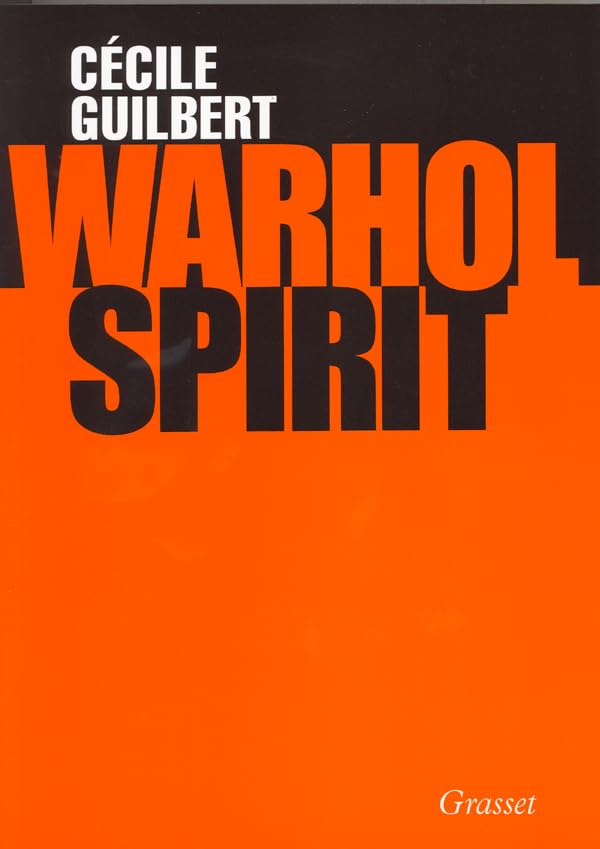
‘Renaissance Man’ is an overused cliché, but Warhol fits the bill perfectly. He was a painter, illustrator, designer, photographer, filmmaker, producer, journalist, editor, anchorman, model and many other things besides. In her latest book — Warhol Spirit — Cécile Guilbert argues, somewhat more contentiously, that he was also a serious writer.

She highlights his influence on Bret Easton Ellis by juxtaposing an extract from American Psycho with a social column penned by Warhol in 1973. The similarities are so obvious — same tonal blankness, compulsive name-dropping and seemingly endless lists of designer goods — that no commentary is necessary. (Fittingly, the film adaptation of American Psycho was directed by Mary Harron whose previous movie had been I Shot Andy Warhol.)

Warhol’s name has cropped up time and again — silkscreen-print-fashion — in reviews of Ellis’s work, but never before had the connection been so clearly established. Except by Ellis himself, that is. One of the characters in Glamorama — his most Warholian novel to date — is mocked because she only owns two books: the Bible plus The Andy Warhol Diaries (“and the Bible was a gift”). The inference is that the Diaries only appeal to illiterate hipsters, but the juxtaposition with scripture is just as significant. The Pope of Pop presides over the celebrity culture and branded environment Glamorama is steeped in, but his all-pervasive presence runs the paradoxical risk of being taken for granted or even overlooked. When Victor, the protagonist, quotes one of Warhol’s epigrams (“Baby, Andy once said that beauty is a sign of intelligence”), it is immediately disproved by his girlfriend’s admission that she has no idea who he is (“Andy who?”). The fact that she could have walked straight out of the Factory or the Chelsea Hotel adds a nice touch of dramatic irony.

The two men met at a launch party for Less Than Zero in 1985. Warhol had not read Ellis’s debut, but was much taken with its title (a nod to Elvis Costello) that resonated with his own rhetoric. Cécile Guilbert zeroes in on the quasi-Zen minimalism of his interview performances. She sees Warhol as a Candide-like figure rather than the usual sub-Wildean ironist: a mystical idiot savant whose very passivity turns him into a mirror (to quote Nico and Lou Reed) or (more appropriately as we shall see) a tape recorder. In POPism, his memoir, Warhol claimed that the words he uttered during interviews always seemed to be “coming from someplace else, someplace behind [him]”. This oracular ventriloquism raises fundamental issues of authorship as does his approach to the novel.

a, A Novel — Warhol’s answer to Ulysses — is the verbatim transcription of a series of taped conversations between the author and actor Ondine. The typescripts (courtesy of four typists including Velvet Underground drummer Mo Tucker who excised all swear words) were themselves faithfully reproduced down to the last typo and abbreviation.

There is a stark contrast between this obsessive all-inclusiveness and the terseness of the truncated title. Guilbert points out that Warhol had contemplated calling his novel “Cock”, but finally plumped for a which just happens to be the missing vowel from his real surname (Warhola). One could argue that this “symbolic castration” also refers to the surgical removal (through the absence of editing) of the author’s authority.

Andy Warhol was a prescient writer if not a great one. With a, he deliberately set out to produce a “bad” novel — an experiment which announces the avant-pulp of people like Stewart Home. His hands-off approach provided a nice take on Barthes‘ “Death of the Author” (an almost literal one given the Valerie Solanas incident which had just taken place). He can also be credited with taking the objectivity of the nouveau roman to its logical conclusion. Perhaps more significantly, he anticipated that the truth of fiction would be ditched in favour of the fictionalization of truth (and invented reality TV in the process).

Warhol is not usually thought of as a writer and in a way he was not one at all since his books were either dictated or transcribed from recordings. From this point of view, he was part of a curiously old-fashioned tradition that predates the Gutenberg Galaxy.

France’s Pre-Banksy Art Provocateurs

This appeared in the Guardian (Art & Architecture blog) on 14 May 2008:

France’s Pre-Banksy Art Provocateurs

At the time of punk, a ‘commando’ unit of French creative guerrillas spearheaded a movement that was the forerunner of today’s spray-stencil street culture

Bazooka
Dominique Fury flanked by two of the Banshees wearing her T-shirts

Imagine Jamie Reid stealing the Sex Pistols’ thunder or Linder Sterling upstaging the Buzzcocks: this is pretty much what happened in France at the end of the 70s. The Jeunes Gens Mödernes (“Mödern Young Things”) exhibition, curated by Jean-François Sanz at the Galerie du Jour in Paris, showcases most aspects of local post-punk culture from badges to paintings through record sleeves, fanzines, photographs, videos and films. A totemic synthesizer, an old-school keyboard and a couple of guitars propped up against diminutive amps take pride of place at the centre of the main room. Cigarette butts have been studiously littered around the pretend stage for added authenticity. This installation of sorts embodies the ghost of gigs past, but it also draws attention to the deafening sound of silence. Visiting agnès b’s labyrinthine gallery is not dissimilar to attending a concert wearing earplugs or watching television on mute — and, frankly, it is all the better for it.

With a few notable exceptions, Gallic punk was derivative and devoid of any real social resonance. Singing about anarchy in front of a handful of socialites on loan from the neighbouring gay clubs was unlikely to threaten the status quo. This is probably why the extraordinary creative energies unleashed in New York and London were channelled, most effectively, into the edgiest fringes of the French art world.

Bazooka, who appeared in 1975, were arguably the greatest punk artists this side of Jamie Reid (Malcolm McLaren once described them as “influential”). They are mainly known in Britain for designing the cover of Elvis Costello’s Armed Forces, but they first shot to infamy during the summer of 1977 when they were invited to (dis)grace the pages of Libération. This led to a series of nocturnal art attacks which consisted in adding increasingly provocative artwork and comments on every inch of space available. Sometimes they even went as far as doctoring the content of articles or changing the layout. They always did this at the 11th hour — just before the paper went to press — so that nobody could foil their subversive plans. “All hail the graphic dictatorship,” trumpeted one of Bazooka‘s most famous slogans, reflecting their fascination with Suprematism (Lissitzky), Constructivism (Rodchenko) and totalitarian propaganda. The aim was to wind up the leftist “war veterans” of May 1968 and their hippie fellow-travellers who made up the bulk of Libé‘s staff and readership. In this they succeeded only too well. Lawsuits were filed and tempers flared. Olivia Clavel was soundly slapped by a female photographer whose work she had butchered; Kiki Picasso (Christian Chapiron) and Loulou Picasso (Jean-Louis Dupré) were both beaten up for their provocative flirtations with fascist iconography. Tensions ran so high that the editor eventually gave Bazooka their own monthly magazine (1978) to avoid a full-blown rebellion within his daily.

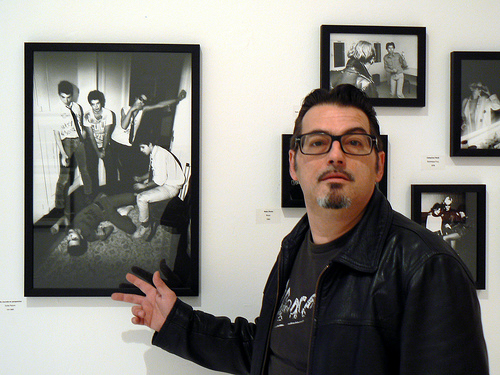
At the time, the members of this “graphic commando” were all living together in a large flat which was part Warholian Factory, part Bauhaus-style powerhouse. Fuelled by drugs, they worked day and night while musicians drifted in and out. There is a famous picture showing Dominique Fury flanked by a pair of Banshees sporting T-shirts she had just produced (pictured above). Speed and (especially) acid led to a Stakhanovist output ranging from countless record sleeves to the credits of TV programmes via an issue of NME. The switch to heroin soon slowed them down and heralded the group’s demise in 1980.

In many ways Bazooka provided a blueprint for the post-punk art collectives which followed in their wake. They celebrated everything modern in a knowing retro-futurist manner that was, in fact, typically postmodern; they rejected the traditional highbrow-lowbrow dichotomy, shunned museums and attacked the cultural establishment.

The Musulmans Fumants (a reference to Chester Himes), co-founded in 1980 by Tristam Dequatremare (former lead singer with punk combo Guilty Razors), preferred to exhibit their works in nightclubs rather than traditional galleries. They were instrumental in reviving figurative painting and launching the international careers of Robert Combas and Hervé Di Rosa who spearheaded the successful Figuration Libre movement (1981).

The Frères Ripoulin (1984) were the Musulmans Fumants’ partners in artistic crimes. They included Nina Childress, who graduated from art-punk band Lucrate Milk, as well as Claude Closky and Pierre Huyghe who went on to find fame and fortune.

Jean Faucheur, their theoretician, believed that the streets were the new art schools at a time when graffiti art had hardly reared its head. The Ripoulins were “affichistes”: they painted their works on posters which were then pasted on strategically-placed advertising hoardings. All these groups were linked to Basquiat, Haring and the whole Lower East Side scene across the Atlantic, but they are also very much the forefathers of the current Street Art movement.

Jeunes Gens Modernes in Paris

This was published by Dazed Digital (Dazed & Confused‘s website) on 24 April 2008:

Jeunes Gens Modernes in Paris

The opening of the Jeunes Gens Mödernes exhibition offered a whole generation a sense of closure. Quite literally, in the case of the hundreds of people who, unable to get in, transformed Rue Quincampoix into an impromptu al fresco carnival — a gathering of the tribes. Once-dodgy skinheads rubbed shoulders with effete dandies under the eyes of mohicaned whippersnappers who could have been (and indeed often were) their offspring.

At times, it felt a bit like having a chinwag with a grizzled Dorian Gray in front of his youthful likeness. Most of the faces on the Parisian post-punk scene were out in force, simultaneously plastered on the walls of the labyrinthine gallery and getting plastered in the cobbled courtyard. Weather-beaten but unbowed. Still high from 1001 nights at Le Palace or Le Rose Bonbon. Happy to have lived to tell the tale.

The “Jeunes Gens Mödernes” (“Mödern Young Things”) tag first cropped up in an issue of Actuel back in 1980. It referred specifically to a small coterie of hipsters revolving around rarefied bands like Artefact, Modern Guy or Suicide Romeo and nightclubs with the strictest of door policies. Here, curator Jean-François Sanz has given the expression a more comprehensive definition to include most aspects of Gallic post-punk culture between 1978 and 1983.

Like Spain’s La Movida or New York’s No Wave (largely inspired by Frenchman Michel Esteban), this was indeed far more than just a musical movement. It was a fully-fledged cultural revolution bent — sometimes outrageously so — on redefining fin-de-siècle modernity.

“Modern” (or “novö” to use Yves Adrien’s coinage with its trademark umlaut) was a ubiquitous buzzword in the wake of punk’s year zero. With hindsight, however, it is quite obvious that this phenomenon bears all the hallmarks of postmodernism — from its recycling of the major 20th century avant-gardes to its space-age retro-futurism.

Philippe Morillon, one of the emblematic artists of that era, explains that “it is at the very point when things disappear that we cling on to them”. He belongs to a generation which jettisoned the traditional highbrow/lowbrow dichotomy and shunned museums altogether. Newspapers, T-shirts or record sleeves were the Bazooka collective’s media of choice; the Musulmans Fumants showcased their works in nightclubs while the Frères Ripoulin turned to billboards. As for Morillon, he worked for advertising agencies.

The exhibition’s achronological bric-à-brac organisation is in keeping with the eclectic, iconoclastic spirit of the Jeunes Gens Mödernes themselves. Paintings, badges, films, fanzines, photographs, installations and videos all take pride of place in deliberately haphazard-fashion: this, after all, was the first truly multimedia movement.

If Jean-François Sanz eschews value judgements, his is not a hands-off approach — much to the chagrin of those who feel excluded. Former Guilty Razors frontman Tristam Dequatremare is perplexed at the absence of the Musulmans Fumants — the group he co-founded — despite being instrumental in reviving figurative painting and launching the international careers of Robert Combas and Hervé Di Rosa. Dominique Fury, who lobbied for their inclusion, believes the curator assembled works which all express a certain “existential frailty” she associates with the essence of adolescence. This is why he opted for the tortured genius of Bazooka, say, over the joie de vivre of the Musulmans Fumants for whom the 80s were one big party.

Fury herself is omnipresent, both as a muse and an artist in her own right. She is an Ariadne’s thread weaving her magic between past and present — the glamorous embodiment of this scene’s enduring legacy. No wonder some 3,000 punters attended the opening which offered a whole generation — and us — a sense of closure.

Des Jeunes Gens Mödernes runs until 17 May at the Galerie du Jour agnès b, 44 Rue Quincampoix, 75004 Paris

Sexy Eiffel Towers

This appeared in the April-May 2008 issue of Flux magazine (issue 64, PP. 36-37)

Sexy Eiffel Towers

Don’t laugh, but France played a crucial part in shaping the punk rock template (and I’m not talking about that Belgian comedy act Plastic Bertrand). Richard Hell’s wasted look, spiky hair and blank ethos were modelled on the fin-de-siècle poètes maudits. The ideological and aesthetic underpinnings of the Pistols camp were largely culled from the (largely French) Situationists. When the movement was still anonymous, Malcolm McLaren favoured calling it “new wave” in homage to the nouvelle vague — a monicker that ended up describing punk’s more commercial fellow-travellers.

According to one school of thought, French punk even predated its British counterpart. In 1972, dandy rock critic Yves “Sweet Punk” Adrien penned a seminal article in which he praised the primal energy of bands like the Stooges, MC5 or Flamin’ Groovies and castigated the sonic self-abuse of so-called progressive musicians. This manifesto was the journalistic equivalent of Lenny Kaye’s massively influential Nuggets compilation, released the same year and available at L’Open Market, Marc Zermati’s legendary record shop. Not content with providing a blueprint for London’s Rough Trade, Zermati was also responsible for the very first punk label (Skydog Records, 1973) and festival (Mont de Marsan, 1976). Future Ze Records supremo Michel Esteban and his partner Lizzy Mercier Descloux (Chrissa in Go Now, Richard Hell’s novel) launched a rival emporium within gobbing distance, thus sealing Les Halles’ reputation as the epicentre of Gallic punk activity. Like Covent Garden (home to the Roxy Club), the area was undergoing extensive refurbishment. Zola’s gutted “Belly of Paris” was about to spew up a Ballardian shopping complex and a futuristic modern art museum that would provide an ideal, dystopian backdrop to the new subculture as well as to the exhibition which, for the first time, charts its legacy.

Des Jeunes Gens Mödernes (“Modern Young Things”), hosted by fashion designer agnès b.’s Galerie du Jour, covers the post-punk period between 1978 and 1983. The title alludes to a label coined by trendy magazine Actuel in 1980 to describe a short-lived local scene — revolving around nightclub Le Rose Bonbon and bands such as Suicide Romeo or Modern Guy — that was unashamedly incestuous and elitist. Curator Jean-François Sanz is eager to explain that the reference is simply an “excuse” to gauge the far wider cultural fallout from the 1977 explosion. Like New York’s No Wave, this was indeed a fully-fledged cultural revolution involving artists, writers, filmmakers and fashionistas as well as musicians.

Dominique Fury — once described as the Parisian Edie Sedgwick — embodied the restless creative spirit of the times. After leaving all-girl combo L. U. V., she joined the Bazooka collective (arguably the most influential punk artists this side of Jamie Reid) having been attracted by the “sheer intensity of their graphic production”. By 1980, she was producing her famous line of signed, one-off “geometric cold wave” T-shirts-cum-artworks for agnès b. and experimenting with industrial fabrics. Tristam Dequatremare, the former lead singer with Guilty Razors who likewise graduated to the art fraternity, sees this exhibition as a means of putting the record straight. “The revival of figurative painting started here in France,” he says, lamenting the fact that the likes of the Musulmans Fumants (the group to which he belonged) or the Frères Ripoulin (which included several members of art-punk outfit Lucrate Milk) have been airbrushed out of international contemporary art history.

The exhibition itself is complemented by a book, a double CD compilation as well as a documentary which reflect the movement’s inherently multimedia nature and exuberant originality. The album contains the cream of the local post-punk crop (Marquis de Sade, Taxi Girl, Elli & Jacno, Etienne Daho, Lizzy Mercier Descloux, Marie et les Garçons…) but also a few covers by contemporary bands who take their inspiration from this period. This is a nice touch as one is left with a distinct sense of unfulfilled promise. The early cultural maelstrom gradually gave way to a more somber mood as the Socialist government’s policies failed and AIDS started taking its toll. As Fury puts it, “Death was disco-dancing beneath the plush red velvet of Le Palace nightclub”.

Des Jeunes Gens Mödernes runs from 3 April until 17 May at the Galerie du Jour agnès b. (44 Rue Quincampoix, 75004 Paris).

Andy Warhol, Serious Writer

This appeared on the Guardian Books Blog on 2 April 2008:

Andy Warhol, Serious Writer
Best-known as a photographer, filmmaker, designer and illustrator, pope of pop Andy Warhol was also an influential novelist

warhol

Andy Warhol was a painter, illustrator, designer, photographer, filmmaker, producer, journalist, editor, anchorman, and model. In her book Warhol Spirit Cécile Guilbert argues, more contentiously, that he was also a serious writer.

She makes much of his influence on Bret Easton Ellis, himself one of the most influential authors of recent years. In one instance, an extract from American Psycho and a social column penned by Warhol in 1973 are printed side by side. The similarities are striking: same tonal blankness, compulsive name-dropping and seemingly endless lists of designer goods. (Fittingly, the film adaptation of American Psycho was directed by Mary Harron, whose previous movie had been I Shot Andy Warhol.)

Warhol’s name has frequently cropped up in reviews of Ellis’s work, but the connection has been most clearly established by Ellis himself. One of the characters in Glamorama is mocked because she only owns two books: the Bible plus the Andy Warhol Diaries (“and the Bible was a gift”). The inference here is that the Diaries appeal to superficial hipsters, but the juxtaposition with scripture is just as significant. The Pope of Pop presides over the celebrity culture and branded environment Glamorama is steeped in, but his presence runs the paradoxical risk of being overlooked — it is part of the novel’s wallpaper. When Victor, the protagonist, quotes one of Warhol’s epigrams (“Baby, Andy once said that beauty is a sign of intelligence”), it is immediately disproved by his girlfriend’s admission that she has no idea who he is (“Andy who?”). The fact that she could have walked straight out of the Factory or the Chelsea Hotel adds a nice touch of dramatic irony.

Apparently, the two men met at a launch party for Less Than Zero in 1985. Warhol had not read Ellis’s debut, but was much taken with its title (a nod to Elvis Costello) that resonated with his own rhetoric. Cécile Guilbert zeroes in on the quasi-Zen minimalism of his interview performances. She sees Warhol as a Candide-like figure rather than the usual sub-Wildean ironist: a mystical idiot savant whose very passivity turns him into a mirror or a tape recorder. In his memoir, POPism, Warhol claimed that the words he uttered during interviews always seemed to be “coming from someplace else, someplace behind [him]”. This oracular ventriloquism raises issues of authorship, as does his approach to the novel.

a: A Novel — Warhol’s answer to Ulysses, published in 1968 — is the verbatim transcription of a series of taped conversations between the author and actor Ondine. The typescripts (courtesy of four typists including Velvet Underground drummer Mo Tucker who excised all swear words) were themselves faithfully reproduced down to the last typo and abbreviation. The outcome is largely unreadable, in the same way that Warhol’s films are largely unwatchable.

Perhaps I am missing the point here. After all, Warhol deliberately set out to produce a “bad” novel as an experiment and his hands-off approach provided a nice variation on Roland Barthes’s “Death of the Author” (an almost literal one given the Valerie Solanas incident which had just occured). He can also be credited with taking the objectivity of the nouveau roman to its logical conclusion and fulfilling B. S. Johnson‘s dream of capturing the “enormity of life” between the covers of a book.

Warhol was a prescient writer, if not a great one. He anticipated that the truth of fiction would be ditched in favour of the fictionalization of truth and invented reality TV in the process. In a way, he was not a writer at all. All his books were either dictated or transcribed from recordings, and in this respect he was part of a curiously old-fashioned tradition that predates the Gutenberg Galaxy.