Melancholia as Ultimate Rebellion

Excerpts from Lee Rourke, “In Conversation: Lee Rourke and Tom McCarthy,” The Guardian (Guardian Review p.12) Saturday 18 September 2010
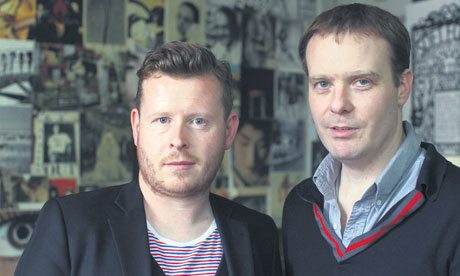
Lee-Rourke-and-Tom-McCart-006
[Lee Rourke (left) and Tom McCarthy. Photograph: Eamonn McCabe for the Guardian]

LR: You’ve said in the past that all art is repetition.

TMcC: Yeah: Joyce’s “commodius vicus of recirculation” . . . Or Mark E Smith’s three Rs: repetition, repetition and repetition . . .

LR: I’ll drink to that. It’s like a never-ending transmission that can’t be switched off.

TMcC: The transmission thing is important. There’s that Kraftwerk song, “I am the receiver and you are the transmitter”, or however it goes. One way of thinking about art, or the novel, is that the writer is the transmitter, the originator: I have something to say about the world and I’m going to transmit it. But this isn’t how I see it, I see it as exactly the inverse: the writer is a receiver and the content is already out there. The task of the writer is to filter it, to sample it and remix it — not in some random way, but conscientiously and attentively. This is what Heidegger says about poets: to be a poet is to listen before speaking; it’s first and foremost a listening and not a speaking. Kafka said it as well: “I write in order to affirm and reaffirm that I have absolutely nothing to say.” Writing, or art, is not about having something to say; it’s about aspiring to a heightened state of hearing. It’s why C is a totally acoustic novel and a receptive novel. The hero, Serge, sits there for hours trawling the aether waves, absorbing, listening to ship-to-shore transmissions, stock market prices, sports results, writing them all down. In a way, if you could see Serge’s transcript it would probably read like an Ezra Pound canto.

LR: This is why Serge is so brilliant, because all this absorption culminates in a form of pure poetry. I’m thinking of the novel’s “Chute” section, especially the first world war passages. Serge in his plane over enemy lines, flying above and below, marking the sky around him with these wonderful vapour trails while shooting up heroin and quoting Hölderlin, and so on. Where does all that come from? I know you’re interested in Marinetti’s manifestos.

TMcC: For Serge the whole battlefield becomes a sound box. He thinks of his machine gun, when he’s firing it into the trenches below, as like a needle being aligned with the groove of a record. When the needle goes in, static comes out, and it all resonates: the percussion of machine-gun fire, the siren wail of howitzers. The difference between Serge and Wilfred Owen is that Serge loves war. By the way, talking of Marinetti: it’s interesting that Marinetti’s novels, which supposedly enact the propositions of his many manifestos, are much less interesting than the manifestos. And the paintings that people did based on his manifestos are much less good as well. The manifestos are a kind of field of potentiality that to actually realise would spoil.

LR: You’ve stated recently that C is essentially a novel about desire as much as about technology, and the “looping” of both within time. This puts me in mind of Beckett’s Krapp’s Last Tape. This idea that technology doesn’t take you forwards into the future, but actually takes you back towards your past.

TMcC: When Beckett’s old man is listening to these old tapes of himself, what it actually comes down to is desire — it’s incredibly moving. He’s there at the end, the end of his life, he wants to stop replaying it, all the loopings, snarling “Wasn’t once enough?”; but he listens again and again and again to this incredibly lyrical passage that he’s recorded about 30 or 40 years ago about him floating in a punt, with a girl, and the water all around them, I mean, it’s fucking amazing, it’s really, really beautiful. This is it, you see: what we find in technology and networks is desire. Which doesn’t mean the desiring individual; it means desiring consciousness itself. That’s why I wanted Serge Carrefax to be more than an individual; if he was a circuit he’d be over-charged. The surge is too much, it blows. It’s about the desire for impossibility. Giorgio Agamben, when describing melancholia (which Serge has in spades), says that the condition isn’t at all a detachment from the world, even though it may seem like it; in fact it’s an investment in the world so much that the desire for the world exceeds its own limit. The melancholic wants what is impossible; he wants impossibility itself — to experience it and to merge with it. To surge towards it. That’s why the melancholic is the ultimate rebel.

LR: Is it a desire for the impossible, or nothingness, to become real? To become a tangible thing?

TMcC: No, I think it’s more than that. I mean Pygmalion gets that: he wants the statue and then it becomes real, and that’s cute. But take Orpheus looking back: he’s far more interesting. He doesn’t really want Eurydice, he wants the dark night. As Maurice Blanchot brilliantly points out, he wants death itself. Not to make the night illuminated or present, but to have it in its absence, to have the presence of absence, something that is impossible. It’s doomed, beautiful and tragic.

LR: This is Blanchot’s Orpheus’s Gaze

TMcC: Right. It’s an essay about five pages long and it’s the most amazing summary of what literature is, or could be, ever written. It’s not about representing the world, it’s not about criticising the world even. It’s about surrendering to a vertigo that can never be mastered, to an abyss that can never be commanded, or excavated or filled in.

LR: But you can leave your mark, right?

TMcC: Yeah, the scratch. Scratching the negative. That’s what artists do at their very best.
The Silent Call of Conscience

Simon Critchley,”Being and Time, Part 7: Conscience,” The Guardian 20 July 2009

“…What gets said in the call of conscience? Heidegger is crystal clear: like Cordelia in King Lear, nothing is said. The call of conscience is silent. It contains no instructions or advice. In order to understand this, it is important to grasp that, for Heidegger, inauthentic life is characterised by chatter — for example, the ever-ambiguous hubbub of the blogosphere. Conscience calls Dasein back from this chatter silently. It has the character of what Heidegger calls “reticence” (Verschwiegenheit), which is the privileged mode of language in Heidegger. So, the call of conscience is a silent call that silences the chatter of the world and brings me back to myself….”

Inalienable Silence

Tom McCarthy, Calling All Agents (London: Vargas Organisation, 2003). 4-5.

“…And yet the Hearings left us with the impression that if (as Gil Scott Heron says) the Revolution will not be televised, then perhaps its nucleus will not be caught on audio tape or broadcast on the airwaves either — or if it will, then it will take the form of silence. For Heidegger, everything stems from the Unspoken: Being calls us, but it does so ‘in the uncanny mode of keeping silent.’ Burroughs’s revolutionary drive extends to a transformation of language that will help cast off the ‘IS’ of identity: this language, he tells us, will be a hieroglyphic one that ‘will give one the option of silence.’ Hollings, discussing Burroughs in an article, writes: ‘Recorded silence only becomes a political act once it is played back.’ There are echoes of Cégeste’s first message here. Hollings was a contributor to Violent Silence (a book about Bataille), a collaborator with John Cage and at the time of the Hearings was conducting research into the erased passages in Nixon’s Watergate tapes. What did he mean ‘recorded silence only becomes a political act once it is played back,’ we asked him. ‘Playing a blank tape,’ he told us, ‘breaking the seal on something and sticking it in a machine and listening to it, is an act of refusal.’ ‘So there is a kind of inalienable silence that is encrypted somehow?’ Anthony Auerbach asked; ‘And this potentially contains the revolutionary moment?’ ‘Exactly so,’ said Hollings. This is the violent silence of Shakespeare’s Cordelia, who tells her father ‘Nothing’ — a single word which leads to general annihilation, wars and madness; or of Stephen Daedalus, self-styled ‘Cordoglio’ who, as he brings about ‘the ruin of all space, shattered glass and toppling masonry, and time one livid final flame,’ says ‘Nothing!’ ‘Maybe,’ I suggested, ‘our radio project should be a quest for that silence’ — a suggestion to which Hollings answered, in what turned out to be the Hearings’ final exchange: ‘I would strongly recommend it.’…”

On p. 12, McCarthy mentions Burroughs’s “putative hushed-up language”.

On p. 16: “This silent word is so charged and so seductive, Abraham and Torok conclude [in Cryptonomy: the Wolf Man’s Magic Word], that it and it alone becomes the object of the Wolf Man’s love. To keep it safe he buries it inside the crypt ‘like a chrysalis in its cocoon’ and carries it around for all his life, showing and hiding it, saying it without saying it, ‘repeating tirelessly to one and all, especially to his analyst: ‘Here is nothing, hold it tight’.”

“‘Poetry,’ in the words of Auden, ‘makes nothing happen’ — an active construct in which ‘nothing’ designates an event, perhaps even a momentous one. In looking into the abyssal ground, reading its source code and transmitting this nothing outwards, maybe we will find that our culture also [like Freud’s Wolf Man] has a secret, silent word.”

Fiction Fatigue

An extract from Robert Collins’s interview with Tom McCarthy:

Robert Collins, “The Novel: Rewound and Remixed,” The Sunday Times 4 July 2010

Less than a century ago, James Joyce and Virginia Woolf took the 19th-century realist novel and forged it into the blinding experimental thunderbolt of high modernism. Ninety years later, with more novels being published than ever, and most of them uniformly aiming for the same realist goal, it’s as if Ulysses, Finnegans Wake and Mrs Dalloway had never happened. Where did the zeal for unfettered innovation go? Even in the brilliantly able hands of David Mitchell, Zadie Smith or Ian McEwan, the novel has regressed almost completely to its realist origins. With commercial expectations in publishing more desperate and unforgiving than ever, the room for experimentation has shrunk to virtually nil.

A recent book, Reality Hunger, by the American author David Shields, has generated febrile literary chatter about the novel’s future. Shields argues that the form, tied to phoney invention and creaky artifice, is no longer a viable medium for the tastes of the hyperconnected age, with its urge towards hybridisation and cross-pollination. Nonfiction — memoir, the lyric essay, rap, all freed from fiction’s dusty strictures — is where it’s at.

You can see novelists showing chronic signs of fiction fatigue. The twice Booker-winner and Nobel laureate JM Coetzee has strayed ever deeper into autobiography in his novels, and has rallied to Shields’s cry: “I, too, am sick of the well-made novel with its plot and its characters and its settings.” He was joined by Smith, who recently swore off writing another novel and, “out of exactly the kind of novel-nausea Shields describes”, decided to produce a collection of essays, Changing My Mind. “Novels,” she writes, “are idiosyncratic, uneven, embarrassing, and quite frequently nausea-inducing — especially if you happen to have written one.”

Novelists, catching the mood of despair, are falling like flies, turning to what now appears as the verdant, promising land of nonfiction. This year alone, Chinua Achebe, Jonathan Safran Foer, Siri Hustvedt and Rupert Thomson have published nonfiction debuts. There are, of course, fiction writers of astounding virtuosity out there, such as Mitchell, McEwan or Hilary Mantel. But these novelists are, it is no disparagement to say, going through the motions. Where’s the novelty, the newness, that the novel promised in Joyce and Woolf’s hands? The contemporary novel’s not dead. It’s sleepwalking.

Then along comes Tom McCarthy. Forty-one, and born in London, McCarthy has stood until recently at the outer edges of the literary world. With his third novel, C, a supercharged, fizzingly written Bildungsroman about a morphine-addicted radio operator in the early decades of the 20th century, he is arguably about to take his place at its centre. …

Potential Literature

On the Official Catalog of the Library of Potential Literature by Ben Segal and Erinrose Mager:

We are very excited to announce the coming existence of The Official Catalog of the Library of Potential Literature. The Catalog is to consist of a series of blurbs/short descriptions of books that do not exist. In order to compile that Catalog, we have asked many of the writers, theorists, and text-makers we most admire to imagine that they’ve just read the most amazing book they’ve ever encountered and then write a brief blurb about the imagined text.

As many of you know, The phrase ‘potential literature’ is highly associated with the Oulipo group. We choose to use the phrase here because, as the Oulipo says, their project, properly, is to conceptualize forms and potential works: not necessarily to bring them into being. Literature is potential literature when it is that shimmering non-work of total possibility. Though Official only by way of titular hyperbole (itself, like the blurbs contained within, a kind of unfulfilled and unfulfillable promise), the Catalog will evoke a library of wonderful — maybe even impossible — books; books that, in spite or even because of their non-existence, excite and fascinate. Each paragraph will be the promise of the unopened book in the moment before reading. […]

Redactive Poetry Project

Dennis Johnson, “Redactive Poetry Probably Legal, Say Experts,” MobyLives 19 March 2010:

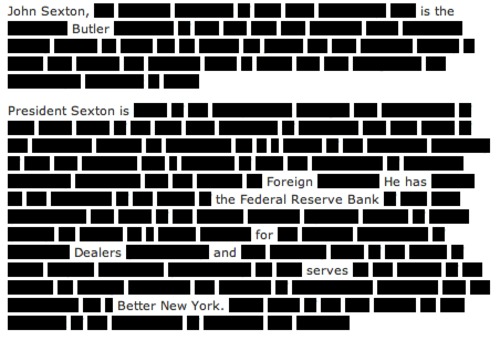
Inspired by a poetic method called “erasure” — “where the poet erases portions of newsprint or blots out text from a novel, using the remaining words to create a different narrative than the original journalist or author’s intention” — a group of students in an intellectual property law class at New York University have launched the Redactive Poetry Project.

Parker Higgins, Amanda Levendowski, and Nick Panama say the aim of the project is to imitate the physical aspect of erasure poetry by having a website that “functions digitally by enabling users to redact portions of text from any webpage on the internet using our RePoMan bookmarklet to create a new poetic work.” That is, the site offers a nifty button that you can add to your bookmarks bar, then simply clicking on it at other websites allows you to “redact” or black-out parts of the text on that website. Redactive poets are then encouraged to take a screen shot of the result and send it to the website, where Higgins, Levendowski and Panama have been posting submissions since earlier this month. …

Burn Baby Burn

Leo Benedictus, “Brian Duffy: ‘Photography was dead by 1972′” The Guardian 12 January 2010

One morning in 1979, Brian Duffy, then one of the most famous photographers in the world, came into work. One of his assistants told him they had run out of toilet paper. His memory is hazy, he admits, but what happened next became an ­episode of snapper folklore.

“I realised,” he recalls in a documentary that airs on BBC4 ­tonight, “that I was making decisions about toilet ­paper. And I thought, ‘This has got to end.’ Either by me murdering my staff, killing myself, or setting fire to the whole fucking thing.” So he gathered every negative and transparency he had ever shot and burned them on a fire in his back garden. After that, he never took another picture.

Except, as it turns out, negatives do not easily catch fire. And when they do, they produce an acrid black smoke: this bonfire ended when an official from Camden council peered over the fence and insisted Duffy put it out. Duffy packed what remained away in shoeboxes in his attic and turned to painting and furniture-restoring. It was only in 2007, when his son Chris went through the boxes, that he reluctantly agreed that they were worth another look. This led to a show in London last year – the first, anywhere, of his career.

To devotees of photography, these surviving pictures were like a salvaged stack from the library at Alexandria.

…So when did it cease to be interesting? Duffy offers some clues in the BBC’s documentary. Talking with Bailey, he says he feels the US photographers ­Irving Penn and Richard Avedon “fucked photography for us”. What does he mean? “They got there,” he says, ­referring to their revolutionary work, which pushed at the boundaries of photography. “You’re a bit annoyed when someone does something and you go, ‘Shit! I was just about to do that!'”

The result, says Duffy, was that “photography was dead by 1972”. He takes a rare pause, then explains: ­”Everything had been resolved between 1839 and 1972. Every picture after 72, I have seen pre-72. Nothing new. But it took me some time to detect its death. The first person who twigged was Henri Cartier-Bresson. He just stopped – and started painting and drawing. God, he was useless.”…

…So Duffy experimented, until he felt the scope for experimentation had ran out. By the 1970s, he was doing most of his work in advertising — with people he didn’t like, on briefs that bored him. “The more I got into it, the more I ­realised I was hanging out with things I was diametrically opposed to. And they wanted me to keep a civil tongue up their rectum.”

So he burned everything….

Silences

An excerpt from Tillie Olsen‘s Silences (1962):

Literary history and the present are dark with silences: some the silences for years by our acknowledged great; some silences hidden; some the ceasing to publish after one work appears; some the never coming to book form at all. What is it that happens with the creator, to the creative process, in that time? What are creation’s needs for full functioning? Without intention of or pretension to literary scholarship, I have had special need to learn all I could of this over the years, myself so nearly remaining mute and having to let writing die over and over again in me. These are not natural silences — what Keats called agonie ennuyeuse (the tedious agony) — that necessary time for renewal, lying fallow, gestation, in the natural cycle of creation. The silences I speak of here are unnatural: the unnatural thwarting of what struggles to come into being, but cannot. In the old, the obvious parallels: when the seed strikes stone; the soil will not sustain; the spring is false; the time is drought or blight or infestation; the frost comes premature. The great in achievement have known such silences — Thomas Hardy, Melville, Rimbaud, Gerard Manley Hopkins. They tell us little as to why or how the creative working atrophied and died in them — if ever it did. Kin to these years-long silences are the hidden silences; work aborted, deferred, denied — hidden by the work which does come to fruition. Hopkins rightfully belongs here; almost certainly William Blake; Jane Austen, Olive Schreiner, Theodore Dreiser, Willa Cather, Franz Kafka, Katherine Anne Porter, many other contemporary writers. Censorship silences. Deletions, omissions, abandonment of the medium (as with Hardy); paralyzing of capacity (as Dreiser’s ten-year stasis on Jennie Gerhardt after the storm against Sister Carrie). Publishers’ censorship, refusing subject matter or treatment as “not suitable” or “no market for.” Self-censorship. Religious, political censorship — sometimes spurring inventiveness — most often (read Dostoyevsky’s letters) a wearing attrition. The extreme of this: those writers physically silenced by governments. Isaac Babel, the years of imprisonment, what took place in him with what wanted to be written? Or in Oscar Wilde, who was not permitted even a pencil until the last months of his imprisonment? Other silences. The truly memorable poem, story, or book, then the writer ceasing to be published (As Jean Toomer, Cane; Henry Roth, Call It Sleep; Edith Summers Kelley, Weeds). Was one work all the writers had in them (life too thin for pressure of material, renewal) and the respect for literature too great to repeat themselves? Was it “the knife of the perfectionist attitude in art and life” at their throat? Were the conditions not present for establishing the habits of creativity (a young Colette who lacked a Willy to lock her in her room each day)? Or — as instanced over and over — other claims, other responsibilities so writing could not be first? (The writer of a class, sex, color still marginal in literature, and whose coming to written voice at all against complex odds is exhausting achievement.) It is an eloquent commentary that this one-book silence has been true of most black writers, only eleven in the hundred years since 1850 have published novels more than twice. There is a prevalent silence I pass by quickly, the absence of creativity where it once had been; the ceasing to create literature, though the books may keep coming out year after year. That suicide of the creative process Hemingway describes so accurately in “The Snows of Kilimanjaro.” He had destroyed his talent himself — by not using it, by betrayals of himself and what he believed in, by drinking so much that he blunted the edge of his perceptions, by laziness, by sloth, by snobbery, by hook and by crook, selling vitality, trading it for security, for comfort. Almost unnoted are the foreground silences, before the achievement. George Eliot, Joseph Conrad, Isak Dinesen, Sherwood Anderson, Dorothy Richardson, Elizabeth Madox Roberts, A. E. Coppard, Angus Wilson, Joyce Caryl. All close to, or in their forties before they came published writers; Lampedusa, Maria Dermout (The Ten Thousand Things). Laura Ingalls Wilder, the “children’s writer,” in their sixties. Very close to this last grouping are the silences where the lives never came to writing. Among these, the mute inglorious Miltons: those whose waking hours are all struggle for existence; the barely educated; the illiterate; women. Their silence the silence of centuries as to how life was, is, for most of humanity.