Delete

Nick Clark, “Web Hits Delete on Magazine’s 12-Year Archive,” The Independent 6 July 2012

When avant-garde literary website 3:AM Magazine went down a week ago, staff hoped it would be up and running within the day.

But they now fear that 12 years of archived material — every article they have published — may be lost for ever after it emerged those responsible for the site’s servers have vanished.

Andrew Gallix, editor-in-chief, told The Independent that the events of the past week have been “traumatic” and highlighted the “the fragility of online content”.

He added: “I never expected those who were meant to host and back up our content to just switch us off without even telling us.”

Messages of support flooded in from Facebook and Twitter for one of the original book blogs. One reader wrote: “Twelve years of writing, vanished. Here’s hoping it’s able to continue somehow.”

Mr Gallix has run the site since 2000, with the literary webzine attracting acclaimed writers including Lee Rourke, Tony O’Neill and Booker Prize nominee Tom McCarthy.

[…] As for 3:AM, Mr Gallix is trying to track down the person responsible for the servers. After a few false leads, as well as a disconnected phone and emails bouncing back, he believes he has tracked him down.

“At this stage, we do not know if we’ll ever be able to speak to him and if he can switch his server back on long enough to allow us to move 12 years’ worth of content to another, more reliable host,” Mr Gallix said. “I should have backed it up somewhere else, but it never occurred to me.”

All the Latest

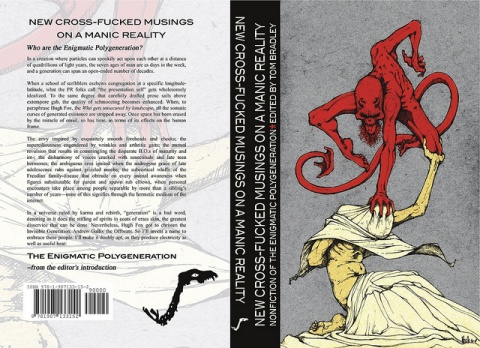
Darran Anderson briefly mentions “Dr Martens’ Bouncing Souls” in his review of the New Cross-Fucked Musings on a Manic Reality anthology (edited by Tom Bradley). He describes the story as “a bruising but graceful play on language, violence and cocksmanship,” which just about sums it up. (The review appeared in 3:AM Magazine on 27 October 2011.)

All the Latest

I’ve written a piece about custard-pie activism for the Guardian‘s Comment is Free section. You can read it here. An expanded version of my review of Marc-Edouard Nabe‘s latest novel appeared in 3:AM Magazine. Also in 3:AM, I talk about my summer reading list.

Indie Literary Sites Start Coming of Age

Katie Allen, “Indie Literary Sites Start Coming of Age,” The Bookseller 8 October 2010:

For the time being, print still rules. There is no denying the cachet of Granta, the London Review of Books and the Times Literary Supplement, plus a number of smaller publications such as Litro and print-and-online publications such as Pen Pusher and Notes from the Underground.

Yet alongside Hamish Hamilton’s own project, Five Dials, the recent recruitment of publishing names including Scott Pack, Simon Trewin and Alma Books m.d. Alessandro Gallenzi as columnists for The View from Here is an example of how seriously the trade is taking independent literary websites.

Gallenzi became involved out of interest in “promoting new talent, new voices, new writers”. However, he is wary of the proliferation of online books content. “There is a certain hierarchy of critics and reviews. I respect the opinion of certain critics because of who he or she is and what they have done before . . . You have to take it on a blog-by-blog basis,” he said.

Sandra Taylor — Pan Mac publicity and digital communications manager — is a keen advocate of online literary magazines.“It’s hard to identify a spike in sales, as you can with a book being mentioned on Radio 4. But we definitely see it as part of a fully integrated campaign because if a reader wants to Google one of our authors, we want there to be richer content available. It’s interesting and important for Google rankings. It’s also important in terms of supporting new writers.”

Viola Fort, editor of untitledbooks.com, said: “Publishers are getting more web-savvy. From the beginning, they saw us as credible. We’ve got a much younger audience than traditional literary magazines. I wanted to do something on a par, but with a new way of access.”

Andrew Gallix, editor of 3:AM, said: “It’s easier today than [when we launched] in 2000, because online publications are taken far more seriously. Then again, it’s far more difficult for us as there are now hundreds of similar webzines.

“When we started out, webzines were looked down upon in Britain as being second-rate. [But] we’re now assiduously courted by publishers, big and small, especially since the credit crunch (which led them to look for cheaper ways to promote their books).

“The majors, in particular, know that we can give authors credibility, which is something that’s difficult to manufacture,” he added.

Jane Bradbury of For Books’ Sake said that publisher attention had been more noticeable since the site chose to focus exclusively on female writers five months ago.

“Independent and smaller presses have been so much more proactive and supportive,” she said, citing Serpent’s Tail and Pulp Press. “More mainstream publishing houses have mostly ignored us so far (with a couple of exceptions such as Virago).

She added: “Maybe that’s to do with them being much more rambling operations. With smaller publishers, they are usually much more on the ball in terms of monitoring online media, such as Twitter etc, and making mutually valuable connections.”