Pour une littérature irréfutable

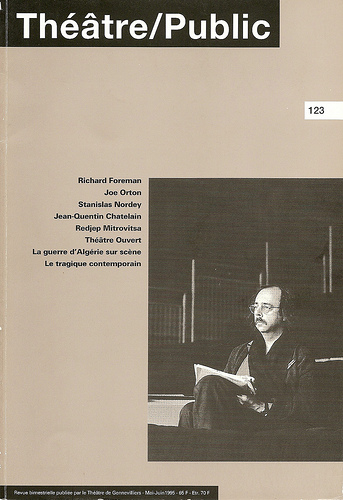
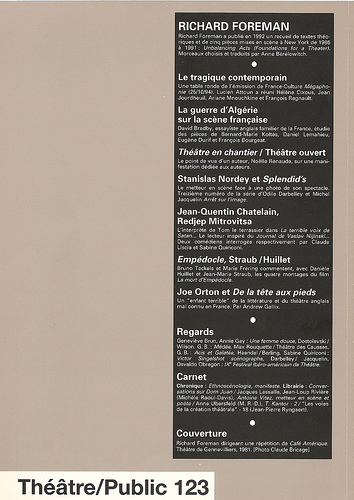
Pour une littérature irréfutable: Joe Orton et De la tête aux pieds, Théâtre/Public 123 (May-June 1995) : 65-70

De la tête aux pieds (1), le roman posthume de Joe Orton, l’enfant terrible de la nouvelle vague théâtrale britannique, a enfin été traduit en français, plus de vingt ans après sa publication outre-Manche. Les spectateurs parisiens ont également pu redécouvrir Le locataire (2), la pièce par laquelle le scandale arriva il y a tout juste trente ans. Deux textes qui n’ont pas pris une ride, d’un auteur qui n’a produit que des œuvres de jeunesse.

Incarcéré dans des latrines, Gombold compose un poème sur un avion en papier. Quelques secondes à peine après Ie décollage, l’engin est renvoyé à son expéditeur sans même avoir été déplié. Il s’agit là d’une des scènes clefs du roman de Joe Orton De la tête aux pieds. Sa carrière durant, l’écrivain fut hanté, en effet, par la peur de ne pas être écouté. Cette obsession n’était, certes, pas sans fondement. Lorsqu’il s’essaye pour la dernière fois au genre romanesque, en 1961, Orton est un homme de lettres…de refus. D’ailleurs, De la tête aux pieds fera aussi peu d’impression que l’envolée poétique de son protagoniste, et Ie rejet du manuscrit par les grandes maisons d’édition londoniennes sanctionnera plus d’une décennie d’échecs littéraires.

Un théâtre de farces et attrapes
John Kingsley Orton avait tout pour ne pas réussir. Il naît à Leicester en 1933 dans un milieu très modeste, et s’illustre rapidement par son recalage à l’examen d’entrée en sixième. Elsie Orton, une mégère qu’aucun homme ne parviendra à apprivoiser, a néanmoins de grands projets pour sa progéniture. Si elle est pleine de bonne volonté dès lors qu’il s’agit de ne pas se trouver en reste avec les voisins, Elsie n’a pas, hélas, les moyens de ses ambitions. Voyant son rejeton rejeté du système scolaire classique, elle sacrifie sa bague de mariage au mont-de-piété afin de l’inscrire dans une école privée, sans même se rendre compte que cet établissement le vouait au secrétariat et non aux humanités. De l’avis de ses professeurs, qui le vouent aux gémonies, le jeune homme est alors illettré. Orton ne peut, toutefois, se résoudre a une vie de grouillot ou de gratte-papier. Il tente d’échapper à la médiocrité de son existence en jouant dans diverses troupes théâtrales amateurs, et décroche par miracle une bourse à la Royal Academy of Dramatic Arts, Ie prestigieux conservatoire d’art dramatique britannique. C’est là qu’il rencontre son amant, Kenneth Halliwell, de sept ans son aîné, qui entreprend aussitôt de faire son éducation sentimentale et intellectuelle. Des échos a peine voilés de cette relation de maître a élève sont décelables dans De la tête aux pieds, une œuvre que l’on pourrait définir, au demeurant, comme un roman d’apprentissage. “J’ai un grand désir de m’instruire”, y affirme Gombold, en toute candeur, après avoir fait la connaissance du très savant Doktor Von Pregnant. On songe aussi à la reprise de ce thème sur Ie mode parodique dans Le locataire, la seule pièce qu’Orton ait dédiée à son compagnon.

A partir de 1953, la vie du couple s’organise autour d’une collaboration littéraire à laquelle Orton ne peut contribuer, dans un premier temps, que par son talent de dactylographe. Ironie du sort: lorsque son protégé entamera une fulgurante carrière d’auteur dramatique, dix ans plus tard, c’est Halliwell, l’écrivain raté, qui en sera réduit à se présenter comme Ie secrétaire de M. Joe Orton. Les signes annonciateurs de ce renversement sont perceptibles dès 1962, date à laquelle ils sont incarcérés pour avoir volé et endommagé un nombre considérable d’ouvrages appartenant a la bibliothèque municipale d’Islington. En effet, depuis trois ans, les deux gays lurons s’adonnaient à une singulière expérience de vandalisme culturel. Non contents de transformer leur studio en gigantesque collage surréaliste, au moyen de centaines de gravures découpées dans des livres d’art, Orton et Halliwell avaient choisi l’honorable bibliothèque comme théâtre d’opérations de sabotage littéraire. Une fois les livres subtilement subtilisés, ils se livraient à une sorte de détournement de fond et de forme. Titres travestis, photos maquillées, prières d’insérer violentés : l’objectif était déjà de décevoir l’attente du lecteur, pour mieux attenter à sa pudeur. Ainsi, apres l’un de leurs passages, une pin up tirait la couverture à elle en affichant sa nudité sur un manuel d’étiquette. Sur une autre jaquette, un vieillard bedonnant, moulé dans un minuscule maillot de bain et tatoué de pied en cap, se pavanait à côté du nom du poète John Betjeman. Entreprise de recréation, donc, mais aussi de récréation. Pour Orton et Halliwell, qui etablissaient un parallèle heroï-comique entre leur bibliothèque municipale et celle d’Alexandrie, la révolution serait ludique, ou ne serait pas. Sonnait, enfin, l’heure du leurre. Les brûlots etaient sagement rangés sur les rayons, comme des bombes à retardement. Le critique-voyou se faisait voyeur pour savourer les réactions tantôt indignées, tantôt amusées du public, avant de quitter Ie champ de bataille jonché d’ouvrages mutilés et défigurés. Ces canulars de potache (post-dadaïstes ou proto-situationnistes) seront perçus par les autorités comme de véritables crimes contre Ie lecteur (leur semblable, leur frère) et, partant, contre la republique des lettres. Sans doute la sévérité de la sentence, six mois de prison ferme, était-elle aussi imputable à I’homosexualité des accusés. Plus tard, Orton révèlera l’épisode qui mit Ie feu aux poudres. C’est après avoir découvert, avec effroi, que la bibliothèque d’Islington ne possédait pas L’histoire du déclin et de la chute de l’Empire romain, qu’il partit en guerre contre “l’âge du papier”, pour reprendre l’expression de Challemel-Lacour. Une bibliothèque papivore, gavée d’oeuvres alimentaires, n’était pas à même de rassasier la boulimie de savoir du jeune écrivain; elle n’ avait pas de raison d’êre. Et Orton de citer les Saintes Ecritures : “… à multiplier les livres, il n’y a pas de limite” (Ec 12 : 14).

Vaudeville à vau-l’eau
L’ascension météorique d’Orton prend son essor a partir de ces attaques contre la galaxie Gutenberg, dans I’orbite de laquelle il gravitait jusqu’alors en quête de reconnaissance. Même au zénith de sa carrière, son oeuvre restera marquée par les empreintes laissées sur les livres empruntés à la bibliothèque de quartier. Pas de quartier pour les genres obsolètes, qu’il mine de l’intérieur, mine de rien. Gare au roman de gare, qu’il détourne, sans crier gare, de ses voies toutes tracées. Le rideau se lève sur Ie train-train habituel. Soudain, Orton raille, la piece déraille, Ie rideau est tiré sur Ie passé. Orton, c’est Dionysos pénétrant par effraction chez Feydeau. II bouleverse Ie boulevard, en Ie plongeant de force dans un bain de jouvence, pour Ie ramener aux sources bachiques des rites de fertilité antiques. Bousculer les habitudes ovines des habitués du théâtre; déshabituer leur regard bovin : voilà les deux mamelles de ces vaudevilles vachards. La stratégie ortonienne, que l’auteur définira lui-même comme “une satire délibérée du mauvais théâtre”, consistera donc à caresser Ie spectateur dans Ie sens du poil, avant de Ie traquer jusque dans ses derniers retranchements. Comme dans la salle de lecture d’Islington, il s’agira d’ attirer Ie chaland sous de fallacieux prétextes afin de l’exposer, à son corps défendant, a une polyphonie de perversions polymorphes : Ie pauvre spectateur sera toujours Ie dindon de ce théâtre de farces et attrapes. Ainsi, Orton usera-t-il de subterfuges, tous plus subtils les uns que les autres, pour subvertir subrepticement les préjuges du béotien, dynamiter ses mythes et, finalement, Ie corrompre de plaisir. C’ est une étrange entreprise que celle de se rire des honnêtes gens!

L’épisode de la bibliothèque et son épilogue carcéral auront des répercussions différentes sur les deux prisonniers. Si l’un semble soudain touché par la grâce, c’est Ie coup de grace pour l’autre. Dans l’année qui suivit sa libération, Halliwell devint son propre geôlier et tortionnaire. II se renferma en lui-même, et tenta de mettre fin à ses jours en se tailladant les veines. La peine à laquelle il était condamné était de celles qui ne se purgent pas. Orton, lui, ne manifesta aucun repentir. Au contraire, n’ayant plus rien a perdre, il se sentit émancipé et put acquérir les moyens de sa vengeance : l’expérience ascétique de la prison avait libéré sa sensibilité esthétique. Il lui semblait, en effet, que la société avait soudain tombé Ie masque. Telle “une vieille catin”, la gueuse avait troussé ses jupes, et l’odeur, selon ses dires, était fétide. C’est en se pinçant Ie nez qu’il épinglerait désormais ses contemporains comme des papillons. C’est en riant qu’il corrigerait leurs moeurs, raillant leurs travers à travers toutes les pièces qu’il produirait. Pour paraphraser Beaumarchais, Orton se pressera de rire de tout, de peur d’être obligé d’en pleurer; il pleurera de rire. Le dramaturge résumera ce gai savoir en une sentence faisant écho à celle qui l’avait embastillé: l’homme est “foncièrement mauvais, mais irrésistiblement drôle”. Le fait est que, dans ces conditions, mieux est de rire que de larmes écrire. Un rire revenu de tout, en quelque sorte, mais aussi et surtout, un rire vengeur, impénitent et impertinent. Orton, I’auteur comique, prendra toujours la plaisanterie très au sérieux, et ce, précisément, parce qu’il savait qu’elle n’était jamais simplement pour rire. Bref, l’envers du décor à lui révélé, Ie détenu détenait son arme secrete: Ie détachement ironique. Le disciple d’Aristophane, d’Horace et de Juvénal avait enfin appris à sublimer sa colère. Dorénavant, il serait inspiré par la sublime colère à laquelle Gombold aspirait: “Mère, purifiez mon coeur, faites que je sois capable de m’indigner correctement”. Pour être cinglante, la correction se devait d’êre administrée “correctement”. Au sortir de prison, Orton était un satiriste. Lui.

L’Oscar Wilde de l’Etat-providence
Le destin des deux hommes se sépare irrémédiablement en 1963, avec l’acceptation par la BBC de la première pièce du jeune dramaturge, The Ruffian on the Stair (Un crime passionnel). Lorsqu’elle est radiodiffusée l’année suivante, Orton est devenu célèbre grâce à la controverse suscitée par Entertaining Mr Sloane (Le locataire). Sa carrière, scandée par les scandales, semble, dès lors, aussi irrésistible que l’humour corrosif de ses oeuvres. Entre 1964 et 1967, il écrit trois pièces pour la télévision (The Good and Faithful Servant, The Erpingham Camp et Funeral Games), un scénario pour les Beatles (Up Against It) et deux chefs-d’ oeuvre pour la scène: Loot (Le butin), qui obtient Ie prix de l’Evening Standard en 1966, et What the Butler Saw (La camisole) dont la première, en 1969, est Ie théâtre d’une véritable bataille d’Hernani. Une pochade pornographique qu’il avait torchée en 1960 pour amuser son amant (Until She Screams), est même incluse dans Oh! Calcutta!, la revue érotique de Kenneth Tynan, dont la recette s’élevait a 360 millions de dollars en 1987. Couronné “Oscar Wilde de l’Etat-providence” par la presse, Ie dramaturge est invité à la television et dans les salons littéraires. Ses oeuvres sont portées aux nues par ses pairs (de Terence Rattigan à Tennessee Wiliams en passant par Pinter), et deux d’entre elles seront portées à I’écran. Très porté sur Ie nu, il est photographié, à la Mishima, vêtu d’un simple slip, et croque in puris naturabilis pour Ie programme de Sloane. Joe Orton est désormais la coqueluche du “swinging London” : Kenneth Halliwell en fait une maladie. C’est cette période, à la fois triomphale et douloureuse selon Ie point de vue, que Stephen Frears a si bien su évoquer dans son film Prick Up Your Ears (1987). Tout juste bon à jouer les boniches, paralysé par une stérilité créatrice et sexuelle, Ie Pygmalion d’Orton sombre dans la dépression la plus noire. Seul le suicide viendra I’en délivrer.

Socrate, qui considérait I’enseignement comme une sorte d’obstétrique spirituelle, savait combien Ie désir de s’instruire peut être proche du desir érotique. Or, dans ces deux domaines, l’élève s’était élevé au-dessus du maître. Tel Pinocchio s’affranchissant de son créateur pour aller goûter aux plaisirs défendus de la fête foraine, Orton, Ie poète des pissotières, s’abandonnait à corps perdu à la promiscuité sexuelle. Cocu, son concubin l’était à plus d’un titre, puisqu’au regard de la postérité l’oeuvre de Halliwell se bornerait désormais à avoir accouché du talent d’autrui. On pense, bien sûr, au Doktor Von Pregnant (“pregnant” signifie “enceinte”) transmettant son savoir encyclopédique à Gombold avant de mourir sans laisser de traces. En effet, sa monumentale Histoire du monde et de ses Choses remarquables, I’oeuvre d’une vie, est emportée a tout jamais par le flot d’immondices d’un égout : une eschatologie scatologique bien prémonitoire.

Et in suburbia ego
Publié à titre posthume en 1971, De la tête aux pieds est un hors-d’oeuvre alléchant plutôt qu’un chef-d’oeuvre léché. Ce roman insolite, qui relate les pérégrinations de Gombold sur le corps d’un géant, reste profondement marqué par I’influence oppressante, sans doute mal digérée, de Kenneth Halliwell. Celle-ci transparaît a travers les innombrables allusions savantes (“Et in Suburbia ego”) et autres plaisanteries en latin de cuisine émaillant Ie recit (une maison de tolérance est baptisée Ie “Consummatum est”). Elle est surtout présente dans la myriade d’influences évoquée ou invoquée par ce texte-palimpseste. L’humour raffiné, le ton volontiers précieux, le chatoiement des dialogues, l’excentricité des arabesques de style, le mariage de l’élégance et de la vulgarité : autant de caractéristiques qui ne manqueront pas d’évoquer Ronald Firbank, Ie dandy des annees folIes, auquel Halliwell vouait un véritable culte. Lu sous cet angle, le roman est un exercice de ventriloquie tout à fait réussi. De même, les rêves mystiques de Gombold font souvent penser aux visions cosmogoniques de Nerval, d’autant que Ie géant ortonien est un de ces Afrites faisant une brève apparition dans Aurélia. Comment ne pas songer aux Voyages de Gulliver aussi, alors qu’une rivière appelée “Swift” est mentionnée dans la version originale du texte? Toutefois, I’influence majeure est sans doute Alice au pays des merveilles. Orton était un grand admirateur de la logique du non-sens. S’étant fourvoyé dans une forêt dantesque, au début du récit, Gombold demande à O’Souillon de lui indiquer Ie meilleur chemin à prendre. Ce dernier lui fait remarquer que cela dépend où il désire se rendre. Comme Gombold n’en a cure, O’Souillon lui rétorque : “Alors peu importe Ie sentier que vous prenez!” Outre quelques curieuses créatures (Ie fondateur du club Humpty Dumpty), la topographie a également quelques similitudes avec l’univers de Lewis Carroll. Alice, on s’en souvient, aime à se glisser dans des terriers et à tomber dans des puits. Gombold, lui aussi, parcourt un paysage fracturé, plein d’abîmes, de ravins, de gouffres et de cavernes. Dans la première scène, il hisse un personnage hors d’un trou, par lequel il s’échappe dans la dernière. Entre temps, il s’est évadé de prison en creusant un tunnel, il a rêvé d’introduire sa langue dans une fente du plancher et a eu vent d’une curieuse légende selon laquelle Ie monde finirait par disparaître dans un gigantesque trou. Toujours désorienté quand il n’est pas enfermé – dans des toilettes, dans une cage de zoo ou dans un tonneau -, Gombold cherche sa voie. A travers lui, Orton cherche sa voix, et c’est bien la que le bât blesse. En effet, l’auteur s’expose parfois à des accusations de plagiat. Certaines scènes semblent tout droit sorties de l’oeuvre de Nathanael West, Ie surréaliste américain, et en particulier de The Dream Life of Balso Snell (1931), dont le titre onirique n’est pas sans rappeler celui qu’Orton avait donné à son propre roman: The Vision of Gombold Proval. L’intrigue, chez West, se déroule dans les entrailles du cheval de Troie. Or, Gombold va l’explorer à son tour, après I’avoir découvert abandonné sur un tas de gravats au beau milieu d’un terrain vague. Sans doute T. S. Eliot avait-il raison: Ie vrai poète vole, alors que le médiocre imite. L’enjeu, ici, est done de départager le vrai poète, qui vole de ses propres ailes, du faussaire sous influences.

Saturé de références mythologiques et ésotériques, De la tête aux pieds est un véritable salmigondis culturel, qui tient souvent de l’exhibitionnisme intellectuel. A la manière d’un potache faisant étalage de sa science, Orton ne peut résister à la tentation d’afficher la culture classique que Halliwell lui a inculquée. A dire vrai, cette érudition proliférante est aussi Ie reflet d’une ambition encyclopédique démesurée, incarnée par Von Pregnant, et visant, semble-t-il, à embrasser la totalité du savoir humain. L’influence du Rameau d’or de J.G. Frazer, qui exerça une fascination sur plusieurs générations d’écrivains anglo-saxons (T. S. Eliot en particulier), a sans doute été déterminante ici. II s’avère done qu’au moment même où il détruisait la bibliothèque d’Islington, I’auteur construisait celle de Babel. Mais Ie projet mallarméen d’Orton est le plus souvent d’inspiration parodique. II se rattache en cela à la grande tradition du “learned wit” (inaugurée par Rabelais et Robert Burton), que l’on retrouvera, en particulier, avec les délires théoriques du psychiatre dans What the Butler Saw (La camisole). A travers une série de jeux intertextuels, l’auteur s’emploie a démythifier les mythes d’Hélène et les garçons. Parfois, l’hypotexte homérique est réinterprété de façon oblique. Gombold, par exemple, découvre un graffito antique dépeignant la belle Hélène sous un jour fort peu flatteur : “II fut contraint de reconnaitre qu’il y avait une part de vérite dans la légende : elle avait Ie visage rond, Ie nez en trompette et les cheveux raides, coupés court comme un garçon.” Au lieu de constater une contradiction flagrante entre la beauté légendaire de la princesse et le portrait qu’il contemple, Gombold en tire la conclusion inverse. Hélène était, bel et bien, aussi quelconque que chez Homère! “Was this the face that launched a thousand ships … ?” La question du Faust marlovien, que I’on devine en filigrane, n’aura jamais eu autant de pertinence. (lci, on l’aura compris, l’inversion textuelle est intimement liée à l’inversion sexuelle du romancier.) Cet exemple de récriture par ricochet, où l’on se réfère au texte original en le déformant, est cependant très rare. Le plus souvent, la démythification prend la forme d’une glose à fonction corrective. De la tête aux pieds devient ainsi, l’espace de quelques lignes, un supplément aux voyages d’Ulysse, suppléant aux erreurs du poète. Von Pregnant laisse entendre que Ie “Seigneur du chant” était non seulement aveugle, mais aussi sourd comme un pot. En effet, toute la lumière est faite sur Ie chant des sirènes – “une petite cavatine (adagio) at captandum vulgus” – qui n’était, en fin de compte, qu’une simple rengaine sans grand mérite musical. Verdict: beaucoup de bruit pour rien! L’épisode de l’ile de Scyros reçoit Ie même traitement révisionniste, mais, cette fois, il y a une inflation de la déflation. Dans l’épopée homérique, Achille est talonné par une prédiction selon laquelle il doit périr à la guerre. Pour échapper à ce funeste destin, il est envoyé dans l’île de Scyros, où, sous Ie nom de Pyrrha, il coule des jours paisibles déguisé en femme, avant d’être démasqué par Ulysse. Von Pregnant soutient que plusieurs erreurs se sont glissées dans l’original. La version qu’il nous livre est un travestissement burlesque, au sens littéraire et littéral, anticipant la confusion sexuelle generalisée de What the Butler Saw (La camisole). Rebaptisé Phyllis (“La petite Phyllis, on l’appelait”), Achille se serait donc tout bonnement converti au travestisme. De plus, chacun aurait su pertinemment qu’il s’agissait en réalité d’un garçon … à l’exception d’Ulysse. Le récit de la découverte de cette méprise est malicieusement oblitéré par des points de suspension, tout comme la fameuse “scène de la baisade” s’évanouit dans une incise dans la dernière version de Madame Bovary. Ce processus de dégradation de la geste épique est, bien entendu, Ie pendant litteraire des tours pendables pour lesquels Orton sera vilipendé et jeté en prison, Dans les deux cas, on ne peut s’empêcher d’établir un parallèle avec la Joconde moustachue et barbue de Marcel Duchamp, ou avec les défigurations picturales d’Asger Jorn, ce peintre danois et ami de Debord, qui détournait, en les retouchant, des chromos trouvés au marché aux puces. La comparaison est, d’ailleurs, tout à fait légitime. Après avoir expérimenté, en amateur, sur les jaquettes de livres et les murs de son domicile, c’est vers l’art du collage que Halliwell se tourna lorsqu’il se rendit a l’évidence que sa carrière littéraire ne décollerait jamais. C’est également en termes de collage qu’Orton définissait son style d’ écriture.

Et patati, et patata
Ce style si singulier est un télescopage de registres hétéroclites, une juxtaposition d’idiomes disparates ou l’on retrouve, pêle-mêle, idiotismes et idioties, poncifs politiques et slogans publicitaires, expressions argotiques et arguties bureaucratiques, jargon juridique et psychanalytique, la mièvrerie des romans à l’eau de rose et I’hyperbole des journaux à sensation. Un bric à brac linguistique fait de bric et de broc, dont la genèse remonte, peut-être, au manifeste des terroristes dans De la tête aux pieds : “Nous sommes contre les fragments, les entreprises merveilleuses, les drames allegoriques, les phrases de plus de huit mots, les deuxièmes chances, les vieillards aux yeux verts, Ie blanc de Chine, le meurtre sans crime, les miracles, les manuels d’Hygiène, la rééducation muscuIaire et toutes les formes de begaiement. …” Dans les pièces d’Orton, il n’y a pas d’idiolectes à proprement parler, les dialogues des différents personnages étant, dans l’ensemble, assez indifférenciés. Ces derniers charrient un flot de paroles dont la tonalité varie brusquement, chavirant d’un niveau de langue à un autre, dans un charivari permanent. Rythme syncopé, syntaxe parataxique, lexique anarchique : on pourrait presque parler de flux d’inconscience. Au degré zéro de l’écriture de bon nombre de ses contemporains, Orton oppose cette voluptueuse volubilité, ce babélisme babillard, qui a la forme informe des discours-fleuve que tout informe. Il est vrai que ses deux premières pièces sont, a bien des égards, des plagiats de Pinter, avec leur style dépouillé, leurs dialogues de sourds et leurs conversations banales, ponctuées de nombreux silences lourds de signification. Mais les protagonistes sont dejà sujets à des accès d’incontinence verbale. Se croyant cocufié, Mike, Ie criminel mal dégrossi de The Ruffian on the Stair (Un crime passionnel), se lance dans un soliloque prolixe sur Ie theme così fan tutte, références bibliques à l’appui, qui ne jurerait pas dans une oeuvre élisabéthaine. Les morceaux de bravoure de ce type contribuent à accentuer l’artificialité du discours. On a toujours l’impression, chez Orton, que les personnages sont en train de débiter un texte appris par coeur, ou de lire des phrases défilant sur un prompteur. Leur drame, qui est aussi celui de tout écrivain, c’est que Ie langage leur est antérieur. Toutefois, à la différence de l’ écrivain, ils restent prisonniers des paroles d’autrui (ces “mots de la tribu” que Mallarmé cherchait a purifier). Quand ils ouvrent la bouche, c’est la voix de leurs maîtres que l’on entend. Dans Ie roman, cette règle s’applique même à la reine, dont les moindres paroles sont redigées à l’avance par ses conseillers : “II ne faut pas croire que je sois responsable de ce qui arrive, ni de ce qui peut arriver ou que l’on peut faire arriver. Les conseillers conseillent et j’accepte leurs conseils. Bien qu’en théorie je ne sois pas tenue d’accepter, en pratique j’accepte. Si en pratique je n’acceptais pas la théorie ne serait plus applicable. Mais iJ est également erroné de se dire que ma position est à titre purement nominal; elle a toute l’apparence d’être à titre nominal mais en realité elle ne l’est pas. Je suis reconnue comme chef théorique, ou comme quasi-chef, d’un certain nombre de personnes, dont Ie caractère et l’intérêt varient considérablement de l’une à l’autre, qui me reconnaissent comme leur quasi-chef et que je reconnais comme mes quasi-sujets théoriques.”

De ce matériau ignoble, ces mots courants, trop courants, courant sur toutes les lèvres, Orton parvient à faire jaillir une poésie nouvelle. L’homo Ortonus, en revanche, reste condamné à un langage de seconde main. II ne parle pas : on parle à travers lui. Dire ce que nul n’a encore dit, Ie rêve de Dante (“quello che mai fu detto d’alcuna”), n’a plus aucun sens dans Ie monde du prêt-à-parler. C’est ce que Terence Rattigan avait pressenti avec beaucoup de finesse, en affirmant que les personnages d’Orton semblent avoir élevés devant la télévision. La sensation de zapping verbal vient précisément de là. Le tenancier de bordel, dans De la tête aux pieds, s’exprime spontanément en formules publicitaires : “Tout Ie monde peut vous donner du sexe, mais pour Ie même prix, Ie Consummatum est vous donne la poésie du sexe.” Le récit de la mort du géant se transforme en journalisme d’investigation : “La perspective de vivre sur un cadavre ne dérangeait pas grand monde. D’ailleurs, il y en avait qui soutenaient que Ie géant n’était pas mort. Même en présence de chairs decomposées et d’asticots a I’endroit où jadis s’étaient étendus des arpents radieux, ils parlaient de phénomènes temporaires.” Soudain, la caméra se fige sur une passante pour l’inévitable micro-trottoir: ” ‘J’imagine que ça va passer’, dit une femme qui poussait un landau.” Orton, qui est mort l’année de la publication du livre de Guy Debord, nous plonge au coeur de la société du spectacle. Il nous montre, en particulier, que la société spectaculaire est l’aboutissement de deux processus connexes. Le premier concerne la maladie que Jules de Gaultier avait diagnostiquée au début de ce siècIe. Pour l’illustrer, tournons-nous vers Katie, la matrone nymphomane d’Entertaining Mr Sloane (Le locataire). Rien, pas même le meurtre de son père, ne parvient à l’émouvoir, mais elle devient très “sentimentale” (ce sont ses propres termes) à la lecture de faits divers tragiques vécus par d’illustres inconnus. Le bovarysme entre dans sa phase terminale : celIe d’une réalité qui, en 1964, est déjà virtuelle. Le second processus, que l’on peut faire remonter à Mallarmé, c’est la dissociation entre signifiant et signifié. Le signifiant ne signifiant plus rien, il peut signifier n’importe quoi, c’est-à-dire tout et son contraire. Lorsqu’une guerre éclate, dans De la tête aux pieds, tous les belligérants en présence prétendent, au même moment, que “Ie vent de l’histoire” est en train de souffler dans leur sens. Plus tard, Squall et ses comparses sont traînés en justice pour consommation immodérée de fruits et légumes. Cette parodie des grands procès staliniens, dont l’efficacité repose sur l’absurdité même du chef d’accusation, ressemble curieusement au procès d’Orton, qui est pourtant postérieur à la rédaction du roman. On aurait aussi bien fait d’incarcérer l’auteur pour avoir mangé trop de bananes et de concombres, à l’instar de Squall, car ce qu’on lui reprochait en realité, c’était son statut de hors-Ia-loi sexuel. Concombres, bananes, livres vandalisés : autant d’euphémismes pour l’innommable. Le règne de l’arbitraire sémantique n’a jamais été mieux exprimé qu’à travers la sophistique des personnages ortoniens. Captieux et capiteux, leurs raisonnements ont la logique implacable de la folie. Une policière demande a Gombold de lui montrer ses papiers, sachant très bien que ce dernier n’en possède pas :
“II va falloir que je m’ en procure, dit Gombold.
– Où ça?
– Auprès de l’ organisme qui les délivre.
– C’est moi qui les délivre”, dit-elle pour couper court.
On trouve de nombreuses variations sur ce thème dans les oeuvres dramatiques, Loot (Le butin) en particulier. McLeavy, qui est sur le point d’être arrêté par Truscott, un inspecteur de police véreux, affirme qu’il va déposer une plainte auprès de la personne dirigeant l’opération. Truscott rétorque que c’est lui qui la dirige, et qu’il se tient donc prêt à enregistrer sa plainte. De même, lors d’un passage à tabac, Truscott sermonne sa victime en lui expliquant que, sous n’importe quel autre régime politique, elle serait déjà en train de se rouler par terre en hurlant de douleur. Cette dernière lui fait remarquer aussitôt qu’elle est en train de se rouler par terre en hurl ant de douleur! La victime se tord de douleur, et le spectateur de rire : Orton a l’art de saisir l’instant cauchemardesque, où Ie bon sens bascule dans le non-sens. Ce n’est pas le moindre de ses talents.

Une secousse sismique
Comme toutes les oeuvres de jeunesse, De la tête aux pieds est aussi une oeuvre d’anticipation. On y trouve déjà la plupart des motifs récurrents et des obsessions du futur dramaturge. L’anticléricalisme bouffon de Loot (Le butin) et de Funeral Games (Jeux funèbres) est annoncé par l’épisode du verger, dans lequel une mûre confesse que ce ne sont pas les prières qui l’ont sauvée de la cueillette, mais ses épines. La survie : voilà ce qu’Orton nous offrira pour toute morale a travers ses pièces. Loot, par exemple, que l’on pourrait très bien rebaptiser “le bonheur dans Ie crime” ou “les infortunes de la vertu,” s’achève par l’arrestation du seul personnage innocent, grâce (sic) à la collusion entre Truscott et les malfaiteurs. Dans l’univers d’Orton, il n’y a point de corruption sinon la lente tombée en décrépitude des corps. Ses personnages font corps avec les masques, derrière lesquels ils dissimulent le néant de leur identité. C’est, sans doute, la raison pour laquelle l’auteur composa une décomposition systématique du corps humain. Après cinquante ans de travail à la chaîne, Buchanan n’est plus qu’un assemblage de pièces détachées : une paire de lunettes, un audiophone, une prothèse en guise de bras (The Good and Faithful Servant). La dépouille de Mme McLeavy est dépouillée de son ratelier et perd son oeil de verre (Loot), la main d’un cadavre est sectionnée (Funeral Games), une statue est émasculée lors d’une explosion (What the Butler Saw) … Le thème du démembrement sacrificiel est dejà omniprésent dans De la têre aux pieds. Il nous suffira de citer la guerre épique opposant les Fessegauches aux Fessedroites, la lente putréfaction du géant moribond, ou encore cet autonomiste qui lutte pour “l’indépendance des membres du corps”. L’identité sexuelle des individus est tout aussi menacée que leur integrité physique. Gombold s’égare dans une contrée où hommes et femmes ont échangé rôles et vêtements (voir Deutéronome 22 : 5). Après avoir été enfermé dans une chambre rose bonbon et accoutré en soubrette, il devient la “maîtresse” de Connie Hogg, une harpie hommasse qui dirige les services de police. Cette gynocratie permet à Orton de donner libre cours à sa misogynie militante. Le conseil des ministres, au cours duquel on décide de faire coïncider une conférence sur Ie désarmement avec les défilés de mode de l’automne, est une véritable page d’anthologie. A en juger, cet extrait du discours de Madame Ie Premier ministre : “II est vital, dans l’intérêt du monde libre, de stabiliser la longueur des jupes!” A la sanglante guerre des sexes qui fait rage entre les belles et les rebelles masculins, on peut opposer Ie “peuple heureux” doté d’une “sexualité consécutive rythmée” : “Dans tous les cas, Ie sexe de départ était masculin, suivi d’une altemance de phases masculines et feminines tout au long de l’existence.” Malgré cet hymne à l’hermaphrodisme, c’est l’imagerie homoérotique qui l’emporte ici comme dans les pièces. Gombold rédige un poème dont I’incipit est “Assassinons nos mères”. Au cours de ses pérégrinations, il surprend un homme très propre sur lui se faire battre comme plâtre puis pisser dessus par un clochard. Dans un bordel, il fait la connaissance d’un jeune propre à rien toujours prêt à enfiler “un jean en cuir extraordinaire” moyennant “un petit supplément”. Enfin, il part en voyage organisé visiter I’une des merveilles du monde, qui n’est autre que Ie monstrueux phallus de l’ Afrite : “Elle se dressait du sol, renflée et velue, les parois marbrées de veines bleues. Si gigantesque, si raide, si puissante que I’on aurait dit un nouveau monde qui jaillissait de l’ancien; un monde a part; beau et menaçant. Une gigantesque érection de la terre.” Avec ce portrait du géant en érection, on passe du phallos grec au fascinus romain. Pourtant, c’est l’aspect ludique, irréverencieux et dionysiaque du phallus qui sera toujours célébré dans l’oeuvre theâtrale d’Orton. Jeunes, séduisants et sans scrupules, ses héros sont les hérauts de la société permissive: ils sont habités par une énergie sexuelle débordante, et dénués de principes hormis celui du plaisir. La responsable du personnel d’une grande entreprise fait de son mieux pour brider la libido de Ray, en l’incitant a épouser la jeune fille qu’il a malencontreusement fécondée (The Good and Faithful Servant). L’un des passe-temps préférés de Hal et Dennis, quand ils ne braquent pas les banques, consiste à déflorer les demoiselles de bonne famille, mais les hommes ne sont pas non plus à I’abri de leur concupiscence. Inséparables depuis la naissance, ces deux enfants terribles, qui ont partagé Ie même berceau, couchent toujours ensemble (Loot). Sloane offre ses faveurs sans autre discrimination que Ie profit qu’il pense pouvoir en retirer. Ainsi, passe-t-il indifféremment des bras de Katie à ceux d’Eddie, Ie frère de cette dernière (Entertaining Mr Sloane). Nick, Ie groom d’hôtel, fornique à tout va. Imaginez Casanova reincarné sous les traits d’un Spirou priapique. En I’espace de vingt-quatre heures, il s’enfile toute une chambrée de collégiennes, avant de s’attaquer à une femme qui pourrait être sa mère, et qui I’est d’ailleurs, comme Ie révèle Ie dénouement oedipien. On reste dans Ie même ton jusqu’à la dernière scène, où Ie membre manquant d’une statue ithyphallique de sir Winston Churchill est enfin retrouvé, et brandi bien haut. Tout est bien qui finit bien (What the Butler Saw). Mais Orton n’est jamais aussi “politiquement incorrect” que dans son adaptation très libre des Bacchantes, The Erpingham Camp. L’action se déroule dans un de ces villages de vacances à la Butlin’s ou Pontin’s, c’est-à-dire un Club Med du pauvre consacré au panem et circenses. Erpingham, l’alter ego de Penthée, règne en monarque absolu sur son royaume du divertissement, jusqu’au jour où l’incompétence d’un G.O. inexperimenté provoque I’insurrection des estivants. Le camp de vacances, transformé en camp de concentration, est sous I’emprise de l’esprit dionysiaque. S’ensuivent, alors, des bacchanales endiablées. Les petites culottes volent dans tous les sens : on s’aime, on sème à tout vent, dans la ferveur révolutionnaire…

Cependant, il ne faudrait pas réduire De la tête aux pieds à un simple catalogue des thèmes qu’Orton exploitera avec succès par la suite. Le roman est aussi une déclaration d’indépendance à l’égard de Halliwell. Gombold est une âme en quête d’autonomie. Ce qu’il admire avant tout chez Ie Doktor Von Pregnant, c’est sa capacité à recréer Ie monde à l’aide de son seul cerveau, à “écrire sans crayons, encre ni papier” ou à “peindre en l’absence de toute peinture”. Gombold tente, à son tour, de “tirer du fantasme une sorte de realité”. Emprisonné au nom de la raison, il emprisonne la raison : il parvient ainsi à vaincre temporairement la réalité, en l’incorporant jusqu’a ce qu’il ne reste plus rien hormis Ie vide qui est en lui, et par lequel il s’évade. C’est Ie principe de la “désertion à l’intérieur de soi-même” dont parlait André Breton à propos de Jacques Vaché, et qui est repris par un personnage de Jules Romain : “Moi, je fous I’camp par I’intérieur”. Comme dans la littérature fantastique, un autre genre auquel ce roman appartient et échappe, on assiste à un effacement de la frontière entre sujet et objet. “Je suis les filles que j’ai moi-même aimées”, écrit Gombold dans un de ses poèmes. A la fin de son périple, Ie héros découvre Ie pouvoir des mots, et se met à etudier Ie langage en termes de stratégie militaire. S’il comprend déssormais que les mots sont de redoutables armes, il ne sait toujours pas comment les utiliser efficacement : “II imagina un livre. Mais c’était perdre son temps. Cela ferait vibrer la structure, mais pas assez. Pour être destructeurs, il fallait que les mots soient irréfutables. En plus, Ie livre pouvait très bien ne pas etre lu”. En plus, ceux qu’Orton écrivait depuis une décennie, ne l’étaient pas. II fallait donc se toumer vers Ie théâtre : “… si I’ on pouvait enfermer l’ennemi dans une même pièce et lui tirer la phrase a bout portant, cela ferait une espèce de secousse sismique”.

1 – Head to Toe, 1971, London : Methuen, 1986. De La tête aux pieds, Paris : Cicero, 1993, traduction Jean-Jacques Pédussaud.
2 – Le locataire, Joe Orton, adapt. Yves Beneyton, m.e.s. Christian Rauth, Théâtre de la Main d’Or, 16/2-10/4/1994.

Andrew Gallix enseigne l’anglais à la Sorbonne-Paris IV. Auteur de Joe Orton’s Comedy of the Last Laugh, New York, Garland, 1995.
I’ll Be Your Mirror: Andy Warhol’s Writing Degree (Less Than) Zero

This appeared in 3:AM Magazine on 24 May 2008:

I’ll Be Your Mirror: Andy Warhol’s Writing Degree (Less Than) Zero

Life and books entertain complex and sometimes paradoxical relations. Authors routinely explain that the lie of fiction is a roundabout way of grasping the truth of fact. Although I suspect this to be the majority view, it is by no means the only one.

Take the Aesthetic Movement’s struggle for artistic self-determination (symbolised by Des Esseintes‘ rejection of nature). Wilde famously wrote that “Life imitates art far more than Art imitates life” and so it was with literature: fiction came to be seen as an alternative to, rather than a reflection of, living — an activity best left to servants according to one of Villiers de l’Isle-Adam‘s characters.

Attempts have also been made at a life-literature merger. Here, you can usually expect macho posturing, violent deaths and spontaneous prose that disappears up its own ars rhetorica — sometimes all three. A prime example is that of the hardcore Dadaists who tried to do away with the “revolting dualism of real and described life” (Boris Poplavsky) by turning themselves into works of art before committing suicide to prove that they were 4 Real, like.

There is a third way; one that chimes with our spectacular times: the literary takeover bid. This trend goes back to the beautifully-barmy magna opera which — from Coleridge‘s omnium-gatherum to Mallarmé‘s “Grand Oeuvre” and beyond — aspired to shoehorn the whole of Creation between the covers of a book. In 1974, Georges Perec wrote down everything he saw from his café table in a bid to record “what happens when nothing happens”. B. S. Johnson was guided by the equally hubristic ambition to include what he called the “enormity of life” in a novel. The infamous “FUCK ALL THIS LYING” diatribe at the end of Albert Angelo, which shatters the reader’s willing suspension of disbelief, is nothing short of an anti-fiction manifesto: “telling stories is telling lies and I want to tell the truth”.

Jonathan Coe has convincingly argued that Johnson’s “pursuit of literary naturalism” — “his perverse desire to reduce the novel to the status of real life” — was one of the factors that contributed to his suicide. “Go into one of the cafés in Islington and turn on your tape recorder and record people’s conversations,” he advises him posthumously, “Then come home and transcribe them and keep doing that until you’ve got two or three hundred pages. There you will have your ‘authentic’ naturalism and you know as well as I do that there is not a single person in the world who would want to read it. It would be unreadable.” This “‘authentic’ naturalism” was implemented in 1968 (four years after the publication of Albert Angelo) by Andy Warhol.

‘Renaissance Man’ is an overused cliché, but Warhol fits the bill perfectly. He was a painter, illustrator, designer, photographer, filmmaker, producer, journalist, editor, anchorman, model and many other things besides. In her latest book — Warhol Spirit — Cécile Guilbert argues, somewhat more contentiously, that he was also a serious writer.

warholspirit.jpg

She highlights his influence on Bret Easton Ellis by juxtaposing an extract from American Psycho with a social column penned by Warhol in 1973. The similarities are so obvious — same tonal blankness, compulsive name-dropping and seemingly endless lists of designer goods — that no commentary is necessary. (Fittingly, the film adaptation of American Psycho was directed by Mary Harron whose previous movie had been I Shot Andy Warhol.)

Warhol’s name has cropped up time and again — silkscreen-print-fashion — in reviews of Ellis’s work, but never before had the connection been so clearly established. Except by Ellis himself, that is. One of the characters in Glamorama — his most Warholian novel to date — is mocked because she only owns two books: the Bible plus The Andy Warhol Diaries (“and the Bible was a gift”). The inference is that the Diaries only appeal to illiterate hipsters, but the juxtaposition with scripture is just as significant. The Pope of Pop presides over the celebrity culture and branded environment Glamorama is steeped in, but his all-pervasive presence runs the paradoxical risk of being taken for granted or even overlooked. When Victor, the protagonist, quotes one of Warhol’s epigrams (“Baby, Andy once said that beauty is a sign of intelligence”), it is immediately disproved by his girlfriend’s admission that she has no idea who he is (“Andy who?”). The fact that she could have walked straight out of the Factory or the Chelsea Hotel adds a nice touch of dramatic irony.

The two men met at a launch party for Less Than Zero in 1985. Warhol had not read Ellis’s debut, but was much taken with its title (a nod to Elvis Costello) that resonated with his own rhetoric. Cécile Guilbert zeroes in on the quasi-Zen minimalism of his interview performances. She sees Warhol as a Candide-like figure rather than the usual sub-Wildean ironist: a mystical idiot savant whose very passivity turns him into a mirror (to quote Nico and Lou Reed) or (more appropriately as we shall see) a tape recorder. In POPism, his memoir, Warhol claimed that the words he uttered during interviews always seemed to be “coming from someplace else, someplace behind [him]”. This oracular ventriloquism raises fundamental issues of authorship as does his approach to the novel.

warhol_brillo.jpg

a, A Novel — Warhol’s answer to Ulysses — is the verbatim transcription of a series of taped conversations between the author and actor Ondine. The typescripts (courtesy of four typists including Velvet Underground drummer Mo Tucker who excised all swear words) were themselves faithfully reproduced down to the last typo and abbreviation.

There is a stark contrast between this obsessive all-inclusiveness and the terseness of the truncated title. Guilbert points out that Warhol had contemplated calling his novel “Cock”, but finally plumped for a which just happens to be the missing vowel from his real surname (Warhola). One could argue that this “symbolic castration” also refers to the surgical removal (through the absence of editing) of the author’s authority.

Andy Warhol was a prescient writer if not a great one. With a, he deliberately set out to produce a “bad” novel — an experiment which announces the avant-pulp of people like Stewart Home. His hands-off approach provided a nice take on Barthes“Death of the Author” (an almost literal one given the Valerie Solanas incident which had just taken place). He can also be credited with taking the objectivity of the nouveau roman to its logical conclusion. Perhaps more significantly, he anticipated that the truth of fiction would be ditched in favour of the fictionalization of truth (and invented reality TV in the process).

Warhol is not usually thought of as a writer and in a way he was not one at all since his books were either dictated or transcribed from recordings. From this point of view, he was part of a curiously old-fashioned tradition that predates the Gutenberg Galaxy.

France’s Pre-Banksy Art Provocateurs

This appeared in the Guardian (Art & Architecture blog) on 14 May 2008:

France’s Pre-Banksy Art Provocateurs

At the time of punk, a ‘commando’ unit of French creative guerrillas spearheaded a movement that was the forerunner of today’s spray-stencil street culture

Bazooka
Dominique Fury flanked by two of the Banshees wearing her T-shirts

Imagine Jamie Reid stealing the Sex Pistols’ thunder or Linder Sterling upstaging the Buzzcocks: this is pretty much what happened in France at the end of the 70s. The Jeunes Gens Mödernes (“Mödern Young Things”) exhibition, curated by Jean-François Sanz at the Galerie du Jour in Paris, showcases most aspects of local post-punk culture from badges to paintings through record sleeves, fanzines, photographs, videos and films. A totemic synthesizer, an old-school keyboard and a couple of guitars propped up against diminutive amps take pride of place at the centre of the main room. Cigarette butts have been studiously littered around the pretend stage for added authenticity. This installation of sorts embodies the ghost of gigs past, but it also draws attention to the deafening sound of silence. Visiting agnès b’s labyrinthine gallery is not dissimilar to attending a concert wearing earplugs or watching television on mute — and, frankly, it is all the better for it.

With a few notable exceptions, Gallic punk was derivative and devoid of any real social resonance. Singing about anarchy in front of a handful of socialites on loan from the neighbouring gay clubs was unlikely to threaten the status quo. This is probably why the extraordinary creative energies unleashed in New York and London were channelled, most effectively, into the edgiest fringes of the French art world.

Bazooka, who appeared in 1975, were arguably the greatest punk artists this side of Jamie Reid (Malcolm McLaren once described them as “influential”). They are mainly known in Britain for designing the cover of Elvis Costello’s Armed Forces, but they first shot to infamy during the summer of 1977 when they were invited to (dis)grace the pages of Libération. This led to a series of nocturnal art attacks which consisted in adding increasingly provocative artwork and comments on every inch of space available. Sometimes they even went as far as doctoring the content of articles or changing the layout. They always did this at the 11th hour — just before the paper went to press — so that nobody could foil their subversive plans. “All hail the graphic dictatorship,” trumpeted one of Bazooka‘s most famous slogans, reflecting their fascination with Suprematism (Lissitzky), Constructivism (Rodchenko) and totalitarian propaganda. The aim was to wind up the leftist “war veterans” of May 1968 and their hippie fellow-travellers who made up the bulk of Libé‘s staff and readership. In this they succeeded only too well. Lawsuits were filed and tempers flared. Olivia Clavel was soundly slapped by a female photographer whose work she had butchered; Kiki Picasso (Christian Chapiron) and Loulou Picasso (Jean-Louis Dupré) were both beaten up for their provocative flirtations with fascist iconography. Tensions ran so high that the editor eventually gave Bazooka their own monthly magazine (1978) to avoid a full-blown rebellion within his daily.

At the time, the members of this “graphic commando” were all living together in a large flat which was part Warholian Factory, part Bauhaus-style powerhouse. Fuelled by drugs, they worked day and night while musicians drifted in and out. There is a famous picture showing Dominique Fury flanked by a pair of Banshees sporting T-shirts she had just produced (pictured above). Speed and (especially) acid led to a Stakhanovist output ranging from countless record sleeves to the credits of TV programmes via an issue of NME. The switch to heroin soon slowed them down and heralded the group’s demise in 1980.

In many ways Bazooka provided a blueprint for the post-punk art collectives which followed in their wake. They celebrated everything modern in a knowing retro-futurist manner that was, in fact, typically postmodern; they rejected the traditional highbrow-lowbrow dichotomy, shunned museums and attacked the cultural establishment.

The Musulmans Fumants (a reference to Chester Himes), co-founded in 1980 by Tristam Dequatremare (former lead singer with punk combo Guilty Razors), preferred to exhibit their works in nightclubs rather than traditional galleries. They were instrumental in reviving figurative painting and launching the international careers of Robert Combas and Hervé Di Rosa who spearheaded the successful Figuration Libre movement (1981).

The Frères Ripoulin (1984) were the Musulmans Fumants’ partners in artistic crimes. They included Nina Childress, who graduated from art-punk band Lucrate Milk, as well as Claude Closky and Pierre Huyghe who went on to find fame and fortune.

Jean Faucheur, their theoretician, believed that the streets were the new art schools at a time when graffiti art had hardly reared its head. The Ripoulins were “affichistes”: they painted their works on posters which were then pasted on strategically-placed advertising hoardings. All these groups were linked to Basquiat, Haring and the whole Lower East Side scene across the Atlantic, but they are also very much the forefathers of the current Street Art movement.

Jeunes Gens Modernes in Paris

This was published by Dazed Digital (Dazed & Confused‘s website) on 24 April 2008:

Jeunes Gens Modernes in Paris

The opening of the Jeunes Gens Mödernes exhibition offered a whole generation a sense of closure. Quite literally, in the case of the hundreds of people who, unable to get in, transformed Rue Quincampoix into an impromptu al fresco carnival — a gathering of the tribes. Once-dodgy skinheads rubbed shoulders with effete dandies under the eyes of mohicaned whippersnappers who could have been (and indeed often were) their offspring.

At times, it felt a bit like having a chinwag with a grizzled Dorian Gray in front of his youthful likeness. Most of the faces on the Parisian post-punk scene were out in force, simultaneously plastered on the walls of the labyrinthine gallery and getting plastered in the cobbled courtyard. Weather-beaten but unbowed. Still high from 1001 nights at Le Palace or Le Rose Bonbon. Happy to have lived to tell the tale.

The “Jeunes Gens Mödernes” (“Mödern Young Things”) tag first cropped up in an issue of Actuel back in 1980. It referred specifically to a small coterie of hipsters revolving around rarefied bands like Artefact, Modern Guy or Suicide Romeo and nightclubs with the strictest of door policies. Here, curator Jean-François Sanz has given the expression a more comprehensive definition to include most aspects of Gallic post-punk culture between 1978 and 1983.

Like Spain’s La Movida or New York’s No Wave (largely inspired by Frenchman Michel Esteban), this was indeed far more than just a musical movement. It was a fully-fledged cultural revolution bent — sometimes outrageously so — on redefining fin-de-siècle modernity.

“Modern” (or “novö” to use Yves Adrien’s coinage with its trademark umlaut) was a ubiquitous buzzword in the wake of punk’s year zero. With hindsight, however, it is quite obvious that this phenomenon bears all the hallmarks of postmodernism — from its recycling of the major 20th century avant-gardes to its space-age retro-futurism.

Philippe Morillon, one of the emblematic artists of that era, explains that “it is at the very point when things disappear that we cling on to them”. He belongs to a generation which jettisoned the traditional highbrow/lowbrow dichotomy and shunned museums altogether. Newspapers, T-shirts or record sleeves were the Bazooka collective’s media of choice; the Musulmans Fumants showcased their works in nightclubs while the Frères Ripoulin turned to billboards. As for Morillon, he worked for advertising agencies.

The exhibition’s achronological bric-à-brac organisation is in keeping with the eclectic, iconoclastic spirit of the Jeunes Gens Mödernes themselves. Paintings, badges, films, fanzines, photographs, installations and videos all take pride of place in deliberately haphazard-fashion: this, after all, was the first truly multimedia movement.

If Jean-François Sanz eschews value judgements, his is not a hands-off approach — much to the chagrin of those who feel excluded. Former Guilty Razors frontman Tristam Dequatremare is perplexed at the absence of the Musulmans Fumants — the group he co-founded — despite being instrumental in reviving figurative painting and launching the international careers of Robert Combas and Hervé Di Rosa. Dominique Fury, who lobbied for their inclusion, believes the curator assembled works which all express a certain “existential frailty” she associates with the essence of adolescence. This is why he opted for the tortured genius of Bazooka, say, over the joie de vivre of the Musulmans Fumants for whom the 80s were one big party.

Fury herself is omnipresent, both as a muse and an artist in her own right. She is an Ariadne’s thread weaving her magic between past and present — the glamorous embodiment of this scene’s enduring legacy. No wonder some 3,000 punters attended the opening which offered a whole generation — and us — a sense of closure.

Des Jeunes Gens Mödernes runs until 17 May at the Galerie du Jour agnès b, 44 Rue Quincampoix, 75004 Paris

Sexy Eiffel Towers

This appeared in the April-May 2008 issue of Flux magazine (issue 64, PP. 36-37)

Sexy Eiffel Towers

Don’t laugh, but France played a crucial part in shaping the punk rock template (and I’m not talking about that Belgian comedy act Plastic Bertrand). Richard Hell’s wasted look, spiky hair and blank ethos were modelled on the fin-de-siècle poètes maudits. The ideological and aesthetic underpinnings of the Pistols camp were largely culled from the (largely French) Situationists. When the movement was still anonymous, Malcolm McLaren favoured calling it “new wave” in homage to the nouvelle vague — a monicker that ended up describing punk’s more commercial fellow-travellers.

According to one school of thought, French punk even predated its British counterpart. In 1972, dandy rock critic Yves “Sweet Punk” Adrien penned a seminal article in which he praised the primal energy of bands like the Stooges, MC5 or Flamin’ Groovies and castigated the sonic self-abuse of so-called progressive musicians. This manifesto was the journalistic equivalent of Lenny Kaye’s massively influential Nuggets compilation, released the same year and available at L’Open Market, Marc Zermati’s legendary record shop. Not content with providing a blueprint for London’s Rough Trade, Zermati was also responsible for the very first punk label (Skydog Records, 1973) and festival (Mont de Marsan, 1976). Future Ze Records supremo Michel Esteban and his partner Lizzy Mercier Descloux (Chrissa in Go Now, Richard Hell’s novel) launched a rival emporium within gobbing distance, thus sealing Les Halles’ reputation as the epicentre of Gallic punk activity. Like Covent Garden (home to the Roxy Club), the area was undergoing extensive refurbishment. Zola’s gutted “Belly of Paris” was about to spew up a Ballardian shopping complex and a futuristic modern art museum that would provide an ideal, dystopian backdrop to the new subculture as well as to the exhibition which, for the first time, charts its legacy.

Des Jeunes Gens Mödernes (“Modern Young Things”), hosted by fashion designer agnès b.’s Galerie du Jour, covers the post-punk period between 1978 and 1983. The title alludes to a label coined by trendy magazine Actuel in 1980 to describe a short-lived local scene — revolving around nightclub Le Rose Bonbon and bands such as Suicide Romeo or Modern Guy — that was unashamedly incestuous and elitist. Curator Jean-François Sanz is eager to explain that the reference is simply an “excuse” to gauge the far wider cultural fallout from the 1977 explosion. Like New York’s No Wave, this was indeed a fully-fledged cultural revolution involving artists, writers, filmmakers and fashionistas as well as musicians.

Dominique Fury — once described as the Parisian Edie Sedgwick — embodied the restless creative spirit of the times. After leaving all-girl combo L. U. V., she joined the Bazooka collective (arguably the most influential punk artists this side of Jamie Reid) having been attracted by the “sheer intensity of their graphic production”. By 1980, she was producing her famous line of signed, one-off “geometric cold wave” T-shirts-cum-artworks for agnès b. and experimenting with industrial fabrics. Tristam Dequatremare, the former lead singer with Guilty Razors who likewise graduated to the art fraternity, sees this exhibition as a means of putting the record straight. “The revival of figurative painting started here in France,” he says, lamenting the fact that the likes of the Musulmans Fumants (the group to which he belonged) or the Frères Ripoulin (which included several members of art-punk outfit Lucrate Milk) have been airbrushed out of international contemporary art history.

The exhibition itself is complemented by a book, a double CD compilation as well as a documentary which reflect the movement’s inherently multimedia nature and exuberant originality. The album contains the cream of the local post-punk crop (Marquis de Sade, Taxi Girl, Elli & Jacno, Etienne Daho, Lizzy Mercier Descloux, Marie et les Garçons…) but also a few covers by contemporary bands who take their inspiration from this period. This is a nice touch as one is left with a distinct sense of unfulfilled promise. The early cultural maelstrom gradually gave way to a more somber mood as the Socialist government’s policies failed and AIDS started taking its toll. As Fury puts it, “Death was disco-dancing beneath the plush red velvet of Le Palace nightclub”.

Des Jeunes Gens Mödernes runs from 3 April until 17 May at the Galerie du Jour agnès b. (44 Rue Quincampoix, 75004 Paris).

Custard Pie in the Sky

409692229_e75d124f7c_t.jpg

This article appeard in 3:AM Magazine in April 2000:

Custard Pie in the Sky
Slapstick tactics and patisserie terrorism in Noël Godin’s Groucho-Marxist manifesto. Revenge has never been so sweet.

“Everything is to be found in Peter Rabbit,” the Consul liked to say.
– Malcolm Lowry, Under the Volcano

Marguerite Duras (nouveau roman), Jean-Luc Godard (nouvelle vague), Bernard-Henri Lévy (nouveau philosophe) and Bill Gates (nouveau riche) have one thing in common, besides their former novelty value. They have all ended up with egg on their faces after falling foul of Noël Godin (nouvelle cuisine), a colourful, cream-tart-toting terrorist, given to fits of Falstaffian histrionics. Since 1969, this boisterous Belgian has stalked some of the most prominent members of the literati, glitterati and politi — Europe’s crème de la crème — intent on giving them a taste of his anger: now he is going global. As reference points, imagine Nechayev starring in one of Mack Sennett’s commotion pictures, Ravachol sparking off a custard-pie free-for-all, or Delia Smith advocating gateau guerilla warfare at a chimpanzees’ tea party. These oft-fêted, sometimes ill-fated, culinary crimes are chronicled in Godin’s toothsomely-titled memoirs, Crème et châtiment (“Cream and Punishment”). Even in print, revenge has never been so sweet.

Dairy devils & doughy deeds
M. Godin, better known under his preposterous nom de guerre Georges Le Gloupier, is an unlikely if delightful desperado. Pie-eyed, pudding-faced and potbellied, he is the proud possessor of an unprepossessing appearance which seems to laugh in the airbrushed mugshot of our aesthetically-correct times. As if that were not enough, he adds insult to injury by displaying a penchant for unsuitable suits of the tatty Tatie variety — a dirt-cheap-and-cheerful Parisian department store — indicating a rejection of Savile Row chic in favour of skid row chicanery. Cheeky sideburns apart, he looks like your average, run-of-the-mill, middle-aged man on the street, all greying temples and tired attire. In fact, he could be anybody, or even nobody for all we know; indeed he is.

Godin-Le Gloupier inhabits a twilight world suspended between plot-hatching obscurity and limelight-hogging ubiquity. His patisserie pranks regularly hit the headlines, and yet he can still strike unawares in broad daylight, confounding the tightest of security measures Fantômas-fashion. France’s top TV producers fall over themselves to invite him on their prime-time tabloid shows for another havoc-wreaking (let alone alcohol-reeking) performance that will send the ratings sorely soaring, but his name does not even appear on the cover of his autobiography. This is where revolutionary abnegation and the proverbial death of the author meet neat marketing strategy.

For promotional purposes, Godin is Le Gloupier, although Le Gloupier is not necessarily Godin. To begin with, the phantom flan-flinger has always been a resolutely collective effort. Whenever la bande à Godin go on the warpath, several comrades are tarted up as Le Gloupier in order to create a diversion, or simply to ensure that at least one of them gets a bull’s-eye. Moreover, from the point of view of characterization, Le Gloupier is as flat as a baking tray. He is a Bergsonian textbook case — the degré zéro of comique de répétition. Any number of dairy devils itching for doughy, doughty deeds can flesh out this most basic of actantial functions: casting a confection at a figure of authority. It’s a piece of cake, so to speak. No wonder, then, that the pie-thrower should have contracted the Purple Rose of Cairo syndrome.

In the time-honoured tradition of Galatea, Pinocchio and sundry gingerbread men legging it after rising from the pastry board, Le Gloupier has taken on a life of his own. Being the stuff folk heroes are made of, he was bound to become public property sooner or later. Today, he is a runaway running gag, popping up all over the place, unbeknown to his creator, who is sometimes associated with attacks he has taken no part in, but is only too willing to take credit for. En un mot, Le Gloupier has become a name to conjure with — a name with which Godin attempts to conjure himself away. Thanks to the recent spate of copycat crimes, he has found it easy as pie to go on playing cat-and-mouse with the gendarmes, despite being shadowed round the clock by a police officer. In any case, arresting him would be neither here nor there because, to all intents and purposes, he is neither here nor there. Making due allowances, a parallel could be drawn with the well-nigh legendary Zapatist leader. When 60,000 Mexicans took to the streets like ducks to water chanting “We are all Marcos,” it became obvious that the masked poet-guerillero (half-Dante, half-Subcomandante) had succeeded in transforming his elusiveness into illusiveness. Godin has reached a similar, semi-mythical status, but disappearing into thin air is not always such an easy task in his case: unobtrusiveness ill-becomes a Belgian braggadocio. Try as he may, Godin never manages to convince us that he is merely the vanguard of gateau guerilla warfare, the icing on the cake, as it were. The interview format of Crème et châtiment captures the virtuoso volubility of his television performances, thus reinforcing the impression of an overpowering presence. The presence of a unique voice which seldom has the opportunity of expressing itself at any length.

Textual harassment
Surprisingly enough, considering that the eponymous “gloup! gloup!” slogan repeated ad nauseam is all his victims ever get out of him, Noël Godin comes over as a mesmerizing conversationalist-cum-consummate stylist. In truth, he can rabbit on like his hero Bugs Bunny on speed until the vaches (French for pigs) come home. Reminiscing over the public humiliation of public figures seems to microwave the cockles of his little heart, setting his tongue a-wagging as if there were no tomorrow and the world needed an urgent talking-to. Eloquent and grandiloquent by turns, Godin turns out to be the talk of the town — a glutton for oratory, an inveterate verbal bulimic, cramming his unsavoury memoirs with meaty mouthfuls, kilograms of epigrams and wondrous witticisms. The author, pleased as Punch, leaves the reader reeling, punch-line-drunk.

Although he loathes the type of postmodern fiction that disappears up its own ars rhetorica, language is the pièce de résistance (a rococo pièce montée would be a more apt description) which Godin dishes out with evident relish. We are talking language with bite here, the mordant kind that bares its teeth and just about everything else, pouring forth at full lick like spewed-up moules frites, when it is not swooning at its own swagger. An acquired taste, of course, but one well worth acquiring if you have the stomach for a gargantuan four-course discourse. The spicy anecdotes are sometimes a mere pre-text: all the fun of the fare resides in their cocasse recountal. Around these veracious, elated, voraciously-related vignettes, Godin erects a Babel of babble, a towering inferno of titillating tittle-tattle: a pleasure-principle dome. Beyond the picaresque peripeteia — in the nooks and crannies of the tortuous sentences, the kooky portmanteau words (“attentarte”) and pithy, presumably off-the-cuff, one-liners — lies the plaisir du texte. The sheer-stocking bliss of textual harassment. The stoccado, scattato stiletto style. Even the cantankerous cursing is quaint and recherché; a devilishly efficacious cross between an eighteenth-century libertine (“foutre Dieu!”) and Tintin’s foul-mouthed sidekick, Captain Haddock (“ventre de boeuf !”, “mille tonerres!”, “jambon à cornes !”). If Godin won’t eat his words — every other sentence is a sentence to death — then the reader probably will: who would refuse to be fed a diet to die for in an age of Prozac prose and Lit Lite?

There are shades of Rabelais, a pervading sense of démesure, in this verbal surfeit, as well as in the constant oscillation between refinement and vulgarity. Gab-gifted Godin’s Gallic garrulity — with its declamatory, tribun-style tournures, and robust Third-Republic, école communale flavour — often degenerates into a slang slanging match with the world as it is and should not be. His cyclothymic style swells up into a bomb blast of bombast in the mock-heroic mode, then collapses from within into an understated, deadpan shorthand like a soufflé gone awry. There is always a rapid detumescent descent from the giddy heights of Godin’s furor loquendi: after each yackety-yack attack, the scintillating syntax grinds to a halt, not with a bang but a whimper. This self-deflating prose, which pricks its own champagne bubble of pomposity every now and then, gives the hilarious impression of an orgy ending in a bout of digestive-biscuit nibbling. Bref, Crème et châtiment is a feisty feast of lingual felicity, which is not to say that it is short on substance.

Prose & cons
Like an epic poem, the book begins in medias res, and then proceeds by successive flashbacks until halfway through the narrative. The first chapter zooms in on Bernard-Henri Lévy’s discomfiture at the 1994 Cannes Film Festival, which sums up Le Gloupier’s oeuvre in Godin’s view. Its title (“B.H.L., mon amour”), modelled on Hiroshima, mon amour, is an oblique reference to the original pie attack perpetrated against Marguerite Duras some fifteen years earlier. A potted history of Le Gloupier’s genesis (“Fondements théoriques de l’attentat pâtissier”) is interpolated into the account of the comical Duras incident which stretches out over two chapters. The three following chapters are devoted to a further analepsis. They form a kind of mini Bildungsroman, taking us from Godin’s early pranks as a fallen choirboy to his post-1968 agitprop. The rest of the book, covering more familiar territory, is devoted to the growth of the “révolution crémière”.

Global village idiot
Some, no doubt, will find this exercise in self-aggrandizement difficult to swallow — a trifle rich — and will probably make a meal of it. To them, Godin will remain a gredin, an oafish loafer whose bread and butter is to slice the upper crust down to size. Alternatively, he will be branded a frustrated loser, a sort of global-village idiot bent on pooping the jet set’s party, or dismissed as a mild irritant, the gratin‘s poil à gratter. Others will see Godin as as the maître farceur of our virtual-reality age, making a spectacle of the disintegrating société du spectacle; a globe-trotting terrorrist, whose stage is the world, forever hitting and running off to creamy, unpasteurized pastures new.

Ultimately, the author remains something of an enigma: a protean master of disguise, a Machiavellian maverick, an avant-garde film director, a pathological liar (in his incapacity as a critic), a righter of wrongs and a writer of sorts. A fruitcake, perhaps, but Crème et châtiment shows us that there is a recipe in his madness.

Godin’s juvenilia & other delinquencies
Noël Godin seems to have been a prankster with a cause for as long as he can remember. His strict Catholic upbringing at the slap-happy hands of Salesian fathers in Liège brought out the little devil in him. Young Godin’s spirited anticlerical capers would stop at nothing: hitching up the nuns’ skirts and shouting “Vive Diderot!” when Jacques Rivette’s La Religieuse was banned in 1966, playing a recorded concert of farts during mass, unleashing flocks of pigeons while The Birds was being shown at school, or even stooping to pissing in stoops — Manneken-Pis-fashion — on the odd occasion.

His law studies came to a sticky end when he poured a pot of glue over a right-wing professor who had worked for the Portuguese dictator Salazar. That was just before getting caught up in the student uprising of 1968 which was to change the course of his life. In 1995, he told The Observer that he was “never cured of the fever of May 1968.” As Walter Pater put it: “To burn always with this hard, gem-like flame, to maintain this ecstasy, is success in life.”

Demon cherub
The demon cherub soon attracted a motley crew of genial freaks and terminal dropouts. Jean-Pierre Bouyxou, the one-time editor of a popular pornographic publication and renowned B-movie pundit, ranked high among them in terms of inspiration. Anatole Atlas, whose fifteen minutes of fame occured in 1972 when he showered Marxist egghead Jacques Lacan in pâtisseries flamandes, was another early convert. Jan Bucquoy, the eccentric agent provocateur whose misdeeds are legion, often lent a helping hand. In 1991, he burned a Magritte, framed the ashes, and entitled the new work of art Les Cendres de Magritte. He is also the founder of two rather unusual museums: the first, for some reason, is devoted exclusively to male underwear; the second is the infamous Musée de la Femme where one can visit a collection of live, naked women of all ages, colours and sizes (which may, or may not, have inspired Tilda Swinton’s stint as the sleeping Serpentine Gallery beauty a few years back). Besides editing a satirical newspaper (Belge) which is regularly banned, Bucquoy is the author of countless obscene Tintin books (in which Snowy the dog is invariably buggered by his bequiffed master), and the director of bittersweet, autobiographical films like La Vie sexuelle des Belges (1995).

Psycho analysis
With his mates, some of whom ended up as inmates, Godin set about gatecrashing the world of politics. In 1969, for instance, a mass meeting of Walloon nationalists degenerated into a western-style saloon rumble, when the agitators started brandishing their flag: the skull and crossbones.

Georges Tutukjian’s undelivered speech on psychoanalysis — three years and many acts of sabotage later — is another typical example. No sooner had the mandarin appeared on stage, than he was joined by Anatole Atlas who argued convincingly, and in no uncertain terms, that psychoanalysis was a load of tripe because it aimed at reintegrating sick people into a society which had made them sick in the first place. The heckler was immediately pounced upon by a couple of burly bouncers and forcibly ejected from the auditorium. Taking advantage of the pandemonium, Noël Godin jumped on stage and launched into a hearty, albeit slightly out-of-tune rendition of “Who’s Afraid of the Big, Bad Stalinist wolf?” The doctored lyrics — establishing a parallel between Uncle Joe and Hitler through a reference to Tex Avery’s lupine portait of the German tyrant — proved well ahead of their time for Belgian intellectual circles, and anathema to M. Tutukjian, a notorious hardline Communist who was one of Claude Lévi-Strauss’s closest collaborators. The second heckler was consequently pounced upon by a couple of burly bouncers, and forcibly ejected from the auditorium. The speaker — who still had not been able to get a word in edgeways — then threw a primadonna wobbly, announcing that the conference was off as far as he was concerned. After protracted negotiations, he finally accepted to answer a few questions from the members of the audience. This turned out to be a big mistake, and even a grave error, on his part. The first question had a decidedly familiar ring to it: “Who’s afraid of the big, bad Stalinist wolf?” enquired Godin (whom Bucquoy had let in again through an emergency exit) with the placid obstinacy of Droopy. By that time, M. Tutukjian’s nerves were in shreds. He pondered the vexed question for a few seconds, getting increasingly hot and bothered by the minute. Suddenly, he got up, pushed his way past a couple of burly bouncers, and left the auditorium almost in tears.

High-flying flyers
Spoof political tracts were also circulated to great effect. One of them, inciting children to take up arms against the adulterated adult world, was distributed outside many Italian schools by people disguised as the cat and fox out of Pinocchio. Another, printed on the day Baader, Meinhof and Ensslin were “suicided” in jail, threatened assorted figures of authority with the most appalling, grand-guignolesque tortures as a retaliatory measure.

Godin was a scrupulous tractarian. When he travestied the tracts of established political parties, he always made sure that they were strikingly true to life. He was literally obsessed with linguistic and typographic punctilios: everything had to look just right, down to the slightest scintilla of detail. When the Soviet forces invaded Czechoslovakia, for instance, he produced a handbill on which the Belgian Communists invited the population to demonstrate its joy. And demonstrate, it did: an angry mob stormed the party’s headquarters, smashing it to smithereens.

Powder-puffed Kirilov
Godin’s extra-curricular activities were just as potent. Isolating the Consul’s comment, in Under the Volcano, that “Everything is to be found in Peter Rabbit,” he reinterpreted Beatrix Potter’s classic in the light of Malcolm Lowry’s (“Jeannot Lapin au-dessous du volcan,” Etudes Comparées 2, 1970).

It is well worth looking up, if only for the psychoanalytical purple patch in which he makes much of the Oedipal tensions and death wish underlying Peter’s compulsion to explore Mr McGregor’s garden, despite his mother’s express order never to go near it — the very same garden where his father had met his fate, ending up, incidentally, in a pie. (The disappointing conclusion, however, is not worth a pet de lapin.) Puffing up Peter Rabbit into a powder-puffed Kirilov was thus the first step towards Godin’s more expeditious literary criticism: the flinging of flans at writers he did not appreciate (not that Lowry ranked among them).

Rapscallion agitprop
These custard-pie scandals have revived interest in Godin’s three courts métrages which, in some circles, are now considered as celluloid classics in the “Dada-punk” vein. Incredibly enough, Godin seasons have already been organized in Paris, Geneva, Berlin and Moscow, as well as in other lesser cultural centres. A compilation video is even in the offing. Of course, one could argue that these short films have all the insolence of Duchamp’s bearded and mustachioed Mona Lisa but, in the final analysis, cheekiness is their only redeeming feature. As works of art, they are irredeemable. Godin himself claims that their only merit is to have established a new genre, which he defines as “la polissonnerie d’agitation” (“rapscallion agitprop”).

Proper gander
The Danish artist Asger Jorn used to doodle on daubs he found at the flea market: Godin did something similar with his first movie. He took, or rather stole, a pre-existing artefact (an army-training film aimed at national-service conscripts), but instead of doctoring it — in keeping with the Situationist tenet of détournement — left it exactly as it was, apart from the inconsequential title (Les Cahiers du Cinéma) and wacky credits. Convinced that the army’s self-praise was self-defeating, he let the public take a proper gander at the propaganda itself. Godin’s artless approach was vindicated by the spectators’ reactions. Stupefied by the stupendous stupidity of the voice-over, none of them were prepared to believe that they were actually listening to the genuine article — quod erat demonstrandum.

Pprrpffrrppff
Prout, prout, tralala, Godin’s second film, was a denunciation of what is now known as ageism; a sort of video-nasty reading of Arsenic and Old Lace. The title is untranslatable literally, and literally untranslatable. “Prout,” an onomatopoeia mimicking the sound of flatulence, could be rendered by James Joyce’s celebrated “Pprrpffrrppff.” “Gone with the Wind” would also do the trick had it not been used before, as well as “I’m For Ever Blowing Raspberries” (the musical reference standing in for “tralala”). However, in all three cases one loses the wind-up windbag element; the childish, polymorphously-perverse delight in verbal diarrhoea (the “Pprrpffrrppff” coda is far too sophisticated). Something along the lines of “pooh,” “weewee” rather than the less juvenile “wee” (“pee” is positively grown-up) or even “knicky-knacky-noos” would do justice to the coprophilious spirit of the title, but not to its committed substance. There is more to “Prout, prout, tralala” than meets the nose. It is not all playful passing of wind, and the subsequent wallowing in the smell thereof, you know. That would be plain old “Prout, prout” without the “tralala” as in faire du tralala (to make a lot of fuss) or avec tout le tralala (with all the trimmings). The full phrase expresses contempt for snobbish airs and graces; it is an up-your-nostril raspberry blown in the face of social pretensions (“la-di-da pprrpffrrppff,” that kind of shit). In view of the plot — which centres on a grandmother who refuses to grow old gracefully — I would plump for “Boring Old Fart Tralalalala Lala La La.” Behind a benign, shrivelled and dishevelled exterior lurks an OTT OAP who blows up police stations, burns down churches, loots supermarkets, horsewhips bailiffs, stones soldiers, kills judges with poisoned gobstoppers, throws custard pies at her children, sleeps with her granddaughter and urinates in the street: a dear old dear!

Noël Godin was in a pickle when his celluloid prank landed a prize for Best Short Film in Belgium. “I had a dilemma there,” he explained to The Observer. “The award was presented by a mayor — the personification of every value I found distasteful. But the prize was two movie cameras. In the end I went up on the podium and threw my arms round him. I said ‘Thank you thank you my mayor’ and kissed him and licked him all over. I pushed him over and with our limbs intertwined, we rolled around the stage while I covered him with kisses. …Every time he tried to get up, I hauled him back by the buttocks.”

Lone loin purloiner
Grève et pets (“Strike and Farts”), with its homophonic echo of Guerre et paix (War and Peace), was Godin’s final foray into filmmaking. Although it was not a radical departure from his previous effort, the film caused quite a stir because it had been subsidized by the Belgian government.

Not that the governmental agency knew what it was promoting with the taxpayer’s hard-earned money. Apart from a lot of lollipop ladies lolloping in the nude and a lone loin purloiner pinching every buxom backside in sight, the original screenplay simply mentioned factory workers downing tools to obtain the abolition of work and the “immediate satisfaction of all their instincts.” What Godin had in mind was probably beyond their wildest nightmares: a close-up of a pair of bare, farting buttocks illustrating “geothermal airstreams” (hence the title), orgies on the shopfloor involving a sow, a blind man, two lesbians from Lisbon and several crocodiles; a truly obscene scene in which a Zairean choirboy is fellated by a nymphomaniac, and another depicting King Baudoin being impaled on a sword. The impalement sequence in particular was deemed beyond the pale, bringing about accusations of lese-majesty from the press, and the scrapping of public funds to the film industry. Even the private co-producer got cold feet, abandoning the distribution of Grève et pets at the first whiff of scandal. Godin was somewhat surprised by this desertion, for he knew for a fact that the man had balls, and enviably large ones at that: he had happened on them in a public lavatory where the priapic producer was auditioning a young female extra.

Aesthetics & Anaesthetics
If Godin’s politics were a development of his aesthetics, his aesthetics was a reaction against anaesthetic politics. While some were trying to make movies which were as wretched as life, he was flaunting the idea that life should be as glamorous as a Hollywood movie. When his righteous, right-on contemporaries — in thrall to the Verfremdungseffekt — were denouncing the American celluloid dream, he was advocating total identification with the impossibly-charming action men and action-packed plots of Tinseltown. In the interview he gave to The Observer, Godin drew a telling parallel between the Baader-Meinhof gang and “the novels of Dumas or the films of Howard Hawks”: “I have a powerful sympathy for the Baader gang, for instance. They gambled their lives, and it was an adventure that could only end one day. Their commitment reminds me of the flame that burns in the novels of Dumas or the films of Howard Hawks: unbridled friendship, reckless joie de vivre , the love of risk, the refusal to accept any limits.” Again that hard, gem-like flame.

Tinpot Red Guards & rearguard tosspots
In keeping with the zeitgeist , Godin believed that demanding the impossible was being realistic. The impossible, of course, had nothing to do with freedom fighters fighting freedom, sawdust Caesars having seizures over Che Guevara posters, or mentally-unemployed, latter-day Lotus-eaters, sheepishly waving about their copies of the Little Red Book. Those opiniated people were the opiate of the people, as far as Godin was concerned. Not that his concern stretched very far. Arguing the dialectical toss with tinpot Red Guards and rearguard tosspots seemed pointless when he could be at the pictures wooing Natalie Wood, or decimating slave traders with Caribbean pirates aboard the Captain Blood.

The grand scheme of things
All aboard, those who will not marry Time, sailing the seven seas to by-corners Byzantine, or wondrous Wherevers, to the end of the earth, at the end of their tethers. Those who have heard the roaring violence on the other side of silence, the cacophony of the spheres, the trickling sand in the hour-glass and the deafening din of the growing grass. Hark the deadening, scythe-like sound of the cycles, going through their implacable motions.

Musical beds the rotating, mating-game overture. Over there, everywhere. The guttural, gutter grunts — evil, primeval — of the climaxing embrace race. Crotch crotchet echoeing siren snare, transfixed by Medusean stare, drowned out by Bacchante blare. Follow, follow, through caverns hollow, and abandon all hope ye who enter there.

Enter Man. A buoy, bobbing up and down on the scrotum-tightening sea. The peacock pelvic thrusts, jerky juttings, and aquatic acrobatics; the alas and alack of it. A boy bobbing up and down on the scrotum-emptying She. She — a lass, alascivious, playing join-the-dots with the cracks in the ceiling. The sallee-man is not the man he used to be. Yo-heave-ho, and alack poor Yoprick! All passion spent, at a price.

A limp lover panting over his prey, like a dying man praying over his own tomb, the vassal of his vessel worship. And harbouring the seaman’s semen, a woman in every seedy port. And all around, the parturition partition. The embowered wooing of the womb: jellied ire entombed in the quagmire of desire. The icky, sticky time bomb ticking away within the womb. Already ticking away, Time within the wombomb; icky, dickory dock. The tempestuous breaking of waters, like all hell let loose, and the throbbing of the plucked umbilical cord. Let loose in Hell to the thrumming, humdrumming humbilical chord: another gurgling baby wreathed in smiles, pushing up daisies. Already pushing up daisies.

“Our world is so sinister,” says Godin, “that we have to laugh, to play the fool a bit” (L.A. Times).

Chief of mischief
In the beginning was the word. Le Gloupier was simply a journalistic hoax, a figment of Jean-Pierre Bouyxou’s skittish imagination. As a film critic in swinging Brussels, Bouyxou would spice up his reviews by peppering them with references to his whimsical creation. Week after week, readers were regaled with cocky, cock-and-bull stories which they seem to have lapped up without so much as batting an eyelid. They learned that Le Gloupier’s authority on all things creepy-crawly (he was the alleged author of a learned treatise on cockchafers written in slang) was matched by his ground-breaking contribution to the arts. Nobody, claimed the counterfeit critic, could remain unmoved by movies such as Moi, rien que moi, toujours moi: at each performance the director would prance about in puris naturabilis before a blank screen, after doing a striptease to the strains of a soppy pop song which he belted out ad captandum vulgus. Even in those early days, Le Gloupier was a chief of mischief. Accusing Pierre Boulez of plagiarizing his symphony for organ, gruyère grater and percussion, he was said to have challenged the composer to a duel, choosing the fire hose as his weapon!

Cooking up, or the critic as artist
At the time, Godin was another talented exponent of the critic-as-artist school. In his time, he conducted more than a hundred interviews with leading directors and actors (from Fritz Lang to Robert Mitchum) without ever actually meeting any of them. This enabled him to mete out the punishment he deemed appropriate to their aestheic or political misdemeanours. During one of these pseudo interviews, Henry Hathaway made the startling revelation that “manure spreads the flu”. In another, Robert Ryan, caught in philosophical mood, stated that there would no longer be any need to go out to work if we all became herbivores. Richard Brooks, who described himself as a “complete moron,” went on record as saying that his films were a load of “hot air”. As for Frédéric Rossif, he promised that his forthcoming efforts would be “dismal failures” just like the previous ones.

Gushing geezer
Godin’s coup de génie, however, was the invention of some forty filmmakers whose fictitious works he diligently reviewed, l’air de rien, using his own family snaps as illustrations (Adam’s too, too bogus gossip column in Vile Bodies obviously springs to mind). There was André Thurdulle’s verisimilar remake of L’Arroseur arrosé. It was very similar to the original, apparently, but made quite a splash on account of the garden hose which sprayed water on the spectators through a hole in the screen. The English title of this cinéma-vérité classic, Hose and Pantihose, reflected its racy climax (“Blooms and Bloomers” with its Joycean overtones and “Libideau” were both rejected by the American distributor on grounds of intellectual pretentiousness). Giving free rein to his fantasies, in fine and in close-up, Thurdulle decided to have the gardener spank the pert postérieur of a silk-stockinged, mini-skirted demoiselle (instead of a little boy’s), thus enhancing the sexual symbolism of the gushing geyser in the closing shot. The avant-garde cinéaste always became a gushing geezer when it came to becoming young ladies’ arrière-trains, explained Godin, getting a little carried away himself in his description par le menu of the nymphet’s chastisement.

Hypocritic
Jean Clabau’s body of work was also lauded as a watershed in the history of the septième art, although female fundaments never played a fundamental part in it. Plants, potted or otherwise, figured more prominently. His masterpiece was a film de genre — a thinly-veiled pastiche of third-rate movies which the French, for reasons best known to themselves, refer to as navets (turnips). Firmly-rooted in the grotesque tradition of Arcimboldo, Légumes de bonne volonté (loosely translated as “Goodwill Grosseries”) was viewed by the hypocritic as an extended metaphor; the metaphor, as Dr Chasuble would put it, being drawn from vegetables. What the film actually meant at the end of the day, you had to rise early to ascertain. For the reviewer — who made it a point of principle never to get up before mpidday — it remained a bottomless mystery, which was all for the best, really, considering that explanations are wicked when works are incomprehensible. Suffice it to say that the plot was based on some sentimental passion of a vegetable fashion: Bertolucci was cast as an old has-bean and Rossellini as an artychoke, but Mastroianni towered above them in the part of the lanky leak.

Mum’s the word
At least one of Godin’s rave reviews had truly far-reaching consequences. It prompted a French historian of Asian cinema to travel all the way to Thailand in search of Vivian Peï, the very first “visually-challenged” filmmaker who, on closer inspection, turned out to be a lot of eyewash. When he came back, incensed, Godin greeted him with a bottle of bourbon and the complete works of Rabelais, to make sure he did not let the word out.

Schoolboy anarchy
The word was made flesh shortly after Godin teamed up with Bouyxou in 1968. Bliss was it that dawn to be young, but to be a perky prankster was very heaven! The two men shared a passion for popular movies and uprisings; they shared their girlfriends, and even their employers (by penning each other’s reviews pending more subversive activities).

Their brand of schoolboy anarchy was reminiscent of the antisocial antics which Joe Orton and Kenneth Halliwell had celebrated, more than a decade earlier, in The Boy Hairdresser: “Donelly had a great enthusiasm for anarchy. The theft of toilet-rolls from public lavatories, pens from post-offices; the obscene telephone calls, the cards inserted in Praed Street windows giving the addresses of vicars’ aunts and aldermens’ widows.” This heady mix of high jinks and low comedy — Godin is the proud owner of a daunting collection of slapstick movies including the complete works of the Three Stooges — also harks back to the insurrectionary humour of late nineteenth-century French anarcho-pranksters like the Hydropathes or the Zutistes to whom he paid homage in his anthology of radical subversion (Anthologie de la subversion carabinée, 1988).

Confectionery con
It was Godin who transformed the original, far-too-farfelu Le Gloupier concoction (buggery, humbuggery and maybugs) into an explosive Molotov cocktail. Although the very first custard pie was a confectionery con, its impact soon snowballed out of all proportion.

In 1969, Godin wrote an article reporting that Le Gloupier had been so outraged by Robert Bresson’s latest film, that he had felt compelled to chuck a “Mack Sennett-style” pie smack in the director’s face. In a sequel worthy of one of Orton’s classic epistolary pranks, he went on to describe how Marguerite Duras had avenged the initial “creamy affront” by giving Le Gloupier an impromptu pastry pasting while he was dining out in Saint-Germain-des-Prés. “Madame,” said the biter bit after licking his frothy chops, “I prefer your patisserie to your novels”.

Incredible, edible weapons
Through some quirk of fate, the publication of the second article coincided with Mme Duras’s arrival in Belgium on a promotional tour. This proved a godsend to Godin. The affair was causing so much fuss that the novelist was immediately forced to hold a press conference during which she repeatedly denied all prior knowledge of “Le Gloutier” (sic). As was to be expected (this is l’ère du soupçon after all) her protestations fell on deaf ears, most commentators suspecting her of being a two-faced, po-faced killjoy who could not appreciate a custard pie if it hit her in the visage. The punters, obeying their baser instincts, were baying for cream. Godin decided to give a final twist to his burlesque saga, thus illustrating Wilde’s dictum that life imitates art. He ambushed the prime exponent of the “empty novel,” and treated her to a real custard pie this time round. A visiting card was nestling in the incredible, edible weapon. It read: “With the compliments of Le Gloupier”.

Noble bandit
The seminal Duras drubbing provided a blueprint for all the subsequent pie attacks. Le Gloupier’s metamorphosis from Ubuesque clown into a latter-day noble bandit figure had occured overnight. A few months later, it was choreograher Maurice Béjart’s turn to fall victim to a chantilly crime. By that time, Le Gloupier had acquired all his distinctive features: the refined dinner jacket and bow tie of gentleman-cambrioleur Arsène Lupin, the false beard and spectacles of a cartoon, bomb-throwing anarchist and, last but not least, the infamous “gloup! gloup!” absurditty. From then on, the “creamy revolution” gathered momentum.

According to Godin, custard pies are the weapons of “the weak and powerless” (L.A. Times). A well-aimed pie can shatter the pompous and vacuous public image of a celebrity in a matter of seconds. Le Gloupier’s targets (politicians, journalists, actors, pop stars, writers) are never selected at random (“Every victim has to be thoroughly justified,” The Observer) and his weapons are chosen with the same meticulous care (“We only use the finest patisserie ordered at the last minute from small local bakers. Quality is everything. If things go wrong, we eat them”). Pseudo-philosopher Bernard-Henri Lévy was flanned on five different occasions because he was “totally in love with himself” and epitomized “empty, vanity-filled literature”.

Godin claims that a custard pie is “an uncannily precise barometer of human nature”. It breaks through the public image and lays bare the victim’s true character. News cameras caught Lévy, the champion of wishy-washy tolerance, beating the shit out of Le Gloupier on one celebrated occasion. Had he responded in good-humoured fashion like New Wave director Jean-luc Godard, Godin would not have pursued this personal vendetta.

The “creamy revolution” has many sympathizers. Bill Gates, for instance, was flanned in 1998 thanks to the information provided by a member of his entourage. Godin can also count on Alfred, a pedigree dog who sometimes carries the pies through security barriers.

Pastry cooks of the world unite! You have nothing to lose.

Petit Guignol

409692229_e75d124f7c_t.jpg

Here is my story which appears in 3:AM London, New York, Paris edited by Andrew Stevens and published by Social Disease in February 2008.

Petit Guignol

I was feeling homesick for the event while it was happening
– Douglas Coupland, Generation X

Daintily, a faun-like figure stole across the cluttered room, pirouetting over the bottles and ashtrays that littered the splattered floorboards. She was the first to notice, having been awakened by a muffled squishy sound as of manifold foreskins peeled back in unison.
Fanny sat up and fumbled for her cigarettes which she dimly recalled leaving beside a dog-eared magazine. She pouted outrageously, mimicking Asia Argento on the glossy cover, but feeling (if truth be told) more like Ségolène Royal gone feral. Not that anyone could see her, nor she anyone. Except when she sparked up and caught a glimpse of the other partygoers who had crashed on the rugs. The expensive Persian rugs with their expansive mindfuck designs: it was all coming back now.

Frédéric Beigbeder in hot pursuit of a statuesque demi-mondaine modelling a lampshade hat. That fucking twat, with his sweater knotted around his neck, whose inanities were still audible above Naast. Astrid surrounded by livid creatures of indeterminate gender lapping up the dark glamour of a voluptuous breakaway Zutiste. Patrick Eudeline reclining on a Moroccan pouffe drinking champagne from a shiny boot of leather. An amazon (with a blonde beehive and the blank expression of a blow-up doll) fellating an oversize banana in some dark (dank?) corner. Gérard Genette doing the twist to Klaxons: rather tentatively at first, then letting rip. Some obscure artist (with an impressive pompadour and an unresolved mother fixation) showing off his collection of potato prints to a bemused Chloé Delaume. A boy who looked like a girl almost kissing a girl who looked like a boy before recoiling in sheer horror. Nick Kent, ashen-faced, claiming to have seen the ghost of Alain Pacadis. Astrid astride an up-and-coming neo-Post-Structuralist who kept neighing and bucking bronco-fashion. Jean-Luc Godard describing his new film project as Blake Edwards meets Russ Meyer. Florian Zeller in hot pursuit of a statuesque demi-mondaine modelling a lampshade hat…

…At some point, there had been a blackout. Matches were struck, candles were lit, she could remember that distinctly.
Probing eyes, disembodied, unblinking and bloodshot, trained on her, boring through. Bleeding gashes in the cloak of night.
Writhing couples, vertical, horizontal or higgledy-piggledy, their serpentine hips suddenly illuminated like quattrocento manuscripts. A torch flashed into the deepest recess.
Astrid, bent over a Formica table — Jackie O hairdo in disarray, retro ski pants concertinaed around her ankles — emitting unmistakably teutonic grunts while a rolly-polly Pataphysician with a twirly moustache bobbed up and down behind her in slo-mo.
Wall-to-wall hip young gunslingers, every one a baby Johnny Thunders.
Pointillist ponces in pointy shoes atomised under the strobe light: lithe, lank youths, all floppy fringes and flailing arms, moonstomping to Plastiscines like there was no tomorrow, although tomorrow was today.

Today was tomorrow when Fanny’s angelic features were bathed in gold, her halo melting like fondue cheese, and sparkling fruit carved in dewdrops dangled lasciviously from chandeliers like overripe testes.
How could she ever forget what it was like?

2260650664_9e72417f50.jpg

He had pounced out of nowhere and pinned her by the arms to the soft furnishings, his breath as fresh as a lungful of menthol, his greedy fingers foraging deep and she had put up a feeble show of resistance like a heroine in some cheap novel and the only time he ever smiled was when he slapped her and it only made her wetter still and she was confused because her mum was a feminist and Gülcher were on the stereo and she closed her eyes as soul surrendered to body and the world melted all around.

“You can only take so much beauty,” he said blowing a plume of smoke at the plaster putti on the ceiling, “before you hit the bottle”. Up close, he looked even more like Jean-Paul Belmondo in Breathless. Same fragile strength. Same studied abandon. A panther in a tonic suit. A pugilist cherub after a few rounds.

Later on that night, Fanny pictured him whizzing by at the speed of light on his shiny Lambretta, pork-pie hat cockily at half-cock, skinny tie flailing the air, high on hormones, bent on being. He was just wind in her hair now. A dot in the distance, merging with the background, at one with the cosmos. Pure life force. …Just wind in her hair. …She closed her eyes, but the world did not melt like it had the first time.
How could she ever forget what it was like? What it was like would never be forgotten — of that she was sure — but what it was like was not what it was.

Yet her heart still pounded to yesterday’s pogobeat. Someone said: Nobody has ever been this young, whereupon Astrid and her fawning retinue had repaired to a dodgy sheesha bar near La Flèche d’Or. In the metro, they mingled with the vanguard of the rush hour. Overground, daylight competed with sodium. Several other revellers had woken up to the dinky farting sound of the faun darting around. As their eyes adjusted to the semi-obscurity, it transpired that he had been dipped, stark naked, in silver greasepaint. It also dawned on them that he was stealing everything his slender frame could carry. They all looked on, entranced, as if he were a cross between Vaslav Nijinsky and Arsène Lupin. A smattering of applause accompanied his final exit while tears rolled down Fanny’s eyes. In that instant, she sensed she had lost something she had never found.

Andrew Gallix is editor of 3:AM Magazine, created the first literary weblog and launched the Offbeat Generation movement.

On Joey Kowalski

409692229_e75d124f7c_t.jpg

In 2007, I wrote four entries for The Little Black Book of Books (Cassell Illustrated) edited by Lucy Daniel.

littleblackbook

Here is my entry on Joey Kowalski, the protagonist of Witold Gombrowicz‘s Ferdydurke (p. 270):

Key character: Joey Kowalski
Title: Ferdydurke
Date: 1937
Author: Witold Gombrowicz (1904 – 1969)
Nationality: Polish
Impact: Gombrowicz’s most famous character embodies the prescient idea that modernity is immaturity.

Joey Kowalski provides us with a thinly-disguised portrait of the author as a young man. In the opening pages, we are even told that he has written an unsuccessful book bearing the very same title as Gombrowicz’s 1933 debut. Although he is clearly the (anti-) hero and first-person narrator, one is reluctant to describe Kowalski as the protagonist because he is constantly acted upon. In the most famous passage, this amorphous thirty-year-old is visited by an eminent old professor who treats him like a kid before marching him off to school where — curiouser and curiouser — he fits in as naturally as a pupil half his age. Ferdydurke (1937) could be defined as a deformation, rather than a formation, novel.

If Kowalski embodies the notion (later popularised by Sartre) that identity is in the eye of the beholder, his own sense of immaturity reflects Poland’s cultural inferiority complex which itself symbolises the growing infantilism of society. Gombrowicz’s first novel is not only an existentialist masterpiece, it also chronicles the emergence of the “new Hedonism” Lord Henry had called for in Dorian Gray as well as the shifting human relations Virginia Woolf had observed in the early years of the twentieth century. Outwardly, we strive for completion, perfection and maturity; inwardly, we crave incompletion, imperfection and immaturity. The natural progression from immaturity to maturity (and death) is paralleled by a corresponding covert regression from maturity to immaturity. Mankind is suspended between divinity and puerility, torn between transcendence and pubescence. Through Joey Kowalski — as well as the schoolgirl and the farmhand — Gombrowicz was able to diagnose this tantalizing tryst with trivia which characterises the modern world.

On Generation X

409692229_e75d124f7c_t.jpg

In 2007, I wrote four entries for The Little Black Book of Books (Cassell Illustrated) edited by Lucy Daniel.

littleblackbook

Here is my entry on Douglas Coupland‘s Generation X (p. 680):

Key Event: Generation X
Title: Generation X: Tales For an Accelerated Culture
Date: 1991
Author: Douglas Coupland (1961- )
Nationality: Canadian
Impact: The book that defined a generation

Although its first recorded occurrence dates back to the early 1950s, “Generation X” gained currency as the name of an English punk band (1976) lifted from the title of an early study on youth culture (1964). Billy Idol’s group was later namechecked by Douglas Coupland in one of his zeitgeist-defining articles (1987-89) that developed into a comic strip and, eventually, a book, published in 1991 (the same year as indie film Slackers and another Gen-X classic, American Psycho). Paradoxically, Generation X gave visibility to a nameless ‘X generation’ of post-baby boomers which, according to Coupland, was “purposefully hiding” — not so much a lost generation, then, as one bent on losing itself. Thereafter, the expression became ubiquitous — supplanting “twentysomething” — and the Canadian author was hailed as the poet laureate of grunge (a phenomenon which also went mainstream in 91).

St Martin’s Press had envisaged an updated version of the Yuppie Handbook, but Coupland penned a bittersweet novel about the search for meaning in a world devoid of grand narratives. The result — a kind of Arabian Nights for slackers — accounts for the book’s instant-classic status and enduring impact. Andy, Claire and Dag all experience mid-twenties crises when they realise their existence has become “a series of scary incidents that simply [aren’t] stringing together to make for an interesting book”. In a bid to become latter-day Scheherazades, they “[q]uit everything”, relocate to the Californian desert where they take on McJobs (another neologism popularised by this book) and transform their lives into “worthwhile tales” through storytelling. Their radical take on downshifting can be seen as a quest for the inscription of absence that points to a prelapsarian Neverland called America. It also happens to be one of the oldest, and indeed greatest, themes in American literature.