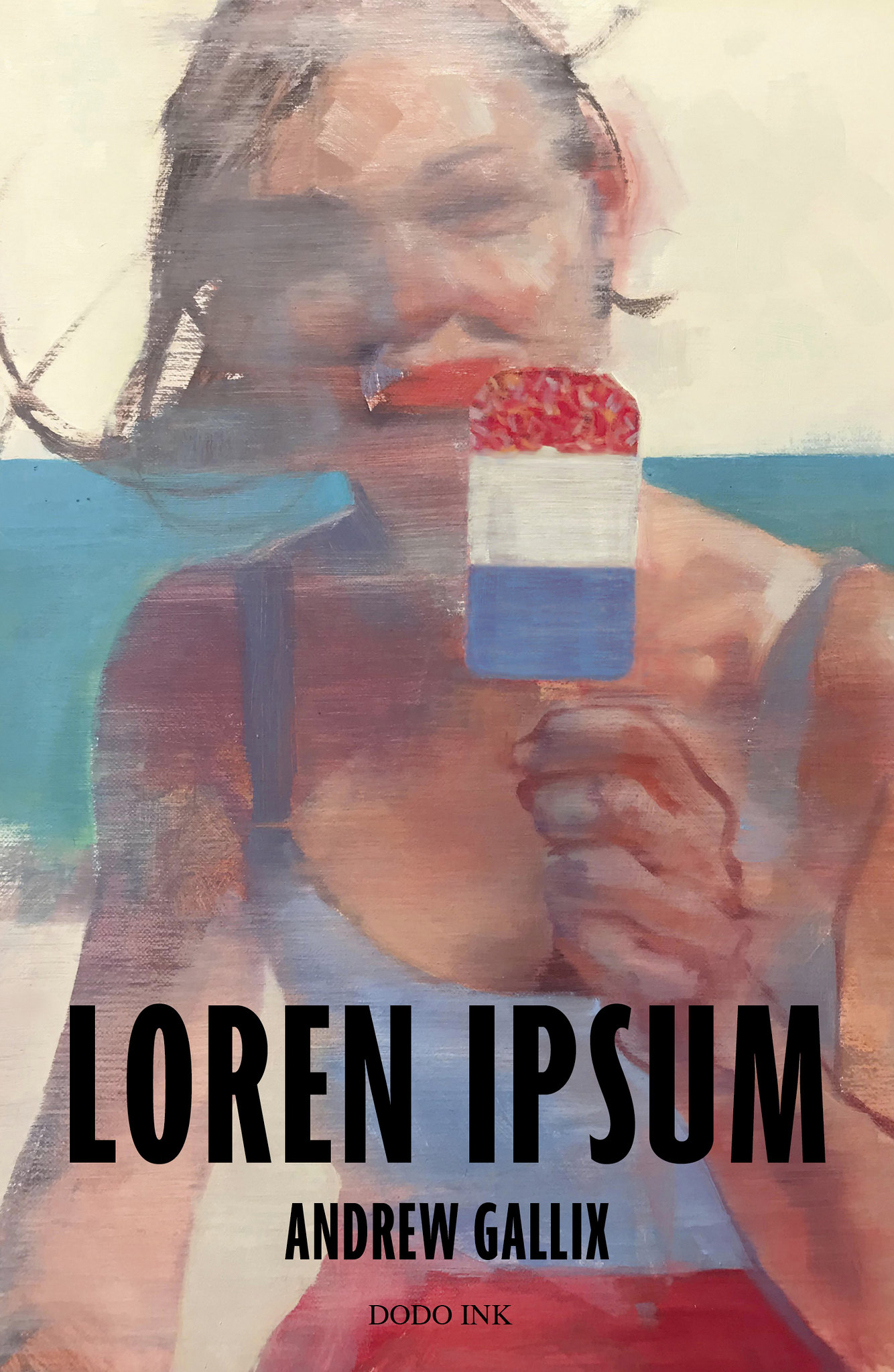
Richard Clegg. “A Book with Meaningful Content.” Review of Loren Ipsum by Andrew Gallix, Bookmunch, 5 November 2025.
Prominent writers are being kidnapped and “executed” by terrorists who are convinced that bourgeois bohemians are the main obstacles to revolution today. Adam Wandle is a reclusive author who has been hiding out on the fringes of Paris. This is the plot but the plot isn’t everything in this novel. The novel is a companion piece to his critical book, Unwords, that covers prose fiction from Michel Butor to Jenn Ashworth.
It is brimful with puns, literary references, and exuberant humour, some sophisticated, some Carry On double entendres. Its elective affinities are as much with Beerbohm and Waugh as with Joyce and Proust. There are terrific lists of bands real or imagined and Chapter 13, a skit on book bloggers caught in a world of either/or that is neither moral or aesthetic, as far from Kierkegaard as it could possibly be. This isn’t a dummy text without meaningful content, a printing device that lorem ipsum means. It is a book with meaningful content.
If you like cryptic puzzles head for the bookshelf, if you like bonkers stories that meander everywhere, then this is the book for you. It is an unsettling read that includes a real life love story with Sam Mills, auto-fiction as well as the boyish ridiculous list: “No (a Yes cover band), Les Nombrilistes, The Nonplussed, The Nooks, No Shit Sherlock, The Noumena.”
Like the critical work Unwords, Loren Ipsum is a book you can dip into again and again. Read it once, then return in an endless loop that might feel part of a Tom McCarthy fiction.
Any Cop?: For Andrew Gallix this is his first foray into longer fiction. If this is his juvenilia I look forward to his middle years, and his late style. The exuberant critic has linked up with his double, the exuberant novelist.
Richard Clegg. “An Antidote to Smug Insularity.” Review of The Threshold and the Ledger by Tom McCarthy, Bookmunch, 8 September 2025:
“Before reading Tom McCarthy’s latest literary excursion, I skimmed my notes on Unwords (Dodo Ink) by his literary fellow traveller, Andrew Gallix, the founder of 3:AM Magazine. These two quotations brought to the fore the key aspects of their endeavour: “Replication (read realism) cannot grasp the essence of things,” and, “Written books are sweet but those unwritten are sweeter.” Both writers like writing about imaginary authors, but not yet a modern day Keats. Both have fought a guerrilla-struggle to widen the scope of English fiction. They seek asylum on the European continent, not near Dover. They are serious but comical too.
…Where Gallix strays towards the French, McCarthy veers towards the Greek and Germanic. They form a necessary coalition against the anti-experimentalists who sometimes seem to dwell in a cave of obscure Victorian novels.”
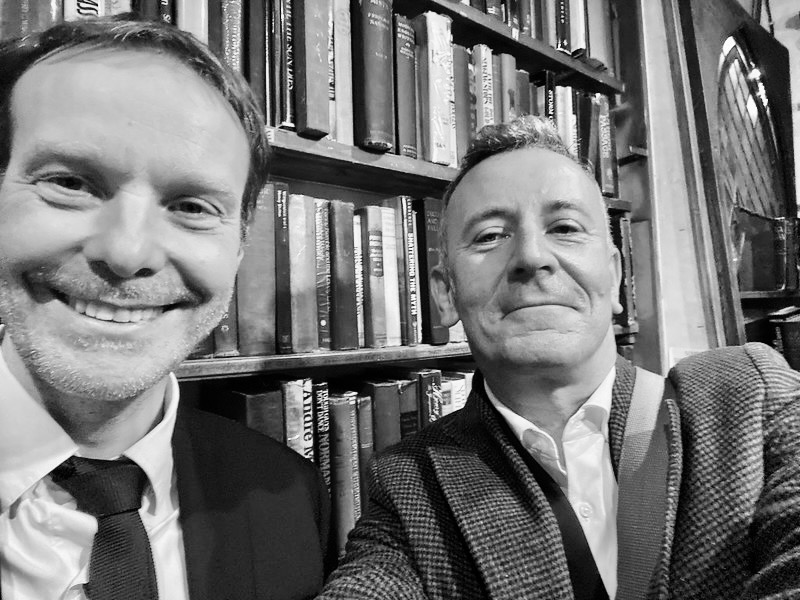
Tom McCarthy and me, Shakespeare and Company, 2022
Law, Jackie. Review of Unwords by Andrew Gallix, Bookmunch, 6 March 2014
With every Tom, Dick and Jackie now able to post their thoughts on the books they read online and thereby call themselves a book reviewer, it is good to find someone who knows their stuff and can express opinions well. What we have here is a hefty tome — over 600 pages in length — of book reviews and essays gathered together from a couple of decades of the author’s published critiques and opinions. Andrew Gallix is clearly a literary powerhouse. I may not agree with his summations of some of the books I too have read — The Netanyahus by Joshua Cohen, for example — but I can still appreciate the skill with which these reviews have been written. Gallix excavates seams others may not think to dig down to, his knowledge drawing out comparisons and observations the less widely read may easily miss. Authors, whose work is often more multi-layered than many readers recognise, would likely be gratified by such surgical attention to their words.
Given its size and contents, Unwords is not a book to be read cover to cover as one might a novel. Rather, it is best dipped into, savoured over time in bite sized chunks. It serves as a sort of archive of European literature, a useful reference for anyone with an interest in the oeuvre.
Gallix takes occasional side-swipes at modern publishing habits, showing a marked contempt for popular literary prizes. Nevertheless, reviews included here are overwhelmingly positive — a number of the books featured were written by those he lists in the acknowledgements. He is clearly well connected within the literary world, not surprising when glancing down the list of publications these pieces originally appeared in.
“Some of the essays and reviews that appear in this book have been expanded, rewritten, or updated. Others have not.”
So, as well as book reviews there are essays and the occasional interview. These generally focus on particular authors, offering a glimpse into their mindset and processes. They become characters at the hand of Gallix, their written works a thread in the plot of their lives. There are proliferations of: pen names, a desire for anonymity, the performance of marketing a persona. Fictions created are not confined to their written (or unwritten) works.
The pieces included provide much to ponder on what is considered art, alongside the conceits of creators and those who admire them.
Authors who take the importance of their output so seriously they cannot publish for fear it won’t be good enough are included. Some feel themselves superior in this: “untainted by recognition” (I did wonder how Albert Cossery funded his hotel room and presumably necessary food).
The works of authors under discussion may impress but many of those featured do not come across as decent human beings. There appears to be disdain for the happily ordinary, those not aspiring for inclusion within their circle of influence.
“Platonic writers tend to see their works as imperfect reflections of an unattainable literary ideal. They do not celebrate the birth of a new opus so much as mourn the abortion of all the other versions that could have been.”
In some ways Unwords could have been regarded as a sort of vanity project — Gallix couldn’t finish the novel he planned to write in his twenties so instead pulls together a book from all the short pieces he did complete over the intervening years. This idea should be given short shrift. The impressive quality of the writing alone makes this tome worth perusing. Much of it, while intellectually stimulating, is also highly entertaining.
In ‘Custard Pie in the Sky’ Gallix is having far too much fun playing with the words he uses. Opinions expressed may at times appear highbrow but remain accessible.
I must also mention a couple of the more personal inclusions. ‘Umbilical Words’ is an intensely moving piece written to be read at his mother’s funeral. ‘Phantom Server’, on the near loss of 3:AM Magazine’s archives, is wonderfully engaging.
The final entry, ‘AfterUnword’, is made up entirely of author quotes and references. They may be enough to make any wannabe novelist question the wisdom of their commitment to seeking publication.
Structured in themes, what is provided is a history of the canon that could become essential reading for anyone wishing to understand the context in which European literature exists. The erudite expositions touch on many ideas including: philosophy, nihilism, absurdity. What becomes clear is how much what is written is a compromise of possibilities.
Any Cop?: A book that surprised me with how much of it lingers, how the whole somehow works given its building blocks. Well worth the time of those with an interest in fiction — and the ecosystem within which such fictions exist.
Clegg, Richard. “Stories That Will Last.” Review of Walter Benjamin Stares at the Sea by C. D. Rose, Bookmunch, 24 February 2023:
… Another boost to the author’s reputation is his inclusion in the gargantuan and magisterial collection of articles by Andrew Gallix Unwords, a survey of modern European fiction, that has just been published by Dodo Ink. It is fitting that C. D. Rose is amongst good company there with the Robbe-Grillets, the Calvinos, and the lesser known North Western writer, H. P. Tinker.
This final quotation, from Andrew Gallix’s essay on Michel Butor, about the laboratory of narrative could stand for C. D. Rose as well:
“Whether he is analysing how a fictive locale may reconfigure the space in which a book is read or excavating old objects … his insights continue to feel new-minted and exhilarating.”



 ANDREW GALLIX