What the Whole Thing is About

Caleb Crain. Rev. of Memory Theater, by Simon Critchley. The New York Times 16 December 2015

… In “The Phenomenology of Spirit,” Hegel imagined history as a long, bloody drama acted out by the spirit of history, which played all the characters. Critchley cleverly describes (or rather, claims that his late teacher cleverly described) Hegel’s idea of history as a moving memory theater — “a kind of proto-­cinema.” The narrator concludes that his own experiments have failed because his memory theater didn’t move, and he looks forward to a posthuman upgrade: “an endlessly recreating, re-enacting memory mechanism.” This sounds awfully like the Internet, to which it is so tempting nowadays to offload one’s more tedious tasks of remembering — and indeed, in a recent interview with Andrew Gallix of 3:AM Magazine, Critchley has admitted that the Internet is “what the whole thing is about.” Maybe it makes more sense to think of “Memory Theater” as an allegory.

Bias, She Wrote

Clara Chow, “Bias, She Wrote,” The Strait Times 13 October 2015

I have no answer to those questions, nor am I sure if this comparison is fair. But the controversy has convinced me of one thing at least: that we never read innocently — that is, without consuming the writer’s identity in some way. As Andrew Gallix wrote in his introduction to the satirical Biographical Dictionary Of Literary Failure: “Literary biography is a by-product of literature: the writer’s life is read, à rebours, in the light of her works.”

Conversely, one might read a writer’s work differently, after finding out something particularly intriguing or unsavoury about her life. We are always reading with or against the grain of who we think the writer is. In submitting my own fiction to international journals, I always state in the first line of my cover letter that I am a writer from Singapore. The off-chance that an overseas editor might find my nationality interesting, I admit, factors in that decision.

Policing Language

Binoy Kampmark, “Pizza Danish, Franglais and Policing Language,” Counterpunch 14 September 2015

Even more strikingly, the battle being waged is against the incursions of American English, rather than more neighbourly intrusions from across the Channel. As Andrew Gallix notes, “American expressions are often adopted with far more enthusiasm in France than across the Channel” [1]. The enemy continues to lodge within.

[1] http://www.theguardian.com/commentisfree/2013/may/23/language-french-identity

The same piece appeared here:
Binoy Kampmark, “Pizza Danish, Franglais and Policing Language,” Eurasia Review 14 September 2015

Misreadings

Jamie Fisher, “A Patron Saint for Sadsacks: What Snark Says About Failure — and What Literature Says Back,” Los Angeles Review of Books 10 June 2015

The Biographical Dictionary of Literary Failure 300dpi

… In his introduction to the BDLF, Andrew Gallix suspects “that there is indeed a touch of Schadenfreude about the pleasure derived from reading these anecdotes of writerly woe.” There’s a name for this pleasure, and this narrative tradition: It’s snark. …

… Gallix’s introduction suggests that in writing the BDLF, Rose “may have been exorcising some demons of his own.” …

… Gallix places Rose’s work alongside any number of famous literary silences in the face of imperfection: “Rimbaud’s renunciation of poetry …, the Dada suicides, Wittgenstein’s coda to the Tractatus, the white paintings of Malevich or Rauschenberg, Yves Klein’s vacant exhibitions, as well (of course) as John Cage’s mute music piece.” Gallix describes the appeal of “absolute whiteness,” untrammeled potential.

This is true enough, in its way; any artist has coped with those moments of paralyzing uncertainty, when silence or irony seem better than wreckage. But Gallix’s misreading of Cage is, I think, telling. Cage intended the vacancy of the work to supply a stage for the ambient environment. His point wasn’t that art is incapable of speech, or that the artist has, finally, nothing to say. His intention was to draw a circle around a small section of public life and say, All that is inside this circle is art. It’s a circle of reception, an announcement that he is willing to listen. When Gallix calls Cage’s piece “mute,” he fails to understand that it is a stage for the people, and the experiences, we don’t usually choose to hear. …

Every Phoneme Counts

My interview with David Winters appeared in BOMB magazine today. Here’s an extract:

davidwinters

Andrew Gallix: Walter Pater famously declared: “All art constantly aspires towards the condition of music.” And this is certainly the case of the works you seem most attracted to. The experience of reading Christine Schutt — whose prose encrypts meaning “in rhythms and melodies” — is compared with that of “listening to music.” While Schutt should be “read reverently aloud” because her “poetic sentences speak of the things they can’t say,” we learn, in another chapter of your book, that Dawn Raffel uses this very same method, à la Flaubert, to compose sentences which “sing of the things that speech alone can’t express.” Time and again, you observe this transmutation of speech into song, whereby style merges with substance; form becomes inseparable from content. This kind of fiction — to quote Beckett on Joyce — is no longer “about something; it is that something itself.” Such novels or stories are untranslatable. They exist on their own terms, like Lish’s Peru, whose “truth lies not in its correspondence to reality, but in its consistency with itself.” You begin your piece on Jason Schwartz’s John the Posthumous by conceding that it is “impossible to synopsize.” This critical impasse leads you to focus as much on your “reading experience” as on the books “under review” — which brings us back to Pater. The author of The Renaissance argued that experience — not “the fruit of experience” — was an end in itself, thus initiating a redefinition of art as the experience of life. Is there some kind of lineage here?

David Winters: I’ll start with “music.” Yes, for me, cadence is everything. I’ve always been drawn to writing written, as William Gass puts it, “by the mouth, for the ear” — writing in which every phoneme counts; where prosody and acoustical patterning constitute a kind of thinking, a kind of cognition. For Pater, music collapses the opposition between subject matter and form — and so, in a sense, do the writers I write about. I’m not an uncritical disciple of Pater, but I do think the phrase “art for art’s sake” retains some residual value, insofar as it serves, in George Steiner’s words, as “a tactical slogan, a necessary rebellion against philistine didacticism and political control.” For instance, an acquaintance of mine once attacked the art I admire as a “triumph of style over substance.” I’d side with Pater in seeing such triumphs as a desirable “obliteration” of the distinction between “form and matter.” I’d follow him, too, in wanting to view the aesthetic object as extra-moral, or at least anti-ideological; an alternate world in which, as he observes in his essay on Botticelli, “men take no side in great conflicts, and decide no great causes, and make great refusals.” For me, part of the power of art lies in precisely those refusals.

Of course, what’s interesting about the passage you quote is the way in which Pater’s own writing obliterates, at a phenomenological level, the distinction between the artwork and what he calls “the moment” — a collapse that, as you say, returns us to “the experience of life.” I don’t mind admitting that I care very little about ethics or politics when it comes to art, and that criticism, for me — considered as a way of thinking through, or working with, works of art — is largely an attempt to live within and learn from that collapse. You mentioned my attraction to novels and stories that seem to resist explication. It’s true I find those kinds of texts more conducive to this experience; strangely, I feel that their closure creates an opening. For me, those works that appear the most self-enclosed — which seem to speak to themselves, like Schwartz’s, in a private language — are paradoxically the most enriching, the most alive. In a way, I feel like they’re more alive than I am. They don’t merely reflect the life I already know; they live lives of their own, and they invite me to change mine.

A Ghostly Presence-Absence

Aaron John Gulyas, The Chaos Conundrum: Essays on UFOs, Ghosts & Other High Strangeness in Our Non-Rational & Atemporal World (Redstar Books, 2013): 13-14

From Chapter One, “Ghosts”:

Not ghosts in the paranormal, “haunted house” sense. Rather, ghosts and hauntings in the sense meant by Jacques Derrida. In his 1993 book Specters of Marx, he discussed the notion that Marxist ideas would haunt the world long afyer the philosophy’s “moment” had passed. Today, the term “hauntology” connotes a more general sense of atemporality — past and present overlapping in art, music, and architecture. A great example is the music of Belbury Poly, which sounds like nothing if not the lost soundtrack to every 1970s Doctor Who episode.

Writers and futurists like Warren Ellis and James Bridle, along with designers such as Russell Davies, have identified atemporality with the emerging digital culture in cities. On this point, writing on the Guardian website in June 2011, Andrew Gallix discussed the connection between hauntology, cities and the digital: “Smartphones, for instance, encourage us never to fully commit to the here and now, fostering a ghostly presence-absence.”

Down the Tubes

Boyd Tonkin, “The Week in Books,” The Independent 14 July 2012

When a dodgy server pulls the literary plug

A couple of weeks ago, I wrote about Andrew Blum’s eye-opening book Tubes, which asks the question: where is the internet? Andrew Gallix, editor of the smart and sparky literary webzine 3:AM, has had reason to find out. His server went down and 3:AM, with its 12 years of archived articles, vanished. Who ran the server, and from where? Gallix’s quest led to Dallas, to Missouri, and to some bloke called Florin in Bucharest, Romania — the zine’s unwitting host. Florin seems to have switched it on again. O, brave new world…
[Full title: “The Week in Books: Welcome back, Ovid — for English poets, you always were the champion
Plus — in search of the internet and the true colour of fiction”]

The Pure Event of the Word

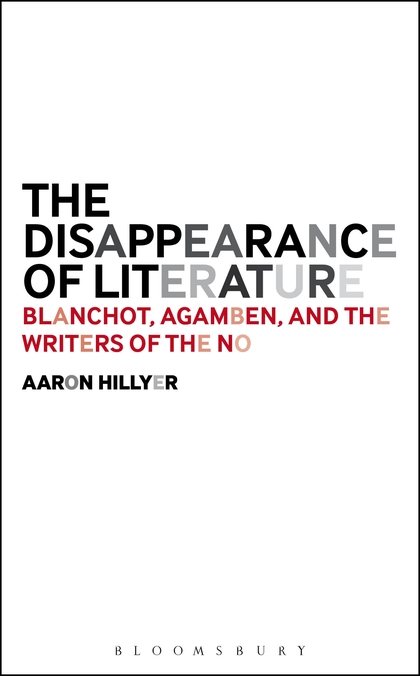
An extract from my review of Aaron Hillyer’s The Disappearance of Literature: Blanchot, Agamben, and the Writers of the No (Bloomsbury) featured in this week’s Times Literary Supplement:

If language cannot speak the world, “can the world speak in language”? That is the crucial question at the heart of The Disappearance of Literature. It proceeds from an agonistic relation to language, which is construed as a curse or, at best, a negative force. From this post-Hegelian perspective, words give us the world by taking it away: they negate things and beings in their singularity, replacing them with concepts. The answer, Hillyer argues, is to negate the negation by deactivating “the tendencies that cause our experience of the world to be as abstract as the language we use to describe it”. Literature must go through a “zone of decreation” that deactivates its habitual signifying and informative functions “in order to communicate communicability itself, openness to the world itself”. Such openness is predicated on the author coinciding with her work; disappearing momentarily into a thingly, asignifying language that now speaks itself. Only a writer who has vanished into “the pure event of the word” — where the telling becomes the teller — may express (although not in so many words) “what absolutely escapes our language”.
disappearance