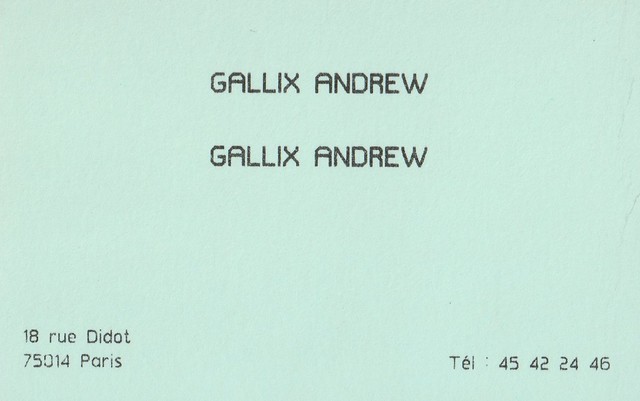
Just found this in my battered old copy of John Lahr’s Prick Up Your Ears. It must date back to the very early 1990s (I lived at that address between late 1986 and 1993). They used to have slot machines in Paris that printed out cheap visiting cards.
Lester Square and Friends. “The Space Between the Notes.” Taps, Cubist Records, 2023.
Picture by: Sophie Davidson
Lester Square was the original guitarist in Adam and the Ants and went on to co-found the Monochrome Set. So you can imagine how thrilled I was when he asked me to contribute to this project alongside the likes of Toby Litt, Nicholas Blincoe and John Robb.
Here’s the press release:
The English affection for miniatures has a long history: Nicholas Hilliard, John Hoskins and Samuel Cooper to name but a few. In the world of literature, critic Colin Manlove observed “The growing pleasure of English writers in creating fantastic miniature worlds which work on their own.”
It may be that those who live upon a small island take delight in small things.
In 2022, having tired of a solitude born of Covid 19, Lester Square emerged blinking into the light and, desperate for company, laid down a challenge to a number of eminent authors of his acquaintance to provide a short story: short enough to leave room for a musical backdrop to provide an expressive counterpoint and intriguing enough to elicit full immersion in a pocket otherworld: as William Blake would describe it, seeing “a world in a grain of sand.”
The process couldn’t have been simpler, collaborators merely sent in a sound file of their reading recorded on a phone. The challenge then for Lester was to set them to music and sound collage which complemented and amplified the mood conjured up by the written word. Sometimes literally — the rhythmic headboard banging as the neighbours have sex next door to Andrew Gallix; sometimes through counterintuitive juxtaposition — the jolly counterpoint to a skinhead attack in Lucy O’Brien’s memoir.
The collision and interplay of genres has resulted in 13 evocative vignettes – some magical, some comical, some foreboding – that have become more than the sum of their miniature parts
…but which leave you wanting more.
Full line-up (in order of appearance): Alan Platt, Michele Kirsch, John Robb, Lucy O’Brien, Nicholas Blincoe, Toby Litt, Paul D Brazill, Lobby Robinson, John Haney, Andrew Gallix.
Here is my review of The Fear by Christiana Spens, published in The Irish Times on 1 April 2023.
In The Fear, Christiana Spens maps out her existential journey through a trauma-induced underworld — a demimonde of the angst-ridden mind — looking to philosophy and politics, art and writing for an “escape route”. Addicted to the all-consuming melodrama (and attendant melancholia) of toxic romances, she eventually suffers a breakdown in Paris while working as an au pair: “I opened my arms to an emptiness I could not contain”.
Having hit rock bottom, it becomes clear that these relationships are not so much doomed to fail as designed to do so. Their essential function is to subsume all her “deeper fears” in a bid to bury them.
Back in Scotland, Spens embarks upon a Master’s degree in terrorism studies — a natural choice given the personal war on terror she is waging. The Fear — this “perpetual flight or fight” mode — takes on a collective dimension at this juncture. It is, she argues, bound up with patriarchal values that rely on “terror and everyday fearfulness to persist” as evidenced, closer to home, by her enigmatic, emotionally absent, and virtually mute, father.
This book of disquiet orbits a sinister black hole that manifests itself through violent panic attacks on the London underground, however much the author strives to repress it. In a particularly poignant passage, she goes on a valiant “pilgrimage” to the suburban neighbourhood where she was raped a decade earlier.
Spens discovers how devilishly difficult it is to face up to her demons. The Fear, itself a survival strategy — a desperate attempt to “negate the pain” of an overwhelming, unbearable reality — keeps on producing new coping mechanisms and displacement activities. “I was writing about fear,” she remarks with regards to her studies, “but the writing itself was a way to avoid feeling it fully”.
The disconnection the author has felt since her assault — when “a phone line [was] cut between the mental and the physical” — is countered by the connection experienced through drawing: “Dissociation was cured by this line, this one simple act”. A similar flow state is achieved when she relates her father’s demise or her son’s birth. Gradually, art becomes “part of living” rather than a mere “solace”. Spens writes herself back to life — and it is a joy to behold.
“New Novel, Old Master.” Review of Robbe-Grillet: L’aventure du Nouveau Roman by Benoît Peeters and Réinventer le roman: Entretiens inédits by Alain Robe-Grillet and Benoît Peeters, Times Literary Supplement, 23-30 December 2022, pp. 24-25.
Alain Robbe-Grillet was born in 1922 — modernism’s annus mirabilis — as though the future nouveau romancier were destined to inherit the experimental spirit of the times, taking postwar literature (and cinema) into uncharted territory. Nabokov, who described La Jalousie (1957) as the greatest love story since Proust, regarded Robbe-Grillet as the foremost French writer of his generation, and for several decades his international reputation, particularly in the United States, would place him firmly in the Camus and Sartre super-league. Yet official commemorations of the centenary of his birth have been conspicuous by their absence in France, a country usually prompt to celebrate its great authors and artists.
In his new biography, Robbe-Grillet: L’aventure du Nouveau Roman, Benoît Peeters suspects that he was deemed too “sexually and politically incorrect” to make the grade. Peeters goes on to suggest that this snub may well have appealed to the novelist’s contrarian temperament, adducing his belated election to the Académie française in 2004. Despite having coveted this accolade since the late 1950s, Robbe-Grillet would never be officially inducted owing to his obstinate refusal to follow protocol — a form of self-sabotage that enabled him to be both an insider and an outsider simultaneously. The arch avant-gardiste was not averse to playing the game, but wanted to do so on his own terms. His agonistic approach to fiction — writing “against” readers rather than “for” them — was matched by his controversial polemics on the novel as a genre. This combative attitude earned him a great deal of enmity at a time when literary matters were still taken very seriously indeed. Peeters reminds us at the outset that if no contemporary writer was ever subjected to so much vitriol (even his funeral elicited a bad write-up in Le Monde), Robbe-Grillet revelled in being reviled. “I owe everything to my opponents”, he once said, reflecting that he had been lucky enough to have had “good enemies” throughout his career. The extreme reactions he regularly inspired seemed, in his eyes, to prove that he was right, spurring him on while also providing his often difficult work with a great deal of free publicity in the mainstream media.
Peeters is a dab hand at biographies, having already produced weighty tomes on Hergé, Jacques Derrida, and Paul Valéry. The challenge here was that Robbe-Grillet had partly pre-empted this exercise with his Romanesques trilogy, published between 1985 and 1994, which combined personal reminiscences (particularly in Le Miroir qui revient) with delirious sexual fantasies (notably in Angélique ou l’enchantement) and outright fiction (see the passages devoted to the shadowy figure of Henri de Corinthe, a putative family friend who may or may not have existed). In the course of these three volumes, the “autobiographical system”, as Robbe-Grillet put it, gradually breaks down.
Another challenge was the sheer volume of material to sift through. Robbe-Grillet’s archives are contained in 459 large boxes — an embarrassment of riches that may serve, as the biographer surmises, as a rampart behind which the author can hide. In 2001 Peeters conducted a series of filmed interviews with the novelist, then almost 80, which were released as a double DVD. They have now been transcribed and published in book form. Réinventer le roman: Entretiens inédits is the perfect companion piece to the biography, giving us direct access not only to the author’s own conversational voice, interpretations and erudition on matters philosophical, historical and even botanical, but also to his jovial good humour and general geniality — characteristics with which he is seldom associated. It often feels, uncannily, as though Robbe-Grillet were giving a running commentary on Peeters’ future biography.
The greatest pitfall would have been to turn Robbe-Grillet into the kind of all-conquering hero he so detested in the novels of Balzac, yet there are definite shades of Rastignac to his boundless ambition. There is also another, more puzzling resemblance. In his infamous 1958 essay, “Nature, humanisme, tragédie”, he claims that in order to appear as true to life as possible, “a good ‘character’ in a [realist] novel must above all be double”. By this token Robbe-Grillet would have made a very good character indeed. As a child he frequently encountered his doppelgänger: he would enter a room and see himself sitting in the armchair. Peeters implies that this was a lifelong occurrence. With this in mind it is striking to note how frequently the question of Robbe-Grillet’s duality (and his duplicity) recurs throughout his career. As a young novelist he scoffed at the notion of vatic inspiration: the creator as a mere conduit, incapable of intelligent reflection on their work. Many of his detractors never forgave him for having the audacity to write novels while producing a theoretical discourse on his practice. The fact that his works were sometimes at odds with his theories enraged them even further — whether this was deliberate, as he later claimed, is open to debate.
The prime example here is La Jalousie — by his own admission (and from the title onwards) a veritable “festival of metaphors” — released at a time when he strongly objected in public to anthropocentric analogies. In the Entretiens Robbe-Grillet claims that some of the more far-fetched theories that were attributed to him, in the early days, actually stemmed from Roland Barthes, who had celebrated his first published novel, Les Gommes (1953), as an instance of object-oriented literature. He further explains that Barthes lost interest in his work as soon as it became patent — with Dans le labyrinthe (1959) — that his interpretations were no longer tenable.
This did not prevent Barthes from accepting to preface Bruce Morrissette’s The Novels of Robbe-Grillet (1963) and giving voice to the idea that there were, in fact, two Robbe-Grillets: the early, anti-humanist one, who slid down the surface of things and a humanist “Robbe-Grillet n° 2”, more preoccupied with symbols and feelings. In his postface to the 1964 paperback edition of Dans le labyrinthe, the theorist Gérard Genette argued, similarly, that Robbe-Grillet was driven to constantly justify himself because he was torn between his “positivist intelligence” and “poetic imagination”. In 1988, when Angélique ou l’enchantement appeared, Bertrand Poirot-Delpech, writing in Le Monde, reprised this view, opposing “Robbe”, the novelist, to “Grillet”, the essayist and critic. This theory was finally borne out — or, rather, enacted — by Franklin J. Matthews, who penned the postface to the 1972 paperback edition of La Maison de rendez-vous: in 2001 a researcher discovered that the “Australian academic” Matthews was none other than Robbe-Grillet himself, who had thus authored both the novel and its critique. In the Entretiens we learn that the writer replicated this pattern by dividing his oeuvre into two discrete periods. In the first, encompassing Les Gommes, Le Voyeur (1955) and La Jalousie (three books whose composition was carefully premeditated), everything is filtered through a single consciousness. Unlike its predecessors, Dans le labyrinthe was no longer based on a pre-existing plot line: the figure of the soldier lost in the city mirrors that of the writer now astray in the meanders of his work. It inaugurated a new period in which the narrative coherence of his early novels disappears altogether, along with most ontological certainties, leaving the text as a battleground, where various consciousnesses are vying for control.
Born and raised in Brest, Robbe-Grillet was a successful young agronomist, studying banana-crop parasites and even producing a face cream containing bull sperm. When attempting to account for his sudden turn to literature in 1950, he invoked “our two gendarmes”, Marx and Freud, according to whom everything is either political or sexual. The political explanation is that he came from a fanatically far-right family who supported Marshal Pétain and the Nazi invaders to the bitter end. The lies on which their values rested led him to reject the “world of ideology, where everything always works; everything is ordered”, including the humanist tenets of literary realism that cover up the messiness of the real world. Despite signing the pro-Algerian Manifesto of the 121 in 1960, Robbe-Grillet would always be suspected, in some quarters, of being a right-winger, notably for his rejection of social realism. Art, for him, is never just a means of embellishing a message: it is the message. A novel is therefore self-sufficient — “expresses nothing but itself” — and its “necessity” has nothing to do with its “utility”, political or otherwise.
The second explanation for Robbe-Grillet opting for literature revolves around his predilection for sadistic sexual practices, which — along with his impotence — set him apart, creating a need for artistic expression. This “sexual difference” manifested itself at an early age, with the porcelain dolls he delighted in torturing or the pictures of women being executed that exerted such a hold over him. Peeters describes his highly unconventional, but very happy, marriage to Catherine Rstakian, which lasted fifty years. In 1955 she offered him a whip as a birthday present; two decades on she offered him a young female admirer who longed to be his slave. At one stage they even shared the same mistress. Not only did she go on to write successful sado-masochistic books, she became a dominatrix, organising lavish S&M soirées. Robbe-Grillet, who was, unsurprisingly, often accused of misogyny, always encouraged her, believing it was important for women to express their sexual fantasies. His own played an increasingly important part in his work, even though he knew they would put off many readers.
He often claimed that the greatest opportunity of his career was that his first novel had been rejected by Gallimard, the embodiment of the French publishing establishment. This paved the way for his close relationship with Jérôme Lindon, at the head of Les Éditions de Minuit (which, ironically, was purchased by Gallimard in 2021), where all his books would be published. He soon became a literary adviser, reading hundreds of manuscripts for Minuit, and recruiting like-minded writers such as Nathalie Sarraute, Marguerite Duras, Michel Butor, Claude Simon and Robert Pinget (Samuel Beckett, an early admirer of Les Gommes, was already in-house). Lindon and Robbe-Grillet, who had a knack for publicity stunts, drew attention to this creative effervescence by capitalizing the phrase “nouveau roman” (new novel), which had been bandied about dismissively by a couple of critics. The Nouveau Roman was never a movement, like the surrealists, where you had to toe a certain line for fear of excommunication, but simply, as Robbe-Grillet put it, “a convenient label for writers seeking to express new relations between Man and the world”. In the late 1950s and early 1960s, he published a series of provocative articles in L’Express, outlining some of these new relations. They were collected in Pour un nouveau roman (1963), his most commercially successful book, which constitutes a devastating critique not only of the ideology that underpins much of nineteenth-century literature, but also of the contemporary novel’s ossification in the Balzacian mould. The novelist’s present task, he argues, is to describe the material world, not to project herself onto it or colonize it by assigning it a meaning; to record the distance between human beings and things without interpreting this distance as a painful division. “Man looks at the world”, but “the world does not look back”. However, in looking at the world, it undergoes a transformation: Robbe-Grillet’s descriptions seem to create their own objects, their own hallucinatory reality.
Benoît Peeters chronicles the ever-shifting alliances of the Nouveau Roman, the rivalry with Michel Butor (who thought Robbe-Grillet was jealous of his success), the rise and fall of Jean Ricardou as the movement’s theoretician, the American conferences; the times when the novelist was more interested in making films (following his collaboration with Alain Resnais on L’Année dernière à Marienbad) or simply living the life of a gentleman farmer, gardening and curating his collection of rare cacti. The Nouveau Roman was indeed the “last great French literary movement”, and it was high time its figurehead had his own biography.
Foulc, Sarah. “The Flip Side of Hemingway’s Paris.” Lit Picks, 4 November 2022.
This is why, for the closing of our Paris-themed week, I’ve chosen to feature the complete antithesis of the book I mentioned in the first issue (Hemingway’s A Moveable Feast), a book that has sharpened my literary landscape of Paris and that I highly recommend:
It’s a collection of written pieces titled We’ll Never Have Paris, edited and introduced by Andrew Gallix, an Anglo-French writer, journalist, and Sorbonne teacher. . . . In response to a “vision of literary Paris (that) has been shaped by anglophone writers”, in his brilliant introduction to the collection, Gallix argues that:
“The Paris we know was always already a beguiling simulacrum, a facsimile of itself, and possibly a dream — ‘the fever dream of Paris,’ as Julian Hanna puts it — from which we should try to awake. (…) Although the museumification of Paris is often overstated, perhaps the city, like Eurydice, can only be contemplated nowadays by turning away from it. It is striking how the following pages abound in alternative visions of the French capital.”
Before coming to this conclusion, Gallix first paints an accurate picture of what Paris is in the global imagination. One that reverberates with the sentence I wrote in the opening paragraph: “Paris is a lightning rod for liberty, a beacon of freedom of expression. Paris is the reinvention of the self.”
“Paris often seems to hold out that promise of radical transformation. When asked why he moved there, Luke, in Geoff Dyer’s Paris Trance, responds ‘To become a different person.’
Paris leaps into our imagination exactly as we remember it from the written tales of those that have glorified the city, at least assigned an ideal to it, and who lived fully in the narrative of their glorification, so much so that — as many writers understand — some of us can only come to see a Paris made of those words:
“For the likes of Tomoé Hill, traveling to Paris is a pilgrimage, not a city break: ‘We go to Paris reverent: as if the city was a heart in a reliquary beating with the words of writers instead of blood’ (p.114) — words which are not, of course, necessarily French ones.”
Gallix, when speaking of his “contention”, directly mentions ‘Hemingway’s Paris’, immediately contrasting it with something else, something more honest, perhaps — ‘that of Rimbaud and Verlaine or Sartre and de Beauvoir’. He invites us to question this vision:
“My contention — and a contentious one it is too — is that the bohemian Paris people think of most readily outside of France — the ur-cliche, if you will — is anglophone. It is the Paris of Hemingway, Joyce, and Shakespeare and Company before being that of Rimbaud and Verlaine or Sartre and de Beauvoir. If we accept this as true, or at least partly so, it is doubtless due to the hegemony of the English language and imperialism of Hollywood as much as the appeal of Hemingway’s blueprint. Scandinavians, say, or Latin Americans have their own take on this myth, revolving around their own writers’ interaction with the French capital, but these versions are mainly consumed locally.”
To this, he adds the relevant argument of the only authors mentioned by Hemingway in A Moveable Feast:
“How many French authors does Hemingway encounter, or even mention, in A Moveable Feast? To be honest, apart from Blaise Cendars, I cannot name a single one off the top of my head. All those that come to mind are either American (Scott Fitzgerald, Ezra Pound, Gertrude Stein, Alice B. Toklas, John Dos Passos), Irish (James Joyce) or English (Ford Maddox Ford, Wyndham Lewis, Aleister Crowley).”
Gallix isn’t certainly the only one to think this, as we discover throughout the collection. British novelist Jean Rhys, best known for her modernist novel Wide Sargasso Sea, is also mentioned in the introduction. She had already noticed the influence of the English-speaking writers in the shaping of the imagination of what Paris was supposed to be. As Gallix writes:
“In a 1964 letter to Diana Athill, Jean Rhys railed against what she dubbed ‘America in Paris’ or ‘England in Paris’, dismissing Hemingway and Miller’s take on the city as inauthentic. ‘The real Paris had nothing to do with that lot’.”
Some of the most interesting insights of this introduction to the collection come directly to broaden our perspective on the conditions that have created the almost-personified Paris that we know today.
“Hemingway described Paris in the 1920s as a place ‘where there was a way of living well and working, no matter how poor you were,’ adding that this was ‘like having a great treasure given to you’. That treasured lifestyle was swept away by the onset of the Depression in the 1930s. As Will Ashon remarks, artists thrive where there is ‘affordable, preferably semi-derelict real estate. Which is to say you can’t be an artist in Paris anymore, or in London either’ (p.301).”
Affordable prices. That was the thing about Paris at that time.
And about New York, Hong Kong, London, and all of these giant capitals, now overpriced, but that still attract swarms of idealistic urban aficionados despite the very high costs of living, compared to when these past legendary generations of artists and intellectuals thrived. In the 20s, writers could sleep in hotels and eat well in Paris.
The ‘daily grind’ that most citizens experience in these cities is overlooked, especially for passing travelers. Tourists will often first spot the tall woman in the trench coat smoking a cigarette and drinking a glass of Chardonnay at the corner brasserie, before the one who just sold them a bottle of water at a kiosk.
It’s often not that glamorous in Paris, nor even artistic.
But despite having always known this, for I had witnessed the less charming aspects of Parisian living, I kept returning and kept getting disillusioned. Maybe it’s unsurprising:
“As a subgenre, the expat memoir or novel frequently follows a narrative arc that takes us on a journey from euphoria (the possibility of escaping, and reinventing oneself elsewhere) to disillusionment (the failure to escape oneself and go native. Fittingly, Jonathan Gibb’s piece is entitled ‘Every Story of Paris is also a Story of Disillusion.’ (…) Christian Spens’s heroine states that ‘Paris had always been a good escape, the best escape of them all’ — until now (p.147) This theme is actually so prevalent that Gavin James Bower fears he may have become a walking (or running) cliché: ‘I run away to Paris — am I sure I’m not a trope?’ (p.151)”




















 ANDREW GALLIX