Dead Philosophers Society

409692229_e75d124f7c_t

Here is my interview with philosopher Simon Critchley, published in 3:AM Magazine on 26 June 2008:

Dead Philosophers Society: An Interview With Simon Critchley

3:AM: Did the idea for The Book of Dead Philosophers come from the Montaigne quote you use as an epigraph? Was that the first spark?

SC: It was one of the first sparks. As so often happens in writing, it was a coincidence: a close friend sent me that quotation from Montaigne just as I was rereading the latter’s “To philosophie is to learne how to die” in Florio’s florid translation. Montaigne is really the hero of the book and I love his suspicion of suspicion, his skepticism and the deeply personal quality of his prose, which is never narcissistic. It is ourselves that we find in Montaigne, not him. But I suppose that’s a narcissistic thing to say.

3:AM: Commenting on another passage from Montaigne, you state that “The denial of death is self-hatred”. This reminded me of Dostoevsky’s Kirilov who attempts to defeat God by committing suicide. His rationale is that, in order to negate transcendence, Man must learn to love himself for what he is and must therefore embrace his own finitude — desire his own death. (One could wonder if the espousal of death isn’t a form of self-love?) Your own conclusion — “Accepting one’s mortality…means accepting one’s limitation” — isn’t that far removed from Kirilov’s way of thinking, is it?

SC: It is very similar to Kirilov and you are right to point that out. I think I wrote about Kirilov somewhere, maybe in Very Little…Almost Nothing. If the denial of death is self-hatred, as it is to deny our freedom and live in fear of death (which is to say, to live in a form of bondage), then the acceptance and affirmation of death is indeed a form of self-love. But I’d want to make a distinction between a form of self-love which is essential to what it means to be human, and a narcissism of self-regard, like Rousseau’s distinction between amour de soi and amour propre, self-love and pride.

coverl.jpg

3:AM: You remind us that Socrates’ last words “articulate the view that death is the cure for life”. This idea that life is a kind of disease to be cured through extinction is key to the likes of Schopenhauer, Leopardi, Beckett and Cioran. Do you agree that there’s a kind of lineage here?

SC: I am hugely attracted to the idea of life as a mistake, as a kind of natural error for which we try and find some metaphysical assurance or consolation. This is the core of Schopenhauer’s dark comic genius. It attracts me because it is based on the idea of life as rooted in an experience of contingency, physical contingency, which we forget and convert into various forms of necessity. I do see a lineage from forms of ancient skepticism and cynicism through Schopenhauer and into figures like Beckett and Cioran. One of the peculiar features of The Book of Dead Philosophers is that I simultaneously play on a number of different and contradictory tendencies in the history of the last few thousand years: cynicism, skepticism, Epicureanism, primitive Christianity, occasionalism, rationalism. The fragmentary form of the book allows me to move across and through a number of different philosophical registers. It is so ridiculous to limit oneself to one version of the truth.

2614324306_5988f39a8f.jpg

3:AM: I’ve always felt that the rise of the writer/artist as alter deus that accompanied the secularisation of many European countries led to the spread of a kind of death wish in literature and the arts (culminating with people like Arthur Cravan and Jacques Rigaut). My theory is that many writers/artists believed the hype and were so frustrated when they realised that godlike, ex nihilo creation eluded them that they turned to destruction. Is (to paraphrase Bakunin) the urge to destroy also a creative one (or, as Larkin put it: “Beneath it all, desire of oblivion runs”)?

SC: I completely agree: one of the outcomes of Romanticism for me is the idea of the writer as imago dei without a deus where art becomes a Promethean creation ex nihilo. I think this tradition also inspired a related Promethean tendency in politics, from the ‘nihilism’ of Nechaev, through to Lenin’s Bolshevism and Marinetti’s futurism. It’s the tradition of what I call “active nihilism“. I criticize this tradition heavily in a number of places, but only because it is so compelling.

3:AM: Wouldn’t you agree that the “fantasies of infantile omnipotence” you hope will disappear through an acceptance of our “limitedness” are often at the root of great art and literature?

SC: Sure. Much of literature in what we might call its rigorously Hegeliano-Sadist development is about the dream of infantile omnipotence which is rooted in the idea that the artist is like Adam in the Garden of Eden, baptizing things into existence through nomination. I don’t think that this tradition can simply be eliminated or overcome, but it should be contrasted with what Blanchot calls “the second slope” of literature, which is concerned with allowing things to be in their irreducible materiality. This is what I think of as the Levinasiano-Stevensian (if that’s an adjective) succession. This is the sort of materialism that Tom McCarthy and I have experimented with in the writing we have done together on Joyce, Shakespeare and others.

3:AM: Some think that art and literature are predicated on what Eluard called “le dur désir de durer” (the painful desire to last) — a desire you don’t seem too keen on…

SC: No, I am perfectly happy with the idea of literature as le dur désir de durer and would want to put the virtue of endurance at the core of much that I think about. But that is not the same as denying one’s mortality. On the contrary, I think.

thumbnail.jpeg

3:AM: The Book of Dead Philosophers has lofty ambitions. You set out to write “a history of philosophers” as opposed to “a history of philosophy” in the teleological mould. In effect, you are defending a specific conception of philosophy against another…

SC: Yes, I am against the idea of the history of philosophy as a history of systems that can be arranged in a certain logical and historical order, such as one finds in Hegel or Heidegger. It is one of the many aspects of being deluded by the idea of progress (Hegel) or even the idea of regress (Heidegger). I am opposing it with an idea of the history of philosophy as a history of philosophers, that is, a history of mortal, fragile and limited creatures like you and I. I am against the idea of clean, clearly distinct epochs in the history of philosophy or indeed in anything else. I think that history is always messy, contingent, plural and material. I am against the constant revenge of idealism in how we think about history.

3:AM: You praise the “ideal of the philosophical death”: what exactly do you mean by that?

SC: The idea of the philosophical death is the core teaching of philosophy in antiquity from Socrates and Epicurus onwards: we can go to our death freely and without fear having given up the consolation of any belief in an afterlife. As Wittgenstein says, is some problem solved by the idea of my living forever? Of course not. It is, however, difficult to fully and completely renounce any idea of the afterlife.

2613539055_0ff865b078.jpg

3:AM: You write that “Death is the last great taboo” and question the unthinking belief in ever-increasing longevity: are we turning into a race of Struldbruggs?

SC: Absolutely. I think we are turning into a world of Struldbruggs. That is all I saw last year in Los Angeles last year when writing the book: bloody botoxed suntanned Struldbruggs. To that extent, I completely agree with Swift. The flip-side of his seeming misanthropy is an affirmation of virtue.

3:AM: Your book also has a self-help quality (to “begin to enable us to face the reality of our death”) — aren’t you afraid of being accused of having done an Alain de Botton?

SC: No comment. My problem with self-help is that I don’t think there is a self to help. The self is something that we become through a series of acts.

3:AM: Don’t you think your attempt to bring philosophers closer to us (“It is in the odd details of a philosopher’s life that they become accessible to us”) runs the risk of being seen as a little reactionary — the equivalent of basing an interpretation of a novel on its author’s life?

SC: It is profoundly reactionary. Absolutely. I’ve turned into some sort of dreadful cultural conservative. No, but seriously, I am not engaging in some sort of biographical reductionism and I loathe such tendencies in relation to literature. I am reacting – and perhaps over-reacting – to an allergy to biography in relation to philosophy and philosophers. Also, much of the biographical information in the book is highly dubious and all the more interesting for that reason.

3:AM: In The Guardian you were recently described as having “found a vocation in teaching philosophy, although [your] passions still lie in music, poetry and politics”. Are you less passionate about philosophy? And how did you end up at university by “complete accident”?

SC: Yes, I don’t know where The Guardian found that stuff, but maybe I said something similar in another interview. The truth is actually much worse and would have to include sob stories about years at catering college, working in factories, a series of industrial accidents and even a year and a half as a lifeguard. I did not mean to suggest that I am less passionate about philosophy than I was. On the contrary, I have an immense childish enthusiasm for the history of philosophy and for what is going on right now and remain stupidly optimistic. The thing is that after leaving school with one ‘O’ level, I played in bands for some years, then became a poet before going to an FE college in Stevenage where someone said that I should apply to university. The thought had never previously crossed my mind. Something to do with social class, no doubt.

3:AM: On the subject of music, please tell us about the “large number of punk bands” you played in. Does that period still resonate as it does with so many of us?

SC: Punk was the crucible out of which my paltry subjectivity was formed. My years watching bands and performing in bands allowed me the imaginative space to try and conceive of a life a little different from what I was meant to do. It was a relentlessly affirmative nihilism. Of course, this was sheer luck. I was born in 1960, and so I was 16 when punk began to happen just down the road in London. Suddenly I found myself at the edge of the world’s centre. And it was because of punk that I began reading Burroughs, Bataille and the Situationists. It was also the time when I became politicized through Rock Against Racism and the Anti-Nazi League. My bands had silly names: The Social Class Five, Panic, The Fur Coughs (who became The Bleach Boys*, I thought of that name) and The Good Blokes. I still mess around with music and have done a lot of work with my oldest friend, John Simmons. I think it is somewhere on YouTube.

[* See their current website]

All the Latest

409692229_e75d124f7c_t

Nick Kocz and Manisha Sharma, Managing Editors of The New River, respond to my Guardian blog on e-literature in their introduction to the Fall 2008 issue (December 2008):

“In September of 2008, The Guardian devoted space to an Andrew Gallix essay on the current state of Electronic Literature. This in itself is significant — an acknowledgement by one of the major newspapers of the English-speaking world that new media writing is worthy of its thoughtful attention. Yet after recapping some of the highlights of the form, the column’s tone becomes dispiriting: ‘So far, the brave new world of digital literature has been largely anti-climatic… Perhaps e-lit is already dead.’

Friends, rest assured we do not share this conclusion.

However, we understand how one can come to believe that electronic literature is a dud: it’s been two decades since the first hypertexts appeared and there’s yet to be a single electronic work that has generated a fraction of the commercial interest as the latest Stephen King novel. Or, for that matter, a fraction of the mainstream critical attention typically bestowed upon the latest Philip Roth or Marilyn Robinson novel. There are no blockbusters, no best sellers in the world of electronic literature. Despite all the ballyhoo, enthusiasts of electronic literature remain a relatively small coterie of practitioners and academics. Far from being relegated to antique store shelves next to Edison cylinders and stereoscopic cards, the book is alive and well.

Also in September, Robert Coover, a longtime advocate of literary experimentalism, gave the keynote address at the Electronic Literature in Europe conference. Needless to say, Coover paints a much more forgiving picture:

‘It took a millennia of cuneiform writing and the demise of the [Sumerian] civilization that invented it before the first known extended narrative was composed using it.

‘In America, book publishing had to wait nearly two centuries for the definitive American novel to appear [Herman Melville’s Moby Dick] and even then it took better than another half century while Melville’s reputation languished before its value was finally understood.’

Coover’s right. People have this idea that European culture was immediately transformed by Gutenberg’s mechanical printing press, but in truth culture lags behind technology. Elizabeth L. Eisenstein, in her landmark 1979 study on the historical effects of the printing press (The Printing Press as an Agent of Change, Cambridge University Press), found that ‘[t]he output of early presses drew on a backlog of scribal work; the first century of printing produced a bookish culture that was not very different from that produced by scribes.’

Much the same seems to be happening today. Gallix asserts that one reason for the curtailed development of electronic literature is that university humanities departments’ “emphasis on digitalising traditional books [comes] at the expense of promoting creative electronic writing.’ Virtually all online literary journals exist to publish work that was primarily intended for the printed page rather than the screen.

While there’s an abundance of MFA programs feeding writers into the traditional print genres of poetry, short story, novel, and memoir, comparatively few programs exist within the academy where emerging new media writers can nurture their talents.

Indeed, there are very few venues where an emerging (or even an established) new media writer can place his or her work.

One such venue, increasingly, is the contemporary art institution. Digital Art, now a museum staple, is but a variant of Digital Literature: both often incorporate textual elements, dreamy and/or surreal narratives, and derive from the same aggressively experimental impulse.

Mark Amerika’s groundbreaking 1997 hypertext Grammatron was cited by The Village Voice as being ‘the first major Internet-published work of fiction to produce an experience unique to the medium.’

Today, Amerika’s work is often intended for gallery exhibition. As he said in a recent interview at London’s Tate Modern, he is ‘consciously trying to blur the distinction between different forms and the venues in which they appear… I mean, what is the difference between what we think of as Cinema, Digital Video, Digital Narrative, Net Art, et cetera, Web 2.0 even?’

Amerika has a point: the distinctions between these media spectrums are getting fuzzier. There’s a cross-fertilization going on that will likely strengthen strains of electronic literature. While Gallix sees digital literature being ‘subsumed into the art world,’ others see it as a sign of the form’s relevancy that it can have such an impact on the contemporary art scene.

‘The real problem,’ Dene Grigar (who co-chaired the 2008 Electronic Literature Organization’s Visionary Landscapes conference in Vancouver) writes elsewhere, ‘would be if digital writing is not included [in contemporary art], which does not seem to be the case.’

Of course, distinctions between digital writing and contemporary art still remain. As a tradeoff for the ability to be read simultaneously by multiple viewers off a single gallery screen, Digital Art just does not feature the same level of interactivity as Digital Literature. This is no small distinction, interactivity being one of the earliest perceived advantages Digital Literature had over its paper-bound forebears.

But the question remains: why does Digital Art thrive in museum environments while Digital Literature is perceived in some quarters as being ‘already dead’?

Certainly audience expectation plays no small role in answering this question. People who step into modern art galleries go so with the understanding that some of what they see will confound them. There is, if you will, a certain humility within the museum-goer. Or at least a marked willingness to engage with that which she cannot immediately understand.

That tolerance for the new and the stylistically different does not exist at the same level in the literary world. Instead, people expect to understand that which they read. When they come across complex or experimental works that resist easy comprehension, readers grumble. American book culture, with its emphasis on accessibility and sales, punishes writers who take risks. Earlier this year, we came across an essay indicating that Donald Barthelme — one of the country’s most respected short story innovators — never sold more than 7,000 copies of any of his collections in his lifetime (he died in 1989). We would be shocked if more than a few of today’s most experimental writers sell half as well as Barthelme.

Seen in this light, should it be surprising that Digital Literature remains at the cultural periphery? Because it is a complex and evolving form born from aggressive experimentalism, it is not as user-friendly as, say, a Harlequin romance. Digital Literature, luckily, resists pandering. Style and complexity, more than any other factor, explains why mainstream culture has yet to embrace the form.

In our survey of the field, we’ve yet to stumble upon the equivalent of a digital Harlequin. Should such a thing exist, and we’re not convinced that it can, its blatant accessibility could very well ensure it a mass-market niche, and perhaps even critical acclaim, for despite however pure-minded we like to imagine Criticism, there is a link in the digital world between accessibility and acclaim.

One of the more fascinating observations in N. Katherine Hayles’ Electronic Literature — New Horizons for the Literary (University of Notre Dame Press, 2008 — order it now, it’s good!) is on the responses garnered by two Michael Joyce hypertexts. The first, 1990’s afternoon: a story, was developed in hypertext’s infancy and in many ways can be seen as an adaptation of a standard book-form narrative for the computer screen. In Hayles’ analysis, ‘afternoon has received many excellent interpretations.’

Joyce’s Twelve Blue appeared just one year later (1991) but was much more complex, both in its technological interpretations and its aesthetic and intellectual intentions. Despite these advances, or, more precisely, because of these advances, reader response suffered. As Hayles notes, ‘The player who comes to Twelve Blue with expectations formed by print will inevitably find it frustrating and enigmatic, perhaps so much so that she will give up before fully experiencing the work. It is no accident that compared to afternoon, Twelve Blue has received far fewer good interpretations and, if I may say so, less comprehension even among people otherwise familiar with electronic literature.’

The good news is that the more creative technologies infuse themselves into daily mainstream life, Electronic Literature as a form will appear less ‘frustrating and enigmatic’ to casual readers.

As Amerika notes, ‘Net Art has changed — let’s call it Net Art 2.0 — it’s really more embedded in daily practice. So when we think of the practice of every day life, Net Art is no longer like this kind of left field thing coming out of nowhere… [People are no longer asking,] ‘What are these artists trying to do?’

‘A lot of people have integrated all this media into their own daily experiences and so for them to experience art as well as part of that networked environment isn’t so odd any more.’

Beware though: leavening is a two-way street. Early hypertexts with their link-heavy emphasis on interactivity helped form what we expect — if not demand — from electronic media. As web usage changes the way we perceive and interact with media, digital literature changes — meaning that digital literature can not remain static.

David Foster Wallace, in perhaps his most insightful essay, “E Unibus Pluram: Television and U.S. Fiction,” deconstructed the reasons why contemporary post-modern fiction can seem stale and out-dated. The self-conscious irony that was the hallmark of post-modernists and meta-fictionists of Barthelme’s generation has been appropriated to better and more pervasive effect by Television: ‘And this is the reason why this irreverent postmodern approach fails…TV has beaten [today’s post-modernists] to the punch.’

There is ample reason to believe digital literature will not be ‘beaten to the punch’ any time soon by other forms. Five of those reasons — Andy Campbell, Angela Ferraiola, Michael J. Maguire, Nick Montfort, and the combo of Davin Heckman & Jason Nelson — are included in this issue. Many more submissions of excellent quality were sent for our consideration — and we received more submissions for this New River Journal issue than any previous issue.

…Despite Gallix’s suspicions, electronic literature is not a stillborn or moribund form. He is not, to say the least, prone to good cheer. Nor is he blindly dismissive. Instead, he is sober in his assessment — which is healthy, if not necessary. We enjoyed his column for the difficult questions it posed about the form’s state of development.

And this made us think. Absent something as crass as sales or distribution figures, how does a new form prove its relevancy? Are there critical or aesthetic benchmarks that we should strive for?

Grigar is quoted by Gallix as saying, ‘One of the most difficult aspects of e-lit is the ability to talk about it fast enough, so fast is the landscape changing.’

Which brings us back to Coover’s guarded yet hopeful keynote:

‘That no such widely acknowledged masters have as yet made their mark on the digital landscape is hardly surprising. All previous masters of a form were born into its technology and environed by it and so far only for pre-teens is that really true today.

‘The new computer technology of our age is still developing and may well need another half century to achieve some sort of maturity… meaning that even if digital novelistic masterpieces are improbably already being created, it will likely take at least that long for them to be widely recognized as such.’

It took generations for the contemporary art institution to become as welcoming as it is today to aggressive experimentalism. Remember how the Impressionists, whose work seems positively quaint today, could not gain entry into officially-sanctioned salons; at the same time, James Abbot McNeil Whistler was being slandered in the London popular press by the age’s most esteemed critic as being not an artist but a ‘cockney… coxcomb… flinging a pot of paint in the public’s face.’

Given the speed in which new technologies are being embraced in what Amerika calls our ‘daily practices,’ we are hopeful that Digital Literature’s gestation period will not be as long as Coover suggests. Which is a good thing, for we believe that the writers presented in this current issue are close to delivering the ‘digital novelistic masterpieces’ we all seek.”

AIDS in French Culture

409692229_e75d124f7c_t

This review of David Caron‘s AIDS in French Culture: Social Ills, Literary Cures (University of Wisconsin Press, 2001) appeared in the inaugural issue of the Hyde Park Review of Books (winter 2002):

David Caron weaves literary criticism, cultural history and gay studies into a brilliant, sometimes dazzling, examination of “AIDS in French Culture.” The importance of his book is beyond doubt — given the extent of the AIDS pandemic in France — but one cannot help feeling that the whole is somehow less than the sum of its parts. Paradoxically enough, for one whose purpose is to dispel the preposterous idea that AIDS appeared to fulfill a purpose, Caron imposes an overarching, teleo(il)logical narrative thread upon what is essentially an episodic structure. Each chapter is a little island of Flaubertian self-containment in which the author introduces regular recaps and pointers to give a semblance of continuity or direction. As a result, the conclusion (where the author belatedly develops his ‘central’ thesis) seems tagged on to a collection of related articles. If the weaving is a little décousu, however, it is mainly because AIDS in French Culture is much more than just another polemical tract.

The author’s premise is that France’s inability to cope with AIDS in an effective manner has been largely due to intellectual muddle. He argues convincingly that the AIDS debate of the 1980s was couched in terms dating back to the Third Republic. The young regime’s blissfully optimistic religion of science was mirrored, in Jekyll and Hyde fashion, by a pathological fin-de-siècle fear of degeneration. Caron analyses skillfully how these forces of unreason were recast as rational discourse to absurd yet devastating effect. The newly-medicalized figure of the male homosexual became the first scapegoat of this “evil side of progress,” before the rise of an unprecedented wave of anti-Semitism.

In a catch-22 situation reminiscent of the mad, circular logic of Joe Orton’s psychiatrist in What the Butler Saw, homosexuals were accused of being both the cause and the consequence of national decadence. In short, they were guilty of being victims: “The homosexual found himself twice determined, and was held responsible for a disorder of which he was also an outcome.” The author tracks down such pseudoscientific postures or impostures from Zola’s attempt to model literature on a medical discourse which itself was “structured by metaphors” to the AIDS epidemic which was simultaneously explained through supposedly-meaningful metaphors and used as a trope “for the collapse of moral values.” Close reading is clearly Caron’s forte and his studies of Zola and Genet offer invaluable insights into the authors’ works. The chapter devoted to Hervé Guibert’s literary détournement of contamination — “the principle governing metaphors” — which enabled the novelist to reclaim infection “not only as a destructive but as a productive process” is a tour de force.

Above all, Caron counters the misconception according to which we are equal in front of the disease: “If, biologically speaking, anybody can get AIDS, not everybody will.” This “humanist cant” is prevalent in France where the “founding narrative of universal equality” has been applied to HIV “as if the virus were to abide by the ‘Declaration of the Rights of Man and the Citizen.'” By refusing to recognize the existence of a gay community, the “French model of republican integration” has been partly responsible for “the deaths of tens of thousands of people.” One can only hope that a French translation will follow shortly. As a form of public service.

516dztyzn3l_ss500_

Mad Anatomy

409692229_e75d124f7c_t

This very short review of Mad Anatomy (Del Sol Press), Kimberly Nichols‘s collection of short stories, was posted on the publisher’s website when the book came out in 2003:

Kimberly Nichols carves a razor-sharp crescent out of a plucked pregnant moon to adorn a dirty martini. Barefoot dances around cactus-skeleton plots like some snake-hipped offspring of Rimbaud and Huck Finn. Skinny dips in the swamp blues of tormented souls or in the tropical storm of conflicting emotions. Like all good American authors, Kim shows us the spiritual rooted in the elemental. Like all great American authors, she shows us that there is another America.

Degeneration X

409692229_e75d124f7c_t

This appeared in the winter 2008/2009 edition of Flux magazine (issue 67, pp. 66-67):

Degeneration X

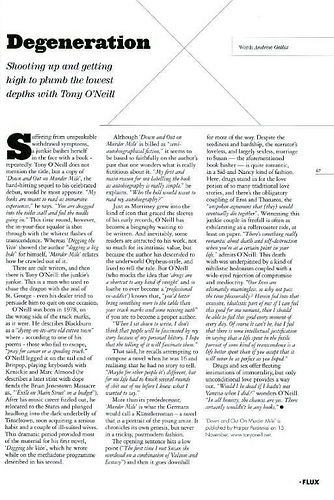
Shooting up and getting high to plumb the lowest depths with Tony O’Neill

Suffering from unspeakable withdrawal symptoms, a junkie bashes herself in the face with a book — repeatedly. Tony O’Neill does not mention the title, but a copy of Down and Out on Murder Mile, the hard-hitting sequel to his celebrated debut, would be most apposite. “My books are meant to read as immersive experiences,” he says. “You are dragged into the toilet stall and feel the needle going in.” This time round, however, the in-your-face squalor is shot through with the whitest flashes of transcendence. Whereas Digging the Vein showed the author “digging a big hole” for himself, Murder Mile relates how he crawled out of it.

There are cult writers, and then there is Tony O’Neill: the junkie’s junkie. This is a man who used to chase the dragon with the zeal of St George — even his dealer tried to persuade him to quit on one occasion.

O’Neill was born in 1978, on the wrong side of the track marks, as it were. He describes Blackburn as a “dying-on-its-arse old cotton town” where — according to one of his poems — those who fail to escape “pray for cancer or a speeding truck”. O’Neill legged it on the tail end of Britpop, playing keyboards with the likes of Kenickie and Marc Almond (he describes a later stint with dope fiends the Brian Jonestown Massacre as “Exile on Main Street, on a budget”). After his music career fizzled out, he relocated to the States and plunged headlong into the dark underbelly of Tinseltown, soon acquiring a serious habit and a couple of ill-suited wives. This dramatic period provided most of the material for his first novel, Digging the Vein, which he wrote while on the methadone programme described in his second.

3188278835_d42a728ea4_m

Although Down and Out on Murder Mile is billed as “semi-autobiographical fiction,” it seems to be based so faithfully on the author’s past that one wonders what is really fictitious about it. “My first and main reason for not labelling the book as autobiography is really simple,” he explains. “Who the hell would want to read my autobiography?”

Just as Morrissey grew into the kind of icon that graced the sleeves of his early records, O’Neill has become a biography waiting to be written. And inevitably, some readers are attracted to his work, not so much for its intrinsic value, but because the author has descended to the underworld Orpheus-style, and lived to tell the tale. But O’Neill (who mocks the idea that “drugs are a shortcut to any kind of insight” and is loath to ever become a “professional ex-addict”) knows that “you’d better bring something more to the table than your track marks and some missing teeth” if you are to become a proper author. “When I sit down to write, I don’t think that people will be fascinated by my story because of my personal history. I hope that the telling of it will fascinate them”. That said, he recalls attempting to compose a novel when he was 16 and realising that he had no story to tell. “Maybe for other people it’s different, but for me life had to knock several rounds of shit out of me before I knew what I wanted to say”.

More than its prededecessor, Murder Mile is what the Germans would call a Künstlerroman — a novel that is a portrait of the young artist. It chronicles its own genesis, but never in a tricksy, postmodern fashion.

The opening sentence hits a low point (“The first time I met Susan she overdosed on a combination of Valium and Ecstasy”) and then it goes downhill for most of the way. Despite the seediness and hardship, the narrator’s loveless, and largely sexless, marriage to Susan — the aforementioned book basher — is quite romantic, in a Sid-and-Nancy kind of fashion. Here, drugs stand in for the love potion of so many traditional love stories, and there’s the obligatory coupling of Eros and Thanatos, the “unspoken agreement that [they] would eventually die together”. Witnessing this junkie couple in freefall, shooting up and getting high to plumb the lowest depths, is often as exhilarating as a rollercoaster ride, at least on paper. “There’s something really romantic about death and self-destruction when you’re at a certain point in your life,” admits O’Neill. This death wish was underpinned by a kind of nihilistic hedonism coupled with a wide-eyed rejection of compromise and mediocrity. “Our lives are ultimately meaningless, so why not pass the time pleasurably? Heroin fed into that excessive, idealistic part of me: if I can feel this good for one moment, then I should be able to feel this good every moment of every day. Of course it can’t be, but I feel that there is some intellectual justification in saying that a life spent in the futile pursuit of some kind of transcendence is a life better spent than if you accept that it will never be as perfect as you hoped.” Drugs and sex offer fleeting intimations of immortality, but only unconditional love provides a way out. “Would I be dead if I hadn’t met Vanessa when I did?” wonders O’Neill. “In all honesty, the chances are yes. There certainly wouldn’t be any books.”

3188258243_f94ce1fc79

3189111346_860b04609e

Fresh Out of Dope

409692229_e75d124f7c_t

This review of Tony O’Neill‘s Down and Out on Murder Mile appeared in the Times Literary Supplement dated 21 November 2008 (No 5512, p. 20):

Fresh Out of Dope

While suffering from withdrawal symptoms, a drug addict hits herself around the face with a book. Tony O’Neill does not tell us the title, but a copy of his new novel — in which this harrowing scene appears — would be appropriate. Down and Out on Murder Mile is the sequel to Digging the Vein (2006), the novel which established its young author as a figurehead of the “Offbeat” literary movement, alongside the more experimental Tom McCarthy. Unlike McCarthy, whose novels subvert the idea of authenticity, O’Neill belongs to the authentic school of writing as exemplified by Charles Bukowski and John Fante. To his admirers, he is a combination of Jack Kerouac and Neal Cassady (or André Breton and Jacques Vaché), a resolution in himself of the art/life dichotomy.

Although Down and Out on Murder Mile is subtitled “A novel” and described by its publisher as “semi-autobiographical fiction”, O’Neill makes no bones about how closely it is based on his own history so that one wonders what, if anything, is fictitious about it. In the acknowledgements, for instance, he thanks his “wife and muse” — whose name in fiction, as in fact, is Vanessa — because she does not object to his “airing [their] dirty laundry in public”. The first-person narrator remains anonymous throughout, making him indistinguishable from the author, and the systematic use of the past tense (except for dialogue) reinforces the biographical feel.

Far from being a simple memoir, however, Down and Out on Murder Mile is a deceptively literary work, one which chronicles its own genesis. When the protagonist describes the mental games he once played to provide himself with “a perfect excuse for a little hit”, he takes a dig at the glamorization of junkie writers: “Did William Burroughs sit around, worrying about taking dope? Or did he just do it and then write immortal books?”. At times, heroin stands for the magic potion found in the traditional love story; at others, it brings about the obligatory mating of Eros and Thanatos: the “unspoken agreement” that the junkie couple will “eventually die together”. The fairy-tale qualities of the narrator’s romance with Vanessa are striking, especially in the squalid circumstances in which it takes place. Contact is first made when he drunkenly speed-dials a number at random on someone else’s mobile phone. Vanessa falls for him when he is at his “lowest ebb”, his “worst point”, his “most destroyed, destitute and bankrupted”, and she sees through all that as if he were a prince in disguise. The fatal attraction of dope is depicted in the novel as the result of a childlike rejection of compromise and mediocrity: “I start to realize that the war on drugs is a war on beauty — a war on perfection, because everything is perfect on heroin”. Addiction is thus an attempt to give permanence to the “lightning crack of divinity” glimpsed at when shooting up. Epiphanies like these are better served by writing than by heroin; and this is the concealed theme of a novel ostensibly concerned with the day-to-day survival of an addict.

The opening sentence hits an almost comically low note: “The first time I met Susan she overdosed on a combination of Valium and Ecstasy at a friend’s birthday party at a Motel 6 on Hollywood Boulevard”. The two soon get married and live unhappily ever after until they relocate to Murder Mile in East London, where the narrator is saved in extremis by unconditional love. A late chapter, entitled “Adulthood”, closes in true coming-of-age fashion: “And I know now, I need to grow up”. This is indeed a Bildungsroman but it is also a Künstlerroman — a portrait of the artist as a young junkie. O’Neill never mentions his first novel, which he wrote while on the methadone programme described here, but its composition haunts the book like a character in search of an author.

3061739368_b78c354b49

New York Review of Books

409692229_e75d124f7c_t

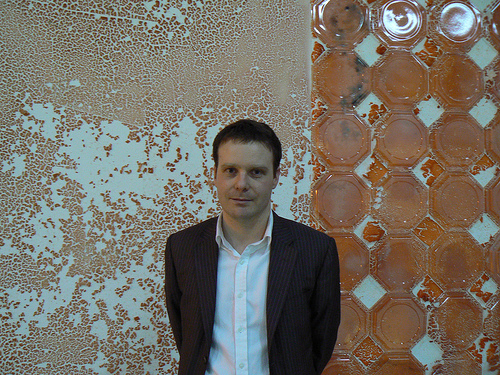
Here is the picture I took of Tom McCarthy at the Palais de Tokyo (Paris) back in February 2007 which now appears in the special anniversary issue of The New York Review of Books (celebrating 45 years in print). It features on the second page (p. 90) of Zadie Smith’s in-depth article on Joseph O’Neill’s Netherland and McCarthy’s Remainder.

Zadie Smith, “Two Paths For the Novel,” The New York Review of Books (volume 55, number 18) 20 November 2008: 89-94.

392173592_d1eb09c8f6

All the Latest

409692229_e75d124f7c_t

On 5 November, as the first results of the American presidential election were about to come in, I took part — with Gerry Feehily — in a radio programme called Minuit/Dix on France Culture. We talked about the Offbeat literary movement. This is how the programme was presented:

“Animé par un esprit punk, la génération Offbeat est un mouvement littéraire né en réaction à la commercialisation du monde de l’édition aux Etats Unis et, surtout, en Grande-Bretagne. Gerry Feehily, romancier Offbeat vivant à Paris, et Andrew Gallix, auteur d’une anthologie d’écrivains Offbeat, évoqueront les enjeux de ce nouveau courant. De son côté, Christophe a longtemps écouté Etienne Daho pour nous parler aujourd’hui de sa biographie Une Histoire d’Etienne Daho (Flammarion). Un live, enfin, avec le retour d’Arnold Turboust.”

Listen here.

minuitdix

3012092927_09dac06d5c

The Pedestrian Poet of the Left Bank

Teach us to sit still.
– T.E. Lawrence

He wandered, he roved; he shuffled, he roamed; he pounded, he expounded, he strode and he strolled.

Perry Pathetic, we called him, this peripatetic poet who paced the streets of Paris, flogging his verse to all and sundry. “My work I have costed,” he told whoever he accosted, “and I’ll spin you a rhyme, if you slip me a dime,” or words to that effect.

Now his walking does the talking, it has no rhyme nor reason: he is poetry in motion.

Ms Ramsay’s Secret Screening Process

“Trews doon,” she snapped after lining up her suitors, “kecks aroond your ankles”. Ms Ramsay was a career woman of the no-nonsense variety with a strong dislike of prevarication, or “shilly-shallying” as she preferred to call it. Her approach to dating was strictly business-like and goal-oriented. No faffing about: life was simply too short — like most eligible males out there. “This should sort out the men from the boys,” she said, producing a tape-measure from her handbag and getting down to brass tacks.