Antediluvian Texts

Delighted to discover that Dennis Cooper‘s “Spotlight On … Alain Robbe-Grillet, For a New Novel (1963)“, posted on 3 August 2026, opens with an old essay of mine. The link is here.

‘David Shields recently dismissed most contemporary novels as “antediluvian texts” that “could have been written by Flaubert 150 years ago”. “In no way,” claimed the author of Reality Hunger, “do they convey what it feels like to live in the 21st century.”

He has a point — albeit one that Alain Robbe-Grillet had already made in 1965 when he deplored the fact that young French novelists were praised for writing “like Stendhal” but castigated as soon as they refused to abide by the “dead rules” of a bygone age. Along with Michel Butor, Nathalie Sarraute and Claude Simon – the main proponents of the new novel (nouveau roman) – Robbe-Grillet stood resolutely in the second camp. In his essays, he returns time and again to the notion that the novel, from Stendhal to Joyce, has constantly evolved – hence the absurdity of using “the norms of the past” to judge the fiction of today. Far from representing a rejection of the past, the quest for a new novel was thus very much in keeping with the history of a genre which, by definition, must always be renewed.

Feeling that his work was too often misrepresented by the critical establishment (with a few notable exceptions including Barthes, Blanchot and Nabokov), Robbe-Grillet published a series of articles to set the record straight. In 1963 they were collected in Towards a New Novel – for my money, one of the most important works of postwar literary criticism. However, these “critical reflections” were never meant to constitute a manifesto. Every novel, according to Robbe-Grillet, is a self-sufficient work of art which cannot be reduced to some external meaning or truth that is “known in advance”. “The New Novel,” as he put it, “is not a theory, it is an exploration.” Why bother writing a book that illustrates a rule when “the statement of the rule would suffice”?

Quoting Heidegger at the beginning of an essay on Waiting For Godot, Robbe-Grillet writes that the human condition is “to be there”. In another essay, he states that it is “chiefly in its presence that the world’s reality resides”. So there you have it. Man is here, the world is there and the distance between the two lies at the heart of the new novel project. We endow the world with meaning (or meaninglessness) in order to control it. From this point of view, the writer’s traditional role was to excavate nature in order to unearth the “hidden soul of things”. Robbe-Grillet calls for the creation of a new form of fiction that reflects the “more modest, less anthropomorphic world” we live in today – one which is “neither significant nor absurd,” but simply is.

This seemingly anodyne observation has serious literary ramifications. Gone is the traditional hero of yore who believed the world was there to be conquered and whose hour of glory coincided with the triumph of individualism. Gone is the humanist “communion” between people and things: “Things are things, and man is only man.” Gone is the notion of tragedy, which Robbe-Grillet sees as a twisted ploy to reaffirm this solidarity: “I call out. No one answers. Instead of concluding that there is no one there (…) I decide to act as if someone were there, but someone who, for some reason or other, will not answer”. In the new novel, “Man looks at the world” but “the world does not look back,” which precludes any symbolism or transcendence. The novelist’s task now is to describe the material world, not to appropriate it or project himself onto it; to record the distance between human beings and things without interpreting this distance as a painful division. All this implies that the “entire literary language” be reformed. Similes and metaphors, which are often used gratuitously to confer literary status upon a text, are seldom innocent since they tend to anthropomorphise the world.

The new novel is routinely attacked for being inhuman and coldly descriptive. Robbe-Grillet responds that his work is in fact far less objective than the godlike, omniscient narrator who presides over so many traditional novels. Description here is purely subjective and takes centre stage, whereas in Balzac, for instance, it simply sets the scene by lending the plot an air of authenticity. Instead of referring to an external, pre-existing reality, Robbe-Grillet’s descriptions seem to create their own objects, their own hallucinatory reality. “Nothing,” he explains, “is more fantastic, ultimately, than precision.”

The reality of any work of art is its form, and to separate style from substance is to “remove the novel from the realm of art”. Art, Robbe-Grillet reminds us, is not just a pretty way of presenting a message: it is the message. Like the world out there, a novel is self-sufficient and “expresses nothing but itself”. Its “necessity” has nothing to do with its “utility”. Whenever an author envisages a future book, “it is always a way of writing which first of all occupies his mind,” which leads Robbe-Grillet to state – provocatively – that “the genuine writer has nothing to say. He has only a way of speaking”. Creative writing classes should always start and end on that note.

Céline: Great Author and ‘Absolute Bastard’

This appeared in Guardian Books on 31 January 2011:

Céline: Great Author and ‘Absolute Bastard’


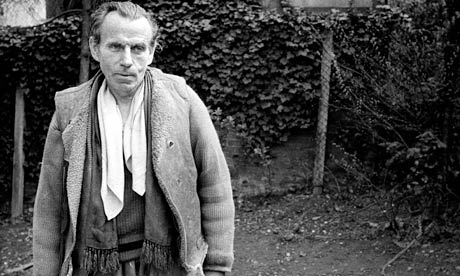
Special case: Louis-Ferdinand Céline. Photograph: Lipnitzki/Roger Viollet/Getty Images

Every year, the French government publishes a list of cultural events and personalities to be commemorated over the next 12 months. Compiling it is a lengthy and carefully-considered process. A High Committee of National Celebrations draws up a provisional list, which is then submitted to the Culture Ministry and, once approved, published in book form. Some 10,000 copies of the Recueil des Célébrations nationales 2011 were printed last autumn ahead of last week’s launch. Frédéric Mitterrand — the culture minister lui-même — had even penned a foreword, proving beyond a shadow of doubt that the project had received his imprimatur. However, when word got out that Louis-Ferdinand Céline was to feature alongside the likes of Blaise Cendrars, Théophile Gautier, Franz Liszt and Georges Pompidou, all hell broke loose.

Serge Klarsfeld, the country’s most famous Nazi hunter and Holocaust memorialist, expressed his indignation in the name of the Association of Sons and Daughters of Jews Deported from France. The Republic, he argued, shouldn’t celebrate “the most antisemitic” Frenchman of his day — a time, lest we forget, when antisemitism was so rife that it led to state-sanctioned Jewish persecution under the Vichy regime. Mitterrand’s decision, two days later, to remove the novelist from the list was logical in light of this backlash, but also somewhat surprising since he must have known that his inclusion would prove controversial in the first place (was he protecting Sarkozy, whose favourite author happens to be Céline?)

Far more surprising, however, was the reaction of the French intelligentsia, who were almost unanimous in their defence of the author of Journey to the End of the Night. Literary heavyweight Philippe Sollers accused the Culture Ministry of “censorship”. Frédéric Vitoux, a member of the prestigious Académie française who wrote a biography of Céline, likened this decision to the airbrushing of history under Stalin. Pop philosopher Alain Finkielkraut feared that some people would draw the conclusion that a “Jewish lobby” was dictating policy to the French government. Bernard-Henri Lévy, another celebrity philosopher, claimed that the commemoration of Céline’s death should have been an opportunity to try to understand how a “truly great author” can also be an “absolute bastard”. Even more surprising, perhaps, was the fact that Serge Klarsfeld himself felt the need to declare that he rated Céline as a “great writer” before going on to describe him as a “despicable human being”.

France is a place where authors and artists are granted a special status — a kind of poetic licence or artistic immunity. In fact, the country continues to view itself, and sometimes to be regarded as, the natural second home of all artists. It is this very liberal attitude which attracted many members of the Lost and Beat generations after the second world war, and that still attracts outsider writers such as Dennis Cooper. Some of the greatest works of contemporary fiction in English — Joyce’s Ulysses, Nabokov’s Lolita or Burroughs’s Naked Lunch — were available in France when they were banned or considered unpublishable in Britain or the US. A telling culture shock occurred on live television, in 1990, when a journalist from Quebec told Gabriel Matzneff that only in Paris would he be feted for writing — however exquisitely — about his liaisons with underage partners (of both genders). Anywhere else, she stated, he would probably end up in prison. The journalist was subsequently depicted as a philistine, unable to appreciate the subtlety of Matzneff’s feelings or the beauty of his style. Baudelaire once wrote that “literature and the arts pursue an aim independent of morality” and, for better or worse, this has clearly become France’s official artistic credo.

Trying to account for this “exception française” is no mean task, but I suspect it has something to do with the elevation of art to the status of surrogate religion during the second half of the 19th century. A similar phenomenon was taking place all over Europe, of course, but it probably had more resonance against the backdrop of the ongoing struggle between Republicanism and Catholicism. Both Flaubert and Baudelaire were prosecuted for public obscenity, but when French MPs called for the banning of Jean Genet‘s The Screens in 1966 (for political reasons, this time), the culture minister (and novelist) André Malraux immediately stepped in to defend the inviolability of artistic freedom. By then, artistic creation was largely considered as a value in itself, beyond morals and politics; even beyond good and evil.

The dominant French view on literature was probably best expressed by Oscar Wilde, who ended his life in exile in Paris: “There is no such thing as a moral or an immoral book. Books are well written, or badly written. That is all.” Not quite, though, in this case. No one is denying Céline’s talent as one of the greatest French writers of the 20th century — probably the greatest, with Proust. Is it possible, however, to distinguish the author of antisemitic tracts from the genius novelist; the man from the artist?