
I’ve written a piece on “Céline: Great Author and ‘Absolute Bastard’” for The Guardian‘s blog.
I’ve written a piece on “Céline: Great Author and ‘Absolute Bastard’” for The Guardian‘s blog.
Excerpts from Lee Rourke, “In Conversation: Lee Rourke and Tom McCarthy,” The Guardian (Guardian Review p.12) Saturday 18 September 2010
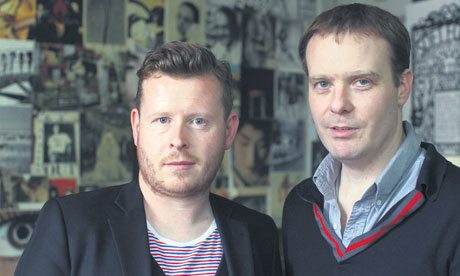
[Lee Rourke (left) and Tom McCarthy. Photograph: Eamonn McCabe for the Guardian]
…LR: You’ve said in the past that all art is repetition.
TMcC: Yeah: Joyce’s “commodius vicus of recirculation” . . . Or Mark E Smith’s three Rs: repetition, repetition and repetition . . .
LR: I’ll drink to that. It’s like a never-ending transmission that can’t be switched off.
TMcC: The transmission thing is important. There’s that Kraftwerk song, “I am the receiver and you are the transmitter”, or however it goes. One way of thinking about art, or the novel, is that the writer is the transmitter, the originator: I have something to say about the world and I’m going to transmit it. But this isn’t how I see it, I see it as exactly the inverse: the writer is a receiver and the content is already out there. The task of the writer is to filter it, to sample it and remix it — not in some random way, but conscientiously and attentively. This is what Heidegger says about poets: to be a poet is to listen before speaking; it’s first and foremost a listening and not a speaking. Kafka said it as well: “I write in order to affirm and reaffirm that I have absolutely nothing to say.” Writing, or art, is not about having something to say; it’s about aspiring to a heightened state of hearing. It’s why C is a totally acoustic novel and a receptive novel. The hero, Serge, sits there for hours trawling the aether waves, absorbing, listening to ship-to-shore transmissions, stock market prices, sports results, writing them all down. In a way, if you could see Serge’s transcript it would probably read like an Ezra Pound canto.
LR: This is why Serge is so brilliant, because all this absorption culminates in a form of pure poetry. I’m thinking of the novel’s “Chute” section, especially the first world war passages. Serge in his plane over enemy lines, flying above and below, marking the sky around him with these wonderful vapour trails while shooting up heroin and quoting Hölderlin, and so on. Where does all that come from? I know you’re interested in Marinetti’s manifestos.
TMcC: For Serge the whole battlefield becomes a sound box. He thinks of his machine gun, when he’s firing it into the trenches below, as like a needle being aligned with the groove of a record. When the needle goes in, static comes out, and it all resonates: the percussion of machine-gun fire, the siren wail of howitzers. The difference between Serge and Wilfred Owen is that Serge loves war. By the way, talking of Marinetti: it’s interesting that Marinetti’s novels, which supposedly enact the propositions of his many manifestos, are much less interesting than the manifestos. And the paintings that people did based on his manifestos are much less good as well. The manifestos are a kind of field of potentiality that to actually realise would spoil.
…LR: You’ve stated recently that C is essentially a novel about desire as much as about technology, and the “looping” of both within time. This puts me in mind of Beckett’s Krapp’s Last Tape. This idea that technology doesn’t take you forwards into the future, but actually takes you back towards your past.
TMcC: When Beckett’s old man is listening to these old tapes of himself, what it actually comes down to is desire — it’s incredibly moving. He’s there at the end, the end of his life, he wants to stop replaying it, all the loopings, snarling “Wasn’t once enough?”; but he listens again and again and again to this incredibly lyrical passage that he’s recorded about 30 or 40 years ago about him floating in a punt, with a girl, and the water all around them, I mean, it’s fucking amazing, it’s really, really beautiful. This is it, you see: what we find in technology and networks is desire. Which doesn’t mean the desiring individual; it means desiring consciousness itself. That’s why I wanted Serge Carrefax to be more than an individual; if he was a circuit he’d be over-charged. The surge is too much, it blows. It’s about the desire for impossibility. Giorgio Agamben, when describing melancholia (which Serge has in spades), says that the condition isn’t at all a detachment from the world, even though it may seem like it; in fact it’s an investment in the world so much that the desire for the world exceeds its own limit. The melancholic wants what is impossible; he wants impossibility itself — to experience it and to merge with it. To surge towards it. That’s why the melancholic is the ultimate rebel.
LR: Is it a desire for the impossible, or nothingness, to become real? To become a tangible thing?
TMcC: No, I think it’s more than that. I mean Pygmalion gets that: he wants the statue and then it becomes real, and that’s cute. But take Orpheus looking back: he’s far more interesting. He doesn’t really want Eurydice, he wants the dark night. As Maurice Blanchot brilliantly points out, he wants death itself. Not to make the night illuminated or present, but to have it in its absence, to have the presence of absence, something that is impossible. It’s doomed, beautiful and tragic.
LR: This is Blanchot’s Orpheus’s Gaze…
TMcC: Right. It’s an essay about five pages long and it’s the most amazing summary of what literature is, or could be, ever written. It’s not about representing the world, it’s not about criticising the world even. It’s about surrendering to a vertigo that can never be mastered, to an abyss that can never be commanded, or excavated or filled in.
LR: But you can leave your mark, right?
TMcC: Yeah, the scratch. Scratching the negative. That’s what artists do at their very best.
Simon Critchley,”Being and Time, Part 7: Conscience,” The Guardian 20 July 2009
“…What gets said in the call of conscience? Heidegger is crystal clear: like Cordelia in King Lear, nothing is said. The call of conscience is silent. It contains no instructions or advice. In order to understand this, it is important to grasp that, for Heidegger, inauthentic life is characterised by chatter — for example, the ever-ambiguous hubbub of the blogosphere. Conscience calls Dasein back from this chatter silently. It has the character of what Heidegger calls “reticence” (Verschwiegenheit), which is the privileged mode of language in Heidegger. So, the call of conscience is a silent call that silences the chatter of the world and brings me back to myself….”
This appeared in Guardian Books on 8 February 2010:
In Theory: Mimetic Desire
Nearly 50 years on, René Girard’s theory remains a powerfully illuminating insight into both literature and the world

Mediated desire … Amanda Drew as Emma and Simon Thorp as Rodolphe in Oxford Playhouse’s 2003 production of Madame Bovary. Photograph: PR
Many thanks for your insightful comments on “The Death of the Author” and interesting suggestions concerning future discussion topics — please keep them coming. All this feedback confirms the utility of a debate on the purpose of literary theory at a time when critics have all too often retreated into academia or become appendages of publishers’ marketing departments. Talented critics can do so much more than just test-drive the latest products for consumers. They can shape the zeitgeist, renew our perception of great literary works and even help authors make sense of their own worlds — a hat-trick René Girard pulled off with Deceit, Desire and the Novel.
Discovering Deceit, Desire and the Novel is like putting on a pair of glasses and seeing the world come into focus. At its heart is an idea so simple, and yet so fundamental, that it seems incredible that no one had articulated it before. Girard’s premise is the Romantic myth of “divine autonomy”, according to which our desires are freely chosen expressions of our individuality. Don Quixote, for instance, aspires to a chivalric lifestyle. Nothing seems more straightforward but, besides the subject (Don Quixote) and object (chivalry), Girard highlights the vital presence of a model he calls the mediator (Amadis of Gaul in this instance). Don Quixote wants to lead the life of a knight errant because he has read the romances of Amadis of Gaul: far from being spontaneous, his desire stems from, and is mediated through, a third party. Metaphysical desire — as opposed to simple needs or appetites — is triangular, not linear. You can always trust a Frenchman to view the world as a ménage à trois.
Mediation is said to be external when the distance between subject and mediator is so great that never the twain shall meet. This is the case of Don Quixote and Amadis, or Emma Bovary and the fashionable Parisian circles she dreams of. Here, the derivative nature of desire is clearly acknowledged. The hero of external mediation “worships his model openly and declares himself his disciple”. When mediation is internal, however, the distance between subject and mediator is small enough to give rise to rivalry between the two. The mediator, who aroused desire for the object in the first place, comes to be seen as an obstacle to the fulfilment of this very desire: “the model shows his disciple the gate of paradise and forbids him to enter with one and the same gesture”. Although now ostensibly a figure of hatred, the mediator continues to be idolised subterraneously or even subconsciously. In Proust‘s In Search of Lost Time, for instance, the Guermantes remain Mme Verdurin’s sworn enemies until the day when she marries into this family she had in fact secretly admired and envied all along.
Girard’s contention is that the need for transcendence has survived the decline of Christianity, resulting in the ersatz “inverted transcendence” of mimetic desire. The spread of this highly-contagious “ontological disease” gathers momentum in the works of Stendhal before reaching pandemic proportions in Proust and Dostoyevsky. Whereas Don Quixote is an “upside-down hero in a right-side-up world,” Julien Sorel (The Red and the Black) is a “right-side-up hero” in a topsy-turvy world. By the time we reach Dostoyevsky (Notes From the Underground, The Possessed), everything has gone awry. All these novels illustrate how internal mediation “triumphs in a universe where the differences between men are gradually erased”. The more egalitarian a society, the closer the mediator and the greater the rivalry.
In Stendhal’s worldview, there once was a golden age when the nobility’s social status was correlated with its nobility of spirit. Passion and spontaneity, which used to be the hallmarks of the true nobleman, have all but disappeared from The Red and the Black, giving way to abject vanity. After the French Revolution, it is no longer possible for the nobility to simply be: it must now justify its privileges in the eyes of “the Other”. In so doing, it becomes ignoble. The aristocrat mimics the bourgeois who mimics the aristocrat. At the level of individuals, this double mediation is a delicate balancing act in which the loser is the one who can no longer conceal his desire for the other, from the other. This revelation acts as an instant passion killer, since it shatters the illusion of “divine autonomy” that had proved so compelling. Open rejection, in turn, makes the heart of the spurned lover grow ever fonder.
Masochism — which features so prominently in both Proust and Dostoyevsky — is a by-product of the increasing proximity of the mediator; a means of enhancing his supposed divinity. The greater the obstacle he represents, the greater his divinity. Girard explains that we become masochists as soon as “we no longer choose our mediator because of the admiration which he inspires in us but because of the disgust we seem to inspire in him”. As the “ontological sickness” progresses, the desired object is increasingly forgotten — it virtually disappears in Dostoyevsky — to be replaced by the mediator. The masochist desires the obstacle which signals the divine presence of the mediator. In the same way, the Proustian snob puts up purely abstract barriers between himself and an object that is so ineffable it barely exists at all. This disappearance of the object is of no real consequence since it “loses its value in the very act of being possessed” anyway.
Writers themselves are not immune to mimetic desire. The release of a book is an “appeal to the public” which is frequently experienced as an affront to authorial pride. Aristocratic writers used to keep up appearances by claiming that they never intended their works to be printed. La Rochefoucauld even went as far as to claim that his manuscript had been stolen by a servant. The modern writer has no servants, so he makes “an anti-appeal to the public in the shape of anti-poetry, anti-novel, or anti-play. The main thing is to make the Other taste the rare, ineffable, and fresh quality of one’s scorn for him”. Sound familiar?
With Deceit, Desire and the Novel, René Girard wanted to demonstrate that the truly “great novelists reveal the imitative nature of desire” in their works. In the process, he reinterpreted some of the most important novels ever written, launched a devastating broadside against the inheritors of Romantic individualism and spawned a whole new sub-genre — mimetic theory — which has been applied to almost everything, from psychology to economics. Were it not for this brilliant debut, published in France back in 1961, incidentally, Facebook may have remained the plaything of a handful of Harvard geeks.
Peter Thiel — a venture capitalist whose mentor at Stanford was none other than Girard lui-même — soon spotted the commercial potential of a social networking site based on mimetic desire. In fact, the whole concept of viral, word-of-mouth marketing follows Girard’s principle according to which the strongest desires are those influenced by an admired third party. The gods haven’t withdrawn: they have gone online and their name is Legion. What the venerable Académicien makes of this exploitation of an “ontological disease” he has been denouncing for half a century is anyone’s guess.
My piece on René Girard‘s mimetic desire appeared on the Guardian Books Blog today.
I’m doing a series of blogs on literary criticism (called “In Theory”) for the Guardian‘s website. The first one, about “The Death of the Author,” was published today.
A short piece on Matthew Coleman‘s artwork appears in the Winter issue of the excellent Flux magazine.

On 30 December 2009, Susan Tomaselli devoted her first 3:AM Cult Hero feature to a piece I’d written about Arthur Cravan for the Guardian Books Blog. You’ll find the full text here.

Leo Benedictus, “Brian Duffy: ‘Photography was dead by 1972′” The Guardian 12 January 2010
One morning in 1979, Brian Duffy, then one of the most famous photographers in the world, came into work. One of his assistants told him they had run out of toilet paper. His memory is hazy, he admits, but what happened next became an episode of snapper folklore.
“I realised,” he recalls in a documentary that airs on BBC4 tonight, “that I was making decisions about toilet paper. And I thought, ‘This has got to end.’ Either by me murdering my staff, killing myself, or setting fire to the whole fucking thing.” So he gathered every negative and transparency he had ever shot and burned them on a fire in his back garden. After that, he never took another picture.
Except, as it turns out, negatives do not easily catch fire. And when they do, they produce an acrid black smoke: this bonfire ended when an official from Camden council peered over the fence and insisted Duffy put it out. Duffy packed what remained away in shoeboxes in his attic and turned to painting and furniture-restoring. It was only in 2007, when his son Chris went through the boxes, that he reluctantly agreed that they were worth another look. This led to a show in London last year – the first, anywhere, of his career.
To devotees of photography, these surviving pictures were like a salvaged stack from the library at Alexandria.
…So when did it cease to be interesting? Duffy offers some clues in the BBC’s documentary. Talking with Bailey, he says he feels the US photographers Irving Penn and Richard Avedon “fucked photography for us”. What does he mean? “They got there,” he says, referring to their revolutionary work, which pushed at the boundaries of photography. “You’re a bit annoyed when someone does something and you go, ‘Shit! I was just about to do that!'”
The result, says Duffy, was that “photography was dead by 1972”. He takes a rare pause, then explains: ”Everything had been resolved between 1839 and 1972. Every picture after 72, I have seen pre-72. Nothing new. But it took me some time to detect its death. The first person who twigged was Henri Cartier-Bresson. He just stopped – and started painting and drawing. God, he was useless.”…
…So Duffy experimented, until he felt the scope for experimentation had ran out. By the 1970s, he was doing most of his work in advertising — with people he didn’t like, on briefs that bored him. “The more I got into it, the more I realised I was hanging out with things I was diametrically opposed to. And they wanted me to keep a civil tongue up their rectum.”
So he burned everything….
Jonathan Jones, “How Dada Spawned the Art of Anarchy,” Guardian Art and Design Blog 29 September 2009
“…Punk and dada, across the decades, share a savage hostility to the security and luxury of artistic respectability. The true anti-artist is never interested in compromise: for Lydon, to class the Pistols as high art was to tame them, contain them. This same anti-art rage is exemplified by Gustav Metzger, whom I interviewed recently, and whose concept of “auto-destructive art” is yet another variant of modern art’s impulse to smash reality.
This impulse to destruct, efface, obliterate cannot be confined to a single kind of modern art. There is as much negation, as icy a contemplation of the void, in the Rothko Chapel in Houston as in any dada collage.
This is why [Greil] Marcus writes so well about dada and its legacy, because he sees its bitter, liberated heart and does not take for granted what it was. It is also why to dismiss “anti-art” tendencies today is to be blind to the way they permeate the entire history of modernism — in short, to be a stuckist.”
****
Jonathan Jones, “Gustav Metzger: The Liquid Crystal Revolutionary,” The Guardian 29 September 2009 (p. 19 of the Arts section)
“…In the 1960s, his argument that destruction is a form of last-chance creativity in a terminal world had a subterranean influence — not least on Pete Townshend, who was Metzger’s student at art college and credits him with inspiring the Who to destroy their instruments. …
In 1974, Metzger called an Art Strike: for three years, from 1977 to 1980, he refused to make, sell or exhibit art, or to promote himself as an artist in any way. …
Today, at the Serpentine, I ask him why he invented auto-destructive art, what he meant by it. ‘It was a summing up of my entire life until that period,’ he says, in the German accent he has never lost. ‘It was my childhood in Nazi Germany, coming to this country as a refugee, as a survivor. And then when we had peace, the entire planet being transformed by nuclear weapons. That is at the centre of my life.’ …
Of watching the [Nazi] parades, he says now: ‘Certainly the brutality of seeing 10,000 people marching like machines — as a child I must have rejected it.’ Did it make him the artist he is? ‘It could be that I saw so much power that I needed to get rid of it in myself. That’s one way to understand the origins of auto-destructive art. In Judaism there is a tradition of rejecting power: the Prophets rejected power. That was part of my childhood, giving up rather than acquiring.’ …
You could say that Metzger is the Kindertransport’s greatest failure: instead of building a constructive life for himself in postwar Britain, he invented a destructive life — or a destructive art. His art is a refusal to forget, to assimilate, to move on. His anger at the world is almost that of an alienated child: he tells me that, in a photograph he once showed me — of a child holding his hands up during the liquidation of the Warsaw Ghetto — he sees himself: ‘I identify with this child.’
Violent art is Metzger’s response to a violent world. In his exhibition, that same Warsaw photograph will be shown concealed behind a barrier, like the other images in his series Historic Photographs. These are his most enduring and remarkable works: you crawl on your hands and knees across the images as a way of remembering what happened. …”
Link to the Gustav Metzger exhibition at the Serpentine Gallery.
Dorian Lynskey, “John Lydon: PiL Lets Me Express Proper Emotions,” The Guardian Monday 7 September 2009 (Arts section, p. 17):
[On the subject of dub reggae] “For me, the best rock is not what you play — it’s what you’re not playing”.
Can artists create art by doing sod all? That’s the question raised in my latest piece for the Guardian‘s website:
“…Jouannais believes that the attempt at an art-life merger, which so preoccupied the avant garde of the 20th century, originated with Walter Pater‘s contention that experience, not “the fruit of experience”, was an end in itself. Oscar Wilde’s nephew, the fabled pugilist poet Arthur Cravan, who kick-started the dada revolution with Francis Picabia before disappearing off the coast of Mexico – embodied (along with Jacques Vaché or Neal Cassady) this mutation. Turning one’s existence into poetry was now where it was at. ‘I like living, breathing better than working,’ Marcel Duchamp famously declared. ‘My art is that of living. Each second, each breath is a work which is inscribed nowhere, which is neither visual nor cerebral; it’s a sort of constant euphoria.'”
More here.
 ANDREW GALLIX