
My short tribute to Jacno appeared on the Guardian‘s music blog today. You’ll find it here.
My short tribute to Jacno appeared on the Guardian‘s music blog today. You’ll find it here.
This appeared in 3:AM Magazine on 14 September 2007. It was reprinted in George Berger’s Let’s Submerge: Tales From the Punk Rock Underground, published on 26 November 2013:
A Pint and a Molotov Cocktail
George Berger interviewed by Andrew Gallix.
3:AM: How did you get into punk?
GB: Seeing the bizarrely-dressed head-turners strolling around Bromley and surrounding areas really turned my head. Clothes and hair and a way of walking that just said “fuck off” to everyone, and straight society in particular. I don’t remember the individuals individually, just the feeling of seeing unrepentant weirdos expressing themselves via their appearance. I’d imagine this was before the word ‘punk’ came into popular use, but it doesn’t really matter either way. Seeing similar — or perhaps the same — people then interviewed on the London Weekend Show by Janet Street Porter, and then on ‘Young Nation’ on Nationwide turned my head yet further: they were sullen and obnoxious and that confused my hormones. I can’t say I liked the look of them, but it opened a door in my mind that had previously been locked and marked ‘no entry’. Finally, the famed Bill Grundy interview drew a line in the sand as I watched it with my outraged parents, trying to conceal my glee. This was clearly a step beyond their affectionate mock-outrage at glam rock.
‘No more apologies’, as Morrissey later described it so beautifully. My zits cleared up almost immediately, perhaps because I wasn’t scared of them anymore. Freedom of feeling, the feeling’s appealing. In other words, punk pushed the right buttons by opening the right (mental) doors at the right time. The music was often great, but was never the point.

3:AM: Your band, Flowers in the Dustbin, were part of the anarcho-punk scene, so you wrote this Crass book as an insider…
GB: Is there any self-respecting anarchist who would admit to being such? I wouldn’t know…
Being part of the London anarcho-punk-goth-crazy-coloured-fools-with-no-rules scene certainly informed the perspective that the book is written with of course, because it meant my early experience with anarchist thought and practice wasn’t limited to Crass. A sense of perspective, as Tap philosophised. But I’m not so sure FITD as a band were as much a part of all that in the way it’s now remembered. There’s a book about anarcho-punk coming out called The Hippies Now Wear Black — we were innocent on both those charges!

3:AM: To what extent did the members of Crass help you with your research and how have they reacted to the book?
GB: The members of Crass — Andy Palmer excepted — were as helpful as anyone could reasonably be expected to be, and in the cases of most, well beyond that.
The Crass members were also strikingly, unusually, generous and kind in a way that prods your conscience into examining its own parameters. Whatever happened to the members of Crass in their respective life-journeys at the time, it seems to have left an indelible urge to be kind and generous. Perhaps that was the energy that originally attracted so many towards them. In fact, I’m certain it was.

3:AM: In another interview you said: “I always felt a bit sorry for the people who bought into Crass at the expense of everything else”. However, when you read the book, it is obvious that the Ants/Crass dichotomy still seems to rankle after all these years. Crass offered a whole lifestyle that was difficult to reconcile with non-anarcho punk bands like the Ants or UK Subs. It was a bit like joining a fundamentalist sect, wasn’t it? Do you think you might have been attracted to this aspect of the band because of your Catholic upbringing?
GB: Meaning Crass were a part of the whole and people who bought into the sideshow ‘anarcho-punk’ often missed out on the other colours of the rainbow — Killing Joke, Bauhaus, Swell Maps, Au Pairs, Slits, etc etc… I don’t think it was a dichotomy at all in the early days, but sadly neither side could resist the bitching that subsequently became one of anarcho-punk’s main characteristics.
I should point out that I wasn’t attracted to Crass so much as fascinated by them, i.e. I was massively drawn to the idea of somewhere like Dial House working for decades as an open house, but could never quite reconcile the difference between the harsh Crass rhetoric and the gentle people in Crass. Frankly, you’d expect Crass to be aggressive and confrontational as people, but they were — and are — lovely. Delibrate dada contradictions? Maybe.
The Crass image encouraged the fundamentalist thing, which I would suggest was due to some kind of archetype hangover from the hippie times (where sects flourished of course). The Ants, Subs etc were far more healthy in this respect, I’d say, as they weren’t playing the parent. Saying ‘be yourself’ is great (Ants / Subs / punk), but the minute you start defining what that self should be, albeit unintentionally, you’re risking straying into a difficult place. The Crass output became self-conscious and ‘preachy’ once they got an audience — I felt sorry for the people who were perhaps young and encountering Crass / punk for the first time at this juncture and so bought into an opinion as though it was a reality. The map is not the territory.
I was repelled by the perceived fundamentalist aspect of Crass, not attracted to it. Whether or not this was connected to being brought up a Catholic, I’ve really no idea.

3:AM: Crass’s obsession with political freedom was so extreme that it enslaved some members. Steve Ignorant actually describes leaving the band as a liberation from the band’s politically-correct shackles: “I couldn’t look at the barmaid’s arse without being branded sexist. I couldn’t have milk in my tea without being called a bastard cos I wasn’t a vegan”. He also told you that if he’d been a 16-year-old punk at the time Crass’s rhetoric would have put him off and he would probably have been an Exploited fan. Even Penny Rimbaud, the band’s éminence grise, admits that they were “too serious”. It’s a double-edged thing, though, isn’t it? Crass meant so much because they were for real, but that purity also implied a po-faced, puritan zealotry…
GB: I don’t think Crass came across like that initially (before Penis Envy, if I’m forced to draw a line in the sand). I’m also not sure Steve is right – I don’t think that whatever took him to Dial House would have otherwise taken him to the Exploited; just a glib quote possibly out of context here. (In book interviews, Steve just spoke his mind whereas some other members of Crass pondered for literally minutes before replying to questions — which is quite unnerving but simultaneously inspiring).

3:AM: Your book often reads like a demystification of Crass’s political correctness. Whereas at the time, they appeared so self-assured — with their black uniforms, military backdrops and corporate logo — here, they come across as far more human and vulnerable. Steve and Pete admit that they knew little about anarchist history; Eve Libertine explains that she had qualms about “Reality Asylum” because of her Christian upbringing; Steve wrote “So What” as a kind of childish dare “to see if there’d be a bolt of lightning” when he sang the blasphemous lyrics… Did all this change the way you perceived the members of the band and the Crass phenomenon or were you conscious of this vulnerability at the time?
GB: I didn’t know the band well enough as people at the time to be sure of the vulnerability. I’d wager few, if any did.
With the book, I wanted to try and find the people behind the image / wall of anynomity. Demystification hits the nail on the head. Whilst Crass were always approachable back then as ‘Crass’, the individuals behind the job were often impossible to discover. Even to themselves, it would appear. At the time, I thought this was counter-productive to ideas that ‘anyone can do it’, so with the book I tried to show that the people that made up Crass and did/didn’t change the world (delete as your reality tunnel dictates) did so without being special and without access to any privilege that you or I haven’t got. And surprised myself with my findings…

3:AM: The more I read your book, the more contradictions appeared. Crass avoided the star system through anonymity but this very anonymity inevitably created a mystique of its own. But the paradox doesn’t stop here as the band were also one of the most accessible ever…
GB: Were they? On one level yes: you could go meet them, chat to them, even visit their house. But as I’ve said, getting to know the real people was out of the question for fans. Still, they did draw the line in a very different place to the stars of the day, even the punk rock stars.
Did they avoid the star system? I’m not so sure — accessibility is surely only one aspect of stardom. People looked up to Crass and looked to them for guidance. By the time they were getting big, they appeared to want to give it, albeit way more responsibly than most of their peers.

3:AM: A couple of other contradictions highlight the band’s unique nature. Politically, they were caught between the old school anarchists and the pacifists; financially, the more records they sold, the more money they lost.
Crass created a massive grassroots anarchist movement, for the first time in British history. They invented their own brand of anarcho-pacifism. They were also the only political band to practise what they preached which is why they sold records by the truckload without any advertising. I remember an interview with Joe Strummer, in the early 80s, in which he said that wherever you went, even in a remote Greek village, you’d see graffiti of the Crass symbol. He was gobsmacked and clearly envious. The band’s achievements were huge, but until your book came out their story went largely unrecorded — weird, isn’t it?
GB: Weird yes, but what Crass were offering was so beautiful — yet so fragile — that it was only ever going to appeal to the demographic who considered it a possible reality.
You’re wrong about their losing money on records — that only happened with “Reality Asylum” — otherwise they made a lot of money. Then showed an inspiring amount of integrity by returning it to what they considered ‘the movement’ and simultaneously arguable tactics and taste in the way they did this by releasing records by a plethora of copyists (not all of course, but many).

3:AM: Crass are obviously still influential and will continue to be so, but they were also very much of their time, weren’t they? I don’t know if you remember, but a few years ago, David Beckham was photographed sporting a T-shirt bearing the Crass logo: I’m sure he had no idea what it was; it didn’t mean anything anymore. I don’t think Crass would have been as influential in a prosperous, post-Thatcherite Britain, do you?
GB: I believe that T-shirt was a Jean-Paul Gaultier creation, but don’t quote me on it. The Crass symbol never meant anything beyond ‘Crass’ and it wasn’t even designed to mean that in the first place.
Crass were of their time, obviously. Our job is to be of ours… I think Crass would have got nowhere without punk, but then neither would so many bands, or any of the rest of us for that matter — it’s all so many ifs and buts.
I’d also mention that I don’t think we do live in a post-Thatcherite age yet.

3:AM: I’ve always thought that anarcho-punk was killed by the fans. All the bands were banging on about peace while the fans were beating the shit out of each other — there was such a contrast between rhetoric and reality…
GB: The anarcho-punks were generally peaceful. Trouble at anarcho gigs was invariably from skinheads, usually right-wing and preying on pitifully-easy pickings. The inherent aesthetic contradiction between the ranting aggressive anarcho noise and the ‘peace’ lyrics was bound to attract a percentage of people who liked the former to the point where they didn’t care about the latter. I’d say the lack of trouble at Poison Girls gigs illustrates that.
Of course, to treat anarcho-punk as a music scene is to ignore the much more pervasive and lasting political movement that included the popularisation of animal rights, the peace camps, the birth of the anti-capitalist demonstrations etc. — you can beat the shit out of a few people at a gig, but you can’t kill the spirit.
3:AM: You write that “If the Buzzcocks wanted a generation of kids to turn up the volume to annoy their parents, Crass made you turn it down so they couldn’t hear the blasphemy”. Maybe that was also part of the problem: over the years, Crass’s righteous anger seemed to turn into a permanent tantrum…
GB: Yes, I’d say so. They weren’t like this at all as people, so one can only conclude that they’d got too stuck into ‘punk’ as cliché and failed to follow their own advice. What seemed so vital and loyal to ‘the cause’ at first ended up feeling reactionary to me, particularly as newcomers appeared to buy into the scene as some kind of rule-book.
3:AM: Another big problem was the old class thing. In spite of the anarchist rhetoric, a class divide remained within the band — in particular between Steve Ignorant, the geezer who wanted to wink at the girls in the front row, and Penny Rimbaud, the public-school educated hippie intellectual…
GB: Actually, I don’t think there was any personal divide between Penny and Steve, but I do think that going on about classlessness against a backdrop of the biggest war of the 20th century in the UK against the working class caught them a bit short.
3:AM: It’s interesting that both Steve Ignorant and John Lydon were influenced by Brighton Rock, which they both read at school…
GB: I bet they’d love a drink together — Steve, Johnny and Pinky, getting leathered in Horatio’s at the end of the pier! I’ll get the first round in: mine’s a pint and a molotov cocktail!
3:AM: When Penny Rimbaud claims, for instance, to have seen flying tribesmen in Africa, do you ever think: this guy is a nutcase not a visionary genius?
GB: I’m amazed people haven’t picked up on this more. If Penny was deliberately winding me up saying this, then he was doing so with an intensity that would put him up there with Brando and De Niro as one of the greatest actors of all time.
Nutcase / visionary genius — as Penny himself has asked on many occasions regarding Wally Hope, where do you draw the line? I think Penny Rimbaud’s whole life appears to be lived as polemic, which may give a clue here, as may his interest in existentialism.

3:AM: On the hippie vs punk debate, you claim that “Crass was right and Malcolm McLaren was wrong”. Obviously, there was continuity as well as rupture, but wouldn’t you agree that punk was the first movement to create a generation gap among youth itself? The hippies were the first generation to refuse to grow up, then punk came along with Sid Vicious stating that he couldn’t remember the Summer of Love because he was too busy playing with his Action Men…
GB: I’d say that there was a generation gap between teds and hippies, mods and teds (rockers) etc
Sid was a great comedian for the zeitgeist one-liners and I’m sure a generation knew instinctively where he was coming from with lines like that. But I think to pick up on generational trivia is to miss the point, particularly in hindsight.
3:AM: You seem to agree with Stewart Home that Crass took the fun out of punk…
GB: Yes, I do. But maybe half the fun was the incredibly broad church punk produced — seeing as that would have disappeared with or without Crass, it’s possible it would have gone anyway. Look at some of the others around then: Six Minute War, Crisis, Pop Group, Discharge, Au Pairs etc: hardly a laugh a minute. Maybe it was something in the air.
3:AM: You have described the composition of this book as an “intense experience”: did you need to write it in order to put this whole period behind you?
GB: Not the period itself — that’s already and unavoidably behind me. This was the period I became a vegetarian and turned the teenage angst into something more structured in my head. But, yes, there is a definite sense of catharsis in writing this book — I still find myself referring to ‘punk’ attitude all the time with a nagging sense that I must sound like an old ted. So I hope that all this ‘30 years of punk’ lark will help me draw a line somewhere if I’m honest. Not with the attitudes it imbibed me with, but maybe with the word itself.

ABOUT THE INTERVIEWEE
George Berger’s latest book is The Story Of Crass. His previous one was a biography of the Levellers. His next one is under contemplation. He also fronts Flowers In The Dustbin and writes a blog from there.

Zoë Street Howe, Typical Girls? The Story of The Slits (London: Omnibus Press, 2009):
Keith Levene: “Viv [Albertine] was the one who made me aware of the Pistols when they were more a myth than an actual band…” (p. 4).
Ana Da Silva: “I remember very well this article that Vivien Goldman had written, she mentioned The Slits, which I thought was great, this band hadn’t done anything but it was there in the papers and everything” (p. 17).
Vivien Goldman: “Tessa was sitting on the bed with Budgie, who had this necklace with a pair of scissors because her group was called The Castrators. It was more of a conceptual thing. Put it this way — I don’t remember the music but I remember the scissors!” (p. 19).
Gina Birch: “…and that’s probably why Vivien Golman was able to write about them, because they’d envisaged what they were going to do before they did it” (p. 18).
Tessa Pollitt: “I started a group called The Castrators with two other girls called Budgie and Angie, but none of us could particularly play, it was just an idea. Suddenly the News of the World was knocking on the door — they wanted to do a sensational article about punkesses. There’s this classic line that says, ‘These girls make The Sex Pistols look like choirboys!'” (p. 18).
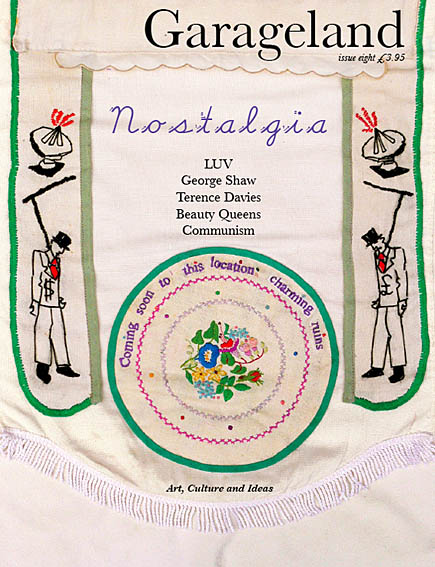
This appeared in the summer 2009 issue of Garageland (issue 8, pp. 30-33).
Unheard Melodies
Andrew Gallix goes in search of the most elusive of the phantom bands — L.U.V.

“As a rock critic, when you reach a certain age, you begin to wonder if all the mental and emotional energy you’ve invested in this music was such a shrewd move,” wrote Simon Reynolds in the introduction to Rip It Up and Start Again. More recently, he wondered if “searching for utopia through music” had not been “a mistake” (Totally Wired). To ascribe such doubts to impending middle age alone would be to forget that there was a time when music truly was a matter of life and death, when days were whiled away listening to records and poring over album covers in some ill-defined but all-important quest. Instead of producing plays or paintings, the best and brightest were busy perfecting one-note solos on replica Starways from Woolies. Rock’n’ roll was central to contemporary culture: it was where it was at.
Needless to say, no band could ever totally live up to such high expectations. Malcolm McLaren shrewdly ensured that the Sex Pistols made precious few live appearances in order to enhance their mystique. Spandau Ballet would use a similar trick at the beginning of their career by playing invite-only gigs. Keats (Morrissey notwithstanding) was right: heard melodies are sweet, but those unheard are sweeter. After all, bands are necessarily approximations of the dreams that conjured them up. Some — like the Libertines whose Arcadian rhetoric was often far more exciting than their songs — are condemned to remain pale reflections of their Platonic ideals. By the same token, a record is always a compromise: The La’s famously spent two years recording and re-recording their first album without ever achieving the desired effect. Even at its best, music cannot vie with the silence it comes from and returns to — the silence inhabited by phantom bands.
We are not talking dead silence here, but rather something akin to the background noise during a performance of 4′ 33″ or the tinnitus burned on to the mind’s ear by imaginary songs overheard through the static in between radio stations. A living silence, perhaps. According to the great academic and critic George Steiner, “A book unwritten is more than a void”. The same could be said about songs unrecorded or unplayed: they actually exist, virtually, in some Borgesian iPod of Babel. Phantom bands themselves are not complete figments of the imagination either: to qualify, they must have some kind of shadowy existence, leave some kind of (lipstick) trace. The Chris Gray Band never existed beyond a few graffiti around Victoria Coach Station in the early seventies, but the idea of forming “a totally unpleasant pop group” designed to subvert showbiz from within would obviously be a major influence on the Pistols project (1). The London SS — whose short lifespan was one long audition bringing together most of the major players on the future London punk scene — is probably the most influential group to have neither released a record nor played a single gig. Synthpunk pioneers The Screamers were described by Jello Biafra as “the best unrecorded band in the history of rock ‘n’ roll”. Typically, their first photoshoot appeared in a magazine when they were yet to play live (2). At a later stage, they were approached to release an album cover containing no record — an art stunt which never materialised but would have been a fitting metaphor for this textbook phantom outfit from Los Angeles. The Screamers managed to become local legends although — or perhaps because — they only did a handful of gigs and never got round to cutting a record (3). The Nova Mob from Liverpool did not even try to go that far. Fronted by Julian Cope, they were a purely conceptual group dedicated to never playing a single note of music. Instead, they would hang around caffs discussing imaginary songs — a practice they referred to as “rehearsing”. Definitely one for the Borgesian iPod.
“It’s like being in love with a woman you’ve never had,” says Dominique Fury, trying to account for the enduring fascination exerted by the group in which she briefly played guitar more than three decades ago: “The relationship hasn’t been consummated”. She smiles. A ray of sunshine has crept into her artist’s studio near Belleville. Through the open window, I can glimpse the pink apple blossom in the middle of the dappled courtyard. All is quiet. All is still. When I say I’m in love, you best believe I’m in love L-U-V. For me, the most phantomatic of phantom bands has always been L.U.V., an elusive and largely illusive all-girl punk combo from Paris. I remember reading tantalising news snippets about them in the music or mainstream press at regular intervals. A quote here, a namecheck there. Just enough to whet my appetite. And then — nothing. A tale told by an idiot, full of silence and fury, signifying nothing. Nostalgia for a band yet to come.
Only one picture of the complete line-up was ever published (in the long-defunct Matin de Paris). Granted, it is worth a thousand words, but the fact that there seem to be no others speaks volumes about the fragility of L.U.V.’s collective identity. It is also rather paradoxical given that style was all the substance they had. From left to right you can see Aphrodisia Flamingo (the rebel), Dominique Fury (the femme fatale), Liliane Vittori (the cerebral rock chick) and Edwige Belmore (the It girl). Wearing matching sunglasses, Aphrodisia and Dominique — the terrible twins who formed the nucleus of the group — stand very close to each other as if they are an item. Aphrodisia stares the world down, her full mouth a smouldering moue of utter contempt — Bardot gone badass. Dominique, in terrorist chic mode, adopts a far more glamorous, almost provocative pose. Liliane, for her part, seems to be fading into the background, a faraway look on her anguished features. Edwige towers above her like some Teutonic titan, sporting a Billy Idol hairdo and the blank expression of a Galeries Lafayette mannequin.
L.U.V. (4) was the brainchild of Aphrodisia Flamingo (Laurence “Lula” Grumbach) who, having mixed with the likes of Nico, Lou Reed and Patti Smith in New York City, returned to Paris determined to launch a girl group of the punk persuasion. One night, down at the Gibus (France’s answer to CBGB), she caught sight of Dominique Fury (née Jeantet) (5). It was L.U.V. at first sight: “I just made a beeline for her because I instantly knew I wanted her in the band”. The fiery, long-haired brunette and the glacial, short-haired blonde were attracted to each other like polar opposites. Dominique speaks repeatedly of a “magnetic relationship”: “There was chemistry between us — something magical that was more than the mere sum of its parts”. Both came from very wealthy but troubled backgrounds (6). Aphrodisia lost her father when she was only eleven; Fury never really found hers (which may explain her penchant for collective experiences) (7). The latter was a revolutionary heiress who made donations to the Black Panthers and bankrolled a couple of utopian communities that she describes as “a quest for something beautifully wild”. Once the opium fumes of the communal dream had dissipated, she embarked on an equally eventful American road trip (almost meeting her fate near the Mexican border) and was soon drawn towards punk’s “dark and romantic aesthetics” — which brings us back to the Gibus circa early 1977.
Although L.U.V. revolved mainly around these two soul mates, the most famous member at the time was in fact Edwige — a striking bisexual amazon who was already a face on the local clubbing scene and would soon be crowned la reine des punks. For fifteen minutes, Paris was at her feet: she ran the door at the hippest joint this side of Studio 54 (Le Palace), was photographed with Warhol for the cover of Façade magazine, formed an electronic duo called Mathématiques Modernes, posed for Helmut Newton and allegedly had a string of affairs with the likes of Grace Jones, Madonna and Sade (“The Sweetest Taboo” is rumoured to be about her). Given her stature, Edwige seemed destined to bang the drums for L.U.V. As Fury puts it, “The group was primarily an image — a work of art — so it was great to have this iconic figure”.
This conception of the band as tableau vivant or performance art was (and indeed remains) at odds with some of the other members’ more conventional aspirations. “Aphrodisia gave me the opportunity to create something,” says Fury, but that something was not rock’n’roll. When L.U.V. petered out, she joined Bazooka, an art collective (where she famously found herself embroiled in a convoluted ménage à trois with two artists of either gender) rather than another band (8). But Liliane, the bassist (9), simply could not understand why Dominique showed no interest in musical proficiency and insisted on teaching her how to master her instrument. Fury reckons “she just wasn’t mad enough”. “She simply didn’t get it,” concurs Aphrodisia. Whenever journalists or A&R people attended rehearsals, they drafted in Hermann Schwartz — Métal Urbain’s axeman — who would play concealed behind a curtain while Fury struck guitar-heroine poses (10).
Aphrodisia, who is currently writing her autobiography, sees L.U.V. as a missed opportunity: “We never wrote a single song. We wanted to, but were probably too stoned” (11). She explains that rehearsals were constantly interrupted because someone always needed to score. She talks about major label interest. She remembers how Rock & Folk, the top French music magazine, would beg them to play a gig that they could cover in their next issue…
Some of us are still waiting for that next issue. Come, let us dance to the spirit ditties of no tone.
Endnotes:
(1) The eponymous Chris Gray was a member of the English section of the Situationist International (expelled in 1967) and the author of the seminal Leaving the 20th Century anthology (1974) which popularised Situationist ideas in Britain. Like Malcolm McLaren and Jamie Reid, he was involved with political pranksters King Mob.
(2) This is reminiscent of the Flowers of Romance (which included Sid Vicious, Viv Albertine and Keith Levene) who gave an interview to a fanzine although they had never played live (and would never do so). The Pistols would later cover the Flowers’ “Belsen Was a Gas”.
(3) The Screamers’ uncompromising music — all synthesizer, keyboard, drums, screamed vocals and not a guitar in sight — was unlikely to get heavy rotation, but delusions of grandeur were probably the main reason why the big time eluded them. A prime example of this was their decision to turn down a tour with Devo. There were also rumours that Brian Eno wanted to produce them, but the band felt that their histrionic live performance could not possibly be captured on vinyl. Instead, they envisaged a video-only release which would have been commercial suicide pre-MTV. It never saw the light of day anyway.
(4) The band’s name is obviously a reference to The New York Dolls’ “Looking For a Kiss,” but according to Laurence Grumbach it also stands for Ladies United Violently or Lipstick Used Viciously. Laurence’s nom de punk was chosen because she was born on 9 August which is St Amour’s day in the French calendar (hence Aphrodisia) and because she was fond of the Flamin’ Groovies (Flamingo). Apparently, it has nothing to do with John Waters’ 1972 film, Pink Flamingos.
(5) Dominique Jeantet reinvented herself as Fury in reference to Faulkner and the Plymouth Fury automobiles. She once owned a guitar with “Fury” inscribed on it.
(6) Fury recently discovered that her godfather was none other than the then future (and now late) President François Mitterrand.
(7) Fury’s father was a protean character. Among many other things, he was a spy with multiple identities who was involved in a plot to assassinate Hitler. Before the war, he had been a member of a far-right terrorist group.
(8) The two artists were Olivia Clavel, who introduced her into the collective, and Loulou Picasso. Bazooka are most famous in Britain for producing the cover of Elvis Costello’s Armed Forces. Dominique Fury, who was once described as the Parisian Edie Sedgwick, also dated Lenny Kaye and Mick Jones of The Clash.
(9) Liliane was also a talented photographer who worked for the music press.
(10) Hermann Schwartz also acted as L.U.V.’s Pygmalion. It was he, for instance, who introduced the girls to The Shangri-Las.
(11) L.U.V. covered two songs: Nico & The Velvet Underground’s “Femme Fatale” and The Troggs’ “Wild Thing”. Dominique Fury showed me some lyrics, both in French and English, that she had written for the band, but I’m not sure she ever shared them with the other members. Some are reminiscent of X-Ray Spex in that they describe a dystopian consumer society. Others stood out because of their violent imagery: “We’ll take the handle and you’ll take the blade”.


The summer issue of Garageland — which includes a piece I wrote about Parisian phantom band L.U.V. — is launched today at Transition Gallery in London. The general theme is Nostalgia, the cover is by Alex Michon (who famously designed many of The Clash’s outfits) and you can buy a copy here.
This appeared in the Guardian (Art & Architecture blog) on 14 May 2008:
France’s Pre-Banksy Art Provocateurs
At the time of punk, a ‘commando’ unit of French creative guerrillas spearheaded a movement that was the forerunner of today’s spray-stencil street culture

Dominique Fury flanked by two of the Banshees wearing her T-shirts
Imagine Jamie Reid stealing the Sex Pistols’ thunder or Linder Sterling upstaging the Buzzcocks: this is pretty much what happened in France at the end of the 70s. The Jeunes Gens Mödernes (“Mödern Young Things”) exhibition, curated by Jean-François Sanz at the Galerie du Jour in Paris, showcases most aspects of local post-punk culture from badges to paintings through record sleeves, fanzines, photographs, videos and films. A totemic synthesizer, an old-school keyboard and a couple of guitars propped up against diminutive amps take pride of place at the centre of the main room. Cigarette butts have been studiously littered around the pretend stage for added authenticity. This installation of sorts embodies the ghost of gigs past, but it also draws attention to the deafening sound of silence. Visiting agnès b’s labyrinthine gallery is not dissimilar to attending a concert wearing earplugs or watching television on mute — and, frankly, it is all the better for it.
With a few notable exceptions, Gallic punk was derivative and devoid of any real social resonance. Singing about anarchy in front of a handful of socialites on loan from the neighbouring gay clubs was unlikely to threaten the status quo. This is probably why the extraordinary creative energies unleashed in New York and London were channelled, most effectively, into the edgiest fringes of the French art world.
Bazooka, who appeared in 1975, were arguably the greatest punk artists this side of Jamie Reid (Malcolm McLaren once described them as “influential”). They are mainly known in Britain for designing the cover of Elvis Costello’s Armed Forces, but they first shot to infamy during the summer of 1977 when they were invited to (dis)grace the pages of Libération. This led to a series of nocturnal art attacks which consisted in adding increasingly provocative artwork and comments on every inch of space available. Sometimes they even went as far as doctoring the content of articles or changing the layout. They always did this at the 11th hour — just before the paper went to press — so that nobody could foil their subversive plans. “All hail the graphic dictatorship,” trumpeted one of Bazooka‘s most famous slogans, reflecting their fascination with Suprematism (Lissitzky), Constructivism (Rodchenko) and totalitarian propaganda. The aim was to wind up the leftist “war veterans” of May 1968 and their hippie fellow-travellers who made up the bulk of Libé‘s staff and readership. In this they succeeded only too well. Lawsuits were filed and tempers flared. Olivia Clavel was soundly slapped by a female photographer whose work she had butchered; Kiki Picasso (Christian Chapiron) and Loulou Picasso (Jean-Louis Dupré) were both beaten up for their provocative flirtations with fascist iconography. Tensions ran so high that the editor eventually gave Bazooka their own monthly magazine (1978) to avoid a full-blown rebellion within his daily.
At the time, the members of this “graphic commando” were all living together in a large flat which was part Warholian Factory, part Bauhaus-style powerhouse. Fuelled by drugs, they worked day and night while musicians drifted in and out. There is a famous picture showing Dominique Fury flanked by a pair of Banshees sporting T-shirts she had just produced (pictured above). Speed and (especially) acid led to a Stakhanovist output ranging from countless record sleeves to the credits of TV programmes via an issue of NME. The switch to heroin soon slowed them down and heralded the group’s demise in 1980.
In many ways Bazooka provided a blueprint for the post-punk art collectives which followed in their wake. They celebrated everything modern in a knowing retro-futurist manner that was, in fact, typically postmodern; they rejected the traditional highbrow-lowbrow dichotomy, shunned museums and attacked the cultural establishment.
The Musulmans Fumants (a reference to Chester Himes), co-founded in 1980 by Tristam Dequatremare (former lead singer with punk combo Guilty Razors), preferred to exhibit their works in nightclubs rather than traditional galleries. They were instrumental in reviving figurative painting and launching the international careers of Robert Combas and Hervé Di Rosa who spearheaded the successful Figuration Libre movement (1981).
The Frères Ripoulin (1984) were the Musulmans Fumants’ partners in artistic crimes. They included Nina Childress, who graduated from art-punk band Lucrate Milk, as well as Claude Closky and Pierre Huyghe who went on to find fame and fortune.
Jean Faucheur, their theoretician, believed that the streets were the new art schools at a time when graffiti art had hardly reared its head. The Ripoulins were “affichistes”: they painted their works on posters which were then pasted on strategically-placed advertising hoardings. All these groups were linked to Basquiat, Haring and the whole Lower East Side scene across the Atlantic, but they are also very much the forefathers of the current Street Art movement.

