London’s Outrage

Here is my first interview with Jon Savage. It appeared in 3:AM Magazine in June 2002:

London’s Outrage Andrew Gallix interviews Jon Savage

3:AM: You were about 23 when punk came along. When did you first hear about it and why did it appeal to you so much?

JS: Being a pop fan from the year dot: I was a teenager at the height of the mid-60s pop explosion. Wanting to rock and there being no rock. The countdown to punk was very simple: Nuggets (1972) and Hard Up Heroes (1973) rekindled interest in the hard, mutated sixties pop that you could buy in Rock On [Ted Carroll’s record shop] in 73-75 (ie Yardbirds, Kinks, Who, Them etc). Patti Smith’s Horses. Charles Shaar Murray’s article about the Ramones (November 75). The Ramones’ first album (April 76). Television’s “Little Johnny Jewel”.

3:AM: I believe you were training to become a solicitor in 1975: did punk save you from a life of tedium like bank clerk Mark Perry, for instance?

JS: Yes. It enabled me ultimately to quit the law and enter the media — another kind of hell but not that particular kind of hell.

3:AM: Unlike Mark Perry, you graduated from Cambridge University. Did your social/intellectual background prevent you from feeling totally integrated within the new scene or, on the contrary, did it help you better understand its numerous influences and appreciate it even more?

JS: Um, I would have to say that despite the influence that those three years of University might well have had on me, you would have to place 13 years of growing in Ealing, and another 8 of being a teenager in Kensington and wandering around central London. I’m a West Londoner and was acutely aware of my pop-saturated environment. So for me not to be fascinated by punk would have been stranger. Plus there is the emotional element (oh sorry, because I have a brain I’m not supposed to have any emotions) and I was totally pissed off, isolated and alienated, in 1976.

3:AM: Why did you pick up a pen rather than a guitar? Did you ever consider forming a band?

JS: No, because to be in a band, in 1977, was to go up and down the country in a van getting spat at. I don’t think so. Plus, I was working in the lawyers’ office at the time and so was unable. Steven Lavers and I had a concept band called Para — I was Para Noia and he was Para Normal — but that’s all it was. If I had been in the same situation 12 years later (like Bob Stanley of Saint Etienne) then I would have no doubt started tinkering around with samplers.

3:AM: When did you start your fanzine London’s Outrage? Were you directly influenced by Sniffin’ Glue? What were your favourite fanzines?

JS: London’s Outrage was done at the end of November 1976: went to see The Clash, saw The Sex Pistols, and did it in two days. I was highly influenced by Sniffin’ Glue, Who Put The Bomp, Bam Balam, and, on the visual side, Claude Pélieu and John Heartfield.

3:AM: Could you tell us about how you produced London’s Outrage, how it was distributed and how many copies you sold?

JS: 50 copies xeroxed. 1000 copies printed. Distributed through Rough Trade — the first one, I might add. All sold. London’s Outrage 2 (all photos and montage set in Notting Hill, Ladbroke Grave and Notting Dale) — only 50 copies xeroxed and sold.

3:AM: I was surprised to discover that Sniffin’ Glue actually had an office: did you also have a professional approach to your zine? Did you ever consider turning London’s Outrage into a more commercial proposition like Jamming, for instance?

JS: No. I always disliked Jamming because I hated The Jam and the whole point of fanzines was to construct a new verbal / visual language, not to ape the existing music media. I also thought Sniffin’ Glue lost its edge when it got ‘professional’. Plus I thought Danny Baker was an idiot, unlike Mark Perry for whom I have great respect.

3:AM: “Outrage” was a punk buzzword like “boredom” or “anarchy”, but why exactly did you call your fanzine London’s Outrage?

JS: It was already on the Sex Pistols’ flyer (for the Notre Dame Hall gig) that I converted for the front cover. Easy.

3:AM: In a TV programme a few years ago, you spoke of the influence of Sheperd’s Bush on the Sex Pistols and of Notting Hill / Ladbroke Grove on The Clash: what impact did London have on the punk scene?

JS: Well, it started in London, didn’t it? This is too wide a question. The answers are in England’s Dreaming. The one thing I would say was that London was so decrepit that 15-25 year olds could leave home and squat or find cheap flats. Obviously, this is no longer possible.

3:AM: What were the punk years like for you on a day-to-day basis? Did you hang out at Louise’s [where the Pistols and the Bromley Contingent used to hang out] in the early days?

JS: No.

3:AM: Were you a regular at The Roxy [London’s first exclusively punk club]?

JS: Yes.

3:AM: Did you shop in Sex, Seditionaries, Acme Attractions, Boy or Beaufort Market [all on London’s King’s Road]?

JS: Yes. In a way that was my introduction because I shopped in Acme and must have been to Sex before I heard the British punk groups. I didn’t shop in Boy because I thought it was naff. My friend Poly Styrene had a stall in Beaufort Market, so I used to hang out there.

3:AM: Who were your favourite bands? Do you still listen to some of them today?

JS: Ramones, Sex Pistols, early Television, early Clash, The Adverts, The Buzzcocks, The Saints, Wire, Penetration, The Slits, Siouxsie, Subway Sect, The Prefects, X-Ray Spex — the distaff side. Still listen to them today, not all the time, but I still like the energy, the humour and the strong emotions. I hated The Jam and The Stranglers: ghastly retro rubbish, old information. The point about punk was that everything should be new.

3:AM: In England’s Dreaming, you claim that punk’s gay roots were hidden as soon as the movement went overground: how important were those roots?

JS: As important as they are throughout the history of popular culture and artistic movements: damn near central. Many of punk’s original participants were gay, and much of the original aesthetic was also. There is much about this in England’s Dreaming. Gay involvement in pop culture is always downplayed, if not ignored, by scared and insecure het boys who can’t admit that much of what they love comes from queers. Well it does, so get used to it.

3:AM: How did you graduate from the world of fanzines to the weekly music press, Sounds, Melody Maker and later The Face?

JS: Quick pick up of anyone on the scene who had a brain in early 1977: in my case, thanks to Dave Fudger and Vivien Goldman. For the rest of it, read Paul Gorman’s In Their Own Write.

3:AM: How did you get on with other young, hip gunslinging punk rock critics like Tony Parsons, Julie Burchill, Caroline Coon, John Ingham or Jane Suck?

JS: This is the bitching question, right? Pass.

3:AM: Much of what you have written (on Joy Division, for instance, or the intro to The Manual) is punk-related: is it still very much an influence for you?

JS: Well, obviously. It’s not like I’m sitting here with spiked up hair or bondage strides, but I do not regret any aspect of my involvement with punk at all and despise those who, in order to achieve some illusory ‘adulthood’, deride their adolescent ideals. I think that successful adulthood depends on the integration of youthful ideals with mature experience of the world.

3:AM: Where does your obsession with pop culture (from Picture Post Idols to house music through The Kinks) come from?

JS: Being a sentient being with quivering antennae in early sixties suburbia. The Beatles hit hard, and then I saw the Kinks on the telly in summer 1964 and couldn’t believe that boys could look like girls and make such an unholy racket. Compared to the other great option, sport, this mix of glamour and perceptual subversion was so much more attractive. Football: just a bunch of people in bad clothes running round in the rain, getting shouted at. I still loathe sport culture, not the sport. I was 10 in 1963, so the whole parade of sixties pop was unfurled before my greedy eyes. I couldn’t get enough of it.

3:AM: How did you come to write The Faber Book of Pop with Hanif Kureishi?

JS: His idea. A good one, as it happens.

3:AM: Did you like him as a writer?

JS: I liked Buddha, didn’t like Intimacy at all. Ultimately, we both want quite different things.

3:AM: Why do you think it took so long for punk to have an impact on British fiction?

JS: Because fiction always lags behind music. And because the literary ‘scene’ in England is SO vile. Example: when in 1975, I left university for the world, my guides were not Martin Amis or Ian McEwan, but Patti Smith and The Ramones. They told me all I needed to know, not the overhyped products of an incredibly small, and inward-looking clique.

3:AM: Who are your favourite contemporary British writers?

JS: I don’t think in these terms. All my reading is concentrated on my work which is at present located in the 1930s.

3:AM: How did the British Film Institute’s Never Mind the Jubilee punk season come about?

JS: I was asked by Hilary Smith (National Film Theatre Head) and I said yes. I knew most of the footage because of the research I’d done for England’s Dreaming and Arena’s Punk and the Pistols programme.

3:AM: What impact do you hope it will have? Punk is often seen retrospectively through the black and white photos of the music press: maybe these films will show how colourful it really was? It might also prove once and for all that there were no mohicans back in 77…

JS: Well that’s a start! I think seeing beyond the clichés presented by lame thirty/fortysomethings (example: Never Mind the Buzzcocks — a total travesty; another example, the super-straight Nick Hornby) is extremely important: punk was wild, outcast, vicious and protective at the same time. It wasn’t boring, and it wasn’t straight (I don’t mean this just in terms of sexuality, but in a perceptual sense). It did not, initially, reinforce the dominant values. So if you’re pissed off, you might pick up some tips. You might find a bunch of outcasts coming together curiously uplifting. There is, also, some great music there (and that’s where I came into all of this). Otherwise: punk is dead. It was 25 years ago: half an adult lifetime. Bye bye.

All the Latest

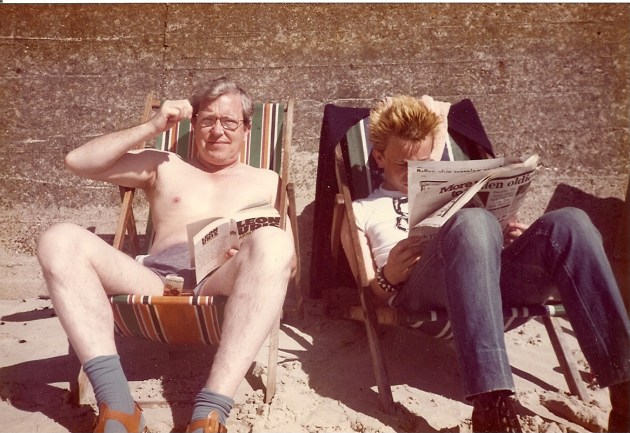
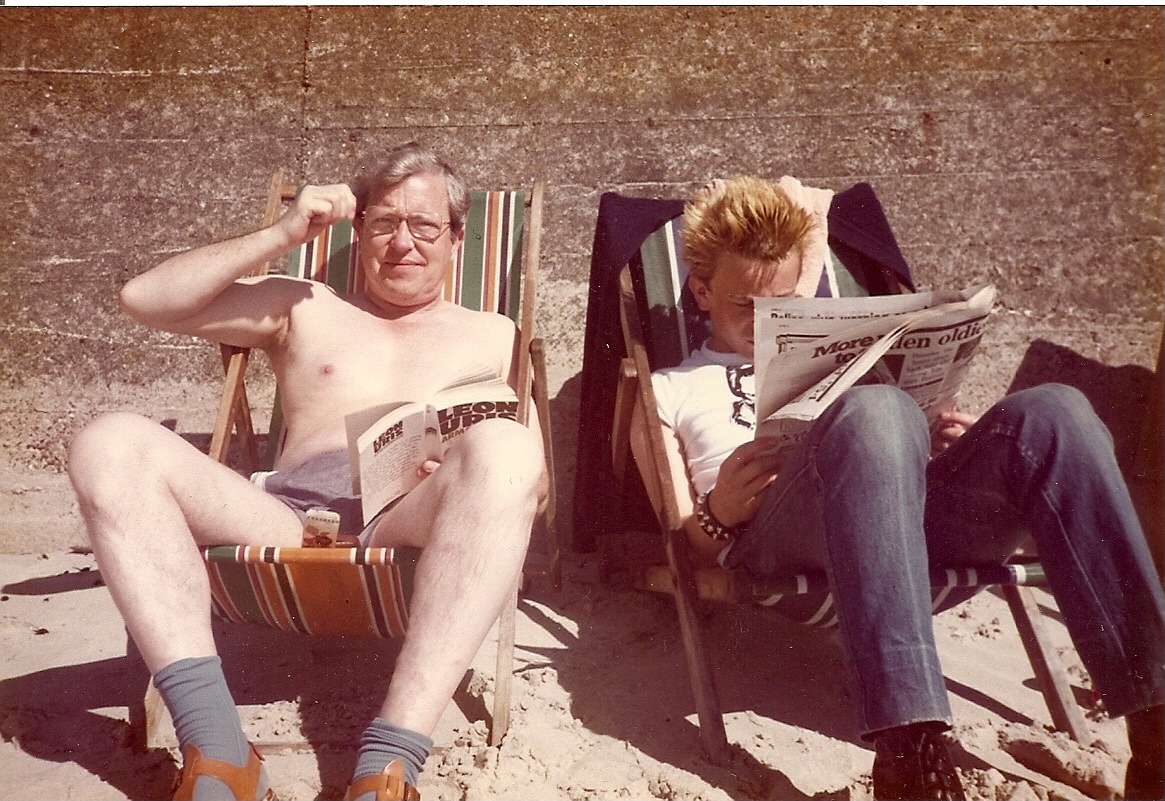
Have just noticed that this picture of me and my stepdad — taken by my mum, in Jersey, back in July 1981 — had been posted on the ISYS (I Saw You Standing) tumblr (This is Me Then, 1 November 2011). He’s rocking the classic socks-and-sandals combo; I’m sporting a punk Charles and Diana T-shirt to “celebrate” the Royal wedding (purchased at the Virgin Megastore on Oxford Street).

Invisible Tradition

Simon Reynolds, “Greil Marcus: A Life in Writing,” The Guardian Saturday 18 February 2012 (Guardian Review p. 12)

At once epic and fragmentary, the book [Lipstick Traces] argues for the Sex Pistols as the culmination of ‘an unheard, invisible tradition’ of apocalyptic protest-poetry stretching back via Situationism and Dada all the way to medieval millenarian sects like the Brethren of the Free Spirit. ‘Johnny Rotten is speaking for himself but all those other voices are in there speaking with him too. All kind of demands on society, on life, on ontology, on epistemology are present in the noise of punk and in that vocal sound, boiled down on to a little 7-inch piece of plastic’.

The Melancholia of Guy the Gorilla

I remember Guy the Gorilla — probably the only real-life ape to ever achieve celebrity status in Britain. In the simian firmament, he’s right up there alongside King Kong, Cheetah, and the PG Tips chimps. A great ape indeed. The poet Philip Larkin used to keep two framed photographs of him — in lieu of the habitual wife and kids — on his desk when he was head librarian at Hull University. Quotations from Goethe and Wilde, pasted on the pictures, seemed to emanate from his gaping mouth like speech bubbles in a comic strip.
To be honest, I hadn’t thought of Guy for a long time, but a documentary about Tony Hancock on BBC Four jogged my memory. It included archive footage of the celebrity primate in his cage, showing off his trademark alpha-male moves. Hancock, we learned, loved going to London Zoo. On one occasion, the keepers even let him slip under the protection barrier so that he could get a closer look at the star attraction. Apparently, he found the experience very moving, which doesn’t surprise me at all. Guy the Gorilla could knuckle-walk with the best of them, but he also had the uncanny ability to stare at the camera as if apeing his human observer’s melancholia.

The last time I visited London Zoo was in the summer of 1977. I remember being shocked by the gory, mutilated corpses of white mice that had been fed to many of the animals on display. I remember observing a Teddy boy with his blonde ponytailed girlfriend. I remember wearing a blue T-shirt laden with with safety pins and badges. I remember reading a review of the Stinky Toys’ first single (which I’d already acquired) in one of the music papers. It was a glorious summer’s day, and we sat at a wooden table, on a wooden bench, outside a cafeteria. I remember the bittersweet fragrance of the sun-warmed wood. I remember relishing the family outing but already feeling — with a sharp pang of regret — that I was outgrowing this sort of thing. I remember sensing that there was pretty much nothing I could do about it.

I can’t remember for sure if we saw Guy the Gorilla that time, but I’m almost certain we didn’t. I still recall the poster that had adorned my bedroom wall, at my mum’s, a few years earlier. It was a full-length portrait framed by a yellow border that almost matched the colour of the wall. By July 1977, Guy the Gorilla was a fading memory; a rolled-up poster in my chest of drawers. The following year, he died of a heart attack during an operation but, for me, he had disappeared on that warm summer’s day when we probably failed to pay him our respects. Seeing my loss mirrored in his liquid eyes would have been heart-rending. He had to be sacrificed.

The Young Parisians

This appeared in the summer 2010 issue of Nude Magazine (issue 16, pp. 40-43):

The Young Parisians

Why don’t you come to Paris with me?
And see the young Parisians’
– “Young Parisians” by Adam and the Ants

‘There’s something very un-British about electronic music,’ says Daniel Miller — founder of Mute Records — in BBC Four’s excellent Synth Britannia documentary. By ‘very un-British’ he means très European — German, of course, but also French. Lest we forget, musique concrète composers like Pierre Schaeffer began their sonic experiments before Stockhausen. Most Continentals in the late 70s were first introduced to synthesizers via Jean-Michel Jarre not Kraftwerk. Métal Urbain — France’s answer to the Sex Pistols — produced their scuzzy rabble-rousing pogobeat on custom-made imitation Moogs at a time when electronic instruments were still usually associated with prog rock dinosaurs. The strong French presence on Angular Records’ recent Cold Waves and Minimal Electronics compilation was generally met with dismay by British music journalists who were blissfully unaware of the existence of a thriving post-punk scene across the Channel (Indochine, a synthpop outfit in the Depeche mode, even became France’s biggest band at one point). Whereas Gallic guitar combos have always been viewed — rightly or wrongly — as derivative vis-à-vis their Anglo-American counterparts, the synth-driven ‘French Touch’ sound was successfully exported ‘around the world’ at the turn of the century. The missing link between the early 80s and late 90s was Denis Quillard, better known as Jacno, who died in November last year at the age of 52 having cemented his country’s love affair with electronic minimalism.

There are times when the past, present and future seem to collide, and one such occasion occurred on 9 February 1977 when Jacno’s band, the Stinky Toys, were invited to a music press junket aboard the eponymous Trans Europe Express coinciding with the release of Kraftwerk’s album. Having a reputation to maintain as the enfants terribles of the local punk scene, the Toys went off the rails, much to the amusement of their more sedate German hosts. Legend has it that singer Elli Medeiros was sick all over the boss of EMI France, who subsequently refused to sign the band to his label and even tried to get them blacklisted. Jacno, however, had caught a glimpse of his musical future. As fate would have it, the train was bound for the Champagne region where he was buried some thirty years later in the vicinity of his family’s impressive country pile.

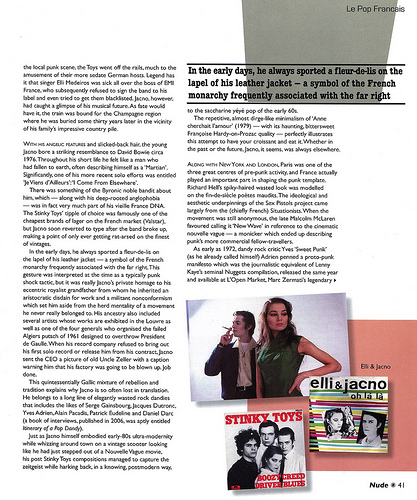
With his angelic features and slicked-back hair, the young Jacno bore a striking resemblance to David Bowie circa 1976. Throughout his short life he felt like a man who had fallen to earth, often describing himself as a ‘Martian’. Significantly, one of his more recent solo efforts was entitled ‘Je viens d’ailleurs’: ‘I Come From Elsewhere’. There was something of the Byronic noble bandit about him, which — along with a deep-rooted anglophobia — was in fact very much part of his vieille France DNA. The Stinky Toys’ tipple of choice was famously one of the cheapest brands of lager on the French market (Valstar), but Jacno soon reverted to type after the band broke up, making a point of only ever getting rat-arsed on the finest of vintages. In the early days, he always sported a fleur-de-lis on the lapel of his leather jacket — a symbol of the French monarchy frequently associated with the far right. This gesture was interpreted at the time as a typically punk shock tactic, but it was really Jacno’s private homage to his eccentric royalist grandfather from whom he inherited an aristocratic disdain for work and a militant nonconformism which set him aside from the herd mentality of a movement he never really belonged to. His ancestry also included several artists whose works are exhibited in the Louvre as well as one of the four generals who organised the failed Algiers putsch of 1961 designed to overthrow President de Gaulle. When his record company refused to bring out his first solo record or release him from his contract, Jacno sent the CEO a picture of old Uncle Zeller with a caption warning him that his factory was going to be blown up. Job done.

This quintessentially Gallic mixture of rebellion and tradition explains why Jacno is so often lost in translation. He belongs to a long line of elegantly wasted rock dandies that includes the likes of Serge Gainsbourg, Jacques Dutronc, Yves Adrien, Alain Pacadis, Patrick Eudeline and Daniel Darc (a book of interviews, published in 2006, was aptly entitled Itinerary of a Pop Dandy). Just as Jacno himself embodied early-80s ultra-modernity while whizzing around town on a vintage scooter looking like he had just stepped out of a Nouvelle Vague movie, his post-Stinky Toys compositions managed to capture the zeitgeist while harking back, in a knowing, postmodern way, to the saccharine yéyé pop of the early 60s. The repetitive, almost dirge-like minimalism of ‘Anne cherchait l’amour’ (1979) — with its haunting, bittersweet Françoise Hardy-on-Prozac quality — perfectly illustrates this attempt to have your croissant and eat it. Whether in the past or the future, Jacno, it seems, was always elsewhere.

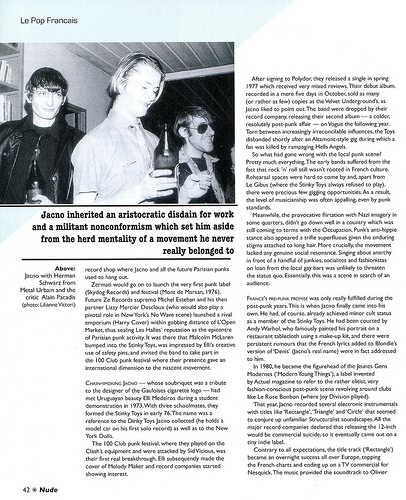
Along with New York and London, Paris was one of the three great centres of pre-punk activity, and France played an important part in shaping the punk template. Richard Hell’s spiky-haired wasted look was modelled on the fin-de-siècle poètes maudits. The ideological and aesthetic underpinnings of the Sex Pistols project came largely from the (chiefly French) Situationists. When the movement was still anonymous, the late Malcolm McLaren favoured calling it ‘New Wave’ in reference to the cinematic Nouvelle Vague — a monicker which ended up describing punk’s more commercial fellow-travellers. As early as 1972, dandy rock critic Yves ‘Sweet Punk’ Adrien (as he already called himself) penned a proto-punk manifesto which was the journalistic equivalent of Lenny Kaye’s seminal Nuggets compilation, released the same year and available at L’Open Market, Marc Zermati’s legendary record shop where Jacno and all the future Parisian punks used to hang out. Zermati would go on to launch the very first punk label (Skydog Records) and festival (Mont-de-Marsan, 1976). Future Ze Records supremo Michel Esteban and his then partner Lizzy Mercier Descloux (who would also play a pivotal role in New York’s No Wave scene) launched a rival emporium (Harry Cover) within gobbing distance of L’Open Market, thus sealing Les Halles’ reputation as the epicentre of Parisian punk activity. It was there that Malcolm McLaren bumped into the Stinky Toys, was impressed by Elli’s creative use of safety pins, and invited the band to take part in the 100 Club punk festival where their presence gave an international dimension to the nascent movement.

Chain-smoking Jacno — whose soubriquet was a tribute to the designer of the Gauloises cigarettes logo — had met Uruguayan beauty Elli Medeiros during a student demonstration in 1973. With three schoolmates, they formed the Stinky Toys in early 76. The name was a reference to the Dinky Toys Jacno collected (he holds a model car on his first solo record) as well as to the New York Dolls. The 100 Club punk festival, where they played on the Clash’s equipment and were attacked by Sid Vicious, was their first real breakthrough. Elli subsequently made the cover of Melody Maker and record companies started showing interest. After signing to Polydor, they released a single in spring 1977 which received very mixed reviews. Their debut album, recorded in a mere five days in October, sold as many (or rather as few) copies as the Velvet Underground’s, as Jacno liked to point out. The band were dropped by their record company, releasing their second album — a colder, resolutely post-punk affair — on Vogue the following year. Torn between increasingly irreconcilable influences, the Toys disbanded shortly after an Altamont-style gig during which a fan was killed by rampaging Hell’s Angels.

So what had gone wrong with the local punk scene? Pretty much everything. The early bands suffered from the fact that rock’n’roll still wasn’t rooted in French culture. Rehearsal spaces were hard to come by and, apart from Le Gibus (where the Stinky Toys always refused to play), there were precious few gigging opportunities. As a result, the level of musicianship was often appalling, even by punk standards. Meanwhile, the provocative flirtation with Nazi imagery in some quarters didn’t go down well in a country which was still coming to terms with the Occupation. Punk’s anti-hippie stance also appeared a trifle superfluous given the enduring stigma attached to long hair. More crucially, the movement lacked any genuine social resonance. Singing about anarchy in front of a handful of junkies, socialites and fashionistas on loan from the local gay bars was unlikely to threaten the status quo. Essentially, this was a scene in search of an audience.

France’s pre-punk promise was only really fulfilled during the post-punk years. This is when Jacno finally came into his own. He had, of course, already achieved minor cult status as a member of the Stinky Toys. He had been courted by Andy Warhol, who famously painted his portrait on a restaurant tablecloth using a make-up kit, and there were persistent rumours that the French lyrics added to Blondie’s version of ‘Denis’ (Jacno’s real name) were in fact addressed to him. In 1980, he became the figurehead of the Jeunes Gens Modernes (‘Modern Young Things’), a label invented by Actuel magazine to refer to the rather elitist, very fashion-conscious post-punk scene revolving around clubs like Le Rose Bonbon (where Joy Division played). That year, Jacno recorded several electronic instrumentals with titles like ‘Rectangle,’ ‘Triangle’ and ‘Circle’ that seemed to conjure up unfamiliar Structuralist soundscapes. All the major record companies declared that releasing the 12-inch would be commercial suicide, so it eventually came out on a tiny indie label. Contrary to all expectations, the title track (‘Rectangle’) became an overnight success all over Europe, topping the French charts and ending up on a TV commercial for Nesquick. The music provided the soundtrack to Olivier Assayas’s first short film (Copyright) in which Elli Medeiros made her debut performance as an actress. Assayas also shot a video for ‘Rectangle’ which shows Jacno playing against the suitably angular, brutalist background of the La Défense area of Paris. The only track on the record that wasn’t an instrumental — the aforementioned ‘Anne cherchait l’amour’ — was sung by Elli. It marked the beginning of Elli & Jacno who provided a blueprint for countless other synth-based duos like Soft Cell and Yazoo, and sold millions of records until they split up in 1984 having written the soundtrack to Eric Rohmer’s Les Nuits de la pleine lune.

Elli would go on to have a couple of massive solo hits in 86-87 before concentrating on her acting career and family life. She made a musical comeback in 2006. Jacno, meanwhile, released six solo albums and produced work by some of France’s greatest stars like Jacques Higelin or Etienne Daho, an early fan of the Stinky Toys. He will always be remembered, however, as the New Wave Erik Satie whose elegant electronic minuets (as Rohmer once described them) seemed to capture the essence of our adolescence. ‘True life,’ as Rimbaud once put it, ‘is elsewhere.’ That is, as ever, where Jacno is to be found.

****

Ten of the best first wave punk bands from over the Channel

Métal Urbain
Think Sex Pistols crossed with Suicide or Throbbing Gristle — or both. Hardcore political lyrics. Their second single was Rough Trade’s first release. Best track: ‘Panik’.

Asphalt Jungle
Fronted by dandy rock critic-cum-novelist Patrick Eudeline. Talked the talk but seldom walked the walk except on their third single, ‘Polly Magoo,’ which sounds like a gang of inebriated football hooligans rutting with Phil Spector. In a good way.

Starshooter
They hailed from Lyon, played a mean live set, had a sense of humour and were solidly working class unlike most of their bourgeois contemporaries. Good mates with the Damned. Listen to: ‘Macho’.

Marie et les Garçons
Also from Lyon. Heavily influenced by the NYC scene at first, then experimented with a disco crossover thang. Second single produced by John Cale. They had a female drummer (the eponymous Marie) who died in the 90s. Top track: ‘Re-Bop’.

Guilty Razors
Famous for singing in pigeon English (‘Provocate,’ ‘I Don’t Wanna Be a Rich’!). Two of their members were of Spanish origin. They were very close to the Slits. Check out: ‘I Don’t Wanna Be a Rich’.

Gazoline
Having been a failed teenybop heartthrob in the 60s, a failed glam rock star in the early 70s and a successful gay cabaret artist, Alain Kan reinvented himself as a punk rocker. His band was named after a group of militant drag queens from the early gay liberation days. Kan disappeared in 1990; no one has seen or heard from him since. Gazoline’s second single is arguably one of the most convincing punk records to ever come out of France. Best track: ‘Radio flic’.

Les Olivensteins
Started later than most of the others and paved the way for the hardcore of the early 80s (Oberkampf, Bérurier Noir et al.). One of their most provocative lyrics described the Vichy regime as the good old days. Their name came from a psychiatrist famous for his anti-drugs crusade. Like Sham 69, they ended up attracting the wrong element and split up. Top track: ‘Fier de ne rien faire’.

1984
On paper, a kind of dystopian Clash but never fulfilled their promise. Listen to: ‘Salted City’.

Les Lou’s
All-girl band managed at one stage by Bernie Rhodes. Highlight: ‘Back on the Street’.

Electric Callas
A flamboyant Bowie/Iggy fanatic from Lyon backed by a dizzying array of line-up changes. Check out: ‘Kill Me Two Times’.

All the Latest

The summer 2010 issue of the brilliant Nude Magazine (issue 16) is out now, and it contains an article by yours truly about Jacno, the founder of the Stinky Toys who went on to become a pioneer of French electropop:

“A look back at the too short life of Denis Quillard (aka Jacno), the artistocratic pop dandy, former Stinky Toy and pioneer of French electronic music.”

The Moors Murderers

The history of The Moors Murderers, the phantom punk band that included Chrissie Hynde and Steve Strange.

In June 1977, Soo Catwoman announced that she was starting a band called the Moors Muderers: “The Moors Murderers thing was a big joke to be honest. I was joking about getting a band together called the Moors Murderers and doing sleazy love songs, I had no idea he [Steve Strange] would actually go out and do it. …” Strange claimed to be part of a band called the Moors Murderers in order to do a photo shoot for German magazine Bravo. Catwoman says she was also present but left the shoot. Steve Strange may have played a gig with The Photons under the Moors Murderers monicker supporting The Slits at an NSPCC benefit concert at Ari Up’s school in Holland Park circa Christmas 1977. After the gig, Steve Strange asked Dave Goodman (who had worked with the Pistols and Eater) to produce their song “Free Hindley”. On 8 January 1978, The Sunday Mirror published a piece on the band (“Why Must They Be So Cruel?”) based on an interview which had taken place at Goodman’s office in Fulham. The four band members were wearing pillow cases on their heads. According to Goodman, they included Strange, Chrissie Hynde and Nick Holmes (Eater’s roadie who is believed to have played guitar on “Free Hindley”).

In mid-January 1978, the Moors Murderers featured in Sounds, wearing bin liners over their heads. They played a few songs for the journalist (“Free Hindley“, “Caviar and Chips”, “Mary Bell” and “The Streets of the East End”). Following the Sounds showcase, the band played the Roxy on 13 January 1978, supporting Open Sore. Steve Strange was on vocals (calling himself Steve Brady) and Hynde was on guitar. Bob Kylie (Open Sore): “They were terrible! Absolutely dreadful!” On 28 January 1978, Strange told Sounds that he had left the band.

The Moors Murderers probably never released a record, but some tracks seem to have been recorded.

16143357_598616780344171_769462397323570243_n