Concrete Expression As Decadence

Mario Praz, The Romantic Agony

The essence of Romanticism consequently comes to consist in that which cannot be described. The word and the form, says Schlegel in Lucinde, are only accessories. The essential is the thought and the poetic image, and these are rendered possible only in a passive state. The Romantic exalts the artist who does not give a material form to his dreams — the poet ecstatic in front of a forever blank page, the musician who listens to the prodigious concerts of his soul without attempting to translate them into notes. It is romantic to consider concrete expression as a decadence, a contamination. How many times has the magic of the ineffable been celebrated, from Keats, with his
Heard melodies are sweet, but those unheard
Are sweeter. . . .
to Maeterlinck, with his theory that silence is more musical than any sound!

The Nothingness Lying Behind It

David Winters, “Transparency by Marek Bieńczyk,” The Quarterly Conversation 28 (4 June 2012)

[…] Bieńczyk’s concern is with “the connections between transparency and the expressible.” The time he covers spans from Aristotle (for whom, as he quotes, “there is only transparency,” as an underlying reality) to the present, where science has superseded such notions, yet where they’re nevertheless necessary, “since the heart of man changes more slowly than the world.” An archetypally heartfelt expression comes from Jean-Jacques Rousseau, in whose Confessions Bieńczyk discerns a desire for transparent speech; for a clear voice which would make the soul perfectly present to itself:

Rousseau believed that the heart of man could speak . . . he saw how language could become a transparent medium for the will of speech, for everything that wishes to be expressed . . . with no secrets and no depths to be fathomed or understood.

[…] But Bieńczyk’s literary history touches on another tradition, which unites an assortment of writers under the sign of

the shared striving for pure light in their texts, their striving for emptiness, for silence . . . their abandoning of the real, the concrete, the perceptible, the living, in favour of the motionless, the fading, the falling silent.

Such striving can be both formal and thematic — as in Beckett, for instance (whom Bieńczyk doesn’t discuss) or Barthes or Blanchot (whom he does). As a theme, it’s best represented by the Polish novelist Andrzej Stasiuk, whose books describe “landscapes with minimal human activity.” Stasiuk focuses on a world where “life has either not gotten going, or has already been extinguished.” Here transparency is, as in Aristotle, “the idea organizing the cosmos” — it sits in the background, the field on which existence occurs. But beyond this, Bieńczyk reminds us, there are writers who treat transparency in terms of textual form. This brings to mind Beckett’s letter to Axel Kaun, which likens language to “a veil one has to tear apart in order to get to . . . the nothingness lying behind it.” Bieńczyk’s lineage links several figures whose language “flirts with silence,” from Chateaubriand to Joubert. In each, he highlights an impulse he calls “negative idealism.” Yet this phrase doesn’t denote mere nihilism. Like the melancholic upward gaze, transparency here reaches beyond a quiet acceptance of the real. After all, as Bieńczyk avers, “if life has its own utopia, perhaps nothingness does too.” […]
A Book of Absolute Whiteness

Ulises Carrión, “The New Art of Making Books,” Kontexts no. 6-7, 1975

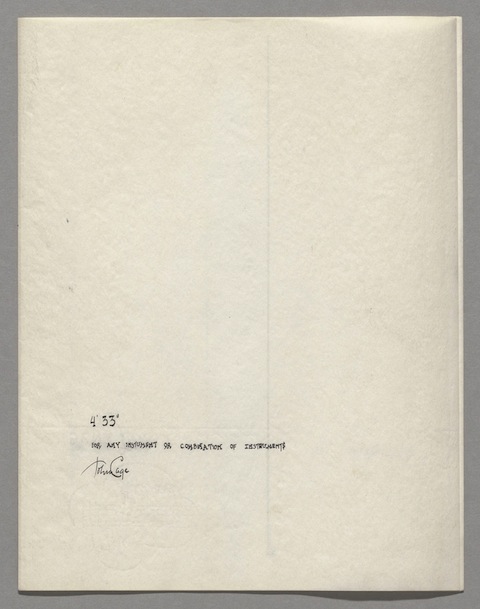
The most beautiful and perfect book in the world is a book with only blank pages, in the same way that the most complete language is that which lies beyond all that the words of a man can say. Every book of the new art is searching after that book of absolute whiteness, in the same way that every poem searches for silence.

The Sound of Thinking

MG: …And in your latest novel, C, you talk a lot about static: you call it ‘the sound of thinking’.
TMC: Yes. That’s where Serge, the hero, is listening to the radio. But there’s another bit in that book where he’s playing a record and he lets it run on after it’s finished to listen to the static at the end, and he hears a huge amount of information in all that silence.
Tom McCarthy and Margarita Gluzberg, “Circuits and Loops,” BOMBlog 4 May 2012

On the Edge of Self-Erasure

Iain Sinclair, Review of Night Thoughts: The Surreal Life of the Poet David Gascoyne, by Robert Fraser, The Guardian (Guardian Review, p. 7) 31 March 2012:

…Without labouring the thesis, he [Robert Fraser] manages to suggest that Gascoyne’s lifelong interest in conspiracy, covert sexuality, the occult, is an extension of the rituals and disguises of London suburbia. Poems, on the edge of self-erasure, fret over the impulse that pushes them towards publication and exposure. The visionary poet, a Christian existentialist, was prolific in his silences. He contrived enough white space for others to mythologise a consistently aborted career. He traded in the distance between his own reluctant muse and the conviction and swagger of the great ones he sought out, echoed and honoured.

…Gascoyne’s rescue, his return to life in the suburban house on the Isle of Wight, was brokered by two remarkable people. Judy Lewis, a vet’s estranged wife, who read his “September Sun: 1947” to a depressed group at Whitecroft Hospital, provoked the previously mute writer to speech. “I am the poet.” “Yes, dear. I’m sure you are.” But it was true. He was the poet and it was always 1947. He became a living quotation recovered from a midden of fragments: “All our trash to cinders bring.”