
“All literature carries exile within it… Bartleby, who prefers not to, is an absolute exile, an alien on planet Earth.”
– Roberto Bolaño, “Exiles,” Between Parentheses: Essays, Articles and Speeches (1998–2003)
“All literature carries exile within it… Bartleby, who prefers not to, is an absolute exile, an alien on planet Earth.”
– Roberto Bolaño, “Exiles,” Between Parentheses: Essays, Articles and Speeches (1998–2003)
EM Cioran, Exercices d’admiration (Anathemas and Admirations), 1986
We are increasingly interested not in what an author says but in what he may have meant, not in his actions but in his projects, less in his actual work than in the work he dreamed of. If Mallarmé intrigues us, it is because he fulfills the conditions of the writer who is unrealised in relation to the disproportionate ideal he has assigned himself… We are adepts of the work that is aborted, abandoned halfway through, impossible to complete, undermined by its very requirements. The strange thing in this case is that the work was not even begun, for of the book, that rival of the universe, there remains virtually no revealing clue; it is doubtful that its structure was outlined in the notes Mallarmé destroyed, those that have survived being unworthy of our attention. Mallarmé: an impulse of thought, a thought that was never actualised, that snagged itself on the potential, on the unreal, disengaged from all actions, superior to all objects, even to all concepts — an expectation of thought.

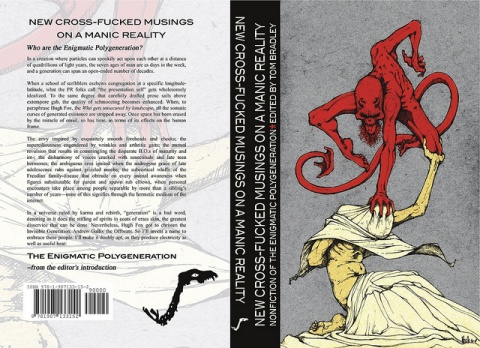
Darran Anderson briefly mentions “Dr Martens’ Bouncing Souls” in his review of the New Cross-Fucked Musings on a Manic Reality anthology (edited by Tom Bradley). He describes the story as “a bruising but graceful play on language, violence and cocksmanship,” which just about sums it up. (The review appeared in 3:AM Magazine on 27 October 2011.)
My piece on the late Jacno — “The Young Parisians” — features in Bare Essentials: The Best of Nude Magazine 2003-2011 (pp. 114-117).

A slightly different version* of this story was published online by The White Review on 22 September 2011.

Celesteville’s Burning
Zut, zut, zut, zut
– Marcel Proust, A la recherche du temps perdu
Sostène Zanzibar was not feeling himself that day; someone else was. A journalist from an English paper. Name of Phyllidia. Or possibly Petronella. Something along those lines. The interview had gone remarkably well. Such probing questions. Very stimulating, very in-depth. There was no denying that Sienna — or possibly Serena — was thoroughly a young woman. Hang on, cross that out. Was a thorough young woman. Very thorough indeed.
In a bid to impress her host, she had taken up gesticulation with all the fervour of a new convert. It was a joy to behold. Her impeccably-manicured hands would suddenly flutter away from the warmth of her lap, describing graceful ellipses as if trying to conjure up words that could not possibly exist. Ever. In any language. Even French.
When the ink ran out of her biro, Zanzibar produced a pencil from his inside pocket with a little flourish. ‘Men,’ he said, ‘alwez ave two penceuls.’ He almost winked, but thought better of it. ‘Women,’ she said a little later, sitting on his face, wearing nothing but her high-heeled boots, ‘always have two pairs of lips.’ She almost added Try these on for size, big boy, but thought better of it too.
Allegra — or possibly Anushka — had struggled to fully comprehend the answers to some (if not most) of her questions. The fact that the former usually bore little (if any) relation to the latter did not help. Neither did Zanzibar’s scattergun delivery nor his baffling habit of peppering his sentences with arcane references to Heidegger and Blanchot. Whenever he switched to pigeon English, he sounded like Jacques Derrida dubbed by Inspector Clouseau, which proved an even greater source of confusion. Of course, now that she was grinding her crotch against his salient features, that his nose kept popping in and out of her prize orifices, Zanzibar’s discourse was largely inaudible anyway. This was as it should be. She wanted to move beyond surface meaning, to experience his words at a more physical — and yet more spiritual — level. That of muffled stubble-mumbles. Warm, moist exhalations. Visceral verbal vibrations. Epic poems licked on to her clitoris, one labial consonant at a time.
Candida — or possibly Chlamydia — tried in vain to decipher the text that was presently being lapped on to her nether regions. She had long removed her horn-rimmed glasses (just before shaking her hair loose), squinting was unbecoming, the letters were upside down, Zanzibar’s tonguewriting — famously dismissed as ‘chicken-scratch squiggles’ by a one-night-stand graphologist — was indeed diabolical and, frankly, the spelling mistakes were doing her head in. It began to dawn on her that, although patently the recipient of this work in progress, she may not be its target audience. In fact, she was now convinced that she was not. Oh no. She was a mouthpiece. A conduit. An instrument. A sounding-board. A relay point. A mediator between the General Reading Public (GRP) and some obscure creative power within Zanzibar that was now being channelled through her. She felt frightfully oracular — a proper little Pythia — and more than a little empowered by the impulses her firm, nubile body was adding in to the mix. These impulses were barely perceptible, but they were definitely there amid all the crosstalk, crackle, static, dribble and thermal noise distorting the transmitted data. She closed her eyes and pictured dozens of snails leaving letter-shaped trails — crinkly slivers of silver — all over her cunt, like so many miniature calligraphers. Now the snails were topsy-turvy, à la bourguignonne, a bubbling mixture of parsley and breadcrumbs oozing from their exposed buttery apertures. Now the snails had morphed into winkles, clustered around her labia minora, in homage to Zanzibar’s controversial debut.
Published in late 1986, Je suis la Femme Bigorneau was a succès de scandale which took the literary establishment by storm; a cause célèbre that turned Zanzibar overnight into the enfant terrible of French letters. Like Leos Carax’s film Mauvais sang, also released at the end of that year, it seemed to capture the zeitgeist and polarise opinion along a generational fault line. Louis Pauwels, editor of Le Figaro Magazine, claimed the novella was a perfect illustration of the ‘mental AIDS’ afflicting the nation’s youth. ‘Makes Schopenhauer sound positively chipper,’ wrote Josyanne Savigneau in her full-page rave review for Le Monde. ‘The kind of book that exists on the slippery cusp between pure genius and utter rubbish,’ wrote a critic at Le Matin de Paris. ‘Bof!’ Philippe Sollers is reported to have said, when sounded on the subject, mid-pied de porc farci grillé, at Brasserie Lipp. Zanzibar was all over the gossip columns too. He dated Béatrice Dalle (who had recently starred in Betty Blue), wrote a song for Etienne Daho, appeared in a video with Les Rita Mitsouko (playing the glockenspiel), spent his nights at the ultra chic Bains Douches nightclub and was headbutted by Jean d’Ormesson during Apostrophes, the highly influential TV show. His parents — René and Monique — told Actuel that they had always known, deep down, that Sostène was special. ‘On sentait bien qu’il allait devenir artiste ou écrivain,’ said his mum. ‘C’était vraiment un chieur,’ his father concurred. They confided that they had done their level best to make him as miserable as possible throughout his childhood so as to provide him with a lifetime of neuroses that would feed his future creative endeavours. ‘N’empêche qu’on a drôlement bien réussi notre coup,’ said René, beaming with paternal pride: it was the gift that keeps giving. Zanzibar, however, was overwhelmed by his new-found notoriety. Béatrice Dalle soon left him and he started dabbling in too many drugs. Rumour has it that he could drink the likes of Serge Gainsbourg, Antoine Blondin or Alain Pacadis under the table — literally in the latter’s case. His next three books were minor bestsellers, and one of them was even turned into a film with Juliette Binoche (La Bonniche, 1991), but Zanzibar was never able to replicate the impact of Bigorneau, which he always likened to his seminal first orgasm (1979). Each new novel resembled an increasingly faded photocopy of the original blueprint, giving rise to what Sam Jordison recently described in The Guardian as ‘a sense of perpetual déjà vu on a dimmer switch’. Bref, his work seemed condemned to a gradual, but irreversible, running down; a depletion of vital energy that implied a dismal future of erectile dysfunction, hair loss and growing inertia.
Angela — or possibly Nigella — glanced at the twit beneath her twat. She recalled how her heart had sunk upon entering the spacious study where the interview would take place. The fabled author was standing at the far end of the room admiring a framed photomontage of a lady with a Morphy Richards iron in lieu of a head. His cat — Erwin — was rubbing himself against his calves in the most wanton fashion. A rebours, Zanzibar’s rampant alopecia made him look like Kojak with a beard growing on the wrong side of his face. To be honest, she would have been hard pressed to say which of these visions was most unsettling. It was as if she had been shown the gates of Paradise only to be denied entrance by some burly bouncer with a gold medallion, a Brummie accent, a bad case of halitosis and a mullet. Covered in dandruff.
The journalist’s black Moleskin notebook lay open, face down, on the coffee table. After an hour or so, weighty topics had been dropped in favour of increasingly flirtatious small talk. Zanzibar got up to refill her glass and, instinctively, she got up too and now they were kissing, deep and slow, their tongues going round and round like the ground bass number in the background, and he gently lifted up her summer frock as the melody soared over the looping bassline, and their bodies were grinding, their tongues intertwining, her head spinning and she found herself reclining — à la bourguignonne — in a Le Corbusier-style chaise longue. ‘J’aime quand ça s’incarne,’ she whispered, drawing him into her buttery aperture with her long legs that he wore over his shoulders in the manner of a sweater casually knotted around a Continental neck. Leaning on her forearms, she tilted her head back, closed her eyes and bit her lip. A slow intake of breath — like a deep drag on a cigarette — subsided into a faint, low-pitched moan, not dissimilar to the sound a puppy makes when kicked.
Suddenly, Zanzibar was all at sea in an endless desert of snow. The ghostly whiteness of her teeth — which he instantly interpreted as Melvillian with Malevichian overtones — sent shivers down his spine, as though the absence it seemed to materialise mirrored his own. Her whole body, he now sensed with each new caress, was designed to frame the void, which, otherwise, would remain invisible — white on white.
His heart was pounding; he was perspiring profusely and his penis had shrivelled up like a salted snail. In order to get his bearings, he endeavoured to recall the journalist’s bloody name once and for all. It could have been Gemma. Or even Emma, for all he knew. Unless, of course, it was Linda. Or Belinda — he would not have put it past her, the little minx. Luella rang a bell — as did Annabella. Not to mention Tamsin and Tamara; Imogen and Iphgenia. It was on the tip of his tongue… Got it! Tippi. Ah, Tippi, Tippi, Tippi. Ze tip of ze tongue taking a trip of two steps down ze palate… Or was it Trixie? Calliope? Suki, Sadie — Parthenope?…
When he was toing, her face appeared blank and featureless: totally inscrutable. When he was froing, it seemed to run the emotional gamut from mild surprise to utter boredom in quick succession. There was either too little or too much information to process. Worlds, he felt, were splitting. Splitting all the time.
All you could hear now was a serving spoon squelching its way through a bowl of pasta. Whatsherface had long stopped biting her lip and her body had grown so limp that he began wondering if she was not asleep, in a coma, or even dead. The thought did cross his mind. Then, she started convulsing and screaming as though she were being torn asunder: ‘Sostène, where are you? Where are you, Sostène? Reviens! Reviens, Sostène! Sostène, reviens! SOSTEEEENE! SOSTEEEEEEEENE!’
‘Thanks,’ she said, upon leaving. Zanzibar stared at the outstretched hand last seen clasping his erect penis. ‘For having me?’ she added by way of explanation, but the high-rising terminal transformed her statement into a question. A final probing question that she left dangling like one of Fat Pat’s earrings as she departed with a toss of hair and a rustle of chiffon. She was marching past the cat who, curled up on a beanbag, did not even bother to look up. She was making her way down the transparent spiral staircase that seemed — like her — to be wound around nothing. Zanzibar just stood there, in the doorway, buffeted by the fragrant breeze she had generated. With closed eyes, he breathed in a lungful of her absence and just stood there. He just stood there, caught in her slipstream. Winded, he just stood there. He just stood there. ‘Putain!’ he muttered and finally closed the door.
****
Bearing a striking resemblance to Ursula Andress (had she been immortalised by Botticelli), the presidential candidate emerged from the sea to spontaneous cries of ‘Vive la République!’. She was naked save for a tricolor sash — ‘Un rien m’habille’ — that bisected the perkiest pair of Delacrucian tits to have ever stalked Le Touquet Plage. ‘Tu vois, là,’ said a young father to his son, ‘ce sont les deux mammelles de la France.’ As he pointed, tears welled up in his grateful eyes. Everything would be all right now. Everything. The crowd parted and Mme Royal glided by. Majestically. Regally. Eponymously… Photographers had a field day, fireworks were let off, babies were brandished, a brass band struck up the national anthem and, just when he was about to get an eyeful, Zanzibar found himself back home in his bathroom. He was standing in front of the mirror, trying to remove his contact lenses, which (as he would discover after plucking out an eyeball) he had forgotten to put in. The eye he was now staring at, and that stared back at him intermittently as he rolled it around in the palm of his hand, resembled a large white egg with a black dot inside — or rather the drawing of a white egg. The black dot alone contained more atoms than all the penceuls in the world.
****
Zanzibar was seated at one of the little round tables dotting the semicircle of cobbled stones outside the Théâtre de l’Europe. He had opted for the last row, furthest away from the road, with the steps leading up to the theatre right behind him. He was the only one there now, a couple of German tourists having just departed. The sun was shining; birds were chirping in the nearby Luxembourg Gardens: summer was in the air. A waiter — as stylish as he was young — brought over an espresso and a glass of water, which he placed gingerly beside Zanzibar’s copy of Le Monde. They had devoted a whole page to ‘l’affaire Zanzibar’. It was all over the papers, the blogs, the social networks, the news bulletins — both radio and television, local and national. There was no escaping it, and that was precisely why he was seated at one of the little round tables dotting the semicircle of cobbled stones outside the Théâtre de l’Europe.
A 58 bus turned into Rue de l’Odéon. Zanzibar followed its slow progress past the clothes shop where the original Shakespeare and Company used to stand. It stopped outside the pharmacy at the other end, on the other side, where an attractive woman he vaguely recognised — but could not quite place — alighted and started walking back in his general direction. As she crossed the road, he identified her as a celebrity graphologist who had publicly pooh-poohed his legendary lovemaking technique a few months back. Name of Amélie. Or possibly Emilie. Something along those lines. It was she too, he now realised, who had played the part of the presidential candidate in that strange dream that was still haunting him. Thankfully, she had not noticed Zanzibar and picked a table in the second row, next to an olive tree in a square metal pot. With an uncanny sense of apropos, she ordered a kir royal. No sooner had the waiter scuttled away than she proceeded to hitch up her maxi dress until vast swathes of toned thigh were exposed to the warm rays. She completed this pre-prandial routine by crossing her legs and lowering, visor-style, the designer sunglasses that had been sitting pretty on her head, like a tiara. Zanzibar’s beady eyes darted from the rear view of the graphologist to the restaurant facing him on the left, back to the graphologist’s signature legs, and on to the Flammarion building facing him on the right. He repeated this circuit many times with meticulous, almost obsessive, care until the person he was waiting for finally emerged from the building.
Théodule Meuniaire was a thirtysomething publishing whizz-kid with rock star good looks, who — it was an open secret — was largely responsible for reviving Zanzibar’s flagging career. He lingered for a few minutes outside Flammarion, talking to someone on his mobile, apparently in a foreign language (probably English), then walked over to his car (a grey Porsche) that was parked only a few metres away. He opened the door, removed his jacket and hung it on a hook inside. Before closing the door, he hooted twice in brief succession while looking over at the pavement café. He waved. Zanzibar quickly unfolded his paper and hid behind it. Peering over his crumpled copy of Le Monde, he saw the graphologist lift up her sunglasses with one hand and wave back with the other. A broad smile had now lit up her face. She sprinkled a few coins on the table and skipped across the road to join her date. They kissed like models in a Doisneau picture and walked, hand in hand, to La Méditerranée, the plush restaurant with its blue exterior and Cocteau decorations. Once they had disappeared from view, Zanzibar called the waiter and whispered something in his ear. ‘Bien sûr, Monsieur, au-cun problème,’ he said. Zanzibar got up and ran over to examine the grey Porsche. A pair of horn-rimmed glasses taunted him from the leather dashboard where they had been conspicuously displayed. With closed eyes, he breathed in a lungful of absence and just stood there. He just stood there, in front of the grey Porsche with the horn-rimmed glasses on the leather dashboard. For a minute or so, he just stood there. He just stood there. ‘Putain!’ he muttered, before making his way back.
The waiter smiled at him and Zanzibar felt obliged to order another espresso. He checked his emails on his iPhone, then glanced at the latest tweets, most of which revolved around ‘l’Affaire’. He ordered yet another smile-induced coffee and started reading again. After a brief recap, the article focused on the prime-time television show, to be broadcast live that very evening, during which a confrontation between Meuniaire and himself was to take place. Whether it would or not was a moot point, not least because the programme consisted of a series of announcements for nominally forthcoming — but, in reality, constantly deferred — features, followed by lengthy commercial breaks, themselves followed by further announcements, and so on until the closing credits. Although quite taken with the concept of a show that was for ever in the process of becoming, Zanzibar had no intention whatsoever of being party to this masquerade. He was equally determined to ensure his rival did not make it to the studio either, and that was — more precisely — why he was seated at one of the little round tables dotting the semicircle of cobbled stones outside the Théâtre de l’Europe.
He looked up, squinting into the sun as the waiter returned, just in time to see Meuniaire and the graphologist glide past in the grey Porsche with the horn-rimmed glasses on the leather dashboard.
Putain!
****
In 1992, having finally acknowledged that there was little lead in his penceul left, Sostène Zanzibar embarked on an ill-fated prequel to Genesis. Although this grandiose project would occupy him for the best part of two decades, we have precious little to show for it. A few meagre excerpts appeared at irregular intervals in obscure style magazines whose prohibitive cover prices were inversely proportional to their confidential circulations. The rest of this ‘work in regress,’ as he liked to describe it, was destroyed. One night, in November 2008, the author deleted the computer files containing the typescript and burned all the print-outs he had archived over the years. According to legend, he then took a taxi to Denfert-Rochereau, uncovered a manhole and disappeared down the catacombs where he spent the following fortnight listening to the same album over and over again on a battered old ghetto blaster believed to have once belonged to Don Letts.
Franco-Swiss all-girl band Les Péronelles (think Shangri-Las meet Slits) always maintained that they had rounded off their first (and last) album (Trois fois rien, 1983) with a hidden track. ‘L’Arlésienne’ was so well hidden, however, that no one had ever found it. With time, it became the Holy Grail of Franco-Swiss rock criticism. An early issue of Les Inrockuptibles contained a six-page feature (‘A l’écoute de l’inouï’) devoted to this unheard melody. It included interviews with the producer and sound engineer as well as cultural luminaries such as Gérard Genette, Jean Baudrillard, John Cage and assorted roadies.
Listening to this ten-minute stretch of silence over and over again was a Zen-like experience at first. Soon, though, Zanzibar was able to recognise, and even anticipate, every hum, hiss and crackle on the track: its teeny tiny tinny tinnitus quality. The song had to be concealed behind, or perhaps even within, this silence that was not quite silence. It had to. He even thought he could sense its presence in the same, almost physical, way one is always aware of being observed. It was just out of earshot; a mere whisper away.
By the middle of the second week, a melody had emerged from the static and wormed itself into his eardrums. It was the sound of music leaking from a commuter’s headphones on public transport. It was the sound of a distant party carried on the wind of time, ebbing and flowing. It was the sound of mythical monsters plumbing the murky depths of ancient oceans. It was the sound of half a dozen rashers sizzling away like nobody’s business in a big fuck-off frying pan. Above all, it was the sound of a wannabe troglodyte slowly going out of his mind.
By the end of the second week, the melody had disappeared. It had never been there in the first place; not really. Zanzibar, now at his wit’s end, had a rare eureka moment. The ghost track was not concealed behind, or even within, the silence — it was that silence itself. He had been listening to it all along, or rather he had not: all along, he had been listening into it for something else. There was, however, nothing else: no behind or within; no depth or beyond. Zanzibar had finally acceded to a heightened sense of hearing. He was now firmly convinced that this recording of real silence — silence that was not quite silence — constituted, en soi, some kind of irreducible message. Communication stripped back to its bare essentials; atomised — degré zéro.
The author’s discovery could not but chime with his long-standing interest in the many-worlds interpretation of quantum mechanics. Whenever he wrestled with the blank page and the blank page won, Zanzibar would shrug it off as being of little import since it meant, ipso facto, that another version of himself was scribbling away in some parallel universe. Although this explanation was offered in jest, the author started thinking of his alter ego — hard at work on the Great Novel (GN) he was not working on — with increasing regularity. Some would say that these thoughts even blossomed into a beautiful, full-blown obsession.
In the early days, Zanzibar had tried his hand at creatio ex nihilo. Did not work. He then had a go at recreating the world within a whopping great Gesammtkuntswerk. This proved equally unfruitful. The words he used to conjure things up simply recorded their absence, instead of preserving them for all eternity: Evanescence, ou la naissance d’Eva (1992) expressed nothing but itself — if that. Writing something, as opposed to writing about something, seemed to be the way forward — or rather backward, as it implied rediscovering some prelapsarian language that merged with the reality of things. Chemin faisant, as he strived to bridge the gap between signifier and signified, Zanzibar also hoped to recapture some of that old magic which had inspired Bigorneau back in the day: a soupçon of oomph; un peu de welly. In the event, he did neither. Every single volume he ever published had thus been an approximate translation — and ultimately a failed instantiation — of the ideal book in his head. Were his novels, then, simply intimations or imitations of his other self’s works: dim echoes, pale copies? Were they inferior versions of the masterpieces his doppelgänger could come up with given half the chance? Zanzibar thought long and hard about all this, finally electing to stop writing in order to let his more talented likeness — whom he pictured as slightly better-endowed and -looking than himself — get on with it.
Flammarion ruthlessly exploited Zanzibar’s disappearance by encouraging the hypothesis of a suicide. Meuniaire claimed on television that this, après tout, would only be in keeping with his ‘fundamentally nihilistic outlook’. Arthur Cravan and Jacques Rigaut were frequently invoked by literary journalists in support of this argument. As a result, Zanzibar’s back catalogue flew off the shelves, with Bigorneau topping the bestseller lists once again. Of course, the second stage of this cunning marketing strategy — i.e. cashing in on Zanzibar’s miraculous reappearance by bringing out a new book asap — was jeopardised by the author’s decision to down penceuls. Meuniaire was promptly dispatched to resolve this delicate problem. As expected, Zanzibar adopted a hardline position (‘C’est une question de principe, un point c’est tout!’) but proved far more amenable as soon as Flammarion threatened to sue his sorry ass. A compromise was finally thrashed out between the two parties, down at Les Deux Magots, where many a bottle of Perrier-Jouët was downed almost cul sec. Zanzibar, who had always tried and failed to convey the inadequacy of words with words, came up with the concept of a novel printed with disappearing ink. Once read, each word would vanish for ever, the full text living on in people’s minds — retold, reinterpreted, reinvented… ‘There’s no such thing as original fiction,’ he said, a little worse for wear, ‘Novels can’t be set in stone.’ He climbed on the table and began chanting, ‘Li-bé-rez le texte! Li-bé-rez le texte!’ After a few phone calls, Meuniaire put a damper on proceedings: the project was too complex to pull off from a technical point of view, and would be far too expensive anyway. So it was back to the drawing board: ‘Une autre bouteille, s’il vous plaît!’ They finally decided that Zanzibar would write an entire novel in longhand, using disappearing ink, and that Flammarion would publish a facsimile of the manuscript — blank page after blank page: ‘Garçon, une autre bouteille!’ What better way to say something without saying it? ‘Allez hop, on fête ça, une autre bouteille!’ What better way to express the idea that the writer has nothing to express? ‘Vous nous remettrez la même chose.’ In between hiccups, Zanzibar explained that his blank book would bear no relation whatsoever to any of the blank books that had ever been published in the past. It would not be a gimmick, a joke, a provocation, a protest or even an artistic gesture — although there would be an element of all those things. His ‘post-literary’ blank pages would not be identical to your ‘non- or pre-literary’ common-or-garden, run-of-the-mill blank pages of the bog-standard variety: they would somehow retain traces of the novel that had once graced them. He then spoke confusedly of palimpsests and the tradition of erasure in contemporary poetry; the word biffure was used thrice. When he started claiming that the absent text would be a kind of manifestation, en creux, of the Great Novel (GN) his other self was composing in a parallel universe, Meuniaire decided to call it a day. It was probably that night, as he was walking home to clear his head that he resolved to publish Le Roman invisible under his own name. Two grown men — intellectuals! French ones, at that! — claiming rights to a blank book was bound to make the front pages. It also made Meuniaire shitloads of money as Le Roman invisible became the must-have accessory of that rentrée littéraire. Suddenly, it was incontournable and, paradoxically, everywhere to be seen. The fact that it doubled up as a handy memo pad turned it into a top seller in the run-up to Christmas too. With the royalties, Meuniaire treated himself to a luxury yacht worthy of a Russian oligarch. He called it Authorship (en anglais dans le texte).
****
A laundry van stopped outside the Michelet Odéon hotel. The words Maison Binger were painted on the side in quaint curlicue letters. A young man in a crisp beige uniform jumped out, leaving the door wide open. Zanzibar made a wild dash for it. The keys were in the ignition; the driver was talking to a pretty receptionist: the race was on.
The van picked up speed, crushing the asphalt beneath its burning wheels, like a shirt-collar under a Morphy Richards. Meuniaire’s grey Porsche was still only a dot in the distance, but it was growing bigger by the second. It contained more atoms than all the penceuls in the world. Soon, those atoms would be spilled all over the leather dashboard and horn-rimmed glasses like chicken-scratch squiggles. Zanzibar was already living in the future. He could see it all, now, with blinding clarity. The shattered glass. The chromium twisted into the shape of Byzantine rings. The gory action painting on the tarmac. The charred corpses in their chariot of fire. He was hunched over the steering wheel, headbutting the windshield, laughing manically, whooping and hollering, with the wind in his combover and imaginary music blaring away in his ears. Four cars now separated him from his prey. He was closing in.
Just as he was about to go for the kill, the grey Porsche lurched into the outside lane. A sudden but steady — and, indeed, uninterrupted — flow of traffic prevented Zanzibar from giving chase. This being Paris, no one saw fit to let him go: steaming ahead was a woman’s prerogative and a man’s virility test. To make matters worse, the cars in his lane had now ground to a halt in what seemed like the mother of all tailbacks. Those on the left-hand side, however, continued to race past as if taking part in a dry run for Le Mans. Watching them whizz by made him a little drowsy after a while. Feeling his eyes glaze over, he stretched, and noticed two large white eggs with black dots inside. The eyes belonged to the Michelin Man who was towering above him benignly from a billboard. Zanzibar fell asleep and was transported back to the tiny village in Bourgogne where he spent his summer holidays as a child. His grandparents’ house with the dark-green shutters and, across the road, the plot of land where his grandfather grew tomatoes and carrots and beans. Halfway up the hill, there was a water pump that looked like an obscene squat robot with a chunky, phallic-looking spout. It said POMPES LEMAIRE and TOURNEZ LENTEMENT (although there was no water in it) and it was green, but a lighter shade than the shutters. On the same side, further up, when you had almost reached the top, there was a little convenience store — the only one for miles. People used to go there to give and receive telephone calls. At the other end of the village, there was a big barn, and on the door of this barn there was an advertisement with the Michelin Man. It was already old and faded by the early 70s. Going back there, he thought, now waking up and rubbing his eyes, would be a little like visiting the setting of his past following the detonation of a neutron bomb. Zanzibar looked up at the billboard again, and it was at this juncture that he realised that there was no driver in the car in front. And none in the one in front of that. And so on. All along, he had been stuck behind a line of fucking parked cars.
Night was beginning to fall. He wondered how long it would take to drive back to the past, and if the Michelin Man would still be waiting for him there.
[*Zanzibar’s cat was called Schrödinger (instead of Erwin) in the White Review version and Pat Evans has become Fat Pat]
Illustration by Max McLaughlin.
Herman Melville, Moby Dick; or, The Whale, Los Angeles Review of Books, 1851
Wonderfullest things are ever the unmentionable…
A new story, entitled “Celesteville’s Burning“, was posted on The White Review‘s site this morning. It’s an extract from a novel I’m working on. You’ll find a teaser below.
“… Allegra – or possibly Anushka – had struggled to fully comprehend the answers to some (if not most) of her questions. The fact that the former usually bore little (if any) relation to the latter did not help. Neither did Zanzibar’s scattergun delivery nor his baffling habit of peppering his sentences with arcane references to Heidegger and Blanchot. Whenever he switched to pigeon English, he sounded like Jacques Derrida dubbed by Inspector Clouseau, which proved an even greater source of confusion. Of course, now that she was grinding her crotch against his salient features, that his nose kept popping in and out of her prize orifices, Zanzibar’s discourse was largely inaudible anyway. This was as it should be. She wanted to move beyond surface meaning, to experience his words at a more physical — and yet more spiritual — level. That of muffled stubble-mumbles. Warm, moist exhalations. Visceral verbal vibrations. Epic poems licked on to her clitoris, one labial consonant at a time. …”
Read the whole story here.
Kenneth Goldsmith, “It’s Not Plagiarism. In the Digital Age, It’s ‘Repurposing’,” The Chronicle of Higher Education 11 September 2011 (an extract from Goldsmith’s Uncreative Writing):
In 1969 the conceptual artist Douglas Huebler wrote, “The world is full of objects, more or less interesting; I do not wish to add any more.” I’ve come to embrace Huebler’s idea, though it might be retooled as: “The world is full of texts, more or less interesting; I do not wish to add any more.”
It seems an appropriate response to a new condition in writing: With an unprecedented amount of available text, our problem is not needing to write more of it; instead, we must learn to negotiate the vast quantity that exists. How I make my way through this thicket of information—how I manage it, parse it, organize and distribute it—is what distinguishes my writing from yours.
The prominent literary critic Marjorie Perloff has recently begun using the term “unoriginal genius” to describe this tendency emerging in literature. Her idea is that, because of changes brought on by technology and the Internet, our notion of the genius — a romantic, isolated figure — is outdated. An updated notion of genius would have to center around one’s mastery of information and its dissemination. Perloff has coined another term, “moving information,” to signify both the act of pushing language around as well as the act of being emotionally moved by that process. She posits that today’s writer resembles more a programmer than a tortured genius, brilliantly conceptualizing, constructing, executing, and maintaining a writing machine.
Perloff’s notion of unoriginal genius should not be seen merely as a theoretical conceit but rather as a realized writing practice, one that dates back to the early part of the 20th century, embodying an ethos in which the construction or conception of a text is as important as what the text says or does. Think, for example, of the collated, note-taking practice of Walter Benjamin’s Arcades Project or the mathematically driven constraint-based works by Oulipo, a group of writers and mathematicians.
[…] Over the past five years, we have seen a retyping of Jack Kerouac’s On the Road in its entirety, a page a day, every day, on a blog for a year; an appropriation of the complete text of a day’s copy of The New York Times published as a 900-page book; a list poem that is nothing more than reframing a listing of stores from a shopping-mall directory into a poetic form; an impoverished writer who has taken every credit-card application sent to him and bound them into an 800-page print-on-demand book so costly that he can’t afford a copy; a poet who has parsed the text of an entire 19th-century book on grammar according to its own methods, even down to the book’s index; a lawyer who re-presents the legal briefs of her day job as poetry in their entirety without changing a word; another writer who spends her days at the British Library copying down the first verse of Dante’s Inferno from every English translation that the library possesses, one after another, page after page, until she exhausts the library’s supply; a writing team that scoops status updates off social-networking sites and assigns them to the names of deceased writers (“Jonathan Swift has got tix to the Wranglers game tonight”), creating an epic, never-ending work of poetry that rewrites itself as frequently as Facebook pages are updated; and an entire movement of writing, called Flarf, that is based on grabbing the worst of Google search results: the more offensive, the more ridiculous, the more outrageous, the better.
These writers are language hoarders; their projects are epic, mirroring the gargantuan scale of textuality on the Internet. […]
There’s been an explosion of writers employing strategies of copying and appropriation over the past few years, with the computer encouraging writers to mimic its workings. When cutting and pasting are integral to the writing process, it would be mad to imagine that writers wouldn’t exploit these functions in extreme ways that weren’t intended by their creators. […]
While home computers have been around for about two decades, and people have been cutting and pasting all that time, it’s the sheer penetration and saturation of broadband that makes the harvesting of masses of language easy and tempting. On a dial-up, although it was possible to copy and paste words, in the beginning texts were doled out one screen at a time. And even though it was text, the load time was still considerable. With broadband, the spigot runs 24/7.
By comparison, there was nothing native to typewriting that encouraged the replication of texts. It was slow and laborious to do so. Later, after you had finished writing, you could make all the copies you wanted on a Xerox machine. As a result, there was a tremendous amount of 20th-century postwriting print-based detournement: William S. Burroughs’s cutups and fold-ins and Bob Cobbing’s distressed mimeographed poems are prominent examples. The previous forms of borrowing in literature, collage, and pastiche — taking a word from here, a sentence from there — were developed based on the amount of labor involved. Having to manually retype or hand-copy an entire book on a typewriter is one thing; cutting and pasting an entire book with three keystrokes — select all / copy / paste — is another.
Clearly this is setting the stage for a literary revolution.
Or is it? From the looks of it, most writing proceeds as if the Internet had never happened. The literary world still gets regularly scandalized by age-old bouts of fraudulence, plagiarism, and hoaxes in ways that would make, say, the art, music, computing, or science worlds chuckle with disbelief.
Imagine all the pains that could have been avoided had Frey or Leroy taken a Koonsian tack from the outset and admitted that their strategy was one of embellishment, with dashes of inauthenticity, falseness, and unoriginality thrown in. But no.
[…] Nearly a century ago, the art world put to rest conventional notions of originality and replication with the gestures of Marcel Duchamp’s ready-mades, Francis Picabia’s mechanical drawings, and Walter Benjamin’s oft-quoted essay “The Work of Art in the Age of Mechanical Reproduction.” […]
In 1959 the poet and artist Brion Gysin claimed that writing was 50 years behind painting. He might still be right: In the art world, since Impressionism, the avant-garde has been the mainstream. Innovation and risk taking have been consistently rewarded. But, in spite of the successes of modernism, literature has remained on two parallel tracks, the mainstream and the avant-garde, with the two rarely intersecting. Now the conditions of digital culture have unexpectedly forced a collision, scrambling the once-sure footing of both camps. Suddenly we all find ourselves in the same boat, grappling with new questions concerning authorship, originality, and the way meaning is forged.
An extract from “The House Plans” from The Collected Stories of Lydia Davis (2009):
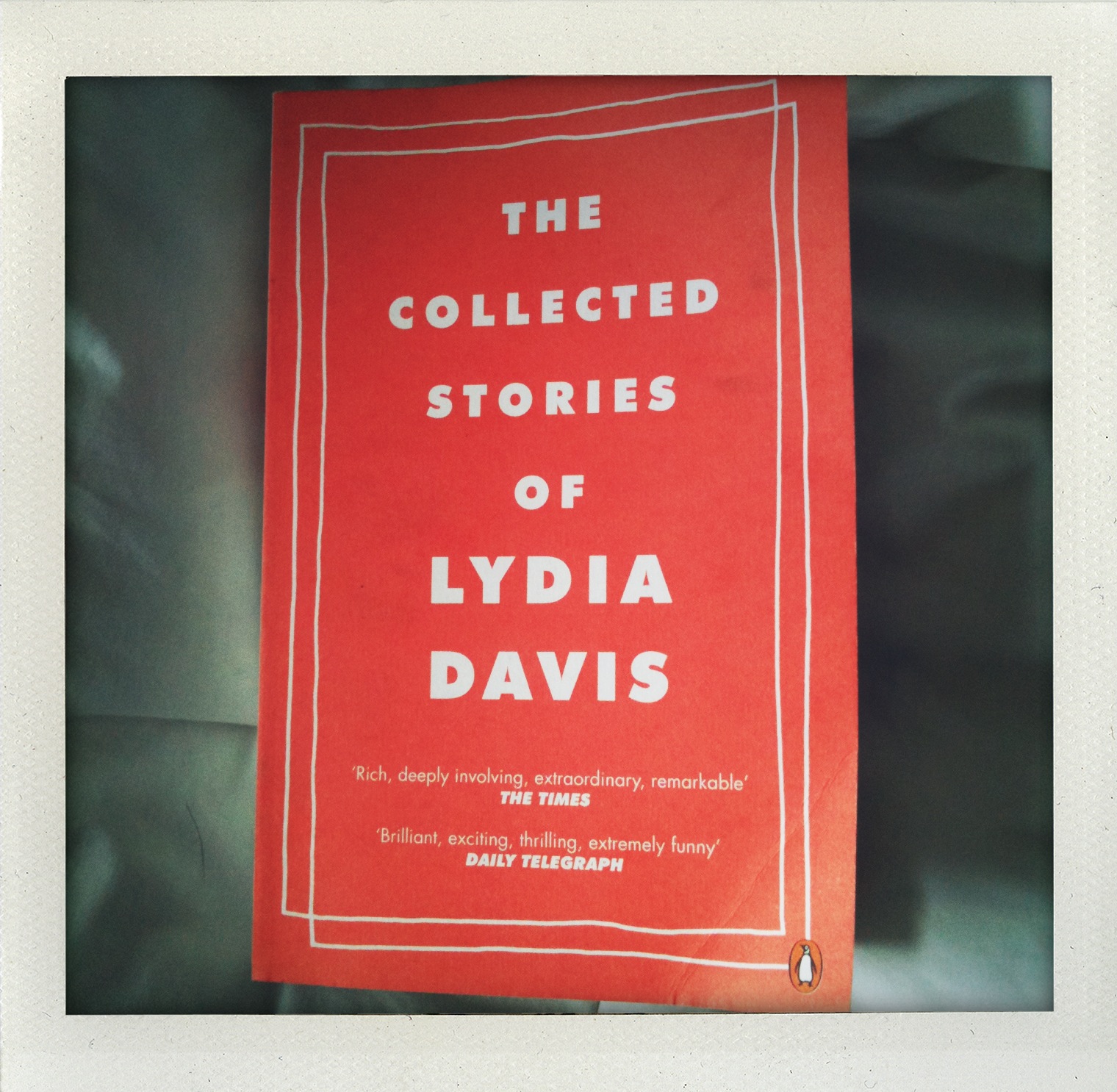
In the beginning, my blueprint had absorbed all my time and attention because I was going to build the house from it. Gradually, the blueprint became more vivid to me than the actual house: in my imagination, I spent more and more time among the pencilled lines that shifted at my will. Yet if I had openly admitted that there was no longer any possibility of building this house, the blueprint would have lost its meaning. So I continued to believe in the house, while all the time the possibility of building it eroded steadily from under my belief.
This appeared in The Guardian’s Comment is Free section on 20 July 2011:
From Jonnie Marbles to the Yippies: A History of Pie Activism
The attack on Rupert Murdoch is part of a tradition of patisserie activism — but shaving foam is no substitute for the real thing

[Nöel Godin, political custard pie thrower. Photograph: Van Parys/Corbis]
Jonathan May-Bowles (aka Jonnie Marbles), who attacked Rupert Murdoch during yesterday’s phone-hacking hearing, has all the makings of a formidable flan flinger. In his capacity as comedian-cum-activist, he embodies a kind of Platonic ideal of patisserie terrorism – that strange interface between slapstick and protest.
Pie-throwing as a political gesture has its roots in the Groucho-Marxism of the 1960s student uprisings and, more specifically, in the prankish happenings of the Yippies. Tom Forçade, the founder of High Times magazine, is usually considered to have perpetrated the very first political pie crime in 1970. Aron Kay, who came to be known as “The Yippie Pie Man”, followed suit, covering countless politicians and celebrities (including the mayor of New York City and Andy Warhol) in cream, between the late 1970s and early 1990s. Yesterday, he allegedly posted a message on a website giving his full support to May-Bowles: “Murdoch definitely needed a pie, for sure.” However, it was a Belgian anarchist who really put “patisserie guerrilla” on the map. One could argue that he even managed to turn it into an art form.
In the late 60s, Nöel Godin was, among other things, a film critic who amused himself by reviewing movies he hadn’t seen or that didn’t even exist. Georges Le Gloupier, a fictitious film director (invented by his partner in crime Jean-Pierre Bouyxou), made regular appearances in these reviews.
In 1969, Godin wrote that Le Gloupier had been so outraged by Robert Bresson‘s latest film that he had felt compelled to chuck a “Mack Sennett-style” pie smack in the director’s face. In a sequel, he went on to describe how the French novelist Marguerite Duras had avenged the initial “creamy affront” by giving Le Gloupier an impromptu pastry pasting while he was dining out in Saint-Germain-des-Prés. “Madame,” said the biter bit after licking his frothy chops, “I prefer your patisserie to your novels.”
Through some quirk of fate, the publication of the second article coincided with Madame Duras’s arrival in Belgium on a promotional tour. This proved a godsend to Godin, who decided to give a final twist to this burlesque saga. He ambushed the prime exponent of the “empty novel” and treated her to a real custard pie this time round. A visiting card was nestling in the incredible, edible weapon. It read: “With the compliments of Le Gloupier.”
The seminal Duras drubbing provided a blueprint for all the subsequent pie attacks. A few months later, it was choreographer Maurice Béjart‘s turn to fall victim to a Chantilly crime. By that time, Le Gloupier had acquired all his distinctive features: the refined dinner jacket and bow tie of gentleman-burglar Arsène Lupin, the false beard and spectacles of a cartoon, bomb-throwing anarchist and, last but not least, the absurd “gloup! gloup!” mantra. In the time-honoured tradition of Galatea, Pinocchio and sundry gingerbread men legging it after rising from the pastry board, Le Gloupier took on a life of his own: he started popping up all over the place, unbeknown to his creator, who was often associated with attacks he had taken no part in, but was only too willing to take credit for.
According to Godin, a well-aimed pie can break through the victim’s public image and lay bare his true character. New Wave director Jean-Luc Godard, for instance, reacted in good-humoured fashion and refused to press charges. By contrast, Bernard-Henri Lévy reacted violently and was flanned on at least five occasions as a result. The vendetta against the pop philosopher turned into a running gag in France.
The movement probably peaked in 1998, with the pieing of Bill Gates. Godin had now become a celebrity in his own right, and was frequently invited on live TV shows to be pied by presenters he had himself pied. The whole thing was descending into farce. However, the website of Godin’s “Internationale pâtissière” continues to advertise the latest pie attacks on a monthly, and sometimes even weekly, basis. The pieing of Murdoch could well be the sign of a revival.
Jonathan May-Bowles still has a thing or two to learn, though. A plateful of shaving foam is no substitute for the real thing. Godin once told the Observer: “We only use the finest patisserie ordered at the last minute from small local bakers. Quality is everything. If things go wrong, we eat them.”
****
Here is a longer (unpublished) version of the same piece:
Jonathan May-Bowles, who attacked Rupert Murdoch during yesterday’s phone-hacking hearing, has all the makings of a formidable flan flinger. In his capacity as comedian-cum-activist, he embodies a kind of Platonic ideal of patisserie terrorism — that strange interface between slapstick and protest. Pity, then, that he didn’t take a leaf out of Mack Sennett‘s book: “A mother never gets hit with a custard pie,” warned the Hollywood director, who knew a thing or two about the use of confectionery as weaponry, “Mothers-in-law, yes. But mothers? Never”. Old men are also a no-no, even if they happen to be at the head of an evil international media conglomerate. Pieing is always a difficult balancing act, a subtle blend of humour and anger, and in this case the first, vital ingredient was sorely lacking. Like the pie itself — a plateful of shaving foam — it wasn’t the real thing. Instead of shattering the spectacle (in Situationist parlance), May-Bowles has simply provided a perfect photo opportunity illustrating the metaphorical humble pie that Murdoch was already eating. Worse still, the media mogul may come out of this looking like the victim.
Pie-throwing as a political gesture has its roots in the Groucho-Marxism of the 60s student uprisings and, more specifically, in the prankish happenings of the Yippies in the United States. Tom Forçade, the founder of High Times magazine, is usually considered to have perpetrated the very first political pie crime in 1970. Aron Kay, who came to be known as “The Yippie Pie Man”, followed suit, covering countless politicians and celebrities (including the mayor of New York City and Andy Warhol) in cream, between the late 70s and early 90s. Yesterday, he allegedly posted a message on a website giving his full support to May-Bowles: “Murdoch definitely needed a pie, for sure!” However, it was Belgian anarchist Noël Godin who really put “patisserie guerrilla” on the map. One could argue that he even managed to turn it into an art form.
Like Aron Kay, Godin was influenced by the slapstick of the Three Stoges and the political ferment of 1968, but he also drew inspiration from the insurrectionary humour of late nineteenth-century French anarcho-pranksters like the Hydropathes or the Zutistes, to whom he paid homage in his anthology of radical subversion (Anthologie de la subversion carabinée, 1988).
In the late 60s, Godin was, among other things, a film critic who amused himself by reviewing movies he hadn’t seen or that didn’t even exist. Georges Le Gloupier, a fictitious film director (invented by his partner in crime Jean-Pierre Bouyxou), made regular appearances in these reviews. In1969, Godin wrote that Le Gloupier had been so outraged by Robert Bresson’s latest film, that he had felt compelled to chuck a “Mack Sennett-style” pie smack in the director’s face. In a sequel worthy of one of Joe Orton’s classic epistolary pranks, he went on to describe how the French novelist Marguerite Duras had avenged the initial “creamy affront” by giving Le Gloupier an impromptu pastry pasting while he was dining out in Saint-Germain-des-Prés. “Madame,” said the biter bit after licking his frothy chops, “I prefer your patisserie to your novels”. Through some quirk of fate, the publication of the second article coincided with Mme Duras’s arrival in Belgium on a promotional tour. This proved a godsend to Godin. The affair was causing so much fuss that the novelist was immediately forced to hold a press conference during which she repeatedly denied all prior knowledge of “Le Gloutier” (sic). Godin decided to give a final twist to this burlesque saga, thus illustrating Wilde’s dictum that life imitates art. He ambushed the prime exponent of the “empty novel,” and treated her to a real custard pie this time round. A visiting card was nestling in the incredible, edible weapon. It read: “With the compliments of Le Gloupier”.
The seminal Duras drubbing provided a blueprint for all the subsequent pie attacks. Le Gloupier’s metamorphosis into a latter-day noble bandit figure had occured overnight. A few months later, it was choreographer Maurice Béjart’s turn to fall victim to a chantilly crime. By that time, Le Gloupier had acquired all his distinctive features: the refined dinner jacket and bow tie of gentleman-cambrioleur Arsène Lupin, the false beard and spectacles of a cartoon, bomb-throwing anarchist and, last but not least, the absurd “gloup! gloup!” slogan. In the time-honoured tradition of Galatea, Pinocchio and sundry gingerbread men legging it after rising from the pastry board, Le Gloupier took on a life of his own, popping up all over the place, unbeknown to his creator, who was sometimes associated with attacks he had taken no part in, but was only too willing to take credit for.
According to Godin, custard pies are the weapons of “the weak and powerless” (L.A. Times). A well-aimed pie can shatter the pompous and vacuous public image of a celebrity in a matter of seconds. Le Gloupier’s targets (politicians, journalists, actors, pop stars, writers) are never selected at random (“Every victim has to be thoroughly justified,” The Observer) and his weapons are chosen with the same meticulous care (“We only use the finest patisserie ordered at the last minute from small local bakers. Quality is everything. If things go wrong, we eat them”). Pseudo-philosopher Bernard-Henri Lévy was flanned on five different occasions because he was “totally in love with himself” and epitomized “empty, vanity-filled literature”.
According to Godin, a well-aimed pie can break through the victim’s public image and lay bare his true character. New Wave director Jean-Luc Godard, for instance, reacted in good-humoured fashion and refused to press charges. By contrast, Bernard-Henri Lévy reacted violently and was flanned on at least five occasions as a result. The vendetta against the pop philosopher turned into a running gag in France.
The movement probably peaked in 1998, with the pieing of Bill Gates. Godin had now become a celebrity in his own right, and was frequently invited on live TV shows to be pied by presenters he had himself pied. The whole thing was descending into farce. However, the website of Godin’s “Internationale pâtissière” continues to advertise the latest pie attacks on a monthly, and sometimes even weekly, basis. The pieing of Murdoch could well be the sign of a revival.
Jonathan May-Bowles still has a thing or two to learn, though. A plateful of shaving foam is no substitute for the real thing. Godin once told the Observer: “We only use the finest patisserie ordered at the last minute from small local bakers. Quality is everything. If things go wrong, we eat them.”
 ANDREW GALLIX