A Writing Against Itself

Andrew Gallix, “Go Forth (Vol. 4)” by Nicolle Elizabeth, The Believer Logger 14 November 2012

Andrew Gallix is editor-in-chief of 3:AM Magazine, which the Guardian credits as technically the first literary blog ever. He writes fiction and criticism, edits books, and teaches at the Sorbonne, and I love him.

NICOLLE ELIZABETH: What is 3:AM, and how did it start?

ANDREW GALLIX: 3:AM is one of the oldest literary webzines out there, as it was launched in April 2000. We were among the first to make use of the international dimension of the web: the founder was American, our first webmaster was Canadian, and the rest of the team was located in Britain, France, Ireland and the US. We were the first, or one of the first, to launch a literary blog (if by that you mean a compendium of literary news links). We innovated by placing fiction in a wider cultural (artistic, in particular musical) context. We also pioneered the revival of live literary events in London, mixing music, art, and spoken word.

NE: This is a collective thing?

AG: Very much so. The whole point of 3:AM was to foster a community of literary loners; to create a space where we can be alone together.

NE: Print ever or no?

AG: Two anthologies of 3:AM short stories (edited by Andrew Stevens) have been published, but the magazine itself is online-only. I think we were also pioneers from that point of view: we realized that online publications were the way forward. They cost virtually nothing, which means that only literary/artistic criteria apply, instead of financial considerations. There are no space constraints (a piece can be as long or as short as it needs to be). You can reach so many more readers than if you publish a story in a small literary journal. Christiana Spens has just launched 3:AM Press, which releases both ebooks and limited print editions, showing our attachment to both formats.

NE: Main concerns ethically?

AG: There is no party line, although we are rather contrarian, hence our tagline (a nod to Groucho Marx, the Ramones, and Adorno): “Whatever it is, we’re against it.” It sounds rather pedantic, I know, but what I consider to be real literature is always, at some level, a writing against itself.

NE: Main concerns aesthetically?

AG: Once again, 3:AM is a very broad anti-church. Personally, I think we should publish fiction that has the inevitability of death.

NE: What advice do you have for those who wish to start a magazine?

AG: Don’t give up the day job.

NE: Anything else you’d like to tell us here?

AG: Sure, but only things which cannot be told.

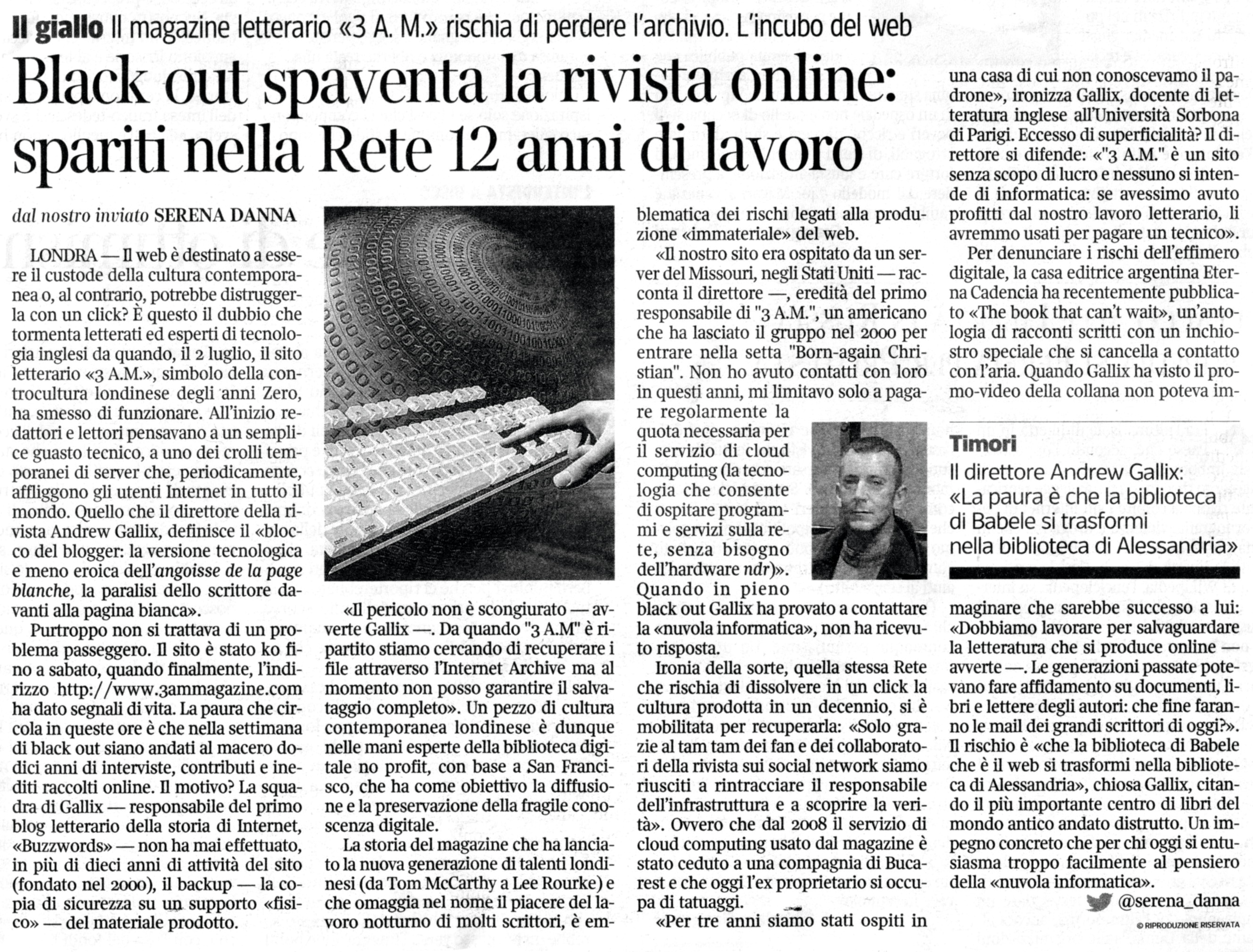
Italian Blackout

Serena Danna, “Black out spaventa la rivista online: spariti nella Rete 12 anni di lavoro,” Corriere della Sera 11 July 2012: 29.

A larger version of this newspaper cutting can be found here.

A few selected extracts:
“[…] il sito letterario 3:AM, simbolo della controcultura londinese degli anni Zero […] il direttore della rivista Andrew Gallix, definisce il “bloco del blogger: la versione tecnologica e meno eroica dell’angoisse de la page blanche, la paralisi dello scrittore davanti alla pagina bianca”. […] La squadra di Gallix — responsabile del primo blog letterario di Internet, “Buzzwords” […] La storia del magazine che ha lanciato la nuova generazione di talenti londinesi (da Tom McCarthy a Lee Rourke) e che omaggia nel nome il piacere del lavoro notturno di molti scrittori, è emblematica dei rischi legati alla produzione “immateriale” del web. […] “Per tre anni siamo stati ospiti in una casa di cui non conoscevamo il padrone”, ironizza Gallix, docente di letteratura inglese all’Università Sorbona di Parigi. Eccesso di superficialità? Il direttore si difende: “3:AM è un sito senza scopo di lucro e nessuno si intende di informatica: se avessimo avuto profitti dal nostro lavoro letterario, li avremmo usati per pagare un tecnico”. […] Quando Gallix ha visto il promo-video della collana non poteva imaginare che sarebbe successo a lui: “Dobbiamo lavorare per salvaguardare la letteratura che si produce online — avverte —. Le generazioni passate potevano fare affidamento su documenti, libri e lettere degli autori: che fine farano le mail dei grandi scrittori di oggi?”. Il rischio è “che la biblioteca di Babele che è il web si transformi nella biblioteca di Alessandria”, chiosa Gallix, citando il più importante centro di libri del mondo antico andato distrutto […]”

Digital Vanishing Act

Edward Champion, “3:AM Magazine — How Twelve Years of Literary Content Disappeared in an Instant,” Reluctant Habits 6 July 2012

3:AM Magazine, the first literary magazine to champion Tom McCarthy’s work and a pioneering avant vanguard that had published the early work of Tao Lin, Tony O’Neill, and Ben Myers, had vanished in an instant, with the hosting company seemingly disappearing along with it. While a substantial chunk of the magazine’s content was still available through the Internet Archive’s Wayback Machine, there was no backup. And according to editor-in-chief Andrew Gallix, the site was held together by little more than “a doctored WordPress system”.

“It never occurred to me that our server could just be switched off without a word of warning and that the owner would do a runner!” wrote Gallix to me by email. Gallix’s efforts earlier in the week to reach the host were unsuccessful. Emails bounced. The phone had been disconnected. Gallix hadn’t received so much as a notice that his valiant magazine was disconnected and no longer in service.

While Gallix had used another host for a site dedicated to McCarthy’s work, he never switched 3:AM over during the twelve years he ran the site. He had a full-time day job. He wanted to read and he wanted to write. If the server crapped out, it would find a way to resurface after a time. “I kept postponing the move in the hope that things would improve,” said Gallix.

There was no reason for Gallix to worry. Because he had experienced very few problems. “The site was down on some occasions,” said Gallix, “sometimes just for a couple of hours; at worst for a whole day: there didn’t seem to be any real cause for concern”.

* * *

3:AM began, as many literary magazines begin, with a short story. Gallix started corresponding with an American named Kent Wilson, and a website was born. 3:AM Magazine, initially a static site comprised of a handful of stories, was founded in 1999. But Wilson had an unanticipated spiritual awakening. And 3:AM, which abided by the motto “Whatever it is, we’re against it,” didn’t fit into these mysterious ways. Wilson asked Gallix to take over 3:AM in April 2000.

“We were the first to really make use of the global dimension of the web,” said Gallix. “All the editors and contributors met online, and it was only after that some of us became friends in real life”.

This commitment to friendship and passion sustained a literary magazine with a distinct and inimical tone. “While in the middle of a feverish pawing at the back-clip of her bra,” begins one typically edgy and entertaining story around this time, “I did not think much of her whispering in my ear that she could not stay for the night because she had to go home feed Satan”.

But as long as the website continued to work, Gallix didn’t rue over the technical logistics. Wilson had given Gallix the name of a host: RMIhost.com, which was run by Reece Marketing Inc. Reece Marketing Inc. was a one man operation run by Brandon Reece. And when I tracked Reece down by telephone on Friday afternoon, he told me that he was stunned that someone was still using it.

“We haven’t done hosting for four or five years,” said Reece, who sounded somewhat surprised at the news that 3:AM had vanished. “I haven’t hosted anybody’s site since 2008.”

Gallix informed me later in the afternoon that he had paid an annual hosting fee, but it was unclear whether someone had taken over from Reece. He received an email every year asking to pay for the next year. So what was RMIhost.com?

“That’s all still up there,” replied Reece. “It’s not doing any business.”

Reece claimed to not know anything about 3:AM Magazine. He said his company had once specialized in website design and had operated out of Dallas. “It was never a successful side company,” said Reece.

Reece recalled a guy named Kent when I asked him. He identified a “born again Christian,” and confirmed that this was Kent Wilson when I provided the surname. But Reece didn’t appear to know what Wilson had given him. Was it possible that he wasn’t even paying attention to RMIHost?

“I don’t ever remember hosting 3:AM Magazine,” said Reece. “I think I would know.”

Reece referred to “a server admin in Bucharest” — a gentleman named Florin — who he promised to email tonight. When I asked Reece if RMIhost had leased any particular server, he seemed baffled.

“DNS,” said Reece. “I haven’t done anything like this in a while.”

Reece was busy “looking for something new right now”. He intimated that he was in a transition period and that the hosting company had been more of an unprofitable sideline. These days, he was living on savings.

“I don’t trust my personal expertise,” said Reece when I asked him about his technical chops. “I don’t even know how to do that myself. You forget everything you do.” But he did promise to get on the case by Monday. He also allowed me to pass along his contact information to Gallix.

As for Gallix, he informed me that he had tech people retrieving what they could off the Internet Archive. But even if 3:AM manages to extract the content, he’s unsure about what “more reliable and reputable host” he’ll offload his content onto. The experience revealed to Gallix “the fragility of online content”.

It remains unclear whether Reece was playing dumb or acting in good faith. But he was willing to pass along his contact info to Gallix, even after I informed him of the significant online outcry that had followed 3:AM‘s server outage. And these efforts do represent a step in the right direction to preserve 3:AM‘s vast archive.

No matter how the 3:AM predicament works out — and there are positive signs that it will — preserving online work may very well be as dangerous as other historical precedents. Or as Tom McCarthy, reached on holiday, declared to me upon learning the news, “My first reaction is: ALEXANDRIA!”

[7/6/2012 6:45 PM UPDATE: As of 6:45 PM EST, 3:AM Magzine has been restored. Many thanks to all who helped out with this story and to Mr. Reece for following through with his promise.]

Delete

Nick Clark, “Web Hits Delete on Magazine’s 12-Year Archive,” The Independent 6 July 2012

When avant-garde literary website 3:AM Magazine went down a week ago, staff hoped it would be up and running within the day.

But they now fear that 12 years of archived material — every article they have published — may be lost for ever after it emerged those responsible for the site’s servers have vanished.

Andrew Gallix, editor-in-chief, told The Independent that the events of the past week have been “traumatic” and highlighted the “the fragility of online content”.

He added: “I never expected those who were meant to host and back up our content to just switch us off without even telling us.”

Messages of support flooded in from Facebook and Twitter for one of the original book blogs. One reader wrote: “Twelve years of writing, vanished. Here’s hoping it’s able to continue somehow.”

Mr Gallix has run the site since 2000, with the literary webzine attracting acclaimed writers including Lee Rourke, Tony O’Neill and Booker Prize nominee Tom McCarthy.

[…] As for 3:AM, Mr Gallix is trying to track down the person responsible for the servers. After a few false leads, as well as a disconnected phone and emails bouncing back, he believes he has tracked him down.

“At this stage, we do not know if we’ll ever be able to speak to him and if he can switch his server back on long enough to allow us to move 12 years’ worth of content to another, more reliable host,” Mr Gallix said. “I should have backed it up somewhere else, but it never occurred to me.”

All the Latest

Have just noticed that this picture of me and my stepdad — taken by my mum, in Jersey, back in July 1981 — had been posted on the ISYS (I Saw You Standing) tumblr (This is Me Then, 1 November 2011). He’s rocking the classic socks-and-sandals combo; I’m sporting a punk Charles and Diana T-shirt to “celebrate” the Royal wedding (purchased at the Virgin Megastore on Oxford Street).

The Expatriate Literary Scene in Paris

Anthony Cuthbertson, “From the Lost to the Beat to Now,” Notes From the Underground 19 November 2010

The expatriate literary scene in Paris

What Allen Ginsberg called, ‘The bewildering beauty of Paris’ has attracted writers and artists for centuries. It has been the setting of great novels and the home of great writers, and in the last hundred years has briefly been the stage for two waves of expatriate writers that changed the face of modern literature: the Lost Generation and the Beat Generation. Fifty years have passed since the latter faded away, and though the expatriate literary scene has remained vibrant, no significant movement has since emerged. However, with the arrival of new soirées, literary journals, writers’ workshops and readings, as well as a fresh generation of writers flocking to Paris, a new wave may well be rolling in.

Historically, Paris has been a place of refuge for artists and writers. It has attracted political and cultural exiles fleeing the injustice and intolerance of their homelands, offering them a liberal safe haven and allowing them artistic freedom. In the 1920’s and 1950’s it became a place of escape for those left disenfranchised by the World Wars. The Génération perdue, as Gertrude Stein named them, included writers like Ernest Hemingway, Ezra Pound, F. Scott Fitzgerald, T.S. Eliot, and later James Joyce and Samuel Beckett. They were a generation disillusioned by the horrors they had witnessed in the First World War, and who felt disaffected and betrayed by their governments back home. Pound wrote of his contemporaries, ‘(they) walked eye-deep in hell believing in old men’s lies, then unbelieving came home, home to a lie’. They gathered in cafés and hung about Stein’s salon to share ideas, bottles of absinthe and write, together forming a movement that still resonates strongly today.

By the time the Second World War and the occupation of Paris came about, these writers had for the most part moved on. Although some later returned after the war (Hemingway famously ‘liberated’ rue de l’Odéon, the then site of the bookshop Shakespeare and Company), a new literary movement in the form of the Beat Generation arrived. Leading figures of the Beats, including William Burroughs, Gregory Corso and Ginsberg, came to Paris for much the same reasons as their predecessors. They sought refuge from the strict conformist confines of McCarthy-era America and found it in Paris. In the years that have followed the departure of the Beats, Paris has remained a centre for culture and art. It continues to attract writers and artists with its history and beauty and the lively literary scene is a reflection of its magnetism.

The first stop for any would-be writer or literary pilgrim should be Shakespeare & Company. Its location may have moved over the years but the spirit and the name have remained. The current owner, George Whitman, has described it as ‘a den of poets and anarchists disguised as a bookshop’, having been sanctuary to writers of both the Lost and Beat Generations. The writers, whom George refers to as ‘tumbleweeds’, drift through the doors and find community and lodging in the poky upstairs rooms in exchange for helping out in the shop below. Supporting young writers continues to be one of the cornerstones of S&C. As well as providing a place to stay, they hold workshops, readings and even organize a literary festival every other year. They have also recently relaunched their literary magazine (The Paris Magazine), and announced the Paris Literary Prize (10,000€) for unpublished writers. In its current location on the banks of the Seine it is as much a tourist attraction as it is a bookshop, but between the piles of books still remain bunks for the next hopeful Hemingway to stay.

Beyond this pillar of the past not much remains of the old haunts of writers beyond landmarks and tourist traps. It is easy to get lost wallowing in the myth of Paris but for new writers it is essential to escape the seductive expatriate past, away from the romance of the Latin quarter and the ghosts that wander the left bank, and over to the other side of the river to where the literary scene is shifting.
Boulevard Saint Germain and its surrounds have developed from bohemian havens to bourgeois hangouts popular with tourists. The cafés once frequented by the likes of Hemingway and Joyce, such as Café de Flore, Les Deux Magots and Le Dôme, now sell souvenir memorabilia and a cup of coffee can set you back six euros.

Nowadays it is areas like Belleville and the 19th and 20th arrondissements in the east of Paris where the cost of living is the cheapest that have become the new centres of the literary scene. These parts of Paris continue to provide a conducive environment for young and aspiring writers.

Paris-based writers have often remarked that unlike other big city literary communities, Paris has an open-minded and accepting scene that encourages experimental forms and welcomes outsiders. David Barnes, the founder and compère of a spoken word poetry night in Belleville at Culture Rapide, describes Paris as “a beautiful backwater where life is slower than New York or London. It gives breathing space, distance from the anglo-metropoles that supports writing”.

He argues that the English speaking community in Paris is just the right size “to come together and do something, to provide a home and platform for, to nurture and be nourished by.” The spoken word nights that take place every week welcome anyone and everyone up on stage to read a poem, tell a story or perform a play — the only rule being ‘make the words come alive’. A collective has formed around this café with regulars comprising English speakers from around the world.

In an age where literary scenes and movements are becoming more international by way of the internet, less centred around a location and more around uniting notions and ideals, Paris has managed to retain its place as one of the world’s literary hubs. Since the turn of this century, a movement referred to as the Offbeat Generation has partly formed in Paris. They comprise of a loose collection of like-minded writers, including Lee Rourke and Booker prize nominee Tom McCarthy, who feel alienated by a mainstream publishing industry dominated by marketing. Paris is home to the founder of this movement, Andrew Gallix, whose Paris-based literary magazine 3:AM has provided the main platform for the Offbeats.

Other English language literary magazines that have formed in Paris in recent years include Double Change, Upstairs at Duroc and Platform. The most recent of these, Platform, formed around the spoken word night at Culture Rapide.

As fate would have it, this new scene that is emerging is forming beside where many of their predecessors have found their final resting place: the Père-Lachaise cemetery. It is behind these gates that you can find the graves of such literary icons as Gertrude Stein and Oscar Wilde.

Its legacy may be one of the great appeals of Paris, though it is the smallness and accessibility of the anglophone writing communities, combined with their supportive and inclusive atmospheres, that is currently causing such a surge in the scene. It seems now that the stories shape the city as much as the city once shaped the stories and for any aspiring writer coming to Paris it would be easy to feel intimidated by the past. For them it is perhaps best to consider again the words of Allen Ginsberg: “You can’t escape the past in Paris, and yet what’s so wonderful about it is that the past and present intermingle so intangibly that it doesn’t seem a burden”. The scenes may be as transient as the writers, but the essence of Paris endures.

Surplus Will: the Stories of Andrew Gallix

The second chapter of Tom Bradley‘s Put It Down in a Book is devoted to a brilliant analysis of some of my short stories. It’s a slightly altered version of an essay that appeared in nthposition in 2007:

Tom Bradley. “Surplus Will: the Stories of Andrew Gallix.” Put It Down in a Book. Cedar Park, TX: 2009. 21-26.

A myriadminded man, Mr Best reminded.
Coleridge called him a myriadminded man…
His unremitting intellect is the hornmad Iago…

— James Joyce, Ulysses

Almost nobody has ever adequately evoked that gorgeous monster-hardon called Paris. But Andrew Gallix has nailed it to the wall like a luminiferous aether of opium jelly. I reckon he can do it because his language is lush and orgiastic as the topic it encompasses. Well up to the task, with plenty left over.

One is left hankering for more, for a whole book of his “Gelignite Dolly-Bird.” She calls for an unzipping and delectating till consciousness succumbs, spilling out into a larger frame: effusion, sheer tsunamic detail of sense and satire, where one gets to fuck and mock multiple celebrities, ankle deep in menses and jizz, all over million-franc Persian rugs.

Gallix’s heroine has only just awakened from a drunken swoon when she sees a silver-greasepainted faun tiptoeing among the piles of her fellow fucked out orgiasts. He has awakened her with his “muffled squishy sound as of manifold foreskins peeled back in unison,” as he despoils the flopped bodies, the semi-comatose pataphysicians, post-structuralists and “pointilllist ponces in pointy shoes.”

Such a silver faun must soon transmogrify into an incubus outright, and so he does. He coalesces into Beauty itself, personified with a dick attached, and he despoils Gallix’s heroine, to the accompaniment of this mentholated whisper: “You can only take so much Beauty…”

And that’s how much Beauty he gives us. The depravity of Gallix’s Paris is transfigured by paragraphs of sheer transcendent Beauty, given out with virtuosic offhandedness, as we ascend into Gallix’s galaxy: “…Fanny’s angelic features were bathed in gold, her halo melting like fondue cheese, and sparkling fruit carved in dewdrops dangled lasciviously from chandeliers like overripe testes.”

This Beauty, this silver faun, is a slender version of that other incubus whom we once saw tiptoeing and despoiling the flopped bodies at Shrewsbury, on the plain between Prince Hal’s camp and the rebels’. That far fatter faun, metallic with chain mail rather than silver greasepaint, was bent over a supine figure, too, like Gallix’s, and likewise whispered in its ear. But he didn’t say, “You can only take so much beauty.” Rather, he huffed, “if thou embowel me to-day, I’ll give you leave to powder me and eat me too tomorrow… with a new wound in your thigh, come you along with me.”

Falstaff’s embowelling cannibal woundings go direct and deep as Gallix’s Beauty, right down to our connective tissue. The former’s stomping ground was a blood-rank battlefield, while the latter’s is a rut-reeking Parisian parlour. But the deeper parallels hold true, those beauteous similarities obtain. As it is in Henry IV Part I, so it is in “Half-Hearted Confessions of a Gelignite Dolly-Bird”: every phrase of Gallix, every juxtaposition of words, is considered and balanced, faithful to the Shakespearean ideal. And, like Will, he waxes hilarious, at will. An almost random selection of one liners from another Gallixean rhapsody, “Forty Tiddly Winks,” will demonstrate:

God knows how much of his mortal coil ended up in the hoover on a weekly basis.

One of them could actually recall being buggered by Bulgakov, and a bloody good shag it was too…

…as if he had spent the night snogging a siren in the snot-green sea. (Not only the Bard, but Joyce is all through this, thoroughly assimilated and metabolized.)

In “Forty Tiddly Winks”, Gallix obliges so-called Judeo-Christian civilization with a hilariously despairing revision of the first several chapters of Genesis. His could be one of those great revisionist insights that penetrate and suffuse the collective awareness and spur new epochs: “The genocide of humanity itself.”

For Gallix, Adam has been replaced by Tim(e), the Miltonic lecturer who lives opposite Cerberus and is perpetually pursued by his own (Time’s) winged chariot. I can see why “Tim is out of joints,” and why he’s in such deep trouble with “them.” It’s because he has found out the most hideous secret of all: Eve and her hung hubby never ate of the tree in the first place, and were never as gods. Tim has Holocausted us all into a hole, Jew and gentile alike. Tim has run out.

The kiddy classroom in “Forty Tiddly Winks,” like the sixth chapter of Genesis, is peopled by critters procreatively bizarre enough to be identified with the Nephilim. Those tots prematurely pubesce, “ovulating wildly” as they gaze up at the forbidden fruit that oozes “Angel-come,” in a paragraph that, beyond its other-dimensional strangeness, is physically delicious, like so many other Gallixian structures.

Miss Ramsay, the kiddies’ teacher, is terrible and unparaphrasable. She is the trans-sexed YHWH, jealous, apple-forbidding, seeing that “it was good.” She skips ahead a few pages to peek at the end of the Good Book, and finds herself suddenly in the middle of Saint John’s rant. Seeing the Four Horsemen of the Apocalypse “beyond the pale, skimming candy-floss clouds on foot-propelled micro-scooters,” Miss Ramsay is turned into a serpent coiffed medusa — one of many magical metamorphoses in this strange Gallixy.

Those micro-scooters go beyond art and beyond criticism, and scoot into realms we can only speculate about. We can only tentatively hazard that something seems to be undulating, or breathing, behind these stories, as in the Hindus’ Unthinkable That — unadulterated strangeness.

This is my favorite kind of writing, all the more pleasurable for its rarity (almost nobody has the chops to do it): exploding with allusions to the big, the timeless, the Biblical, the Shakespearean, the Miltonic, the Joycean, claiming its own niche among those gorgeous monster hardons through sheer dint of artistic and intellectual doughtiness, and at the same time dancing light as a mote of hashish ash.

Nietzsche distinguished between artists who wring their works from a deficit of vitality, and those who blast forth from sheer surplus will. Andrew Gallix is clearly to be counted among the latter.


All the Latest

409692229_e75d124f7c_t

Tom Bradley mentions me and the Offbeats in his brilliant essay on Crossing Chaos Enigmatic Ink (a small publishing house) which features in the latest issue of Exquisite Corpse (June 2009). Here’s the relevant extract:

Crossing Enigmatic Ink: Locus of the Enigmatic Polygeneration

“…Weltanschaungen, however earnestly professed by the immediate consciousness, are mere mental fads among scribblers. We’re all just trying to give a few copies of our books the widest possible angle of dispersion, in the hope that someone might accidentally bury a fragment of a page in a jar in the preservative desert, Qumran-wise. All contrived explanations of the world that may or may not obtain on the far side of our dust jackets are just temporary means of distraction from the unscientific horror of being remaindered and pulped. In the meantime we busily concoct for our output critical neologisms that might hawk a few vendible price units. We’re almost as prolific confecting generic tags as we are writing stuff to paste them on. We secrete names of Movements for the mongers to itemize, and busily stake claims to the most squalid promo gimmicks, as we fall prey to the teasefully withheld blandishments of that Babylonian harlot best described by Andrew Gallix

…an increasingly reactionary publishing world driven by marketing departments (who have transformed “literary fiction” into a genre) and their academic lackeys (in thrall to the Booker novel)…

— and Jonathan Penton, of Make It New Media:

And when we live with the sort of impersonal, venal corporations that control Twenty-First Century industry, literature suffers. The so-called “publishers” that currently produce the majority of America’s books don’t understand or care about literature that does not immediately make a clear profit. They put fiction and poetry next to blockbuster movies and celebrity tell-alls, and do not see the point. And they haven’t just purchased our printing presses — they’ve purchased the names of the publishers of yesteryear, and attempt to harness the goodwill once generated by these publishers, portraying themselves as the continuing keepers of culture while pushing books down the eternal spiral of the lowest common denominator.

Either spirit exists or it’s a phantasm — or maybe it constitutes some mentally masturbatory Heisenberg quibble that doesn’t exist but nevertheless obtains. In any case, the most intimate access we have to the collective soul’s ungenerated immateriality comes in, and on, books. In this postlapsarian shit-hole of an earth, the naked spirit is presented as nearly unencumbered with existence as it can be via a thin layer of inky molecules on paper (a hundred-percent green, in Crossing Chaos Enigmatic Ink’s case). A book is the closest the insensible can come to being sensed, as John of Patmos knew. In his insular malnourishment he made a bagel sandwich of it:

And I saw a mighty angel come down from heaven, clothed with a cloud: and a rainbow was upon his head, and his face was as it were the sun, and his feet as pillars of fire. And he had in his hand a little book open…And he said unto me, Take the little book, and eat it up.
— Revelation 10:1-2, 9

Writing, if good, transcends time as handily as space, and constitutes the only human permanence. We have no idea what the kithara sounded like before or after Milesian Timotheus added a string to it. Apelles’ paintings are lost tantalizations. Meanwhile, Plato’s dialogues are realer, more present, than the dork in the next cubicle.

And, just as Soul is captured best in print, so proportionally vast is the sacrilege that occurs when literature gets stolen, raped, pimped, whored-out, used as corporocratic asswipe. This makes resistance to big media nothing less than the most important dharma of generated existence. HarperCollins vulgarizes the only non-ephemeral part of us. And despite the majority of our seven authors’ cries denying the existence of the “s” word, they will all join in the following exhortation —

Extend to “communications corporations” the same malign neglect with which you treat the stupid movies their books are churned out for no other purpose than to be turned into. Wish them entropized into papier mache by the blizzard of broken glass that will result when globally warmed hurricanes move north. Leave them languishing at the bottom of a demolition site to warm the thermically equilibrious heart of GX Jupitter-Larsen himself. Supercellular mesocyclones can blow the Big Apple all the way up the Brahmins’ fart-hole, for all anyone who loves lit cares. Odessos-Schmodessa.

Let proximity itself go down the same municipal sewer system. Digital connectivity has rendered physical locality irrelevant and made polyversality the new thing. A generically schizoid reviewer can be sitting right here in Nagasaki writing an article for a magazine in Baton Rouge about a publisher in a London quantumly bilocated, spookily acted upon, in Ontario — and, throughout the entire transaction neither a single cubic inch of flesh will have been pressed, nor gustable cock sucked.

To the same degree that carefully drafted prose sails above extempore gab, the quality of schmoozing has been enhanced. When a school of scribblers eschews congregation at a specific longitude-latitude, what the PR folks call “the presentation self” gets wholesomely idealized. When, to paraphrase Hugh Fox’s epigraph, the Who gets unsecured by landscape, all the somatic curses of generated existence are stripped away. Once space has been erased by the miracle of email, so has time, in terms of its effects on the human frame.

The envy inspired by exquisitely smooth foreheads and cheeks; the superciliousness engendered by wrinkles and arthritic gaits; the mutual revulsion that results in commingling the disparate B.O.s of maturity and im-; the disharmony of voices cracked with senectitude and late teen hormones; the ambiguous eros ignited when the androgyne grace of late adolescence rubs against grizzled moobs; the subcortical whiffs of the Freudian family-disease that obtrude on every animal awareness when figures substitutable for parent and spawn rub elbows, when personal encounters take place among people separable by more than a sibling’s number of years — none of this signifies through the hermetic medium of the internet.

In a creation where particles can spookily act upon each other at a distance of quadrillions of light years, and, in the meantime, the foreclosed home right next door, upon being scheduled for demolition, spookily begins to sport the name of our fifth planet in disembodied black light — the seven ages of man are as days in the week, and a generation can span an open-ended number of decades.

In a universe ruled by karma and rebirth, “generation” is a bad word, denoting as it does the stifling of spirits in coats of crass skin, the greatest disservice that can be done. Nevertheless, Hugh Fox got to christen the Invisible Generation, Andrew Gallix the Offbeats. So I’ll invent a name to embrace Crossing Chaos Enigmatic Ink’s stable. It will be a “sticky statement,” many-worldly enough to encompass the catalogue’s quantum proclivities, and will also contain a mnemonicism referring back to the brand name from whose womb this septuple existent is undergoing parturition. I’ll make the name doubly apt, as these writers produce electricity as well as useful heat:

The Enigmatic Polygeneration …”

All the Latest

409692229_e75d124f7c_t

Patrice Carrer, author of the French translation of Tony O’Neill‘s Notre Dame du Vide, mentions me and the Offbeats in his postface (pp. 237-238). The book was published in June 2009.

notredameduvide

Patrice Carrer, “Repères Critiques,” Notre Dame du Vide by Tony O’Neill (Paris: 13E Note Editions, 2009)

Parmi les principaux mouvements littéraires radicaux comptant de nombreux “amis en ligne” — notamment des figures de la contre-culture tels Dan Fante ou Billy Childish —, on trouve, à part nos Brutalists ou encore le collectif Riot Lit, l’Offbeat Generation, pareillement portée sur Huysmans, Bukowski et la dive bouteille. D’après son porte-parole Andrew Gallix, rédacteur en chef du magazine littéraire en ligne 3:AM, l’âge de ses auteurs s’échelonne de dix-huit à quarante ans; l’O.G. réunit des gens qui se sentent “aliénés dans un monde éditorial dominé par le maketing”. …Phénomène anglo-saxon, ces mouvements cousins sont de plus en plus présents sur le Net. Parmi les auteurs qui montent, retenons les noms de Heidi James-Garwood, Laura Hird, Matthew Coleman, Ben Myers, Tom McCarthy, H.P. Tinker, Andrew Gallix… et, d’abord, bien sûr, Tony O’Neill.

New York Review of Books

409692229_e75d124f7c_t

Here is the picture I took of Tom McCarthy at the Palais de Tokyo (Paris) back in February 2007 which now appears in the special anniversary issue of The New York Review of Books (celebrating 45 years in print). It features on the second page (p. 90) of Zadie Smith’s in-depth article on Joseph O’Neill’s Netherland and McCarthy’s Remainder.

Zadie Smith, “Two Paths For the Novel,” The New York Review of Books (volume 55, number 18) 20 November 2008: 89-94.

392173592_d1eb09c8f6