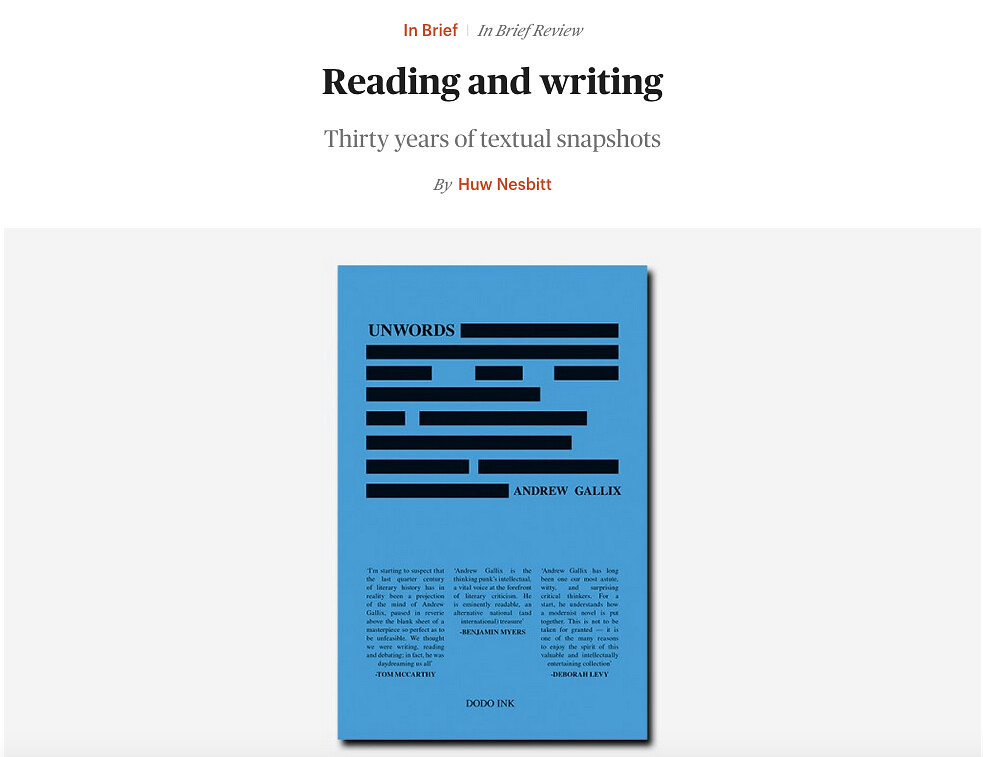
Huw Nesbitt has written a mind-blowing review of Unwords for the latest issue (14th June 2024) of the TLS.
“From the disappointment of the book he never published, Unwords’ author has produced something rare: a work of criticism that aspires to the condition of art.”
Aldridge, Jonny. “Haunting and Being Haunted.” Review of Unwords by Andrew Gallix, Writing Stories, 21 May 2024
Most of what I write never lives up to my expectations artistically or commercially and I spent a lot of time (my twenties) haunted by the feeling this was a problem.
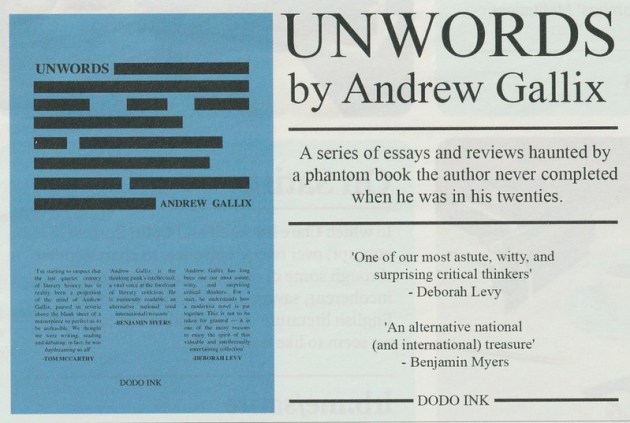
But some books change you and Unwords by Andrew Gallix was one of them. It is a litany of reimaginings, reframings of what the novel is. It’s 600 pages of “essays and reviews haunted by a phantom book the author never completed when he was in his twenties”. It’s — a paean to writers who do not feel the need to publish in order to affirm or reaffirm their status qua writers. Writers for whom literature is ‘the locus of a secret that should be preferred to the glory of making books’ (Maurice Blanchot). Writers of works whose potentiality never completely translates into actuality. Writers who believe in the existence of books they have imagined but never composed. Writers whose books keep on writing themselves after completion.
This list (about a third the length of Andrew Gallix’s in full) seems to me far truer than the narrow notion of a book as the discrete thing bought from shelves in shops or shoved hastily through letterboxes by harassed couriers. If not truer, then more palatable, digestible, and easier on the gut. Proper writers bear this out: the 90,000 words binned during drafting (Bernardine Evaristo), the 40-something full rewrites (Claire Keegan), the seven novels written before the ‘debut’ (Richard Milward)… To say writing is a mess is to say: creativity is creative. The problem isn’t my writing, it’s my expectations. My shallow idea of what the novel can be.
Reinventing the novel
Perhaps this is obvious: Unwords is unapologetically esoteric. But its punk intellectual aesthetic is playful, endearing, and thought-provoking. A collection of 20 years of words, it’s also unsettlingly repetitious. Gallix not only circles the same ideas but reuses the exact same quotes, rehashes the same phrases and sentence structures, plagiarises his own opinions. Haunts his own writing. This is the point. It’s the text he should have completed in his twenties. We are, all of us, writing our ur-novel, seeking the ideal of literature that made us want to wade among words in the first place. …
Greco, Nicolas. “Roland Barthes’ Album: Unpublished Correspondence and Texts.” ASAP Journal, 19 July 2018
Writing for The Los Angeles Review of Books, Andrew Gallix points out the distinction Roland Barthes makes between a book and an album in his lectures on The Preparation of the Novel (from that late 1970s): the book can be considered a “complete work,” a monument which will ultimately be destroyed, whereas an album is “what lives in us.” Describing his visit to the BnF (Bibliothèque nationale de France) exhibition on Barthes in 2015 — called “Panorama” — Gallix suggests that it “provides us with a panoramic view of the polymath’s multifaceted career. This dizzying, kaleidoscopic portrait of Roland Barthes — dissolved in the constructive secretions of his web — highlights his engagement with the world.”
Macdonald, Rowena. “From Old Analogue to Nervily Digital.” Review of Unwords by Andrew Gallix and No Judgement by Lauren Oyler, The Irish Times, 23 March 2024
Andrew Gallix is an Anglo-French writer who lives in Paris and set up 3:AM Magazine, one of the first online literary magazines, in the year 2000. Unwords is a collection of essays but is also, as he explains, “not the book I wanted to write”.
The book he wanted to write was a work of criticism started in 1990, for which he got a publishing contract, but which remained unfinished because he couldn’t perfect the manuscript to his liking. “I wanted my book to contain not only multitudes, but everything.”
This “phantom book” haunts the pages of Unwords and the theme of unwritten books, unreadable books and books that attempt but fail to contain the whole of experience (as all books are doomed to do) is revisited throughout along with writers who stop writing, writers who “do not feel the need to publish in order to affirm … their status”, “writers who take their time; writers who take their lives … writers who vanish into their writing” or “who vanish into thin air”.
Unwords includes witty, accessible essays on French philosophers (Barthes, Sartre et al), French and English underground culture and the experimental authors that 3:AM has championed, alongside phenomena such as prank pie-throwing, hauntology and spam literature. Towards the end it includes personal pieces on Gallix’s time as a punk in New York, an elegy to lost childhood/Guy the Gorilla and a moving letter to his late mother.
Gallix is at heart a modernist and has little time for middlebrow, well-made novels by careerist “professional” authors. For me the most inspirational character in Unwords is Albert Cossery, the Egyptian-born writer, who died in 2008 aged 94, and who lived in the same Left Bank hotel for 63 years, did not bother to get a day job and instead subsisted on the royalties from his eight novels and followed the same radically lazy daily routine: “Every day, he got up at noon (like his characters), dressed up in his habitual dandified fashion and made his way to the Brasserie Lipp for a spot of lunch. From there, he usually repaired to the Flore or the Deux Magots where he would cast an Olympian eye over the drones passing by. Then it was time for his all-important siesta. Repeat ad infinitum”.
Neither London nor Paris allows writers to be so lackadaisical nowadays. Unwords may not be the Gesamtkunstwerk that Gallix wanted to write but the erudition contained within is remarkable, and yet it has a charming light touch.
So, to Lauren Oyler’s No Judgement. If I came to Gallix warm, as I’m familiar with 3:AM Magazine, I came to Oyler cold, having never heard of her. …
Gallix is a gentle melancholy guide, more analogue, older, European; Oyler is nervily digital, younger, very American in sensibility despite more than a decade in Europe. …
Unwords and No Judgement reveal the world views of two equally clever authors; are you in the mood for encouragement towards intellectual discourse, or confrontation?
Emily Kate. “New Year, New Non-Fiction to read in 2024!” The Turnaround Blog, 17 January 2024:
“Speaking of books made to challenge and intrigue — Unwords by Andrew Gallix is the latest must-read title for fans of all things literary and perhaps a bit “meta”. Unwords consists of essays and reviews haunted by a phantom book the author never completed in his twenties. Andrew is one of the UK’s top literary critics, as founder of the blog 3:AM Magazine and a regular contributor to numerous magazines and newspapers. Inside Unwords, readers find the highest form of intergloss, from reviews to manifestos, from interviews to personal essays, and deep dives into captivating literary rabbit holes.”




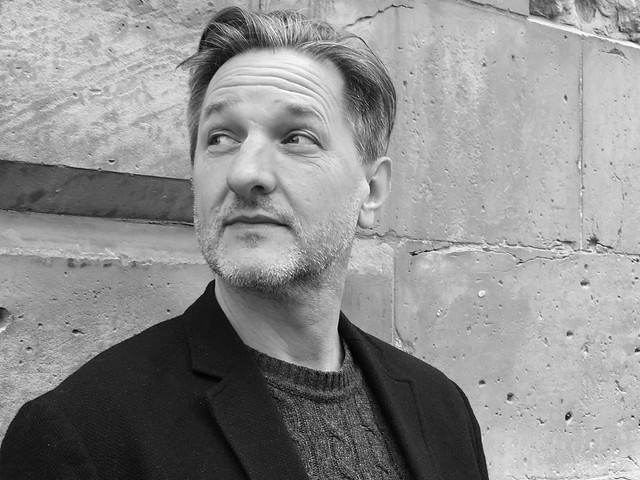

 ANDREW GALLIX