Edward Champion, “3:AM Magazine — How Twelve Years of Literary Content Disappeared in an Instant,” Reluctant Habits 6 July 2012

3:AM Magazine, the first literary magazine to champion Tom McCarthy’s work and a pioneering avant vanguard that had published the early work of Tao Lin, Tony O’Neill, and Ben Myers, had vanished in an instant, with the hosting company seemingly disappearing along with it. While a substantial chunk of the magazine’s content was still available through the Internet Archive’s Wayback Machine, there was no backup. And according to editor-in-chief Andrew Gallix, the site was held together by little more than “a doctored WordPress system”.
“It never occurred to me that our server could just be switched off without a word of warning and that the owner would do a runner!” wrote Gallix to me by email. Gallix’s efforts earlier in the week to reach the host were unsuccessful. Emails bounced. The phone had been disconnected. Gallix hadn’t received so much as a notice that his valiant magazine was disconnected and no longer in service.
While Gallix had used another host for a site dedicated to McCarthy’s work, he never switched 3:AM over during the twelve years he ran the site. He had a full-time day job. He wanted to read and he wanted to write. If the server crapped out, it would find a way to resurface after a time. “I kept postponing the move in the hope that things would improve,” said Gallix.
There was no reason for Gallix to worry. Because he had experienced very few problems. “The site was down on some occasions,” said Gallix, “sometimes just for a couple of hours; at worst for a whole day: there didn’t seem to be any real cause for concern”.
* * *
3:AM began, as many literary magazines begin, with a short story. Gallix started corresponding with an American named Kent Wilson, and a website was born. 3:AM Magazine, initially a static site comprised of a handful of stories, was founded in 1999. But Wilson had an unanticipated spiritual awakening. And 3:AM, which abided by the motto “Whatever it is, we’re against it,” didn’t fit into these mysterious ways. Wilson asked Gallix to take over 3:AM in April 2000.
“We were the first to really make use of the global dimension of the web,” said Gallix. “All the editors and contributors met online, and it was only after that some of us became friends in real life”.
This commitment to friendship and passion sustained a literary magazine with a distinct and inimical tone. “While in the middle of a feverish pawing at the back-clip of her bra,” begins one typically edgy and entertaining story around this time, “I did not think much of her whispering in my ear that she could not stay for the night because she had to go home feed Satan”.
But as long as the website continued to work, Gallix didn’t rue over the technical logistics. Wilson had given Gallix the name of a host: RMIhost.com, which was run by Reece Marketing Inc. Reece Marketing Inc. was a one man operation run by Brandon Reece. And when I tracked Reece down by telephone on Friday afternoon, he told me that he was stunned that someone was still using it.
“We haven’t done hosting for four or five years,” said Reece, who sounded somewhat surprised at the news that 3:AM had vanished. “I haven’t hosted anybody’s site since 2008.”
Gallix informed me later in the afternoon that he had paid an annual hosting fee, but it was unclear whether someone had taken over from Reece. He received an email every year asking to pay for the next year. So what was RMIhost.com?
“That’s all still up there,” replied Reece. “It’s not doing any business.”
Reece claimed to not know anything about 3:AM Magazine. He said his company had once specialized in website design and had operated out of Dallas. “It was never a successful side company,” said Reece.
Reece recalled a guy named Kent when I asked him. He identified a “born again Christian,” and confirmed that this was Kent Wilson when I provided the surname. But Reece didn’t appear to know what Wilson had given him. Was it possible that he wasn’t even paying attention to RMIHost?
“I don’t ever remember hosting 3:AM Magazine,” said Reece. “I think I would know.”
Reece referred to “a server admin in Bucharest” — a gentleman named Florin — who he promised to email tonight. When I asked Reece if RMIhost had leased any particular server, he seemed baffled.
“DNS,” said Reece. “I haven’t done anything like this in a while.”
Reece was busy “looking for something new right now”. He intimated that he was in a transition period and that the hosting company had been more of an unprofitable sideline. These days, he was living on savings.
“I don’t trust my personal expertise,” said Reece when I asked him about his technical chops. “I don’t even know how to do that myself. You forget everything you do.” But he did promise to get on the case by Monday. He also allowed me to pass along his contact information to Gallix.
As for Gallix, he informed me that he had tech people retrieving what they could off the Internet Archive. But even if 3:AM manages to extract the content, he’s unsure about what “more reliable and reputable host” he’ll offload his content onto. The experience revealed to Gallix “the fragility of online content”.
It remains unclear whether Reece was playing dumb or acting in good faith. But he was willing to pass along his contact info to Gallix, even after I informed him of the significant online outcry that had followed 3:AM‘s server outage. And these efforts do represent a step in the right direction to preserve 3:AM‘s vast archive.
No matter how the 3:AM predicament works out — and there are positive signs that it will — preserving online work may very well be as dangerous as other historical precedents. Or as Tom McCarthy, reached on holiday, declared to me upon learning the news, “My first reaction is: ALEXANDRIA!”
[7/6/2012 6:45 PM UPDATE: As of 6:45 PM EST, 3:AM Magzine has been restored. Many thanks to all who helped out with this story and to Mr. Reece for following through with his promise.]
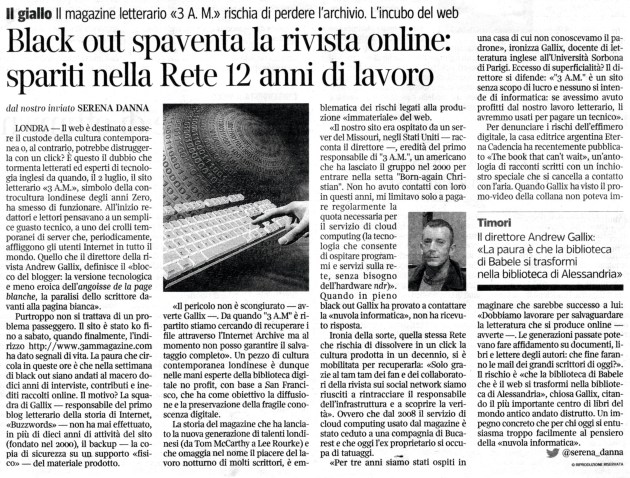


 ANDREW GALLIX