Authentically Inauthentic

409692229_e75d124f7c_t

This appeared in 3:AM Magazine on 30 July 2009

Authentically Inauthentic

Gavin James Bower interviewed by Andrew Gallix.

n598070164_6393473_7895029
[Pic: Carl Wilkinson]

3:AM: In a way, you became a novelist as a result of the failure of all your other career options. You started off as an intern at Dazed & Confused, but instead of encouraging you to become a journalist, they introduced you to modelling. You were a model for the best part of 2 years and then packed it in because you hadn’t gone mega as you’d hoped (the “skinny-jeans-and-winklepickers ‘look’,” as you describe it, was no longer all the rage anyway). Then you worked for a production company — a job you enjoyed — but were made redundant. And that’s when you started writing Dazed & Aroused, right?

GJB: I like the idea of finding success through failure. There’s something bittersweet about it, as if I’d worked all my life in a factory and then, on the day I retired, won the lottery.

But, in truth, it feels more like I’ve come full circle — and all a bit by accident too. I first wanted to be a writer at uni and had some success as a journalist, but then didn’t really manage to get off the ground when I graduated. I kind of just fell into modelling as a way to get to London, which, being from a small town in the North, had this tremendous pull for me. I suppose I was going to figure it out as I went along. That was ‘the plan’ anyway.

When modelling didn’t work out, though, and after working a few media jobs for a while — and getting sucked into the whole 22 grand job thing — I ended up writing the novel I’d wanted to write since first arriving in London. I’d been working for a ‘green’ production company, but they’d spunked about eight million quid against a wall and made everyone redundant — so I had plenty of time on my hands over Christmas 2007. I’d been making notes on a novel for the two years I’d been in London, and was very clear on its premise. My writing’s very ideas-driven and not so reliant on plot, which probably makes it ‘literary fiction’ I suppose.

Anyway, that was all worked out — but I hadn’t dared to commit to the narrator’s own story. It was always going to be about alienation in the way Marx explained it in his Economic and Philosophical Manuscripts of 1844, with the narrator being the personification of the capitalist social relation — an estranged individual who exploits others for personal gain, but refuses to connect to anyone or anything — but I’d been too cowardly to commit to creating his personality, and the world he inhabited day to day. I was stuck somewhere between a cynical office worker and a trustafarian — neither of which appealed to me as a writer.

I’d been very reluctant to write what for me was a ‘serious’ novel and set in the fashion world. With me losing my job, though, I just made a decision to sit down and write it. I had so much ammunition, and it just made sense.

n598070164_6393560_4263716

3:AM: I understand that writing was always your main ambition, though. Apart from Ellis (whom we’ll return to), which authors inspired you to become a writer yourself?

GJB: I’d say early Marx was a big influence, as was Jean-Paul Sartre, especially Nausea. I’d always read a lot of philosophy too, being a history graduate, and probably enjoyed that more than fiction.

When it comes to fiction, William S. Burroughs, Albert Camus, F. Scott Fitzgerald: these are all writers I admire.

One of the first people who really got me excited about being a writer myself, though, was Lee Taylor (editor of Flux magazine). My first published article was in FLUX. I emailed him to ask for some work experience with the mag, while I was still at uni. He didn’t want anyone but we ended up having a month-long email conversation, which then led to me just writing something. He published it and that was that.

3:AM: You’ve said that you like Richard Milward, Chris Killen, Joe Stretch, and Niven Govinden. Do you feel an affinity with them? I see strong parallels between your work and that of Christiana Spens and Joe Stretch in particular: do you agree?

GJB: I’m reading and loving The Wrecking Ball right now actually, and it’s incredible to see the parallels now my book’s been published. I’m not sure I’d have written it that way, though, had I read Spens beforehand — because I wouldn’t want to have felt like I was copying her. She’s a terrific writer, very talented.

Richard Milward, Joe Stretch and Chris Killen are all in their twenties, like me, and also Northern, like me. Beyond that, I don’t see that many parallels between us, as they each strike me as uniquely talented, idiosyncratic and a bit mad to be honest. It’s no bad thing, though, and is also quite flattering because I really do like their writing a lot.

2944_174412115164_598070164_6741890_3871943_n

3:AM: In your book, there’s a scene in which a copy of We Are the New Romantics, Niven Govinden’s debut novel, appears. Now, a blurb by Govinden adorns the jacket of your own first novel (“Sharper than an Alexander McQueen cut”). This, I think, is a good example of the almost disquieting relationship between reality and fiction surrounding your work. I almost get the impression that you turned yourself into a character out of a Bret Easton Ellis book before writing one yourself. Take the internship at Dazed & Confused, for instance: you could have done an internship at a daily newspaper or a literary journal. You also used to write (and model for) Flux magazine, which appeals to a similar hipster constituency as Dazed, so the choice doesn’t seem totally innocent. Then there’s the fact that you can talk authentically about inauthenticity since you’ve experienced the model lifestyle from the inside. Do you reckon there’s an element of truth in all this?

GJB: I Iove the idea of being able to talk authentically about inauthenticity — I might nick that for when I next need a blurb.

If I could’ve landed an internship at a national newspaper, I’d have snapped it up. I didn’t get past a first interview for the graduate scheme at the Daily Express. True story. Looking back, I think I took the only internship going, but it’s no coincidence that I looked to magazines reflecting my interests and ended up at an arts-cum-style mag.

When I left university, I didn’t consider myself particularly ‘literary’, whatever that means. I wanted to be a journalist and was writing 500 words about installation art and hipster musicians, or bigger pieces on Surrealism. I seemed to call everyone and everything ‘bourgeois’ for a while. I think I needed to grow up as a person, as well as a writer, before being able to write a novel. Incidentally, my first and only attempt at novel writing prior to Dazed & Aroused was during uni. I was really only flirting with the idea of writing more than a page of anything, and it ended up being just a lot of sex — and not even good sex at that.

Years later, when I sat down to write what became Dazed & Aroused, I felt ready. It was as if I was purging myself of Alex — a disconnected, almost two-dimensional individual incapable of empathising with people around him, only taking from them and never giving anything in return. I wasn’t ever really caught up in the modelling world the way Alex is in the novel, and my friends were all doing very different things. Even so, his viewpoint and estrangement is an expression of mine, and so it felt very cathartic ridding myself of that aspect of my own personality, which I think all fictional creations are in a sense, as well as turning something a bit negative — the modelling — into a positive. The funny thing is, though, now the book’s out and I’m single myself — and no longer a model — I feel more and more like him every day.

As for Niven, I read and enjoyed We Are The New Romantics before writing Dazed & Aroused. I name-dropped him because of the scene in which his book appears. The characters are trying to create a sense of romance by doing drugs and listening to Depeche Mode. I think this sense of futility when it comes to romance, to idealism, is kind of my generation’s ‘thing’ — and I certainly got that from reading Niven’s book.

After I finished mine, when I was looking for an agent, I approached him for advice on getting published. I’d found him on Facebook, as it happened, and he was really nice about it. I sent the manuscript to him when it was going to be published, to see if he could come up with anything and, being Niven, he gave me a killer line.

I like the ‘almost disquieting relationship between reality and fiction’ surrounding my work, so don’t want to say more. I wouldn’t want it any other way.

496241091_36a3d7ac71

3:AM: Ok, back to Ellis. The first paragraph of Dazed, with the advertising slogan, is a nod to the opening of American Psycho. We could also mention the name-dropping, the lists of brands, Natalie’s “cool trends”, the juxtaposition of glamour and squalor (the toilets covered in diarrhoea due to the laxatives models take) and the DJ who plays Bloc Party’s “Song for Clay (Disappear Here)”. Ellis really is a major influence, isn’t he?

GJB: I have no idea what you’re talking about…

Ok seriously, yes, he’s a major influence. He’s my favourite writer and Less Than Zero my favourite novel. The Bloc Party song is the only explicit nod to him and his work in my book, but the similarities stylistically are there, certainly. I really hadn’t considered that about the first paragraph, though, and thought I was being original. Oh well.

I would say, however, that the premise and point of Dazed & Aroused is, for me, very different to anything by Ellis. It puts the ‘social’ in anti-social. (Note to self: use that when asked to blurb for Stewart Home’s next book.) In all seriousness, though, I wrote it as an indictment of individualism, and think it’s very much a materialist work at heart. Also, it’s fundamentally anti-capitalist, which I don’t think Ellis is or ever has been. He’s far more of a satirist too — pointing out problems rather than proposing solutions — whereas I’ve always fancied myself as more than just a troublemaker.

3:AM: You were three years old when Less Than Zero came out. Has it achieved classic status for you? Is it part of literary history?

GJB: I’ve never been more affected by a book and so, for me, it’s a classic. In my opinion, Less Than Zero is the best book of its kind: a book about jaded youth, about the end of innocence, about embracing the abyss. What’s funny is, Less Than Zero defined a generation and yet, today, no book is more relevant to young people.

Apart from mine, of course…

3:AM: “Gen X was brought up with a sense of values that it saw collapsing, so we have a kind of nostalgia, I guess, for something a bit more solid, although we’re very suspicious of it”: what do you make of Ewan Morrison‘s take on Generation X? That tension between suspicion and nostalgia is present in Douglas Coupland‘s work but also, I think, in Ellis’s: can you identify with that although you belong to another generation?

GJB: I’m in Generation ZZZ…right?

On a bad day, I feel like we all just don’t give a shit about anything. And even the few who do — don’t really. We’re apolitical in the worst sense, because we don’t actively look for alternatives — say, to parliamentary democracy, to oil or, crucially, to capitalism. And what makes this all the more shoddy is, we all say the same things and then do nothing about it — including me.

I suppose we’re all on some level looking for something more solid, but what’s on offer is so beguiling — and the alternatives so unpalatable — that we’re stuck between one thing, the here and now, and what’s next. It’s probably Marx’s influence on me, but I’d say we’re all just waiting for the house of cards to collapse.

On a good day, though, I think there are loads of people who do care, and who are doing something about it in a million and one ways. When I feel like that I want to knock the house of cards over myself, and I don’t want to wait around for someone else to do it for me. On a good day…

n598070164_2710302_9294

3:AM: I don’t know if you remember that early Toby Litt story in which the narrator says that “All of this intellect stuff is fine as a consolation” for not being a beautiful young hipster which, he argues, “is how it developed in the first place: Socrates not being Alcibiades”? Since you don’t have to compensate for “not being Alcibiades”, what motivates you to write?

GJB: I don’t agree with Toby Litt, but I will say this: I’m not pretty enough to be a top model, and am too pretty to be a serious writer. I have no consolation.

3:AM: Could you tell us about the (non-)relationship between Alex and his father?

GJB: Alex is part of a generation of men who’ve been let down by their fathers, and he refuses to let it go. Like a lot of men my age I suppose, Alex blames everyone else for his unhappiness, refusing to see that it’s his unwillingness to connect with people, to make any real decisions about his life and future, which leaves him isolated, alone and unable to feel anything by the end of the novel. His father, like Alex, is essentially selfish and, having left his family and revealed himself as fallible — as all fathers do when they leave home, I’d say — he suffers the consequences.

3:AM: Your book also seems to follow a kind of Alfie/Billy Liar, tumescent/detumescent pattern: cocky young hero comes a cropper…

GJB: I don’t think Alex is a dark character, but he’s certainly not a hero. His is a cautionary tale and, as a narrator, Alex is a vehicle for me to say that I don’t like capitalism and think we need something better — or else we’ll all end up alienated, miserable and ultimately alone.

You’re right, though. The final line could easily be: ‘What’s it all about, Alex?’

3:AM: To what extent is Dazed autobiographical?

GJB: I reckon that all writing is autobiographical because, as a writer, you’re interpreting life and then projecting your prejudices on to the page. The key is, not to pretend otherwise.

I’ve just written a second book — about growing up in the North and wanting to escape — which I think is far more autobiographical and even personal than Dazed & Aroused. London, and modelling, is such a small part of my life.

Even so, a lot of what happens peripherally in Dazed & Aroused — aside from the central relationships, which is pure fiction — is based on something I experienced first-hand and then changed beyond recognition. I never related to anything in the book the way Alex does. I was either not there or, if I was, thinking something completely different.

So, to answer your question, to no extent is Dazed & Aroused autobiographical, in the sense that I am not Alex and none of it happened anyway. Apart from a lot of it.

3:AM: Apparently, you approached some 40 publishers before your manuscript was finally accepted, by Quartet Books. Did any of them give you any explanations or advice?

GJB: I think I approached 40 agents before getting one (Annabel at PFD). I don’t know how many publishers read my manuscript, but it was probably a lot. My agent only showed me the first few rejections — none of which were nasty — and then decided that this wasn’t a very good idea. I do seem to recall one of them saying that Alex reminded them of Holden Caulfield, but wasn’t as much of an ‘everyman’ character. Which was nice. In a way. I suppose.

3:AM: Things seem to have gone really fast since then: according to your blog, you signed your contract in March (2009) and the book came out in July. How long did you spend writing it? Were you writing full time, or did you have a day job? I think your novel went though 3 different drafts: was the first one very different from the finished product?

GJB: The book took around eight weeks to write, broken up by Christmas in the middle. I was writing full-time during this first draft, and then temped during the re-drafting and submission stage.

The three drafts were very similar: I really just refined it with the help of close friends and my brother. And weirdly, since being accepted by my agent last summer, it’s barely been edited. I don’t know whether that’s a ‘good thing’.

n598070164_2706462_8920

3:AM: Who is this Kim van der Pols and how did she end up being the cover girl?

GJB: My friend Carl Davis designed the cover, based on an image taken by a photographer called Rebecca Parkes. Kim Van Der Pols was the model in the original, and is a very beautiful and sweet girl. I couldn’t be happier with it. I think it looks brilliant, very seductive and alluring, and perfectly captures Alex’s infatuation with all things ephemeral.

3:AM: How did the Stewart Home blurb come about? Are you a fan?

GJB: I’m a fan, yes. I interviewed him when I was writing for Flux, back in 2003, and we kept in touch.

He didn’t read it, though, unlike the others who gave blurbs (cross my heart). He told me not to take the industry too seriously, and asked me to come up with something for him instead. All my ideas were a bit shit, to be honest, so he suggested: ‘Fashion will never be the same…’. Appropriately, given that he didn’t read it, it’s as ambiguous as you can get — but I think it’s pretty cool all the same.

3:AM: You are currently adapting Dazed into a screenplay, aren’t you?

GJB: I think Dazed & Aroused would work well as a film. I might even play Alex myself. (Um, I’m joking. I think.)

I’ll be working with a friend on it, once book two is promoted and I can forget about it, and I’ve finished book two, which is one draft away from completion. I’ve never written a screenplay but, then again, I’d never written a novel…

3:AM: Your next novel, Made in Britain, focuses on three 16-year-olds growing up in the North. From what I’ve seen, the structure seems a little reminiscent of The Informers but I get the feeling this one’s going to be more gritty and less glamorous than your debut.

GJB: Each chapter is going to comprise three viewpoints, and the book will move chronologically from there. I’d not even thought about The Informers as an influence to be honest, and I don’t think it’ll feel like that to people because that’s so loosely connected without any clear narrative, while this has a strong narrative and clear plotline, and is written in the vernacular.

The book’s about growing up in provincial Britain and what it feels like when hope turns to despair. It’s the result of my love-hate relationship with where I was born and grew up [Burnley]. I’m very ambitious as a writer so, once I’d got the modelling out of my system, I wanted to write something far more personal. I was up North last winter and thought, why haven’t I written about being working class and from the North? So that’s what I did.

The Future is Going to Be Boring

409692229_e75d124f7c_t

This appeared in the summer 2009 issue of Flux magazine (issue 69, p. 77):

The Future is Going to Be Boring

Despite his bohemian hairdo and stripy tops, Lee Rourke is a creature of habit. Every single story in Everyday, his 2007 debut, was composed of a Saturday afternoon in the very same east London pub. And each one of these stories (or “fragments” as he prefers to call them) bears more than a passing resemblance to all the others. Time and again, the author retreads well-worn ground like a criminal constantly returning to the scene of his crime. Photocopying machines abound — underscoring this repetition compulsion — and the figure of Sisyphus looms large, from the hypnotic sway of a lady’s derrière in “Cruel Work” to the Groundhog Day pattern of “Footfalls”. If there is nothing new under the sun, all that remains is an eternity of repetition, recycling and re-enactment. That’s the gist of it.

“Our future is already boring, and we’ve not even reached it yet,” laments one of the scientists (echoing J. G. Ballard) in the piece you are about to read. Lee Rourke is rapidly becoming the poet laureate of tedium. One of his early “fragments” is called “Being Lee Rourke is Boring” — a title that exemplifies the author’s curious oscillation between self-aggrandisement and self-effacement. Should his dedication be in any doubt, Rourke is preparing a critical study in which he analyses how ennui has been “a central creative force” in literary history. He has also just completed a poetry collection that delves into the mind-numbing, soul-destroying monotony of office life: its eponymous emblem is Varroa destuctor, a bee-killing mite. “Most of my characters are either ergophobic or have major philosophical problems with the nature of work,” the author says.

Lee Rourke, a 37-year-old London-based Mancunian, is already one of the leading lights of the Offbeats and a respected reviewer. His first novel (published next year by American indie Melville House) is bound to further raise his profile. The Canal revolves around the Ballardian triumvirate of boredom, violence and technology. Set against the backdrop of Regent’s Canal — “one of the myriad arteries that flood a city like London with activity” — it is a book about dwelling “in the Heidegerrian sense,” about “the toing and froing of human interaction within a mechanised society” as well as the tale of “one man’s search for understanding and companionship”.

1

The Importance of Doing Nothing

409692229_e75d124f7c_t

This appeared in the summer 2009 issue of Flux magazine (issue 69, pp. 50-51):

The Importance of Doing Nothing

You know something is seriously awry when even the Tory leader claims we should be focusing on GWB as well as GDP. General Well-Being is a catch-all phrase, but in our long-hours culture it can only mean one thing: striking a better work-life balance. As Paul Lafargue — Karl Marx’s son-in-law — pointed out, God seems to have sussed it from the word go: “after six days of work, he rests for all eternity” (The Right to be Lazy, 1883). Although scripture is notoriously open to interpretation, prelapsarian Eden is patently presented as a work-free environment. It is only after the Fall — and, crucially, as a result of it — that men were condemned to earn their dough: “In the sweat of thy face shalt thou eat bread, till thou return unto the ground” (Genesis 3:19). Women, for their pains, would bring forth children “in sorrow”. The word ‘travail’ — French for ‘work’ — also happens to refer to labour pains: it derives from the Latin tripalium which, fittingly enough, was an instrument of torture. As for ‘labour’ itself, it comes from labor meaning ‘trouble’. No wonder work is a four-letter word (to quote the 1968 Cilla Black number famously covered by the Smiths).

In ancient Greece, work was restricted to slaves — a set-up which provided a blueprint for the West until the Industrial Revolution. By the early nineteenth century, however, “the voice of busy common-sense” — as Keats dubbed it — had become deafening (“Ode on Indolence,” 1819). Nietzsche observed how people were beginning to feel guilty of “prolonged reflection”: “Well, formerly, it was the other way around: it was work that was afflicted with the bad conscience. A person of good family used to conceal the fact that he was working if need compelled him to work. Slaves used to work, oppressed by the feeling that they were doing something contemptible” (The Gay Science, 1882). “It is to do nothing that the elect exist,” Oscar Wilde reaffirmed defiantly in the face of a triumphant work ethic. Contemplation, he lamented, had come to be regarded as “the gravest sin of which any citizen can be guilty” rather than “the proper occupation of man”. It is this gradual erosion of the contemplative life — “the life that has for its aim not doing but being” — which writers and dreamers have always tried to resist (“The Critic as Artist,” 1891). Robert Louis Stevenson — who poured scorn on those “who are scarcely conscious of living except in the exercise of some conventional occupation” — argued that idleness “does not consist in doing nothing, but in doing a great deal not recognised in the dogmatic formulations of the ruling class” (“An Apology for Idlers,” 1881). In How to be Idle (2004), Tom Hodgkinson — co-founder of The Idler magazine (1993) — reminds us that “living is an art, not something that you fit in around your job”.

Pockets of collective anti-work resistance appeared at regular intervals throughout the 20th century, from the drop-out beatniks to the unemployed punks. The Sex Pistols’ brazen “I’m a Lazy Sod” contained the classic line: “I don’t work, I just speed; that’s all I need”. Bow Wow Wow’s second single — “W.O.R.K. (N.O. Nah No! No! My Daddy Don’t)” — turned the tables on Thatcherite austerity by celebrating the rise of the idle poor. Many like Morrissey went looking for a job and then found a job and heaven knows were miserable now. 1991 saw the release of Slackers as well as the publication of Generation X whose protagonists relocate to the Californian desert after opting out of the rat race. Douglas Coupland’s downshifting classic was subtitled “Tales for an Accelerated Culture,” mirroring the parallel rise of the Slow movement anticipated by Bertrand Russell (“In Praise of Idleness,” 1932) and chronicled by Carl Honoré (In Praise of Slow: Challenging the Cult of Speed, 2004).

“Our epoch has been called the century of work,” Lafargue wrote, back in the 1880s, “It is in fact the century of pain, misery and corruption.” “Labour is the one thing a man has had too much of,” D. H. Lawrence echoed in the 1920s (“A Sane Revolution”). Unsurprisingly, Dr. Frank Lipman’s current diagnosis is that we are all completely knackered (Spent? End Exhaustion & Feel Great Again, 2009). So what are we to do? One option is to follow the advice of New Rich guru Timothy Ferriss whose best-selling The 4-Hour Work Week (2007) is designed to teach you how to let money make itself by outsourcing your business. Alternatively, we could turn to Melville’s Bartleby who, when asked to do anything, answers: “I would prefer not to” (Bartleby, the Scrivener, 1853). We could also take our cue from Jerome K. Jerome — the forefather of Phone In Sick Day — and get our kicks from the illicit thrill of skiving: “There is no fun in doing nothing when you have nothing to do” (“On Being Idle,” 1889). Following Thierry Paquot (The Art of the Siesta, 1998), Hodgkinson prescribes hitting the snooze button where it hurts: “Edison promoted the idea of ‘more work, less sleep’. The idler’s creed is ‘less work, more sleep'”.

One man who devoted his life and, er, work (8 slim volumes in 65 years) to sleep was Egyptian émigré Albert Cossery. His was a militant form of idleness which he saw as the only way to fully enjoy “the Edenic simplicity of the world”. In an early short story, the inhabitants of an impoverished neighbourhood are prepared to kill off those who interrupt their sacred slumber before noon; in another, an Oblomov-style character refuses to leave his bed for a whole year. Cossery was convinced that those who rejected (or were deprived of) material wealth gained access to a heightened state of consciousness hence the constant association between destitution and nobility. In 1945, he checked in to a poky hotel — on the very same Parisian street where the iconic “Ne travaillez jamais” (“Never work”) graffito would soon appear — and remained there, doing precious little, until he passed away last year. Cossery chose to get a life instead of a job. Perhaps more of us should do the same — the world might be a better place.

3745543291_82f8b46e13_o

3745552357_e3866aeea5_o

We Are All Necronauts

409692229_e75d124f7c_t

This appeared in the summer 2009 issue of Flux magazine (issue 69, pp. 42-43):

We Are All Necronauts

For the past decade, the International Necronautical Society has been encouraging us to learn to die in new, imaginative ways

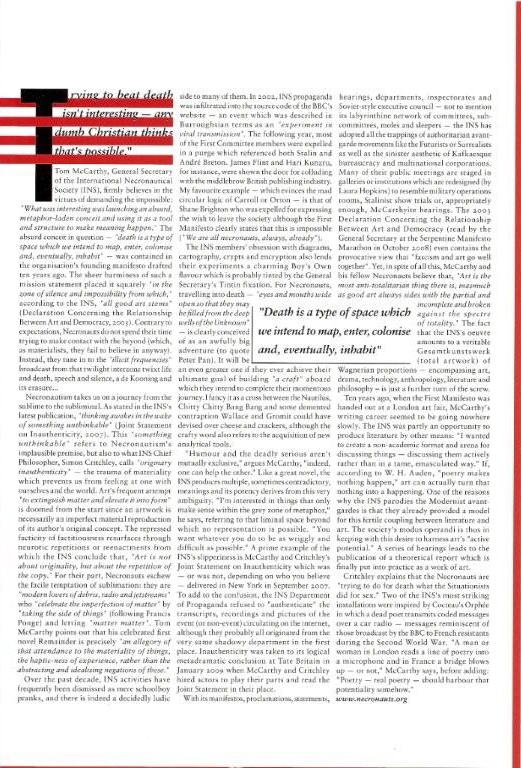
“Trying to beat death isn’t interesting — any dumb Christian thinks that’s possible.” Tom McCarthy, General Secretary of the International Necronautical Society (INS), firmly believes in the virtues of demanding the impossible: “What was interesting was launching an absurd, metaphor-laden conceit and using it as a tool and structure to make meaning happen.” The absurd conceit in question — “death is a type of space which we intend to map, enter, colonise and, eventually, inhabit” — was contained in the organisation’s founding manifesto drafted ten years ago. The sheer barminess of such a mission statement placed it squarely “in the zone of silence and impossibility from which,” according to the INS, “all good art stems” (Declaration Concerning the Relationship Between Art and Democracy, 2003). Contrary to expectations, Necronauts do not spend their time trying to make contact with the beyond (which, as materialists, they fail to believe in anyway). Instead, they tune in to the “illicit frequencies” broadcast from that twilight interzone twixt life and death, speech and silence, a de Kooning and its erasure…

Necronautism takes us on a journey from the sublime to the subliminal. As stated in the INS’s latest publication, “thinking awakes in the wake of something unthinkable” (Joint Statement on Inauthenticity, 2007). This “something unthinkable” refers to Necronautism’s implausible premise, but also to what INS Chief Philosopher Simon Critchley calls “originary inauthenticity” — the trauma of materiality which prevents us from feeling at one with ourselves and the world. Art’s frequent attempt “to extinguish matter and elevate it into form” is doomed from the start since an artwork is necessarily an imperfect material reproduction of its author’s original concept. The repressed facticity of factitiousness resurfaces through neurotic repetitions or reenactments from which the INS conclude that “Art is not about originality, but about the repetition of the copy”. For their part, Necronauts eschew the facile temptation of sublimation: they are “modern lovers of debris, radio and jetstreams” who “celebrate the imperfection of matter” by “taking the side of things” (following Francis Ponge) and letting “matter matter”. Tom McCarthy points out that his celebrated first novel Remainder is precisely “an allegory of that attendance to the materiality of things, the haptic-ness of experience, rather than the abstracting and idealising negations of these”.

Over the past decade, INS activities have frequently been dismissed as mere schoolboy pranks, and there is indeed a decidedly ludic side to many of them. In 2002, INS propaganda was infiltrated into the source code of the BBC’s website — an event which was described in Burroughsian terms as an “experiment in viral transmission”. The following year, most of the First Committee members were expelled in a purge which referenced both Stalin and André Breton. James Flint and Hari Kunzru, for instance, were shown the door for colluding with the middlebrow British publishing industry. My favourite example — which evinces the mad circular logic of Carroll or Orton — is that of Shane Brighton who was expelled for expressing the wish to leave the society although the First Manifesto clearly states that this is impossible (“We are all necronauts, always, already”).

The INS members’ obsession with diagrams, cartography, crypts and encryption also lends their experiments a charming Boy’s Own flavour which is probably tinted by the General Secretary’s Tintin fixation. For Necronauts, travelling into death — “eyes and mouths wide open so that they may be filled from the deep wells of the Unknown” — is clearly conceived of as an awfully big adventure (to quote Peter Pan). It will be an even greater one if they ever achieve their ultimate goal of building “a craft” aboard which they intend to complete their momentous journey. I fancy it as a cross between the Nautilus, Chitty Chitty Bang Bang and some demented contraption Wallace and Gromit could have devised over cheese and crackers, although the crafty word also refers to the acquisition of new analytical tools.

“Humour and the deadly serious aren’t mutually exclusive,” argues McCarthy, “indeed, one can help the other”. Like a great novel, the INS produces multiple, sometimes contradictory, meanings and its potency derives from this very ambiguity. “I’m interested in things that only make sense within the grey zone of metaphor,” he says, referring to that liminal space beyond which no representation is possible. “You want whatever you do to be as wriggly and difficult as possible”. A prime example of the INS’s slipperiness is McCarthy and Critchley’s Joint Statement on Inauthenticity which was — or was not, depending on who you believe — delivered in New York in September 2007. To add to the confusion, the INS Department of Propaganda refused to “authenticate” the transcripts, recordings and pictures of the event (or non-event) circulating on the internet, although they probably all originated from the very same shadowy department in the first place. Inauthenticity was taken to its logical metadramatic conclusion at Tate Britain in January 2009 when McCarthy and Critchley hired actors to play their parts and read the Joint Statement in their place.

With its manifestos, proclamations, statements, hearings, departments, inspectorates and Soviet-style executive council — not to mention its labyrinthine network of committees, sub-committees, moles and sleepers — the INS has adopted all the trappings of authoritarian avant-garde movements like the Futurists or Surrealists as well as the sinister aesthetic of Kafkaesque bureaucracy and multinational corporations. Many of their public meetings are staged in galleries or institutions which are redesigned (by Laura Hopkins) to resemble military operations rooms, Stalinist show trials or, appropriately enough, McCarthyite hearings. The 2003 Declaration Concerning the Relationship Between Art and Democracy (read by the General Secretary at the Serpentine Manifesto Marathon in October 2008) even contains the provocative view that “fascism and art go well together”. Yet, in spite of all this, McCarthy and his fellow Necronauts believe that “Art is the most anti-totalitarian thing there is, inasmuch as good art always sides with the partial and incomplete and broken against the spectre of totality.” The fact that the INS’s oeuvre amounts to a veritable Gesamtkunstswerk (total artwork) of Wagnerian proportions — encompassing art, drama, technology, anthropology, literature and philosophy — is just a further turn of the screw.

Ten years ago, when the First Manifesto was handed out at a London art fair, McCarthy’s writing career seemed to be going nowhere slowly. The INS was partly an opportunity to produce literature by other means: “I wanted to create a non-academic format and arena for discussing things — discussing them actively rather than in a tame, emasculated way.” If, according to W. H. Auden, “poetry makes nothing happen,” art can actually turn that nothing into a happening. One of the reasons why the INS parodies the Modernist avant-gardes is that they already provided a model for this fertile coupling between literature and art. The society’s modus operandi is thus in keeping with this desire to harness art’s “active potential.” A series of hearings leads to the publication of a theoretical report which is finally put into practice as a work of art.

Critchley explains that the Necronauts are “trying to do for death what the Situationists did for sex”. Two of the INS’s most striking installations were inspired by Cocteau’s Orphée in which a dead poet transmits coded messages over a car radio — messages reminiscent of those broadcast by the BBC to French resistants during the Second World War. “A man or woman in London reads a line of poetry into a microphone and in France a bridge blows up — or not,” McCarthy says, before adding: “Poetry — real poetry — should harbour that potentiality somehow.”

http://www.necronauts.org

1

2

Unheard Melodies

409692229_e75d124f7c_t

This appeared in the summer 2009 issue of Garageland (issue 8, pp. 30-33).

Unheard Melodies

Andrew Gallix goes in search of the most elusive of the phantom bands — L.U.V.

garageland

“As a rock critic, when you reach a certain age, you begin to wonder if all the mental and emotional energy you’ve invested in this music was such a shrewd move,” wrote Simon Reynolds in the introduction to Rip It Up and Start Again. More recently, he wondered if “searching for utopia through music” had not been “a mistake” (Totally Wired). To ascribe such doubts to impending middle age alone would be to forget that there was a time when music truly was a matter of life and death, when days were whiled away listening to records and poring over album covers in some ill-defined but all-important quest. Instead of producing plays or paintings, the best and brightest were busy perfecting one-note solos on replica Starways from Woolies. Rock’n’ roll was central to contemporary culture: it was where it was at.

Needless to say, no band could ever totally live up to such high expectations. Malcolm McLaren shrewdly ensured that the Sex Pistols made precious few live appearances in order to enhance their mystique. Spandau Ballet would use a similar trick at the beginning of their career by playing invite-only gigs. Keats (Morrissey notwithstanding) was right: heard melodies are sweet, but those unheard are sweeter. After all, bands are necessarily approximations of the dreams that conjured them up. Some — like the Libertines whose Arcadian rhetoric was often far more exciting than their songs — are condemned to remain pale reflections of their Platonic ideals. By the same token, a record is always a compromise: The La’s famously spent two years recording and re-recording their first album without ever achieving the desired effect. Even at its best, music cannot vie with the silence it comes from and returns to — the silence inhabited by phantom bands.

We are not talking dead silence here, but rather something akin to the background noise during a performance of 4′ 33″ or the tinnitus burned on to the mind’s ear by imaginary songs overheard through the static in between radio stations. A living silence, perhaps. According to the great academic and critic George Steiner, “A book unwritten is more than a void”. The same could be said about songs unrecorded or unplayed: they actually exist, virtually, in some Borgesian iPod of Babel. Phantom bands themselves are not complete figments of the imagination either: to qualify, they must have some kind of shadowy existence, leave some kind of (lipstick) trace. The Chris Gray Band never existed beyond a few graffiti around Victoria Coach Station in the early seventies, but the idea of forming “a totally unpleasant pop group” designed to subvert showbiz from within would obviously be a major influence on the Pistols project (1). The London SS — whose short lifespan was one long audition bringing together most of the major players on the future London punk scene — is probably the most influential group to have neither released a record nor played a single gig. Synthpunk pioneers The Screamers were described by Jello Biafra as “the best unrecorded band in the history of rock ‘n’ roll”. Typically, their first photoshoot appeared in a magazine when they were yet to play live (2). At a later stage, they were approached to release an album cover containing no record — an art stunt which never materialised but would have been a fitting metaphor for this textbook phantom outfit from Los Angeles. The Screamers managed to become local legends although — or perhaps because — they only did a handful of gigs and never got round to cutting a record (3). The Nova Mob from Liverpool did not even try to go that far. Fronted by Julian Cope, they were a purely conceptual group dedicated to never playing a single note of music. Instead, they would hang around caffs discussing imaginary songs — a practice they referred to as “rehearsing”. Definitely one for the Borgesian iPod.

“It’s like being in love with a woman you’ve never had,” says Dominique Fury, trying to account for the enduring fascination exerted by the group in which she briefly played guitar more than three decades ago: “The relationship hasn’t been consummated”. She smiles. A ray of sunshine has crept into her artist’s studio near Belleville. Through the open window, I can glimpse the pink apple blossom in the middle of the dappled courtyard. All is quiet. All is still. When I say I’m in love, you best believe I’m in love L-U-V. For me, the most phantomatic of phantom bands has always been L.U.V., an elusive and largely illusive all-girl punk combo from Paris. I remember reading tantalising news snippets about them in the music or mainstream press at regular intervals. A quote here, a namecheck there. Just enough to whet my appetite. And then — nothing. A tale told by an idiot, full of silence and fury, signifying nothing. Nostalgia for a band yet to come.

Only one picture of the complete line-up was ever published (in the long-defunct Matin de Paris). Granted, it is worth a thousand words, but the fact that there seem to be no others speaks volumes about the fragility of L.U.V.’s collective identity. It is also rather paradoxical given that style was all the substance they had. From left to right you can see Aphrodisia Flamingo (the rebel), Dominique Fury (the femme fatale), Liliane Vittori (the cerebral rock chick) and Edwige Belmore (the It girl). Wearing matching sunglasses, Aphrodisia and Dominique — the terrible twins who formed the nucleus of the group — stand very close to each other as if they are an item. Aphrodisia stares the world down, her full mouth a smouldering moue of utter contempt — Bardot gone badass. Dominique, in terrorist chic mode, adopts a far more glamorous, almost provocative pose. Liliane, for her part, seems to be fading into the background, a faraway look on her anguished features. Edwige towers above her like some Teutonic titan, sporting a Billy Idol hairdo and the blank expression of a Galeries Lafayette mannequin.

L.U.V. (4) was the brainchild of Aphrodisia Flamingo (Laurence “Lula” Grumbach) who, having mixed with the likes of Nico, Lou Reed and Patti Smith in New York City, returned to Paris determined to launch a girl group of the punk persuasion. One night, down at the Gibus (France’s answer to CBGB), she caught sight of Dominique Fury (née Jeantet) (5). It was L.U.V. at first sight: “I just made a beeline for her because I instantly knew I wanted her in the band”. The fiery, long-haired brunette and the glacial, short-haired blonde were attracted to each other like polar opposites. Dominique speaks repeatedly of a “magnetic relationship”: “There was chemistry between us — something magical that was more than the mere sum of its parts”. Both came from very wealthy but troubled backgrounds (6). Aphrodisia lost her father when she was only eleven; Fury never really found hers (which may explain her penchant for collective experiences) (7). The latter was a revolutionary heiress who made donations to the Black Panthers and bankrolled a couple of utopian communities that she describes as “a quest for something beautifully wild”. Once the opium fumes of the communal dream had dissipated, she embarked on an equally eventful American road trip (almost meeting her fate near the Mexican border) and was soon drawn towards punk’s “dark and romantic aesthetics” — which brings us back to the Gibus circa early 1977.

Although L.U.V. revolved mainly around these two soul mates, the most famous member at the time was in fact Edwige — a striking bisexual amazon who was already a face on the local clubbing scene and would soon be crowned la reine des punks. For fifteen minutes, Paris was at her feet: she ran the door at the hippest joint this side of Studio 54 (Le Palace), was photographed with Warhol for the cover of Façade magazine, formed an electronic duo called Mathématiques Modernes, posed for Helmut Newton and allegedly had a string of affairs with the likes of Grace Jones, Madonna and Sade (“The Sweetest Taboo” is rumoured to be about her). Given her stature, Edwige seemed destined to bang the drums for L.U.V. As Fury puts it, “The group was primarily an image — a work of art — so it was great to have this iconic figure”.

This conception of the band as tableau vivant or performance art was (and indeed remains) at odds with some of the other members’ more conventional aspirations. “Aphrodisia gave me the opportunity to create something,” says Fury, but that something was not rock’n’roll. When L.U.V. petered out, she joined Bazooka, an art collective (where she famously found herself embroiled in a convoluted ménage à trois with two artists of either gender) rather than another band (8). But Liliane, the bassist (9), simply could not understand why Dominique showed no interest in musical proficiency and insisted on teaching her how to master her instrument. Fury reckons “she just wasn’t mad enough”. “She simply didn’t get it,” concurs Aphrodisia. Whenever journalists or A&R people attended rehearsals, they drafted in Hermann Schwartz — Métal Urbain’s axeman — who would play concealed behind a curtain while Fury struck guitar-heroine poses (10).

Aphrodisia, who is currently writing her autobiography, sees L.U.V. as a missed opportunity: “We never wrote a single song. We wanted to, but were probably too stoned” (11). She explains that rehearsals were constantly interrupted because someone always needed to score. She talks about major label interest. She remembers how Rock & Folk, the top French music magazine, would beg them to play a gig that they could cover in their next issue…

Some of us are still waiting for that next issue. Come, let us dance to the spirit ditties of no tone.

Endnotes:

(1) The eponymous Chris Gray was a member of the English section of the Situationist International (expelled in 1967) and the author of the seminal Leaving the 20th Century anthology (1974) which popularised Situationist ideas in Britain. Like Malcolm McLaren and Jamie Reid, he was involved with political pranksters King Mob.

(2) This is reminiscent of the Flowers of Romance (which included Sid Vicious, Viv Albertine and Keith Levene) who gave an interview to a fanzine although they had never played live (and would never do so). The Pistols would later cover the Flowers’ “Belsen Was a Gas”.

(3) The Screamers’ uncompromising music — all synthesizer, keyboard, drums, screamed vocals and not a guitar in sight — was unlikely to get heavy rotation, but delusions of grandeur were probably the main reason why the big time eluded them. A prime example of this was their decision to turn down a tour with Devo. There were also rumours that Brian Eno wanted to produce them, but the band felt that their histrionic live performance could not possibly be captured on vinyl. Instead, they envisaged a video-only release which would have been commercial suicide pre-MTV. It never saw the light of day anyway.

(4) The band’s name is obviously a reference to The New York Dolls’ “Looking For a Kiss,” but according to Laurence Grumbach it also stands for Ladies United Violently or Lipstick Used Viciously. Laurence’s nom de punk was chosen because she was born on 9 August which is St Amour’s day in the French calendar (hence Aphrodisia) and because she was fond of the Flamin’ Groovies (Flamingo). Apparently, it has nothing to do with John Waters’ 1972 film, Pink Flamingos.

(5) Dominique Jeantet reinvented herself as Fury in reference to Faulkner and the Plymouth Fury automobiles. She once owned a guitar with “Fury” inscribed on it.

(6) Fury recently discovered that her godfather was none other than the then future (and now late) President François Mitterrand.

(7) Fury’s father was a protean character. Among many other things, he was a spy with multiple identities who was involved in a plot to assassinate Hitler. Before the war, he had been a member of a far-right terrorist group.

(8) The two artists were Olivia Clavel, who introduced her into the collective, and Loulou Picasso. Bazooka are most famous in Britain for producing the cover of Elvis Costello’s Armed Forces. Dominique Fury, who was once described as the Parisian Edie Sedgwick, also dated Lenny Kaye and Mick Jones of The Clash.

(9) Liliane was also a talented photographer who worked for the music press.

(10) Hermann Schwartz also acted as L.U.V.’s Pygmalion. It was he, for instance, who introduced the girls to The Shangri-Las.

(11) L.U.V. covered two songs: Nico & The Velvet Underground’s “Femme Fatale” and The Troggs’ “Wild Thing”. Dominique Fury showed me some lyrics, both in French and English, that she had written for the band, but I’m not sure she ever shared them with the other members. Some are reminiscent of X-Ray Spex in that they describe a dystopian consumer society. Others stood out because of their violent imagery: “We’ll take the handle and you’ll take the blade”.

3682070749_7e22cfa44b_b

3682071841_766cd2727c_b

3682072615_a292a64ae4_b

3682073351_7c5b18a25b_b

Interview With Chris Killen

409692229_e75d124f7c_t

This interview was published in 3:AM Magazine on 7 June 2009:

Middle Beginning End
Chris Killen interviewed by Andrew Gallix.

ck4

3:AM: I know that you started writing when you were 18 (you’re now 27) — what attracted you in the first place?

CK: After finding a few writers that I really liked, that I wanted to read everything I could find — J.D. Salinger, Charles Bukowski, John Fante, Richard Brautigan, etc. — it seemed natural to also start writing things of my own.

3:AM: I was surprised when I read The Bird Room because I was expecting something far more pared down given some of your influences, but your similes, for instance, are to die for (one of the female characters “has a voice like a nail file, one which smoothes away anything rough or unnecessary”). How many drafts did you go through?

CK: There were three main drafts. There was an original 30,000 word one. Then I edited it down to just under 20,000 words. Then, the final draft, probably where I inserted all those similes and things that you liked, brought it back up to about 35,000 words.

But I also edit as I’m writing. I can’t do that thing where you just write a draft straight through and then go back at the end and clean it up. I do a kind of ‘cyclic’ thing where I loop back and edit after about every six sentences or so.

3:AM: On the subject of influences, are you a fan of Dan Rhodes? I think William — the narrator — embodies a very Rhodesque kind of pessimistic and slightly masochistic masculinity…

CK: I am definitely a fan of Dan Rhodes, the person. I have only met him once and emailed a few times, but he seems very nice and genuine. I wouldn’t say he was an influence on my writing, though, because I’ve only read a couple of his books — Gold and Anthropology — and both well after I’d finished The Bird Room. I do like what I’ve read, though.

chriskillen

3:AM: Could you tell us about the role Steven Hall has played in the publication of The Bird Room?

CK: Steven was instrumental in my deal with Canongate. I met him a couple of times when I was working at Waterstone’s — once at an event for The Raw Shark Texts and once over the counter on a Saturday afternoon. We’d chatted a bit about books we liked, online writing, etc. I mentioned that I had finished a novel (at that point I was on the second draft, the 19,000 word version) and Steven asked if he could read it. He gave me his email address, I sent it to him, and then he passed the first chapter and my email onto his editor, Francis, at Canongate.

3:AM: Gwendoline Riley, Joe Stretch, HP Tinker…there seems to be a thriving literary scene in Manchester — or is this a false impression? Is a scene coalescing around your monthly reading night (No Point in Not Being Friends)?

CK: Both true and false, I think. There are definitely a lot of good, interesting writers in Manchester, but I don’t think they all hang out together all the time. Or if they do, I’m not invited.

I have met lots of nice people through the No Point nights, and there are people who come back again and again and who read regularly. But that’s kind of a worry for me, though, if anything — the idea of a pronounced ‘scene’. To me, that implies that it’s become too cliquey and incestuous to be attractive to nervous outsiders.

3:AM: Do you feel an affinity with other authors writing today?

CK: In terms of other ‘young, British authors’ or something, maybe Richard Milward and Joe Stretch. Not so much in writing style, but in terms of ‘situation’ and meeting them a few times and hanging out and them being nice.

I feel affinity mostly with ‘internet’ writers. I say ‘internet’, but a lot of the people whose blogs I follow — Shane Jones, Sam Pink, Blake Butler, Brandon Scott Gorrell, etc. — are also publishing or have published books this year. Which is great.

I feel a particular affinity with Brandon Scott Gorrell. I have talked to him on gmail chat, corresponded by email, read his blog, his poems, his currently unpublished novel (“My Hair Will Defeat You”), and seen short films he has made. Occasionally I feel like Brandon Scott Gorrell is a more ‘hip’, American version of me or something.

ck7

3:AM: You’re going to be the Writing Fellow at the University of Manchester. Are you looking forward to that?

CK: That’s happening right now. I’m here for one semester, until July, I think. It’s really good — I have my own room to sit in and write. I’m on hand to give extra feedback to the MA and Phd writing students. And due to a sequence of unforeseen events, I am also teaching undergraduate creative writing one day a week.

ck6

3:AM: Do your musical and film activities tie in with your writing?

CK: I don’t know. Not as much as I’d like. I think of the music and film things I’ve done as just sort of ‘making a mess’. Being silly. And then I think of my writing — or at least The Bird Room and current novel-in-progress — as more ‘serious’ somehow. I would like there to be less distinction between the two. I would like to make films that were slightly more ‘serious’ and also not write thinking, ‘No, that’s too stupid, I can’t write that …’ I admire people with a ‘solid, overall aesthetic’ but don’t think I’ve achieved that, or if I ever will.

ckcover

3:AM: Moving on to the novel itself… The first paragraph ends with “Oh god, I should start again somewhere else”: had you planned out the structure right from the start?

CK: Not really. The original draft was even more fragmentary. It was just presented as short disconnected scenes, the only real structure or plan being that certain scenes seemed to ‘work’ better next to each other. The idea was that in presenting disconnected scenes it would seem like memories, that when you think about events, you hardly ever do so in a chronological or ‘novelistic’ way. Or at least I don’t.

But that was also pretty impossible to read — I got good early reactions to the writing itself, but no one had a clue what the story was. I settled on a good ‘halfway house’ — the middle/beginning/end structure — by the third big draft.

3:AM: William is a first-person narrator while in the Helen chapters you resort to omniscient, third-person narration. Why the difference between the two? Is it because you can empathise with William and find it more difficult to inhabit a female character’s mind? And is there any significance — a loss of autonomy? — in William’s move from first-person to third-person narration?

CK: That might be true — that I felt less confident in writing a female character first-person. But I also wanted the tone to be different for the Helen sections, and I wasn’t sure that would be as effective with a stylistically different first-person narration, for instance. I don’t tend to like books with lots of different first person voices in them, I don’t know why. Because the William sections are so confined to his viewpoint, somewhat ‘claustrophobic’ I think, it felt good to write the Helen parts third-person — to have more ‘room’ or ‘space’ in them, maybe.

I’m not sure what you mean about William’s shifts into third-person? There’s a moment when he moves into second-person: the ‘wanking scene’. That was supposed to imply a level of ‘removal’; originally a thing I wanted to do with his character was imply a yearning for distance from himself, somehow, and to explore the different ways he tries to achieve this, and how those could be presented. I don’t know.

ck2

3:AM: William is a Billy Liar-style character who lives, to a great extent, in his imagination and in many cases it’s difficult to tell for sure whether what he is describing is fact or fiction. The choice of such an unreliable first-person narrator was deliberate, right? Is he a figure of the writer?

CK: People have commented a lot about the ‘unreliability’ of William. I’m not so sure. I mean, yeah, obviously, he is not a ‘normal’ ‘everyday bloke’ — he is very neurotic and … Oh, I don’t know. I can’t answer this question properly for some reason. Sorry.

3:AM: The Mishima epigraph (“At the same time as looking, I must subject myself to being thoroughly looked at”) is key, isn’t it?

One of the reasons why William desperately tries to track down the home porn movie Alice once featured in is directly linked to the epigraph: “I want to see her without her seeing me”. Being watched is either depicted as painful or shameful. When Alice (who works “in eyes” and wears contact lenses not because she needs to but simply because she enjoys “putting things in [her] eyes”) sleeps with William for the first time, her eyes keep widening until her partner becomes “painfully aware” that he is (or thinks he is) being scrutinised. The bartender who watches Alice getting frisky leads William to feel that “everyone in the bar — everyone in the world — is looking”. The same feeling recurs when the taxi driver winks at William in the rear-view mirror as Alice is about to fellate him. When Alice goes off with William’s mate, he immediately imagines them having shameless sex in public: “She’s out with him again. They’re in public somewhere, fucking. Market Square, probably. A crowd has gathered. Someone is handing out balloons and commemorative plates. A group of tourists is clapping and taking photographs”. When Helen (whose new identity involves wearing coloured contacts) feels she is about to throw up at the hairdresser’s, what she fears most is having “to watch herself do it in the mirror”. The most important scene is probably the one in which William objects to the presence of the bathroom mirror: “Pissing and shitting and being an animal should be enough without having to watch yourself as you do it”. He then carries the mirror outside and leans it against a wall: “Let nature have its stupid cock reflected back at it. See how the leaves and slugs and bottle tops like it for a change”.

Could you talk to us about this central theme? How conscious were you of its importance when you were in the process of writing the book?

CK: Yes, the ‘looking vs. being looked at’ theme is very important. I’m glad you picked up on it. It found it strange, when I was reading some of the reviews of The Bird Room, that they damned it as being very ‘lightweight’ and ‘flimsy’, when I was worried initially if I wasn’t being too ‘heavy’ with that theme.

ck3

I was very conscious of those elements when writing the novel. I wanted to explore feelings of detachment, and the idea that when someone looks at you, they kind of ‘take you away’ with them — the images of you, that they sort of ‘record’ you. So for someone like William, who is so uncomfortable with himself that he occasionally wishes he didn’t exist, the idea of being ‘recorded’/remembered by others is particularly unattractive. I guess that’s where the porn elements come in — for him, porn (and in particular the clip of Alice) is a way in which he can watch others without them seeing him; he can truly express himself and his ‘desires’.

3:AM: Some of the funniest and saddest scenes in The Bird Room are those in which William is totally ignored by his former girlfriend. Throughout the book he seems torn between the desire to disappear and be visible (“I look at my reflection in the back-door window. I’m still here. I still exist”). Is this correct, and is there a correlation between the two?

CK: Yes there is. The feelings I described above — William’s desires to disappear, be ignored, to not have people looking at him/recording him, to not have to live in the world and make mistakes and hurt or influence others… Those work at odds against his other ‘human’ desires; you know: to be loved, to form a relationship (however idealised he has made it in his head), to be wanted, etc. The tension comes from his swings between the two, I think, and how it is pretty much impossible to reconcile two such polar needs or desires.

3:AM: There are two Williams who seem to embody two radically opposed versions of masculinity. The narrator is described by Helen as William or Will as if they were two different personae. Clair has reinvented herself as Helen (who is officially an actress) and has an imaginary sister. At one point, she impersonates her housemate and ekes out a living by embodying men’s sexual fantasies. The two protagonists are very much divided selves, aren’t they?

CK: Absolutely. I think it’s more pronounced and obvious with William and Will — I mean, personally I think of them as two separate characters, so in the ‘world’ of the novel, they are different people. But the idea, when writing them, was to sort of polarise my own personality — my more ‘outgoing’ gregarious side, and my more insular, neurotic side — and turn them into separate people and really ‘go further’ with them. I guess, meaning, I don’t think in real life I am either quite as insecure and neurotic as William or vacant and twattish as Will. But, you know, I am both of those things a bit, sometimes.

With Helen/Clair, that was more about looking at how someone would reconstruct their own identity, if they had decided that they didn’t like who they were anymore.

But yes, then she sort of ‘bleeds’ into Alice towards the end. I know it doesn’t make complete sense; I didn’t want or intend it to be explained in that way, like there is a ‘secret code’ to work out or anything. I like how in fiction you can do things and those things don’t have to make sense like they would in the real world. I am going to stop trying to explain it now, as I feel like I am doing more damage to it rather than helping/justifying it.

ck10

3:AM: In the restaurant scene, William imagines that he is double-clicking on Alice’s head “until she falls in love with [him] again”. He also double-clicks on his rival: “I select and delete him”. In another passage, William imagines Alice with an ex: “Her skin sends something like a text message to her brain…”. Are you highlighting the dangers of living in a kind of virtual reality?

CK: No, I certainly wasn’t setting out to ‘satirise’ the current ‘information age’ or even to say, ‘I think it is dangerous’. I just thought it was a good way to explore those feelings of detachment / ways of becoming a different person / etc. The internet is very much a part of my life and the people I was writing about also use it a lot. William, for instance, uses it so much, as a way of hiding from the real world that it has infiltrated his thought process. That has happened to me in the past. I have thought thoughts with internet words in them, and then gone, ‘Oh’.

3:AM: Please tell us a bit more about the novel’s ornithological theme (not only the title, William’s paintings but also some similes like “Your luck has turned around on itself like an owl’s head”…)

CK: Some of the bird references were just for ‘tone’. But the title, and the main sort of ‘symbolic’ bird episode — Will’s anecdote about biting the head of his sister’s budgie for a dare, and not seeing the influence of that in his own work — that was a possibly heavy-handed way of me saying, ‘There are lots of subconscious factors influencing and determining our lives. Maybe. In my opinion.’

Can Artists Create Art By Doing Nothing?

409692229_e75d124f7c_t

This appeared in the Art and Design section of the Guardian website on 1 June 2009:

Can Artists Create Art by Doing Nothing?

Félicien Marboeuf, a fictitious author who never wrote a book, is the inspiration for a new exhibition. Andrew Gallix celebrates artists who have turned doing very little into an art form

F-licien-Marboeuf-001

More than 20 artists will pay homage to Félicien Marboeuf in an eclectic exhibition opening in Paris next week. Although he’s hardly a household name, Marboeuf (1852-1924) inspired both Gustave Flaubert and Marcel Proust. Having been the model for Frédéric Moreau (Sentimental Education), he resolved to become an author lest he should remain a character all his life. But he went on to write virtually nothing: his correspondence with Proust is all that was ever published — and posthumously at that. Marboeuf, you see, had such a lofty conception of literature that any novels he may have perpetrated would have been pale reflections of an unattainable ideal. In the event, every single page he failed to write achieved perfection, and he became known as the “greatest writer never to have written”. Heard melodies are sweet, but those unheard are sweeter, wrote John Keats.

Jean-Yves Jouannais, the curator of this exhibition, had already placed Marboeuf at the very heart of Artistes sans Oeuvres (Artists without Works), his cult book that first appeared in 1997 and has just been reprinted in an expanded edition. The artists he brings together all reject the productivist approach to art, and do not feel compelled to churn out works simply to reaffirm their status as creators. They prefer life to the dead hand of museums and libraries, and are generally more concerned with being (or not being) than doing. Life is their art as much as art is their life — perhaps even more so.

Jouannais believes that the attempt at an art-life merger, which so preoccupied the avant garde of the 20th century, originated with Walter Pater‘s contention that experience, not “the fruit of experience”, was an end in itself. Oscar Wilde’s nephew, the fabled pugilist poet Arthur Cravan — who kick-started the dada revolution with Francis Picabia before disappearing off the coast of Mexico — embodied (along with Jacques Vaché or Neal Cassady) this mutation. Turning one’s existence into poetry was now where it was at.

“I like living, breathing better than working,” Marcel Duchamp famously declared. “My art is that of living. Each second, each breath is a work which is inscribed nowhere, which is neither visual nor cerebral; it’s a sort of constant euphoria.” The time frame of the artwork shifted accordingly, from posterity — Paul Éluard‘s “difficult desire to endure” — to the here and now. Jouannais celebrates the skivers of the artistic world, those who can’t be arsed. “If I did anything less it would cease to be art,” Albert M Fine admitted cheekily on one occasion. Duchamp also prided himself on doing as little as possible: should a work of art start taking shape he would let it mature — sometimes for several decades — like a fine wine.

Phantom works abound in Jouannais’s book, from Harald Szeemann‘s purely imaginary Museum of Obsessions to the recreation of fictitious exhibitions by Alain Bublex through Stendhal‘s numerous aborted novels or the Brautigan Library‘s collection of rejected manuscripts. There is of course the case of Roland Barthes, whose career as a theorist was partly a means of not writing the novel he dreamed of (Vita Nova). One of my favourite examples is Société Perpendiculaire, co-created by Jouannais with Nicolas Bourriaud and others in the early 80s. This “hyperrealistic bureaucratic structure”, dedicated to the “poetry of virtual events”, had no other function but to produce reams of administrative texts pertaining to projects that would never see the light of day.

The Société Perpendiculaire would have provided a perfect working environment for Flaubert’s cretinous copyists Bouvard and Pécuchet, whose influence looms large in these pages. Just as Jorge Luis Borges‘s Pierre Menard rewrites Don Quixote verbatim, Gérard Collin-Thiébaut set about copying Sentimental Education in its entirety in 1985. Sherrie Levine also reduced artistic production to reproduction by signing famous paintings or photographs by other artists. Erasure is an even more common strategy. Man Ray set the tone with Lautgedicht (1924), his painting of a poem with all the words blanked out, which anticipated Emilio Isgrò’s Cancellature of the 1960s. The most famous examples here are Robert Rauschenberg‘s Erased de Kooning Drawing (1953) and Yves Klein‘s infamous empty exhibition (1958).

Jouannais’s artists without works are essentially of a sunny disposition, totally at odds with the impotent rage of the “failure fundamentalists”, as he calls them.

Displaying a wealth of material — paintings, sketches, collages, photographs and installations — the exhibition focuses on Marboeuf the man rather than the author. Marboeuf as a beautiful child; in middle age, bald as a coot, with a creepy-looking smile on his face; Marboeuf looking suspiciously Proustian on his death bed; Marboeuf’s grave … This biographical angle is hardly surprising given the author’s limited output, but rather more so when you consider that he is purely a figment of Jouannais’s imagination.

The Socialite Manifesto

409692229_e75d124f7c_t

I wrote a short presentation of Christiana Spens‘s The Socialite Manifesto for the Spring 2009 issue of Flux magazine (issue 68, p. 92):

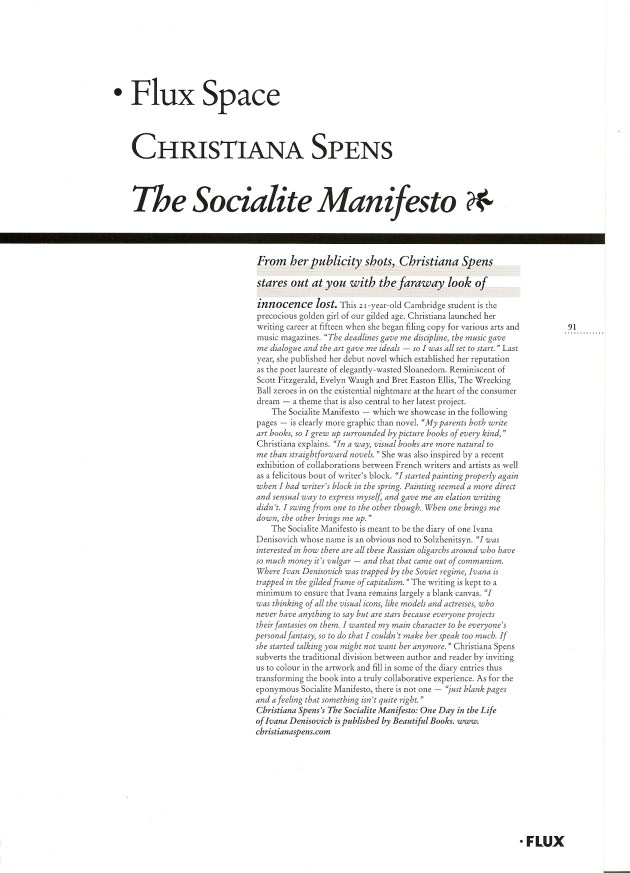
From her publicity shots, Christiana Spens stares out at you with the faraway look of innocence lost. This 21-year-old Cambridge student is the precocious golden girl of our gilded age. Christiana launched her writing career at fifteen when she began filing copy for various arts and music magazines. “The deadlines gave me discipline, the music gave me dialogue and the art gave me ideals — so I was all set to start.” Last year, she published her debut novel which established her reputation as the poet laureate of elegantly-wasted Sloanedom. Reminiscent of Scott Fitzgerald, Evelyn Waugh and Bret Easton Ellis, The Wrecking Ball zeroes in on the existential nightmare at the heart of the consumer dream — a theme that is also central to her latest project.

The Socialite Manifesto — which we showcase in the following pages — is clearly more graphic than novel. “My parents both write art books, so I grew up surrounded by picture books of every kind,” Christiana explains. “In a way, visual books are more natural to me than straightforward novels.” She was also inspired by a recent exhibition of collaborations between French writers and artists as well as a felicitous bout of writer’s block. “I started painting properly again when I had writer’s block in the spring. Painting seemed a more direct and sensual way to express myself, and gave me an elation writing didn’t. I swing from one to the other though. When one brings me down, the other brings me up.”

The Socialite Manifesto is meant to be the diary of one Ivana Denisovich whose name is an obvious nod to Solzhenitsyn. “I was interested in how there are all these Russian oligarchs around who have so much money it’s vulgar — and that that came out of communism. Where Ivan Denisovich was trapped by the Soviet regime, Ivana is trapped in the gilded frame of capitalism.” The writing is kept to a minimum to ensure that Ivana remains largely a blank canvas. “I was thinking of all the visual icons, like models and actresses, who never have anything to say but are stars because everyone projects their fantasies on them. I wanted my main character to be everyone’s personal fantasy, so to do that I couldn’t make her speak too much. If she started talking you might not want her anymore.” Christiana Spens subverts the traditional division between author and reader by inviting us to colour in the artwork and fill in some of the diary entries thus transforming the book into a truly collaborative experience. As for the eponymous Socialite Manifesto, there is not one — “just blank pages and a feeling that something isn’t quite right.”

2

1

Why a 17th-Century Novel is a Hot Political Issue in France

409692229_e75d124f7c_t

This appeared in Guardian Books on 31 March 2009:

Why a 17th-Century Novel is a Hot Poltical Issue in France

Nicolas Sarkozy’s well-publicised scorn has turned The Princess of Cleves into a focus for opponents of the French president

ns4

During a meeting back in February 2006, Nicolas Sarkozy took the opportunity to mock the “sadist or idiot” who had seen fit to include questions about a 17th-century novel in an exam for public sector workers. “When was the last time you asked a counter clerk what she thought of The Princess of Cleves?” he enquired, playing to the gallery. Cue laughter from the audience. The future president’s point was a moot one: just because an acquaintance with the classics isn’t strictly necessary to perform administrative tasks — menial or otherwise — it doesn’t mean it should be discouraged. What was doubtless intended as a populist plea for more common sense came across­ as haughty philistinism. Should time and money be wasted teaching counter clerks to read above their station? Do these people want to end up crushed by a bookcase à la Leonard Bast? Let them eat Da Vinci Code!

But the presidential aspersions cast on Madame de La Fayette‘s masterpiece have kept coming. Last year, for instance, Sarkozy declared that voluntary work should be taken into account when civil servants are considered for promotion. It’s just as important as knowing The Princess of Cleves off by heart, the clearly traumatised head of state argued. He went on to confess, in a joking tone, that he had “suffered” at the pages of that confounded novel as a schoolboy, which prompted Régis Jauffret — a famous author — to surmise that his mother must have soundly spanked him for getting a poor mark on the subject. Le Figaro, meanwhile, suggested that the president’s aversion may be due to the fact that his personal secretary (allegedly) failed an exam because she was incapable of saying who had written the book — ironic, given that its authorship remains shrouded in mystery (it’s now generally thought to be a collective work orchestrated by Mme de La Fayette).

So what’s the story with this book, so famous in France, so little-known elsewhere? The Princess of Cleves is undoubtedly a literary landmark. It is widely regarded as one of the first historical and psychological novels; indeed, it’s one of the first novels full stop. Its intellectual take on matters of the heart made it a template for much French literature and cinema. Yet, in spite of its brilliance, it is also a resolutely old-fashioned tale of unconsummated passion in which duty triumphs over love — one that most French people are force-fed at school and are happy never to read again. Until now, that is.

Sarkozy’s personal vendetta — cloaked in anti-elitist demagoguery — has managed to turn The Princess of Cleves into an unlikely symbol of political resistance. In the eyes of many, it now exemplifies the sheer effusion of a culture that cannot be squared with this government’s vulgar mercantile ethos. Christophe Honoré was so incensed by the president’s declarations that he adapted the supposedly irrelevant novel into a teen movie set in a Parisian lycée (La Belle Personne). University lecturers and students, who have been on strike against governmental reforms for the past two months, have organised several marathon readings up and down the country. The most prominent one so far was staged outside the Panthéon in Paris: Louis Garrel, who played a leading part in Honoré’s film, was among the numerous people who took turns to read five-minute extracts until the last sentence was uttered more than six hours later. The book has been claimed by sundry protesters and declaimed through megaphones during recent demonstrations where banners bearing messages of support —­ “Free the Princess of Cleves” —­ also flourished. A pastiche of the novel, drawing parallels between Henry II‘s lavish court life and Sarkozy’s bling-bling presidential style, is doing the rounds in academic circles. Heavyweight politicians (Ségolène Royal, François Bayrou) and intellectuals (Régis Debray, Elisabeth Badinter) have publicly sided with Mme de La Fayette. On television, Jauffret invited every French citizen to send a copy of the book to the Élysee Palace in protest at Sarkozy’s “glorification of ignorance”. The novel even sold out at the recent Paris book fair and more than 2,000 “I’m reading The Princess of Cleves” badges were snapped up in record time (for those who can’t lay their hands on one of them, you can join the inevitable Facebook group). When Télérama, France’s top cultural weekly, asked 100 writers to name their favourite books, The Princess of Cleves came third behind Proust’s In Search of Lost Time and Joyce’s Ulysses. Such a result would have been highly unlikely pre-Sarkozy.

France may no longer be the centre of world culture, but culture remains at the centre of what it means to be French. Ask any counter clerk.

The Resurrection of Guy Debord

409692229_e75d124f7c_t

This appeared in the Guardian Books blog on 18 March 2009:

The Resurrection of Guy Debord

The situationist arch-rebel has finally been recognised as a ‘national treasure’ in France – but would he have appreciated it?

demonstration-in-paris-30-002

Guy-Ernest Debord would be spinning in his grave — had he not been cremated following his suicide in 1994. The arch-rebel who prided himself on fully deserving society’s “universal hatred” has now officially been recognised as a “national treasure” in his homeland.

The French government has duly stepped in to prevent Yale University from acquiring his personal archives, which contain almost everything he ever produced from the 1950s onwards: films, notes, drafts, unpublished works and corrected proofs, as well as his entire library, typewriter and spectacles. The crowning jewel is, of course, the manuscript of The Society of the Spectacle, Debord’s devastating pre-emptive strike on virtual reality. The small wooden table on which his magnum opus was composed is also thrown in.

It’s difficult to convey how bizarre it is to hear Christine Albanel — Sarkozy’s minister of culture — describing the revolutionary Debord as “one of the last great French intellectuals” of the second half of the 20th century. A love-in between a resurrected Andreas Baader and Angela Merkel would be only marginally more surprising. Then again, intellectuals have been something of a Gallic speciality ever since the Dreyfus Affair. They’re accorded the privileged status usually reserved for the likes of Bono on these shores. Jean-Paul Sartre’s funeral, in 1980, attracted some 50,000 punters. I doubt whether Noam Chomsky or Tom Paulin will top that.

But however incongruous her position, Madame Albanel is spot-on: no one — not even his sworn ideological enemies — can deny Debord’s importance. Even though the young prankster soon turned into a curmudgeonly old soak, his influence is all-pervasive. In fact, it was precisely because he hated the modern world with a passion that he was able to analyse it so presciently. “All that was once directly lived has become mere representation,” he observes in the opening pages of The Society of the Spectacle — a statement that’s only grown in truth since he made it, back in 1967.

Howls for Sade, his first movie, certainly was not “mere representation”. It was the cinematographic equivalent of a meeting between Yves Klein’s monochromes and John Cage’s 4′ 33″: the screen remains blank throughout — all-white when there is some dialogue and all-black the rest of the time. During the last 20 minutes, the film plays itself out in total silence and obscurity.

Guy Debord co-founded not one, but two, radical movements: the Lettrist International (1952) and the more famous Situationist International (1957), which popularised concepts such as “dérive” and “détournement”. The situationists’ hour of glory was undoubtedly the student uprising of May 1968, which they partly shaped, but their influence has kept on growing ever since, from Malcolm McLaren and Jamie Reid‘s work with the Sex Pistols to the current crop of British psychogeographers (Iain Sinclair, Will Self, Stewart Home et al) via Factory Records and The Idler‘s anti-work ethic.

In 1959, Debord and the artist Asger Jorn published Mémoires, which was bound in sandpaper so that it would attack any book placed next to it. For years, this lethal dust jacket served as a perfect symbol of Debord’s abrasiveness: he was the ultimate outsider whose ideas could never be assimilated by the mainstream. So what went wrong?

The official recognition of Debord’s work tends to dissociate the revolutionary from the writer whose classical prose style has been compared with that of great memorialists such as Saint-Simon. This negates the situationist belief that politics, literature and art must go hand in hand: “The point is not to put poetry at the service of revolution, but to put revolution at the service of poetry”. Revolution was supposed to lead to the “supercession of art” by enabling human beings to live poetry and become works of art. From this point of view, Debord belongs to the tradition of dadaists and surrealists such as Jacques Vaché, Arthur Cravan or Boris Poplavsky.

“There is no such thing as a moral or an immoral book,” Oscar Wilde famously wrote. “Books are well written, or badly written. That is all.” The French have long made this aphorism their own, as exemplified by the reception given to the likes of Rimbaud, Céline, Jean Genet or Dennis Cooper. It seems that the only crime an author can commit on the other side of the Channel is poor writing — although you can always count on a murderer for a fancy prose style.