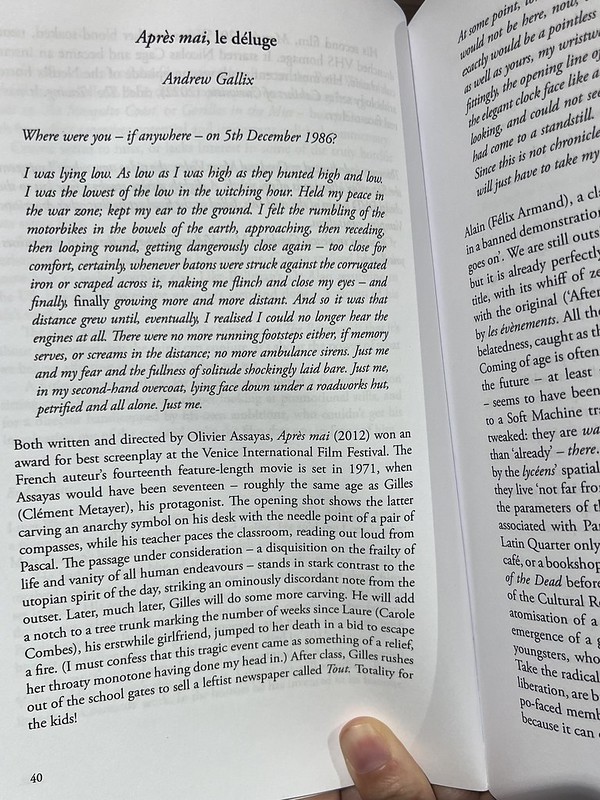
Unwords (published on 18th January 2024) is now available for pre-order here and elsewhere.

My new book, Unwords, comes out in January 2024.
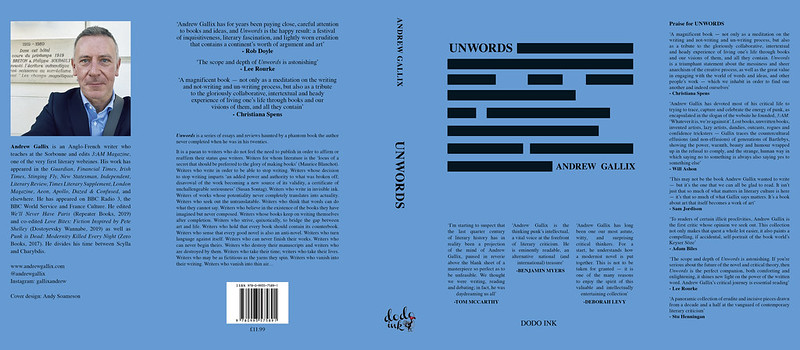
Here is “Millenial Edgelord”, my interview with Susan Finlay, 3:AM Magazine, 27 August 2023.

Andrew Gallix: At the beginning of The Lives of the Artists, you write, ‘I’ve always been scared of writing a memoir in case I come across as unlikable or worse still boring’. There’s absolutely no risk of that, but I wonder if this fear may account, at least in part, for the book’s shapeshifting quality (it includes poems, emails, a PowerPoint presentation, a screenplay, a chapter to be read in a ‘slam’ style…)?
Susan Finlay: A friend of a similar age recently referred to her ‘first person aversion’ and this is something I can definitely relate to. One of the things I became aware of when writing The Lives of the Artists, was that although I like to think of myself as having a youthful outlook, there’s a real difference between my millennial contemporaries and gen z in terms of how we present ourselves. Taking selfies, sharing family photos, mental health issues — you name it — on social media just isn’t something I feel able to do without huge amounts of anxiety/cringe. At the same time, I suffer from big time FOMO and like talking about myself. So yes, the ‘shapeshifting’ is a way of doing/not doing this, and containing both my repulsion of and desire for exposure simultaneously.
AG: You mention a promotional article in which you’d referred to your ‘younger selves’. Sadly, you go on to explain, the plural was edited out and turned into a singular in the published version. You have now got your revenge with The Lives of the Artists — a deliciously paradoxical choice of title for a memoir. Could you talk to us about this emphasis on a plural self, which is so refreshing in this age of navel-gazing?
SF: When I was at art college, the question of Identity with a capital ‘I’ was a big thing. I remember Anouchka Grose coming into give a guest lecturer, and how she used the example of a shopping list to explain the ways in which identity can be regarded as being in a permanent state of flux: if the person who made the list was the same person as the one who arrived at the shop, then the list would be obsolete. Rather, you write things down to remind the future you of what the past you thought that they would want. This really stuck with me, not only the idea of different selves, but different selves leaving reminders for each other, and trying to predict who else they might become. It’s also a convenient way to escape taking responsibility for the less pleasant aspects of oneself: ‘But that was the old me!’
AG: You recount how you once posted the portrait of another Susan — Susan Sontag — in lieu of your likeness on your website. Are you doing something similar here, where each chapter is prefaced with the reproduction of a self-portrait by a female artist? How did you go about choosing these frontispieces, and how do you see them interacting with the text? Why is one self-portrait male?
SF: Yes, I am, or I’m trying to. The choices of frontispiece were informed by a number of things. First, I wanted artists who also chose to portray themselves as someone else in their portrait, or to link their image to a particular profession, which as I’m writing this after a bout of insomnia at 5AM and feeling pretty lazy I’m going to say made it ‘a bit meta’. Second, I liked the idea of giving equal weight to relatively unknown female artists alongside the better known ones. Third, there was no budget so I had to choose images that weren’t in copyright. I’m not sure why I chose one male figure, other than I liked his expression and felt I could relate to it somehow. And because a small press anti-memoir taking pops at the arts establishment does feel kind of David and Goliath.
AG: The title of your book is probably a nod to Giorgio Vasari’s The Lives of the Most Excellent Painters, Sculptors, and Architects as one of the two epigraphs is from this 16th century art historian. Could you tell us about his praise of rough sketches — their spontaneity and energy — and how this relates to your own work?
SF: Well, like the idea of plural selves it can function as a get-out clause for bad behaviour (or to put it nicely, poetic licence). It’s also a reaction to the type of soulless, overworked books that those very prestigious creative writing programmes sometimes (but by no means always) produce: technically they’re perfect but also boring because you can still see through all the ‘tricks’. That said, although my first drafts are always written in a hurried fever dream, I write literally hundreds of versions of each book. So, while I aim for a spontaneous feel, in reality there’s a lot of mundane grind behind it.
AG: Does the title of your book also imply that your life as an artist has an exemplary quality in that it mirrors the lives of many other struggling up-and-coming artists?
SF: I like to think so. I mean, feeling like you’re in the cool gang, that’s the reward.
AG: You talk about the hardship (juggling multiple minimum-wage jobs, moving back in with your parents on several occasions, etc.) you encountered as a budding artist who — unlike most full-time artists — wasn’t ‘seriously loaded’. There is a great deal of social satire here (the posh conservatives who ‘identify as queer’; correct English defined as ‘the dialect of the ruling class’ etc.) as in The Jacques Lacan Foundation. Could you please talk to us about this?
SF: The last few years has seen some fabulous changes concerning diversity within the arts — but class is the one area where the need for change still goes largely unacknowledged. 82% of people in England and Wales identify as white. Around 92% of them attend or have attended state schools. Yet big publishers and blue-chip galleries are, by and large, populated by disproportionately large amounts of white, privately educated people. My theory is that such people are (sometimes) happy to champion works by people of colour, because they believe that in so doing, they will be perceived as enlightened, risk-taking members of the majority. In direct contrast, to highlight the lack of people from financially underprivileged backgrounds also highlights that they belong to an elitist minority — and who wants to highlight that?
Not only does this situation often result in ‘fake diversity’, whereby publishing a book by a Nigerian heiress becomes an example of an ‘engagement with multicultural Britain,’ it also prevents deeper, structural change from occurring. Take for example the mysterious ‘readers’ involved in the vast majority of literary prizes. Yes, the official panel of judges includes those from a variety of ethnic and socio-economic backgrounds, but the 20 or so entries that they actually choose from are, by and large, still selected by white upper-middle-class people. And things won’t really change until we actually talk about these things.
Phew! I could (and often do) bore for England on this topic!
AG: Your move to Berlin was motivated, in part, by the fact that living a bohemian lifestyle in London had become too costly. As you put it, ‘contrary to popular opinion you can’t be really poor — or poor without a safety net — and bohemian’. Do you think Berlin is to contemporary artists and writers what Paris was, say, to the Lost Generation?
SF: Yes, in that they’ll be an expat artist or writer in pretty much every Berlin cafe you visit because it’s still cheap enough to allow you to waste time (but in a good way). No, in that that Parisian moment was just so unique, reckless, and stylish that I don’t think anything can match it. It is my fantasy of an artist’s life.
AG: Your memoir seems to be almost as much about an artistic lifestyle — with an emphasis on style (‘I bought a pair of white jeans because I was thinking “casual at Cannes”’) — as about your life as an artist (in fact, it’s your passion for ‘music and clothes’ that guided you towards art in the first place). You remark, for instance, that ‘it’s so nice to wander through an art exhibition and feel as if I’m my idea of myself’. Is this why you describe cinema as ‘the highest art form’ — because it comes closest to bridging the gap between art and life?
SF: Well, it is now! I love that reading and I’m keen to ‘borrow’ it. However, when I wrote the line, I was thinking more about how film combines writing, visuals, music, and so on and demands skill in lots of different areas. Also, something about the way it can make one feel — or not feel — that time is passing. Also, glamour, yes, it has a lot to do with that too, and that (supposedly) Lacanian thing of seeing a beautiful, poetic figure on the screen and thinking ‘Hey, that could be me…’.
AG: Following on from the previous question, you are particularly attracted to a specific kind of wasted glamour once found in style magazines, commercials, and films. It is best illustrated by the final sentence (‘“Well, you’re never too old to get into smack’”). Could you tell us about this?
SF: Again, I think this goes back to the difference between millennials and gen z, in that I came of age reading about ‘cocaine Kate’, Mark E Smith, and deliberately, wilfully provocative advertising for Dunlop tyres. Reading transphobic Guardian columnists gets me every bit as riled up as the next hipster-leftie, but TBH I’m a massive edgelord too. I know smoking is bad for your health and that few women can achieve the same physique as Lily-Rose Depp without an eating disorder, but when I see her smoking in her little bondage-style bikini I still think she looks cool. Another way of putting it, is that I’ve always been seduced by ‘wasted figures’, because I always will be seduced by anyone who appears young and in the moment enough to be indifferent to death. Deep down I think all sensible people are, even if, being sensible, they don’t admit it.

AG: During a lecture you’re asked to give on your practice (and which you don’t give due to the pandemic), you inform students that on your website your work as an artist is separate from your work as a writer. You go on to add, ‘Of course, in reality there is an overlap, both in that my tastes are my tastes regardless of the medium and that my whole sensibility and frame of reference is intensely art school’. Do you think you approach writing differently because you’re also an artist?
SF: In a word, yes. I’ve always been more interested in whether something can be said to have cultural value than whether it is ‘good’. Similarly, the concept of being or not being a ‘literary’ writer strikes me as an irrelevant concern. That definitely comes from art school (although not necessarily the art world), a place where they also teach you to take a gun to a knife fight, spit on the graves of your heroes, and that clothes always always maketh the man/woman/just no to even having to explain myself to you.
AG: Are you afraid of losing your ‘dual artist-writer identity’, of being viewed increasingly as a writer rather than an artist who (also) writes; whose writing derives from her art practice? Do you think this would entail some kind of loss?
SF: This question really hit a nerve. Yes I do, yes to an extent I have already, and yes it is a big loss. Last week I visited two friends at their studios and I realised how completely out-of-touch I am. I still paint, but in a Sunday painter way — i.e. for pleasure only — whereas previously it was all about the struggle to create something new and to show that I was really up-to-date on all the shows. At the same time, I’ve never got the sense that I belong in the world of ‘proper writers’, so the current situation makes me feel really weird: special on a good day, slightly lost on a bad one.
AG: The last two chapters are truly extraordinary. I won’t describe them because that would spoil the reader’s enjoyment, but perhaps you could give us an insight into their composition?
SF: What a lovely thing to say. I guess, this is the point where I should give Rachel Cattle some credit. Obviously, the editors I’ve not gelled with make more interesting copy, so they’re the ones that appear in the book, but I’ve been lucky enough to work with some excellent ones too. Rachel and I have very similar tastes and backgrounds, and she totally got where I was coming from. Whenever there was a particularly large, associative leap, or a switch between time periods she’d put ‘You could push this further’ in the comments. I guess that loops back to my being a millennial edgelord — I like being told to push it.
AG: What’s next, Susan?
SF: Currently, I’m working on a sci-fi called The Ultraviolet Catastrophe — a bit of a departure. It’s kind of a space race satire. The draft seems to have confused a lot of people.
“Haunted by the Music.” Review of August Blue by Deborah Levy, The Irish Times, 13 May 2023, p. 26.

A character in Swimming Home (2011), Deborah Levy’s breakthrough title, confides that she only enjoys biographies once the subjects have escaped “from their family, and spend the rest of their life getting over them”. In August Blue, her eighth novel, the author reprises this approach, but flips it round. The family Elsa is striving to get over is the one she never had, hence the question that haunts this book, lending it a spectral quality: how do you escape from the presence of absence?
Elsa M Anderson, the young protagonist, has quite a back story to contend with. Having been abandoned at birth by her mother, this piano prodigy was then “gifted” (authorial pun intended) by her foster parents to Arthur Goldstein, so that she could become a resident pupil at his prestigious music school. Goldstein, a diminutive but flamboyant aesthete, moulds his protégée into a virtuoso performer of international repute. He regards Elsa as his “child muse” rather than simply his child, encouraging her — through the cultivation of her talent — to dwell in a higher abode: “He meant a home in art”. The art of others is what he really meant. Although he cares for her deeply, as becomes apparent in his dying days, Goldstein discouraged Elsa’s “early attempts at composition”, threatened as he was by her ability to “hear something that he did not understand”.
Three weeks prior to the opening scene, this “something” — an “embryonic symphony” — had infiltrated the piano concerto Elsa was interpreting at Vienna’s Golden Hall. Her hands (insured for millions of dollars) “refused to play” the score despite the conductor’s baton-wielding histrionics: for a few minutes, Elsa “ceased to inhabit Rachmaninov’s sadness”, and dared to inhabit her own. She then walked off stage, sabotaging her career but reclaiming her life. As a prelude to this very public breakdown, she had dyed her hair blue, signalling a defiant “separation from [her] DNA”, but also from her mentor, whose “hostage” she had been since the age of six.
After rejecting the “old composition”, Elsa is free to dance to a new tune. An all-pervasive mood of “hyper-alert connections to everything” — not dissimilar to Levy’s adventurous free-associative prose — holds sway as she peregrinates through Athens, Paris, London and Sardinia. Her choice of creation (over interpretation) engenders a proliferation of duplications. Timelines overlap and locales collide in an intricate network of uncanny echoes exemplified by the ants that run along the rim of Elsa’s bath in both her London and Paris flats: “They had found a portal to all my worlds”. The non-binary teenager’s refusal to become their father’s “little me” likewise mirrors the heroine’s quest for identity and autonomy.
Elsa, however, is borne back into the past as she ventures into the future. The repressed returns in various guises, particularly in the shape of a pair of mechanical horses purchased by a young woman in an Athens flea market. These knick-knacks conjure up a recurring childhood memory — that of a piano being pulled by horses across a field — whose significance is slowly revealed to character and reader alike.
Not only does Elsa feel that the mechanical horses have somehow been stolen from her, but she is also convinced that the stranger at the market is in fact her doppelgänger. Although she is in her early 30s, like Elsa, and wears a very similar raincoat, the two women are in no way identical. Yet the protagonist seems to be in telepathic communication with this “psychic double” who, she believes, is stalking her across several countries. Elsa retrieves the hat the woman has forgotten, vowing to hand it back in exchange for the totemic horses.
The extent to which the doppelgänger is merely a figment of her lonely imagination, an idealised version of herself (“Perhaps she was a little more than I was”), or even her polar opposite in some parallel quantum universe remains open to interpretation. With her “attitude and confidence”, she certainly seems to embody the self-composure that the newly emancipated Elsa aspires to: “Perched between her lips was a fat cigar. Glowing at the end. It was a poke at life. A provocation”. At times, this “unlikely double” almost seems to merge with another phantom figure — that of the birth mother.
“My words were smaller than my feelings,” Elsa laments. The novelist’s achievement is to have found words equal to hers. Deborah Levy is now regarded as a grande dame of literature, but she remains as vital as ever, and August Blue is a mistresspiece.


© Andrew Gallix
“How Modern Artists Caught the Doodle Bug.” Apollo, 18 April 2023.

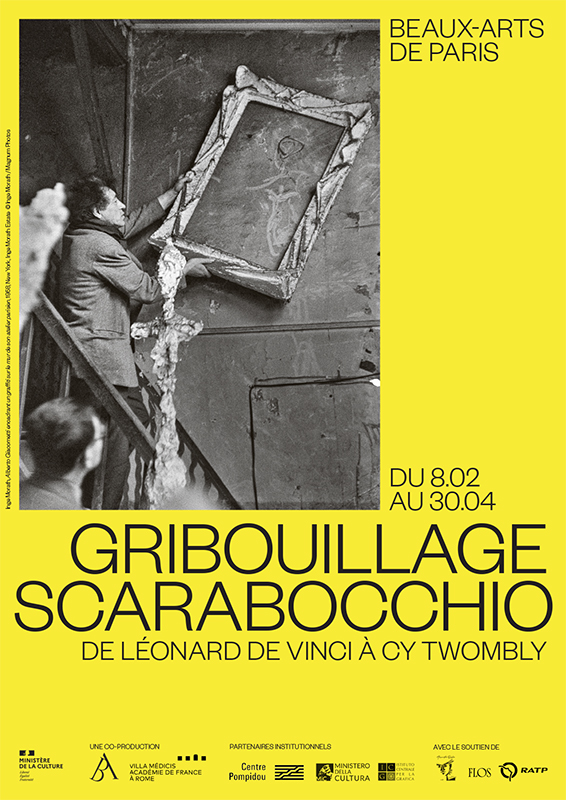
Imagine Dubuffet or Basquiat scrawling on the back of a Michelangelo and you get a good idea of the first impressions of a visitor to ‘Gribouillage/Scarabocchio: From Leonardo da Vinci to Cy Twombly’, currently at the Beaux-Arts de Paris. Curated by Francesca Alberti and Diane H. Bodart, the show explores the striking, perhaps even disquieting resemblance between doodles discovered on works by the Renaissance masters and those of modern artists.
This sumptuously presented exhibition maintains an achronological arrangement throughout. The antique cast of a profile carved into a segment of wall from Alberto Giacometti’s Paris studio hangs cheek by jowl, at the entrance, with the drawing of another profile, discovered — along with a profusion of small but intricate sketches — behind a fresco by Benozzo Gozzoli (1471–72). On a nearby partition, works by Cy Twombly (1967) are flanked by Claude Lorrain drafts (1630) and a Delacroix lithograph (1827), its thick borders alive with the artist’s marginalia.
The question that hangs over the entire exhibition is whether the doodles of the past should be interpreted in the light of artistic modernity. In the Renaissance, prevailing wisdom dictated that the hand was the instrument of reason. By contrast, Leonardo da Vinci himself described his sketching technique as componimento inculto — literally, uncultivated compositions. Leonardo advocated letting go; allowing the hand to drift on the page — guided by happenstance or what we would now call the unconscious — until latent figures surface. The finest example of this vagabond style is Stefano della Bella’s 1648 study of a young man falling to his death, seemingly submerged by the swirling scribbles from which he emerges.
The exhibition abounds in variations on Leonardo’s template: André Masson’s surrealist automatic drawings, Robert Breer’s minimalist cartoon, A Man and His Dog Out for Air (1957), or Henri Michaux’s suitably hypnotic pieces produced under the influence of mescaline. Physical constraints are frequently adopted in pursuit of spontaneity: Salvador Dalí drawing while pleasuring himself; Willem de Kooning electing to draw with his left hand or with several pencils at the same time. A film of 1995 shows Robert Morris performing one of his numerous Blind Time compositions. The film finds an echo in Brassaï’s photograph of Henri Matisse from 1939, standing bold upright beside the face he has just scrawled on a door with closed eyes and a piece of chalk, while also calling to mind the spiritualism that inspired Victor Hugo’s ink sketches.

For Paul Klee, who naturally looms large here, the activities of drawing and writing were identical. Many of the works on display — those of Klee, Giacometti, Masson, Twombly, and Steinberg in particular — conjure up Roland Barthes’ famous essays on the artistic tradition of ‘illegible’ writing, which, he felt, held out the utopian promise of a world free from the tyranny of preordained meaning.
But the exhibition also revels in the subversive charge of doodling. The section where Renaissance sketches are presented vertically on counters — allowing you to see the official production on one side and the unofficial on the other — provides the illicit thrill of a peep show. Images are sometimes of a scatological or sexual nature. There are caricatures of cuckolds with outsize horns from the 17th century and photographs of criminals’ tattoos taken by the French police around the Second World War. A diminutive sketch by Michelangelo represents a young man defecating. James Ensor draws a man urinating against a graffitied wall on which someone has scrawled ‘Ensor is mad’! The artistic production of the mentally ill is explored, as well as that of bored office clerks and children. ‘It took me four years to paint like Raphael, but a lifetime to paint like a child,’ said Picasso. Visiting this exhibition, one gets the impression that he was by no means the only one.
Like its subject matter, ‘Gribouillage’ is an irreverent, provocative and playful show, but it also reaffirms the power that doodles hold over us in the modern era. As George Steiner once remarked, ‘modernity often prefers the sketch to the finished painting’ — both because it gets us closer to the original inspiration of the artist and because it remains unfinished, in the process of becoming.
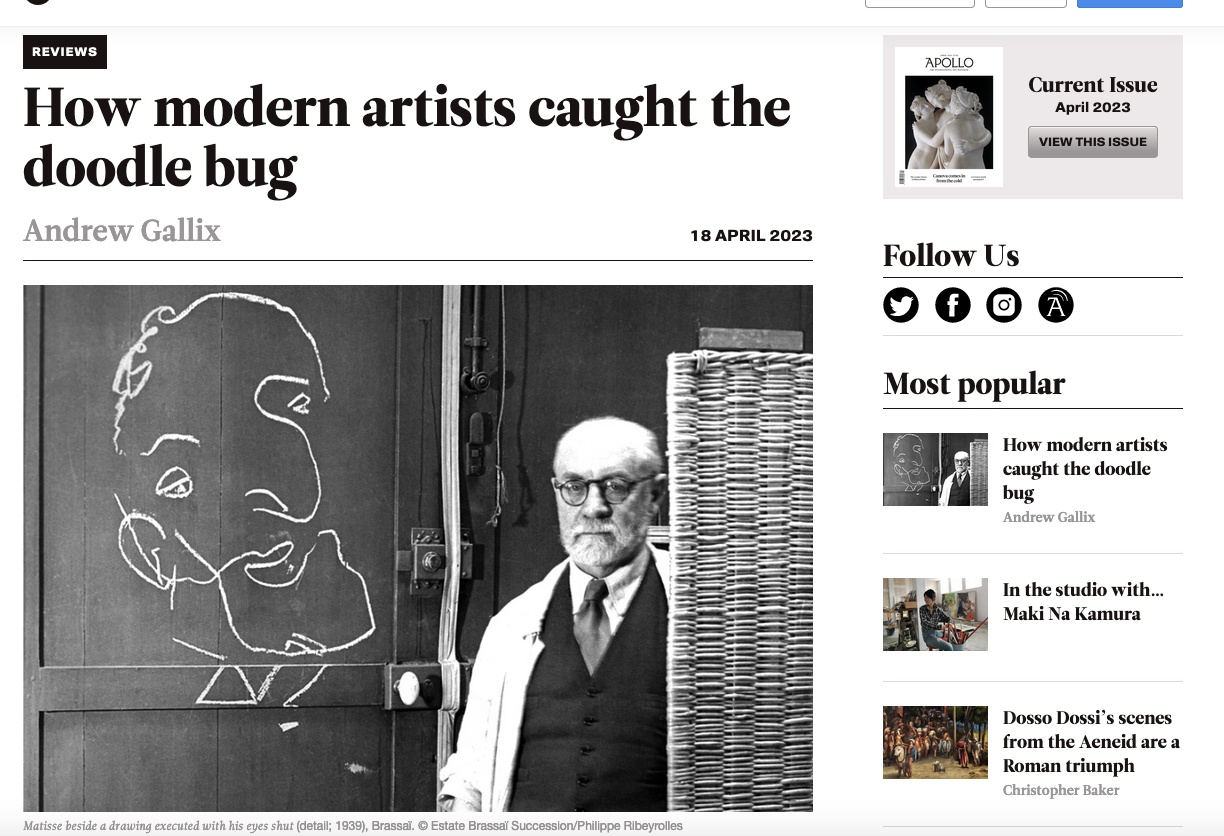
Here is a different, longer, unpublished version of the above review:
To misquote Borges, all artists create their own precursors. ‘Gribouillage de Léonard de Vinci à Cy Twombly’, currently at the Beaux-Arts de Paris, seems predicated on such a principle. The premise of this sumptuous exhibition, curated by Francesca Alberti and Diane H. Bodart, is the striking — at times even disquieting — resemblance between doodles discovered on works by the Renaissance masters and those of prominent modern artists. Imagine Dubuffet or Basquiat scrawling on the back of a Michelangelo and you get a good idea of the visitor’s initial impression, sustained by a studiously achronological arrangement, with ancient and modern juxtaposed throughout. The antique cast of a profile carved into a segment of wall from Alberto Giacometti’s Paris studio hangs cheek by jowl, at the entrance, with the drawing of another profile, discovered — along with a profusion of small but intricate sketches — behind a fresco by Benozzo Gozzoli (1471-1472). On a nearby partition, works by Cy Twombly (1967) are flanked by Claude Lorrain drafts (1630) and a Delacroix lithograph (1827), its thick borders alive with the artist’s marginalia. Thus reframed, should the doodles of yesteryear be reinterpreted à rebours, in the light of artistic modernity? This question, that hangs over the entire exhibition, is illustrated by Inge Morath’s black-and-white photograph of Giacometti holding up an empty frame to showcase a white figure daubed on his studio wall.
The existence of a rival tradition — whose origins may stretch back to the cave paintings painstakingly reproduced by Henri Breuil or the Pompeian graffiti photographed by Brassaï, both on display here — is embodied by Leonardo da Vinci himself. The sketching technique he described as componimento inculto — literally, uncultivated compositions — ran counter to the then prevailing notion that the artist’s hand should be the instrument of reason. Contrarily, Leonardo advocated letting go; allowing the hand to drift on the page — guided by happenstance or what we would now call the unconscious — until latent figures surface from the tohubohu. The finest example of this vagabond style is Steffano della Bella’s 1648 study of a young man falling to his death, seemingly submerged by the swirling scribbles he emerges from. Robert Breer’s minimalist cartoon, A Man and His Dog Out for Air (1957), comes a close second.
The exhibition abounds in variations on Leonardo’s template: André Masson’s surrealist automatic drawings, or Henri Michaux’s suitably hypnotic pieces produced under the influence of mescaline. Physical constraints are frequently adopted in pursuit of spontaneity: Salvador Dalí drawing while pleasuring himself; Willem de Kooning electing to draw with his left hand or with several pencils at the same time. A 1995 film shows Robert Morris, eyes wide shut, performing, as it were, one of his numerous Blind Time compositions. The latter echoes Brassaï’s 1939 photograph of Henri Matisse standing bold upright beside the face he has just scrawled on a door with closed eyes and a piece of chalk. (We are not far off from the spiritualism that inspired Victor Hugo’s ink sketches.) Svetlana and Igor Kopystiansky’s short film, Steps Sole Sound (1979), put me in mind of Robert Walser — the infamous picture of footsteps in the snow leading up to the dead writer’s prone body — or the Ann Quin character who abandons conventional art in favour of making ‘paintings with her footprints in the snow’.
Doodling, especially in the shape of scribbles and squiggles, lies at the intersection of art and writing. It is the liminal space where the one becomes the other. For Paul Klee, who naturally looms large here, both activities were identical. For most preliterate children too, presumably. Many of the works on display — those of Klee, Giacometti, Masson, Twombly, and Steinberg in particular — conjure up Roland Barthes’ famous essays on the artistic tradition of ‘illegible’ writing, which, he felt, held out the utopian promise of a world free from the tyranny of preordained meaning. The best way to sever the connection between hand and intellect is indeed by deactivating the communicative powers of language itself.
If doodling has gradually come out of the closet and taken centre stage, this sprawling exhibition manages to retain part of its subversive charge. The section where Renaissance sketches are presented vertically on counters — allowing you to see the official production on one side and the unofficial on the other — provides the illicit thrill of a peep show. Images are sometimes of a scatological or sexual nature. There are dick pics from the 16th century, caricatures of cuckolds with outsize horns from the 17th, and photographs of criminals’ tattoos taken by the French police around the Second World War. A diminutive sketch by Michelangelo represents a young man defecating. James Ensor draws a man urinating against a graffitied wall on which someone has scrawled ‘Ensor is mad’! The artistic production of the mentally ill is explored, as well as that of children or bored office clerks à la Bartleby.
Like its subject matter, ‘Gribouillage’ is an irreverent, provocative and ludic show, but it is also an important one. As soon as Western art ceased to be mere imitation of the great works of the past — as soon as it became modern — a glaring gap opened up between inspiration and execution. This is why, as George Steiner remarks, ‘modernity often prefers the sketch to the finished painting’. Not only does it seem closer to the source of origin, but its unfinished nature means that it remains in the process of becoming. Doodling preserves art’s potentiality by gesturing to a future finished work as yet untainted by instantiation.
“New Novel, Old Master.” Review of Robbe-Grillet: L’aventure du Nouveau Roman by Benoît Peeters and Réinventer le roman: Entretiens inédits by Alain Robe-Grillet and Benoît Peeters, Times Literary Supplement, 23-30 December 2022, pp. 24-25.

Alain Robbe-Grillet was born in 1922 — modernism’s annus mirabilis — as though the future nouveau romancier were destined to inherit the experimental spirit of the times, taking postwar literature (and cinema) into uncharted territory. Nabokov, who described La Jalousie (1957) as the greatest love story since Proust, regarded Robbe-Grillet as the foremost French writer of his generation, and for several decades his international reputation, particularly in the United States, would place him firmly in the Camus and Sartre super-league. Yet official commemorations of the centenary of his birth have been conspicuous by their absence in France, a country usually prompt to celebrate its great authors and artists.
In his new biography, Robbe-Grillet: L’aventure du Nouveau Roman, Benoît Peeters suspects that he was deemed too “sexually and politically incorrect” to make the grade. Peeters goes on to suggest that this snub may well have appealed to the novelist’s contrarian temperament, adducing his belated election to the Académie française in 2004. Despite having coveted this accolade since the late 1950s, Robbe-Grillet would never be officially inducted owing to his obstinate refusal to follow protocol — a form of self-sabotage that enabled him to be both an insider and an outsider simultaneously. The arch avant-gardiste was not averse to playing the game, but wanted to do so on his own terms. His agonistic approach to fiction — writing “against” readers rather than “for” them — was matched by his controversial polemics on the novel as a genre. This combative attitude earned him a great deal of enmity at a time when literary matters were still taken very seriously indeed. Peeters reminds us at the outset that if no contemporary writer was ever subjected to so much vitriol (even his funeral elicited a bad write-up in Le Monde), Robbe-Grillet revelled in being reviled. “I owe everything to my opponents”, he once said, reflecting that he had been lucky enough to have had “good enemies” throughout his career. The extreme reactions he regularly inspired seemed, in his eyes, to prove that he was right, spurring him on while also providing his often difficult work with a great deal of free publicity in the mainstream media.
Peeters is a dab hand at biographies, having already produced weighty tomes on Hergé, Jacques Derrida, and Paul Valéry. The challenge here was that Robbe-Grillet had partly pre-empted this exercise with his Romanesques trilogy, published between 1985 and 1994, which combined personal reminiscences (particularly in Le Miroir qui revient) with delirious sexual fantasies (notably in Angélique ou l’enchantement) and outright fiction (see the passages devoted to the shadowy figure of Henri de Corinthe, a putative family friend who may or may not have existed). In the course of these three volumes, the “autobiographical system”, as Robbe-Grillet put it, gradually breaks down.
Another challenge was the sheer volume of material to sift through. Robbe-Grillet’s archives are contained in 459 large boxes — an embarrassment of riches that may serve, as the biographer surmises, as a rampart behind which the author can hide. In 2001 Peeters conducted a series of filmed interviews with the novelist, then almost 80, which were released as a double DVD. They have now been transcribed and published in book form. Réinventer le roman: Entretiens inédits is the perfect companion piece to the biography, giving us direct access not only to the author’s own conversational voice, interpretations and erudition on matters philosophical, historical and even botanical, but also to his jovial good humour and general geniality — characteristics with which he is seldom associated. It often feels, uncannily, as though Robbe-Grillet were giving a running commentary on Peeters’ future biography.
The greatest pitfall would have been to turn Robbe-Grillet into the kind of all-conquering hero he so detested in the novels of Balzac, yet there are definite shades of Rastignac to his boundless ambition. There is also another, more puzzling resemblance. In his infamous 1958 essay, “Nature, humanisme, tragédie”, he claims that in order to appear as true to life as possible, “a good ‘character’ in a [realist] novel must above all be double”. By this token Robbe-Grillet would have made a very good character indeed. As a child he frequently encountered his doppelgänger: he would enter a room and see himself sitting in the armchair. Peeters implies that this was a lifelong occurrence. With this in mind it is striking to note how frequently the question of Robbe-Grillet’s duality (and his duplicity) recurs throughout his career. As a young novelist he scoffed at the notion of vatic inspiration: the creator as a mere conduit, incapable of intelligent reflection on their work. Many of his detractors never forgave him for having the audacity to write novels while producing a theoretical discourse on his practice. The fact that his works were sometimes at odds with his theories enraged them even further — whether this was deliberate, as he later claimed, is open to debate.
The prime example here is La Jalousie — by his own admission (and from the title onwards) a veritable “festival of metaphors” — released at a time when he strongly objected in public to anthropocentric analogies. In the Entretiens Robbe-Grillet claims that some of the more far-fetched theories that were attributed to him, in the early days, actually stemmed from Roland Barthes, who had celebrated his first published novel, Les Gommes (1953), as an instance of object-oriented literature. He further explains that Barthes lost interest in his work as soon as it became patent — with Dans le labyrinthe (1959) — that his interpretations were no longer tenable.
This did not prevent Barthes from accepting to preface Bruce Morrissette’s The Novels of Robbe-Grillet (1963) and giving voice to the idea that there were, in fact, two Robbe-Grillets: the early, anti-humanist one, who slid down the surface of things and a humanist “Robbe-Grillet n° 2”, more preoccupied with symbols and feelings. In his postface to the 1964 paperback edition of Dans le labyrinthe, the theorist Gérard Genette argued, similarly, that Robbe-Grillet was driven to constantly justify himself because he was torn between his “positivist intelligence” and “poetic imagination”. In 1988, when Angélique ou l’enchantement appeared, Bertrand Poirot-Delpech, writing in Le Monde, reprised this view, opposing “Robbe”, the novelist, to “Grillet”, the essayist and critic. This theory was finally borne out — or, rather, enacted — by Franklin J. Matthews, who penned the postface to the 1972 paperback edition of La Maison de rendez-vous: in 2001 a researcher discovered that the “Australian academic” Matthews was none other than Robbe-Grillet himself, who had thus authored both the novel and its critique. In the Entretiens we learn that the writer replicated this pattern by dividing his oeuvre into two discrete periods. In the first, encompassing Les Gommes, Le Voyeur (1955) and La Jalousie (three books whose composition was carefully premeditated), everything is filtered through a single consciousness. Unlike its predecessors, Dans le labyrinthe was no longer based on a pre-existing plot line: the figure of the soldier lost in the city mirrors that of the writer now astray in the meanders of his work. It inaugurated a new period in which the narrative coherence of his early novels disappears altogether, along with most ontological certainties, leaving the text as a battleground, where various consciousnesses are vying for control.
Born and raised in Brest, Robbe-Grillet was a successful young agronomist, studying banana-crop parasites and even producing a face cream containing bull sperm. When attempting to account for his sudden turn to literature in 1950, he invoked “our two gendarmes”, Marx and Freud, according to whom everything is either political or sexual. The political explanation is that he came from a fanatically far-right family who supported Marshal Pétain and the Nazi invaders to the bitter end. The lies on which their values rested led him to reject the “world of ideology, where everything always works; everything is ordered”, including the humanist tenets of literary realism that cover up the messiness of the real world. Despite signing the pro-Algerian Manifesto of the 121 in 1960, Robbe-Grillet would always be suspected, in some quarters, of being a right-winger, notably for his rejection of social realism. Art, for him, is never just a means of embellishing a message: it is the message. A novel is therefore self-sufficient — “expresses nothing but itself” — and its “necessity” has nothing to do with its “utility”, political or otherwise.
The second explanation for Robbe-Grillet opting for literature revolves around his predilection for sadistic sexual practices, which — along with his impotence — set him apart, creating a need for artistic expression. This “sexual difference” manifested itself at an early age, with the porcelain dolls he delighted in torturing or the pictures of women being executed that exerted such a hold over him. Peeters describes his highly unconventional, but very happy, marriage to Catherine Rstakian, which lasted fifty years. In 1955 she offered him a whip as a birthday present; two decades on she offered him a young female admirer who longed to be his slave. At one stage they even shared the same mistress. Not only did she go on to write successful sado-masochistic books, she became a dominatrix, organising lavish S&M soirées. Robbe-Grillet, who was, unsurprisingly, often accused of misogyny, always encouraged her, believing it was important for women to express their sexual fantasies. His own played an increasingly important part in his work, even though he knew they would put off many readers.
He often claimed that the greatest opportunity of his career was that his first novel had been rejected by Gallimard, the embodiment of the French publishing establishment. This paved the way for his close relationship with Jérôme Lindon, at the head of Les Éditions de Minuit (which, ironically, was purchased by Gallimard in 2021), where all his books would be published. He soon became a literary adviser, reading hundreds of manuscripts for Minuit, and recruiting like-minded writers such as Nathalie Sarraute, Marguerite Duras, Michel Butor, Claude Simon and Robert Pinget (Samuel Beckett, an early admirer of Les Gommes, was already in-house). Lindon and Robbe-Grillet, who had a knack for publicity stunts, drew attention to this creative effervescence by capitalizing the phrase “nouveau roman” (new novel), which had been bandied about dismissively by a couple of critics. The Nouveau Roman was never a movement, like the surrealists, where you had to toe a certain line for fear of excommunication, but simply, as Robbe-Grillet put it, “a convenient label for writers seeking to express new relations between Man and the world”. In the late 1950s and early 1960s, he published a series of provocative articles in L’Express, outlining some of these new relations. They were collected in Pour un nouveau roman (1963), his most commercially successful book, which constitutes a devastating critique not only of the ideology that underpins much of nineteenth-century literature, but also of the contemporary novel’s ossification in the Balzacian mould. The novelist’s present task, he argues, is to describe the material world, not to project herself onto it or colonize it by assigning it a meaning; to record the distance between human beings and things without interpreting this distance as a painful division. “Man looks at the world”, but “the world does not look back”. However, in looking at the world, it undergoes a transformation: Robbe-Grillet’s descriptions seem to create their own objects, their own hallucinatory reality.
Benoît Peeters chronicles the ever-shifting alliances of the Nouveau Roman, the rivalry with Michel Butor (who thought Robbe-Grillet was jealous of his success), the rise and fall of Jean Ricardou as the movement’s theoretician, the American conferences; the times when the novelist was more interested in making films (following his collaboration with Alain Resnais on L’Année dernière à Marienbad) or simply living the life of a gentleman farmer, gardening and curating his collection of rare cacti. The Nouveau Roman was indeed the “last great French literary movement”, and it was high time its figurehead had his own biography.


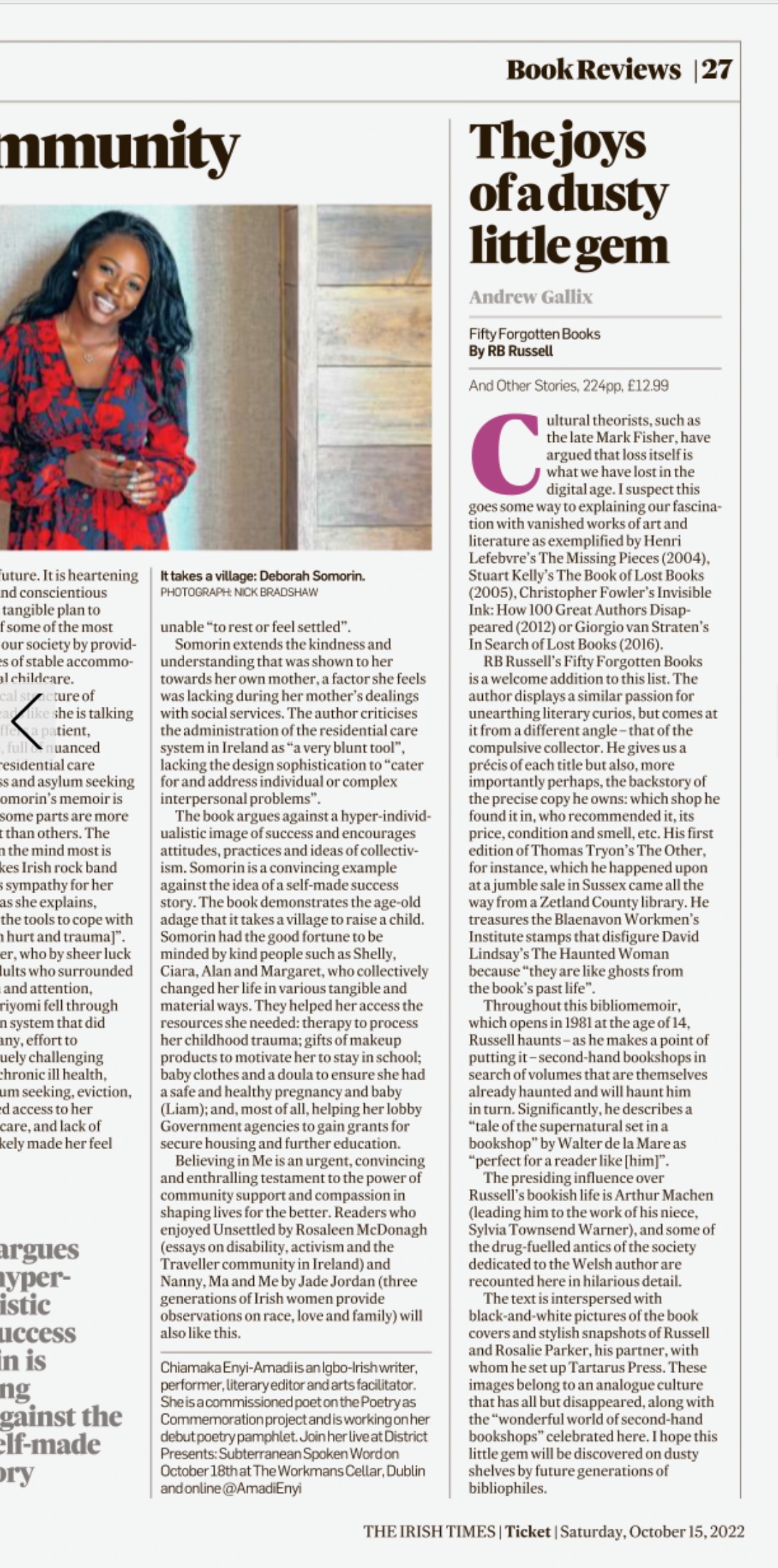
“The Joys of a Dusty Little Gem.” Review of Fifty Forgotten Books by R. B. Russell. The Irish Times, 15 October 2022, p. 27.
Cultural theorists, such as the late Mark Fisher, have argued that loss itself is what we have lost in the digital age. I suspect this goes some way to explaining our fascination with vanished works of art and literature as exemplified by Henri Lefebvre’s The Missing Pieces (2004), Stuart Kelly’s The Book of Lost Books (2005), Christopher Fowler’s Invisible Ink: How 100 Great Authors Disappeared (2012) or Giorgio van Straten’s In Search of Lost Books (2016).
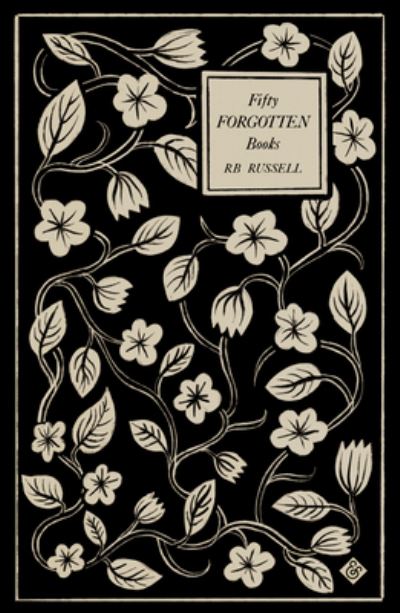
R. B. Russell’s Fifty Forgotten Books is a welcome addition to this list. The author displays a similar passion for unearthing literary curios, but comes at it from a different angle — that of the compulsive collector. He gives us a précis of each title but also, more importantly perhaps, the backstory of the precise copy he owns: which shop he found it in, who recommended it, its price, condition and smell, etc. His first edition of Thomas Tryon’s The Other, for instance, which he happened upon at a jumble sale in Sussex came all the way from a Zetland County library. He treasures the Blaenavon Workmen’s Institute stamps that disfigure David Lindsay’s The Haunted Woman because “they are like ghosts from the book’s past life”.
Throughout this bibliomemoir, which opens in 1981 at the age of 14, Russell haunts — as he makes a point of putting it — second-hand bookshops in search of volumes that are themselves already haunted and will haunt him in turn. Significantly, he describes a “tale of the supernatural set in a bookshop” by Walter de la Mare as “perfect for a reader like [him]”.
The presiding influence over Russell’s bookish life is Arthur Machen (leading him to the work of his niece, Sylvia Townsend Warner), and some of the drug-fuelled antics of the society dedicated to the Welsh author are recounted here in hilarious detail.
The text is interspersed with black-and-white pictures of the book covers and stylish snapshots of Russell and Rosalie Parker, his partner, with whom he set up Tartarus Press. These images belong to an analogue culture that has all but disappeared, along with the “wonderful world of second-hand bookshops” celebrated here. I hope this little gem will be discovered on dusty shelves by future generations of bibliophiles.
“This Year’s Cult Classic.” Review of Bad Eminence by James Greer. The Irish Times, 16 July 2022, p. 16.

Bad Eminence, American author James Greer’s third novel, is the kind of book you open at your peril. The title alone (a reference to Milton’s Satan) should be warning aplenty, but it is my duty to report that a Latin phrase, planted in the opening pages, leads — once read — to instant possession by the devil. By the same token, I strongly advise you not to cut out and ingest the large dot containing a highly potent hallucinogenic, however much the narrator enjoins you to do so.
Things are already weird enough as it is with the regular intrusion of “sponsored content”, the small black-and-white photographs reminiscent of W.G. Sebald (who is name-checked several times), the recurrence of swans and characters called Temple, not to mention the growing sense of psychosis and gradual dissolution of all ontological certainty.
Vanessa Salomon — the wisecracking narratrix — is a young Franco-American translator, blessed with tremendous “genetic gifts” and a knack for nihilistic aphorisms. Thanks to her reputation for tackling works deemed untranslatable, she is hired by Not Michel Houellebecq to translate his new novel before it is even written. What France’s most famous author really covets, however, is another copy without an original: Vanessa’s celebrity “bitch twin sister”. Or is it?
The novel reaches a metatextual crescendo when the heroine parses a sentence she has just written: “I shut the lid of the laptop and headed back to bed”. She points out that this can only have been typed before or after the event, reflecting her dream of a book that would inhabit “the spaces between the binary code of our existence”. “Everything,” she declares, in what amounts to a manifesto, “is in the process either of becoming or unbecoming, and it is the task of the artist not to make something new but to make something present”.
Once the rollicking narrative has caught up with itself, the novel implodes in real-time. It becomes increasingly obvious that transgressive, S&M fantasies from the Robbe-Grillet book Vanessa was translating at the beginning have been contaminating the rest of her life, and that her world is now awash with simulacra and doppelgängers.
Hilarious, exhilarating and mind-blowing, Bad Eminence is this year’s cult classic.


Greer, James. “More Parody Than Satire.” Interview by Andrew Gallix. 3:AM Magazine, 16 July 2022.

3:AM: In Bad Eminence, France’s most famous author, Not Michel Houellebecq (or at least one of them, as there may be two!) asks the narrator-protagonist, Vanessa Salomon, to translate his new novel before he’s even written it. In other words, he wants her to produce a copy without an original. To what extent did Baudrillard’s take on the simulacrum shape your book, and when did you hit upon the idea of the twin (Vanessa claims to have a “bitch twin sister”) as simulacrum?
JG: A Parisian friend once told me that she went to high school with the (now famous) actor Eva Green, and that Eva had a twin sister. Everyone at her school assumed that the twin sister was much more likely to become a famous actor, because she was outgoing and dramatic, whereas Eva was bookish and shy. No idea if that story’s true, but I thought it might make a promising start to . . . something. One of these days I’ll have to read some Baudrillard.
3:AM: Which goes to prove, once again, that you don’t need to have read Baudrillard to be influenced by him!
Not Michel Houellebecq’s impossible demand reflects the primacy of translation — the recurring idea, in the book, that all writing is already a form of translation (of ideas, feelings, the world, into words). As Kafka puts it (in translation!) in The Zürau Aphorisms, “All language is but a poor translation”. Do you share this view to a certain extent?
JG: I don’t know about “poor” — I might substitute the word “failed” or “inadequate” — but I do share his view, and would go further and say that all lived experience is a translation of sense perceptions into stories we tell (ourselves) about ourselves. There are good translations and bad translations, but you always want to read the original when possible. It’s just that it’s almost always not possible.
3:AM: The novel reaches a metatextual crescendo, when Vanessa parses a sentence she has just written: “I shut the lid of the laptop and headed back to bed”. She goes on to point out that this can only have been typed before or after the event. Does this remark reflect her dream of writing a book that would inhabit “the spaces between the binary code of our existence”? Are you also trying to occupy this liminal space?
JG: I don’t think Vanessa is that self-aware, honestly. She strikes me as someone who’s trying to pretend that she’s smarter than she actually is, and throws up a wall of superficial erudition to prevent anyone getting too close. But speaking for myself, yes, that’s exactly what I’m trying to do.
3:AM: Once the narrative has caught up with itself, the novel seems to implode in real time as it becomes increasingly clear that Vanessa’s translations have been contaminating the rest of her life: everything and everyone seems to be a copy — her world is awash with doppelgängers and simulacra. It is, in particular, the Robbe-Grillet novel she is translating at the beginning, which is seeping through, so I was wondering what relationship you had with the nouveau romancier’s work?
JG: An uneasy one. I’ve always been a fan of the way Robbe-Grillet and some of the other writers lumped under that clumsy but useful self-designation tried to expand the possibilities of the novel — not always successfully, but still. They tried. When I write films, for example, I have no choice but to adhere to a specific format, which can also be quite liberating in its own way (like trying to write a sonnet, or build a car); but when I set out to write a novel I can’t seem to help plunging ahead like I’ve just been freed from Making Sense jail, which is a real place that exists. I’m less enamored of some of Robbe-Grillet’s specific obsessions (for example, degrading sexual violence), but a book like Dans le labyrinthe was formative for me, almost comically so. I love a good maze. Of the nouveau roman writers, I tend to prefer Nathalie Sarraute. How I came to hit on Souvenirs du triangle d’or as the urtext for Bad Eminence is a thing no longer accessible by my brain. It just felt right at the time, I guess.

L to R James Greer, Vanessa Salomon. Copyright Thomas Early.
3:AM: Please tell us about the black-and-white photographs. They are obviously reminiscent of W. G. Sebald, who is namechecked several times, but is there also a link with Francesca Woodman, whom Vanessa is obsessed with (to the point of living in her former apartment)?
JG: In an ideal world, i.e. one in which money did not exist, the photos would have been in colour. The nod to Sebald is, as you say obvious, and as with the “sponsored content” both parodic and serious, depending on context. If I could compose pictures half as beautifully as Francesca Woodman did, I would absolutely claim a link there, but I can’t, so I won’t. Nonetheless, her work, which seems to exist in the liminal space you referred to earlier, very much resonates with me, and I hope that resonance is to some degree reflected in the text.
3:AM: Even though the novel is hilarious and very playful, it is also the study of a divided self, isn’t it?
JG: One of my selves emphatically agrees with you. Another thinks you’re crazy. Still another wants to sue, for some reason, but don’t worry, I never listen to any of them.
3:AM: In an age of earnest autofiction and misery memoirs, your novel seems audaciously — almost procatively — ludic and self-referential. Did you have the feeling, when writing Bad Eminence, that you were going against the grain?
JG: I knew as it developed tentacles and tangents that Bad Eminence would likely be swimming against what no one ever calls (but should?) the literary tide. That’s always been the case with me, a person who is not particularly good at swimming. Having said that, I do read more or less everything w/r/t contemporary literature, and enjoy quite a bit of what I read. I didn’t set out to write something in opposition to anything else. My brain doesn’t work that way. I wish I could just write something that people enjoy on a large and commercially successful scale, but — this could be my 90s indierock roots showing — I have an unfortunate tendency to sabotage anything that comes across as overly earnest. I think it’s because I am by nature a sentimental fool and I’m scared that people will find that out and make fun of me. As a result, I often end up writing novels that amuse only me, which is the kind of narrowcasting publishers live for.
3:AM: Why is Bad Eminence being released in the UK before the US?
JG: It’s not, in fact, unless something changed and I’m in the dark (not for the first time). The publication date is the same in the US and the UK, it’s just that And Other Stories, who is publishing the book in both countries, is based in the UK. Because I was writing in the voice of a French/British woman who’d been living in NYC for five years, I was very careful to mix in a confusing array of Anglicisms, Americanisms, clunky literal translations from her French brain into English, and a mishmash of different spellings and made-up words. The overall effect, if I’ve done my job, is to make you think the book was published in the UK before the US.
3:AM: Finally, could you please tell us about the “sponsored content”? At first, I thought it was merely satire, but now I’m not so sure!
JG: Singani 63 is a real brand of liquor imported by a real film director named Steven Soderbergh, with whom I have had a long and fruitful working relationship. Any suggestion that I included his brand in my “sponsored content” in exchange for a better deal on my next project with him is a fabrication. Also, not to pick nits, but I think it’s more parody than satire.