Here is my interview with Tom McCarthy that appeared in 3:AM Magazine on 13 July 2006.

3:AM: It’s very rare, these days, to see a work of literary criticism being given such prominence. Do you agree that this is probably largely due to the fact that the main subject is not Balzac or Baudelaire — two key references here — but a comic-strip hero?
TMcC: First of all, I’m not sure I’d describe Tintin and the Secret of Literature as ‘criticism’. More as an essay. I like the idea of the essay as a primary literary form. You can trace it from David Foster Wallace through Blanchot all the way back to people like Hazlitt. But yes, the fact that it revolves around Tintin and not just Balzac and Baudelaire has certainly helped it get attention — although it wasn’t strategic to do this. I genuinely rate Hergé’s work, and wanted to read it alongside Balzac, Baudelaire, Bergson, Bachelard and all the rest, hopping from one to the other in a set of playful, serendipitous detours — which is exactly what the essay format allows.
3:AM: Your book is very much in the tradition of Barthes‘s Mythologies (an anthology which you fail to mention). I can’t remember if Barthes actually mentions Tintin anywhere, but he certainly could have done. In a way, the two figures go curiously well together: Tintin’s heyday corresponds roughly to that of Barthes and both, today, appear a little quaint. Was it Barthes who inspired this book? After all, your Tintin is primarily a semiologist who “can navigate [a key word in the McCarthy canon] the world of signs” (Tintin and the Secret of Literature p. 22), a deciphering cipher who embodies (along with Snowy?) the presence of absence — the Melvillian “whiteness of the whale” (p. 161) — but also, of course, Barthes’s “écriture blanche”.
TMcC: I do kind of mention Mythologies when I refer to wrestling and tomato tins early on in the book. I love Barthes: he’s a beautiful, generous writer. He never mentions Tintin directly as far as I know, although Derrida, another big presence (or present absence or whatever) in my book, does, glancingly, in The Post Card. Hergé read Barthes; you can see his influence very directly in the final book, Tintin and Alph-Art, in which language becomes a set of physical signs, giant letters which are held up and scrutinised by his characters.
ODETTE’S BITS
3:AM: Are you the first to draw a parallel between Sarrasine and the Tintin corpus? I haven’t read Balzac’s novel, but, from what you write, La Zambinella seems to bear a resemblance to Proust’s Odette de Crécy. Am I mistaken?
TMcC: As far as I know I am the first to draw a parallel between Tintin and Sarrasine. I re-read Barthes’s S/Z, which turns around that particular novella, initially because I wanted to write about Hergé’s total mastery of plot: the way he misdirects, doubles, occludes, jams and so on, all these devices Barthes describes so well in his take on Balzac. But as I did I realised that there were loads of points of correspondence between Sarrasine and the Tintin books. Balzac’s eponymous artist becomes obsessed by the opera singer la Zambinella, like Captain Haddock does with Bianca Castafiore; he copies her, like the sculptor Balthazar does the fetish in The Broken Ear; he’s murdered, as is Balthazar; the copy is copied and these copies are themselves copied, in both. Fundamentally, it’s about entering the realm of denatured simulation that is art. La Zambinella’s voice draws Sarrasine backstage, into a world of artifice, just as la Castafiore’s voice draws Haddock backstage and on into a world of inauthenticity. And these worlds prove fatal: the castrato la Zambinella effectively kills Sarrasine, and ultimately the not-really-pubescent Tintin effectively kills Hergé.
With Proust, I’ve got to admit I’ve never got as far as the Odette bits in the Remembrance. There are passages I find completely compelling, like the bit about how you can construct a composite memory of a house from various other houses you’ve known or read about or seen in pictures (which is more or less what my hero does in Remainder, but other bits lose me, and I put it down again for two years, then re-read as far as the house bit, then same again: a kind of incomplete repetition loop. Perhaps that’s what Old Marcel would have wanted.
ILLICIT FREQUENCIES
3:AM: Given that the literary status of the Tintin books is uncertain/debatable, isn’t it a little perverse to analyse them in order to uncover the “secret of literature”?
TMcC: Yes — and that’s why I wanted to do it. It would be easy to identify literary motifs in Faulkner or Dickens or someone. But what does it tell us when a corpus that makes no claims to being ‘literature’ displays a symbolic register as developed as Faulkner’s and characters as deep and rich as Dickens’s, not to mention themes and plots more or less identical to Sophocles’s and Shakespeare’s: the fall of the noble house, family secrets coming out into the open, the relation between host and guest gone disastrously wrong and so on? So much of the very best literature opens up illicit frequencies so that meaning can travel along channels other than the obvious or rational. The Tintin books are full of these frequencies, these channels; they even dramatise their setting up, hunting down, rumbling and relocating. And then it struck me that literature as a whole might hide its most intimate secrets in the most illicit of all zones, one tucked away ‘off-stage’, ‘aside’, below the radar of literature proper, which is of course the kind of zone that cartoons lurk in.

3:AM: Could you tell us about the cover of the book and Tintin’s absence from the illustrations inside?
TMcC: The cover is by Jochen Gerner, a French artist. I saw a book he’d done called TNT en Amérique, in which he buried the whole of Tintin in America under black ink but left a few symbols, mainly of money, divinity and violence (i.e. dollar signs, crosses and guns, all done in cartoony style) as markers for what he’d erased — all on the correct pages, corresponding to frames in the original book. So I contacted him and asked him to do the cover, and he was really into it. We looked at the main motifs in The Castafiore Emerald — the window, the piano, the cameras and spotlights that, ultimately, occlude more than they reveal — and he applied his technique (which, after Bataille, he calls ‘déformation’) to these. And in the foreground, as on Hergé’s, the tufted figure with his finger to his lips, saying ‘Shhhh!’ — what in the book I call “the condition of the secret become visible”.
To answer the second part of your question: I didn’t want images directly from the Tintin books inside my book. I was more interested in showing how these images (which I’m assuming most people who read my book will be at least slightly familiar with) mutate into and out of other ones: eighteenth-century portraits of castrato singers, stills from Buster Keaton films and, not least, ‘detourned’ versions of the Tintin books themselves. These last images break down into political activist ones, pornographic ones and ‘art’ ones: an interesting triangle.

THE BOY HAIRDRESSER
3:AM: Given your chapter devoted to “Castafiore’s Clit” (if you ever form a band, promise me that you’ll use that name) and your comments about Tintin’s androgyny, I was surprised you didn’t devote at least a few lines to the once-ubiquitous gay Tintin haircut…
TMcC: A band called Castafiore’s Clit is a great idea. Kind of Jane’s Addiction meets The Thompson Twins. Yes, it’s funny that Tintin has lent his haircut to gay culture. I found out recently that the Rocker quiff of the Fifties was taken directly from Jean Marais’s haircut in Cocteau’s Orphée, another big presence in my book.
THE SINS OF THE FATHER
3:AM: During the Second World War, Hergé had no qualms about publishing his comic strips in Le Soir, a newspaper that was under Nazi control and had clear Nazi sympathies. Interestingly enough, as you point out, Paul de Man also wrote for Le Soir. However, I was surprised that you did not make more of this coincidence. Paul de Man’s undermining of meaning and values having been reinterpreted (and partly discredited) in the light of the posthumous discovery of his youthful far-right views, should not we also be somewhat wary of Hergé’s “retroactive wiping-out of history” (p. 41), the erosion of Rastapopoulos’s “Semitic status” (pp. 44-45) or his reinvention as a “liberal leftist” (p. 46)? After all, anti-capitalism and anti-consumerism which, in your view, testify to the author’s “right-to-left trajectory” (p. 47) are common tenets on the far right as well as the far left…
TMcC: I never went with the argument that Paul de Man’s shameful youthful secret undermines all of deconstruction (is Derrida, a Jew, a secret anti-Semite too?), not least because when I was at university one of this argument’s main advocates serially harassed his female students while simultaneously espousing feminism, which for me kind of discredited anything he had to say. Yes, the anti-consumerist thing can serve a right-wing position as much as a left-wing one, and I point out in the book that Hergé kept the same villains in place throughout his career (secret cabals, men in hoods). But I think his right-to-left trajectory was a genuine one, as was Paul de Man’s. Things are connected. Fascism is a moment that the twentieth century goes through, in the arts as much as anywhere else. Think of Yeats, Spengler, Hamsun, Pound, Céline — brilliant and hugely influential writers who were fascists. Do we discount anything that’s come after them? Of course not: you trace the fallout of the disaster, how it mutates and develops. Think of Heidegger, a one-time Nazi out of whose thought the incredibly compelling ethical vision of Levinas (another Jew) has emerged. Anyway, it would be naive and liberal to want all our artists to be nice Guardian readers. Some people are arseholes. And another thing: Paul de Man doesn’t undermine meaning and value — just certain tired and reactionary notions of both.
[Just for the record: I didn’t mean to imply that Hergé’s, Céline’s or Yeats’s works should be rejected because of their political views, although I clearly gave that impression. Like Tom, I subscribe to a resolutely politically-incorrect conception of literature. My point simply concerned anti-capitalism and anti-consumerism (which the far left certainly has no monopoly over) along with the fact that certain thinkers’ seemingly-rational ideas are so obviously linked to individual history (Maurras’s deafness or Foucault’s masochism, for instance) that one should sometimes approach them with a little caution. Another issue we could have raised here is the Arendt-Heidegger relationship, but that would probably have been one serendipitous detour — to quote McCarthy — too many!]
FOUND IN TRANSLATION
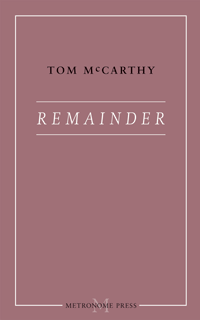
3:AM: Remainder — the best novel of 2005 which, due to its republication by Alma Books, looks set to be the novel of 2006 (ironically enough, given the theme of the book) — could be described as the best French novel ever written in English by an Englishman. With Tintin and the Secret of Literature, your approach is once again resolutely French. Almost all of your major references are French (Balzac, Baudelaire, Barthes, Derrida…), and even the vocabulary you use is Gallicized (“fictive,” for instance, which is far closer to the French “fictif” than “fictional”). Where does your familiarity with French culture and the French language come from? Was it deliberate on your part to largely avoid references to British or American literature? Wouldn’t it have been interesting to give a more English perspective on Tintin since Tintinologists have a habit of being Belgian or French?
TMcC: First of all, thanks for your kind words about Remainder, and I’ll try to persuade my French publisher, Hachette Littératures, to use your “best French novel in English” line as a blurb for their edition that’s coming out next September — I couldn’t think of better praise! Yes, most of the points of reference in Tintin and the Secret of Literature are French, although Defoe, Bunyan, Behn and other Anglo early novelists get a look in — plus there’s a big digression through Shakespeare’s Sonnets. I guess I just really like French literature. The English were going really well from the sixteenth to the nineteenth centuries, producing poets like Donne and Marvell and novels like Clarissa and Tristram Shandy, but it all went horribly wrong somewhere in the late nineteenth/early twentieth and, while the French (and Americans) embarked on the wildest adventures with thought and form — Mallarmé, Breton, Cendrars, Faulkner etc etc — we got Thomas fucking Hardy and DH fucking Lawrence. The only top-class twentieth century English writers are the ones we claim spuriously: Americans like Eliot and James, Poles like Conrad, Irishmen like Joyce and Beckett…
3:AM: At the same time, there is a sense of humour and earthiness which are very un-French, as it were. After the publication of a strange review in The Economist which presented your book as a send-up of French theory, you spoke to me of the astounding “idiocy of English empirical culture”: do you think Tintin and the Secret of Literature is going to reignite the critical Querelle des Anciens et des Modernes of the 80s and 90s?
TMcC: I think to ignite any thought at The Economist you’d need to stick a ton of semtex up their arses. That review was quite funny, though: it perfectly captured the red-faced, vein-popping fury of Little England once the values on which it bases its entire identity are ever-so-slightly “solicited”, as Derrida would say. English takes on Tintin always present Hergé as a ’satirist’ and only that: a self-sufficient, rational subject who uses words and images as tools to tell us something he knows because he’s worked it out, rationally, you see. That’s the empirical line on literature tout court: the rational expression of a self-sufficient subject — as though we weren’t constantly made and unmade within language, desire, history, symbolic networks and so on. It’s as moronic as crediting a surfer with creating the wave which carries him and allows him to ply his craft — and back into which he’s eventually going to sink.

McCARTHYISM
3:AM: You say that you were introduced to Tintin by your mother at the age of seven. That, in itself, probably says a lot about your social background — that and your early encounter with Hugo Williams (mentioned by the poet in an article he wrote in the TLS about your International Necronautical Society). In France, in the 70s, Le Journal de Tintin tended to be read in Catholic and conservative circles whereas kids from Communist families usually read a comic called Pif. What sort of social and cultural milieu were you raised in, Tom?
TMcC: I come from a liberal arts-steeped middle-class family. My mum would tell us the stories of The Odyssey and The Merchant of Venice on car journeys. My parents were left-ish but not radical. They voted Labour but I went to a private day-school from the age of twelve.
3:AM: You write that “Everybody wants to be Tintin,” but I get the feeling that that everybody applies, first and foremost, to you. You even bear a slight physical resemblance to Hergé’s hero…
TMcC: I went to a fancy dress party dressed as Tintin once…
3:AM: Susan Tomaselli rounds off her review with the claim that Tintin and the Secret of Literature made her feel like re-reading Remainder (your debut novel) rather than the Tintin books themselves. Do you see this as a success or a failure?
TMcC: Success — although she should read the Tintin books too. In a way, I used Tintin and the Secret of Literature to work through some of the themes in Remainder in a more conscious way: the relationship between trauma and repetition, for example, or the idea of inauthenticity which emerged from the de Man essay “The Rhetoric of Temporality”, which I hadn’t read when I wrote Remainder even though it could almost be describing that book. It’s great to be able to switch modes, and come at the same territory from a different angle.
WE WANTED TO BLOW UP TIME ITSELF
3:AM: Your whole oeuvre seems to be contained within this critical essay: Tintin and the Secret of Literature could thus be read as a work of internal intertextuality. First of all, there’s the importance of meridians which points to Greenwich Degree Zero, your recent artistic collaboration with Rod Dickinson…
TMcC: …when we blew up the Greenwich Observatory, or at least produced the documentation of having blown up the Observatory, completing the task of Martial Bourdin, model for Conrad’s Stevie in The Secret Agent. We wanted to blow up time itself. Funnily enough, there’s a scene in The Broken Ear where a secret agent like Stevie carries a time-bomb around and gets blown up by it because he doesn’t realise the town clocks have broken. I love the sequence in The Sound and the Fury where Quentin carries a broken clock around and rides trams in different directions in a sub-Einsteinian attempt to escape time — then dies…

WE WANTED TO BLOW UP BRIDGES
3:AM: Then you’ve got the references to Cocteau’s Orphée and, more generally, your fascination with the “transmission-reception figure” (as you put it elsewhere): “[Tintin] will also be aware, as a radio operator, that the waves which carry his transmissions will travel outwards endlessly through space. Who knows where the signals will end up, or what they will end up meaning?” (p. 91).
TMcC: If I had to select five things to put in a space capsule to show aliens what we were capable of, Orphée would be one of them. It’s the most perfect piece of art, which lays out our existence as being in relation to death, technology, transmission-reception and desire — not to mention repetition. Death, a beautiful princess (and arts patron) falls in love with Orphée so she has another poet snatched to the underworld so he can send illicit, looping radio messages to Orphée which draw him towards her, through a mirror. Cocteau based his radio messages on the ones sent to occupied France during World War Two: these short lines of poetry. Most of them meant nothing, but one in every two hundred meant — only to those who knew — ‘blow up the bridge’. A man or woman in London reads a line of poetry into a microphone and in France a bridge blows up — or not. Poetry — real poetry — should harbour that potentiality somehow.
3:AM: You talk about Alph-Art, the eponymous avant-garde movement of Hergé’s posthumous book, which is “a cover for a giant forgery operation” (p. 158). Couldn’t this also be a fitting definition of your own “semi-fictitious” avant-garde movement, the International Necronautical Society?
TMcC: The INS had its own radio transmission network, operating out of the ICA two years ago, generating messages like Cocteau’s and actually transmitting them over the radio London-wide (and, via collaborating radio stations, world-wide). It looked like a giant factory floor, with workers running everywhere carrying lines of text — lines which, having been plucked from other media sources, were kind of second-hand if not fake. The INS is itself semi-fake, as you point out. Although the fake can hide the real.
THE UNNAMEABLE
3:AM: On page 84, you explain that, according to Freud, trauma produces “a desire for repetition mixed with a need to disguise the scene being repeated”. Could you comment on this sentence with reference to your novel Remainder?
TMcC: It’s not just Freud who says this: even his most positivist counterparts concur. Under ultra-extreme stress, the part of the mind that processes raw data into the narrative thread we call ‘memory’ simply goes on strike and refuses to process. It’s called ‘dissociation’. So the data’s present, but not dealt with, and therefore keeps bobbing up and demanding to be incorporated somehow. As it can’t form part of normal memory, it plays itself out in weird ways — ones that contain elements of the original event but are also scrambled, disguised. And it will keep repeating, albeit in modulated form, until it is accommodated properly. Well, in Remainder the hero has undergone a traumatic event which he hasn’t retained as straight memory but rather as fragments of data: the sense of being about to be hit, blue lights, railings, being held above a tray or bed and so on. These induce a propensity to repeat stuff in him. Another interesting thing about post-trauma is that (to return to a motif we touched on a moment ago) it makes people feel inauthentic, fake, because everything is of a lesser magnitude of experience than the trauma-moment itself, the only ‘real’ thing. And then the subject back-projects for himself a time when he wasn’t fake, and longs for that time. That’s what my guy is doing with his re-enactments: repeating backwards to an imagined era of authenticity — but repeating, more accurately, towards the trauma-moment itself, the true, unnameable moment, the moment of truth and unnameability itself.
THE CHINK ON THE CARPET
3:AM: The re-enactments in Remainder or in your artistic work: mimesis or simulacrum?
TMcC: Aha: very good question, bang on the money. In Remainder, he wants the authentic, so he sets up a zone of mimesis, paying architects and designers to recreate his ‘remembered’ building and re-enactors to ‘be’ the lady he remembers frying liver on the floor below him, the pianist he remembers practising Rachmaninoff and so on. He wants to accede through these re-enactments to a mode of authenticity, of simply ‘being’ rather than simulating. But of course it doesn’t work: the re-enactments tend more towards the status of simulacra, what Plato defines as ‘a copy without an original’. But then, paradoxically, the most jarring and obviously inconsistent things, the ‘extra’ bits, the ones with no originals of any type at all, are what catapult him into ultra-authenticity — which, not coincidentally, is also pure violence. It’s the little chink on the carpet of his re-enacted bank heist that flips the whole re-enactment over into all-too-real-ness, when the re-enactor trips on it, or rather on its absence, and his gun goes off…

[Stewart Home and Tom McCarthy at 3:AM Magazine‘s Xmas Bash, London 2005]
THE CRACK IN THE WALL
3:AM: Barthes writes that “…the ‘realistic’ artist never places reality at the origin of his discourse, but only and always, as far back as can be traced, an already written real, a prospective code, along which we discern, as far as the eye can see, only a succession of copies” (quoted on p. 55): this is also, unwittingly, what the protagonist of Remainder does, right?
TMcC: Remainder has been read by some critics as an allegory of realism and of the realist mode of art, and this isn’t an entirely wrong reading — although if the hero had actually been an artist rather than an Everyman, some bloke, it would have been an entirely different, and inferior, book. But yes, it definitely turns around his copying, and even (as he sets about getting his re-enactors to re-enact the moments when they prepared for the previous re-enactment) his copying his moments of copying, endlessly regressive. We can try to work it out together, but ultimately I can’t give the definitive schematic meta-reading of the book any more than you — perhaps less. It was intuitive: I was looking at a crack in a wall and had a moment of dejà-vu and wished I had loads of money to re-enact this moment and there was the novel.
EVERYTHING LITERATURE SHOULD BE
3:AM: When discussing tobacco throughout the Tintin books, you explain (following Derrida) that it “goes up in smoke” but “also leaves remains, ashes, which maintain symbolic links to memory, death and inheritance. Baudelaire’s story takes off from the change left over from the two friends’ luxury expenditure: like the coin itself, it proceeds from the remainder” (p. 135). Why are remnants so important in your work?
TMcC: It’s what’s left. After the disaster, after thought, interpretation, writing itself. It’s like when Wallace Stevens says “The plum survives its poems”. Writing has to deal with this remainder, and good writing has to deal with the fact that it can never fully deal with it. Francis Ponge knows this. He writes brilliant prose poems about, for example, oranges: the texture of their cells, the way they leave goop on your hands so that even when you’ve ‘expressed’ them there’s a residue that’s not contained. If Susan Tomaselli or anyone else really want to do themselves a favour, they should re-read neither Remainder nor the Tintin books but rather Ponge’s Le Parti pris des choses (you can get it in dual text). It’s everything writing should be.
[This interview was initially posted here.]