The Impossibility of Narrating the Event

Tom McCarthy interviewed by Richard Wolinsky, Bookwaves (KPFA) 1 November 2010:

“This idea of reconstruction, of how to narrate the event: this is the kind of conceptual impossibility at the core of Remainder, which involves this guy elaborately spending millions of pounds to hire people to reconstruct events that he vaguely remembers — and they never get it right because you can’t. And, I suppose, this is almost a metaphor for all of narrative: the impossibility of actually narrating the event.”

The Enigmatic Polygeneration

One of my stories — “Dr Martens’ Bouncing Souls” — features in a new anthology entitled New Cross-Fucked Musings on a Manic Reality (Dog Horn Publishing, December 2010). Here is an extract from Tom Bradley‘s introduction:

In a universe ruled by karma and rebirth, “generation” is a bad word denoting as it does the stifling of spirits in coats of crass skin, the greatest disservice that can be done. Nevertheless, Hugh Fox got to christen the Invisible Generation, Andrew Gallix the Offbeats. So I’ll invent a name to embrace these people. I’ll make it doubly apt, as they produce electricity as well as useful heat: the Enigmatic Polygeneration.

crossfuckFIX2

This appears on the back cover:

This volume is ripe with prime produce sprung from minds that span five decades, but comprise a single literary generation. And who are the Enigmatic Polygeneration? They were christened by Tom Bradley in chapter four of Put It Down in a Book, as follows:

Digital connectivity has rendered physical locality irrelevant and made polyversality the new thing . . . Once space has been erased by the miracle of email, so has time, in terms of its effects on the human frame . . . In a creation where particles can spookily act upon each other at a distance of quadrillions of light years, the Seven Ages of Man are as days in the week, and a generation can span an open-ended number of decades . . . I’ll invent a name that’s doubly apt, as these writers produce electricity as well as useful heat.

In this vast anthology, among other delights, you will meet a pornographic ventriloquist and a man who has spent a lifetime getting laid only because he looks like certain famous people. You’ll be taken deep into the heads of such gentry as Charles Manson, Jack the Ripper (who, we learn, was actually Bram Stoker), and Kerry Thornley, author of a book about Lee Harvey Oswald published before the Kennedy assassination.

Andrew Gallix will give you a crash course in transgression, and underground press legend Hugh Fox will bring you to understand what it means to be the small Jewish boy who would one day become Charles Bukowski’s first biographer. Meanwhile, mighty Dave Migman teaches us how to live and die. Fabulous Adam Lowe reveals his adventures in cross-genre, multimedia literature. And lovely Deb Hoag . . . well, as usual, she’s got a surprise!

The Expatriate Literary Scene in Paris

Anthony Cuthbertson, “From the Lost to the Beat to Now,” Notes From the Underground 19 November 2010

The expatriate literary scene in Paris

What Allen Ginsberg called, ‘The bewildering beauty of Paris’ has attracted writers and artists for centuries. It has been the setting of great novels and the home of great writers, and in the last hundred years has briefly been the stage for two waves of expatriate writers that changed the face of modern literature: the Lost Generation and the Beat Generation. Fifty years have passed since the latter faded away, and though the expatriate literary scene has remained vibrant, no significant movement has since emerged. However, with the arrival of new soirées, literary journals, writers’ workshops and readings, as well as a fresh generation of writers flocking to Paris, a new wave may well be rolling in.

Historically, Paris has been a place of refuge for artists and writers. It has attracted political and cultural exiles fleeing the injustice and intolerance of their homelands, offering them a liberal safe haven and allowing them artistic freedom. In the 1920’s and 1950’s it became a place of escape for those left disenfranchised by the World Wars. The Génération perdue, as Gertrude Stein named them, included writers like Ernest Hemingway, Ezra Pound, F. Scott Fitzgerald, T.S. Eliot, and later James Joyce and Samuel Beckett. They were a generation disillusioned by the horrors they had witnessed in the First World War, and who felt disaffected and betrayed by their governments back home. Pound wrote of his contemporaries, ‘(they) walked eye-deep in hell believing in old men’s lies, then unbelieving came home, home to a lie’. They gathered in cafés and hung about Stein’s salon to share ideas, bottles of absinthe and write, together forming a movement that still resonates strongly today.

By the time the Second World War and the occupation of Paris came about, these writers had for the most part moved on. Although some later returned after the war (Hemingway famously ‘liberated’ rue de l’Odéon, the then site of the bookshop Shakespeare and Company), a new literary movement in the form of the Beat Generation arrived. Leading figures of the Beats, including William Burroughs, Gregory Corso and Ginsberg, came to Paris for much the same reasons as their predecessors. They sought refuge from the strict conformist confines of McCarthy-era America and found it in Paris. In the years that have followed the departure of the Beats, Paris has remained a centre for culture and art. It continues to attract writers and artists with its history and beauty and the lively literary scene is a reflection of its magnetism.

The first stop for any would-be writer or literary pilgrim should be Shakespeare & Company. Its location may have moved over the years but the spirit and the name have remained. The current owner, George Whitman, has described it as ‘a den of poets and anarchists disguised as a bookshop’, having been sanctuary to writers of both the Lost and Beat Generations. The writers, whom George refers to as ‘tumbleweeds’, drift through the doors and find community and lodging in the poky upstairs rooms in exchange for helping out in the shop below. Supporting young writers continues to be one of the cornerstones of S&C. As well as providing a place to stay, they hold workshops, readings and even organize a literary festival every other year. They have also recently relaunched their literary magazine (The Paris Magazine), and announced the Paris Literary Prize (10,000€) for unpublished writers. In its current location on the banks of the Seine it is as much a tourist attraction as it is a bookshop, but between the piles of books still remain bunks for the next hopeful Hemingway to stay.

Beyond this pillar of the past not much remains of the old haunts of writers beyond landmarks and tourist traps. It is easy to get lost wallowing in the myth of Paris but for new writers it is essential to escape the seductive expatriate past, away from the romance of the Latin quarter and the ghosts that wander the left bank, and over to the other side of the river to where the literary scene is shifting.
Boulevard Saint Germain and its surrounds have developed from bohemian havens to bourgeois hangouts popular with tourists. The cafés once frequented by the likes of Hemingway and Joyce, such as Café de Flore, Les Deux Magots and Le Dôme, now sell souvenir memorabilia and a cup of coffee can set you back six euros.

Nowadays it is areas like Belleville and the 19th and 20th arrondissements in the east of Paris where the cost of living is the cheapest that have become the new centres of the literary scene. These parts of Paris continue to provide a conducive environment for young and aspiring writers.

Paris-based writers have often remarked that unlike other big city literary communities, Paris has an open-minded and accepting scene that encourages experimental forms and welcomes outsiders. David Barnes, the founder and compère of a spoken word poetry night in Belleville at Culture Rapide, describes Paris as “a beautiful backwater where life is slower than New York or London. It gives breathing space, distance from the anglo-metropoles that supports writing”.

He argues that the English speaking community in Paris is just the right size “to come together and do something, to provide a home and platform for, to nurture and be nourished by.” The spoken word nights that take place every week welcome anyone and everyone up on stage to read a poem, tell a story or perform a play — the only rule being ‘make the words come alive’. A collective has formed around this café with regulars comprising English speakers from around the world.

In an age where literary scenes and movements are becoming more international by way of the internet, less centred around a location and more around uniting notions and ideals, Paris has managed to retain its place as one of the world’s literary hubs. Since the turn of this century, a movement referred to as the Offbeat Generation has partly formed in Paris. They comprise of a loose collection of like-minded writers, including Lee Rourke and Booker prize nominee Tom McCarthy, who feel alienated by a mainstream publishing industry dominated by marketing. Paris is home to the founder of this movement, Andrew Gallix, whose Paris-based literary magazine 3:AM has provided the main platform for the Offbeats.

Other English language literary magazines that have formed in Paris in recent years include Double Change, Upstairs at Duroc and Platform. The most recent of these, Platform, formed around the spoken word night at Culture Rapide.

As fate would have it, this new scene that is emerging is forming beside where many of their predecessors have found their final resting place: the Père-Lachaise cemetery. It is behind these gates that you can find the graves of such literary icons as Gertrude Stein and Oscar Wilde.

Its legacy may be one of the great appeals of Paris, though it is the smallness and accessibility of the anglophone writing communities, combined with their supportive and inclusive atmospheres, that is currently causing such a surge in the scene. It seems now that the stories shape the city as much as the city once shaped the stories and for any aspiring writer coming to Paris it would be easy to feel intimidated by the past. For them it is perhaps best to consider again the words of Allen Ginsberg: “You can’t escape the past in Paris, and yet what’s so wonderful about it is that the past and present intermingle so intangibly that it doesn’t seem a burden”. The scenes may be as transient as the writers, but the essence of Paris endures.

On The Beat Anthology

Dan Holloway kindly mentions me a couple of times in his interview with Sean McGahey apropos of The Beat anthology. Here are the two relevant extracts:

beat-anthology-banner

Dan Holloway, “Beat Me Before I Come Up With Any More Crass Metaphors,” Eight Cuts 13 November 2010

A while ago I recommended the really rather fantastic Beat Anthology, the best of the also fantastic site The Beat UK, published by the equally fantastic Blackheath Books. It’s a remarkable collection of stories that it’s rather tricky to track down to a certain theme, oeuvre, or any other arts wank category. Well, almost. Because I did notice a preponderence of public transport. Is this a comment on our eco-aware age? Is it an anti-individualist statement? Are the authors actually, like me, just not quite up to getting a driving licence.

Do I have a favourite? No, not really. I loved Andrew Gallix’s train; and Melissa Mann’s car (hmm, car, it must have been one of those street share jobs). But I couldn’t say one story was better than another. Some have more modes of transport, and some fewer maybe, but better? That’s about more than planes, trains, and automobiles.

[…] I was intrigued reading some of these pieces — like Andrew Gallix’s and Lee Rourke’s. the short story is a great place for paying with voice and form, but I wonder if the results can ever really transfer to novels. What’s rich in shorts can be stodgy in novels; what’s piquant can become downright tedious. What IS the point of novels other than publishers don’t really know what else to do?

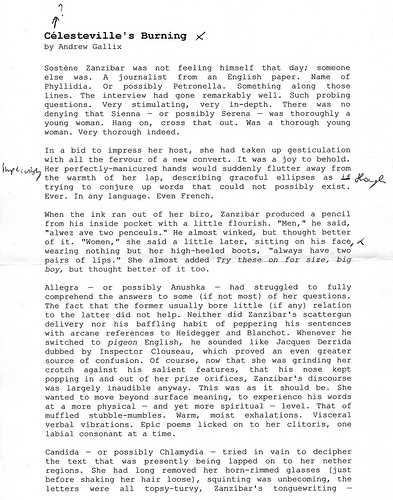
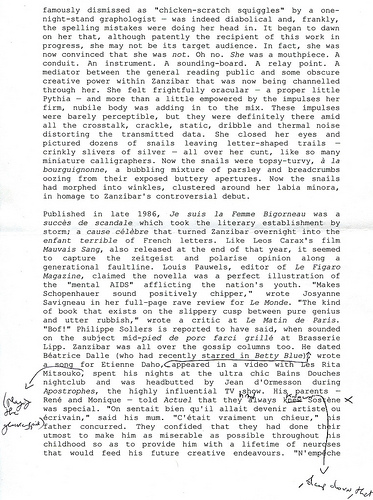
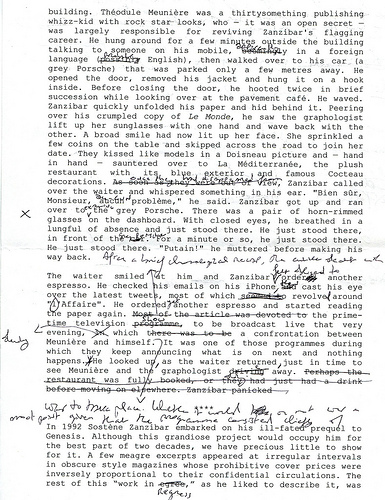
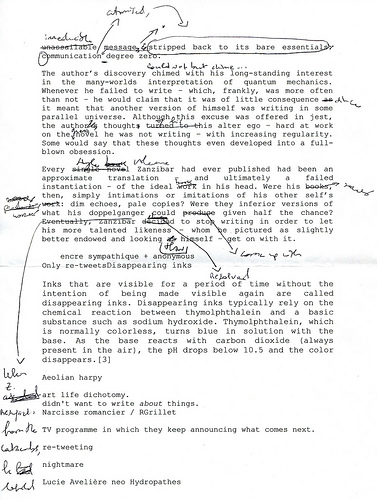
Upon Reading “Celesteville’s Burning”

Tom Bradley on “Celesteville’s Burning” 5 October 2010:

“Celesteville’s Burning” is brilliant. It’s the best thing of yours I’ve read. Assuming I’m familiar with all or most of your fiction, I would call this a breakthrough.

As always, the Gallixian wit is everwhere: the “doppelgänger given half the chance”; the “Holy Grail of Franco-Swiss rock criticism”; the “wind in his combover,” and countless other instances that pour forth from every sentence and phrase. You’ve always exploded with linguistic brilliance, syntactic agility and erudition. What a mood enhancer it’s been, throughout your work, to meet with these qualities in an author who does us the honor of assuming the same capacities in his readers.

In “Celesteville’s Burning” you’re displaying further technical mastery. With apparent effortlessness you move in and out of settings objective, subjective, and everything in between. The first to hit me was the light-speed spatial transition of the journalist’s cunt onto Zanzibar’s face, effected right in the middle of a paragraph. All of a sudden we are treated to a blending of her vaginal sensations with the literary sensation caused by Zanzibar: an announcement that we are in the light hands of a master.

You have achieved narrational virtuosity, signaled by your supremely perverse confidence in supplying a plethora of sensory detail in scenes that seem to come from out of nowhere, dreams whose larger purpose you haven’t yet established in our minds — e.g., Grandmother’s house. You know full well that we will not only endure but enjoy the moment of disorientation, and will follow.

The insistent, perverse, yet unfailingly lucid use of French and Franglais — is this also a symptom of a breakthrough? Have you staked out your own territory and sunk roots in the borderland between your two native cultures?

Zanzibar’s ludicrous early success, his lugubrious decline and late failure, his preposterously self-indulged “quantum” writer’s block, and the diseased way in which the established press will exploit it — I sense a breakthrough here, too. You’ve long acknowledged and bewailed the contemptible state of Franco-English letters. But here, with an amazing vastness of detail that only an insider could generate (where did you learn so much about these effete movers and shakers?), you have finally masticated this hideous situation, peristalsed it and shat it out. The despair which “the mainstream” must engender in less hardy souls can’t come near you any more. You are free to laugh from high up, to heap the kind of scorn that will humiliate any member of the lit establishment who reads this.

I can feel a Gallix novel coming on — and not an invisible palimpsest. This artistic unfolding of yours is heartening and exciting to watch. Some saggy asses in London-Paris-New York that have long needed kicking are in for it now.

Indie Literary Sites Start Coming of Age

Katie Allen, “Indie Literary Sites Start Coming of Age,” The Bookseller 8 October 2010:

For the time being, print still rules. There is no denying the cachet of Granta, the London Review of Books and the Times Literary Supplement, plus a number of smaller publications such as Litro and print-and-online publications such as Pen Pusher and Notes from the Underground.

Yet alongside Hamish Hamilton’s own project, Five Dials, the recent recruitment of publishing names including Scott Pack, Simon Trewin and Alma Books m.d. Alessandro Gallenzi as columnists for The View from Here is an example of how seriously the trade is taking independent literary websites.

Gallenzi became involved out of interest in “promoting new talent, new voices, new writers”. However, he is wary of the proliferation of online books content. “There is a certain hierarchy of critics and reviews. I respect the opinion of certain critics because of who he or she is and what they have done before . . . You have to take it on a blog-by-blog basis,” he said.

Sandra Taylor — Pan Mac publicity and digital communications manager — is a keen advocate of online literary magazines.“It’s hard to identify a spike in sales, as you can with a book being mentioned on Radio 4. But we definitely see it as part of a fully integrated campaign because if a reader wants to Google one of our authors, we want there to be richer content available. It’s interesting and important for Google rankings. It’s also important in terms of supporting new writers.”

Viola Fort, editor of untitledbooks.com, said: “Publishers are getting more web-savvy. From the beginning, they saw us as credible. We’ve got a much younger audience than traditional literary magazines. I wanted to do something on a par, but with a new way of access.”

Andrew Gallix, editor of 3:AM, said: “It’s easier today than [when we launched] in 2000, because online publications are taken far more seriously. Then again, it’s far more difficult for us as there are now hundreds of similar webzines.

“When we started out, webzines were looked down upon in Britain as being second-rate. [But] we’re now assiduously courted by publishers, big and small, especially since the credit crunch (which led them to look for cheaper ways to promote their books).

“The majors, in particular, know that we can give authors credibility, which is something that’s difficult to manufacture,” he added.

Jane Bradbury of For Books’ Sake said that publisher attention had been more noticeable since the site chose to focus exclusively on female writers five months ago.

“Independent and smaller presses have been so much more proactive and supportive,” she said, citing Serpent’s Tail and Pulp Press. “More mainstream publishing houses have mostly ignored us so far (with a couple of exceptions such as Virago).

She added: “Maybe that’s to do with them being much more rambling operations. With smaller publishers, they are usually much more on the ball in terms of monitoring online media, such as Twitter etc, and making mutually valuable connections.”

All the Latest

I’m quoted in an article by Katie Allen (“Indie Literary Sites Start Coming of Age”) that appeared in The Bookseller on 8 October 2010.

On 13 August 2010, Slow Travel Berlin republished a piece I wrote on “The Virtues of Slow Writing“.

On 5 August 2010, IKE published an article on the Offbeat Generation in which they quote Jim Ruland saying this about me, back in 2007: “Andrew Gallix writes as if he invented Warhol on Monday, punk rock on Tuesday and then took the rest of the week off after declaring the project a sodding mess. In this day and age when laundry detergent is bold and automobiles are innovative, Gallix’s prose is like a fresh breath of mercurochrome: sharp and acrid with truths that are hideous to behold even though it’s good for us. Never mind Gallix? Bollocks!”

On 3 August 2010, Susan Tomaselli devoted her “3:AM Cult Hero” column in 3:AM Magazine to a piece I’d written for the Guardian about fictitious non-author Félicien Marboeuf, “the greatest writer never to have written”.

It’s All Greek

Here is a short, unpublished review of Tom McCarthy‘s C:

It’s All Greek

How do we recombine the debris of literary history?

Inspired By: Cocteau’s Orphée in which dead poet broadcasts coded messages on living poet’s car radio, hence the author as listener-repeater; Background: Concept of the crypt (site of an encoded primal scene) linking Cocteau, Freud’s Wolf Man, invention of telephone, discovery of Tutankhamun and Nabokov’s Ada; Protagonist Modelled On: Alexander Bell, Maurice Blanchot, Howard Carter, Marinetti, Orpheus, Sergei Pankejeff, Georg Trakl; Obligatory Plot Summary: Born, fails to mourn dead teenage sister, treated for melancholia in central Europe, airborne radio operator during WWI, student in drug-fuelled 20s London, civil servant in spy-ridden Egypt, dies; Representative Sentence: “What he sees is darkness, but he sees it.”

The history of Tom McCarthy’s debut, Remainder, has almost achieved legendary status. It was first released on a tiny Parisian art press, having been spurned by all the major publishing houses in Britain, yet ended up making the cover of the New York Times, receiving the 2008 Believer Book Award and being lauded by Zadie Smith as “one of the great English novels of the past ten years”. Where do you go from there? Backwards, of course, like Dr. Learmont’s face that seems to multiply “down a telescoping corridor of memories” [77] or the archaeologists in Egypt — not to mention Serge with his predilection for coitus a tergo. McCarthy’s second novel, Men in Space, was mostly written before his first. His third — which is being touted as his big breakthrough — stems from Calling All Agents (2003), a fascinating essay that already contained all the keys to his book to come. Imagine a Bible concordance predating The Bible itself. In fact, C is CAA re-encrypted: a space in which the event that is true literature can take place.

With his first period piece, McCarthy goes back to the future (and Futurism) in order to rescue fiction from its current impasse. The timeline of this Bildungsroman is highly significant. It begins in 1898 — when Serge Carrefax is born to the “mechanical buzz” [10] of his father’s wireless radio experiments — and ends in 1922 — the year of The Waste Land and Ulysses — when he dies. The association between modern communications technology and modernism provides the backdrop to a redefinition of literature as transmission rather than self-expression.

Unsurprisingly for a novel revolving around incest — both literal and metaphorical — C contains numerous mises en abyme. There’s the tapestry of a staircase hanging above a staircase, or the school pageant (a nod to The Mousetrap in Hamlet) that dramatizes the Orphic theme underlying the entire work. The most apposite is Sophie’s “strange associative web” [71] that proliferates like a tumor and seems to harbor some dark secret within its intricate ramifications. McCarthy’s text also keeps generating new meanings, sometimes of its own volition, as words and ideas cross-fertilize in incestuous ways. Language, says Heidegger, speaks. Thus Sophie mutters beautiful schizophrenic gibberish as though she had “turned herself into a receiver” [75]. The Morse code clicks sometimes seem to be “speaking on their own” [67]. The deaf children are spoken through, their voices “ventriloquised” as if “piped in from somewhere else;” [4] their utterances resembling “a mispronounced version of something else, other sentences that are trying to worm their way up to the surface, make themselves heard” [79]. The headlong rush into modernity, away from the parodic pastoral setting, is paralleled by a return to the primitive magic of the oral tradition. The idea that something may even be lurking behind mere hearing is often hinted at. “[M]uffled signals” [83] are half-heard through wireless static (itself likened to “the sound of thought” [64]). Serge is haunted by “vague impressions of bodies hovering just beyond the threshold of the visible” [68] when riding “the dial’s far end” [83].

The protagonist teeters on the brink of some revelation that eludes him until he receives the ultimate, hallucinatory “call”. The reader can also break the code: incest is the encrypted primal scene of literature — the scene of our failed mourning for the works of the past. It’s all Greek, in the end.

[Picture: Tom McCarthy and Daniel Defoe, Bunhill Fields, London, August 2010. By Andrew Gallix.]

Melancholia as Ultimate Rebellion

Excerpts from Lee Rourke, “In Conversation: Lee Rourke and Tom McCarthy,” The Guardian (Guardian Review p.12) Saturday 18 September 2010

Lee-Rourke-and-Tom-McCart-006
[Lee Rourke (left) and Tom McCarthy. Photograph: Eamonn McCabe for the Guardian]

LR: You’ve said in the past that all art is repetition.

TMcC: Yeah: Joyce’s “commodius vicus of recirculation” . . . Or Mark E Smith’s three Rs: repetition, repetition and repetition . . .

LR: I’ll drink to that. It’s like a never-ending transmission that can’t be switched off.

TMcC: The transmission thing is important. There’s that Kraftwerk song, “I am the receiver and you are the transmitter”, or however it goes. One way of thinking about art, or the novel, is that the writer is the transmitter, the originator: I have something to say about the world and I’m going to transmit it. But this isn’t how I see it, I see it as exactly the inverse: the writer is a receiver and the content is already out there. The task of the writer is to filter it, to sample it and remix it — not in some random way, but conscientiously and attentively. This is what Heidegger says about poets: to be a poet is to listen before speaking; it’s first and foremost a listening and not a speaking. Kafka said it as well: “I write in order to affirm and reaffirm that I have absolutely nothing to say.” Writing, or art, is not about having something to say; it’s about aspiring to a heightened state of hearing. It’s why C is a totally acoustic novel and a receptive novel. The hero, Serge, sits there for hours trawling the aether waves, absorbing, listening to ship-to-shore transmissions, stock market prices, sports results, writing them all down. In a way, if you could see Serge’s transcript it would probably read like an Ezra Pound canto.

LR: This is why Serge is so brilliant, because all this absorption culminates in a form of pure poetry. I’m thinking of the novel’s “Chute” section, especially the first world war passages. Serge in his plane over enemy lines, flying above and below, marking the sky around him with these wonderful vapour trails while shooting up heroin and quoting Hölderlin, and so on. Where does all that come from? I know you’re interested in Marinetti’s manifestos.

TMcC: For Serge the whole battlefield becomes a sound box. He thinks of his machine gun, when he’s firing it into the trenches below, as like a needle being aligned with the groove of a record. When the needle goes in, static comes out, and it all resonates: the percussion of machine-gun fire, the siren wail of howitzers. The difference between Serge and Wilfred Owen is that Serge loves war. By the way, talking of Marinetti: it’s interesting that Marinetti’s novels, which supposedly enact the propositions of his many manifestos, are much less interesting than the manifestos. And the paintings that people did based on his manifestos are much less good as well. The manifestos are a kind of field of potentiality that to actually realise would spoil.

LR: You’ve stated recently that C is essentially a novel about desire as much as about technology, and the “looping” of both within time. This puts me in mind of Beckett’s Krapp’s Last Tape. This idea that technology doesn’t take you forwards into the future, but actually takes you back towards your past.

TMcC: When Beckett’s old man is listening to these old tapes of himself, what it actually comes down to is desire — it’s incredibly moving. He’s there at the end, the end of his life, he wants to stop replaying it, all the loopings, snarling “Wasn’t once enough?”; but he listens again and again and again to this incredibly lyrical passage that he’s recorded about 30 or 40 years ago about him floating in a punt, with a girl, and the water all around them, I mean, it’s fucking amazing, it’s really, really beautiful. This is it, you see: what we find in technology and networks is desire. Which doesn’t mean the desiring individual; it means desiring consciousness itself. That’s why I wanted Serge Carrefax to be more than an individual; if he was a circuit he’d be over-charged. The surge is too much, it blows. It’s about the desire for impossibility. Giorgio Agamben, when describing melancholia (which Serge has in spades), says that the condition isn’t at all a detachment from the world, even though it may seem like it; in fact it’s an investment in the world so much that the desire for the world exceeds its own limit. The melancholic wants what is impossible; he wants impossibility itself — to experience it and to merge with it. To surge towards it. That’s why the melancholic is the ultimate rebel.

LR: Is it a desire for the impossible, or nothingness, to become real? To become a tangible thing?

TMcC: No, I think it’s more than that. I mean Pygmalion gets that: he wants the statue and then it becomes real, and that’s cute. But take Orpheus looking back: he’s far more interesting. He doesn’t really want Eurydice, he wants the dark night. As Maurice Blanchot brilliantly points out, he wants death itself. Not to make the night illuminated or present, but to have it in its absence, to have the presence of absence, something that is impossible. It’s doomed, beautiful and tragic.

LR: This is Blanchot’s Orpheus’s Gaze

TMcC: Right. It’s an essay about five pages long and it’s the most amazing summary of what literature is, or could be, ever written. It’s not about representing the world, it’s not about criticising the world even. It’s about surrendering to a vertigo that can never be mastered, to an abyss that can never be commanded, or excavated or filled in.

LR: But you can leave your mark, right?

TMcC: Yeah, the scratch. Scratching the negative. That’s what artists do at their very best.

C By Tom McCarthy

This appeared in the September 2010 issue of Dazed & Confused (vol. 2, issue 89, p. 196):

C by Tom McCarthy

Incest, spies and coke-fuelled adventures

Let’s not beat about the bush: Tom McCarthy’s third novel, C, is a masterpiece: a sprawling associative web that keeps generating new meanings as though of its own volition. “That’s the beautiful thing about what literature does to language,” says McCarthy. “You stick these slippery terms in and they start cross-fertilising in ways you never anticipated — incestuous ways.” C takes us from a fairytale English silk farm to spy-ridden Egypt by way of a central European spa town, aerial warfare and a coke-fuelled London filled with bright young Amazons. It is a comedy of errors, a gothic mystery, a boy’s own story; a traditional 19th-century novel seemingly rewritten by Burroughs or Ballard. You’ll find geometry, technology and trauma. Loops, repetitions and mutations. Incest, insects and radio bugs. And phantom words emanating from subterranean worlds half-glimpsed “at the dial’s far end”. Tune in…

DAZED & CONFUSED: C could be seen as a futurist novel. Serge, the protagonist, even seems to be partly modelled on Marinetti himself…
TOM MCCARTHY: I love Marinetti, and, yes, he’s part of Serge’s make-up, particularly in the war section. But Serge is equally a mixture of Freud’s Wolf Man, the beautifully fucked-up melancholic eternally grieving for his dead sister; and Alexander Bell, inventor of the phone (who also lost two siblings); and Howard Carter, the Egyptologist who disinterred the ur-family tomb; and a bunch of other people. I’m interested in the places where technology and mourning intersect.

There’s also a strong retro-futurist — even steampunk — element to C. Did you feel the need to revisit the early 20th century in order to reinvent the future of the novel?
Yes. Walter Benjamin says that the angel of history faces backwards. I think it’s the same for literature: you’ve got to look back in order to move forwards. It’s not just the foundations of contemporary technology that are being laid in the early 20th century (the code radio bugs used exactly anticipated text speak, just as lots of their output anticipated Twitter), but also literature’s period of high modernism that’s coming to a head. Not for nothing does the novel end in 1922: it’s the year that Ulysses and The Waste Land came out. The task for the contemporary writer (sadly, one which many writers of today are shirking) is to work through that period’s legacy — dynamically and radically, but attentively too.

All the major themes in C — from wireless technology to the discovery of Tutankhamun — come from your early experiments with the International Necronautical Society (INS), don’t they?
I had the idea for C while I was working on the INS project at the ICA. There, we had a radio station modelled on the illicit one in Jean Cocteau’s film Orphée (where the person transmitting is already dead), sending out all these coded poetic messages. I was looking at writing around encryption, and the concept of the ‘crypt’ that you get in psychoanalysis and philosophy.

Incest lies at the heart of C: this, for you, is the source code of western literature, right?
Yes. You go back from Nabokov through Faulkner through Racine right back to Sophocles, and incest is the central theme that keeps recurring. For Freud, the incest prohibition is what makes us civilised, socialised, even human, so that’s the taboo all tragic heroes, who are fundamentally doomed rebels, are most drawn towards transgressing.

Why do you think that all new means of telecommunication are linked to death, mourning and melancholia?
I don’t know if I can explain it. It’s just a pattern that keeps recurring. For every comm-tech invention, there seems to be a dead sibling somewhere. Bell even made a pact with his brother that, if one of them died like their other brother had, the surviving one would invent a device capable of receiving messages from the dead. Then the second brother dies, and Bell invents the telephone. He remained a rationalist, a sceptic — basically because his brothers never called. But the desire, the fantasy, is there in the technology: a ghost in the machine. It’s the same with radio. Seances in the 20s weren’t about spirit and ectoplasm any more: they were about “tuning in” to voices resonating on high frequencies, like radio waves. With the internet, it seems to be more about a presence than an absence: everything’s there, every click and keystroke ever made eternally retrievable, a giant archive. That’s a kind of haunting too, though.

Text and Photography
ANDREW GALLIX