
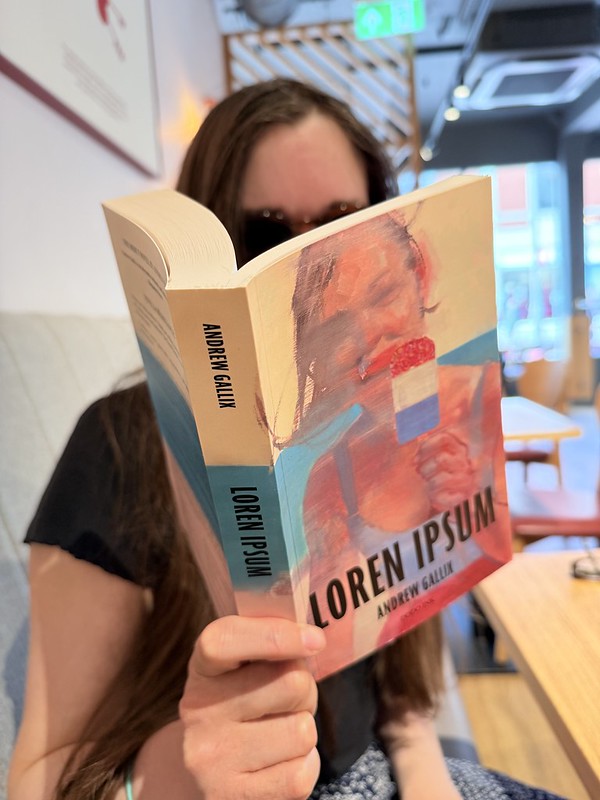
Oscar Mardell has reviewed Loren Ipsum in Review31.

Loren Ipsum is a number of extraordinary things: the daughter of a high-flying architect and a renowned landscape gardener, an alumna of the University of Oxford, a former model, a beloved children’s author, and even a bestselling novelist. Now she is a literary journalist to boot — a writer, that is, who writes about writers and writing (and whose work seems to feature exclusively in publications with names ending in “Review of Books”). She is, then, almost a fantasy or parody version of a certain kind of literary success, but is she herself a text?
For her admirer, Sostène Zanzibar, Loren’s allure appears to reside less in her credentials and more in the fact that she is — like Lorem ipsum, the dummy text used in graphic design — more of a placeholder: “not so much a text one could read … as a pretext designed to delineate a space where nothing but place took place… Something along those lines.” But how is this alluring? Don’t we admire people for themselves? “Home…” muses Sostène one evening, drunk in the back of a taxi taking him to his own home, “was always somewhere else in a constantly deferred future”. In today’s stagnant present — in a culture largely defined by the endless return of the same — what seems to have become most covetable is the promise of that other place, that somewhere else.
Loren has come to Paris in order to work on a monograph about an obscure movement called Mordernism — a kind of “working-class literary avant-garde”. The movement’s founder, one Adam Wandle, is a reclusive author with a penchant for autobiography and for making grand pronouncements along the lines of “literature is a hate crime, or it is nothing”. Not long after Loren’s arrival, however, Wandle finds himself at the centre of a scandal. One by one, the members of the Parisian literati are being kidnapped and killed by a terrorist organisation. Solange de la Turlute — the conservative boss of an old French publishing house — is strangled to death with her Hermès scarf near the Champs Élysées. Jonathan Titterington-Jones — a terminally pompous author who writes only “to express himself” and because “it’s just what I do, really” — has his head blown off at a cocktail party (similar fates are suffered by a host of other non-working-class, non-avant-garde writers, all bearing bitingly satirical names such as Marquis de Perlimpinpin, Firmin Lepiador, and Septimus Smegma). And Wandle’s grand pronouncements — often lifted from works so obscure that Wandle himself can hardly recall them — keep turning up on the corpses.
Has Wandle, as one character wonders, “been co-opted as a kind of guru … or was he actually their éminence grise?’ Or is it all just a coincidence? While the terrorists’ political agenda is hard to discern, they do have one thing in common: a shared faith in a “Blue Island” where they expect to find solace and peace.
But are their killings even the real thing? Are they, as Sostène might say of Loren, simply placeholders or pretexts? Acts committed in lieu of whatever it is that actually needs to happen? Are they more metaphorical “killings”? Not literal murders but something more along the lines of “character assassinations”? The murder of de la Turlute seems so potent with meaning and its motive so shrouded in secrecy that the journalists covering the story find themselves brushing up on André Gide to make any sense of it all. Prior to having his head blown off, Titterington-Jones is subjected to a detailed interrogation whose questions seem less appropriate to a hostage situation than to a book signing or an interview; his answers, moreover, sound less like pleas than like exegeses.
In this pitch-perfect study of writers, life, life-writing, and the writing life, it is well-nigh impossible to distinguish what is real from what is symbolic and from what is simply a stand-in for something else. In Loren Ipsum, everything — literature and terrorism included — turns out to be a combination of the three. And what everyone seems to want here is an escape from a stagnant present — a one-way ticket, if not to the terrorists’ “Blue Island” specifically, then simply to that other place, that somewhere else more broadly.
In Loren Ipsum, however, it is not just the Parisian literati that get kidnapped but the narrative itself. Parts of the novel read like exercises in a naïve and unselfconscious realism (one chapter even begins, “The Marquise went out” — although, it is at seven rather than five). These, however, are quickly hijacked first by the outright fantastical — such as when a mermaid storms a literary soirée on the Seine (and subsequently launches a lengthy discourse on the subject of mermaid-identity-politics) — and later by meta-commentaries so knowing that they practically read as lit crit. Elsewhere the text adopts a psychogeographical register, drifting through old Parisian haunts and the various states of mind that they induce (honorary mentions are made of Chez Moune, the former dyke club on Rue Pigalle, as well as L’Atlas, the long-running porno cinema on the Boulevard de Clichy).
But these, in turn, are derailed by obsessive explorations of mindlessness and non–places (such as the Armani Emporium that sits on the former site of the Drugstore Publicis, “where Serge Gainsbourg purchased his Cuban cigars and the terrorist Carlos [a.k.a. the Jackal] once threw a grenade”). Likewise, passages of life-writing and autobiography are quietly taken hostage by the creeping suspicion that there is really no such thing as a self to describe (or, at least, that the self itself is simply another placeholder for a deeper, more elusive, form of identity). Even an innocuous chat in a bar is taken over by a chapter-long catalogue of band names.
And the result? In “Tlön, Uqbar, Orbis Tertius”, Jorge Luis Borges describes a people for whom “a book that does not contain its counterbook is considered incomplete”. Loren Ipsum feels less like a book that is “complete”, in this sense, and more like an entire library’s worth of such books.
In Don DeLillo’s Mao II, Bill Gray muses on the “curious knot that binds novelists and terrorists”: “What terrorists gain, novelists lose… The danger they represent equals our own failure to be dangerous.” In Loren Ipsum, however, Gallix offers a subtler and more complex take. From this collision of publishing culture and guerrilla warfare, what emerges is not simply that novelists are failed terrorists, but that terrorists are, in turn, failed playwrights — authors of carefully stage-managed media spectacles which necessarily fall short of their aims (like virtually everything else in Loren Ipsum, the revolution is only ever deferred).
Then again, even successful authors are, in a sense, failed authors. For Loren Ipsum (as its title implies), every literary work is ultimately a dummy text — it exists in lieu of what really needs to be written. And Loren Ipsum is itself no exception. Its brilliance lies not just in its ability to contain its own “counterbooks”, but in its gestures toward or promises of a text so vast and contradictory and uninterpretable that it cannot be contained by any book (nor reconciled very easily with today’s stagnant present) — that is, toward life itself.






 ANDREW GALLIX