
This interview with Clémentine Deliss was published in 3:AM Magazine in December 2005:
Detour in the Orthodoxy: Andrew Gallix Interviews Clémentine Deliss
3:AM: I gather that Metronome was primarily an arts magazine. Why did you decide, after nine years, to launch into fiction with a new publishing house called Metronome Press?
CD: Metronome has always worked with fiction. The very first issues included texts of fiction rather than criticism or theoretical texts written by art critics. The intention has been to create a detour in the orthodoxy of a person’s work whether they are an artist, critic, or writer. There is no point in replicating the same identity that one carries as a professional within the context of Metronome. Metronome is there to create a short-circuit between professionals working in different fields of aesthetic practice, and in many cases, in different urban locations (spanning Africa to Europe). The spark or trigger that awakens professional curiosity is potent when a moment of differentiation or otherness is recognised by the participating interlocutors (there can be no complacency with regard to the intersection of different theoretical discourses within art). So fiction in the context of contemporary art practice sets up a certain field of expression in contrast to the more standardised forms of writing we find in art magazines. Metronome is an organ, not an art magazine as such. To set up Metronome Press is to build on the ongoing interest in fiction and translation, nothing more. There is no exception to the rule.
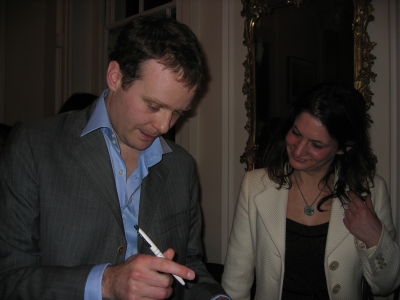
London launch of Metronome Press at the Arts Club: Tom McCarthy & Louise Stern
3:AM: Metronome Press is “dedicated to developing fiction and new styles of writing in relation to contemporary art practice”. Why are you so interested in the art/writing interface? Is the distinction between the two worlds disappearing?
CD: I am interested in experiments related to interpretation. Metronome is an interpretational tool rather than a vehicle for the promotion of artists’ works. Metronome Press has a similar attitude. It has not been set up within a literary field, but within the context of writing produced in relation to art production. Our challenge is the art world, and its discourse, not the literary world. We do not deny that visual artists can produce good literature, nor do we exclude the input of writers within our framework, but our main area of investigation is research and experimentation in art practice.
3:AM: Three of the first four novels in the collection are by writers (Tom Gidley, Tom McCarthy and Phyllis Kiehl) who also have artistic activities. Are they primarily artists who write on the side, or is writing integral to their artistic vision? Did you encourage any of them to take up the pen for the first time, or were all three already writers as well as artists?
CD: Phyllis Kiehl and Tom Gidley are primarily visual artists. Both have written in the past, and have now produced novels. They were writers before I knew them. I had published Phyllis Kiehl’s short stories in several earlier issues of Metronome (4, 5, 6, 7), and Tom Gidley had written a lot for Frieze in the past. I knew that Gidley had withdrawn for a while in order to write a book, and so I contacted him when we set up Metronome Press to see if he was interested. Phyllis was working on Fat Mountain Scenes whilst she and I were living in Paris. By publishing Fat Mountain Scenes, she was able to place her novel within the art context prior to the literary world of publishing.
3:AM: How did you come across Tom Gidley, Phyllis Kiehl and Tom McCarthy’s works?
CD: As I said above, I knew Tom Gidley and Tom McCarthy had both finished novels and whilst I had not read them, I was curious to follow up the hunch that fiction within art practice might be the way forward. And Phyllis as I said earlier, was in the process of writing her first novel as we both moved to Paris. It all made sense and their inclusion in the first collection of fiction produced by Metronome Press is a sign that perhaps there is a further interest out there. We are keen to receive manuscripts, scenarios, novels, etc., from artists.

London launch: Phyllis Kiehl & Tom Gidley
3:AM: In the US, it is quite acceptable for writers to play music and do art (or vice versa), but not so much in Europe. Is this something that should be encouraged?
CD: It’s always interesting to enter different territories. Today there is an important shift in the way we view art as an aesthetic field or set of practices, rather than as differentiated compartmentalised art productions (theatre/dance/visual arts/literature/film, etc). But you have to be lucid about whatever crossover you are ready to experiment with, and the context in which you are doing it. For Metronome Press to take on the airs of a literary publishing house in Paris, with all the history this city has, would be suicide! However, for us to work within art practice using fiction as a means of expression, and encouraging artists to experiment with other styles of communication, seems a logical step to take in today’s world.
3:AM: Do you see Metronome Press as a French, English or Anglo-French venture? It is based in Paris, but the first four novels are in English and one of your web addresses is a UK address…
CD: Metronome Press is based in Paris. It has no nationalist identity. It relates to those locations where we live (and that is necessarily subjective) and to those locations where we have worked.
3:AM: You are republishing Charles Henri Ford and Parker Tyler’s The Young and Evil which had originally been published by Obelisk Press in 1933. How did this come about?
CD: Thomas Boutoux and I loved the book. It is languid and tight at the same time. A perfect combination of erotic thinking and scenic or episodic action with a touch of historical information on the art scene of the early twentieth century. We were fortunate to be able to secure the rights and reprint an edition that is laid out exactly as the first edition was. There are cheap versions from other publishers, but the graphics that Charles Henri Ford had developed are rarely respected.
3:AM: The latest issue of Metronome mixes fiction and erotica as a homage to Maurice Girodias‘s Olympia Press. Do you see Metronome Press as the heir of the Olympia Press?
CD: Metronome Press is inspired by the system that Girodias had developed. If we could have a hotel too and a bar like Girodias we’d be happy! Let’s hope, however, that we don’t enjoy the multiple bankruptcies that characterised Girodias’ professional career!
3:AM: Do you think the anglophone literary scene in Paris is about to enjoy a revival?
CD: I don’t think that is the issue. Everyone and everywhere is anglophone these days. But we do hope that Paris will open up even more to the international situation it has always nurtured.
 ANDREW GALLIX