
An old story of mine, “Angel at a 25 Degree Angle” (written in 2000), was republished by Lit Up Magazine yesterday.
An old story of mine, “Angel at a 25 Degree Angle” (written in 2000), was republished by Lit Up Magazine yesterday.
Tom Bradley, Rev. of Apparitional Experience, 3:AM Magazine 6 March 2013

Fiddleblack Annual #1: Apparitional Experience, Fiddleblack Press 2013
This is a collection of ghost stories “purposely without ghosts”. The epigraph, from On the Road, serves to announce the emphatic Americanness of the contents. Like Kerouac with his continuous roll of typing paper, most of the authors herein have opted for the unadorned style, which has its roots in that country’s Puritan past. The collection satisfies eminently one’s appetite for such work. There are few or no ghosts of the literary sort haunting the first hundred or so pages of this book.
And then, all of a sudden, in the last story, up springs a manifestation that couldn’t be more unAmerican, in the best of all the good senses of that near-universally approbative adjective. It’s Andrew Gallix, and he is purposely with ghosts.
His story, “Fifty Shades of Grey Matter”, displays all the anti-Puritannical virtuosity, erudition, urbanity and sensory luxuriousness that have been established as his trademarks in such works as “Dr Martens’ Bouncing Souls“, “Celesteville’s Burning“, “Half-Hearted Confessions of a Gelignite Dolly-Bird” and “Forty Tiddly Winks“. Andrew Gallix stands out, not only in this book, but on the literary scene at large, as a major exponent of literary sophistication, both syntactical and philosophical.
When he goes On the Road (in his case, that would be the rue Victor Cousin, on his way to teach at one of the world’s oldest universities), Andrew Gallix treads in the astral traces of such unabashed eschewers of the unadorned style as Aquinas, Erasmus, Saint Francis Xavier, Balzac, Saisset, Victor Hugo, de Beauvoir, Teilhard de Chardin, Barthes, Deleuze, Ricoeur, et al. It stands to reason that he’s not obsessed with counting and banishing modifiers and flagellating subordinate clauses down to the bare declarative bones. He knows nothing of the retentive rules of deportment laid down by creative writing programs in the country that invented those institutions.
“Joycean” has been whored out as an adjective for so long, especially by Americans, that it lost meaning two generations ago. But if the term could be resurrected and shriven, it would apply to “Fifty Shades of Grey Matter” better than any fiction I’ve read in years. Andrew Gallix has done precisely what the stream of consciousness demands — and I don’t mean the long-hackneyed literary device, but the complex phenomenological proposition. Every sentence, every phrase, depicts and serves the multiple functions of human awareness, all at once, without discontinuity. The lush descriptions are delivered in a voice that delineates its own quirky persona and those around it, while moving the plot along, expanding upon thematic material, and being hilarious in the bargain.
This complexity can only be achieved by a writer who has at his fingertips all the resources of a longstanding culture, the full vocabulary of two languages, and none of the self-conscious laconicism of those perpetual Puritans who pout, unhaunted, across the Atlantic.
Dylan Nice, “Thin Enough to Break,” Other Kinds
She was all the things I couldn’t paint.
Lars Iyer, “Outside Literature: The Lars Iyer Interview,” interview by Tim Smyth, The Quarterly Conversation 31 4 March 2013
In Vila-Matas, we find a humorous recapitulation of Blanchot’s sense that a certain way of literary writing is at an end, and that a new kind of writing, one which registers this end in some way, is beginning. Andrew Gallix has much of interest to say on the topic of the various “ends” of literature that have occurred.[2] In one sense, I want to say that literature is always ending! The end is eternal. It will go on forever. There can be no “apocalypse” of literature. And for that reason, there will always be more hot tubs, more lists, more distractions! But I also want to insist on the specificity, on the singularity of this end . . . I believe in it . . .
Let me risk pretension by putting as follows. Historically, any simple avant-gardist idea of a new literary practice necessarily reconsolidates the traditional institution of literature that it claims to critique. A literary practice that is ostensibly “outside” literature posits an “inside” of literature. By disobeying the police who maintain the borders of literature, they simultaneously confirm the role of those police; avant-garde practices depend on them. But what happens when the police leave their posts? What happens when no-one mans the border — when the sanctity of literature becomes a matter of indifference? There can no longer be an “outlaw” avant-gardism, because there is no law to transgress. But nor is there a literature self-certain enough, secure enough, to arrest, domesticate or tame its “outside.” The authority of literature has vanished. The house of literature is deserted. Granted, that house is haunted. There are such things as literary ghosts, even a literary “hauntology,” as Gallix calls it.
My piece on the unread and the unreadable appeared on The Guardian‘s website today.
This interview with Clémentine Deliss was published in 3:AM Magazine in December 2005:
Detour in the Orthodoxy: Andrew Gallix Interviews Clémentine Deliss
3:AM: I gather that Metronome was primarily an arts magazine. Why did you decide, after nine years, to launch into fiction with a new publishing house called Metronome Press?
CD: Metronome has always worked with fiction. The very first issues included texts of fiction rather than criticism or theoretical texts written by art critics. The intention has been to create a detour in the orthodoxy of a person’s work whether they are an artist, critic, or writer. There is no point in replicating the same identity that one carries as a professional within the context of Metronome. Metronome is there to create a short-circuit between professionals working in different fields of aesthetic practice, and in many cases, in different urban locations (spanning Africa to Europe). The spark or trigger that awakens professional curiosity is potent when a moment of differentiation or otherness is recognised by the participating interlocutors (there can be no complacency with regard to the intersection of different theoretical discourses within art). So fiction in the context of contemporary art practice sets up a certain field of expression in contrast to the more standardised forms of writing we find in art magazines. Metronome is an organ, not an art magazine as such. To set up Metronome Press is to build on the ongoing interest in fiction and translation, nothing more. There is no exception to the rule.
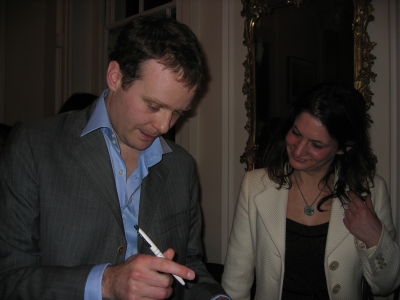
London launch of Metronome Press at the Arts Club: Tom McCarthy & Louise Stern
3:AM: Metronome Press is “dedicated to developing fiction and new styles of writing in relation to contemporary art practice”. Why are you so interested in the art/writing interface? Is the distinction between the two worlds disappearing?
CD: I am interested in experiments related to interpretation. Metronome is an interpretational tool rather than a vehicle for the promotion of artists’ works. Metronome Press has a similar attitude. It has not been set up within a literary field, but within the context of writing produced in relation to art production. Our challenge is the art world, and its discourse, not the literary world. We do not deny that visual artists can produce good literature, nor do we exclude the input of writers within our framework, but our main area of investigation is research and experimentation in art practice.
3:AM: Three of the first four novels in the collection are by writers (Tom Gidley, Tom McCarthy and Phyllis Kiehl) who also have artistic activities. Are they primarily artists who write on the side, or is writing integral to their artistic vision? Did you encourage any of them to take up the pen for the first time, or were all three already writers as well as artists?
CD: Phyllis Kiehl and Tom Gidley are primarily visual artists. Both have written in the past, and have now produced novels. They were writers before I knew them. I had published Phyllis Kiehl’s short stories in several earlier issues of Metronome (4, 5, 6, 7), and Tom Gidley had written a lot for Frieze in the past. I knew that Gidley had withdrawn for a while in order to write a book, and so I contacted him when we set up Metronome Press to see if he was interested. Phyllis was working on Fat Mountain Scenes whilst she and I were living in Paris. By publishing Fat Mountain Scenes, she was able to place her novel within the art context prior to the literary world of publishing.
3:AM: How did you come across Tom Gidley, Phyllis Kiehl and Tom McCarthy’s works?
CD: As I said above, I knew Tom Gidley and Tom McCarthy had both finished novels and whilst I had not read them, I was curious to follow up the hunch that fiction within art practice might be the way forward. And Phyllis as I said earlier, was in the process of writing her first novel as we both moved to Paris. It all made sense and their inclusion in the first collection of fiction produced by Metronome Press is a sign that perhaps there is a further interest out there. We are keen to receive manuscripts, scenarios, novels, etc., from artists.

London launch: Phyllis Kiehl & Tom Gidley
3:AM: In the US, it is quite acceptable for writers to play music and do art (or vice versa), but not so much in Europe. Is this something that should be encouraged?
CD: It’s always interesting to enter different territories. Today there is an important shift in the way we view art as an aesthetic field or set of practices, rather than as differentiated compartmentalised art productions (theatre/dance/visual arts/literature/film, etc). But you have to be lucid about whatever crossover you are ready to experiment with, and the context in which you are doing it. For Metronome Press to take on the airs of a literary publishing house in Paris, with all the history this city has, would be suicide! However, for us to work within art practice using fiction as a means of expression, and encouraging artists to experiment with other styles of communication, seems a logical step to take in today’s world.
3:AM: Do you see Metronome Press as a French, English or Anglo-French venture? It is based in Paris, but the first four novels are in English and one of your web addresses is a UK address…
CD: Metronome Press is based in Paris. It has no nationalist identity. It relates to those locations where we live (and that is necessarily subjective) and to those locations where we have worked.
3:AM: You are republishing Charles Henri Ford and Parker Tyler’s The Young and Evil which had originally been published by Obelisk Press in 1933. How did this come about?
CD: Thomas Boutoux and I loved the book. It is languid and tight at the same time. A perfect combination of erotic thinking and scenic or episodic action with a touch of historical information on the art scene of the early twentieth century. We were fortunate to be able to secure the rights and reprint an edition that is laid out exactly as the first edition was. There are cheap versions from other publishers, but the graphics that Charles Henri Ford had developed are rarely respected.
3:AM: The latest issue of Metronome mixes fiction and erotica as a homage to Maurice Girodias‘s Olympia Press. Do you see Metronome Press as the heir of the Olympia Press?
CD: Metronome Press is inspired by the system that Girodias had developed. If we could have a hotel too and a bar like Girodias we’d be happy! Let’s hope, however, that we don’t enjoy the multiple bankruptcies that characterised Girodias’ professional career!
3:AM: Do you think the anglophone literary scene in Paris is about to enjoy a revival?
CD: I don’t think that is the issue. Everyone and everywhere is anglophone these days. But we do hope that Paris will open up even more to the international situation it has always nurtured.
Lars Iyer, “Impossible Literature,” interview by Antônio Xerxenesky, 3:AM Magazine 6 February 2013
Andrew Gallix suggestively distinguishes between two kinds of belatedness. There is the belatedness already present in Don Quixote: the novel as a ‘fallen’ form, coming in the wake of older forms. And then, there is the romantic and Modern dream of the ‘Literary Absolute’, which expresses belatedness with respect to a total work of art — like Mallarmé’s conception of The Book, for example. Such belatedness, for me, holds in particular for those Modernist vanguards which sought in some way to link art to politics, which sought to change life, to change the world. As I argue in my manifesto, the conditions for such vanguards have vanished, and with them a whole dream of Literature, with a capital ‘L’.
My story “Fifty Shades of Grey Matter” features in Fiddleblack‘s first annual anthology — Apparitional Experience — which is devoted to ghostless ghost stories. It goes on sale today and is available here.
“Fifty Shades of Grey Matter” is described, on the website, as “a completely pure example of concept horror” that is “worth the cover price alone”.
From the website:
A response to the idea of “ghost stories without ghosts,” this anthology includes stories by John McManus, Todd Grimson, Andrew Gallix and other authors familiar to fans of Fiddleblack’s hard-to-parse self-definitions (antipastoralism and concept horror). The collection’s twelve stories are nothing if not equally enunciative, atmospheric and carved sharply into floorboards and muck-spattered glass. No, there’s nary an actual ghost involved, but this work is clearly haunted.
Apparitional Experience is built by twelve writers investigating on their own terms, examining nostalgia and risk, and how these elements can reconfigure our perceptions of self against place, how we’re sometimes duped into rationalizing our own existence. Here, our ghosts are not the reappearing spectral dead. Our ghosts take the shape of people and relationships once lost or forcibly forgotten, faded missions and feelings, and motivations no longer there. The writers of Apparitional Experience have written something for the fallen dreams, in a sense, for the very possibility of loss of control in our everyday lives, and the isolationist thoughts that possibility might bring.
This anthology demonstrates twelve interpretations of these elements from authors with rather different bodies of work all converging at a single dark center. John McManus characterizes rural perversity, and Mark Welborn walks us down a beautiful, densely haunted hiking trail. Joe Ricker and Charles Dodd White independently reinvigorate conventions for the modern Southern Gothic. Elias Marsten gives us rote antipastoralism, Kevin Catalano brings us an example of hyperintensive horror without limits, and Nicholas Rombes channels a particularly asphyxiating H.P. Lovecraft to counter a dark and new journalistic account of the Great Recession by Daniel Roberts. Bringing in the book’s final third is a dizzying piece of Thomas Ligotti-inspired work by Adam S. Cantwell, followed by an astringent body horror narrative by Karin Anderson. Todd Grimson’s woozy three-part flash fiction recalls David Lynch, and, to close, worth the cover price alone, is a completely pure example of concept horror by Andrew Gallix.
Apparitional Experience, as you may find, does not make for light reading in any sense of the phrase. There is much more to fear in the natural world, fear enough that these authors do not ever find true mirrors to the supernatural in their work. Rather, they discover that there are no ghosts. There is nothing out there past the concrete, past the trees. In the face of that person you hate and fear, there is no evil spirit, no broken. There is nothing all around us. Nothing at all.
Full Stop magazine interviewed me as part of their “Pathos” series, examining “the consequences of pursuing writing as a vocation”.
“Pathos: Andrew Gallix,” Full Stop 16 January 2013
Last winter, Full Stop introduced “The Situation in American Writing,” a questionnaire adapted from The Partisan Review that asked questions about literature’s responsibility to address seismic changes in culture, the publishing industry, and the political and geopolitical landscape. That questionnaire, which featured responses from Marilynne Robinson, George Saunders, Victor LaValle, T.C. Boyle, Dana Spiotta, and dozens of other writers was illustrative of the concerns and preoccupations that writers carry with them when practicing their craft.
This year we are interested in the situation of writers, rather than writing, in the subjective experience of writing fiction (or in this case, memoir), rather than fiction’s responsibilities to respond to a rapidly changing world. To this end we are interested in examining the trying intellectual, creative, and emotional labor that is often unacknowledged or effaced in the public presentation of writing. What we’re interested in, to put it another way, is pathos.
This year, we’ve crafted a questionnaire asking writers about the effect writing has had on their physical, emotional, and economic health; on the idea of poverty being a precondition for writing well; on what makes writing truthful to one’s self and to readers. Ultimately, we are interested in the consequences of pursuing writing as a vocation.
Andrew Gallix is the Editor-in-Chief of the consistently great 3:AM Magazine which features a motto that is the envy of Full Stop: ”Whatever it is, we’re against it.” He also teaches at the Sorbonne, writes for The Guardian, and is currently working on a novel, as well as a collection of reviews of impossible books in collaboration with David Winters.
How has your decision to write affected your health? Has it had negative effects on your personal life?
The great Polish writer Witold Gombrowicz said, “One cannot be nothingness all week and then suddenly expect to exist on Sunday.” It’s equally difficult to have a day job and be “nothingness” in the evening — especially if you’re trying to juggle a family life at the same time. Things must be much easier when you can write for a living. I’m pretty sure writing contributed to my divorce, for instance!
There is long tradition that links the craft of writing with poverty. Do you think that’s appropriate? Does poverty feel like the most appropriate condition for your practice as a writer?
No. The authors I know who insist upon writing for a living, although their work is resolutely uncommercial, end up, paradoxically, being obsessed with financial matters. Every single word they write must be counted, and accounted for; turned into money to pay the bills. Don’t get me wrong: writers should be paid, but you can’t force people to buy books, let alone read them. Those lucky, or cunning enough, to find a wide audience don’t usually stop writing, all of a sudden, because they’re raking it in. Some of the most interesting writers today come from very privileged backgrounds. Others don’t, and if their books fail to sell in sufficient quantities, they usually have to supplement their incomes through grants, teaching, journalism, or jobs in publishing. The creative writing industry is, in part, a means of subsidising writers’ careers.
The question of the cost of letters (to refer to the title of a book on this subject published by Waterstone’s in 1998) is an important one, because it reflects the evolution of literature itself. When literature was essentially an aristocratic pursuit — for people who had both time and money — this question was immaterial. It only really arises with the spread of literacy and the emergence of writers who didn’t hail from the ranks of the idle rich. The Waterstone’s book I mentioned — How Much Do You Think a Writer Needs to Live on?: The Cost of Letters (edited by Andrew Holgate and Honor Wilson-Fletcher) — was inspired by a survey of literary living standards carried out by Cyril Connolly fifty years earlier. When it was published by Horizon, in 1948, British society was being radically transformed through mass education and the Welfare State. Connolly’s survey contained the following questions:
How much do you think a writer needs to live on?
Do you think a serious writer can earn this sum by his writing and if so, how?
If not, what do you think is a suitable second occupation for him?
Do you think literature suffers from the diversion of a writer’s energy into other employments or is enriched by it?
Do you think the state or any other institution should do more for writers?
Are you satisfied with your own solution of the problem and have you any specific advice to give young people who wish to earn their living by writing?
The main question (which wasn’t addressed because it went without saying at the time) is, of course, that of the definition of a “serious writer” — one who may be worthy of being subsidised in the absence of commercial success. Who decides who is a “serious writer” in the first place? Is it the writer him/herself? His/her peers? Academia? The media? The reading public? The state? I’ve always been a little dubious about the romantic image of the impoverished, tortured genius scribbling away in his, or indeed her, dingy garret, but it does reflect a very real process of privatisation of the writing profession.
Walter Benjamin famously described the “birthplace of the novel” — and hence that of modern literature — as “the solitary individual”: an individual cut off from tradition, who, unlike the writers of antiquity, could no longer claim to be the mouthpiece of religion or society. The writer’s legitimacy, in a “destitute time” (Hölderlin) of absent gods and silent sirens (Kafka) — a disenchanted world (Schiller) which is still ours — becomes highly arbitrary.
Personally, financial difficulties have always diverted me away from my writing. Having said that, the necessity to write often stems (at least in part) from a feeling of dissatisfaction — a sense that something is missing — so, from that point of view, not being rich and contented is probably an asset.
In a rare 1983 interview the enigmatic and often dour Romanian writer Emil Cioran speaks about only reading Nietzsche’s letters because he became concerned with how untruthful Nietzsche’s published works seemed when read against the miserable condition of his day to day existence (isolated, weak, sickly, certainly not characterized by any sense of vigor). Is there any sense in which the truth of one’s condition should be related to the truth of one’s writing, even if in an oblique sense?
In an oblique sense, yes; otherwise, not necessarily. As I was saying, literature is often a compensatory activity; an elaborate form of wish-fulfilment. I am absolutely fascinated by the impact that someone’s physical and psychological life can have on his/her thinking and writing — how apparently rational choices are due, for instance, to a tiny todger, short stature, child abuse, or the absence of a parent. Sartre claimed that he began writing to make up for his ugliness and impress women. We all want to be loved, and writing is always a love letter of sorts. As Richard Brautigan put it, “Just because people love your mind, doesn’t mean they have to have your body” — but one lives in hope, of course.
Perhaps Cioran’s remark makes more sense in the context of philosophy, but literature is the space of contradiction and ambiguity, and that’s what interests me.
Incidentally, I once lived in the same street as Cioran, in Paris.
Are you envious of other people’s success? If so, are you more envious of people’s success in your field or outside of it? Why?
I am, especially if I think they don’t deserve it. I’m more envious of people in my own field, of course, because I feel closer to them. It’s a phenomenon that René Girard skillfully analyses in Deceit, Desire & the Novel.
Give one example in which you had high hopes for success (artistic, commercial, or otherwise) but had those hopes dashed.
When I was really young, and still a student, I got a contract with an American publisher for a short work of criticism. I’d sent them the manuscript, on the off-chance, and it turns out that they wanted to publish it as it was. I was really proud: I didn’t know anyone my age who had published a book — but, of course, I wasn’t satisfied. The manuscript, in my eyes, wasn’t good enough. I asked the publisher to give me a little time to work on it. They granted me a one-year deadline, on the understanding that I’d send in the revised manuscript after six months. Six months, that’s all you need, they said, six months. Almost five years later, I was still working away on the manuscript, wracked by guilt, and I had to draw the conclusion, eventually, that the project I’d embarked upon was unfinishable. As Blanchot said of Joubert, I preferred failure to “the compromise of success” — or at least, that’s my excuse.
Do you feel like the world owes you a chance to make a living as a writer?
Absolutely not, but I hate the world for it!
What is the strongest emotional reaction you have ever elicited from a reader, either in your written work or during a reading? What is the strongest emotional reaction you have ever elicited from yourself during the writing process?
When people I respect have told me that they wished they’d written a story of mine.
When I’ve managed to write something so painful that I thought I’d never see it through.
When, on the rare occasion and in the distant past, women have wanted my body, just because they loved my mind.
When are you at your most truthful as a writer?
When I’m not writing.
 ANDREW GALLIX