Author and librarian Stu Hennigan chooses Loren Ipsum as one of his 5 autumn picks in The Bookseller:
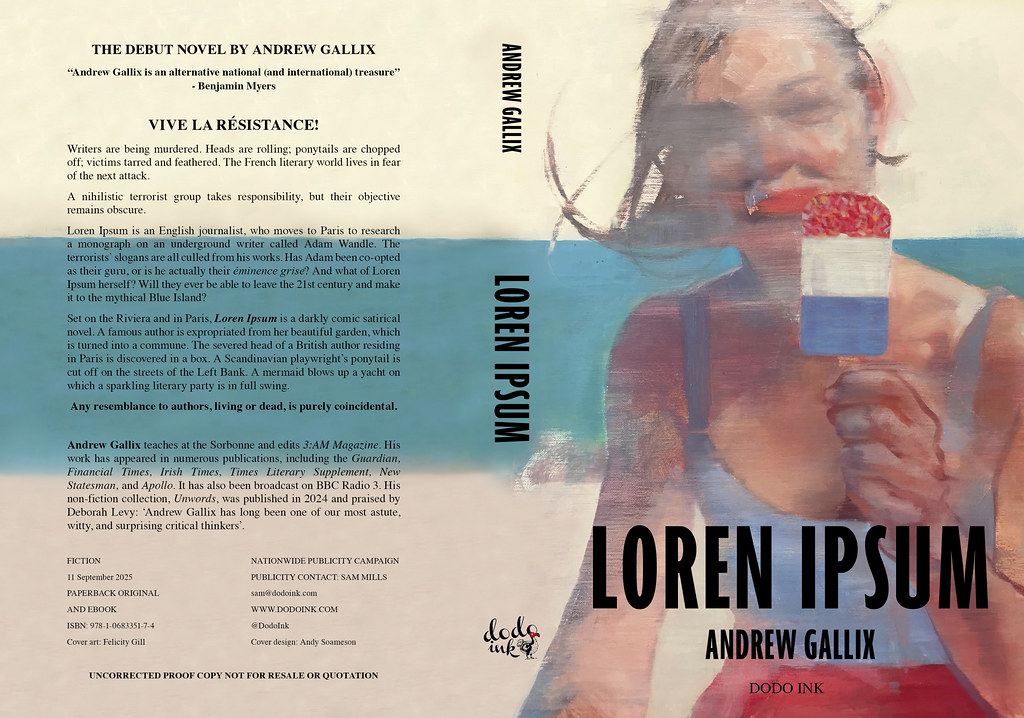
Andrew Gallix is one of the great unsung heroes of the UK literary scene, through his almost two decades fearlessly and tirelessly platforming bleeding-edge new writing as editor of the legendary 3:AM Magazine, and his reputation as an astute, perceptive and incisive critic (as collected in last year’s Unwords). His debut novel is a wild literary thriller in which ‘the death of the author’ is repeatedly taken too literally, as a nihilistic terrorist group slaughters the writers of France for reasons obscure, and a British journalist, Loren Ipsum, becomes embroiled. You’ll need to be on your toes to keep up with this one.
The elements were leading him a merry dance. The wind, in particular, was winding him up. He paused to remonstrate with his umbrella, which seemed to have developed a mind of its own since blowing inside out. Its erratic movements resembled those of a divination rod gone haywire. Buffeted on all sides, the man gripped the shaft with both hands, holding on for dear life. Oh, the gusto of those gusts! Loren pictured him soaring away like Mary Poppins — an unlikely prospect in view of his corpulence. Besides, the disjointed canopy lay presently in a puddle at his feet. The man gazed ruefully at the carnage of twisted ribs. Turning his chubby face skywards, he closed his eyes for a few seconds while the righteous rain streamed down his hirsute features. Ah, those rivers of rivulets! Whether he was communing with God, steeling himself for the next stage of his pilgrimage, or simply weathering the weather, Loren knew not. In fact, he was adrift on a vulva-shaped rowing boat in the middle of a fjord, sailing into darkness. The kind of absolute darkness where you can see the light, if only you look hard enough. And there it was, shimmering in the distance, and he was tingling all over and everything everywhere was growing luminous and numinous. He was alive. Right now, he was alive. Drenched — but alive. It was pouring and he was porous; part of everything. Never again would he take existence for granted. He resolved, there and then, to spurn the dead hand of stultifying routine and seek out the spiritual in the everyday. So he beat on, borne back ceaselessly onto the ground he had just covered, but eventually inching forwards through hard-won incremental triumphs. At a glacial pace, he thus contrived to travel the length of the bistro from whence Loren, transfixed, had observed the whole saga. This, she thought, is what happens when nothing happens. Nothing was happening before her very eyes. …
‘If Petronius had taken ketamine with Guy Debord…’
‘Loren Ipsum is like a chemical (or celestial, or necro-feline) phenomenon the very observation of which causes it to radically mutate under your gaze. As you turn the pages, biting satire morphs into tender autobiography, literary theory into crime, and farce into a complex reflection of culture and its place in history’ Tom McCarthy, author of Remainder and The Making of Incarnation
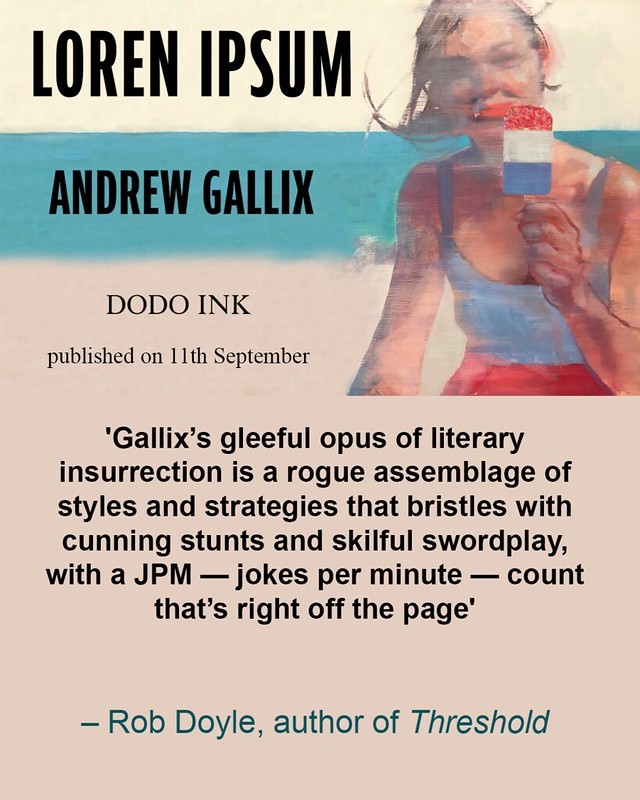
“In Loren Ipsum language itself is up in arms, subverting syntax and blasting holes in meaning left, right, and centre. Gallix’s gleeful opus of literary insurrection is a rogue assemblage of styles and strategies that bristles with cunning stunts, skilful swordplay, and meta-tricksy in-your-endos, with a JPM — jokes per minute — count that’s right off the page”
Loren Ipsum is a roman à clef which gleefully scrapes its keys over the surface of the realist novel, turning it inside out and revelling in the carnage it creates. It forms an anti-biography which spills the tea on several lives, teases truth like a saucy flash of knickers, artfully nicks from several sources and spins puns to make sense unspun.
Dazzlingly comic and profoundly serious, this novel — like all great writing — is utterly futile and absolutely essential, both confounding and illuminating. Loren Ipsum writes, rewrites and unwrites the great Anglo-French novel, destroying then re-creating the world with each chapter.










 ANDREW GALLIX