All the Latest

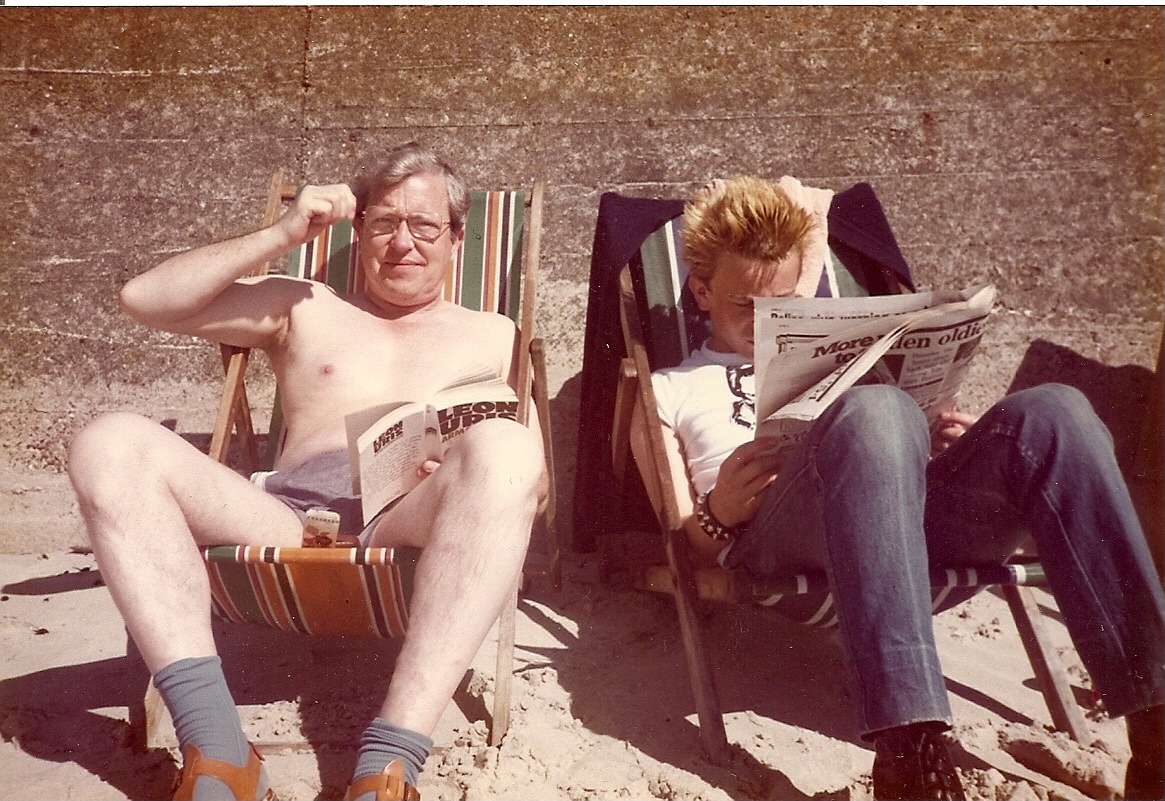
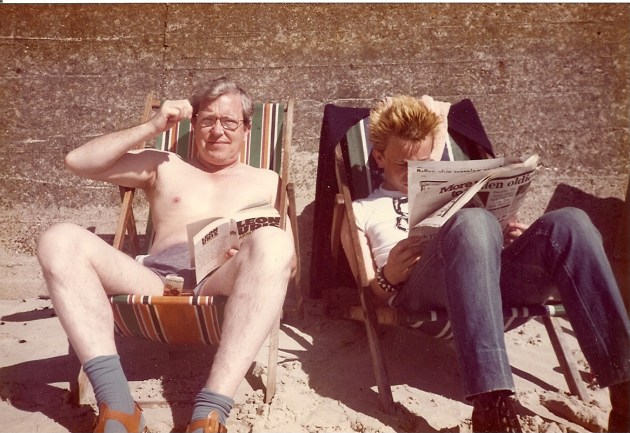
Have just noticed that this picture of me and my stepdad — taken by my mum, in Jersey, back in July 1981 — had been posted on the ISYS (I Saw You Standing) tumblr (This is Me Then, 1 November 2011). He’s rocking the classic socks-and-sandals combo; I’m sporting a punk Charles and Diana T-shirt to “celebrate” the Royal wedding (purchased at the Virgin Megastore on Oxford Street).

Invisible Tradition

Simon Reynolds, “Greil Marcus: A Life in Writing,” The Guardian Saturday 18 February 2012 (Guardian Review p. 12)

At once epic and fragmentary, the book [Lipstick Traces] argues for the Sex Pistols as the culmination of ‘an unheard, invisible tradition’ of apocalyptic protest-poetry stretching back via Situationism and Dada all the way to medieval millenarian sects like the Brethren of the Free Spirit. ‘Johnny Rotten is speaking for himself but all those other voices are in there speaking with him too. All kind of demands on society, on life, on ontology, on epistemology are present in the noise of punk and in that vocal sound, boiled down on to a little 7-inch piece of plastic’.

The Melancholia of Guy the Gorilla

I remember Guy the Gorilla — probably the only real-life ape to ever achieve celebrity status in Britain. In the simian firmament, he’s right up there alongside King Kong, Cheetah, and the PG Tips chimps. A great ape indeed. The poet Philip Larkin used to keep two framed photographs of him — in lieu of the habitual wife and kids — on his desk when he was head librarian at Hull University. Quotations from Goethe and Wilde, pasted on the pictures, seemed to emanate from his gaping mouth like speech bubbles in a comic strip.
To be honest, I hadn’t thought of Guy for a long time, but a documentary about Tony Hancock on BBC Four jogged my memory. It included archive footage of the celebrity primate in his cage, showing off his trademark alpha-male moves. Hancock, we learned, loved going to London Zoo. On one occasion, the keepers even let him slip under the protection barrier so that he could get a closer look at the star attraction. Apparently, he found the experience very moving, which doesn’t surprise me at all. Guy the Gorilla could knuckle-walk with the best of them, but he also had the uncanny ability to stare at the camera as if apeing his human observer’s melancholia.

The last time I visited London Zoo was in the summer of 1977. I remember being shocked by the gory, mutilated corpses of white mice that had been fed to many of the animals on display. I remember observing a Teddy boy with his blonde ponytailed girlfriend. I remember wearing a blue T-shirt laden with with safety pins and badges. I remember reading a review of the Stinky Toys’ first single (which I’d already acquired) in one of the music papers. It was a glorious summer’s day, and we sat at a wooden table, on a wooden bench, outside a cafeteria. I remember the bittersweet fragrance of the sun-warmed wood. I remember relishing the family outing but already feeling — with a sharp pang of regret — that I was outgrowing this sort of thing. I remember sensing that there was pretty much nothing I could do about it.

I can’t remember for sure if we saw Guy the Gorilla that time, but I’m almost certain we didn’t. I still recall the poster that had adorned my bedroom wall, at my mum’s, a few years earlier. It was a full-length portrait framed by a yellow border that almost matched the colour of the wall. By July 1977, Guy the Gorilla was a fading memory; a rolled-up poster in my chest of drawers. The following year, he died of a heart attack during an operation but, for me, he had disappeared on that warm summer’s day when we probably failed to pay him our respects. Seeing my loss mirrored in his liquid eyes would have been heart-rending. He had to be sacrificed.

The Young Parisians

This appeared in the summer 2010 issue of Nude Magazine (issue 16, pp. 40-43):

The Young Parisians

Why don’t you come to Paris with me?
And see the young Parisians’
– “Young Parisians” by Adam and the Ants

‘There’s something very un-British about electronic music,’ says Daniel Miller — founder of Mute Records — in BBC Four’s excellent Synth Britannia documentary. By ‘very un-British’ he means très European — German, of course, but also French. Lest we forget, musique concrète composers like Pierre Schaeffer began their sonic experiments before Stockhausen. Most Continentals in the late 70s were first introduced to synthesizers via Jean-Michel Jarre not Kraftwerk. Métal Urbain — France’s answer to the Sex Pistols — produced their scuzzy rabble-rousing pogobeat on custom-made imitation Moogs at a time when electronic instruments were still usually associated with prog rock dinosaurs. The strong French presence on Angular Records’ recent Cold Waves and Minimal Electronics compilation was generally met with dismay by British music journalists who were blissfully unaware of the existence of a thriving post-punk scene across the Channel (Indochine, a synthpop outfit in the Depeche mode, even became France’s biggest band at one point). Whereas Gallic guitar combos have always been viewed — rightly or wrongly — as derivative vis-à-vis their Anglo-American counterparts, the synth-driven ‘French Touch’ sound was successfully exported ‘around the world’ at the turn of the century. The missing link between the early 80s and late 90s was Denis Quillard, better known as Jacno, who died in November last year at the age of 52 having cemented his country’s love affair with electronic minimalism.

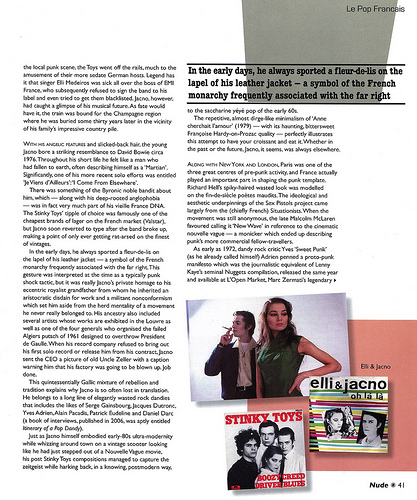
There are times when the past, present and future seem to collide, and one such occasion occurred on 9 February 1977 when Jacno’s band, the Stinky Toys, were invited to a music press junket aboard the eponymous Trans Europe Express coinciding with the release of Kraftwerk’s album. Having a reputation to maintain as the enfants terribles of the local punk scene, the Toys went off the rails, much to the amusement of their more sedate German hosts. Legend has it that singer Elli Medeiros was sick all over the boss of EMI France, who subsequently refused to sign the band to his label and even tried to get them blacklisted. Jacno, however, had caught a glimpse of his musical future. As fate would have it, the train was bound for the Champagne region where he was buried some thirty years later in the vicinity of his family’s impressive country pile.

With his angelic features and slicked-back hair, the young Jacno bore a striking resemblance to David Bowie circa 1976. Throughout his short life he felt like a man who had fallen to earth, often describing himself as a ‘Martian’. Significantly, one of his more recent solo efforts was entitled ‘Je viens d’ailleurs’: ‘I Come From Elsewhere’. There was something of the Byronic noble bandit about him, which — along with a deep-rooted anglophobia — was in fact very much part of his vieille France DNA. The Stinky Toys’ tipple of choice was famously one of the cheapest brands of lager on the French market (Valstar), but Jacno soon reverted to type after the band broke up, making a point of only ever getting rat-arsed on the finest of vintages. In the early days, he always sported a fleur-de-lis on the lapel of his leather jacket — a symbol of the French monarchy frequently associated with the far right. This gesture was interpreted at the time as a typically punk shock tactic, but it was really Jacno’s private homage to his eccentric royalist grandfather from whom he inherited an aristocratic disdain for work and a militant nonconformism which set him aside from the herd mentality of a movement he never really belonged to. His ancestry also included several artists whose works are exhibited in the Louvre as well as one of the four generals who organised the failed Algiers putsch of 1961 designed to overthrow President de Gaulle. When his record company refused to bring out his first solo record or release him from his contract, Jacno sent the CEO a picture of old Uncle Zeller with a caption warning him that his factory was going to be blown up. Job done.

This quintessentially Gallic mixture of rebellion and tradition explains why Jacno is so often lost in translation. He belongs to a long line of elegantly wasted rock dandies that includes the likes of Serge Gainsbourg, Jacques Dutronc, Yves Adrien, Alain Pacadis, Patrick Eudeline and Daniel Darc (a book of interviews, published in 2006, was aptly entitled Itinerary of a Pop Dandy). Just as Jacno himself embodied early-80s ultra-modernity while whizzing around town on a vintage scooter looking like he had just stepped out of a Nouvelle Vague movie, his post-Stinky Toys compositions managed to capture the zeitgeist while harking back, in a knowing, postmodern way, to the saccharine yéyé pop of the early 60s. The repetitive, almost dirge-like minimalism of ‘Anne cherchait l’amour’ (1979) — with its haunting, bittersweet Françoise Hardy-on-Prozac quality — perfectly illustrates this attempt to have your croissant and eat it. Whether in the past or the future, Jacno, it seems, was always elsewhere.

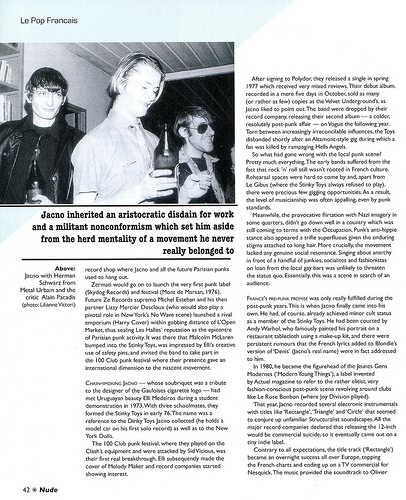
Along with New York and London, Paris was one of the three great centres of pre-punk activity, and France played an important part in shaping the punk template. Richard Hell’s spiky-haired wasted look was modelled on the fin-de-siècle poètes maudits. The ideological and aesthetic underpinnings of the Sex Pistols project came largely from the (chiefly French) Situationists. When the movement was still anonymous, the late Malcolm McLaren favoured calling it ‘New Wave’ in reference to the cinematic Nouvelle Vague — a monicker which ended up describing punk’s more commercial fellow-travellers. As early as 1972, dandy rock critic Yves ‘Sweet Punk’ Adrien (as he already called himself) penned a proto-punk manifesto which was the journalistic equivalent of Lenny Kaye’s seminal Nuggets compilation, released the same year and available at L’Open Market, Marc Zermati’s legendary record shop where Jacno and all the future Parisian punks used to hang out. Zermati would go on to launch the very first punk label (Skydog Records) and festival (Mont-de-Marsan, 1976). Future Ze Records supremo Michel Esteban and his then partner Lizzy Mercier Descloux (who would also play a pivotal role in New York’s No Wave scene) launched a rival emporium (Harry Cover) within gobbing distance of L’Open Market, thus sealing Les Halles’ reputation as the epicentre of Parisian punk activity. It was there that Malcolm McLaren bumped into the Stinky Toys, was impressed by Elli’s creative use of safety pins, and invited the band to take part in the 100 Club punk festival where their presence gave an international dimension to the nascent movement.

Chain-smoking Jacno — whose soubriquet was a tribute to the designer of the Gauloises cigarettes logo — had met Uruguayan beauty Elli Medeiros during a student demonstration in 1973. With three schoolmates, they formed the Stinky Toys in early 76. The name was a reference to the Dinky Toys Jacno collected (he holds a model car on his first solo record) as well as to the New York Dolls. The 100 Club punk festival, where they played on the Clash’s equipment and were attacked by Sid Vicious, was their first real breakthrough. Elli subsequently made the cover of Melody Maker and record companies started showing interest. After signing to Polydor, they released a single in spring 1977 which received very mixed reviews. Their debut album, recorded in a mere five days in October, sold as many (or rather as few) copies as the Velvet Underground’s, as Jacno liked to point out. The band were dropped by their record company, releasing their second album — a colder, resolutely post-punk affair — on Vogue the following year. Torn between increasingly irreconcilable influences, the Toys disbanded shortly after an Altamont-style gig during which a fan was killed by rampaging Hell’s Angels.

So what had gone wrong with the local punk scene? Pretty much everything. The early bands suffered from the fact that rock’n’roll still wasn’t rooted in French culture. Rehearsal spaces were hard to come by and, apart from Le Gibus (where the Stinky Toys always refused to play), there were precious few gigging opportunities. As a result, the level of musicianship was often appalling, even by punk standards. Meanwhile, the provocative flirtation with Nazi imagery in some quarters didn’t go down well in a country which was still coming to terms with the Occupation. Punk’s anti-hippie stance also appeared a trifle superfluous given the enduring stigma attached to long hair. More crucially, the movement lacked any genuine social resonance. Singing about anarchy in front of a handful of junkies, socialites and fashionistas on loan from the local gay bars was unlikely to threaten the status quo. Essentially, this was a scene in search of an audience.

France’s pre-punk promise was only really fulfilled during the post-punk years. This is when Jacno finally came into his own. He had, of course, already achieved minor cult status as a member of the Stinky Toys. He had been courted by Andy Warhol, who famously painted his portrait on a restaurant tablecloth using a make-up kit, and there were persistent rumours that the French lyrics added to Blondie’s version of ‘Denis’ (Jacno’s real name) were in fact addressed to him. In 1980, he became the figurehead of the Jeunes Gens Modernes (‘Modern Young Things’), a label invented by Actuel magazine to refer to the rather elitist, very fashion-conscious post-punk scene revolving around clubs like Le Rose Bonbon (where Joy Division played). That year, Jacno recorded several electronic instrumentals with titles like ‘Rectangle,’ ‘Triangle’ and ‘Circle’ that seemed to conjure up unfamiliar Structuralist soundscapes. All the major record companies declared that releasing the 12-inch would be commercial suicide, so it eventually came out on a tiny indie label. Contrary to all expectations, the title track (‘Rectangle’) became an overnight success all over Europe, topping the French charts and ending up on a TV commercial for Nesquick. The music provided the soundtrack to Olivier Assayas’s first short film (Copyright) in which Elli Medeiros made her debut performance as an actress. Assayas also shot a video for ‘Rectangle’ which shows Jacno playing against the suitably angular, brutalist background of the La Défense area of Paris. The only track on the record that wasn’t an instrumental — the aforementioned ‘Anne cherchait l’amour’ — was sung by Elli. It marked the beginning of Elli & Jacno who provided a blueprint for countless other synth-based duos like Soft Cell and Yazoo, and sold millions of records until they split up in 1984 having written the soundtrack to Eric Rohmer’s Les Nuits de la pleine lune.

Elli would go on to have a couple of massive solo hits in 86-87 before concentrating on her acting career and family life. She made a musical comeback in 2006. Jacno, meanwhile, released six solo albums and produced work by some of France’s greatest stars like Jacques Higelin or Etienne Daho, an early fan of the Stinky Toys. He will always be remembered, however, as the New Wave Erik Satie whose elegant electronic minuets (as Rohmer once described them) seemed to capture the essence of our adolescence. ‘True life,’ as Rimbaud once put it, ‘is elsewhere.’ That is, as ever, where Jacno is to be found.

****

Ten of the best first wave punk bands from over the Channel

Métal Urbain
Think Sex Pistols crossed with Suicide or Throbbing Gristle — or both. Hardcore political lyrics. Their second single was Rough Trade’s first release. Best track: ‘Panik’.

Asphalt Jungle
Fronted by dandy rock critic-cum-novelist Patrick Eudeline. Talked the talk but seldom walked the walk except on their third single, ‘Polly Magoo,’ which sounds like a gang of inebriated football hooligans rutting with Phil Spector. In a good way.

Starshooter
They hailed from Lyon, played a mean live set, had a sense of humour and were solidly working class unlike most of their bourgeois contemporaries. Good mates with the Damned. Listen to: ‘Macho’.

Marie et les Garçons
Also from Lyon. Heavily influenced by the NYC scene at first, then experimented with a disco crossover thang. Second single produced by John Cale. They had a female drummer (the eponymous Marie) who died in the 90s. Top track: ‘Re-Bop’.

Guilty Razors
Famous for singing in pigeon English (‘Provocate,’ ‘I Don’t Wanna Be a Rich’!). Two of their members were of Spanish origin. They were very close to the Slits. Check out: ‘I Don’t Wanna Be a Rich’.

Gazoline
Having been a failed teenybop heartthrob in the 60s, a failed glam rock star in the early 70s and a successful gay cabaret artist, Alain Kan reinvented himself as a punk rocker. His band was named after a group of militant drag queens from the early gay liberation days. Kan disappeared in 1990; no one has seen or heard from him since. Gazoline’s second single is arguably one of the most convincing punk records to ever come out of France. Best track: ‘Radio flic’.

Les Olivensteins
Started later than most of the others and paved the way for the hardcore of the early 80s (Oberkampf, Bérurier Noir et al.). One of their most provocative lyrics described the Vichy regime as the good old days. Their name came from a psychiatrist famous for his anti-drugs crusade. Like Sham 69, they ended up attracting the wrong element and split up. Top track: ‘Fier de ne rien faire’.

1984
On paper, a kind of dystopian Clash but never fulfilled their promise. Listen to: ‘Salted City’.

Les Lou’s
All-girl band managed at one stage by Bernie Rhodes. Highlight: ‘Back on the Street’.

Electric Callas
A flamboyant Bowie/Iggy fanatic from Lyon backed by a dizzying array of line-up changes. Check out: ‘Kill Me Two Times’.

All the Latest

The summer 2010 issue of the brilliant Nude Magazine (issue 16) is out now, and it contains an article by yours truly about Jacno, the founder of the Stinky Toys who went on to become a pioneer of French electropop:

“A look back at the too short life of Denis Quillard (aka Jacno), the artistocratic pop dandy, former Stinky Toy and pioneer of French electronic music.”

The Moors Murderers

The history of The Moors Murderers, the phantom punk band that included Chrissie Hynde and Steve Strange.

In June 1977, Soo Catwoman announced that she was starting a band called the Moors Muderers: “The Moors Murderers thing was a big joke to be honest. I was joking about getting a band together called the Moors Murderers and doing sleazy love songs, I had no idea he [Steve Strange] would actually go out and do it. …” Strange claimed to be part of a band called the Moors Murderers in order to do a photo shoot for German magazine Bravo. Catwoman says she was also present but left the shoot. Steve Strange may have played a gig with The Photons under the Moors Murderers monicker supporting The Slits at an NSPCC benefit concert at Ari Up’s school in Holland Park circa Christmas 1977. After the gig, Steve Strange asked Dave Goodman (who had worked with the Pistols and Eater) to produce their song “Free Hindley”. On 8 January 1978, The Sunday Mirror published a piece on the band (“Why Must They Be So Cruel?”) based on an interview which had taken place at Goodman’s office in Fulham. The four band members were wearing pillow cases on their heads. According to Goodman, they included Strange, Chrissie Hynde and Nick Holmes (Eater’s roadie who is believed to have played guitar on “Free Hindley”).

In mid-January 1978, the Moors Murderers featured in Sounds, wearing bin liners over their heads. They played a few songs for the journalist (“Free Hindley“, “Caviar and Chips”, “Mary Bell” and “The Streets of the East End”). Following the Sounds showcase, the band played the Roxy on 13 January 1978, supporting Open Sore. Steve Strange was on vocals (calling himself Steve Brady) and Hynde was on guitar. Bob Kylie (Open Sore): “They were terrible! Absolutely dreadful!” On 28 January 1978, Strange told Sounds that he had left the band.

The Moors Murderers probably never released a record, but some tracks seem to have been recorded.

16143357_598616780344171_769462397323570243_n

A Pint and a Molotov Cocktail

409692229_e75d124f7c_t

This appeared in 3:AM Magazine on 14 September 2007. It was reprinted in George Berger’s Let’s Submerge: Tales From the Punk Rock Underground, published on 26 November 2013:

A Pint and a Molotov Cocktail

George Berger interviewed by Andrew Gallix.

3:AM: How did you get into punk?

GB: Seeing the bizarrely-dressed head-turners strolling around Bromley and surrounding areas really turned my head. Clothes and hair and a way of walking that just said “fuck off” to everyone, and straight society in particular. I don’t remember the individuals individually, just the feeling of seeing unrepentant weirdos expressing themselves via their appearance. I’d imagine this was before the word ‘punk’ came into popular use, but it doesn’t really matter either way. Seeing similar — or perhaps the same — people then interviewed on the London Weekend Show by Janet Street Porter, and then on ‘Young Nation’ on Nationwide turned my head yet further: they were sullen and obnoxious and that confused my hormones. I can’t say I liked the look of them, but it opened a door in my mind that had previously been locked and marked ‘no entry’. Finally, the famed Bill Grundy interview drew a line in the sand as I watched it with my outraged parents, trying to conceal my glee. This was clearly a step beyond their affectionate mock-outrage at glam rock.

‘No more apologies’, as Morrissey later described it so beautifully. My zits cleared up almost immediately, perhaps because I wasn’t scared of them anymore. Freedom of feeling, the feeling’s appealing. In other words, punk pushed the right buttons by opening the right (mental) doors at the right time. The music was often great, but was never the point.

136838559_c1ae270d79.jpg

3:AM: Your band, Flowers in the Dustbin, were part of the anarcho-punk scene, so you wrote this Crass book as an insider…

GB: Is there any self-respecting anarchist who would admit to being such? I wouldn’t know…

Being part of the London anarcho-punk-goth-crazy-coloured-fools-with-no-rules scene certainly informed the perspective that the book is written with of course, because it meant my early experience with anarchist thought and practice wasn’t limited to Crass. A sense of perspective, as Tap philosophised. But I’m not so sure FITD as a band were as much a part of all that in the way it’s now remembered. There’s a book about anarcho-punk coming out called The Hippies Now Wear Black — we were innocent on both those charges!

gerardbill2tiercopy.jpg

3:AM: To what extent did the members of Crass help you with your research and how have they reacted to the book?

GB: The members of Crass — Andy Palmer excepted — were as helpful as anyone could reasonably be expected to be, and in the cases of most, well beyond that.

The Crass members were also strikingly, unusually, generous and kind in a way that prods your conscience into examining its own parameters. Whatever happened to the members of Crass in their respective life-journeys at the time, it seems to have left an indelible urge to be kind and generous. Perhaps that was the energy that originally attracted so many towards them. In fact, I’m certain it was.

1383137754_2386f76248_m.jpg

3:AM: In another interview you said: “I always felt a bit sorry for the people who bought into Crass at the expense of everything else”. However, when you read the book, it is obvious that the Ants/Crass dichotomy still seems to rankle after all these years. Crass offered a whole lifestyle that was difficult to reconcile with non-anarcho punk bands like the Ants or UK Subs. It was a bit like joining a fundamentalist sect, wasn’t it? Do you think you might have been attracted to this aspect of the band because of your Catholic upbringing?

GB: Meaning Crass were a part of the whole and people who bought into the sideshow ‘anarcho-punk’ often missed out on the other colours of the rainbow — Killing Joke, Bauhaus, Swell Maps, Au Pairs, Slits, etc etc… I don’t think it was a dichotomy at all in the early days, but sadly neither side could resist the bitching that subsequently became one of anarcho-punk’s main characteristics.

I should point out that I wasn’t attracted to Crass so much as fascinated by them, i.e. I was massively drawn to the idea of somewhere like Dial House working for decades as an open house, but could never quite reconcile the difference between the harsh Crass rhetoric and the gentle people in Crass. Frankly, you’d expect Crass to be aggressive and confrontational as people, but they were — and are — lovely. Delibrate dada contradictions? Maybe.

The Crass image encouraged the fundamentalist thing, which I would suggest was due to some kind of archetype hangover from the hippie times (where sects flourished of course). The Ants, Subs etc were far more healthy in this respect, I’d say, as they weren’t playing the parent. Saying ‘be yourself’ is great (Ants / Subs / punk), but the minute you start defining what that self should be, albeit unintentionally, you’re risking straying into a difficult place. The Crass output became self-conscious and ‘preachy’ once they got an audience — I felt sorry for the people who were perhaps young and encountering Crass / punk for the first time at this juncture and so bought into an opinion as though it was a reality. The map is not the territory.

I was repelled by the perceived fundamentalist aspect of Crass, not attracted to it. Whether or not this was connected to being brought up a Catholic, I’ve really no idea.

1382241767_08de0167db.jpg

3:AM: Crass’s obsession with political freedom was so extreme that it enslaved some members. Steve Ignorant actually describes leaving the band as a liberation from the band’s politically-correct shackles: “I couldn’t look at the barmaid’s arse without being branded sexist. I couldn’t have milk in my tea without being called a bastard cos I wasn’t a vegan”. He also told you that if he’d been a 16-year-old punk at the time Crass’s rhetoric would have put him off and he would probably have been an Exploited fan. Even Penny Rimbaud, the band’s éminence grise, admits that they were “too serious”. It’s a double-edged thing, though, isn’t it? Crass meant so much because they were for real, but that purity also implied a po-faced, puritan zealotry…

GB: I don’t think Crass came across like that initially (before Penis Envy, if I’m forced to draw a line in the sand). I’m also not sure Steve is right – I don’t think that whatever took him to Dial House would have otherwise taken him to the Exploited; just a glib quote possibly out of context here. (In book interviews, Steve just spoke his mind whereas some other members of Crass pondered for literally minutes before replying to questions — which is quite unnerving but simultaneously inspiring).

1383137884_f9d63e04be_m.jpg

3:AM: Your book often reads like a demystification of Crass’s political correctness. Whereas at the time, they appeared so self-assured — with their black uniforms, military backdrops and corporate logo — here, they come across as far more human and vulnerable. Steve and Pete admit that they knew little about anarchist history; Eve Libertine explains that she had qualms about “Reality Asylum” because of her Christian upbringing; Steve wrote “So What” as a kind of childish dare “to see if there’d be a bolt of lightning” when he sang the blasphemous lyrics… Did all this change the way you perceived the members of the band and the Crass phenomenon or were you conscious of this vulnerability at the time?

GB: I didn’t know the band well enough as people at the time to be sure of the vulnerability. I’d wager few, if any did.

With the book, I wanted to try and find the people behind the image / wall of anynomity. Demystification hits the nail on the head. Whilst Crass were always approachable back then as ‘Crass’, the individuals behind the job were often impossible to discover. Even to themselves, it would appear. At the time, I thought this was counter-productive to ideas that ‘anyone can do it’, so with the book I tried to show that the people that made up Crass and did/didn’t change the world (delete as your reality tunnel dictates) did so without being special and without access to any privilege that you or I haven’t got. And surprised myself with my findings…

1382241897_802399f167.jpg

3:AM: The more I read your book, the more contradictions appeared. Crass avoided the star system through anonymity but this very anonymity inevitably created a mystique of its own. But the paradox doesn’t stop here as the band were also one of the most accessible ever…

GB: Were they? On one level yes: you could go meet them, chat to them, even visit their house. But as I’ve said, getting to know the real people was out of the question for fans. Still, they did draw the line in a very different place to the stars of the day, even the punk rock stars.

Did they avoid the star system? I’m not so sure — accessibility is surely only one aspect of stardom. People looked up to Crass and looked to them for guidance. By the time they were getting big, they appeared to want to give it, albeit way more responsibly than most of their peers.

1382242249_8b6385e858_m.jpg

3:AM: A couple of other contradictions highlight the band’s unique nature. Politically, they were caught between the old school anarchists and the pacifists; financially, the more records they sold, the more money they lost.

Crass created a massive grassroots anarchist movement, for the first time in British history. They invented their own brand of anarcho-pacifism. They were also the only political band to practise what they preached which is why they sold records by the truckload without any advertising. I remember an interview with Joe Strummer, in the early 80s, in which he said that wherever you went, even in a remote Greek village, you’d see graffiti of the Crass symbol. He was gobsmacked and clearly envious. The band’s achievements were huge, but until your book came out their story went largely unrecorded — weird, isn’t it?

GB: Weird yes, but what Crass were offering was so beautiful — yet so fragile — that it was only ever going to appeal to the demographic who considered it a possible reality.

You’re wrong about their losing money on records — that only happened with “Reality Asylum” — otherwise they made a lot of money. Then showed an inspiring amount of integrity by returning it to what they considered ‘the movement’ and simultaneously arguable tactics and taste in the way they did this by releasing records by a plethora of copyists (not all of course, but many).

libertine1.jpg

3:AM: Crass are obviously still influential and will continue to be so, but they were also very much of their time, weren’t they? I don’t know if you remember, but a few years ago, David Beckham was photographed sporting a T-shirt bearing the Crass logo: I’m sure he had no idea what it was; it didn’t mean anything anymore. I don’t think Crass would have been as influential in a prosperous, post-Thatcherite Britain, do you?

GB: I believe that T-shirt was a Jean-Paul Gaultier creation, but don’t quote me on it. The Crass symbol never meant anything beyond ‘Crass’ and it wasn’t even designed to mean that in the first place.

Crass were of their time, obviously. Our job is to be of ours… I think Crass would have got nowhere without punk, but then neither would so many bands, or any of the rest of us for that matter — it’s all so many ifs and buts.

I’d also mention that I don’t think we do live in a post-Thatcherite age yet.

crass3.jpg

3:AM: I’ve always thought that anarcho-punk was killed by the fans. All the bands were banging on about peace while the fans were beating the shit out of each other — there was such a contrast between rhetoric and reality…

GB: The anarcho-punks were generally peaceful. Trouble at anarcho gigs was invariably from skinheads, usually right-wing and preying on pitifully-easy pickings. The inherent aesthetic contradiction between the ranting aggressive anarcho noise and the ‘peace’ lyrics was bound to attract a percentage of people who liked the former to the point where they didn’t care about the latter. I’d say the lack of trouble at Poison Girls gigs illustrates that.

Of course, to treat anarcho-punk as a music scene is to ignore the much more pervasive and lasting political movement that included the popularisation of animal rights, the peace camps, the birth of the anti-capitalist demonstrations etc. — you can beat the shit out of a few people at a gig, but you can’t kill the spirit.

3:AM: You write that “If the Buzzcocks wanted a generation of kids to turn up the volume to annoy their parents, Crass made you turn it down so they couldn’t hear the blasphemy”. Maybe that was also part of the problem: over the years, Crass’s righteous anger seemed to turn into a permanent tantrum…

GB: Yes, I’d say so. They weren’t like this at all as people, so one can only conclude that they’d got too stuck into ‘punk’ as cliché and failed to follow their own advice. What seemed so vital and loyal to ‘the cause’ at first ended up feeling reactionary to me, particularly as newcomers appeared to buy into the scene as some kind of rule-book.

3:AM: Another big problem was the old class thing. In spite of the anarchist rhetoric, a class divide remained within the band — in particular between Steve Ignorant, the geezer who wanted to wink at the girls in the front row, and Penny Rimbaud, the public-school educated hippie intellectual…

GB: Actually, I don’t think there was any personal divide between Penny and Steve, but I do think that going on about classlessness against a backdrop of the biggest war of the 20th century in the UK against the working class caught them a bit short.

3:AM: It’s interesting that both Steve Ignorant and John Lydon were influenced by Brighton Rock, which they both read at school…

GB: I bet they’d love a drink together — Steve, Johnny and Pinky, getting leathered in Horatio’s at the end of the pier! I’ll get the first round in: mine’s a pint and a molotov cocktail!

3:AM: When Penny Rimbaud claims, for instance, to have seen flying tribesmen in Africa, do you ever think: this guy is a nutcase not a visionary genius?

GB: I’m amazed people haven’t picked up on this more. If Penny was deliberately winding me up saying this, then he was doing so with an intensity that would put him up there with Brando and De Niro as one of the greatest actors of all time.

Nutcase / visionary genius — as Penny himself has asked on many occasions regarding Wally Hope, where do you draw the line? I think Penny Rimbaud’s whole life appears to be lived as polemic, which may give a clue here, as may his interest in existentialism.

crasslyrics.jpg

3:AM: On the hippie vs punk debate, you claim that “Crass was right and Malcolm McLaren was wrong”. Obviously, there was continuity as well as rupture, but wouldn’t you agree that punk was the first movement to create a generation gap among youth itself? The hippies were the first generation to refuse to grow up, then punk came along with Sid Vicious stating that he couldn’t remember the Summer of Love because he was too busy playing with his Action Men…

GB: I’d say that there was a generation gap between teds and hippies, mods and teds (rockers) etc

Sid was a great comedian for the zeitgeist one-liners and I’m sure a generation knew instinctively where he was coming from with lines like that. But I think to pick up on generational trivia is to miss the point, particularly in hindsight.

3:AM: You seem to agree with Stewart Home that Crass took the fun out of punk…

GB: Yes, I do. But maybe half the fun was the incredibly broad church punk produced — seeing as that would have disappeared with or without Crass, it’s possible it would have gone anyway. Look at some of the others around then: Six Minute War, Crisis, Pop Group, Discharge, Au Pairs etc: hardly a laugh a minute. Maybe it was something in the air.

3:AM: You have described the composition of this book as an “intense experience”: did you need to write it in order to put this whole period behind you?

GB: Not the period itself — that’s already and unavoidably behind me. This was the period I became a vegetarian and turned the teenage angst into something more structured in my head. But, yes, there is a definite sense of catharsis in writing this book — I still find myself referring to ‘punk’ attitude all the time with a nagging sense that I must sound like an old ted. So I hope that all this ‘30 years of punk’ lark will help me draw a line somewhere if I’m honest. Not with the attitudes it imbibed me with, but maybe with the word itself.

punkrockstarstheyresogroovy.jpg

ABOUT THE INTERVIEWEE
George Berger’s latest book is The Story Of Crass. His previous one was a biography of the Levellers. His next one is under contemplation. He also fronts Flowers In The Dustbin and writes a blog from there.

1383137754_2386f76248_m.jpg