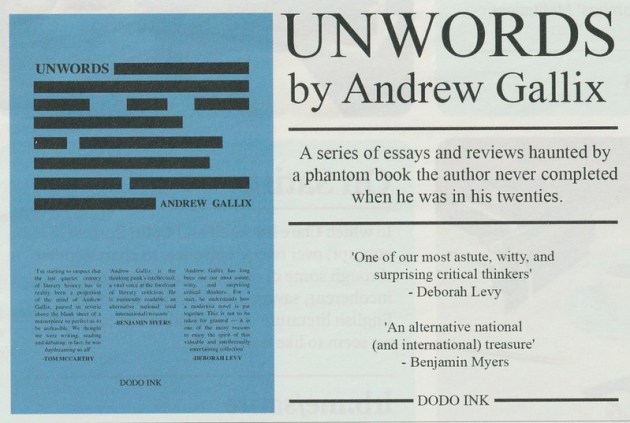
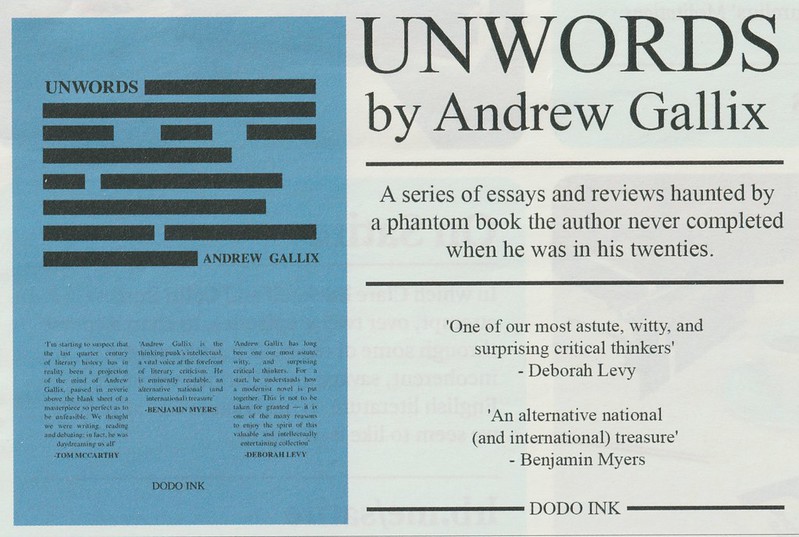
“I’m starting to suspect that the last quarter century of literary history has in reality been a projection of the mind of Andrew Gallix, paused in reverie above the blank sheet of a masterpiece so perfect as to be unfeasible. We thought we were writing, reading and debating; in fact, he was daydreaming us all.” – Tom McCarthy, novelist, 2023
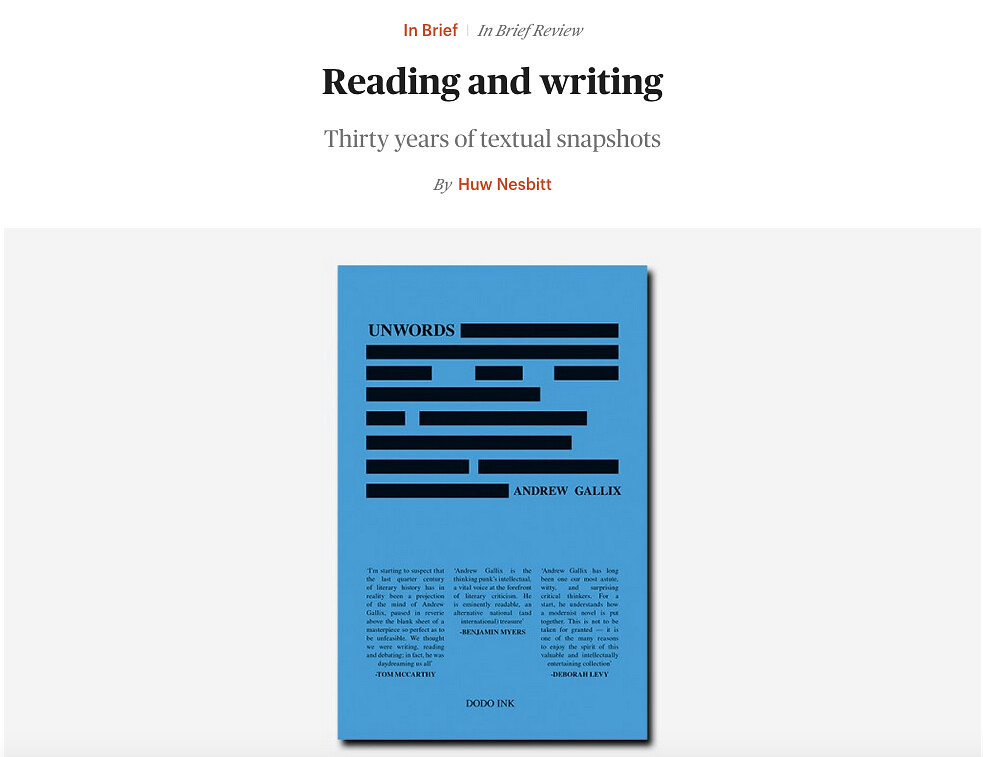
Nesbitt, Huw. “Reading and Writing: Thirty Years of Textual Snapshots.” Review of Unwords by Andrew Gallix, Times Literary Supplement, 14 June 2024, p. 25
Masquerading as a wide-ranging collection of literary essays, Unwords is in fact a hybrid work of critical theory and biography. A reader might object that literature is already brimming with such experiments. Yet few are delivered with Andrew Gallix’s charm.
Originally published in the TLS, the Guardian, the Irish Times and 3:AM Magazine, the literary website Gallix founded in 2000, the essays in this collection are written in crisp newspaper prose, avoiding the preponderant “I” and paragraph-long sentences frequently found in creative non-fiction. At the book’s heart sits the story of Gallix’s writing career. In 1990, he landed a deal with a publisher for a book about a “middling English novelist and playwright (dead)”. Then Gallix blew it, writing an unwieldy, unfinishable Gesamtkunstwerk instead. Undeterred, he took to criticism, opting to sketch a treatise on literature via freelance commissions.
“The best authors … are wary of the consolations of fiction”, Gallix writes in an article on literary realism. “They sense that the hocus-pocus spell cast by storytelling threatens to transform their works into bedtime stories.” He prefers — and draws this collection’s title from — what Samuel Beckett described as the literature of the “unword”: fiction that isn’t just about something but is the thing itself. “The reality of any work of art is its form, and to separate style from substance is to ‘remove the novel from the realm of art'”, he notes in another essay, quoting the nouveau romancier Alain Robbe-Grillet.
To elaborate this thesis, he explores the work of authors often classed as stylists. Naturally there are big names: Jonathan Franzen, Joyce Carol Oates, Deborah Levy, Joshua Cohen. But, Gallix is equally at home with the obscure. “The book’s apparent lack of direction is part of a strategy … to ensure that it does not become another bogus piece of literary fiction”, he remarks of Lars Iyer’s Dogma (2012), a plotless novel about two bungling philosophy professors. “Perhaps what Tunnel Vision really aspires to be is a self-portrait without a self”, he observes of the Irish writer Kevin Breathnach’s autofictional debut (2019).
A sense of provocation permeates Unwords. This is reinforced by tributes to the Parisian punk icon Jacno (“He belongs to a long line of elegantly wasted rock dandies”) and the French-Egyptian postwar novelist Albert Cossery, who wrote only one sentence a day. For Gallix, literature doesn’t exist to be binged, to delight or comfort: novels are real objects requiring reflection, whose language and syntax very often lead us back to the world itself.
Unwords brings together thirty years of reading and literary contemplation. It offers what Roland Barthes termed biographemes, textual snapshots where life and literature are indistinguishable. “Simply put, life writing is writing as a way of life”, Gallix notes. From the disappointment of the book he never published, Unwords’ author has produced something rare: a work of criticism that aspires to the condition of art.
Huw Nesbitt has written a mind-blowing review of Unwords for the latest issue (14th June 2024) of the TLS.
“From the disappointment of the book he never published, Unwords’ author has produced something rare: a work of criticism that aspires to the condition of art.”
Aldridge, Jonny. “Haunting and Being Haunted.” Review of Unwords by Andrew Gallix, Writing Stories, 21 May 2024
Most of what I write never lives up to my expectations artistically or commercially and I spent a lot of time (my twenties) haunted by the feeling this was a problem.
But some books change you and Unwords by Andrew Gallix was one of them. It is a litany of reimaginings, reframings of what the novel is. It’s 600 pages of “essays and reviews haunted by a phantom book the author never completed when he was in his twenties”. It’s — a paean to writers who do not feel the need to publish in order to affirm or reaffirm their status qua writers. Writers for whom literature is ‘the locus of a secret that should be preferred to the glory of making books’ (Maurice Blanchot). Writers of works whose potentiality never completely translates into actuality. Writers who believe in the existence of books they have imagined but never composed. Writers whose books keep on writing themselves after completion.
This list (about a third the length of Andrew Gallix’s in full) seems to me far truer than the narrow notion of a book as the discrete thing bought from shelves in shops or shoved hastily through letterboxes by harassed couriers. If not truer, then more palatable, digestible, and easier on the gut. Proper writers bear this out: the 90,000 words binned during drafting (Bernardine Evaristo), the 40-something full rewrites (Claire Keegan), the seven novels written before the ‘debut’ (Richard Milward)… To say writing is a mess is to say: creativity is creative. The problem isn’t my writing, it’s my expectations. My shallow idea of what the novel can be.
Reinventing the novel
Perhaps this is obvious: Unwords is unapologetically esoteric. But its punk intellectual aesthetic is playful, endearing, and thought-provoking. A collection of 20 years of words, it’s also unsettlingly repetitious. Gallix not only circles the same ideas but reuses the exact same quotes, rehashes the same phrases and sentence structures, plagiarises his own opinions. Haunts his own writing. This is the point. It’s the text he should have completed in his twenties. We are, all of us, writing our ur-novel, seeking the ideal of literature that made us want to wade among words in the first place. …
Macdonald, Rowena. “From Old Analogue to Nervily Digital.” Review of Unwords by Andrew Gallix and No Judgement by Lauren Oyler, The Irish Times, 23 March 2024
Andrew Gallix is an Anglo-French writer who lives in Paris and set up 3:AM Magazine, one of the first online literary magazines, in the year 2000. Unwords is a collection of essays but is also, as he explains, “not the book I wanted to write”.
The book he wanted to write was a work of criticism started in 1990, for which he got a publishing contract, but which remained unfinished because he couldn’t perfect the manuscript to his liking. “I wanted my book to contain not only multitudes, but everything.”
This “phantom book” haunts the pages of Unwords and the theme of unwritten books, unreadable books and books that attempt but fail to contain the whole of experience (as all books are doomed to do) is revisited throughout along with writers who stop writing, writers who “do not feel the need to publish in order to affirm … their status”, “writers who take their time; writers who take their lives … writers who vanish into their writing” or “who vanish into thin air”.
Unwords includes witty, accessible essays on French philosophers (Barthes, Sartre et al), French and English underground culture and the experimental authors that 3:AM has championed, alongside phenomena such as prank pie-throwing, hauntology and spam literature. Towards the end it includes personal pieces on Gallix’s time as a punk in New York, an elegy to lost childhood/Guy the Gorilla and a moving letter to his late mother.
Gallix is at heart a modernist and has little time for middlebrow, well-made novels by careerist “professional” authors. For me the most inspirational character in Unwords is Albert Cossery, the Egyptian-born writer, who died in 2008 aged 94, and who lived in the same Left Bank hotel for 63 years, did not bother to get a day job and instead subsisted on the royalties from his eight novels and followed the same radically lazy daily routine: “Every day, he got up at noon (like his characters), dressed up in his habitual dandified fashion and made his way to the Brasserie Lipp for a spot of lunch. From there, he usually repaired to the Flore or the Deux Magots where he would cast an Olympian eye over the drones passing by. Then it was time for his all-important siesta. Repeat ad infinitum”.
Neither London nor Paris allows writers to be so lackadaisical nowadays. Unwords may not be the Gesamtkunstwerk that Gallix wanted to write but the erudition contained within is remarkable, and yet it has a charming light touch.
So, to Lauren Oyler’s No Judgement. If I came to Gallix warm, as I’m familiar with 3:AM Magazine, I came to Oyler cold, having never heard of her. …
Gallix is a gentle melancholy guide, more analogue, older, European; Oyler is nervily digital, younger, very American in sensibility despite more than a decade in Europe. …
Unwords and No Judgement reveal the world views of two equally clever authors; are you in the mood for encouragement towards intellectual discourse, or confrontation?
Law, Jackie. Review of Unwords by Andrew Gallix, Bookmunch, 6 March 2014
With every Tom, Dick and Jackie now able to post their thoughts on the books they read online and thereby call themselves a book reviewer, it is good to find someone who knows their stuff and can express opinions well. What we have here is a hefty tome — over 600 pages in length — of book reviews and essays gathered together from a couple of decades of the author’s published critiques and opinions. Andrew Gallix is clearly a literary powerhouse. I may not agree with his summations of some of the books I too have read — The Netanyahus by Joshua Cohen, for example — but I can still appreciate the skill with which these reviews have been written. Gallix excavates seams others may not think to dig down to, his knowledge drawing out comparisons and observations the less widely read may easily miss. Authors, whose work is often more multi-layered than many readers recognise, would likely be gratified by such surgical attention to their words.
Given its size and contents, Unwords is not a book to be read cover to cover as one might a novel. Rather, it is best dipped into, savoured over time in bite sized chunks. It serves as a sort of archive of European literature, a useful reference for anyone with an interest in the oeuvre.
Gallix takes occasional side-swipes at modern publishing habits, showing a marked contempt for popular literary prizes. Nevertheless, reviews included here are overwhelmingly positive — a number of the books featured were written by those he lists in the acknowledgements. He is clearly well connected within the literary world, not surprising when glancing down the list of publications these pieces originally appeared in.
“Some of the essays and reviews that appear in this book have been expanded, rewritten, or updated. Others have not.”
So, as well as book reviews there are essays and the occasional interview. These generally focus on particular authors, offering a glimpse into their mindset and processes. They become characters at the hand of Gallix, their written works a thread in the plot of their lives. There are proliferations of: pen names, a desire for anonymity, the performance of marketing a persona. Fictions created are not confined to their written (or unwritten) works.
The pieces included provide much to ponder on what is considered art, alongside the conceits of creators and those who admire them.
Authors who take the importance of their output so seriously they cannot publish for fear it won’t be good enough are included. Some feel themselves superior in this: “untainted by recognition” (I did wonder how Albert Cossery funded his hotel room and presumably necessary food).
The works of authors under discussion may impress but many of those featured do not come across as decent human beings. There appears to be disdain for the happily ordinary, those not aspiring for inclusion within their circle of influence.
“Platonic writers tend to see their works as imperfect reflections of an unattainable literary ideal. They do not celebrate the birth of a new opus so much as mourn the abortion of all the other versions that could have been.”
In some ways Unwords could have been regarded as a sort of vanity project — Gallix couldn’t finish the novel he planned to write in his twenties so instead pulls together a book from all the short pieces he did complete over the intervening years. This idea should be given short shrift. The impressive quality of the writing alone makes this tome worth perusing. Much of it, while intellectually stimulating, is also highly entertaining.
In ‘Custard Pie in the Sky’ Gallix is having far too much fun playing with the words he uses. Opinions expressed may at times appear highbrow but remain accessible.
I must also mention a couple of the more personal inclusions. ‘Umbilical Words’ is an intensely moving piece written to be read at his mother’s funeral. ‘Phantom Server’, on the near loss of 3:AM Magazine’s archives, is wonderfully engaging.
The final entry, ‘AfterUnword’, is made up entirely of author quotes and references. They may be enough to make any wannabe novelist question the wisdom of their commitment to seeking publication.
Structured in themes, what is provided is a history of the canon that could become essential reading for anyone wishing to understand the context in which European literature exists. The erudite expositions touch on many ideas including: philosophy, nihilism, absurdity. What becomes clear is how much what is written is a compromise of possibilities.
Any Cop?: A book that surprised me with how much of it lingers, how the whole somehow works given its building blocks. Well worth the time of those with an interest in fiction — and the ecosystem within which such fictions exist.
Clegg, Richard. “Stories That Will Last.” Review of Walter Benjamin Stares at the Sea by C. D. Rose, Bookmunch, 24 February 2023:
… Another boost to the author’s reputation is his inclusion in the gargantuan and magisterial collection of articles by Andrew Gallix Unwords, a survey of modern European fiction, that has just been published by Dodo Ink. It is fitting that C. D. Rose is amongst good company there with the Robbe-Grillets, the Calvinos, and the lesser known North Western writer, H. P. Tinker.
This final quotation, from Andrew Gallix’s essay on Michel Butor, about the laboratory of narrative could stand for C. D. Rose as well:
“Whether he is analysing how a fictive locale may reconfigure the space in which a book is read or excavating old objects … his insights continue to feel new-minted and exhilarating.”






 ANDREW GALLIX