Upon Reading “Celesteville’s Burning”

Tom Bradley on “Celesteville’s Burning” 5 October 2010:

“Celesteville’s Burning” is brilliant. It’s the best thing of yours I’ve read. Assuming I’m familiar with all or most of your fiction, I would call this a breakthrough.

As always, the Gallixian wit is everwhere: the “doppelgänger given half the chance”; the “Holy Grail of Franco-Swiss rock criticism”; the “wind in his combover,” and countless other instances that pour forth from every sentence and phrase. You’ve always exploded with linguistic brilliance, syntactic agility and erudition. What a mood enhancer it’s been, throughout your work, to meet with these qualities in an author who does us the honor of assuming the same capacities in his readers.

In “Celesteville’s Burning” you’re displaying further technical mastery. With apparent effortlessness you move in and out of settings objective, subjective, and everything in between. The first to hit me was the light-speed spatial transition of the journalist’s cunt onto Zanzibar’s face, effected right in the middle of a paragraph. All of a sudden we are treated to a blending of her vaginal sensations with the literary sensation caused by Zanzibar: an announcement that we are in the light hands of a master.

You have achieved narrational virtuosity, signaled by your supremely perverse confidence in supplying a plethora of sensory detail in scenes that seem to come from out of nowhere, dreams whose larger purpose you haven’t yet established in our minds — e.g., Grandmother’s house. You know full well that we will not only endure but enjoy the moment of disorientation, and will follow.

The insistent, perverse, yet unfailingly lucid use of French and Franglais — is this also a symptom of a breakthrough? Have you staked out your own territory and sunk roots in the borderland between your two native cultures?

Zanzibar’s ludicrous early success, his lugubrious decline and late failure, his preposterously self-indulged “quantum” writer’s block, and the diseased way in which the established press will exploit it — I sense a breakthrough here, too. You’ve long acknowledged and bewailed the contemptible state of Franco-English letters. But here, with an amazing vastness of detail that only an insider could generate (where did you learn so much about these effete movers and shakers?), you have finally masticated this hideous situation, peristalsed it and shat it out. The despair which “the mainstream” must engender in less hardy souls can’t come near you any more. You are free to laugh from high up, to heap the kind of scorn that will humiliate any member of the lit establishment who reads this.

I can feel a Gallix novel coming on — and not an invisible palimpsest. This artistic unfolding of yours is heartening and exciting to watch. Some saggy asses in London-Paris-New York that have long needed kicking are in for it now.

Indie Literary Sites Start Coming of Age

Katie Allen, “Indie Literary Sites Start Coming of Age,” The Bookseller 8 October 2010:

For the time being, print still rules. There is no denying the cachet of Granta, the London Review of Books and the Times Literary Supplement, plus a number of smaller publications such as Litro and print-and-online publications such as Pen Pusher and Notes from the Underground.

Yet alongside Hamish Hamilton’s own project, Five Dials, the recent recruitment of publishing names including Scott Pack, Simon Trewin and Alma Books m.d. Alessandro Gallenzi as columnists for The View from Here is an example of how seriously the trade is taking independent literary websites.

Gallenzi became involved out of interest in “promoting new talent, new voices, new writers”. However, he is wary of the proliferation of online books content. “There is a certain hierarchy of critics and reviews. I respect the opinion of certain critics because of who he or she is and what they have done before . . . You have to take it on a blog-by-blog basis,” he said.

Sandra Taylor — Pan Mac publicity and digital communications manager — is a keen advocate of online literary magazines.“It’s hard to identify a spike in sales, as you can with a book being mentioned on Radio 4. But we definitely see it as part of a fully integrated campaign because if a reader wants to Google one of our authors, we want there to be richer content available. It’s interesting and important for Google rankings. It’s also important in terms of supporting new writers.”

Viola Fort, editor of untitledbooks.com, said: “Publishers are getting more web-savvy. From the beginning, they saw us as credible. We’ve got a much younger audience than traditional literary magazines. I wanted to do something on a par, but with a new way of access.”

Andrew Gallix, editor of 3:AM, said: “It’s easier today than [when we launched] in 2000, because online publications are taken far more seriously. Then again, it’s far more difficult for us as there are now hundreds of similar webzines.

“When we started out, webzines were looked down upon in Britain as being second-rate. [But] we’re now assiduously courted by publishers, big and small, especially since the credit crunch (which led them to look for cheaper ways to promote their books).

“The majors, in particular, know that we can give authors credibility, which is something that’s difficult to manufacture,” he added.

Jane Bradbury of For Books’ Sake said that publisher attention had been more noticeable since the site chose to focus exclusively on female writers five months ago.

“Independent and smaller presses have been so much more proactive and supportive,” she said, citing Serpent’s Tail and Pulp Press. “More mainstream publishing houses have mostly ignored us so far (with a couple of exceptions such as Virago).

She added: “Maybe that’s to do with them being much more rambling operations. With smaller publishers, they are usually much more on the ball in terms of monitoring online media, such as Twitter etc, and making mutually valuable connections.”

All the Latest

I’m quoted in an article by Katie Allen (“Indie Literary Sites Start Coming of Age”) that appeared in The Bookseller on 8 October 2010.

On 13 August 2010, Slow Travel Berlin republished a piece I wrote on “The Virtues of Slow Writing“.

On 5 August 2010, IKE published an article on the Offbeat Generation in which they quote Jim Ruland saying this about me, back in 2007: “Andrew Gallix writes as if he invented Warhol on Monday, punk rock on Tuesday and then took the rest of the week off after declaring the project a sodding mess. In this day and age when laundry detergent is bold and automobiles are innovative, Gallix’s prose is like a fresh breath of mercurochrome: sharp and acrid with truths that are hideous to behold even though it’s good for us. Never mind Gallix? Bollocks!”

On 3 August 2010, Susan Tomaselli devoted her “3:AM Cult Hero” column in 3:AM Magazine to a piece I’d written for the Guardian about fictitious non-author Félicien Marboeuf, “the greatest writer never to have written”.

It’s All Greek

Here is a short, unpublished review of Tom McCarthy‘s C:

It’s All Greek

How do we recombine the debris of literary history?

Inspired By: Cocteau’s Orphée in which dead poet broadcasts coded messages on living poet’s car radio, hence the author as listener-repeater; Background: Concept of the crypt (site of an encoded primal scene) linking Cocteau, Freud’s Wolf Man, invention of telephone, discovery of Tutankhamun and Nabokov’s Ada; Protagonist Modelled On: Alexander Bell, Maurice Blanchot, Howard Carter, Marinetti, Orpheus, Sergei Pankejeff, Georg Trakl; Obligatory Plot Summary: Born, fails to mourn dead teenage sister, treated for melancholia in central Europe, airborne radio operator during WWI, student in drug-fuelled 20s London, civil servant in spy-ridden Egypt, dies; Representative Sentence: “What he sees is darkness, but he sees it.”

The history of Tom McCarthy’s debut, Remainder, has almost achieved legendary status. It was first released on a tiny Parisian art press, having been spurned by all the major publishing houses in Britain, yet ended up making the cover of the New York Times, receiving the 2008 Believer Book Award and being lauded by Zadie Smith as “one of the great English novels of the past ten years”. Where do you go from there? Backwards, of course, like Dr. Learmont’s face that seems to multiply “down a telescoping corridor of memories” [77] or the archaeologists in Egypt — not to mention Serge with his predilection for coitus a tergo. McCarthy’s second novel, Men in Space, was mostly written before his first. His third — which is being touted as his big breakthrough — stems from Calling All Agents (2003), a fascinating essay that already contained all the keys to his book to come. Imagine a Bible concordance predating The Bible itself. In fact, C is CAA re-encrypted: a space in which the event that is true literature can take place.

With his first period piece, McCarthy goes back to the future (and Futurism) in order to rescue fiction from its current impasse. The timeline of this Bildungsroman is highly significant. It begins in 1898 — when Serge Carrefax is born to the “mechanical buzz” [10] of his father’s wireless radio experiments — and ends in 1922 — the year of The Waste Land and Ulysses — when he dies. The association between modern communications technology and modernism provides the backdrop to a redefinition of literature as transmission rather than self-expression.

Unsurprisingly for a novel revolving around incest — both literal and metaphorical — C contains numerous mises en abyme. There’s the tapestry of a staircase hanging above a staircase, or the school pageant (a nod to The Mousetrap in Hamlet) that dramatizes the Orphic theme underlying the entire work. The most apposite is Sophie’s “strange associative web” [71] that proliferates like a tumor and seems to harbor some dark secret within its intricate ramifications. McCarthy’s text also keeps generating new meanings, sometimes of its own volition, as words and ideas cross-fertilize in incestuous ways. Language, says Heidegger, speaks. Thus Sophie mutters beautiful schizophrenic gibberish as though she had “turned herself into a receiver” [75]. The Morse code clicks sometimes seem to be “speaking on their own” [67]. The deaf children are spoken through, their voices “ventriloquised” as if “piped in from somewhere else;” [4] their utterances resembling “a mispronounced version of something else, other sentences that are trying to worm their way up to the surface, make themselves heard” [79]. The headlong rush into modernity, away from the parodic pastoral setting, is paralleled by a return to the primitive magic of the oral tradition. The idea that something may even be lurking behind mere hearing is often hinted at. “[M]uffled signals” [83] are half-heard through wireless static (itself likened to “the sound of thought” [64]). Serge is haunted by “vague impressions of bodies hovering just beyond the threshold of the visible” [68] when riding “the dial’s far end” [83].

The protagonist teeters on the brink of some revelation that eludes him until he receives the ultimate, hallucinatory “call”. The reader can also break the code: incest is the encrypted primal scene of literature — the scene of our failed mourning for the works of the past. It’s all Greek, in the end.

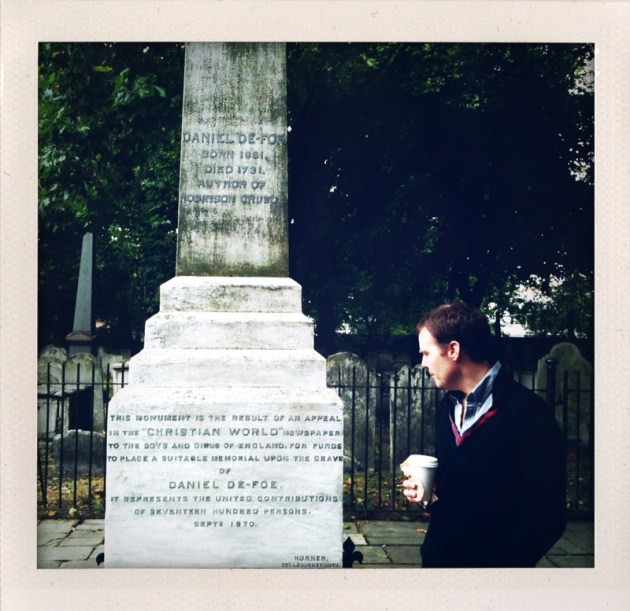
[Picture: Tom McCarthy and Daniel Defoe, Bunhill Fields, London, August 2010. By Andrew Gallix.]

Melancholia as Ultimate Rebellion

Excerpts from Lee Rourke, “In Conversation: Lee Rourke and Tom McCarthy,” The Guardian (Guardian Review p.12) Saturday 18 September 2010

Lee-Rourke-and-Tom-McCart-006
[Lee Rourke (left) and Tom McCarthy. Photograph: Eamonn McCabe for the Guardian]

LR: You’ve said in the past that all art is repetition.

TMcC: Yeah: Joyce’s “commodius vicus of recirculation” . . . Or Mark E Smith’s three Rs: repetition, repetition and repetition . . .

LR: I’ll drink to that. It’s like a never-ending transmission that can’t be switched off.

TMcC: The transmission thing is important. There’s that Kraftwerk song, “I am the receiver and you are the transmitter”, or however it goes. One way of thinking about art, or the novel, is that the writer is the transmitter, the originator: I have something to say about the world and I’m going to transmit it. But this isn’t how I see it, I see it as exactly the inverse: the writer is a receiver and the content is already out there. The task of the writer is to filter it, to sample it and remix it — not in some random way, but conscientiously and attentively. This is what Heidegger says about poets: to be a poet is to listen before speaking; it’s first and foremost a listening and not a speaking. Kafka said it as well: “I write in order to affirm and reaffirm that I have absolutely nothing to say.” Writing, or art, is not about having something to say; it’s about aspiring to a heightened state of hearing. It’s why C is a totally acoustic novel and a receptive novel. The hero, Serge, sits there for hours trawling the aether waves, absorbing, listening to ship-to-shore transmissions, stock market prices, sports results, writing them all down. In a way, if you could see Serge’s transcript it would probably read like an Ezra Pound canto.

LR: This is why Serge is so brilliant, because all this absorption culminates in a form of pure poetry. I’m thinking of the novel’s “Chute” section, especially the first world war passages. Serge in his plane over enemy lines, flying above and below, marking the sky around him with these wonderful vapour trails while shooting up heroin and quoting Hölderlin, and so on. Where does all that come from? I know you’re interested in Marinetti’s manifestos.

TMcC: For Serge the whole battlefield becomes a sound box. He thinks of his machine gun, when he’s firing it into the trenches below, as like a needle being aligned with the groove of a record. When the needle goes in, static comes out, and it all resonates: the percussion of machine-gun fire, the siren wail of howitzers. The difference between Serge and Wilfred Owen is that Serge loves war. By the way, talking of Marinetti: it’s interesting that Marinetti’s novels, which supposedly enact the propositions of his many manifestos, are much less interesting than the manifestos. And the paintings that people did based on his manifestos are much less good as well. The manifestos are a kind of field of potentiality that to actually realise would spoil.

LR: You’ve stated recently that C is essentially a novel about desire as much as about technology, and the “looping” of both within time. This puts me in mind of Beckett’s Krapp’s Last Tape. This idea that technology doesn’t take you forwards into the future, but actually takes you back towards your past.

TMcC: When Beckett’s old man is listening to these old tapes of himself, what it actually comes down to is desire — it’s incredibly moving. He’s there at the end, the end of his life, he wants to stop replaying it, all the loopings, snarling “Wasn’t once enough?”; but he listens again and again and again to this incredibly lyrical passage that he’s recorded about 30 or 40 years ago about him floating in a punt, with a girl, and the water all around them, I mean, it’s fucking amazing, it’s really, really beautiful. This is it, you see: what we find in technology and networks is desire. Which doesn’t mean the desiring individual; it means desiring consciousness itself. That’s why I wanted Serge Carrefax to be more than an individual; if he was a circuit he’d be over-charged. The surge is too much, it blows. It’s about the desire for impossibility. Giorgio Agamben, when describing melancholia (which Serge has in spades), says that the condition isn’t at all a detachment from the world, even though it may seem like it; in fact it’s an investment in the world so much that the desire for the world exceeds its own limit. The melancholic wants what is impossible; he wants impossibility itself — to experience it and to merge with it. To surge towards it. That’s why the melancholic is the ultimate rebel.

LR: Is it a desire for the impossible, or nothingness, to become real? To become a tangible thing?

TMcC: No, I think it’s more than that. I mean Pygmalion gets that: he wants the statue and then it becomes real, and that’s cute. But take Orpheus looking back: he’s far more interesting. He doesn’t really want Eurydice, he wants the dark night. As Maurice Blanchot brilliantly points out, he wants death itself. Not to make the night illuminated or present, but to have it in its absence, to have the presence of absence, something that is impossible. It’s doomed, beautiful and tragic.

LR: This is Blanchot’s Orpheus’s Gaze

TMcC: Right. It’s an essay about five pages long and it’s the most amazing summary of what literature is, or could be, ever written. It’s not about representing the world, it’s not about criticising the world even. It’s about surrendering to a vertigo that can never be mastered, to an abyss that can never be commanded, or excavated or filled in.

LR: But you can leave your mark, right?

TMcC: Yeah, the scratch. Scratching the negative. That’s what artists do at their very best.

C By Tom McCarthy

This appeared in the September 2010 issue of Dazed & Confused (vol. 2, issue 89, p. 196):

C by Tom McCarthy

Incest, spies and coke-fuelled adventures

Let’s not beat about the bush: Tom McCarthy’s third novel, C, is a masterpiece: a sprawling associative web that keeps generating new meanings as though of its own volition. “That’s the beautiful thing about what literature does to language,” says McCarthy. “You stick these slippery terms in and they start cross-fertilising in ways you never anticipated — incestuous ways.” C takes us from a fairytale English silk farm to spy-ridden Egypt by way of a central European spa town, aerial warfare and a coke-fuelled London filled with bright young Amazons. It is a comedy of errors, a gothic mystery, a boy’s own story; a traditional 19th-century novel seemingly rewritten by Burroughs or Ballard. You’ll find geometry, technology and trauma. Loops, repetitions and mutations. Incest, insects and radio bugs. And phantom words emanating from subterranean worlds half-glimpsed “at the dial’s far end”. Tune in…

DAZED & CONFUSED: C could be seen as a futurist novel. Serge, the protagonist, even seems to be partly modelled on Marinetti himself…
TOM MCCARTHY: I love Marinetti, and, yes, he’s part of Serge’s make-up, particularly in the war section. But Serge is equally a mixture of Freud’s Wolf Man, the beautifully fucked-up melancholic eternally grieving for his dead sister; and Alexander Bell, inventor of the phone (who also lost two siblings); and Howard Carter, the Egyptologist who disinterred the ur-family tomb; and a bunch of other people. I’m interested in the places where technology and mourning intersect.

There’s also a strong retro-futurist — even steampunk — element to C. Did you feel the need to revisit the early 20th century in order to reinvent the future of the novel?
Yes. Walter Benjamin says that the angel of history faces backwards. I think it’s the same for literature: you’ve got to look back in order to move forwards. It’s not just the foundations of contemporary technology that are being laid in the early 20th century (the code radio bugs used exactly anticipated text speak, just as lots of their output anticipated Twitter), but also literature’s period of high modernism that’s coming to a head. Not for nothing does the novel end in 1922: it’s the year that Ulysses and The Waste Land came out. The task for the contemporary writer (sadly, one which many writers of today are shirking) is to work through that period’s legacy — dynamically and radically, but attentively too.

All the major themes in C — from wireless technology to the discovery of Tutankhamun — come from your early experiments with the International Necronautical Society (INS), don’t they?
I had the idea for C while I was working on the INS project at the ICA. There, we had a radio station modelled on the illicit one in Jean Cocteau’s film Orphée (where the person transmitting is already dead), sending out all these coded poetic messages. I was looking at writing around encryption, and the concept of the ‘crypt’ that you get in psychoanalysis and philosophy.

Incest lies at the heart of C: this, for you, is the source code of western literature, right?
Yes. You go back from Nabokov through Faulkner through Racine right back to Sophocles, and incest is the central theme that keeps recurring. For Freud, the incest prohibition is what makes us civilised, socialised, even human, so that’s the taboo all tragic heroes, who are fundamentally doomed rebels, are most drawn towards transgressing.

Why do you think that all new means of telecommunication are linked to death, mourning and melancholia?
I don’t know if I can explain it. It’s just a pattern that keeps recurring. For every comm-tech invention, there seems to be a dead sibling somewhere. Bell even made a pact with his brother that, if one of them died like their other brother had, the surviving one would invent a device capable of receiving messages from the dead. Then the second brother dies, and Bell invents the telephone. He remained a rationalist, a sceptic — basically because his brothers never called. But the desire, the fantasy, is there in the technology: a ghost in the machine. It’s the same with radio. Seances in the 20s weren’t about spirit and ectoplasm any more: they were about “tuning in” to voices resonating on high frequencies, like radio waves. With the internet, it seems to be more about a presence than an absence: everything’s there, every click and keystroke ever made eternally retrievable, a giant archive. That’s a kind of haunting too, though.

Text and Photography
ANDREW GALLIX

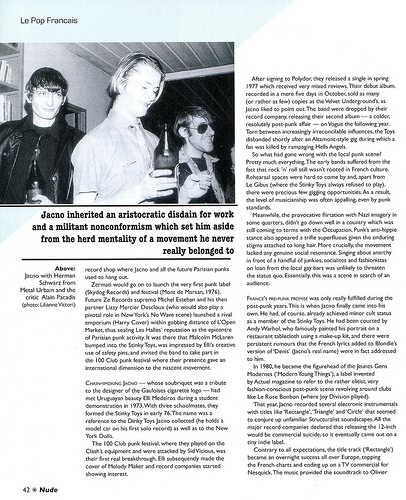
The Young Parisians

This appeared in the summer 2010 issue of Nude Magazine (issue 16, pp. 40-43):

The Young Parisians

Why don’t you come to Paris with me?
And see the young Parisians’
– “Young Parisians” by Adam and the Ants

‘There’s something very un-British about electronic music,’ says Daniel Miller — founder of Mute Records — in BBC Four’s excellent Synth Britannia documentary. By ‘very un-British’ he means très European — German, of course, but also French. Lest we forget, musique concrète composers like Pierre Schaeffer began their sonic experiments before Stockhausen. Most Continentals in the late 70s were first introduced to synthesizers via Jean-Michel Jarre not Kraftwerk. Métal Urbain — France’s answer to the Sex Pistols — produced their scuzzy rabble-rousing pogobeat on custom-made imitation Moogs at a time when electronic instruments were still usually associated with prog rock dinosaurs. The strong French presence on Angular Records’ recent Cold Waves and Minimal Electronics compilation was generally met with dismay by British music journalists who were blissfully unaware of the existence of a thriving post-punk scene across the Channel (Indochine, a synthpop outfit in the Depeche mode, even became France’s biggest band at one point). Whereas Gallic guitar combos have always been viewed — rightly or wrongly — as derivative vis-à-vis their Anglo-American counterparts, the synth-driven ‘French Touch’ sound was successfully exported ‘around the world’ at the turn of the century. The missing link between the early 80s and late 90s was Denis Quillard, better known as Jacno, who died in November last year at the age of 52 having cemented his country’s love affair with electronic minimalism.

There are times when the past, present and future seem to collide, and one such occasion occurred on 9 February 1977 when Jacno’s band, the Stinky Toys, were invited to a music press junket aboard the eponymous Trans Europe Express coinciding with the release of Kraftwerk’s album. Having a reputation to maintain as the enfants terribles of the local punk scene, the Toys went off the rails, much to the amusement of their more sedate German hosts. Legend has it that singer Elli Medeiros was sick all over the boss of EMI France, who subsequently refused to sign the band to his label and even tried to get them blacklisted. Jacno, however, had caught a glimpse of his musical future. As fate would have it, the train was bound for the Champagne region where he was buried some thirty years later in the vicinity of his family’s impressive country pile.

With his angelic features and slicked-back hair, the young Jacno bore a striking resemblance to David Bowie circa 1976. Throughout his short life he felt like a man who had fallen to earth, often describing himself as a ‘Martian’. Significantly, one of his more recent solo efforts was entitled ‘Je viens d’ailleurs’: ‘I Come From Elsewhere’. There was something of the Byronic noble bandit about him, which — along with a deep-rooted anglophobia — was in fact very much part of his vieille France DNA. The Stinky Toys’ tipple of choice was famously one of the cheapest brands of lager on the French market (Valstar), but Jacno soon reverted to type after the band broke up, making a point of only ever getting rat-arsed on the finest of vintages. In the early days, he always sported a fleur-de-lis on the lapel of his leather jacket — a symbol of the French monarchy frequently associated with the far right. This gesture was interpreted at the time as a typically punk shock tactic, but it was really Jacno’s private homage to his eccentric royalist grandfather from whom he inherited an aristocratic disdain for work and a militant nonconformism which set him aside from the herd mentality of a movement he never really belonged to. His ancestry also included several artists whose works are exhibited in the Louvre as well as one of the four generals who organised the failed Algiers putsch of 1961 designed to overthrow President de Gaulle. When his record company refused to bring out his first solo record or release him from his contract, Jacno sent the CEO a picture of old Uncle Zeller with a caption warning him that his factory was going to be blown up. Job done.

This quintessentially Gallic mixture of rebellion and tradition explains why Jacno is so often lost in translation. He belongs to a long line of elegantly wasted rock dandies that includes the likes of Serge Gainsbourg, Jacques Dutronc, Yves Adrien, Alain Pacadis, Patrick Eudeline and Daniel Darc (a book of interviews, published in 2006, was aptly entitled Itinerary of a Pop Dandy). Just as Jacno himself embodied early-80s ultra-modernity while whizzing around town on a vintage scooter looking like he had just stepped out of a Nouvelle Vague movie, his post-Stinky Toys compositions managed to capture the zeitgeist while harking back, in a knowing, postmodern way, to the saccharine yéyé pop of the early 60s. The repetitive, almost dirge-like minimalism of ‘Anne cherchait l’amour’ (1979) — with its haunting, bittersweet Françoise Hardy-on-Prozac quality — perfectly illustrates this attempt to have your croissant and eat it. Whether in the past or the future, Jacno, it seems, was always elsewhere.

Along with New York and London, Paris was one of the three great centres of pre-punk activity, and France played an important part in shaping the punk template. Richard Hell’s spiky-haired wasted look was modelled on the fin-de-siècle poètes maudits. The ideological and aesthetic underpinnings of the Sex Pistols project came largely from the (chiefly French) Situationists. When the movement was still anonymous, the late Malcolm McLaren favoured calling it ‘New Wave’ in reference to the cinematic Nouvelle Vague — a monicker which ended up describing punk’s more commercial fellow-travellers. As early as 1972, dandy rock critic Yves ‘Sweet Punk’ Adrien (as he already called himself) penned a proto-punk manifesto which was the journalistic equivalent of Lenny Kaye’s seminal Nuggets compilation, released the same year and available at L’Open Market, Marc Zermati’s legendary record shop where Jacno and all the future Parisian punks used to hang out. Zermati would go on to launch the very first punk label (Skydog Records) and festival (Mont-de-Marsan, 1976). Future Ze Records supremo Michel Esteban and his then partner Lizzy Mercier Descloux (who would also play a pivotal role in New York’s No Wave scene) launched a rival emporium (Harry Cover) within gobbing distance of L’Open Market, thus sealing Les Halles’ reputation as the epicentre of Parisian punk activity. It was there that Malcolm McLaren bumped into the Stinky Toys, was impressed by Elli’s creative use of safety pins, and invited the band to take part in the 100 Club punk festival where their presence gave an international dimension to the nascent movement.

Chain-smoking Jacno — whose soubriquet was a tribute to the designer of the Gauloises cigarettes logo — had met Uruguayan beauty Elli Medeiros during a student demonstration in 1973. With three schoolmates, they formed the Stinky Toys in early 76. The name was a reference to the Dinky Toys Jacno collected (he holds a model car on his first solo record) as well as to the New York Dolls. The 100 Club punk festival, where they played on the Clash’s equipment and were attacked by Sid Vicious, was their first real breakthrough. Elli subsequently made the cover of Melody Maker and record companies started showing interest. After signing to Polydor, they released a single in spring 1977 which received very mixed reviews. Their debut album, recorded in a mere five days in October, sold as many (or rather as few) copies as the Velvet Underground’s, as Jacno liked to point out. The band were dropped by their record company, releasing their second album — a colder, resolutely post-punk affair — on Vogue the following year. Torn between increasingly irreconcilable influences, the Toys disbanded shortly after an Altamont-style gig during which a fan was killed by rampaging Hell’s Angels.

So what had gone wrong with the local punk scene? Pretty much everything. The early bands suffered from the fact that rock’n’roll still wasn’t rooted in French culture. Rehearsal spaces were hard to come by and, apart from Le Gibus (where the Stinky Toys always refused to play), there were precious few gigging opportunities. As a result, the level of musicianship was often appalling, even by punk standards. Meanwhile, the provocative flirtation with Nazi imagery in some quarters didn’t go down well in a country which was still coming to terms with the Occupation. Punk’s anti-hippie stance also appeared a trifle superfluous given the enduring stigma attached to long hair. More crucially, the movement lacked any genuine social resonance. Singing about anarchy in front of a handful of junkies, socialites and fashionistas on loan from the local gay bars was unlikely to threaten the status quo. Essentially, this was a scene in search of an audience.

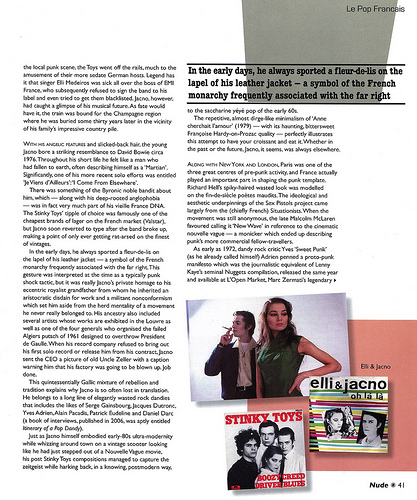
France’s pre-punk promise was only really fulfilled during the post-punk years. This is when Jacno finally came into his own. He had, of course, already achieved minor cult status as a member of the Stinky Toys. He had been courted by Andy Warhol, who famously painted his portrait on a restaurant tablecloth using a make-up kit, and there were persistent rumours that the French lyrics added to Blondie’s version of ‘Denis’ (Jacno’s real name) were in fact addressed to him. In 1980, he became the figurehead of the Jeunes Gens Modernes (‘Modern Young Things’), a label invented by Actuel magazine to refer to the rather elitist, very fashion-conscious post-punk scene revolving around clubs like Le Rose Bonbon (where Joy Division played). That year, Jacno recorded several electronic instrumentals with titles like ‘Rectangle,’ ‘Triangle’ and ‘Circle’ that seemed to conjure up unfamiliar Structuralist soundscapes. All the major record companies declared that releasing the 12-inch would be commercial suicide, so it eventually came out on a tiny indie label. Contrary to all expectations, the title track (‘Rectangle’) became an overnight success all over Europe, topping the French charts and ending up on a TV commercial for Nesquick. The music provided the soundtrack to Olivier Assayas’s first short film (Copyright) in which Elli Medeiros made her debut performance as an actress. Assayas also shot a video for ‘Rectangle’ which shows Jacno playing against the suitably angular, brutalist background of the La Défense area of Paris. The only track on the record that wasn’t an instrumental — the aforementioned ‘Anne cherchait l’amour’ — was sung by Elli. It marked the beginning of Elli & Jacno who provided a blueprint for countless other synth-based duos like Soft Cell and Yazoo, and sold millions of records until they split up in 1984 having written the soundtrack to Eric Rohmer’s Les Nuits de la pleine lune.

Elli would go on to have a couple of massive solo hits in 86-87 before concentrating on her acting career and family life. She made a musical comeback in 2006. Jacno, meanwhile, released six solo albums and produced work by some of France’s greatest stars like Jacques Higelin or Etienne Daho, an early fan of the Stinky Toys. He will always be remembered, however, as the New Wave Erik Satie whose elegant electronic minuets (as Rohmer once described them) seemed to capture the essence of our adolescence. ‘True life,’ as Rimbaud once put it, ‘is elsewhere.’ That is, as ever, where Jacno is to be found.

****

Ten of the best first wave punk bands from over the Channel

Métal Urbain
Think Sex Pistols crossed with Suicide or Throbbing Gristle — or both. Hardcore political lyrics. Their second single was Rough Trade’s first release. Best track: ‘Panik’.

Asphalt Jungle
Fronted by dandy rock critic-cum-novelist Patrick Eudeline. Talked the talk but seldom walked the walk except on their third single, ‘Polly Magoo,’ which sounds like a gang of inebriated football hooligans rutting with Phil Spector. In a good way.

Starshooter
They hailed from Lyon, played a mean live set, had a sense of humour and were solidly working class unlike most of their bourgeois contemporaries. Good mates with the Damned. Listen to: ‘Macho’.

Marie et les Garçons
Also from Lyon. Heavily influenced by the NYC scene at first, then experimented with a disco crossover thang. Second single produced by John Cale. They had a female drummer (the eponymous Marie) who died in the 90s. Top track: ‘Re-Bop’.

Guilty Razors
Famous for singing in pigeon English (‘Provocate,’ ‘I Don’t Wanna Be a Rich’!). Two of their members were of Spanish origin. They were very close to the Slits. Check out: ‘I Don’t Wanna Be a Rich’.

Gazoline
Having been a failed teenybop heartthrob in the 60s, a failed glam rock star in the early 70s and a successful gay cabaret artist, Alain Kan reinvented himself as a punk rocker. His band was named after a group of militant drag queens from the early gay liberation days. Kan disappeared in 1990; no one has seen or heard from him since. Gazoline’s second single is arguably one of the most convincing punk records to ever come out of France. Best track: ‘Radio flic’.

Les Olivensteins
Started later than most of the others and paved the way for the hardcore of the early 80s (Oberkampf, Bérurier Noir et al.). One of their most provocative lyrics described the Vichy regime as the good old days. Their name came from a psychiatrist famous for his anti-drugs crusade. Like Sham 69, they ended up attracting the wrong element and split up. Top track: ‘Fier de ne rien faire’.

1984
On paper, a kind of dystopian Clash but never fulfilled their promise. Listen to: ‘Salted City’.

Les Lou’s
All-girl band managed at one stage by Bernie Rhodes. Highlight: ‘Back on the Street’.

Electric Callas
A flamboyant Bowie/Iggy fanatic from Lyon backed by a dizzying array of line-up changes. Check out: ‘Kill Me Two Times’.

The Screamers

Jon Savage, “Jon Savage on Song: The Screamers – 122 Hours of Fear,” Guardian Music Blog 27 July 2010

Thanks to YouTube, this 70s synth-punk band who never released a record have finally found an audience

The clip begins with a frontal shot of a helicopter: the sound of its take-off bleeds into descending synthesiser notes. A caption comes up: “Screamers.” The second image to be seen is out of focus, a pink/brown blur against a sea green background. The ominous notes continue, with an abrasive synthesiser counter melody. Live drums come in, upping the tempo to manic punk.

The blur comes into focus: it’s the back of a spiky-haired head, jerking to the manic tempo then resting stock-still. The camera pans out while the music churns. Suddenly, it stops and the figure turns round: “Be quiet or be killed,” it screams, and you see the close up of a face contorted with fury and frustration. Ninety seconds in, the tension is broken and the song starts.

Taken from a headline in the Los Angeles Herald-Examiner about the hijacking of Luftansa flight 181 in 1977, 122 Hours of Fear is sung from the point of view of a hostage; a similar theme to R.A.F by Brian Eno and Snatch. This was, after all, the era of the famous shoot-outs at Entebbe and Mogadishu, where the hi-jackings of an Air France and a Lufthansa flight respectively made global news.

The Screamers’ singer, Tomata du Plenty, takes you right into the chilling scenario. His background in performance art gives him total control: his sculpted, swept-up 50s psycho hustler face keeps firmly within the camera position, lapsing from anger into stillness in the space of seconds. He is simultaneously within and outside the song: this is not arch, but conversely even more involving.

At 2:15 minutes, the camera pans out further, and you see the band. KK Barrett, a blond-haired drummer in a striped T-shirt, provides the visceral element, while two synthesiser players — Paul Roessler and Tommy Gear — encompass the stage moves that lie between willingness to please and total hostility. The camera pans back as du Plenty jack-knifes on to one knee.

There are several seconds of silence: “You’d better shut up and listen,” du Plenty yells and the furore starts again. The rest of the clip is more like a standard live run-through, with the musicians bobbing along with the rhythm, but at the end the camera returns to the singer, who stares at the lens with a gaze that runs from gurning speed psychosis to a certain, pained vulnerability.

This remarkable promo was shot at San Francisco’s Target Video in September 1978. Although they were inner circle members of the Los Angeles punk scene, the Screamers — like all of their peers — did not have a record deal. In fact, they never would, despite a heavily defined image, the vaunting ambition that they exhibited in interviews and the acres of press they attracted.

The Screamers were at the absolute cutting-edge of their time and place. There were other synth-punk groups, such as Suicide, Throbbing Gristle and the Normal, but they were based in New York and Europe, and were moving towards making slightly smoother, electro-pop records. Their nearest equivalent were the fabulously abrasive Metal Urbain from Paris.

There were other reasons for the lack of music industry interest. The era of mass synth success, of Soft Cell and the Human League, was at least three years away, and the confrontational nature of 122 Hours of Fear, (If I Can’t Have What I Want, I Don’t Want) Anything and Punish Or Be Damned was not likely to get punk-hostile record companies flocking.

Plenty of other Californian punk groups, such as the Germs, the Avengers and the Dils, were in the same boat, and they released classic independent 45s. But when I talked to the Screamers right after the Target video shoot, Tommy Gear summarily dismissed the whole idea: “What’s having a record? If I had a couple of thousand I could go out and make a record, what’s that? It’s nothing.”

The interview was strange. Consumed with the power of his concepts, Gear was extremely sarcastic, before deciding to relent just enough to show flickers of charm. Tomata du Plenty was dreamy and light, prone to gnomic epithets such as: “I think advertising is more exciting than the product most of the time.” KK Barrett was the voice of reason; well, somebody had to be.

I didn’t mind the barrage too much, having gone through far worse with Devo. It was expected then. But I thought that they were getting a little over-determined, especially when Gear started talking about the group in terms of the Monkees: “One thing we might want to do is to project ourselves as a video-projection instead of doing a performance. So we can get the money without having to be there.”

The Screamers kept on talking, having these fabulous ideas, while the world passed them by. As the first wave of the Los Angeles punk scene disintegrated around them, they held out for that perfect deal that never came. They never released a record, and disappeared into yellowing fanzine pages, decaying handbills and old VHS copies, an example of what might have been.

Until the advent of YouTube, that is. Type “the Screamers” into the search option and you’ll find an array of live and studio footage, including 122 Hours of Fear. The total hits for the clips add up to more than 100,000, which is probably 95,000 people more than ever saw or heard the group throughout their career. In the 21st century, the Screamers have finally found their audience.

The Silent Call of Conscience

Simon Critchley,”Being and Time, Part 7: Conscience,” The Guardian 20 July 2009

“…What gets said in the call of conscience? Heidegger is crystal clear: like Cordelia in King Lear, nothing is said. The call of conscience is silent. It contains no instructions or advice. In order to understand this, it is important to grasp that, for Heidegger, inauthentic life is characterised by chatter — for example, the ever-ambiguous hubbub of the blogosphere. Conscience calls Dasein back from this chatter silently. It has the character of what Heidegger calls “reticence” (Verschwiegenheit), which is the privileged mode of language in Heidegger. So, the call of conscience is a silent call that silences the chatter of the world and brings me back to myself….”