
The great Spanish novelist Enrique Vila-Matas has posted a link to my 2012 article, “La influencia de la ansiedad,” on his blog.
The great Spanish novelist Enrique Vila-Matas has posted a link to my 2012 article, “La influencia de la ansiedad,” on his blog.
John Cage, “Indeterminacy,” Silence: Lectures and Writings: 270
One day when I was studying with Schoenberg, he pointed out the eraser on his pencil and said, “This end is more important than the other.”
Brian Dillon, “The Revelation of Erasure,” Objects in this Mirror: Essays 2014
… Erasure is never merely a matter of making things disappear: there is always some detritus strewn about in the aftermath, some bruising to the surface from which word or image has been removed, some reminder of the violence done to make the world look new again. Whether rubbed away, crossed out or reinscribed, the disappeared entity has a habit of returning, ghostlike: if only in the marks that usurp its place and attest to its passing. But writing, for example, is already, long before lead hits pulp, a question of erasure, an art of leaving out. Every painting, said Picasso, is a sum of destructions: the artist builds and demolishes in the same instant. Which is perhaps what Jasper Johns had in mind when he said of Robert Rauschenberg’s Erased de Kooning Drawing (1953) that it embodied an “additive subtraction”: after a month’s sporadic destruction, and forty spent erasers, what is left is a surface startlingly alive, active, palimpsestic (pp. 309-310).
… A painting — at least a figurative painting — which is, as it were, too deep, risks becoming a glutinous mess, erasing itself by its very urge to completion. In Honoré de Balzac’s story “The Unknown Masterpiece,” the great painter Frenhofer labors for years at a picture of a young woman, until she disappears, leaving only a tiny, perfect foot looming out of the surrounding chaos: “Colors daubed one on top of the other and contained by a mass of strange lines forming a wall of paint.” By unintentionally erasing his painting, Frenhofer has in effect produced the first modernist monochrome, but he has done it by larding his canvas with too much significance, not too little: excess is a form of erasure too (p. 312).
… If the erased face always conjures the image of some primal violence, the expunged word inevitably attests to a repression of some kind, whether psychological or political. In the coy ellipses with which, in the novels of the eighteenth century, readers were invited to imagine undescribed erotic adventures, on the blacked-out pages of classified documents, or in the cancelled lines of a prisoner’s censored letter, the lost word denotes the intercession of authority (p. 311).
… Two works by Joseph Kosuth, entitled Zero & Not and One (1985, 1986) point out both the psychoanalytic attitude to language and the tendency of Freud’s words to assert their authority despite our efforts to wipe them out. A Freudian text is printed on the gallery wall, then struck through with black tape, so that it is erased but still insists, remains more or less readable: its lesson — the lesson of psychoanalysis — a lesson, after all, about the impossibility of erasure — simply won’t go away (p. 312).
The fondest, least plausible dream of modernist art and literature was of a world without memory: a cultural tabula rasa from which all trace of the styles of the past had been erased. The arts of evacuation imagined by the likes of Samuel Beckett, Yves Klein, and John Cage aspired to a deliberate vacuity: a vacant stage, an empty gallery, a silent orchestra. But in each case the project is impossible: some sound, image or word will intervene to recall the world left behind. …
“What we require is silence, but what silence requires is that I go on talking,” declared Cage in his “Lecture on Nothing”: the silence dreamed of by the art of the last century is always expectant, about to be spoken into. In 1996, the artist, writer, and curator Jeremy Millar interviewed the novelist J. G. Ballard, set to duplicating the tape before getting it transcribed, and accidentally erased hours of the great man’s thoughts. The ruined cassette, one long pregnant pause, could only become an artwork: Erased Ballard Interview (1996–2001). You listen, heart in mouth, just as Millar must have done, hoping that Ballard’s cultivated tones will, any second now, interrupt the hiss. And at the same time, you hear everything in this piece: the whole history of the avant-garde affair with emptiness, the dematerialization of the work of art, its evanescence into pure idea or gesture, up to and including Rauschenberg’s erasure of de Kooning’s drawing: all of it, suggests Millar’s blank tape, merely an absurd error (pp. 315-316).
Maybe the total erasure of a work of art, or the making of a work that had an utter absence at its heart, was never possible to begin with, or maybe it’s simply a fantasy to which contemporary art is no longer willing to give itself over, except playfully (p. 316). …
Nicholas Rombes, who was Writer in Residence over at Necessary Fiction in December 2013 and January 2014, invited Tobias Carroll, Cari Luna, Lincoln Michel, Masha Tupitsyn, Karolina Waklawiak, Joanna Walsh, and myself to contribute fiction and non-fiction pieces on the theme of movie writing. You will find Nicholas Rombes’s own fine offering here.


And here’s a short extract from my essay, “The World Without Me“:
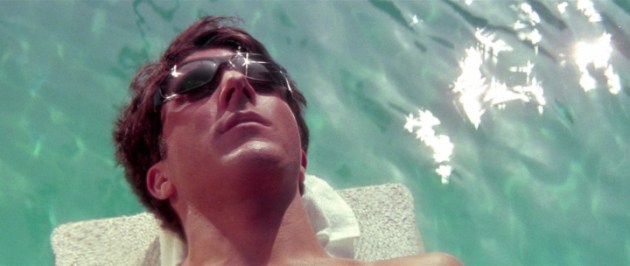
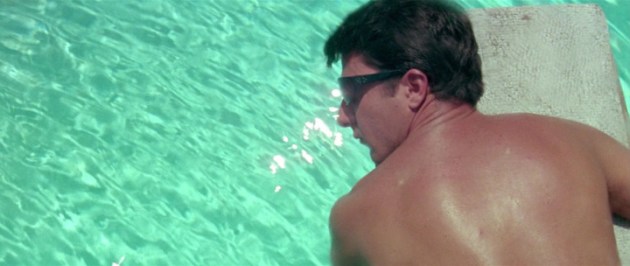
Soon Benjamin will need to escape, choose some course of action. He is on a collision course with Elaine, the accident that has already happened. In the meantime, he is a castaway adrift upon shimmering amniotic fluid. A young man without qualities, in trunks and sunglasses, cradling a can of beer on his belly — Bartleby Californian-stylee. I like him best when he just goes with the flow; that is, when he goes nowhere. The camera lingers longingly on the texture of the ripples. Sunny constellations twinkle on the celestial water’s surface. Benjamin, recumbent on his lilo, fades out as the ever-morphing abstract of light reflections fades in.
Linder Sterling, “Linder Sterling: ‘Lady Gaga Didn’t Acknowledge I Wore a Meat Dress First’ by Sean O’Hagan, The Observer [The New Review, p. 5] 12 January 2014
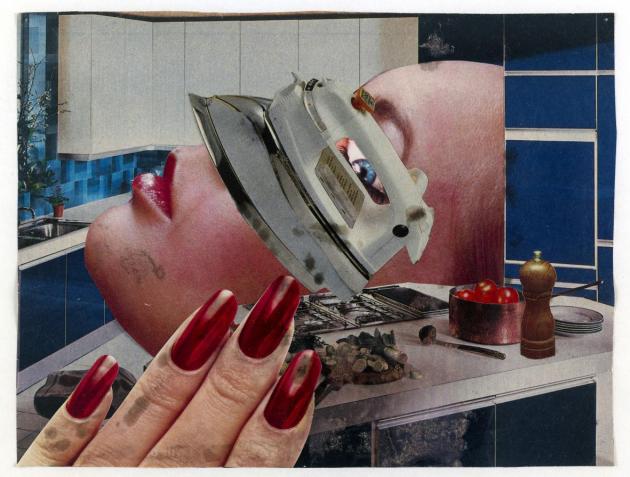
You attended the now famous Sex Pistols performance at the Free Trade Hall in Manchester in June 1976. Was it as exciting and galvanising as received wisdom has it?
Oh yes. It was a docking station. The first time I could plug into something new and exciting in its confusion. You just knew something was going on just because it was so different to anything else. There was no attempt at professionalism or entertainment. Things were always on the verge of disintegration onstage and yet there was also this incredible energy emanating from these very glamorous urchins. It was a radical change of gear. I remember thinking, “Oh, I have not been here before and I don’t even have the language to describe what it is.” It really was the last great British underground.
My piece on realism is referenced, rather dismissively, by J. W. Cormack in a question he puts to the excellent Jason Schwartz. Is it really contentious to claim that most people’s idea of a traditional novel — a “proper” novel — is (alas) one which can be loosely defined as “realist”?
J. W. Cormack, “Jason Schwartz,” BOMB 7 January 2014
Speaking of category, I read a fairly de rigueur article from The Guardian, one of those “end of fiction” pieces you see every few years — although this one seemed to be equating “traditional fiction” with “the realist novel.” Is this a mistake? Do you feel like the world needs a different fictive vocabulary than the purely representational one we’ve become accustomed to?
Gilles Deleuze and Félix Guattari, “What is a Minor Literature?”, Kafka: pour une littérature mineure, 1975
Céline’s syntactic evolution: from Journey to Death on the Installment Plan to Guignol’s Band (following which, Céline had nothing more to say, except about his misfortunes, that is, he no longer wanted to write, he only needed money). And that is always the way it ends, lines of flight from language: the silence, the interrupted, the interminable, or still worse.
Blaise Cendrars, “The Art of Fiction N°38” by Michel Manoll, The Paris Review 37 (Spring 1966)
I’m not an extraordinary worker, I’m an extraordinary daydreamer. I exceed all my fantasies — even that of writing.
Louise Glück, Proofs and Theories: Essays on Poetry, 1994
It seems to me that the desire to make art produces an ongoing experience of longing, a restlessness sometimes, but not inevitably, played out romantically, or sexually. Always there seems something ahead, the next poem or story, visible, at least, apprehensible, but unreachable. To perceive it at all is to be haunted by it; some sound, some tone, becomes a torment — the poem embodying that sound seems to exist somewhere already finished. It’s like a lighthouse, except that, as one swims towards it, it backs away [via].
[See William Gaddis, Vladimir Nabokov, and Dylan Nice.]
This appeared in Guardian Books on 12 November 2013:
The End of Realist Stories
The limitations of mimetic storytelling are ever more apparent, but what should come next is less clear

Real style … a woman walks in front of Gerhard Richter’s painting ‘Strip’ showing at the Albertinum gallery in Dresden. Photograph: Jens Meyer/AP
Literary fiction is dead — or if not dead then finished, according to the Goldsmiths prize-shortlisted writer Lars Iyer, who argues it has become a “repertoire, like The Nutcracker at Christmas” and suggests that novelists should spread the word that “the time for literary novels is over“. But literary fiction has always been dead, has always needed the mould-breaking writing which the Goldsmiths prize celebrates.
Ever since its birth, writers have been suspicious of the novel, reaching for the authenticity of the real — often presenting their work as memoir, à la Robinson Crusoe. For Scheherazade, storytelling is, literally, a stay of execution. For the rest of us, it is merely a pastime; a distraction from our ultimate destruction. Ashamed of its frivolity, fiction drapes itself in the gravitas of non-fiction.
If literature needs to be something more than just storytelling, then perhaps one could argue with Maurice Blanchot that it only truly becomes grown-up when it “becomes a question” hanging over the space separating it from the world. By showing its sleight of hand, the novel can live up to Adorno’s definition of art as “magic delivered from the lie of being truth“, but it loses its innocence in the process. No longer is it possible for a serious novelist to go back to the “good old days” when — as Gombrowicz put it — one could write “as a child might pee against a tree“.
But things were never as simple as that. The original realist novel was no straightforward attempt to describe the world; rather, an attempt to dismantle off-the-peg representations of reality already present in literature of the time. For Fredric Jameson, realism only exists dialectically, when it is in contention with some opposite it harbours. Madame Bovary, for instance, carries romance in its narrative in order to kill it off, and turn into its antithesis.
Jameson sees the rise of realism as part of the secularisation of society; a process that ran counter to the “universalising conceptions of life” propagated by religion. Increasingly, novels sought to focus on the singular, contingent, and therefore unliterary aspects of reality that had no prior linguistic expression. More specifically, Jameson detects a growing “autonomisation of the senses” post-Balzac. Emotions — already classified “conscious states” — were shunned in favour of “affects”, those nameless “bodily feelings” that could be shown, but not told.
The realist novel was a product of this tension between telling and showing; between an age-old “storytelling impulse” (the narration of a tale that has happened “once and for all”) and fragments through which the “eternal affective present” was explored in increasingly experimental ways. The outcome is that “one of the two antithetical forces finally outweighs the other and assures its disintegration”. Narrative convention frequently broke down as a result of the novel’s linguistic imperialism — its quest for the “unique phenomenon which bears no recognisable name”. Gradually, however, the unnamed would get named, and the novel would beget new conventions, sub-genres, and stereotypes, which would have to be deconstructed in turn. Jameson contends that the one genre realism cannot dissolve is realism itself, which, in my view, speaks volumes about the state of fiction today. With a nod to Mark Fisher‘s idea of capitalist realism, one could speak of fictive realism to describe the widespread belief that the 19th-century novel — or a variant thereof — is fiction’s unsurpassable horizon.
Literature only coincides with itself when it claims to be what it is not. As soon as it acknowledges its made-up nature, the novel looks back at itself in anger; becomes its own worst enemy. The best authors, in my book, sense that the hocus-pocus spell cast by storytelling threatens to transform their works into bedtime stories for grown-ups. As Borges warns, “A book that does not contain its counterbook is considered incomplete”.
The history of the novel could thus be reinterpreted as a product of fiction fatigue: an inner struggle between book and counterbook. Don Quixote perceives the mundane reality he inhabits through the prism of chivalric romances, which leads him, famously, to mistake windmills for giants. Emma Bovary is a desperate housewife, whose shopping-and-fucking daydreams are fuelled by the sentimental literature she consumes, and is eventually consumed by. Leonard Bast, in Howards End, fills his head with the “husks of books” instead of the “real thing”, and ends up crushed by a bookcase.
Cervantes, Flaubert, and EM Forster all fought fiction with fiction, in the name of the “real thing”. Similarly, the realist novel attempted to dissolve whatever smacked of literariness. As Alain Robbe-Grillet pointed out in his nouveau roman heyday, serious writers always “believe they are realists”, and “literary revolutions” are all made “in the name of realism”. Whenever a given mode of writing becomes “a vulgar recipe, an academic mannerism which its followers respect out of routine or laziness, without even questioning its necessity, then it is indeed a return to the real which constitutes the arraignment of the dead formulas and the search for new forms capable of continuing the effort”.
Robbe-Grillet accused the Balzacian novel of propagating an outdated, anthropocentric worldview. Its rounded characters were an expression of triumphant bourgeois individualism; its lifelike plots mirrored readers’ “ready-made idea of reality“. Such works were designed to convey the impression of a stable, “entirely decipherable universe”, and the novelist’s task was, precisely, to do the deciphering; to unearth “the hidden soul of things”. For his part, the nouveau romancier was convinced that the “discovery of reality” through literature would only continue if these “outworn forms” were jettisoned, along with “the old myths of ‘depth'” that supported them. In the new novel he called for, the presence of the world — “neither significant nor absurd” — prevails over any attempt to project meaning on to it. Reality is no longer a given, but a taken; something that each novel must create anew. As a result, the primacy of substance over style is reversed. Style is what “constitutes reality” in such a novel, which ultimately “expresses nothing but itself”.
The nouveau roman may not be very new any more, but there’s no shortage of writers lining up alongside Iyer to call time on the traditional novel. For David Shields, novels are “antediluvian texts that are essentially still working in the Flaubertian mode”. JM Coetzee is “sick of the well-made novel,” while Zadie Smith says she suffers from “novel-nausea”. Even the thought of fiction is enough to make Karl Ove Knausgaard “feel nauseous“.
Tim Parks is the latest to confess he shares “Shields’s changing reaction to traditional novels,” but he’s less convinced that Shields’s hunger for reality is the answer. Writers such as Beckett or Lydia Davis may have avoided the trap of the traditional novel, he argues, but “this kind of writing … seems to derive its energy by gauging its distance from the traditional novel, by expressing its disbelief and frustration with the form, and there is a limit to the pleasures, comedy and wisdom of negative energy and deconstruction”.
If the novel is dead — always already — as Iyer suggests, then it’ll take more than a dose of reality to infuse a spark of being into the lifeless thing lying at our feet.
****
Here is a longer, earlier incarnation of this piece:
Fictive Realism
The Goldsmiths Prize, whose first laureate will be announced next month, was launched “to reward fiction that breaks the mould or opens up new possibilities for the novel form”. Hopefully, it will act as an antidote to the blandness of the Booker and the spread of so-called fiction fatigue. Reports of the death of the novel have always been greatly exaggerated, of course, but David Shields clearly struck a chord with his Reality Hunger manifesto. Novels, he claimed — reprising arguments which Robbe-Grillet and John Barth had rehearsed in the 50s and 60s — are “works of nostalgic entertainment,” “antediluvian texts that are essentially still working in the Flaubertian mode”. J. M. Coetzee declared that he, too, was “sick of the well-made novel with its plot and its characters and its settings”. Zadie Smith came down with a similar bout of “novel-nausea”. Karl Ove Knausgaard reached a stage where “just the thought of fiction, just the thought of a fabricated character in a fabricated plot made [him] feel nauseous”. According to Lars Iyer — whose coruscating comedy, Exodus, graces the Goldsmiths shortlist — literary fiction has become “a kind of repertoire, like The Nutcracker at Christmas”. In a recent interview, he even argues that the task of the novelist today is to spread the word that that “the time for literary novels is over”.
According to Nietzsche, the terrible truth about existence was revealed but also beautified in tragedy at its Grecian best. Offered a glimpse into the abyss, the spectator was saved from the temptation to jump by the aesthetic anaesthetic. Likewise in literature, where fact is viewed, obliquely, through fiction. This tension between the Dionysian and Apollonian accounts for some authors’ ambivalence towards the narcotic of narrative: its reassuring reordering of chaos, and entertainment value. For Scheherazade, storytelling is, literally, a stay of execution. For the rest of us, it is merely a pastime; a distraction from our ultimate destruction. This, no doubt, is why so many early novels purported to be authentic documents — frequently memoirs, à la Robinson Crusoe. Ashamed of its frivolous lack of necessity, fiction draped itself in the gravitas of non-fiction. After Maurice Blanchot, one could argue, contrarily, that literature only truly emerges when it “becomes a question” hanging over the space separating it from the world. By showing its sleight of hand, the novel can live up to Adorno‘s definition of art as “magic delivered from the lie of being truth,” but it loses its innocence in the process. No longer is it possible for a serious novelist to go back to the “good old days,” when — as Gombrowicz put it — one could write “as a child might pee against a tree”.
Literature only coincides with itself when it claims to be what it is not. As soon as it acknowledges its fictive nature, the novel looks back at itself in anger; becomes its own worst enemy. The best authors, in my book, are wary of the consolations of fiction, with their whiff of prelapsarian micturation. They sense that the hocus-pocus spell cast by storytelling threatens to transform their works into bedtime stories for grown-ups. “A book that does not contain its counterbook is considered incomplete,” warns Borges, in one of his most famous stories. The history of the novel could thus be construed as a product of fiction fatigue: an inner struggle between book and counterbook. In Don Quixote — arguably the first great novel — the eponymous anti-hero perceives the mundane reality he inhabits through the prism of chivalric romances, which leads him, famously, to mistake windmills for giants. Likewise Madame Bovary. Emma is a desperate housewife, whose shopping-and-fucking daydreams are fuelled by the sentimental literature she consumes, and is eventually consumed by. Leonard Bast, in Howards End, fills his head with the “husks of books” instead of the “real thing,” and ends up crushed by a bookcase.
Cervantes, Flaubert, and E. M. Forster all fought fiction with fiction, in the name of the “real thing”. As Alain Robbe-Grillet pointed out in his nouveau roman heyday, serious writers always “believe they are realists,” and “literary revolutions” are all made “in the name of realism”. Whenever a given mode of writing becomes “a vulgar recipe, an academic mannerism which its followers respect out of routine or laziness, without even questioning its necessity, then it is indeed a return to the real which constitutes the arraignment of the dead formulas and the search for new forms capable of continuing the effort”. Robbe-Grillet accused the Balzacian novel of propagating an outdated, anthropocentric worldview. Its rounded characters were an expression of triumphant bourgeois individualism; its lifelike plots mirrored readers’ “ready-made idea of reality”. Such works were designed to convey the impression of a stable, “entirely decipherable universe,” and the novelist’s task was, precisely, to do the deciphering; to unearth “the hidden soul of things”. The nouveau romancier believed, for his part, that the “discovery of reality” through literature would only continue if these “outworn forms” were jettisoned, along with “the old myths of ‘depth'” that supported them. In the new novel he called for, the presence of the world — “neither significant nor absurd” — prevails over any attempt to project meaning on to it. Although the world is simply there in all its awesome weirdness, reality is no longer a given, but a taken; something that each novel must create anew. As a result, the primacy of substance over style is reversed. Style is what “constitutes reality” in such a novel, which ultimately “expresses nothing but itself”.
With a nod to Mark Fisher‘s “capitalist realism“, one could speak of fictive realism to describe the widespread belief that the 19th-century novel — or a variant thereof — is literature’s unsurpassable horizon. The paradox is that the original (real?) realist novel, set out to dismantle off-the-peg representations of reality, as Fredric Jameson explains in The Antinomies of Realism. The title of his latest work refers to the conflicted, agonistic nature of this literary trend. Realism only exists dialectically, when it is in contention with some opposite it harbours. Madame Bovary, for instance, carries romance within its belly in order to abort it, and turn into its antithesis.
Uncontentiously, Jameson sees the rise of realism as part of a process of secularisation of society, that ran counter to the “universalizing conceptions of life” propagated by religion. Increasingly, novels took on an Adamic quality by focusing on the singular and contingent — aspects of reality that had no prior linguistic expression. More specifically, Jameson detects a growing “autonomization of the senses” post-Balzac. Emotions — already classified (and literary) “conscious states” — were shunned in favour of affects, those nameless “bodily feelings” that could be shown, but not told. The realist novel was the result of this tension between an age-old “storytelling impulse” (the telling of a tale that has happened “once and for all” in the preterite tense) and fragments through which the “eternal affective present” would be explored in increasingly experimental ways. The outcome is that “one of the two antithetical forces finally outweighs the other and assures its disintegration”. Narrative convention would frequently break down as a result of the novel’s linguistic imperialism — its quest for the “unique phenomenon which bears no recognizable name”. Gradually, however, the unnamed would get named, and the novel would beget new sub-genres and stereotypes which would have to be deconstructed in turn. Jameson contends that the one genre realism cannot dissolve is realism itself, which, in my view, speaks volumes about the state of the novel today. “A book that does not contain its counterbook”? Sounds like literary fiction to me.
 ANDREW GALLIX