The Idea of Paris

Carroll, Tobias. “Is Paris Still an Art World Heavyweight?” InsideHook, 20 November 2019:

[…] A very different take on Paris and art comes from the recent anthology We’ll Never Have Paris, edited by Andrew Gallix. From his perspective, a lot of discussion of Paris emerges from Anglophone perceptions of it. “I have lived here most of my life — in several parts of the 9th and 14th arrondissements, as well as in the 6th and 18th — and currently reside in one of Paris’s poor, rat-infested northern banlieues, soon to be subsumed into a brave new Grand Paris,” he says. “I certainly cannot be accused of labouring under the delusion that it is all glamorous boutiques and bohemian cafés. I know what the reality of everyday life in Paris is and relaying it to an English-speaking readership was not what I set out to do. Quite the contrary, in fact.”

For Gallix, the anthology became a way to explore how certain writers helped to shape enduring perceptions of Paris. “It dawned on me that the romantic notion of a bohemian Paris that many people entertain all over the world owed as much to Hemingway and other English-language writers as to Hugo or Rimbaud,” he explains. “So I set out to explore this Anglo version of Paris. I wanted to see how the idea of Paris — whether rooted in their experience or not — inspired Anglophone writers today.”

Here, the contributors hail from a host of nations, including Will Self, Max Porter and Joanna Walsh. “I started off by approaching authors whose work I admired and who had, I knew, resided for a while in Paris, either recently or years ago,” Gallix says. “At the same time, I shunned the expat communities and in particular all those purveyors of ghastly expat memoirs. I also made sure that some of the contributors had never even set foot in France, let alone Paris, so that the remit would become a kind of Oulipian writing constraint in their case. Only five contributors, out of 79, currently reside in the French capital.”

Gallix also planned for a weighty volume from the very beginning. “I knew from the start that I wanted to produce a capacious volume that readers could dip into aboard the Eurostar or while sipping a coffee at a sidewalk café,” he says.

As for the reaction to We’ll Never Have Paris, it’s been mixed, he explains. “The book got very good reviews in the Times Literary Supplement and Financial Times. However, sales have proved much healthier in the US than in the UK despite the lack of reviews across the Pond,” Gallix says. “This is probably due to a strong sales team and good distribution. Perhaps the allure of Paris also remains greater over there. You tell me.”

Regardless of whether you embrace Paris wholeheartedly or view it with a historical remove, both [Will Mountain] Cox and Gallix are, in their own ways, demonstrating the continued vibrancy of the city and the work it can inspire. It’s not what you might expect, but it might be just the work you’re looking for.

Life on Marx

Ashford, James. “What is Hauntology?” The Week, 31 October 2019:

[…] And away from politics, “at its most basic level, it ties in with the popularity of faux-vintage photography, abandoned spaces and TV series like Life on Mars”, said writer and academic Andrew Gallix in The Guardian in 2011.

“When you come to think of it, all forms of representation are ghostly,” he added. “Works of art are haunted, not only by the ideal forms of which they are imperfect instantiations, but also by what escapes representation.”

A Ghost-Hunting Manual for the End of History

Mardell, Oscar. Review of Love Bites: Fiction Inspired by Pete Shelley and Buzzcocks, edited by Andrew Gallix, Tomoé Hill and C.D. Rose. 3:AM Magazine, 27 October 2019:

[…] And it’s not only time that is out of joint. Andrew Gallix’s ‘Operators Manual’ begins with the haunting passage:

I live on a trap street. One of those fictitious roads cartographers add to their maps in order to confound plagiarists. Have I confounded you now that you have found me? Found me here, of all places — a non-existent one.

Gallix’s piece is, among other things, a masterstudy in place as palimpsest, a setting defined by what is elsewhere. […]

Here are some more highlights from the review:

Like the band that inspired them, the pieces collected here share an obsessive focus on the ordinary, lovingly cataloguing its mundane, glamourless, and frustrating weirdness. They document the awkwardness and the hilarity of human relationships, and of love in particular — the way it violates and completes our everyday lives, and the way it transcends the gender divisions by which those lives are often structured. The singularity of the source, in other words, has begotten wonderful issue. Love Bites is about as far away from the linear or sentimental retrospective as you can get. This is no starry-eyed tourist guide to some bygone era; think of it as a ghost-hunting manual for The End of History. It will be a hard — perhaps impossible — act to follow. And whatever comes next is destined to look like a parody of an old routine.

Love Bites

Love Bites, edited by Tomoé Hill, C.D. Rose and yours truly, is out now!

It contains 35 short stories inspired by the late Pete Shelley and Buzzcocks courtesy of:

Emma Bolland, Victoria Briggs, Tobias Carroll, Shane Jesse Christmass, David Collard, Sarah-Clare Conlon, Lara Alonso Corona, Cathleen Davies, Jeremy Dixon, Sharron Duggal, Wendy Erskine, Gerard Evans, Javi Fedrick, Mark Fiddes, Andrew Gallix, Meave Haughey, Tomoé Hill, Richard V. Hirst, David Holzer, Andrew Hook, Tom Jenks, Jonathan Kemp, Luke Kennard, Mark Leahy, Neil Nixon, Russell Persson, Hette Phillips, Julie Reverb, C.D. Rose, Lee Rourke, Germán Sierra, Beach Sloth, NJ Stallard and Rob Walton.

A Masterpiece!

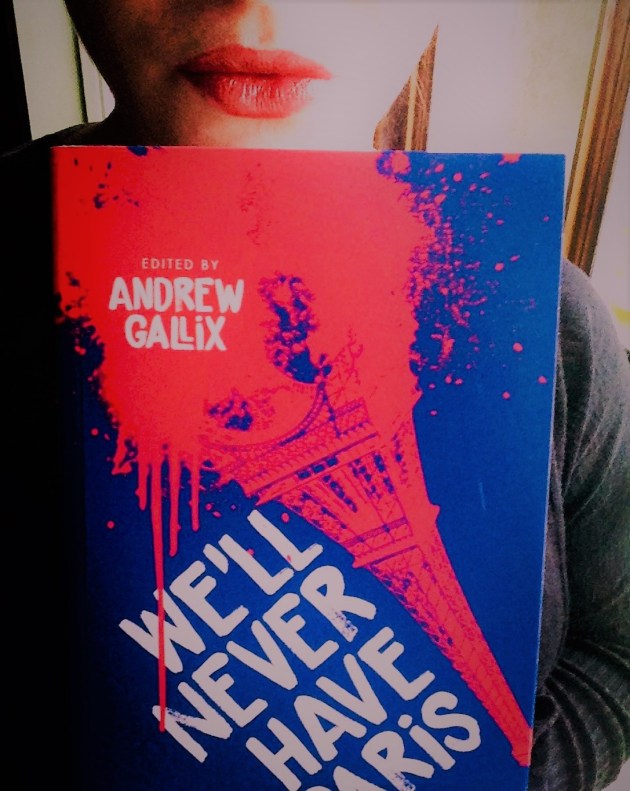
A big thanks to Jane Roberts (pictured) for her rave review of We’ll Never Have Paris:

Strong contender for one of my favourite anthologies … ever. Almost 600 pages containing some of the most enlightening, complex, and intriguing authors of the present day. Swap the Brexit blues for this red, white, and blue marvel. It is impossible for me to choose a particular highlight, albeit the introduction alone is worth the full price of the collection. A masterpiece.

A Lungful of Absence

A big thanks to Des Lewis for his very generous review of my short story (“Celesteville’s Burning: A Work in Regress”) that features in We’ll Never Have Paris:

And, if many of the previous stories in this not-Paris book had not been quite so inspiring as they have been, then I would have thought this excellent Gallix story was the sole reason why I was MEANT to read this massive book (a book that I picked up at a whim!) — from the “Zut, zut, zut” of Marcel Proust to the Putain! Putain! Putain! of Sostène Zanzibar, this work is an astonishing delight. Zanzibar is a writer with a chequered career, a sexual fling with a young lady journalist etc., a rivalry with another exponent of the writerly or filmic arts, car chases across Paris, and much more. Yet, the biggest delight was his John Cage connected search for a tune within silence, or vice versa. And his publication of blank literature. (…) I LOVED this story. And so much more to tell you about it.

You will find all of Des Lewis’s real-time reviews of We’ll Never Have Paris here and there.

Monocle 24 Radio

On 15th August, I was interviewed about We’ll Never Have Paris (Repeater Books) for Fernando Augusto Pacheco’s programme, The Stack, on Monocle 24 Radio. The interview was broadcast two days later. You can listen to my segment here. Full programme below.

What Soho Wore

What Soho Wore. 15 July-25 September 2016, The Photographers’ Gallery London.

From July 2016, Nina Manandhar, photographer and founder of What We Wore archive project, will be in residence at The Photographers’ Gallery mapping the hidden cultural history of Soho through people’s photography and stories. As independent clubs and shops are increasingly lost from the centre of the city, What Soho Wore explores the area’s rich cultural history and the role that photography has had within the multiple scenes, movements and communities that have made Soho what it was and is today.

The images and stories will be presented on The Media Wall, online and during a final discussion event on 18 September.

[This picture of me (left) and my mate Yannick, taken in September 1981, was part of the exhibition and the book that had preceded it. It also appears in the video below.]

What Soho Wore – an interview with Nina Manandhar from The Photographers’ Gallery on Vimeo.

Finnish

Pekka Hakala, “европейские страны видят в английском угрозу национальным языкам.” Helsingin Sanomat, 5 November 2018:

… Давний противник использования английского языка — Франция. Писатель и университетский преподаватель Эндрю Гэлликс (Andrew Gallix) связывает щепетильность французов с окончанием Семилетней войны и подписанием в 1763 году Парижского мирного договора, в соответствии с которым Франция уступала Великобритании колонии в Канаде и на Карибских островах. …

The Belly of Paris

Nick Lander, “Vantre (Not Ventre).” Jancis Robinson, 22 July 2019:

In his recently published and well-reviewed book, the Anglo-French writer turned editor Andrew Gallix explores a fascinating theme.

He quotes Oscar Wilde from The Picture of Dorian Grey: ‘When good Americans die, they move to Paris’.

Gallix’s collection of contributions from over 70 authors is entitled We’ll Never Have Paris. Published by Repeater in the US and Penguin Random House in the UK, his book seeks to explore the myths that surround this wonderfully attractive and romantic city. His thesis is that Paris can just as easily be disappointing as fulfilling.

It is a shame that among all the well-known contributors there is no one whose speciality is writing about restaurants, the phenomenon which Paris at the turn of the 19th century gave to the world, and a common reason why visitors to this website also visit The City of Light.

Beauvilliers, Lavenne and Veron et Baron were three of the most prestigious restaurants in the early 1800s in Paris. As well as the good food and wine they offered, they were also able to provide a further reason for the many British then in Paris to visit them: they offered a rare opportunity to watch the French at play.

Had I been asked to contribute, I am afraid that I would have had to end any paean of praise to Paris and its restaurants on a disappointed note. There are so many good places to eat, so many that evoke happy memories of my times in the city, but I am always at a loss to answer the following question: why are so many open only Monday to Friday and closed at the weekend when most tourists are there?…