Killing the Literary

Illya Szilak, “Killing the Literary: The Death of E-Lit,” The Huffington Post 19 March 2013

“Is e-literature one big anti-climax?” complained Andrew Gallix in The Guardian in September 2008. For many of us working in the field, the question still needles. Gallix’s argument that e-lit is hobbled by its association with print literature is valid. Five years on, most English literature departments don’t offer courses in e-lit, and most creative writing programs don’t include it.

[…] For e-lit to be accepted as a legitimate art form, we must stop using print literature as the sole paradigm for judging and experiencing it. What the standard should be is, as yet, unclear. Gallix ends his article with a quote from Mark Amerika which emphasizes the evolving status of e-lit.

Amerika may well be on to something when he claims that we are witnessing the emergence of a ‘digitally-processed intermedia art’ in which literature and all the other arts are being ‘remixed into yet other forms still not fully developed.’

[…]

Reading the Unreadable

This appeared on The New York Times‘s Opinionator blog on 27 February 2013. It featured in The Stone, a column devoted to philosophy moderated by Simon Critchley:

Reading the Unreadable
So many books, so little time. Who doesn’t feel the anxiety of it all? In a post at The Guardian’s Books blog, Andrew Gallix moves from a meditation on the phenomenon of the “failed or forgotten” writer, to the deliberate unreadability of the “conceptual writing” championed by the poet Kenneth Goldsmith, to the inevitability of the “blank book” prophesied by Kierkegaard. Gallix wonders whether this kind of literary elusivity isn’t ultimately a gift; he claims, following Hegel, that “words give us the world by taking it away.”

Purposely with Ghosts

Tom Bradley, Rev. of Apparitional Experience, 3:AM Magazine 6 March 2013

Fiddleblack Annual #1: Apparitional Experience, Fiddleblack Press 2013

This is a collection of ghost stories “purposely without ghosts”. The epigraph, from On the Road, serves to announce the emphatic Americanness of the contents. Like Kerouac with his continuous roll of typing paper, most of the authors herein have opted for the unadorned style, which has its roots in that country’s Puritan past. The collection satisfies eminently one’s appetite for such work. There are few or no ghosts of the literary sort haunting the first hundred or so pages of this book.

And then, all of a sudden, in the last story, up springs a manifestation that couldn’t be more unAmerican, in the best of all the good senses of that near-universally approbative adjective. It’s Andrew Gallix, and he is purposely with ghosts.

His story, “Fifty Shades of Grey Matter”, displays all the anti-Puritannical virtuosity, erudition, urbanity and sensory luxuriousness that have been established as his trademarks in such works as “Dr Martens’ Bouncing Souls“, “Celesteville’s Burning“, “Half-Hearted Confessions of a Gelignite Dolly-Bird” and “Forty Tiddly Winks“. Andrew Gallix stands out, not only in this book, but on the literary scene at large, as a major exponent of literary sophistication, both syntactical and philosophical.

When he goes On the Road (in his case, that would be the rue Victor Cousin, on his way to teach at one of the world’s oldest universities), Andrew Gallix treads in the astral traces of such unabashed eschewers of the unadorned style as Aquinas, Erasmus, Saint Francis Xavier, Balzac, Saisset, Victor Hugo, de Beauvoir, Teilhard de Chardin, Barthes, Deleuze, Ricoeur, et al. It stands to reason that he’s not obsessed with counting and banishing modifiers and flagellating subordinate clauses down to the bare declarative bones. He knows nothing of the retentive rules of deportment laid down by creative writing programs in the country that invented those institutions.

“Joycean” has been whored out as an adjective for so long, especially by Americans, that it lost meaning two generations ago. But if the term could be resurrected and shriven, it would apply to “Fifty Shades of Grey Matter” better than any fiction I’ve read in years. Andrew Gallix has done precisely what the stream of consciousness demands — and I don’t mean the long-hackneyed literary device, but the complex phenomenological proposition. Every sentence, every phrase, depicts and serves the multiple functions of human awareness, all at once, without discontinuity. The lush descriptions are delivered in a voice that delineates its own quirky persona and those around it, while moving the plot along, expanding upon thematic material, and being hilarious in the bargain.

This complexity can only be achieved by a writer who has at his fingertips all the resources of a longstanding culture, the full vocabulary of two languages, and none of the self-conscious laconicism of those perpetual Puritans who pout, unhaunted, across the Atlantic.

Literary Hauntology

Lars Iyer, “Outside Literature: The Lars Iyer Interview,” interview by Tim Smyth, The Quarterly Conversation 31 4 March 2013

In Vila-Matas, we find a humorous recapitulation of Blanchot’s sense that a certain way of literary writing is at an end, and that a new kind of writing, one which registers this end in some way, is beginning. Andrew Gallix has much of interest to say on the topic of the various “ends” of literature that have occurred.[2] In one sense, I want to say that literature is always ending! The end is eternal. It will go on forever. There can be no “apocalypse” of literature. And for that reason, there will always be more hot tubs, more lists, more distractions! But I also want to insist on the specificity, on the singularity of this end . . . I believe in it . . .

Let me risk pretension by putting as follows. Historically, any simple avant-gardist idea of a new literary practice necessarily reconsolidates the traditional institution of literature that it claims to critique. A literary practice that is ostensibly “outside” literature posits an “inside” of literature. By disobeying the police who maintain the borders of literature, they simultaneously confirm the role of those police; avant-garde practices depend on them. But what happens when the police leave their posts? What happens when no-one mans the border — when the sanctity of literature becomes a matter of indifference? There can no longer be an “outlaw” avant-gardism, because there is no law to transgress. But nor is there a literature self-certain enough, secure enough, to arrest, domesticate or tame its “outside.” The authority of literature has vanished. The house of literature is deserted. Granted, that house is haunted. There are such things as literary ghosts, even a literary “hauntology,” as Gallix calls it.

Impossible Literature

Lars Iyer, “Impossible Literature,” interview by Antônio Xerxenesky, 3:AM Magazine 6 February 2013

Andrew Gallix suggestively distinguishes between two kinds of belatedness. There is the belatedness already present in Don Quixote: the novel as a ‘fallen’ form, coming in the wake of older forms. And then, there is the romantic and Modern dream of the ‘Literary Absolute’, which expresses belatedness with respect to a total work of art — like Mallarmé’s conception of The Book, for example. Such belatedness, for me, holds in particular for those Modernist vanguards which sought in some way to link art to politics, which sought to change life, to change the world. As I argue in my manifesto, the conditions for such vanguards have vanished, and with them a whole dream of Literature, with a capital ‘L’.

Full Stop

Full Stop magazine interviewed me as part of their “Pathos” series, examining “the consequences of pursuing writing as a vocation”.
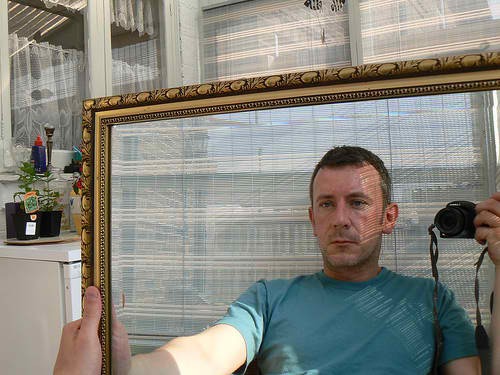
andrewgallix

“Pathos: Andrew Gallix,” Full Stop 16 January 2013

Last winter, Full Stop introduced “The Situation in American Writing,” a questionnaire adapted from The Partisan Review that asked questions about literature’s responsibility to address seismic changes in culture, the publishing industry, and the political and geopolitical landscape. That questionnaire, which featured responses from Marilynne Robinson, George Saunders, Victor LaValle, T.C. Boyle, Dana Spiotta, and dozens of other writers was illustrative of the concerns and preoccupations that writers carry with them when practicing their craft.

This year we are interested in the situation of writers, rather than writing, in the subjective experience of writing fiction (or in this case, memoir), rather than fiction’s responsibilities to respond to a rapidly changing world. To this end we are interested in examining the trying intellectual, creative, and emotional labor that is often unacknowledged or effaced in the public presentation of writing. What we’re interested in, to put it another way, is pathos.

This year, we’ve crafted a questionnaire asking writers about the effect writing has had on their physical, emotional, and economic health; on the idea of poverty being a precondition for writing well; on what makes writing truthful to one’s self and to readers. Ultimately, we are interested in the consequences of pursuing writing as a vocation.

Andrew Gallix is the Editor-in-Chief of the consistently great 3:AM Magazine which features a motto that is the envy of Full Stop: ”Whatever it is, we’re against it.” He also teaches at the Sorbonne, writes for The Guardian, and is currently working on a novel, as well as a collection of reviews of impossible books in collaboration with David Winters.

How has your decision to write affected your health? Has it had negative effects on your personal life?

The great Polish writer Witold Gombrowicz said, “One cannot be nothingness all week and then suddenly expect to exist on Sunday.” It’s equally difficult to have a day job and be “nothingness” in the evening — especially if you’re trying to juggle a family life at the same time. Things must be much easier when you can write for a living. I’m pretty sure writing contributed to my divorce, for instance!

There is long tradition that links the craft of writing with poverty. Do you think that’s appropriate? Does poverty feel like the most appropriate condition for your practice as a writer?

No. The authors I know who insist upon writing for a living, although their work is resolutely uncommercial, end up, paradoxically, being obsessed with financial matters. Every single word they write must be counted, and accounted for; turned into money to pay the bills. Don’t get me wrong: writers should be paid, but you can’t force people to buy books, let alone read them. Those lucky, or cunning enough, to find a wide audience don’t usually stop writing, all of a sudden, because they’re raking it in. Some of the most interesting writers today come from very privileged backgrounds. Others don’t, and if their books fail to sell in sufficient quantities, they usually have to supplement their incomes through grants, teaching, journalism, or jobs in publishing. The creative writing industry is, in part, a means of subsidising writers’ careers.

The question of the cost of letters (to refer to the title of a book on this subject published by Waterstone’s in 1998) is an important one, because it reflects the evolution of literature itself. When literature was essentially an aristocratic pursuit — for people who had both time and money — this question was immaterial. It only really arises with the spread of literacy and the emergence of writers who didn’t hail from the ranks of the idle rich. The Waterstone’s book I mentioned — How Much Do You Think a Writer Needs to Live on?: The Cost of Letters (edited by Andrew Holgate and Honor Wilson-Fletcher) — was inspired by a survey of literary living standards carried out by Cyril Connolly fifty years earlier. When it was published by Horizon, in 1948, British society was being radically transformed through mass education and the Welfare State. Connolly’s survey contained the following questions:

How much do you think a writer needs to live on?
Do you think a serious writer can earn this sum by his writing and if so, how?
If not, what do you think is a suitable second occupation for him?
Do you think literature suffers from the diversion of a writer’s energy into other employments or is enriched by it?
Do you think the state or any other institution should do more for writers?
Are you satisfied with your own solution of the problem and have you any specific advice to give young people who wish to earn their living by writing?

The main question (which wasn’t addressed because it went without saying at the time) is, of course, that of the definition of a “serious writer” — one who may be worthy of being subsidised in the absence of commercial success. Who decides who is a “serious writer” in the first place? Is it the writer him/herself? His/her peers? Academia? The media? The reading public? The state? I’ve always been a little dubious about the romantic image of the impoverished, tortured genius scribbling away in his, or indeed her, dingy garret, but it does reflect a very real process of privatisation of the writing profession.

Walter Benjamin famously described the “birthplace of the novel” — and hence that of modern literature — as “the solitary individual”: an individual cut off from tradition, who, unlike the writers of antiquity, could no longer claim to be the mouthpiece of religion or society. The writer’s legitimacy, in a “destitute time” (Hölderlin) of absent gods and silent sirens (Kafka) — a disenchanted world (Schiller) which is still ours — becomes highly arbitrary.

Personally, financial difficulties have always diverted me away from my writing. Having said that, the necessity to write often stems (at least in part) from a feeling of dissatisfaction — a sense that something is missing — so, from that point of view, not being rich and contented is probably an asset.

In a rare 1983 interview the enigmatic and often dour Romanian writer Emil Cioran speaks about only reading Nietzsche’s letters because he became concerned with how untruthful Nietzsche’s published works seemed when read against the miserable condition of his day to day existence (isolated, weak, sickly, certainly not characterized by any sense of vigor). Is there any sense in which the truth of one’s condition should be related to the truth of one’s writing, even if in an oblique sense?

In an oblique sense, yes; otherwise, not necessarily. As I was saying, literature is often a compensatory activity; an elaborate form of wish-fulfilment. I am absolutely fascinated by the impact that someone’s physical and psychological life can have on his/her thinking and writing — how apparently rational choices are due, for instance, to a tiny todger, short stature, child abuse, or the absence of a parent. Sartre claimed that he began writing to make up for his ugliness and impress women. We all want to be loved, and writing is always a love letter of sorts. As Richard Brautigan put it, “Just because people love your mind, doesn’t mean they have to have your body” — but one lives in hope, of course.

Perhaps Cioran’s remark makes more sense in the context of philosophy, but literature is the space of contradiction and ambiguity, and that’s what interests me.

Incidentally, I once lived in the same street as Cioran, in Paris.

Are you envious of other people’s success? If so, are you more envious of people’s success in your field or outside of it? Why?

I am, especially if I think they don’t deserve it. I’m more envious of people in my own field, of course, because I feel closer to them. It’s a phenomenon that René Girard skillfully analyses in Deceit, Desire & the Novel.

Give one example in which you had high hopes for success (artistic, commercial, or otherwise) but had those hopes dashed.

When I was really young, and still a student, I got a contract with an American publisher for a short work of criticism. I’d sent them the manuscript, on the off-chance, and it turns out that they wanted to publish it as it was. I was really proud: I didn’t know anyone my age who had published a book — but, of course, I wasn’t satisfied. The manuscript, in my eyes, wasn’t good enough. I asked the publisher to give me a little time to work on it. They granted me a one-year deadline, on the understanding that I’d send in the revised manuscript after six months. Six months, that’s all you need, they said, six months. Almost five years later, I was still working away on the manuscript, wracked by guilt, and I had to draw the conclusion, eventually, that the project I’d embarked upon was unfinishable. As Blanchot said of Joubert, I preferred failure to “the compromise of success” — or at least, that’s my excuse.

Do you feel like the world owes you a chance to make a living as a writer?

Absolutely not, but I hate the world for it!

What is the strongest emotional reaction you have ever elicited from a reader, either in your written work or during a reading? What is the strongest emotional reaction you have ever elicited from yourself during the writing process?

When people I respect have told me that they wished they’d written a story of mine.

When I’ve managed to write something so painful that I thought I’d never see it through.

When, on the rare occasion and in the distant past, women have wanted my body, just because they loved my mind.

When are you at your most truthful as a writer?

When I’m not writing.

Fleeting

The wonderful Deborah Levy was kind enough to mention me in an interview with Matt Shoard for Fleeting Magazine (“8 Questions for Deborah Levy”) published on 22 December 2012. Here’s the relevant extract:

Are you comforted by the assertion that there are yet People on Earth who know what they are doing? Or, like me, do you subscribe to the notion that people who knew what they were doing began to die off about 1945 and are now on the brink of extinction?

Yes, Benjamin Eastham and Jacques Testard, editors of the stunning new Art Literature and Politics journal The White Review know what they are doing and they also know who they do not want to do business with. Andrew Gallix, writer and editor of 3:AM Magazine knows what he’s doing and I am so pleased he’s doing it. Uber publisher and translator Stefan Tobler at And Other Stories is a man of vision and steel; he knows what he’s doing in any number of languages. So does Matt Shoard of Fleeting and so does John Self, an incredibly astute reader and critic. Every generation throws up its new thinkers and they tend to make a cultural revolution. They have energy and purpose and sometimes wear really nice shoes. They make everyone else look exhausted and clapped out. That is how it should be.

A Writing Against Itself

Andrew Gallix, “Go Forth (Vol. 4)” by Nicolle Elizabeth, The Believer Logger 14 November 2012

Andrew Gallix is editor-in-chief of 3:AM Magazine, which the Guardian credits as technically the first literary blog ever. He writes fiction and criticism, edits books, and teaches at the Sorbonne, and I love him.

NICOLLE ELIZABETH: What is 3:AM, and how did it start?

ANDREW GALLIX: 3:AM is one of the oldest literary webzines out there, as it was launched in April 2000. We were among the first to make use of the international dimension of the web: the founder was American, our first webmaster was Canadian, and the rest of the team was located in Britain, France, Ireland and the US. We were the first, or one of the first, to launch a literary blog (if by that you mean a compendium of literary news links). We innovated by placing fiction in a wider cultural (artistic, in particular musical) context. We also pioneered the revival of live literary events in London, mixing music, art, and spoken word.

NE: This is a collective thing?

AG: Very much so. The whole point of 3:AM was to foster a community of literary loners; to create a space where we can be alone together.

NE: Print ever or no?

AG: Two anthologies of 3:AM short stories (edited by Andrew Stevens) have been published, but the magazine itself is online-only. I think we were also pioneers from that point of view: we realized that online publications were the way forward. They cost virtually nothing, which means that only literary/artistic criteria apply, instead of financial considerations. There are no space constraints (a piece can be as long or as short as it needs to be). You can reach so many more readers than if you publish a story in a small literary journal. Christiana Spens has just launched 3:AM Press, which releases both ebooks and limited print editions, showing our attachment to both formats.

NE: Main concerns ethically?

AG: There is no party line, although we are rather contrarian, hence our tagline (a nod to Groucho Marx, the Ramones, and Adorno): “Whatever it is, we’re against it.” It sounds rather pedantic, I know, but what I consider to be real literature is always, at some level, a writing against itself.

NE: Main concerns aesthetically?

AG: Once again, 3:AM is a very broad anti-church. Personally, I think we should publish fiction that has the inevitability of death.

NE: What advice do you have for those who wish to start a magazine?

AG: Don’t give up the day job.

NE: Anything else you’d like to tell us here?

AG: Sure, but only things which cannot be told.

Italian Blackout

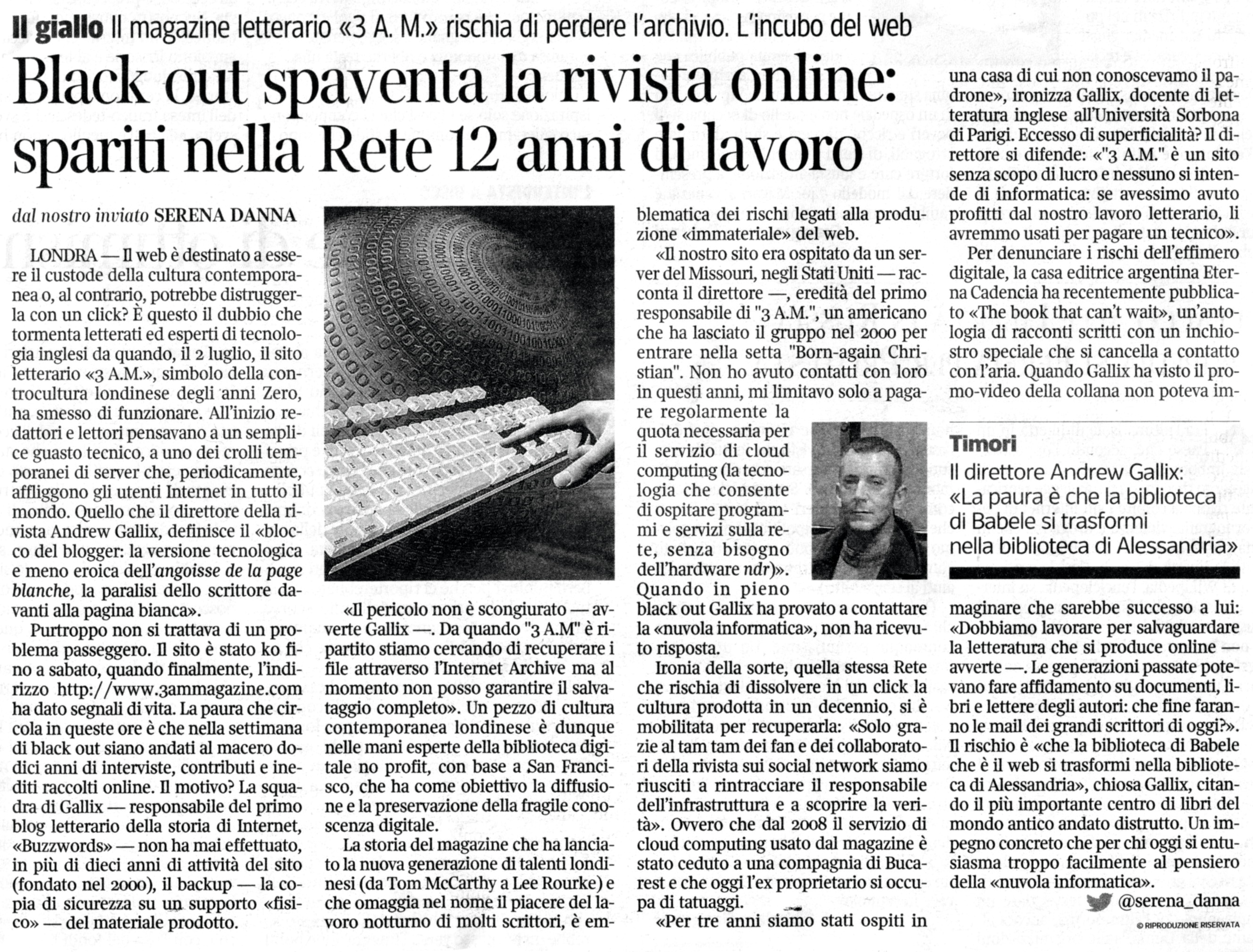
Serena Danna, “Black out spaventa la rivista online: spariti nella Rete 12 anni di lavoro,” Corriere della Sera 11 July 2012: 29.

A larger version of this newspaper cutting can be found here.

A few selected extracts:
“[…] il sito letterario 3:AM, simbolo della controcultura londinese degli anni Zero […] il direttore della rivista Andrew Gallix, definisce il “bloco del blogger: la versione tecnologica e meno eroica dell’angoisse de la page blanche, la paralisi dello scrittore davanti alla pagina bianca”. […] La squadra di Gallix — responsabile del primo blog letterario di Internet, “Buzzwords” […] La storia del magazine che ha lanciato la nuova generazione di talenti londinesi (da Tom McCarthy a Lee Rourke) e che omaggia nel nome il piacere del lavoro notturno di molti scrittori, è emblematica dei rischi legati alla produzione “immateriale” del web. […] “Per tre anni siamo stati ospiti in una casa di cui non conoscevamo il padrone”, ironizza Gallix, docente di letteratura inglese all’Università Sorbona di Parigi. Eccesso di superficialità? Il direttore si difende: “3:AM è un sito senza scopo di lucro e nessuno si intende di informatica: se avessimo avuto profitti dal nostro lavoro letterario, li avremmo usati per pagare un tecnico”. […] Quando Gallix ha visto il promo-video della collana non poteva imaginare che sarebbe successo a lui: “Dobbiamo lavorare per salvaguardare la letteratura che si produce online — avverte —. Le generazioni passate potevano fare affidamento su documenti, libri e lettere degli autori: che fine farano le mail dei grandi scrittori di oggi?”. Il rischio è “che la biblioteca di Babele che è il web si transformi nella biblioteca di Alessandria”, chiosa Gallix, citando il più importante centro di libri del mondo antico andato distrutto […]”

Digital Vanishing Act

Edward Champion, “3:AM Magazine — How Twelve Years of Literary Content Disappeared in an Instant,” Reluctant Habits 6 July 2012

3:AM Magazine, the first literary magazine to champion Tom McCarthy’s work and a pioneering avant vanguard that had published the early work of Tao Lin, Tony O’Neill, and Ben Myers, had vanished in an instant, with the hosting company seemingly disappearing along with it. While a substantial chunk of the magazine’s content was still available through the Internet Archive’s Wayback Machine, there was no backup. And according to editor-in-chief Andrew Gallix, the site was held together by little more than “a doctored WordPress system”.

“It never occurred to me that our server could just be switched off without a word of warning and that the owner would do a runner!” wrote Gallix to me by email. Gallix’s efforts earlier in the week to reach the host were unsuccessful. Emails bounced. The phone had been disconnected. Gallix hadn’t received so much as a notice that his valiant magazine was disconnected and no longer in service.

While Gallix had used another host for a site dedicated to McCarthy’s work, he never switched 3:AM over during the twelve years he ran the site. He had a full-time day job. He wanted to read and he wanted to write. If the server crapped out, it would find a way to resurface after a time. “I kept postponing the move in the hope that things would improve,” said Gallix.

There was no reason for Gallix to worry. Because he had experienced very few problems. “The site was down on some occasions,” said Gallix, “sometimes just for a couple of hours; at worst for a whole day: there didn’t seem to be any real cause for concern”.

* * *

3:AM began, as many literary magazines begin, with a short story. Gallix started corresponding with an American named Kent Wilson, and a website was born. 3:AM Magazine, initially a static site comprised of a handful of stories, was founded in 1999. But Wilson had an unanticipated spiritual awakening. And 3:AM, which abided by the motto “Whatever it is, we’re against it,” didn’t fit into these mysterious ways. Wilson asked Gallix to take over 3:AM in April 2000.

“We were the first to really make use of the global dimension of the web,” said Gallix. “All the editors and contributors met online, and it was only after that some of us became friends in real life”.

This commitment to friendship and passion sustained a literary magazine with a distinct and inimical tone. “While in the middle of a feverish pawing at the back-clip of her bra,” begins one typically edgy and entertaining story around this time, “I did not think much of her whispering in my ear that she could not stay for the night because she had to go home feed Satan”.

But as long as the website continued to work, Gallix didn’t rue over the technical logistics. Wilson had given Gallix the name of a host: RMIhost.com, which was run by Reece Marketing Inc. Reece Marketing Inc. was a one man operation run by Brandon Reece. And when I tracked Reece down by telephone on Friday afternoon, he told me that he was stunned that someone was still using it.

“We haven’t done hosting for four or five years,” said Reece, who sounded somewhat surprised at the news that 3:AM had vanished. “I haven’t hosted anybody’s site since 2008.”

Gallix informed me later in the afternoon that he had paid an annual hosting fee, but it was unclear whether someone had taken over from Reece. He received an email every year asking to pay for the next year. So what was RMIhost.com?

“That’s all still up there,” replied Reece. “It’s not doing any business.”

Reece claimed to not know anything about 3:AM Magazine. He said his company had once specialized in website design and had operated out of Dallas. “It was never a successful side company,” said Reece.

Reece recalled a guy named Kent when I asked him. He identified a “born again Christian,” and confirmed that this was Kent Wilson when I provided the surname. But Reece didn’t appear to know what Wilson had given him. Was it possible that he wasn’t even paying attention to RMIHost?

“I don’t ever remember hosting 3:AM Magazine,” said Reece. “I think I would know.”

Reece referred to “a server admin in Bucharest” — a gentleman named Florin — who he promised to email tonight. When I asked Reece if RMIhost had leased any particular server, he seemed baffled.

“DNS,” said Reece. “I haven’t done anything like this in a while.”

Reece was busy “looking for something new right now”. He intimated that he was in a transition period and that the hosting company had been more of an unprofitable sideline. These days, he was living on savings.

“I don’t trust my personal expertise,” said Reece when I asked him about his technical chops. “I don’t even know how to do that myself. You forget everything you do.” But he did promise to get on the case by Monday. He also allowed me to pass along his contact information to Gallix.

As for Gallix, he informed me that he had tech people retrieving what they could off the Internet Archive. But even if 3:AM manages to extract the content, he’s unsure about what “more reliable and reputable host” he’ll offload his content onto. The experience revealed to Gallix “the fragility of online content”.

It remains unclear whether Reece was playing dumb or acting in good faith. But he was willing to pass along his contact info to Gallix, even after I informed him of the significant online outcry that had followed 3:AM‘s server outage. And these efforts do represent a step in the right direction to preserve 3:AM‘s vast archive.

No matter how the 3:AM predicament works out — and there are positive signs that it will — preserving online work may very well be as dangerous as other historical precedents. Or as Tom McCarthy, reached on holiday, declared to me upon learning the news, “My first reaction is: ALEXANDRIA!”

[7/6/2012 6:45 PM UPDATE: As of 6:45 PM EST, 3:AM Magzine has been restored. Many thanks to all who helped out with this story and to Mr. Reece for following through with his promise.]