Lily Samson

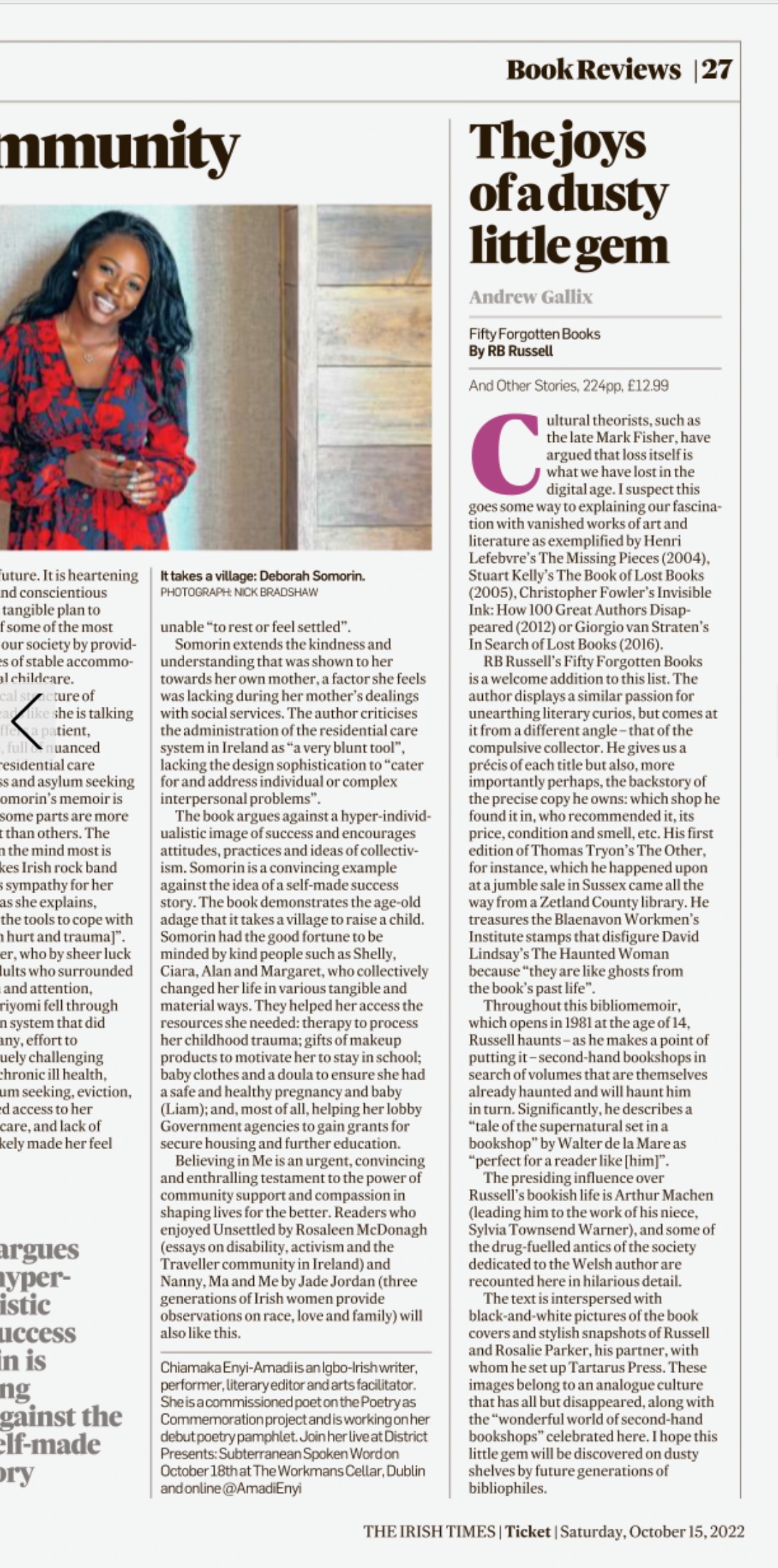
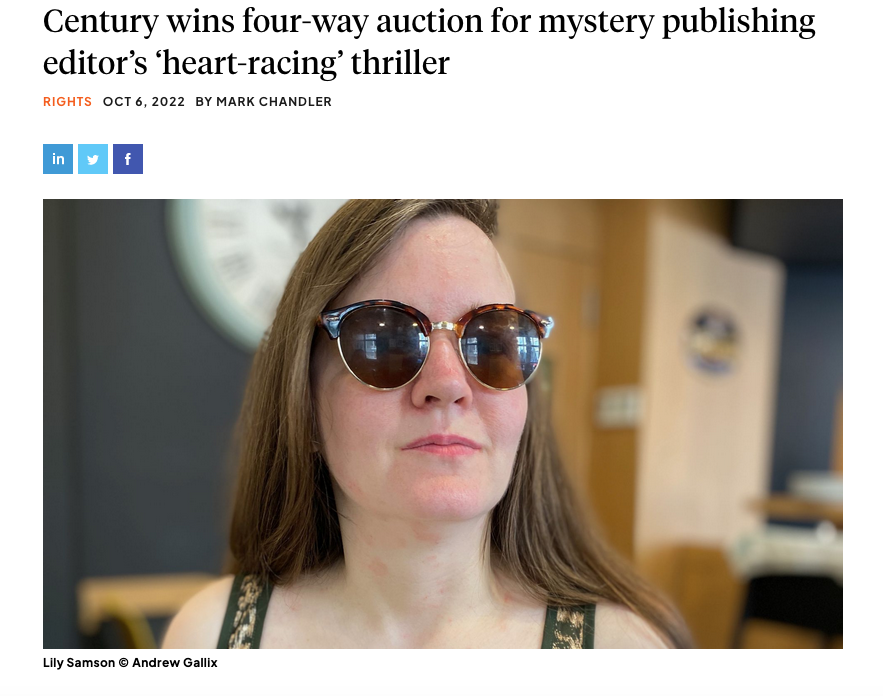
Delighted that my author pic of Lily Samson should feature in The Bookseller.

‘Samson is the pen name for an editor who works at a London publishing company. She studied English at the University of Oxford and divides her time between London and Paris, where her French partner resides. In her spare time she enjoys indulging her obsession with Hitchcock movies and moonlighting as a freelance artist.’

© Andrew Gallix

Unwords (Cover Reveal)

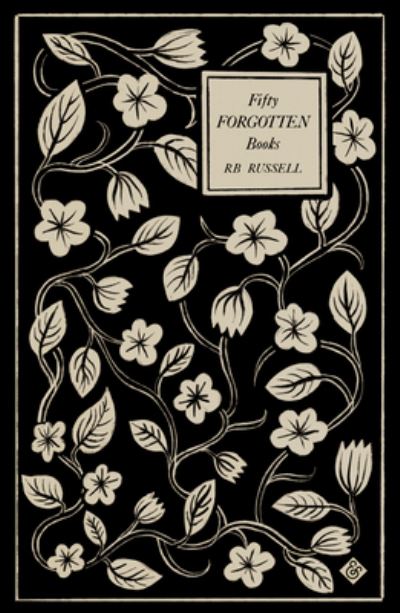
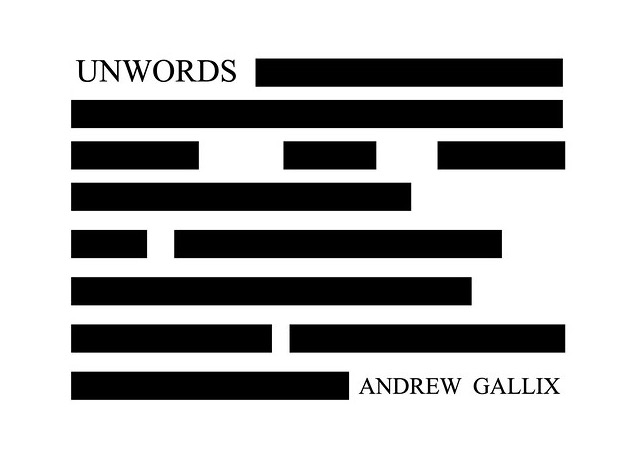
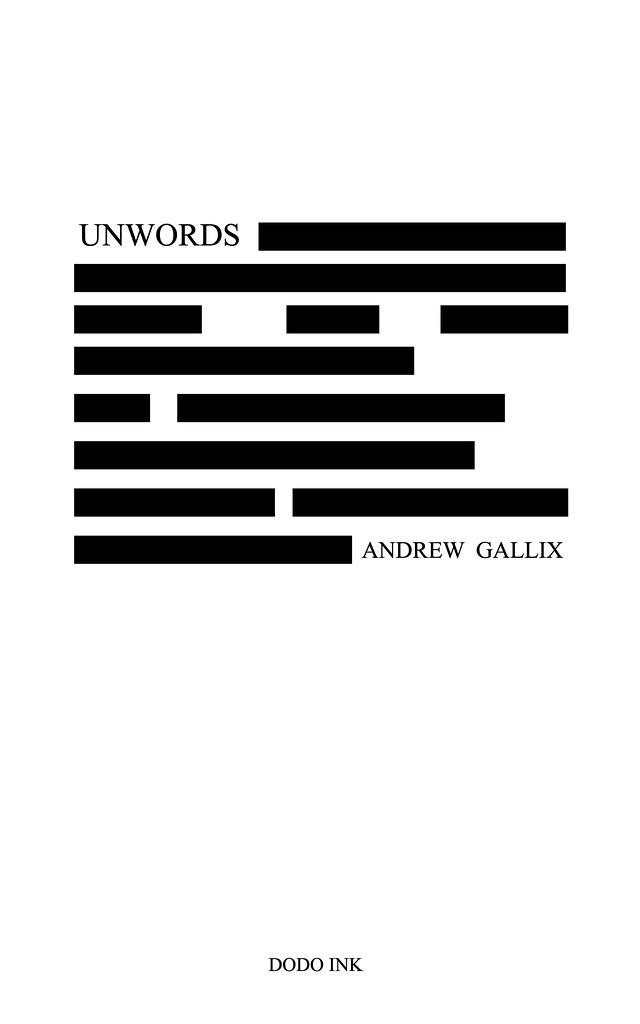
Here is the cover of the ebook version of Unwords (Dodo Ink):

Unwords is a series of essays and reviews haunted by a phantom book I never completed when I was in my 20s.

It is about writers who do not feel the need to publish in order to affirm or reaffirm their status qua writers. Writers for whom literature is the ‘locus of a secret that should be preferred to the glory of making books’ (Maurice Blanchot). Writers who write in order to be able to stop writing. Writers whose decision to stop writing imparts ‘an added power and authority to what was broken off; disavowal of the work becoming a new source of its validity, a certificate of unchallengeable seriousness’ (Susan Sontag). Writers who write in invisible ink. Writers of works whose potentiality never completely translates into actuality. Writers who seek out the untranslatable. Writers who think that words can do what they cannot say. Writers who believe in the existence of the books they have imagined but never composed. Writers whose books keep on writing themselves after completion. Writers who strive, quixotically, to bridge the gap between art and life. Writers who hold that every book should contain its counterbook. Writers who sense that every good novel is also an anti-novel. Writers who turn language against itself. Writers who can never finish their works. Writers who can never begin theirs. Writers who destroy their manuscripts and writers who are destroyed by them. Writers who take their time; writers who take their lives. Writers who may be as fictitious as the yarns they spin. Writers who vanish into their writing. Writers who vanish into thin air…

It contains essays on the highest form of intergloss (and everything having already been said), the death of the novel, the death of the author, the unwritten, the unread and unreadable, the International Necronautical Society, fictive realism, Alain Robbe-Grillet’s reality hunger, the Oulipo and literary bondage, René Girard and mimetic desire, literary prizes, France’s rentrée littéraire, The Princess of Cleves as political weapon, linguistic nationalism, commemorating Louis-Ferdinand Céline, Guy Debord as national treasure, the new wave of French urban fiction, Jacno and the jeunes gens modernes movement, Marc Zermati, patisserie terrorism, Arthur Cravan, the slow writing movement, the importance of doing nothing, the dark young things, Andy Warhol’s answer to Ulysses, the poetics of spam, the literati and digerati, the disappearance of 3:AM Magazine (and literature), umbilical words, the melancholy of Guy the Gorilla, the world without me, two interviews with philosopher Simon Critchley, and an after(un)word made up of quotations.

It also contains reviews of works by Jenn Ashworth, Zygmunt Bauman, Claire-Louise Bennett, Laurent Binet, Owen Booth, Gavin James Bower, Kevin Breathnach, Michel Butor, David Caron, Joshua Cohen, Sam Coll, Steven Connor, Albert Cossery, Douglas Coupland, Tim Etchells, Jonathan Franzen, Dan Fox, Paul Gorman, James Greer, Len Gutkin, Isabella Hammad, Aaron Hillyer, Lars Iyer, Heidi James, Stuart Jeffries, Jean-Yves Jouannais, Alice Kaplan, Hanif Kureishi, Deborah Levy, Agustín Fernández Mallo, Ben Marcus, Tom McCarthy, Sam Mills, benjamin Moser, Marc-Edouard Nabe, Joyce Carol Oates, Tony O’Neill, Russell Persson, Max Porter, Chris Power, Ann Quin, C. D. Rose, Lee Rourke, Tiphaine Samoyault, Kathryn Scanlan, Will Self, Christiana Spens, H. P. Tinker, Tracey Thorn, Jean-Philippe Toussaint, Anna Vaught, Joanna Walsh, Damon Young.

This Year’s Cult Classic

“This Year’s Cult Classic.” Review of Bad Eminence by James Greer. The Irish Times, 16 July 2022, p. 16.


Bad Eminence, American author James Greer’s third novel, is the kind of book you open at your peril. The title alone (a reference to Milton’s Satan) should be warning aplenty, but it is my duty to report that a Latin phrase, planted in the opening pages, leads — once read — to instant possession by the devil. By the same token, I strongly advise you not to cut out and ingest the large dot containing a highly potent hallucinogenic, however much the narrator enjoins you to do so.

Things are already weird enough as it is with the regular intrusion of “sponsored content”, the small black-and-white photographs reminiscent of W.G. Sebald (who is name-checked several times), the recurrence of swans and characters called Temple, not to mention the growing sense of psychosis and gradual dissolution of all ontological certainty.

Vanessa Salomon — the wisecracking narratrix — is a young Franco-American translator, blessed with tremendous “genetic gifts” and a knack for nihilistic aphorisms. Thanks to her reputation for tackling works deemed untranslatable, she is hired by Not Michel Houellebecq to translate his new novel before it is even written. What France’s most famous author really covets, however, is another copy without an original: Vanessa’s celebrity “bitch twin sister”. Or is it?

The novel reaches a metatextual crescendo when the heroine parses a sentence she has just written: “I shut the lid of the laptop and headed back to bed”. She points out that this can only have been typed before or after the event, reflecting her dream of a book that would inhabit “the spaces between the binary code of our existence”. “Everything,” she declares, in what amounts to a manifesto, “is in the process either of becoming or unbecoming, and it is the task of the artist not to make something new but to make something present”.

Once the rollicking narrative has caught up with itself, the novel implodes in real-time. It becomes increasingly obvious that transgressive, S&M fantasies from the Robbe-Grillet book Vanessa was translating at the beginning have been contaminating the rest of her life, and that her world is now awash with simulacra and doppelgängers.

Hilarious, exhilarating and mind-blowing, Bad Eminence is this year’s cult classic.

Laboratory of Narrative

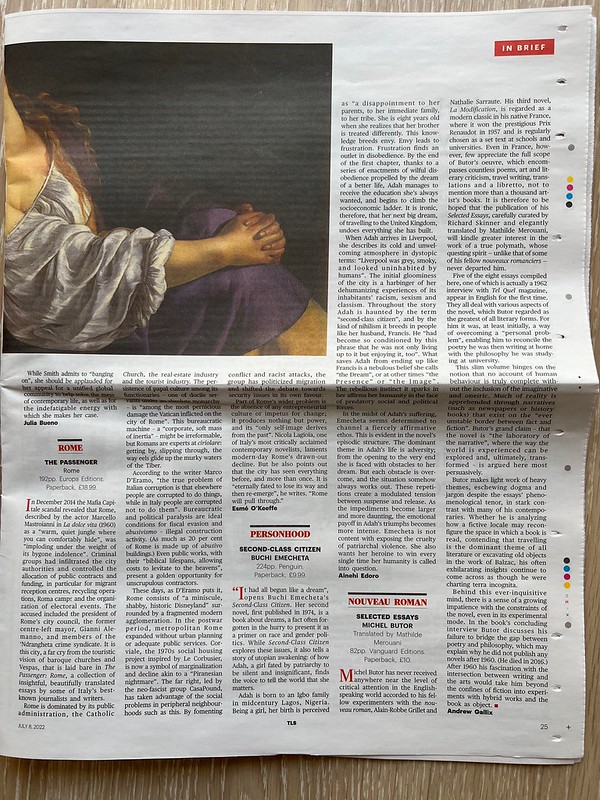
Here is my review of Michel Butor’s Selected Essays, Times Literary Supplement, 8 July 2022, p. 25.


Michel Butor has never received anywhere near the level of critical attention in the English-speaking world accorded to his fellow experimenters with the nouveau roman, Alain Robbe-Grillet and Nathalie Sarraute. His third novel, La Modification, is regarded as a modern classic in his native France, where it won the prestigious Prix Renaudot in 1957 and is regularly chosen as a set text at schools and universities. Even in France, however, few appreciate the full scope of Butor’s oeuvre, which encompasses countless poems, art and literary criticism, travel writing, translations and a libretto, not to mention more than a thousand artist’s books. It is to be hoped that the publication of his Selected Essays, carefully curated by Richard Skinner and elegantly translated by Mathilde Merouani, will kindle greater interest in the work of a true polymath, whose questing spirit — unlike that of some of his fellow nouveaux romanciers — never departed him.

Five of the eight essays compiled here, one of which is actually a 1962 interview with Tel Quel magazine, appear in English for the first time. They all deal with various aspects of the novel, which Butor regarded as the greatest of all literary forms. For him it was, at least initially, a way of overcoming a “personal problem”, enabling him to reconcile the poetry he was then writing at home with the philosophy he was studying at university.

This slim volume hinges on the notion that no account of human behaviour is truly complete without the inclusion of the imaginative and oneiric. Much of reality is apprehended through narratives (such as newspapers or history books) that exist on the “ever unstable border between fact and fiction”. Butor’s grand claim — that the novel is “the laboratory of the narrative”, where the way the world is experienced can be explored and, ultimately, transformed — is argued here most persuasively.

Butor makes light work of heavy themes, eschewing dogma and jargon despite the essays’ phenomenological tenor, in stark contrast with many of his contemporaries. Whether he is analyzing how a fictive locale may reconfigure the space in which a book is read, contending that travelling is the dominant theme of all literature or excavating old objects in the work of Balzac, his often exhilarating insights continue to come across as though he were charting terra incognita.

Behind this ever-inquisitive mind, there is a sense of a growing impatience with the constraints of the novel, even in its experimental mode. In the book’s concluding interview Butor discusses his failure to bridge the gap between poetry and philosophy, which may explain why he did not publish any novels after 1960. (He died in 2016.) After 1960 his fascination with the intersection between writing and the arts would take him beyond the confines of fiction into experiments with hybrid works and the book as object.

The Making of Incarnation

Here is my review of The Making of Incarnation by Tom McCarthy. The Irish Times, 2 October 2021, p. 15:

Tom McCarthy’s fifth and arguably most ambitious novel brings to mind Theodor Adorno’s definition of art as “magic delivered from the lie of being truth”. The Making of Incarnation is about bodies in space — outer space in the case of the sci-fi blockbuster (Incarnation) that serves as both armature and mise en abyme. Here, the lie of being truth (which another character describes as “[n]aturalist bullshit”) must be perpetuated at all costs.

Ben Briar is flown in from the United States as part of a shadowy project called Degree Zero (a nod to Roland Barthes and his reality effect) to ensure that the film’s script, however fanciful, complies with the basic laws of physics. Herzberg, the art director, expends a great deal of energy convincing this “Realism Tsar” that the inclusion of mundane objects in the unlikeliest of set-ups can effectively “counteract the defamiliarisation”. Much is subsequently made of the CGI rendering of a fork (“your basic IKEA Livnära”) that recurs — comically as well as cosmically — throughout the climactic disintegration of the spacecraft.

Given that Briar works for a consultancy called Two Cultures (vide C. P. Snow), it is hardly surprising that he should view physics as a creative endeavour — “a plunge into the farthest-flung reaches of the imagination”. The unfolding of the plot, as the shoot progresses, is interspersed with complex descriptions of the wind tunnels and motion-capture techniques deployed behind the scenes. These are so meticulously detailed that they take on a hypnotic, almost hallucinatory, quality.

Kinesis moves in mysterious ways: at every corner, the scientific turns out to be underpinned by the poetic — or even the messianic. Pantaray Motion Systems is not only the slightly sinister corporate behemoth providing the cutting-edge technology without which there would be no movie; it also has “a heroic status tinged with traces of the mystical”.

Anthony Garnett, its founder, recalls once considering Norbert Wiener (the originator of cybernetics) as “prophet, messiah and apostle”. There was something in his vision that he thought “he’d left behind with Aeschylus, Catullus, Sappho: a condition best denoted by the old, unscientific label poetry”.

Garnett’s colleague Pilkington — referred to, behind his back, as the “Ancient Mariner” — senses that all machines are “stand-ins for some ultimate machine we’ll never build but nonetheless can’t stop ourselves from trying to”. Tasked with orchestrating an experimental plane crash, he goes looking for the “ur-disaster” — the “totality that hovers above every partial iteration”.

Monica Dean, who is conducting research into Lillian Gilbreth, discovers that the pioneer of factory-floor ergonomics had come to entertain “the possibility of some ‘higher’ or ‘absolute’ movement . . . derived from no source other than itself”. The novel is teeming with such intimations of preordained patterns or underlying algorithms.

In this quest for perfection, the human body is ultimately an obstacle. We are reminded that the French scientist Marey sought to infuse his compatriots with the “energy and dynamism of the locomotive” and that Taylorism was seen by some in the Soviet Union as an opportunity to liberate the worker from “the shackles of his very body”. This rejection of incarnation is (paradoxically) embodied by the film’s high romantic denouement: the two lovers, whose union is impossible, bow out in a blaze of glory, expecting to coincide with themselves — and everything — at the instant of their deaths.

The novel, however, does not end with the blinding light of revelation, but a “blackness neither rays nor traces penetrate”. Besides, there is an error in the code behind the film’s final frame — an invisible blemish only the technician is aware of. It recalls Pilkington’s secret that he alone was responsible for the failure of Project Albatross, a minute miscalculation having led the plane to vanish instead of crashing. He imagines the lost aircraft occupying “an aporia, blind alley, cubby-hole or nook”.

This instant of its disappearance, “cut out from the flow of time” — for ever suspended, deferred — is akin to the sense of dislocation that several characters experience: the feeling of being in two locations at once “without really being in either”; of experiencing the present and the past simultaneously while being at one remove from both.

Is not this liminality the very space of fiction, squatted by the two addicts, who reappear right at the end, lost in their pipe dreams and inevitably conjuring up Beckett’s Vladimir and Estragon?

The answer, no doubt, is to be found in Lillian Gilbreth’s Box 808 — the one that allegedly “changes everything”, that may “chisel a Northwest Passage through a stretch of the hitherto theoretical-physically impossible”. The one that is missing, of course, and that everyone — from the protagonist, Pantaray’s Dr Mark Phocan, to the secret services — is looking for.

The truth is out there: Tom McCarthy has worked his magic once again.