![]()
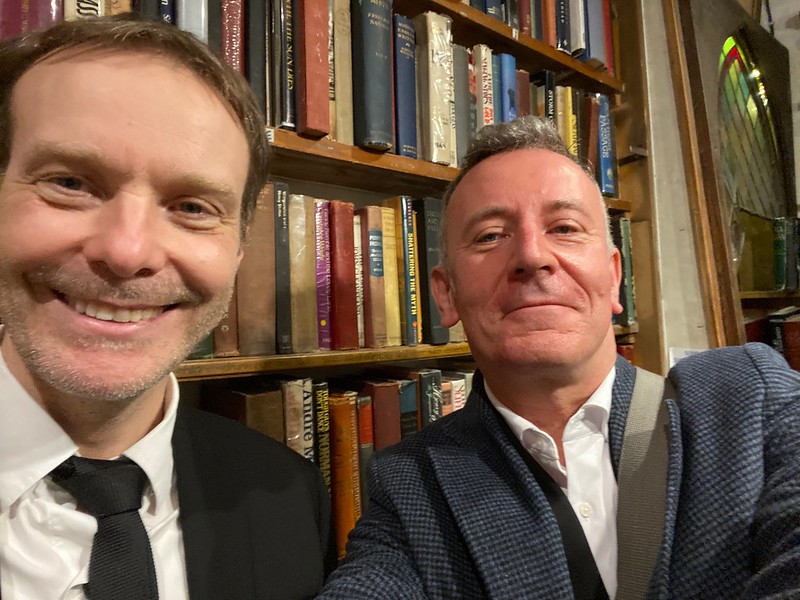
Me and William, New Malden, August 2011.

![]()
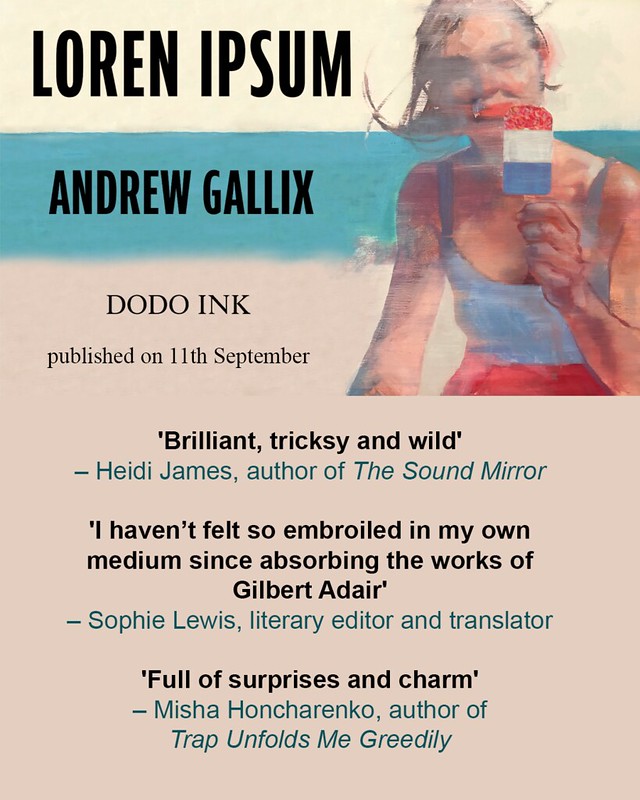
“In Loren Ipsum language itself is up in arms, subverting syntax and blasting holes in meaning left, right, and centre. Gallix’s gleeful opus of literary insurrection is a rogue assemblage of styles and strategies that bristles with cunning stunts, skilful swordplay, and meta-tricksy in-your-endos, with a JPM — jokes per minute — count that’s right off the page”
![]()
Loren Ipsum is a roman à clef which gleefully scrapes its keys over the surface of the realist novel, turning it inside out and revelling in the carnage it creates. It forms an anti-biography which spills the tea on several lives, teases truth like a saucy flash of knickers, artfully nicks from several sources and spins puns to make sense unspun.
Dazzlingly comic and profoundly serious, this novel — like all great writing — is utterly futile and absolutely essential, both confounding and illuminating. Loren Ipsum writes, rewrites and unwrites the great Anglo-French novel, destroying then re-creating the world with each chapter.
![]()
“Thrilling, Dystopian and Inescapable.” Review of For Emma by Ewan Morrison, The Irish Times, 19 April 2025, p. 22.

In his thrilling eighth novel, Ewan Morrison takes us to the heart of the digital nightmare from which we are trying to awake. For Emma is the type of book one would describe as timely, were it not already too late.
Abigail, an editor at a major publishing house, receives an email from someone claiming to be the therapist of Josh Cartwright, the perpetrator of a deadly terrorist attack in San Francisco. This message contains a daily video diary in which the bomber chronicles his experiments with explosives and deteriorating state of mind during the month leading up to the outrage.
Sensing that she may have a publishing hit on her hands, Abigail sets about transcribing these webcam videos in secret. She even fantasises about a bidding war — “not that I, as editor, would be in it for the money”.
Although steeped in cutting-edge technology, For Emma is an epistolary novel, as well as a roman à thèse. Each video is a missive Josh addresses to his late daughter, who was the victim of a covert AI experiment involving a brain implant (shades of Elon Musk’s Neuralink). Zach Neumann (new man), the tech guru at the head of the sinister transhumanist corporation responsible for Emma’s death, is to deliver a speech on the “Coming Technological Utopia” (always the flip side of dystopia), where Josh plans to exact revenge by blowing himself up. No spoilers.
Josh blames his own lack of convictions — beyond a “righteous passion for recycling plastics” — for his inability to save his daughter, whose questing mind turned her into a science prodigy. The real danger, however, stems from the search for a grand narrative — an answer to the “Big Why” — rather than nihilism.
Morrison picks up the debate where Dostoevsky left off: is life meaningless if humanity turns out to be a cosmic accident? Can it still have a purpose after the loss of a child?
In this world of deepfakes, ontological uncertainty fuels a hermeneutics frenzy. Abigail’s transcripts are interspersed with regular editorial notes, where she interprets the videos showing Josh decoding the messages he believes Emma is sending him from beyond the grave. Everybody, including the poor reader, is gradually sucked into a global conspiracy. If only this were science fiction!