Fleeting

The wonderful Deborah Levy was kind enough to mention me in an interview with Matt Shoard for Fleeting Magazine (“8 Questions for Deborah Levy”) published on 22 December 2012. Here’s the relevant extract:

Are you comforted by the assertion that there are yet People on Earth who know what they are doing? Or, like me, do you subscribe to the notion that people who knew what they were doing began to die off about 1945 and are now on the brink of extinction?

Yes, Benjamin Eastham and Jacques Testard, editors of the stunning new Art Literature and Politics journal The White Review know what they are doing and they also know who they do not want to do business with. Andrew Gallix, writer and editor of 3:AM Magazine knows what he’s doing and I am so pleased he’s doing it. Uber publisher and translator Stefan Tobler at And Other Stories is a man of vision and steel; he knows what he’s doing in any number of languages. So does Matt Shoard of Fleeting and so does John Self, an incredibly astute reader and critic. Every generation throws up its new thinkers and they tend to make a cultural revolution. They have energy and purpose and sometimes wear really nice shoes. They make everyone else look exhausted and clapped out. That is how it should be.

Reading Crooked

Author and filmmaker Donari Braxton has read my story “Fifty Shades of Grey Matter” (included in Fiddleblack‘s first annual print edition) and his reaction has left me speechless:

“This, is, fucking, fan, tas, tic. This is the best piece of short fiction I’ve read in a good long while, at least this 2012. It’s one of the best things you’ve ever written, that I’m familiar with. It is fuck, ing, fan, tas, tic.

The world you create is disarmingly gauche and socially backwards, but the affinities between characters, however brief, are simultaneously soberingly close-at-hand, dare I say relatable, in spite of the flash format. The insights in between — those little poetic gems in the form of errant elbows — are all earned by the context-of-use, the fun-ness, and the arc, of the read, and quite a few of them are brilliant. The love story itself is pathetically honest. The writing confident, the narrative lived-in. Be proud of yourself. It’s brilliant.

…If you don’t get that your last piece here is as fiercely strong as it is, you’re reading crooked. I wish I’d written it, and I can hardly ever say that, is the truth.”

A Writing Against Itself

Andrew Gallix, “Go Forth (Vol. 4)” by Nicolle Elizabeth, The Believer Logger 14 November 2012

Andrew Gallix is editor-in-chief of 3:AM Magazine, which the Guardian credits as technically the first literary blog ever. He writes fiction and criticism, edits books, and teaches at the Sorbonne, and I love him.

NICOLLE ELIZABETH: What is 3:AM, and how did it start?

ANDREW GALLIX: 3:AM is one of the oldest literary webzines out there, as it was launched in April 2000. We were among the first to make use of the international dimension of the web: the founder was American, our first webmaster was Canadian, and the rest of the team was located in Britain, France, Ireland and the US. We were the first, or one of the first, to launch a literary blog (if by that you mean a compendium of literary news links). We innovated by placing fiction in a wider cultural (artistic, in particular musical) context. We also pioneered the revival of live literary events in London, mixing music, art, and spoken word.

NE: This is a collective thing?

AG: Very much so. The whole point of 3:AM was to foster a community of literary loners; to create a space where we can be alone together.

NE: Print ever or no?

AG: Two anthologies of 3:AM short stories (edited by Andrew Stevens) have been published, but the magazine itself is online-only. I think we were also pioneers from that point of view: we realized that online publications were the way forward. They cost virtually nothing, which means that only literary/artistic criteria apply, instead of financial considerations. There are no space constraints (a piece can be as long or as short as it needs to be). You can reach so many more readers than if you publish a story in a small literary journal. Christiana Spens has just launched 3:AM Press, which releases both ebooks and limited print editions, showing our attachment to both formats.

NE: Main concerns ethically?

AG: There is no party line, although we are rather contrarian, hence our tagline (a nod to Groucho Marx, the Ramones, and Adorno): “Whatever it is, we’re against it.” It sounds rather pedantic, I know, but what I consider to be real literature is always, at some level, a writing against itself.

NE: Main concerns aesthetically?

AG: Once again, 3:AM is a very broad anti-church. Personally, I think we should publish fiction that has the inevitability of death.

NE: What advice do you have for those who wish to start a magazine?

AG: Don’t give up the day job.

NE: Anything else you’d like to tell us here?

AG: Sure, but only things which cannot be told.

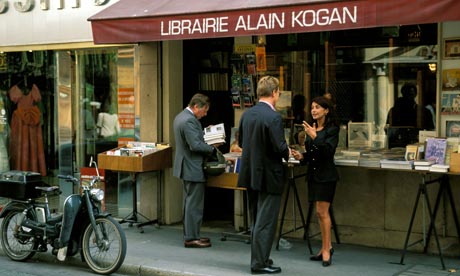
La Rentrée Littéraire Redux

This appeared in Guardian Books on 9 October 2012:

La Rentrée Littéraire Redux

The French books world’s demented annual commercial knockout context shows little sign of going away


[Eternal return… Parisian book buyers. Photograph: Alamy]

Much ink was expended, earlier this year, on the subject of parenting in France. For better or worse — usually the former — it was deemed far less “child-centric” than across the Channel. There is, however, at least one area where French kids set the agenda: the agenda (French for “diary”) itself.

Although nominally in December, the end of the year really occurs in early summer, when schools break up for a two-month hiatus. By August, Paris feels eerily empty, in a way that London, for instance, never does. At times, it almost looks like the local population has been wiped out by a neutron bomb, leaving hordes of tourists roaming around a ghost town. Most of those who cannot afford to go away are relegated — out of sight, out of mind and out of work — to the infamous banlieues, which, owing to some strange optical illusion, only become visible when they disappear in flames.

By the same token, it is September, and not January, which marks the true beginning of the year; a beginning that spells eternal recurrence rather than renaissance. “La rentrée” — the back-to-school season extended to the entire populace — never fails to remind me of Joey Kowalski, the narrator of Gombrowicz’s Ferdydurke, who, despite being 30 years old, is marched off to school as though he had been caught playing truant. “La rentrée” is the bell that signals the end of playtime; the restoration that follows revolution. In an annual re-enactment of the “retour à la normale” after the carnival of May 1968, everybody returns to the old “train-train quotidien”: the daily grind of “métro, boulot, dodo” (commute, work, bed — an expression derived from a poem by Pierre Béarn). A vague sense that real life is elsewhere (as Rimbaud never quite put it) lingers a while, before fading like suntans and memories of holiday romances.

The start of the new school year (“la rentrée scolaire”) coincides, give or take a few weeks, with the opening of the publishing season (“la rentrée littéraire”). In fact, both rentrées go together like cheese and wine, Alsace and Lorraine, or Deleuze and Guattari. This is not purely coincidental, since publishers are largely dependent upon education for the grooming of future generations of book buyers. The “rentrée littéraire” is the equivalent of cramming for your finals — a tome-intensive blitzkrieg geared towards the autumn literary prizes and subsequent Christmas sales. The season kicks off mid-August, really kicks in mid-October, and climaxes in November, when most book prizes are awarded: the illustrious Prix Goncourt (hot on the heels of the Grand Prix de l’Académie française in October) but also the Prix Décembre, Femina, Flore, Interallié, Médicis, Renaudot, and a few others besides. The major publishing houses tend to carpet bomb, chucking as many titles at these awards as they can, while the indies have no other choice but to go for surgical hits, on a wing and a press release.

So far, this year’s vintage has been pretty much business as usual, apart from the growing popularity of ebooks. At season’s close, 646 novels will have been released (compared with 654 in 2011 and 701 in 2010). If French fiction is down a little, the number of foreign titles remains constant (220 against 219 last year). As a result of the uncertain economic climate, there are fewer debuts (69 against 74) and more mass-market print runs (including Fifty Shades of Grey and the new JK Rowling). Pursuing a trend observed over the past few years, many of the heavyweights (Jean Echenoz, Patrick Modiano, Philippe Sollers et al.) have been held over until mid-October in order to heighten anticipation and maximize impact upon November’s book prizes.

Some of this season’s most hotly touted titles have a distinct whiff of déjà vu. There’s the new Houellebecq (Aurélien Bellenger, whose first book was an essay on the old Houellebecq). There’s the presidential campaign, which is fast becoming a sub-genre, with no less than seven books devoted to the latest instalment (including a non-fiction novelisation by HHhH author Laurent Binet). And then there’s the obligatory scandal which, this year, comes courtesy of Richard Millet (“l’affaire Millet”!) and his “literary praise” of mass murderer Anders Breivik.

The best take on the “rentrée littéraire” appears in Ecclesiastes: “of making many books there is no end”. In no other country is so much fiction published in such a short period of time. With hundreds of novels competing for a dozen prizes or so, most are destined to sink without trace — unsold and unread. Industry observers claim that if a debut novel has not caused a buzz by mid-September, it’s (French) toast. The result is a book glut comparable to Europe’s wine lakes and butter mountains.

David Meulemans, who heads indie press Aux Forges de Vulcain, made a few waves recently by announcing that he would not be taking part in this year’s rentrée. He described the publishing season as “mass commercial suicide”: a launch pad for prizes virtually no one stands a chance of ever winning. Sylvain Bourmeau — who praises the extraordinary diversity of publications on offer (belying, in his view, the French literati’s reputation for navel-gazing) — acknowledges, in Libération, that the rentrée is indeed a “weird national lottery”. For the past decade, Pierre Astier has been one of its most vocal critics. This former indie publisher, who went on to launch one of France’s first literary agencies, highlights the hypocrisy of a system — controlled by an old boys’ network — that fosters cut-throat competition without establishing a level playing field. Conflicts of interest abound; nepotism is rife. Being life members, the Goncourt judges are endowed with godly powers. Four of them even have books in the running for this year’s awards, which are usually carved up among the major publishing houses anyway. Astier also criticises the lack of openness to francophone writers, which he interprets as a sign that decolonisation has not gone far enough.

Although its quaint customs are often parodied (as in Patrick Besson’s Ma rentrée littéraire), the publishing season, is still widely seen as an instance of France’s cultural exceptionalism; its “droit à la différence” — or even différance.


The Booker Steps Away From Being its Own Genre

This appeared in The Guardian (Comment is Free section) on 28 July 2012:

The Booker Steps Away From Being its Own Genre

The inclusion on the Man Booker longlist of four debuts and three novels from excellent indie publishers is a welcome sign

[Science Fiction novelist China Miéville has criticised the Booker Prize for becoming its own genre. Photograph: Sarah Lee for the Guardian]

The announcement of this year’s Booker longlist, just a few days before the opening of the Olympics, reminds us that literary jousting originated in ancient Greece. Modern literary competitions appeared shortly after the revival of the Olympic Games at the end of the 19th century. The Nobel prize in literature (1901) was followed by the Prix Goncourt in France (1903), the Pulitzer prizes in the States (1917) and the James Tait Black memorial prizes in Britain (1919). Compared with their Greekish forebears, they are far trickier affairs. Australian author Richard Flanagan is clearly no friend of contemporary book contests: in his view, they are often barometers “of bad taste” that only serve “to give dog shows a good name”.

The aristocratic authors of an earlier period often felt that there was something a little common, even humiliating, about wanting to be read by others, possibly of an inferior station. In Deceit, Desire, and the Novel, René Girard describes some of the excuses they came up with to give the impression that their works had got into print without their knowledge. La Rochefoucauld (to whom I am vaguely related through one of his descendants’ bastard offspring) claimed, for instance, that his manuscript had been stolen by a servant.

Thomas Bernhard had similar issues with literary prizes. My Prizes: An Accounting, published posthumously, is a series of diatribes against the nine eponymous prizes he received up until 1980 and the “assholes” who bestowed them upon him — which brings us back to the Booker.

In François Ozon’s film Swimming Pool, a bestselling author (played by Charlotte Rampling) pays a visit to her publisher, where she bumps into an up-and-coming novelist who has just won a minor literary prize. After the latter’s departure, the publisher tries — and fails — to clear the air by describing the award as “hardly the Booker prize!” Charlotte Rampling’s character reminds him of what he always used to say at the beginning of his career: “Awards are like haemorrhoids: sooner or later, every arsehole gets one”. This scene epitomises the Booker effect: the petty rivalries and insidious corrupting influence.

Launched in 1969, the Booker was always conceived of as a publicity stunt designed to shift units. I think it is fair to say that no other literary prize in the world has ever received so much media attention. By 1990, when Gilbert Adair included a chapter entitled “Le Booker nouveau est arrivé” in his Barthes-inspired Myths and Memories, the prize had already become an institution, thanks to a marketing strategy not dissimilar to that of Beaujolais nouveau.

The Booker has always worn its commercialism on its sleeve: its official name — the Man Booker Prize — derives from its original (Booker-McConnell) and current (the Man Group) sponsors. This, of course, is not necessarily a bad thing. Trying to sell more books is certainly nothing to be ashamed of, and the Booker has two big advantages over the Gallic Goncourt: it is not controlled by the publishing industry and the judging panel changes every year. However, financial considerations do, regrettably, play a part in the selection process: a publisher must “contribute £5,000 towards general publicity if the book reaches the shortlist” and “a further £5,000 if the book wins the prize”. Indies may find it difficult to stump up this sort of money.

The Nobel is awarded to “the person who shall have produced in the field of literature the most outstanding work in an ideal direction”. Aimed at “the intelligent general audience,” the Booker never entertained such lofty ambitions. It was always resolutely middlebrow as last year’s controversy over “readable books” that “zip along” amply illustrated.

Since its inception, the prize has championed a type of well-made mainstream novel that reflects the liberal humanist world view of the Home Counties (sometimes with decorative postmodern knobs on). When a thriller found its way on to the longlist, many people thought that the judges had lost the plot, and were no longer able to recognise a Booker novel. This reaction only confirmed China Miéville‘s argument that despite traditionally shunning genre fiction, the Booker had itself become a genre. This, I feel, has been the prize’s most pernicious influence. The novel — which was meant to be the genre to end all genres in which philosophy and poetry would be reunited — has been reduced to innocuous literary fiction narratives written as though modernism had never happened.

This year, there has been no populist talk of jolly good reads or zip-along page-turners. On the contrary, chairman Peter Stothard signalled the judges’ intention to focus on “texts not reputations“: books “that you can make a sustained critical argument about”. The kind that “you don’t leave on the beach” and want to “read again and again”. Hence, perhaps, the presence of four debuts and three novels released by excellent indie publishers (And Other Stories, Myrmidon Books and Salt).

The inclusion of Deborah Levy‘s Swimming Home, one of the finest new novels I have read (and already reread) in a long time, seems like a very good omen indeed. It radiates the sensual languor of sun-drenched afternoons in the south of France and the disquieting, uncanny beauty only perceived by a true daytime insomniac. At times, it reminded me of Ozon’s film. Let us hope this year’s Booker will not be awarded to an arsehole.

****

Here is a longer — uncut and unedited — version of the above text. A draft, if you will:

The announcement of this year’s Booker longlist, just a few days before the opening of the Olympics, reminds us that literary jousting originated in Ancient Greece. These early competitions, however, were more akin to poetry slams or the itinerant Literary Death Match, than to the sedate book prizes we are accustomed to. Dithyrambic contests were collective, all-singing-and-dancing renditions of poetic works. The name of the victorious chorus would often go down in history, while that of the poet himself would be forgotten. It was, above all, the performance that was being assessed.

Modern literary competitions appeared shortly after the revival of the Olympic Games at the end of the nineteenth century. The Nobel Prize in Literature (1901) was followed by the Goncourt in France (1903), the Pulitzer in the States (1917) and the James Tait Black Memorial Prize in Britain (1919). Compared with their Greekish forbears, they are far trickier affairs. Australian author Richard Flanagan is clearly no friend of contemporary book contests: in his view, they are often barometers “of bad taste” that only serve “to give dog shows a good name”. Whether or not most prizes “get it mostly wrong,” he clearly has a point when it comes to the Nobel: “No one I know hails Sigrid Undset or Frans Eemil Sillanpaa or Par Lagerkvist — Nobel laureates in 1928 and 1939 and 1951, respectively — as globally significant writers, important as they are to their own national literatures, perhaps because no one I know has ever read them. Yet Tolstoy, Chekhov, Kafka, Fitzgerald, Joyce, Cortazar, Nabokov, Borges, Kundera, Roth and Bolano have all been passed over for the gong of gongs”.

According to Lars Iyer (whose novel Spurious was shortlisted for last year’s Not the Booker), “the prestige of authorship” — producing great works — has given way to “the prestige of an ephemeral kind of literary careerism,” which is sanctioned by book clubs and prizes: “With pomp and circumstance, the award ceremonies vainly bestow medals of greatness on novels that vaguely mime our fading memory of masterpiece. The prestige, the debris, the body of Literature remains even as the spirit has fled”. The aristocratic authors of an earlier period often felt that there was something a little common, even humiliating, about wanting to be read by others, possibly of an inferior station. In Deceit, Desire, and the Novel, René Girard describes some of the excuses they came up with to give the impression that their works had got into print without their knowledge. La Rochefoucauld (to whom I am vaguely related through one of his descendants’ bastard offspring) claimed, for instance, that his manuscript had been stolen by a servant. Thomas Bernhard had similar issues with literary prizes. In the autobiographical Wittgenstein’s Nephew (1982), he describes a cursory acceptance speech as “a few sentences, amounting to a small philosophical digression, the upshot of which was that man was a wretched creature and death a certainty”. My Prizes: An Accounting, published posthumously, is a series of diatribes against the nine eponymous prizes he received up until 1980 and the “assholes” who bestowed them upon him — which brings us back to the Booker.

In François Ozon’s film Swimming Pool (2003), a bestselling author (played by Charlotte Rampling) pays a visit to her publisher, where she bumps into an up-and-coming novelist who has just won a minor literary prize. After the latter’s departure, the publisher tries — and fails — to clear the air by describing the award as “hardly the Booker Prize!” Charlotte Rampling’s character reminds him of what he always used to say at the beginning of his career: “Awards are like haemorrhoids: sooner or later, every arsehole gets one”. This scene epitomises the Booker effect: the petty rivalries and insidious corrupting influence.

Launched in 1969, the Booker was always conceived of as a publicity stunt designed to shift units. I think it is fair to say that no other literary prize in the world has ever received so much media attention. By 1990, when Gilbert Adair included a chapter entitled “Le Booker nouveau est arrivé” in his Barthes-inspired Myths and Memories, the prize had already become an institution, thanks to a marketing strategy not dissimilar to that of Beaujolais nouveau. The Booker has always worn its commercialism on its sleeve: its official name — the Man Booker Prize — derives from its original (Booker-McConnell) and current (the Man Group) sponsors. This, of course, is not necessarily a bad thing. Trying to sell more books is certainly nothing to be ashamed of, and the Booker has two big advantages over the Gallic Goncourt: it is not controlled by the publishing industry and the judging panel changes every year. However, financial considerations do, regrettably, play a part in the selection process: a publisher must “contribute £5,000 towards general publicity if the book reaches the shortlist” and “a further £5,000 if the book wins the prize”. Indies may find it difficult to stump up this sort of money.

The Nobel is awarded to “the person who shall have produced in the field of literature the most outstanding work in an ideal direction”. Aimed at “the intelligent general audience,” the Booker never entertained such lofty ambitions. It was always resolutely middlebrow as last year’s controversy over “readable books” that “zip along” amply illustrated. Since its inception, the prize has championed a type of well-made mainstream novel that reflects the liberal humanist world view of the Home Counties (sometimes with decorative postmodern knobs on). When a thriller found its way on to the longlist, many people thought that the judges had lost the plot, and were no longer able to recognise a Booker novel. This reaction only confirmed China Miéville‘s argument that despite traditionally shunning genre fiction, the Booker had itself become a genre. This, I feel, has been the prize’s most pernicious influence. The Novel — which was meant to be the genre to end all genres in which philosophy and poetry would be reunited — has been reduced to innocuous literary fiction narratives written as though Modernism had never happened.

This year, there has been no populist talk of jolly good reads or zipalong page-turners. On the contrary, chairman Peter Stothard signalled the judges’ intention to focus on “texts not reputations“: books “that you can make a sustained critical argument about”. The kind that “you don’t leave on the beach” and want to “read again and again”. Hence, perhaps, the presence of four debuts and three novels released by excellent indie publishers (And Other Stories, Myrmidon Books and Salt). The inclusion of Deborah Levy‘s Swimming Home, one of the finest new novels I have read (and already reread) in a long time, seems like a very good omen indeed. It radiates the sensual languor of sun-drenched afternoons in the south of France and the disquieting, uncanny beauty only perceived by a true daytime insomniac. At times, it reminded me of Ozon’s film. Let us hope this year’s Booker will not be awarded to an arsehole!

All the Latest

I was asked to write a piece about the Booker longlist. You can read it here in the Guardian‘s Comment is Free section:

[…] The inclusion of Deborah Levy‘s Swimming Home, one of the finest new novels I have read (and already reread) in a long time, seems like a very good omen indeed. It radiates the sensual languor of sun-drenched afternoons in the south of France and the disquieting, uncanny beauty only perceived by a true daytime insomniac. At times, it reminded me of Ozon’s film. Let us hope this year’s Booker will not be awarded to an arsehole.

Whatever Happened to 3:AM Magazine?

This appeared in Guardian Books on 10 July 2012:

Whatever Happened to 3:AM Magazine?

When the 3:AM website suddenly vanished last week, the might of social media helped track down the person who could switch the server back on. But what are the implications for online magazines?

[Turn it on again … server outages were undeniably on the rise, but this time there was no website to check. Photograph: Thomas Northcut/Getty Images]

I concluded my last contribution to this site with a quotation from Maurice Blanchot: “Literature is going toward itself, toward its essence, which is disappearance”. Little did I know that 3:AM Magazine — the literary webzine I had edited with a group of friends for more than a decade — would shortly after vanish suddenly into cyberspace. Whether it was going toward its essence is a moot point, which falls outside of our present remit.

When I am not running late, I often check the website, along with my email, before setting off for work. The last time I performed this routine, I sat, for what seemed like ages, staring, bleary-eyed, at an empty page that obstinately refused to load. Blogger’s block, as I like to call it, is a less heroic, technological version of l’angoisse de la page blanche: the agony experienced by writers in front of a blank page. The only sign of activity came from the little dotted line going round and round in vicious circles like Sisyphus‘s boulder or — rather fittingly in this instance — nobody’s business. With hindsight, I realise it should have put me in mind of the proverbial dotted line on which dodgy contracts are carelessly signed. At this juncture, however, I wasn’t unduly worried — or at least I wasn’t yet aware that my relative (and frankly uncharacteristic) nonchalance may have been (was) inappropriate. After all, this sort of thing had been happening — not happening — on and off for several months, and each time normal service had resumed of its own accord, as if by magic.

Although rare, server outages were undeniably on the rise, and downtime had gone from a couple of hours to a couple of days. This, of course, should have prompted a reassessment of my non-interventionist attitude, but there was little I could do, short of moving the entire website to a new company and server, which is precisely the kind of drastic measure I was eager to postpone for as long as possible. Attempting to make contact with our host — whether by phone, email, carrier pigeon or Ouija board — was a fruitless exercise I had long given up in favour of more fulfilling pursuits such as staring at empty web pages failing to load. Besides, these outages afforded me a few guilty pleasures, not least a little breathing space from the frenzy of online activity: they reminded me of the carnivalesque atmosphere brought about, in my childhood household, by the power cuts of the 1970s. And there was the frisson of flirting with disaster without going all the way — until that fated morning when I tried to check the website only to discover that there was no website to check. There was still no website when I came home from work that evening, nor the following day, nor the day after that. When the expected resurrection had failed, Godot-like, to materialise for almost a week, we were forced to contemplate the nightmare scenario of having lost 12 years’ worth of archives.

The web is a Library of Babel that could go the way of the Library of Alexandria. It is the last word in the quest for a book in which everything would be said — a tradition that extends from epic poetry to Joyce’s Ulysses through the Bible, the Summa Theologica, Coleridge‘s omnium-gatherum and the great encyclopedias, as well as Mallarmé‘s “Grand Oeuvre”. It is the ultimate Gesamtkunstwerk — “the catalog of catalogs”, the “total” library conjured up by Borges — but it also marks the triumph of the ephemeral.

In order to mimic the instant gratification provided by the web, Argentinian publisher Eterna Cadencia recently published an anthology of short stories using disappearing ink. Once you open the volume, the ink begins to fade in contact with light and air, vanishing completely within two months. In recent years, I have received a growing number of requests from early contributors to 3:AM Magazine, asking me to delete a poem or story of theirs. These people are usually applying for a new job, and find themselves haunted online by youthful incarnations of themselves that may jeopardise their futures. Yet it only took an instant for someone to switch off 3:AM‘s server and solve this problem. The past does not pass on the web; it lingers or resurfaces — unless, of course, it is wiped away. In our case, most of the material was retrievable via the Internet Archive, but as Sam Jordison pointed out in a recent email, how can we be sure that this site, or a similar one, will always be around? At least, in the old days of dead trees, you could safeguard copies of your journal in libraries or universities. When 3:AM was launched, I used to print out every new article we posted, but stopped when the site started running to thousands of pages. I had never imagined that the company I was paying to host, and indeed back up, our webzine would vanish without a word of warning, like disappearing ink.

3:AM‘s servers (located in Dallas, Texas) were owned by a company (based in Saint Joseph, Missouri) whose website was down. Emails bounced back and the phone had been disconnected. We naturally assumed that the owner — whose main claim to fame was his contribution to the penis-enlargement business — had done a runner. But as soon as the word was out, we were inundated with heart-warming messages of support and offers of help via social media, and within a few hours, Twitter had located the owner’s whereabouts. 3:AM readers informed us that he was now the landlord of — or an employee in (there were conflicting reports) — a tattoo parlour. Someone even kindly mailed me an overexposed picture of the aforementioned establishment.

American novelist Steve Himmer spotted that he and the alleged fugitive had a friend in common on Facebook, who was able to send a direct message. London-based author Susana Medina friended him and striked up a conversation. His mobile phone number and personal email addresses were soon unearthed and passed on by amateur sleuths. Blogger Edward Champion conducted a phone interview with the errant entrepreneur in which the latter claimed that he had wound up his web hosting business in 2008 and had no idea that he was still hosting us. He mentioned a “server admin in Bucharest” — name of Florin — who had been handling the company’s “lingering details”. If this is all true, and it could well be, 3:AM had been running on some unattended phantom server. I also wonder whom I have been paying all these years.

Thanks to our readers’ support, and to Champion’s fine detective work, the server has been switched back on (possibly by Florin) … until we migrate elsewhere.