valentinvermot follows emiliepierrade
valentinvermot follows emiliepierrade
emiliepierrade does not follow valentinvermot
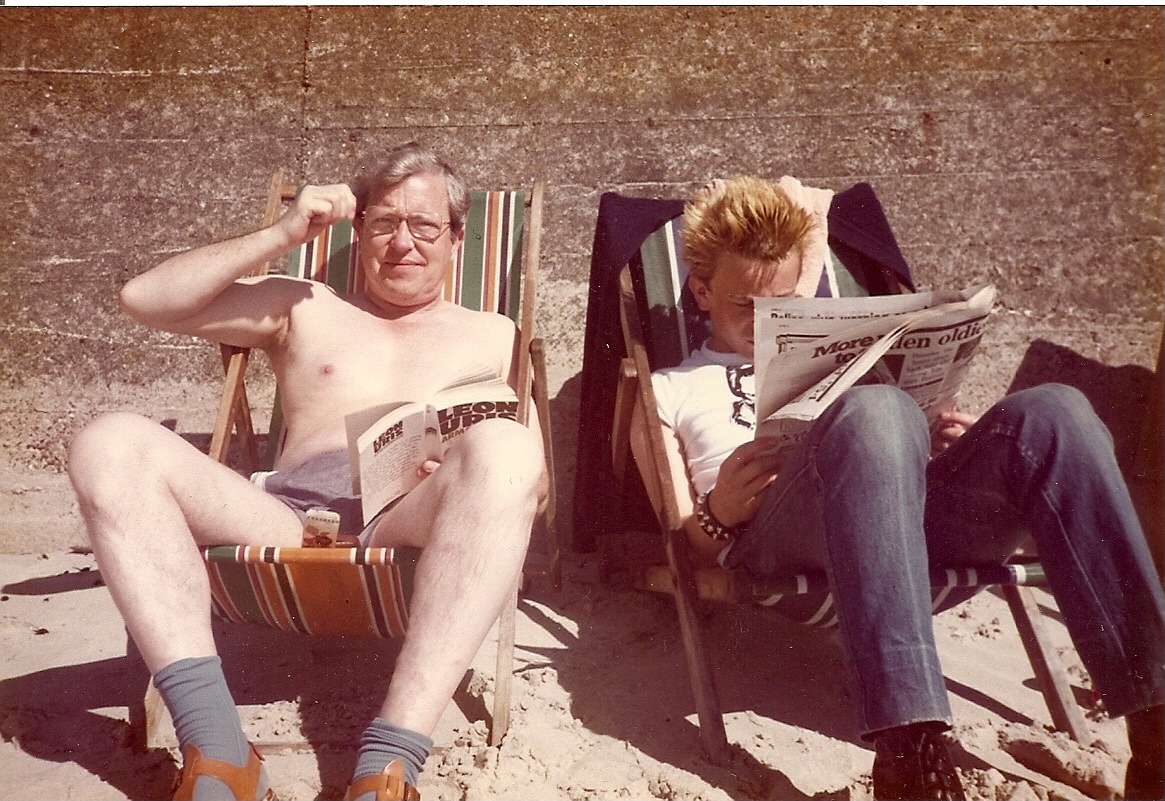
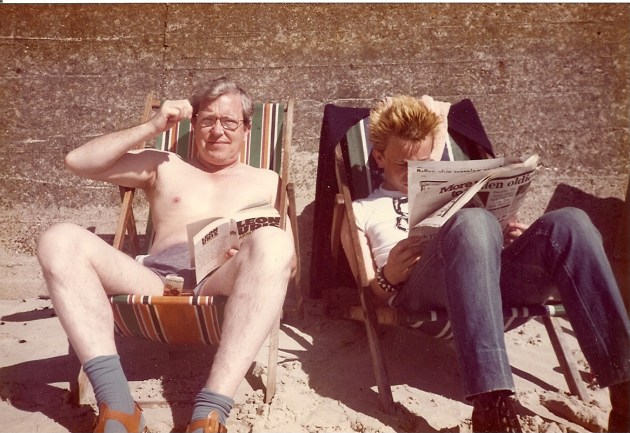
Have just noticed that this picture of me and my stepdad — taken by my mum, in Jersey, back in July 1981 — had been posted on the ISYS (I Saw You Standing) tumblr (This is Me Then, 1 November 2011). He’s rocking the classic socks-and-sandals combo; I’m sporting a punk Charles and Diana T-shirt to “celebrate” the Royal wedding (purchased at the Virgin Megastore on Oxford Street).
I LOVE YOU
I WANT YOU
I NEED YOU
I ADORE YOU
I MISS YOU
I AM OBSESSED WITH YOU
I ADMIRE YOU
I WORSHIP YOU
I CANNOT LIVE WITHOUT YOU
“Words for Lost” belongs to Valentin Vermot’s series of e-mail and text message erasures. The original was an e-mail from Emilie Pierrade received on Sunday 30 May 2004 at 9:26 pm:
I LOVE YOU
I WANT YOU
I NEED YOU
I ADORE YOU
I MISS YOU
I AM OBSESSED WITH YOU
I ADMIRE YOU
I WORSHIP YOU
I CANNOT LIVE WITHOUT YOU
Emilie
Emili
Emil
Emi
Em
E
e-i-l-i-m-E
Valentin Vermot deleted her name, one letter at a time, until he was back where he had begun. There was no escape.
On one of the corners of rue des Abbesses and rue Aristide Briand, there is a café called La Villa. The decor could be described as gentlemen’s club stroke colonial chic. African masks look down, with long faces, from dark oak panelling. The lighting is always subdued, as though some hallowed mystery had to be preserved from the cold light of day. In the first section, there are twelve black leather armchairs on either side of six black round tables. The armchair where Emilie once sat is in front of me, by the window. It is impossible to say for sure if it is the exact same one, or if the armchairs have been moved around. It is a question of belief. I believe this is the armchair in which Emilie is no longer sitting. I believe that everything must leave some kind of mark, and that her buttocks are haunting the leather seat. The distance separating the armchair in which I am sitting from the armchair in which Emilie is no longer sitting is absolute. The journey between the two refuses to draw to a close as I draw close.
You will never read this. If you did, you would instantly fall in love with me again. Each letter was soaked overnight in a 90% proof voodoo potion, spirited out of New Orleans. By the end of this sentence, all the words would rain down on you, like a shower of beads from a frilly balcony. Then you would be mine, for ever. You will never read this.
This appeared in 3:AM Magazine on 11 July 2011:

L’Homme qui arrêta d’écrire, Marc-Edouard Nabe, 2010
Marc-Edouard Nabe has always relished playing with fire, but never more so than when he burned what would have been the fifth volume of his journal. His main motivation was to avoid being trapped in a Shandyesque race with time, ending up pigeonholed as a diarist. Nevertheless, he went on to describe this event in Alain Zannini (2002), a novel so blatantly autobiographical that it even bore his real name as its title (Nabe, short for “nabot” — midget — is a nom de plume). The implication was clear: having lived his life in order to narrate it, Zannini had gradually become Nabe’s creation. What, then, would happen if the writer were to stop writing?
This ontological question is raised in L’Homme qui arrêta d’écrire (“The Man Who Stopped Writing”), which begins with the author-narrator’s paradoxical assertion — given the length of the book, let alone its very existence — that he has forsaken literature after being dropped by his publisher. “A publisher paying me to write books nobody reads,” he deadpans, “I thought this would go on for ever.”
For the best part of two decades, the real-life Nabe had received a monthly wage from Les Editions du Rocher, but this stipend was suddenly withdrawn when they were bought out in 2005. The novelist responded by taking legal action. Throughout the lengthy lawsuit, he expressed himself by means of posters, which his hardcore supporters pasted all over the walls of France’s major cities. He also maintained the fiction that his authorial days were over, so as to remain in character while secretly writing his novel about writing no more.
The appearance of L’Homme qui arrêta d’écrire thus came as quite a surprise, not least because Nabe chose to go down the self-publishing, or rather “anti-publishing”, route. The minimalist jet-black cover has a whiff of piracy about it: no barcode, no ISBN, no publisher’s name or logo; the spine remains bare. On the front, the author’s name is reduced to “Nabe” as if it had become a brand, and on the back you only find a number, indicating that it is the author’s twenty-eighth published work (and seventh novel). The book is only available through an official website and a handful of highly unlikely retailers (a butcher’s, a florist’s, a hairdresser’s and three restaurants at the last count). By cutting out the middleman, Nabe claims to be able to make a 70% profit, instead of the usual 10%, on each copy sold. The initial print run — funded by the sale of paintings (Nabe is also an artist and jazz guitarist) — sold out within a month; there have been three more since. Last year, the novel was shortlisted for the prestigious Renaudot prize — a first for a self-published volume in France — and last month, the online platform morphed into a full-blown company.
This declaration of war on the publishing industry is in keeping with Nabe’s image as an écrivain maudit. “Great artists,” says the protagonist, as Baudelaire’s Flowers of Evil manuscript is auctioned off at Sotheby’s, “have but one purpose: to become moral alibis for the bastards of posterity”. Initially accused of being a crypto-fascist (partly because of his predilection for Céline and Lucien Rebatet), Nabe is now frequently depicted as a pro-Palestinian leftist (whose anti-Americanism, it must be said, borders on the pathological). His first television appearance, in 1985, proved so incendiary that he was beaten up by a leading anti-racist campaigner. Every day, he declared — looking every inch the provocative young fogey, complete with centre parting, bow tie and retro spectacles — I shoot up with a Montblanc pen full of “utter hatred of humanity”. A great admirer of Jacques Mesrine, Nabe famously befriended the flamboyant bankrobber Albert Spaggiari as well as the Venezuelan terrorist Carlos the Jackal. Following 9/11, he produced a pamphlet entitled Une Lueur d’espoir (“A Glimmer of Hope”) and argued repeatedly that bin Laden was only acting in self-defence. In 2003, he even travelled to Baghdad, where he protested against the invasion of Iraq in typically Gallic fashion: by writing a novel. These antics may have earned him a large cult following, but Mazarine Pingeot summed up the views of many when she declared that Nabe was “unfortunately” a great writer.
Despite running to almost 700 pages, L’Homme qui arrêta d’écrire has no chapters or even paragraphs, as though it were shot in real time, like 24, the American TV series the narrator watches. If the dialogue is a little didactic — even Socratic — at times, there are far fewer purple passages than usual. This is the affectless, almost pedestrian, prose of someone who will not even allow himself to sign an autograph or compose a letter any more. The novel is meant to read as if it were unwritten. This tonal blankness (often reminiscent of Houellebecq’s) is marred on occasion by poor punning, but it can also be shot through with flashes of sheer poetry: a vintage sewing machine is likened to a “giant bee in mourning”; a brunette’s hair looks like it has been “soaked in liquid night”.
Structurally, L’Homme qui arrêta d’écrire is a 21st-century reworking of Dante’s Divine Comedy, taking us all the way from Inferno to Paradiso via Purgatorio. The picaresque plot begins when the protagonist abandons his calling, and spans seven days during which events that really took place over several years are skilfully conflated. At a loose end, the “post-writer” wanders around town and meets Jean-Phi, a young celebrity blogger who acts as his Virgil, guiding him through his post-literary vita nuova. Nabe’s mouthpiece dreams of a “literary lobotomy” that would rid him of all the bookish references preventing him from living fully in the here and now. Try as he may, Jean-Phi is unable to wean him off his old ways, and each new stroll through the streets of Paris gives rise to a digression about Raymond Roussel‘s birthplace or Proust‘s childhood haunts. However, as the days go by, and his life becomes increasingly bound up with Jean-Phi’s youthful entourage, the narrator rediscovers the pleasure of living gratuitously, without having to worry about transmuting his experiences into words. In the final pages, Mallarmé‘s famous dictum that “The world was made in order to result in a beautiful book” appears on a poster but, crucially, it has been misquoted, so that it is now the book which results in a beautiful world.
The protagonist inhabits this inverted world. Early on, he wonders if his new condition does not necessarily imply that he has himself become a character, as if a writer and his creation were but two sides of the same coin. The names of all the famous living people who appear in the novel have been slightly doctored (Depardieu, for instance, becomes Depardieux). This is no doubt to avoid lawsuits, but it also seems to indicate that they too have stepped through the looking-glass, on the other side of which they are exposed as grotesque parodies of themselves. As one of Jean-Phi’s friends remarks, a mere typo can suddenly plunge you into another universe.
One of the key scenes is a chance meeting with Alain Delons (Delon), on the seventh day. The narrator explains that he is his favourite actor because in all his major films Delon/s goes on a quest for a doppelgänger he could replace or who could replace him. The same, of course, can be said about the novelist’s entire oeuvre, which is haunted by the figure of the double. Narrator and author are as indistinguishable as ever, here, although the former is clearly an anti-Nabe, inhabiting a parallel universe where he has been defeated by his detractors. L’Homme qui arrêta d’écrire, proof of the real-life author’s triumph, is an affirmation of the truth of fiction, as well as of the virtues of unmediated life: after all, he wrote his novel by pretending not to. Give Nabe a mask, and he will tell you the truth. Just don’t ask him — or me, for that matter — who the doppelgänger is.
Zannini/Nabe once quipped that Alain Zannini — in which Zannini meets Nabe — was told in the “double person singular”. Sometimes, however, I really is another, rather than just the other half of a divided self. Although no oil painting, Michel Houellebecq is Dorian Gray to Nabe’s picture — the acceptable face of controversy. Or at least this is Nabe’s spin on events. In the early 90s, both men lived at the same address (103 Rue de la Convention in the fifteenth arrondissement of Paris) facing each other, like bookends, across a cobbled courtyard. Both belong to the same generation, come from similar lower middle-class backgrounds, had domineering Corsican mothers they rebelled against, established their reputations by courting controversy and chronicled the demise of French joie de vivre. Nabe was, in fact, the senior partner in this relationship, up until the success of Atomised in 1998.
In The Map and the Territory, which finally earned him the Goncourt prize last year, Houellebecq depicted his own murder. Nabe immediately outed himself as the culprit in the course of an interview. What he really meant is that Houellebecq had committed literary suicide, by selling out and writing a Goncourt novel. Losing the Renaudot prize, on the other hand, reaffirmed Nabe’s outsider status. Like his master, Céline, he remains untainted by recognition, alone against the world; beyond the pale. With an eye on posterity, Marc-Edouard Nabe is biding his time.
This appeared in Bookslut on 5 March 2012 (issue 118):
Dogma by Lars Iyer
For Scheherazade, storytelling cannot end; for Lars Iyer, it cannot begin. Two novels in, and some reviewers are wondering where his trilogy is going, if anywhere. According to Alfred Hickling, in The Guardian, this “lack of direction becomes self-defeating”. He has a point. It is, in fact, the point.
Spurious, last year’s debut, precedes Dogma, its nominal sequel, but it would make little difference if one were to read them in reverse order, simultaneously, or even back to front. Both volumes can be dipped into at random, safe in the knowledge that the very same obsessions and characters will recur, like some trauma-induced repetition compulsion. Readers of Spurious will rediscover Lars and W. — the self-styled “landfill thinkers” — modeled on the author himself and his colleague William Large, two English philosophy lecturers who have both published books on the works of Maurice Blanchot. Their relationship revolves around the cruel but hilarious abuse that W. constantly heaps on Lars, a modus operandi that baffles their North American hosts: “Don’t they understand that it’s the only way we can express affection? It’s a British working class thing, W. told them, but they only looked at us blankly”. Lars is mocked for everything from his lack of style (“No woman would have permitted your vest phase“) to his non-thinking (“‘It’s like Zen,’ says W. ‘Pure absence'”). On the very first page, W. likens the roaring of the sea to his friend’s alleged stupidity: “It’s the sound of unlearning, he says. It’s the sound of Lars, of the chaos that undoes every idea”. They go off on a sparsely-attended lecture tour of the Deep South (“Six bored people, looking at their watches. Did we come all the way for this?”) during which they pontificate over pints of Big Ass Beer, buy souvenir togas in Athens, and are immortalized on the banks of the Mississippi for W.’s Facebook page: “He rides me like a horse. I ride him like a horse. Sal rides both of us, like two horses, with the camera set on automatic”. W. and Lars also attend music festivals, where they neck Plymouth Gin from water bottles, discussing Jandek’s “non-music” (“the ‘non-‘ is not privative”) and Josh T. Pearson’s integrity (“He speaks from inside the burning bush”). They look for religion in the everyday (“‘Are you going religious?’ says Sal. ‘I hate it when you go religious'”) and attempt to step into life like Rosenzweig (“This is where philosophy must begin anew, right here in the pub!”). Most significantly perhaps, they launch their own intellectual movement, the eponymous Dogma: “Dogma was greater than us. Dogma was broader, more generous. Weren’t we only swallows in the updraft? Weren’t we leaves swept up in an autumn storm?”
On the final page, W. asks his companion to be his Boswell, thus providing the trilogy with its creative primal scene. Lars, Dogma‘s narrator, plays the part of “the Delphic Pythia, speaking for the Oracle”: he carries out his duties to the letter, almost completely erasing his own voice from the book. Most of the time, it is W. we hear speaking through Lars. He speaks of Lars, but also for Lars — in his place — as though he were a ventriloquist, but the ventriloquist is himself ventriloquized since Lars is reporting all of this. W. even begins to wonder if Lars has not conjured him up “from a sense of his own failure,” and some reviewers have speculated that he may indeed be a figment of the narrator’s imagination. Lars’s very self-effacement provides a kind of passive (possibly passive-aggressive) resistance to W., simply by letting him express himself fully. One is reminded of that medieval depiction of Socrates taking dictation from Plato, in which Derrida makes out “Plato getting an erection in Socrates’s back” (The Post Card: From Socrates to Freud and Beyond). Moving on from Lars’s hypothetical erection, there are two explicit references to ventriloquism in Dogma. The second one is clearly attributed to W., and provides a nice instance of dramatic irony: “Our eternal puppet show, says W. Our endless ventriloquy. Who’s speaking through us? Who’s using our voices?” The first reference, however, remains anonymous. W’s external monologue seems to have been completely absorbed, here, by a narrative voice whose origin is no longer clearly Lars: “We were ventriloquised; we spoke, but not with our voices”.
Like its predecessor, Dogma is composed of individual fragments that originated as blog posts on the author’s website. In spite of this episodic pattern, the novel is expertly crafted throughout. A few throwaway remarks about the “famous Poles of Plymouth” in the opening pages segue seamlessly into an evocation of Stroszek; itself forestalling the American lecture tour during which W. and Lars identify with the protagonists of Herzog’s film: “They’d come to escape the past! And what did Bruno find? The dancing chicken, W. says”.
Some of these fragments are arranged in sequences, while others could be shuffled around like the loose pages in Marc Saporta’s book-in-a-box. Structurally, as well as thematically, each stand-alone vignette embodies the hope — ever dashed, but eternally springing — of a radical new departure: “We need a realitätpunkt, W. says. A point of absolute certainty, from which everything could begin. But the only thing of which he can be certain is the eternal crumbling of our foundations, the eternal stop sign of our idiocy”.
The very possibility of starting afresh — of turning over a new leaf, and then another — seems to have vanished, hence the lack of direction; of narrative drive. Spurious never really begins: it opens in medias res. Dogma never really ends, as the final Beckettian sentence testifies: “It’s time to die, says W. But death does not come”. The novel stops and starts; it repeats on itself as though it had binged on Plymouth Gin: “Every day, the same failure”. Lars and W. mooch about in the dead time of stasis, a disjointed time, which is not so much dead, as endlessly dying. “But that’s just it: death doesn’t want us, W. says,” in an earlier passage, “It isn’t our time, and it will never be our time.” Things are forever coming to an end, but the end itself never comes: “The conditions for the end are here, W. says, but not the end itself, not yet…” The two characters are suspended in this liminal state, stupefied by the non-stop inertia of late capitalism, “pushing [their] shopping cart full of Plymouth Gin through the gathering darkness,” biding their time: “The apocalypse is imminent, things are coming to an end, but in the meantime…? It’s always the meantime in the pub, W. says”. And again: “Only the disaster is real, W. says. There is no future. And isn’t that a relief: that there is no future? And meanwhile, his long fall. Meanwhile our long fall through the clouds…” And yet again: “Perhaps this is a great waiting room; this, the time before a dentist’s appointment, when nothing very important happens: we leaf through a magazine, we gaze out of the window … But they’ve forgotten to call our names, haven’t they? They’ve forgotten we are here, in the eternal waiting room”.
And what exactly is this mean limbo time? Even the seemingly gormless narrator has an answer, albeit a second-hand one: “The infinite wearing away, I said, quoting Blanchot. Eternullity, I said, quoting Lefebvre”. “We’re dead men,” W. later concurs, “the walking dead.”
Messianism — that desperate hope, or hopeful despair — lies at the very heart of Dogma. “You need a volume of Rosenzweig with you at all times,” W. explains, producing The Star of Redemption from his trusty man bag aboard a Greyhound bus bound for Memphis (of all places). Back in Britain, he boasts that he is “still reading Rosenzweig, very slowly, in German, every morning” despite failing to “understand a word” of it. He describes himself as “a man of the end who yearns for the beginning,” but beginning and end are but interchangeable opt-outs from the “endless end,” symbolized by the “eternal scratching of the rats” under Lars’s floorboards, or the “endless, remorseless teaching” that is the “wreck of the humanities“. The Mersey Estuary at sunset is likened to “the end of the world” or “the beginning,” as though both times were indeed identical. The desire to be born again is just that: a desire to be born again, to be borne back. W.’s longing for the Apocalypse is thus mirrored by his nostalgia for an idyllic childhood (“Ah, his Canadian years!”), his vision of Lars and himself as “idiot Whitmans” in “blousy shirts” roaming a prelapsarian America, and even his matutinal work routine:
It is never early enough for W. (who believes things started going downhill in the mid-Neolithic); but neither is it ever late enough. Just as the end keeps on ending endlessly, the novel itself keeps on beginning inexorably. In the paradoxical incipit of Grammars of Creation, George Steiner declares that “We have no more beginnings”: here, we have nothing but beginnings, but it comes to the same thing really. One is reminded of W., “looking for the America hidden by America”: “a perpetually new America stretching its limbs in the sun”. Dogma is also constantly in the process of becoming, which is why — for all the talk of exhaustion and Armageddon — it feels so vital and remarkably angst-free. We learn that Lars had once travelled to Patmos, where the Book of Revelation was written, but ended up by accident on Paros, “the party island.” Short of a revelation, the novel turns into a comic celebration.
Each new fragment harbors the potential to disrupt the continuum represented by the (theoretically infinite) succession of paragraphs. This promise of a revolutionary revelation — the achievement of artistic closure — is never fulfilled, and it produces a daisy chain of failed fragments: a compulsion to retread the same ground. W. claims that our reading is “only the shadow of reading, the search for the world-historical importance that reading once had”. Likewise, Dogma is only the shadow of a novel, the search for the world-historical importance that novels once had. It gestures towards the kind of book it could be if novels still mattered; if only it could take itself seriously enough to really get going. At times, this phantom book shines through the pages “like a watermark”.
Roland Barthes famously argued that “to be modern is to know that which is not possible any more”. By this token, Dogma is resolutely modern. Lars and W.’s saving grace is their acute awareness of their limitations; an awareness that can be extended to the book itself: “We know we fall short, desperately short. We know our task is too great for us, but at least we have a sense of it, its greatness”. In a recent interview at Ready Steady Book, Iyer explained that “Kafka’s work transmits a sense of the importance of notions of God, of belief, even as it deprives us of them”. This is precisely what Dogma does for literature. The book’s apparent lack of direction is part of a strategy to sabotage its literariness; to ensure that it does not become another bogus piece of literary fiction.
For the Romantics, the early German Romantics, in particular, a fragment was a synecdoche standing for a larger, ideal work left to the reader’s imagination. What is missing here is not a bigger, better book that could have been, or indeed could still be, written, but one that is no longer possible at all. In Dogma, W. is nagged by the fear that he may already have had his great idea without knowing it. When he finally loses his university job, he is caught unawares, although it is something he had been predicting right from the start: “He had been waiting for the end, W. says, and still the end surprised him”. Gradually, almost imperceptibly, we move from a sense of impending doom to a feeling that the disaster is already behind us; haunting us: “It’s time, W. says. No, it’s after time. It’s too late. We’re living a posthumous life”. In the final pages, Lars is also described as living each day “as though it were the day after the last”.
According to Iyer, who recently wrote an anti-manifesto on the subject, ours is a “literature which comes after literature”. If John Barth (“The Literature of Exhaustion,” 1967) and the High Postmodernists wrote literature’s conclusion, we are now writing its epilogue. Whereas Harold Bloom’s Romantic poets felt “belated” vis-à-vis their illustrious predecessors, we feel belated with regards to literature itself. For us, literature can no longer be “the Thing itself”; it can only be “about the vanished Thing”. From this point of view, Lars Iyer’s work ranks alongside the hauntological novels of Tom McCarthy and Lee Rourke, which excavate the lost futures of literary modernity.
 ANDREW GALLIX